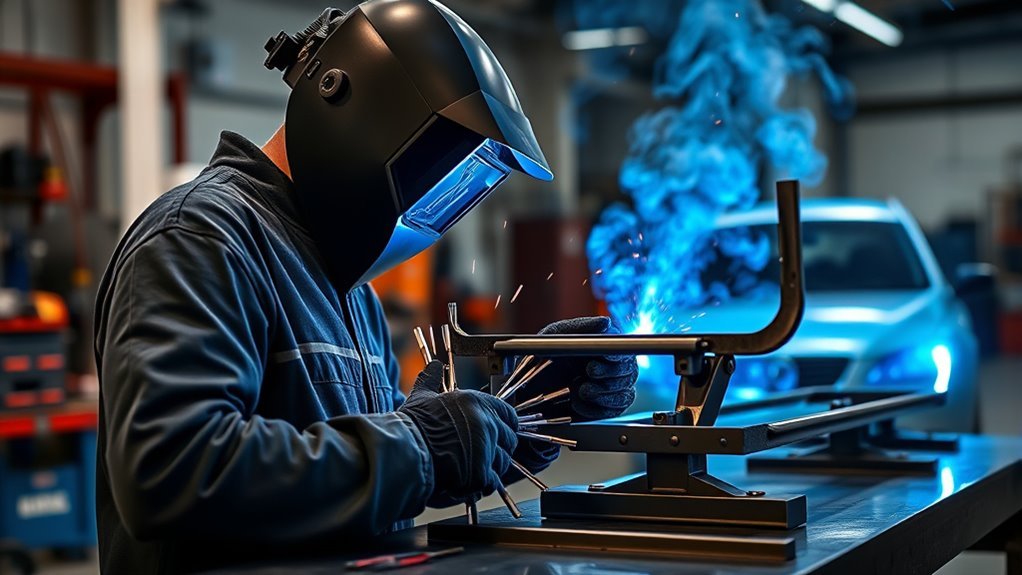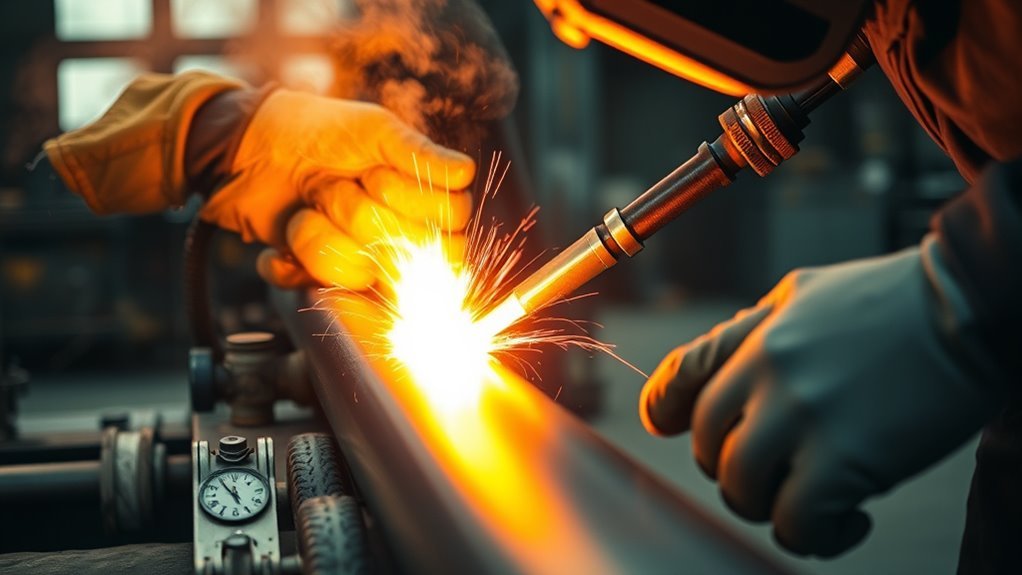
Pre-weld heat treatment is the controlled heating of base metal before welding to reduce thermal shock, drive off moisture, slow cooling, and lower the risk of cracking. You use it to limit hydrogen pickup, residual stress, and brittle microstructures that can weaken the weld. It is most common on hardenable steels, low-alloy steels, high-strength steels, cast iron, and thick sections. Typical steel preheat ranges often fall between 50°C and 250°C, but the correct value must come from the material specification, welding procedure, joint thickness, and applicable code.
Quick Answer
Pre-weld heat treatment, usually called preheating, warms the base metal before welding so the joint cools more slowly and evenly. This helps remove moisture, reduce hydrogen cracking, limit hard brittle structures, and protect weld quality, especially on thick steel, low-alloy steel, HSLA steel, and crack-sensitive materials.
Key Takeaways
- Preheating reduces thermal shock by narrowing the temperature difference between the weld area and the surrounding base metal.
- It helps drive off moisture and lowers the risk of hydrogen-induced cracking in crack-sensitive steels.
- Carbon steel often uses lower preheat ranges than low-alloy or high-strength steels, but the welding procedure should always control the final setting.
- Temperature must be checked and maintained before and during welding, not guessed by color or torch time.
- Preheating and post-weld heat treatment are different processes, and one does not automatically replace the other.
At a Glance
| Main Purpose | Reduce cracking risk, moisture, hydrogen pickup, residual stress, and rapid cooling before welding. |
| Common Temperature Range | Often 50°C to 250°C for many steels, depending on grade, thickness, carbon equivalent, and procedure requirements. |
| Tools Needed | Torch, induction heater, resistance heater, infrared heater, temperature crayons, contact thermometer, thermocouples, or infrared camera. |
| Best For | Thick sections, hardenable steels, low-alloy steels, HSLA steels, restrained joints, cold work areas, and moisture-sensitive jobs. |
What Is Pre-Weld Heat Treatment?
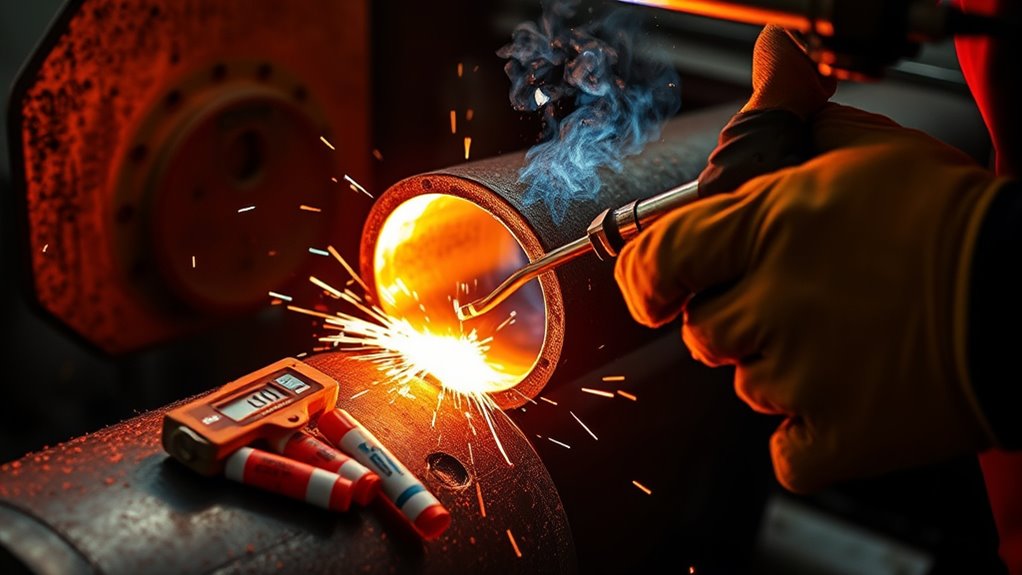
Pre-weld heat treatment is the controlled application of heat to the base metal and nearby heat-affected zone before welding. In most shop and field welding work, this step is called preheating. You use it to prepare the joint so the welding process starts from a stable thermal condition, not a cold and uneven one.
By warming the material first, you drive off moisture, slow the cooling rate, and create a more gradual temperature shift from ambient temperature to welding temperature. That matters because rapid cooling can trap brittle structures in thicker or hardenable steels. These structures can weaken the weld and increase the chance of delayed cracking.
Preheating also helps you stay within accepted welding procedure requirements and protect the component from avoidable damage. The exact temperature depends on material type, thickness, carbon equivalent, hydrogen control, restraint, and the welding code or procedure being used. For many steels, the range often falls between 50°C and 250°C, but some materials need lower, higher, or more tightly controlled limits.
When you apply it correctly, you control the process, reduce risk, and keep your work technically sound. Additionally, preheating can help reduce the effects of contamination and surface moisture, but it does not replace proper cleaning. If the steel has coating, paint, grease, mill scale, or heavy rust, clean the joint area before welding.
Note: Preheating is not the same as simply making the metal hot. It is a controlled temperature step that must be measured, held, and maintained across the required area of the joint.
Why Preheating Prevents Weld Cracking
When you preheat the base metal before welding, you reduce thermal gradients and slow the cooling rate. This helps prevent cracking as the weld metal and heat-affected zone cool after each pass.
You give the weld pool and heat-affected zone time to cool more evenly, so residual stress does not build as sharply and split the joint. This controlled cooling also limits brittle microstructures, including martensite in hardenable steels and some HSLA steels, which can make the weld prone to failure.
Preheating also drives off surface moisture, lowering hydrogen pickup and reducing the chance of hydrogen-induced cracking. Hydrogen cracking is especially dangerous because it may not appear right away. A weld can look acceptable at first and then crack after cooling, loading, or time in service.
When you follow the specified preheat range for the material and thickness, you help protect weld quality and structural integrity. Skipping this step can leave you with welding imperfections that weaken the assembly and compromise performance.
In practice, preheating gives you more control, fewer defects, and a cleaner path to sound, durable welds. Additionally, understanding the importance of cleaning aluminum before welding can further improve weld quality, although aluminum has different preheat rules than carbon steel.
Warning: Do not overheat the base metal beyond the welding procedure limit. Too much heat can reduce mechanical properties, increase distortion, damage coatings or nearby parts, and create safety hazards.
When Preheating Is Needed for Steel
You need preheating for steel when the grade is hardenable, such as HSLA or low-alloy steel, or when thicker sections increase the risk of forming brittle microstructures. You may also need it when the joint is highly restrained, the work area is cold, the electrode process has hydrogen risk, or the weld must meet a qualified welding procedure.
Typical preheat ranges run from 50°C to 150°C for many carbon steels and 100°C to 250°C for many low-alloy steels, depending on composition and thickness. These ranges are only practical starting points. The final requirement should come from the approved welding procedure specification, material standard, code, or engineer. Additionally, it is crucial to size welds according to the thinner member in joints to prevent issues like cracking and ensure structural integrity.
You also need preheating to drive off moisture and reduce hydrogen cracking, so you should follow the applicable preheat guidelines closely.
Material Thickness and Grade
Thickness and alloying level largely determine whether steel needs preheating before welding. You should treat steel thickness as a primary control point. Once sections become thick enough to pull heat away quickly, preheat helps limit cracking, hard spots, and distortion.
As a practical rule, sections above about 25 mm often deserve closer preheat review, especially when the steel has higher carbon content, higher alloy content, or high restraint. Thin steel can sometimes be welded without preheat, but thin does not always mean safe. A small crack-sensitive part may still need controlled heating if the procedure calls for it.
With different alloy types, the required heat shifts because chemistry changes hardenability. Carbon steels often need 50–150°C, while low-alloy steels usually call for 100–250°C.
If you work with high-strength low-alloy steels, preheating is especially useful because it suppresses brittle microstructures in the heat-affected zone. For steels with high carbon equivalency, you need to be even more deliberate, since the weld area becomes more crack-prone.
Match soak time to the grade and thickness so heat spreads evenly and the joint is ready for sound, controlled welding.
Moisture and Crack Prevention
Beyond thickness and grade, moisture control is another major reason to preheat steel before welding.
You use pre-weld heat treatment to drive off surface and absorbed moisture, which helps prevent hydrogen cracking and steadies the weld pool. Good moisture management also lowers the cooling rate of the weld and base metal, so you reduce crack formation in high-strength low-alloy steels and other crack-sensitive grades.
Keep the preheat above the minimum required for the steel. Carbon steels often need about 50°C to 150°C, depending on thickness and chemistry. If you skip it, you can promote brittle martensite and weaken joint integrity.
Preheating gives you cleaner fusion, fewer defects, and a more reliable weld that is less likely to fail early.
Other Conditions That May Require Preheat
Material grade and thickness are not the only triggers. You may also need preheat when the joint design or working environment increases cracking risk.
- High restraint: Rigid parts cannot move freely as the weld shrinks, so stress builds faster.
- Cold base metal: Outdoor work in cold weather can cool the weld too quickly.
- High carbon equivalent: More hardenable steel chemistry increases the risk of brittle heat-affected zones.
- Hydrogen-sensitive processes: Poor consumable storage, damp electrodes, or contaminated surfaces can raise hydrogen risk.
- Repair welding: Older, unknown, fatigued, or contaminated steel may need more conservative heat control.
- Code work: Pressure vessels, structural steel, pipelines, and critical equipment may have mandatory preheat rules.
Recommended Preheat Temperatures and Hold Times
You will typically preheat carbon steel to 50°C to 150°C and low-alloy steel to 100°C to 250°C, but you should verify the exact range against the material’s carbon equivalency and the applicable code.
You will also need to set hold time by grade and thickness, with thicker sections requiring longer soak times to reach uniform temperature.
During welding, you must keep the preheat within the specified minimum and maximum limits to reduce cracking, distortion, and harmful microstructure changes. Additionally, preheating is crucial for welding cast iron to prevent quench cracks and improve the chance of a stronger repair weld.
Recommended Temperature Ranges
Recommended preheat temperatures typically fall between 50°C and 150°C for carbon steel and 100°C to 250°C for low-alloy steel, with the exact range depending on the material grade, thickness, restraint, hydrogen level, and carbon equivalency. You need tight temperature control and heat uniformity to reduce cracking risk and protect component integrity, especially in thicker sections and HSLA steels. Use the table below as a quick guide:
| Material | Common Range | Key Concern |
|---|---|---|
| Carbon steel | 50-150°C | Crack resistance |
| Low-alloy steel | 100-250°C | Hardenability |
| HSLA steel | Spec-defined | Brittleness |
| Thick plate | Higher end | Through-heating |
| All grades | Procedure-defined | Consistency |
Check your material specification and welding standard before you set the torch. Hold only long enough for even soaking, and do not exceed the maximum interpass temperature if one is listed.
Material-Specific Hold Times
Hold times should match the material’s heat input needs. Carbon steel often preheats at 50°C to 150°C, while low-alloy steel may need 100°C to 250°C, with thicker sections requiring longer soak to bring the full joint area to an even temperature.
- Set soak time by grade and thickness.
- Keep HSLA steel within target preheat to limit brittle microstructures.
- Hold long enough to drive off moisture and cut hydrogen cracking risk.
- Follow carbon equivalency guidance from the applicable code, welding procedure, or engineering standard.
You will get the preheat benefits only when you maintain temperature long enough for the whole joint to stabilize. If you rush, outer surfaces warm while the core stays cold, and cracking can follow.
Use the recommended hold times as a practical control, not a guess. That discipline gives you cleaner welds, safer service, and more freedom from repair cycles.
Pro Tip: Measure preheat on the opposite side of the heated surface when possible. That helps confirm the joint is heated through, not just warm on the surface.
How to Check and Maintain Preheat Temperature
Checking preheat is just as important as applying it. You should not rely on metal color, flame time, or hand feel. Use a tool that confirms the actual temperature at the joint.
Common temperature-checking options include:
- Temperature-indicating crayons: Simple and useful for field work when matched to the required temperature.
- Contact thermometers: Good for direct surface readings on accessible areas.
- Thermocouples: Useful for long welds, controlled procedures, and traceable records.
- Infrared thermometers or cameras: Helpful for scanning larger areas, but readings can be affected by surface finish, angle, scale, and emissivity.
Check the temperature across the required heating band, not only at one spot. For many welds, the heated band should extend beyond the joint on both sides so the heat-affected zone does not cool too quickly. During multi-pass welding, keep the joint above the minimum preheat temperature and below the maximum interpass temperature.
Products Worth Considering

Comprehensive Welding Package: our package comes with 24 low temperature universal welding rods available to meet your welding requirements; Whether you are a novice or an experienced welder, this kit of welding rods ensures you have things you need for your welding projects; Material is relatively brittle, received with breakage is a normal phenomenon, does not affect the use

Accurate results are +/- 1 percent of rated temperature; reliable always in calibration

Accurate results are +/- 1 percent of rated temperature; reliable always in calibration
How Preheating Removes Moisture and Hydrogen
Preheating drives off moisture from the base metal and heat-affected zone, reducing the hydrogen available to cause cracking during welding.
You use this moisture removal to lower absorbed water in the joint area, so hydrogen diffusion has less fuel to work with. When you raise the metal to the right temperature, you stabilize the weld pool and limit rapid phase changes that can trap hydrogen in the weld area.
That matters because trapped moisture raises hydrogen levels, weakens grain boundaries, and threatens weld integrity. By holding the material at the correct preheat range, you help the weld fuse cleanly and cut the chance of porosity, cracking, and other defects.
Additionally, proper zinc removal ensures a cleaner weld environment, reducing the risk of contamination.
You should match preheating guidelines to the material type and thickness, because different steels release moisture and hydrogen at different rates.
Done correctly, preheating gives you tighter control, better soundness, and a weld that performs on your terms.
Common On-Site Preheating Methods
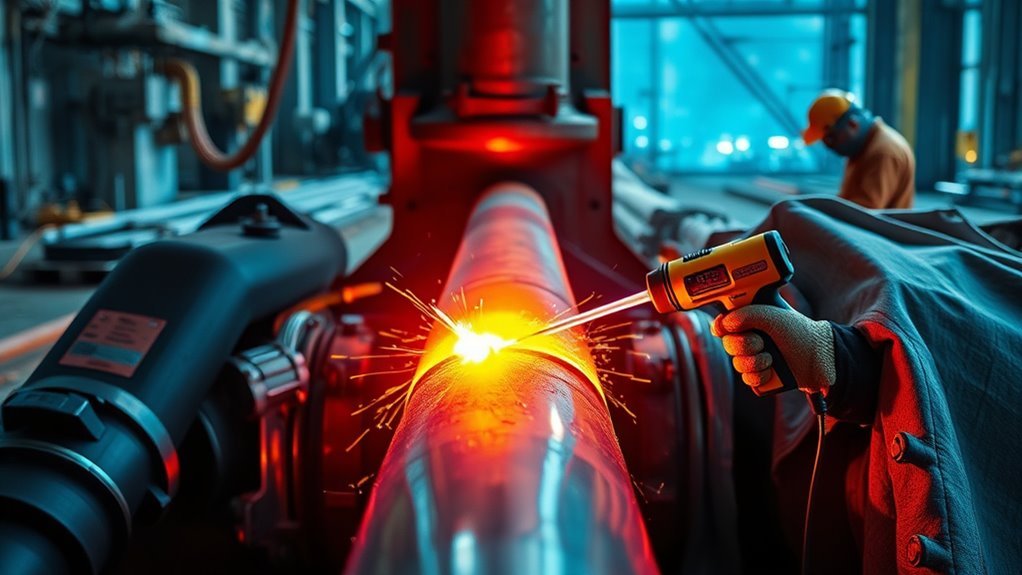
On-site preheating can be done with torches, induction units, resistance heaters, or infrared panels, and you should choose the method that best matches the joint size, material, access conditions, and required temperature control.
With torch heating, you can direct heat where you need it and adjust quickly, but you must move evenly to avoid hot spots. Torch heating is common, flexible, and useful for field repairs, but it depends heavily on operator skill.
- Induction benefits: You get rapid, uniform heating, especially on larger, round, or alloy parts.
- Resistance heating: You use this cost-effective option for smaller jobs or controlled heat bands where electrical resistance heats the workpiece directly.
- Infrared panels: You apply non-contact heat, reducing overheating risk while improving uniformity on accessible surfaces.
- Temperature monitoring: You verify preheat with thermocouples, temperature crayons, contact thermometers, or infrared cameras so you stay within the specified range and limit cracking.
When you match the method to the job, you control the process, protect the joint, and keep your welding work precise and reliable. Additionally, using proper protective clothing during preheating activities minimizes risks associated with heat exposure and sparks.
Products Worth Considering

Powerful Flame Temperature Heat up to 5252°F (2900°C)

Complete Kit: Ideal for HVAC & Light Duty Brazing - Designed specifically for light-duty brazing and welding jobs, this kit is your go-to tool for HVAC repairs, metal crafts, and other precision tasks. Its portable design is perfect for on-the-go professionals

3.6ft Hose for Extra Reach: This propane torch kit have a 3.6ft long gas hose that connects the torch to your propane/Map source, it's handy to get into small places. Warm tips: Gas bottles don't like being upside down
Torch Preheating
Torch preheating is practical for small repairs, field work, irregular shapes, and areas where other equipment is hard to fit. Move the flame continuously and heat from both sides when possible. Avoid concentrating the flame in one small area, because uneven heating can create distortion or local overheating.
Induction Preheating
Induction heating is often cleaner and more uniform than manual torch heating. It works well for pipe, heavy plate, rotating components, and repeatable shop jobs. The main advantage is control. You can set target temperature, monitor heat rise, and reduce operator variation.
Resistance and Infrared Preheating
Resistance heaters are useful when you need controlled heat over a set area. They are common in maintenance, fabrication, and jobs where records matter. Infrared panels are helpful for non-contact heating when access is available and you want less direct flame exposure.
Preheating vs. Post Weld Heat Treatment
You use preheating before welding to slow cooling, limit brittle microstructures in thicker steels, and reduce moisture-driven hydrogen cracking. Those are core preheat advantages. It is especially important for HSLA steels and any joint where thickness, restraint, or alloy content raises cracking risk. Additionally, understanding welding techniques can help ensure that preheating is applied effectively.
You apply post-weld heat treatment, often shortened to PWHT, after welding. PWHT is usually done at much higher temperatures than preheat and is used to relax stresses, remove retained hydrogen, temper hard microstructures, and improve toughness in the completed joint. Some pressure equipment, heavy fabrication, and critical welds may require PWHT for safety and compliance.
In practice, you do not treat them as interchangeable. Preheating protects the weld while you make it, and PWHT stabilizes it after it is formed.
Control temperature and soak time carefully, or you may trade freedom from cracking for distortion, poor properties, or failed inspection.
| Process | When It Happens | Main Purpose |
|---|---|---|
| Preheating | Before and during welding | Slow cooling, remove moisture, reduce cracking risk |
| PWHT | After welding | Relieve stress, temper hard zones, improve service performance |
Common Preheating Mistakes to Avoid
Preheating helps only when it is controlled. Poor heating can create the same problems you are trying to prevent. Watch for these common mistakes:
- Heating only one side: This can leave the root or opposite side too cold.
- Guessing the temperature: Always use a temperature tool instead of judging by color.
- Ignoring interpass temperature: Multi-pass welds can get too hot if you keep welding without checks.
- Heating too narrow an area: The weld zone may still cool too fast if the surrounding metal remains cold.
- Skipping cleaning: Preheat can remove moisture, but it does not remove grease, paint, zinc, rust, or oil.
- Using one temperature for every steel: Different grades need different heat control.
Note: If the weld is for a load-bearing structure, pressure part, vehicle frame, lifting equipment, or code-controlled job, follow the approved welding procedure instead of general temperature ranges.
Safety Precautions Before Preheating
Preheating adds open flame, hot surfaces, electrical equipment, and burn risk to the welding area. Before you start, clear flammable materials, check ventilation, inspect hoses and cables, and make sure nearby workers understand that the part may remain hot after the flame or heater is removed.
Wear welding gloves, eye protection, flame-resistant clothing, and the PPE required for the heating method. If the part has zinc coating, paint, solvent residue, oil, or unknown contamination, remove it safely before heating. Heating coated metal can release fumes that are more hazardous than normal welding smoke.
Also think about distortion and fit-up. Heat can move parts before welding begins, especially thin sections and long assemblies. Use clamps, fixtures, and balanced heating to keep the joint aligned.
When On-Site Heat Treatment Experts Help Most
When you need tight control over base-metal temperature before welding, on-site heat treatment experts help most by delivering uniform preheat that limits distortion, reduces cracking risk, and drives off moisture that can trigger hydrogen-induced cracking.
You get on-site expertise when the job demands exact temperatures, traceable records, controlled heating equipment, and no guesswork. Their heat treatment can help keep you aligned with ASME, AWS, project specifications, and approved welding procedures, even on complex joints and HSLA steels.
- Large weldments
- Thin sections
- Moisture-sensitive alloys
- Shutdown repairs
They can monitor temperature with advanced wireless controls, so you can verify compliance in real time and avoid costly rework. Proper PPE setup is essential in ensuring safety during the heat treatment process.
Specialist heat-treatment crews are most useful when the job has high consequence, tight tolerance, hard-to-access joints, or strict documentation requirements.
When your weld integrity matters, expert preheat is not optional; it is the practical path to reliable, standards-based results.
Frequently Asked Questions
What is pre-weld heat treatment?
Pre-weld heat treatment is controlled heating of the base metal before welding. It improves the welding condition by removing moisture, slowing cooling, reducing thermal stress, and lowering the chance of hydrogen cracking and brittle heat-affected zones.
Do you heat treat before or after welding?
You may do both, but they serve different purposes. Preheating happens before and during welding to reduce cracking risk. Post-weld heat treatment happens after welding to relieve stress, reduce hardness, and improve service performance when the procedure requires it.
What temperature should steel be preheated to before welding?
Many carbon steels fall around 50°C to 150°C, while many low-alloy steels fall around 100°C to 250°C. The exact temperature depends on grade, thickness, carbon equivalent, restraint, hydrogen control, and the approved welding procedure.
Can you weld without preheating?
Yes, some thin and low-carbon steels can be welded without preheat. However, hardenable steel, thick plate, high restraint, cold conditions, damp surfaces, and code-controlled work may require preheat to avoid cracking and inspection failure.
How do you know if the preheat is hot enough?
Use temperature crayons, contact thermometers, thermocouples, or infrared tools. Check more than one point around the joint and keep the weld area above the minimum preheat temperature during welding.
Conclusion
When you preheat before welding, you are not just warming steel. You are setting the stage for a sound, crack-resistant joint. You reduce moisture, slow cooling, soften thermal shock, and protect the weld from hydrogen damage.
If your material is thick, hardenable, highly restrained, cold, or exposed to moisture, you need to review the preheat requirement before striking an arc. Think of preheat as a small controlled step that prevents a big fracture later. Use the right temperature, hold it properly, measure it accurately, and you will weld with greater control and confidence.