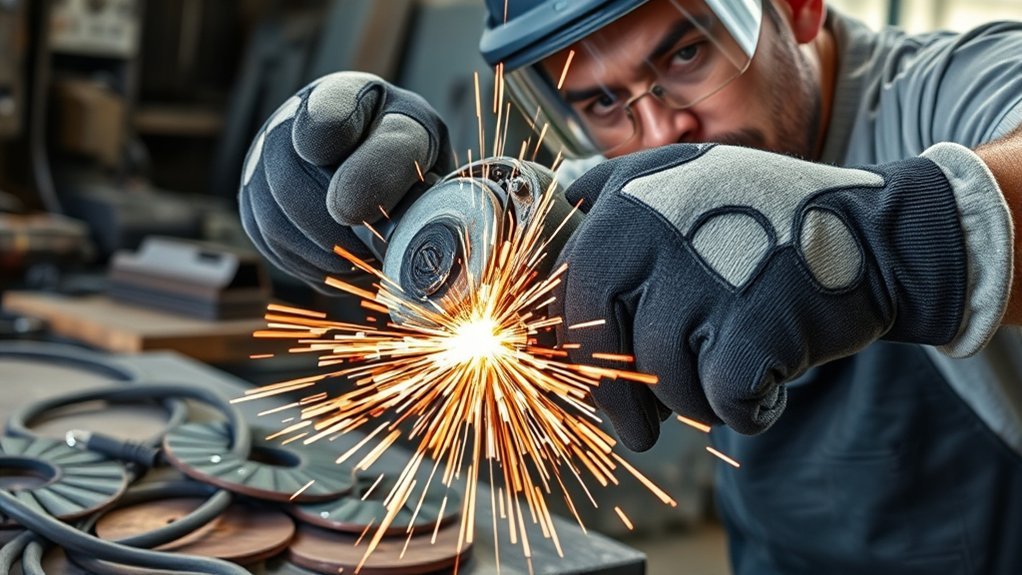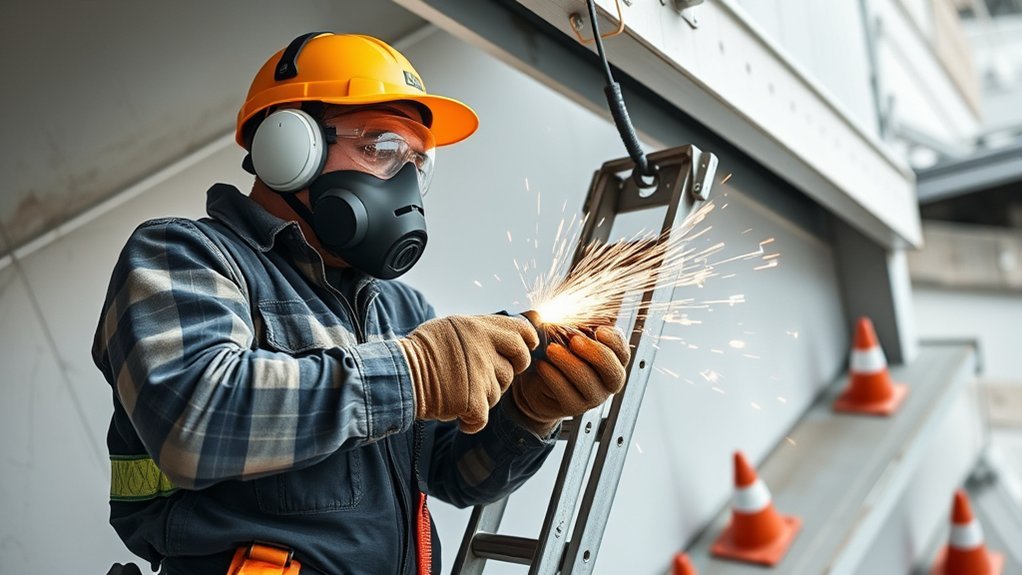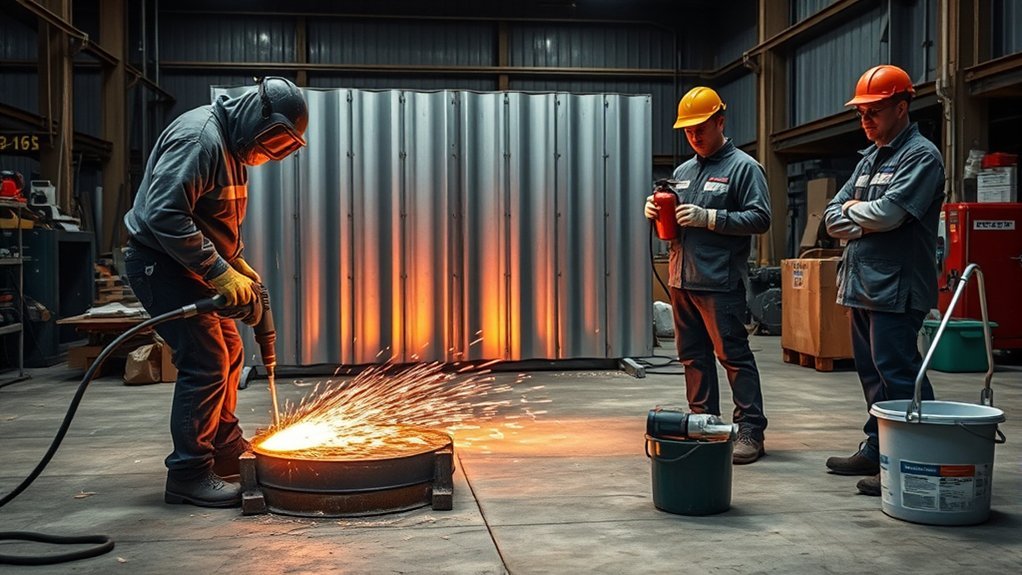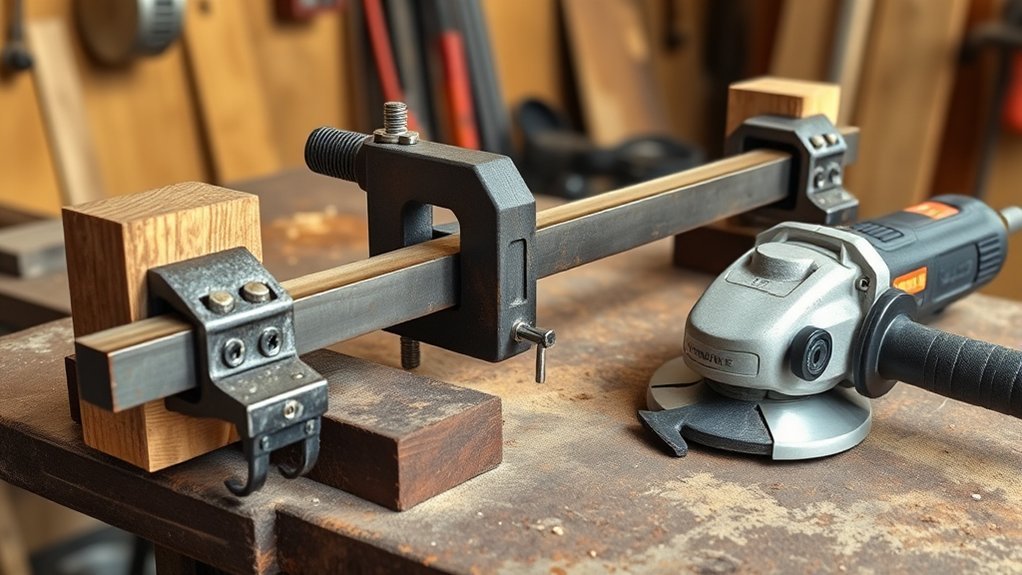
A loose workpiece can turn a simple angle grinder cut into a serious safety risk. The material may roll, lift, vibrate, or close around the cutting wheel, causing a rough cut, wheel damage, or kickback. A safer setup keeps the main workpiece secure, supports the offcut, leaves the disc path clear, and gives you room to control the grinder with both hands.
Quick Answer
Place the workpiece on a rigid, noncombustible bench and secure the main section with a vise, C-clamps, bar clamps, or a rated fixture. Support long material on both sides of the cut, keep every clamp outside the disc and guard path, tighten evenly, and shake-test the setup before powering the grinder.
Key Takeaways
- Switch off and disconnect the grinder before positioning the material, adjusting the guard, or changing the clamping setup.
- Use a vise, mechanical clamp, or purpose-built fixture as the primary restraint; do not depend on an ordinary welding magnet alone.
- Secure the main workpiece and support the offcut so it cannot drop, twist, or close the kerf around the wheel.
- Keep clamps, supports, cords, and the bench outside the full path of the wheel, guard, and grinder body.
- Stop immediately if anything shifts, then disconnect power and rebuild the setup before restarting.
At a Glance
| Time Required | About 3 to 10 minutes for most setups; longer for large panels or irregular shapes |
| Difficulty | Beginner to intermediate, depending on the material and workpiece shape |
| Tools Needed | Stable bench, vise or mechanical clamps, support blocks or stands, marker, measuring tools, angle grinder, correct cutting wheel, guard, side handle, and PPE |
| Cost | Usually no added cost when suitable clamps and supports are already available; otherwise the cost varies by clamp type and capacity |
What’s in This Article
- Before You Begin Angle Grinder Clamping
- Why Proper Clamping Is Essential
- Preparing Your Work Area
- Choosing the Best Clamping Devices
- How to Support the Workpiece and Offcut
- Step-by-Step Clamping Guide
- How to Clamp Common Workpiece Shapes
- How to Apply Even Pressure
- Common Clamping Mistakes
- How to Prevent Wheel Pinching and Kickback
- How to Check Stability
- Essential Grinder Safety Checks
- What to Do if the Workpiece Shifts
- Frequently Asked Questions
- Conclusion
- Sources
Before You Begin Angle Grinder Clamping
Set aside a few minutes to prepare before you touch the clamps or start the grinder. A rushed setup can damage the material, trap the wheel, send an offcut to the floor, or place your hands too close to the cutting path.
Switch the grinder off and unplug it before adjusting a corded tool. For a cordless grinder, remove the battery when the design allows it or use the manufacturer’s specified lockout method. Keep the power disconnected while you position the workpiece, move the guard, inspect the wheel, or alter the supports.
Read the instructions supplied with the grinder and cutting wheel. The accessory must be designed for the material, fit the grinder and flanges correctly, work with the installed cutting guard, and have a maximum speed rating at least as high as the grinder’s rated no-load speed. OSHA and Bosch Professional grinder guidance both emphasize correct wheel inspection, mounting, speed compatibility, guarding, and workpiece support.
Gather a stable workbench, bench vise, C-clamps, bar clamps, suitable quick-action clamps, V-blocks or pipe jaws for round stock, and support blocks or stands for long material. Use fitted eye and face protection, hearing protection, suitable gloves, protective footwear, and clothing that will not easily ignite or catch on the tool. Manufacturer PPE guidance recommends safety glasses plus a face shield for flying debris and sparks.
Warning: Never hold a small or loose workpiece in one hand while operating an angle grinder with the other. Secure it in a vise or purpose-built fixture so both hands remain available to control the grinder and side handle.
Note: Most clamping setups take 3 to 10 minutes. Complex shapes, large sheets, and heavy stock may require more time and additional supports.
Why Proper Clamping Is Essential for Safe Angle Grinder Use
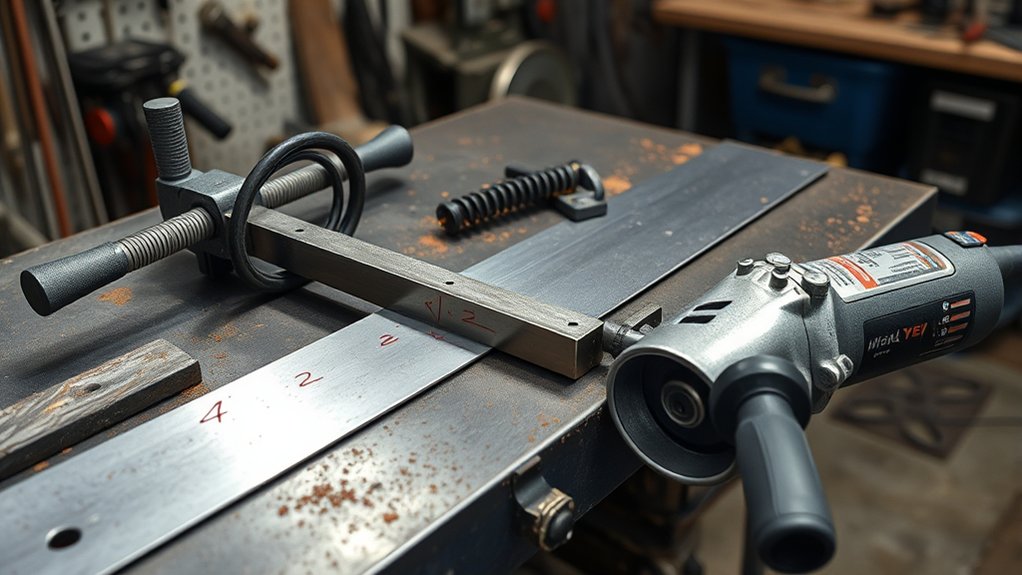
Proper clamping protects you from movement that can spoil the cut or make the cutting wheel bind. A secure workpiece also lets you keep a balanced stance and guide the grinder with both hands instead of trying to control the material at the same time.
Bosch states that a workpiece held with clamping devices or in a vise is more secure than one held by hand. Mechanical clamps such as a bench vise, C-clamps, bar clamps, or a purpose-built fixture provide predictable holding force when they contact the workpiece squarely.
A firmly secured workpiece also helps you maintain a steady cutting angle. This reduces wandering, rough edges, and the temptation to twist the cutting wheel back toward the marked line.
Clamping is not only an accuracy step. It keeps both hands available to control the grinder if the wheel begins to bind or the cut changes direction.
Preparing Your Work Area for Safe Clamping
Prepare the area before you position the material. You need a solid bench, clear footing, good visibility, controlled dust, and a safe path for sparks and the offcut.
Work Area Organization
Remove clutter from the bench and floor so you can stand securely and move without tripping over cords, hoses, scrap, or tools. The bench must not rock, slide, or flex under the workpiece and cutting force.
Move paper, cardboard, rags, sawdust, fuel, solvents, gas cylinders, batteries, and other combustible materials away from the spark stream. Check both the front and back of the work area because sparks and hot particles can travel beyond the immediate cut.
Do not allow the wheel to cut toward a clamp screw, bench edge, support stand, power cord, battery, dust hose, or hidden object. Leave open space below the cut when the wheel must pass through the workpiece.
Adequate Lighting Setup
Use overhead lighting and a task light when shadows hide the cut line, clamp jaws, or underside supports. Position the light outside the spark path and arrange it so glare from bare metal does not obscure the mark.
Check the cut from the position where you will actually operate the grinder. A line that is visible from above may disappear behind the guard when you move into the working stance.
Ventilation and Dust Control
Ventilation matters when cutting metal, masonry, tile, concrete, brick, mortar, stone, or coated material. Local dust extraction is more effective than relying only on an open door or window. Use a grinder-compatible shroud and dust extractor when the manufacturer approves that setup.
NIOSH explains that cutting and grinding concrete, brick, mortar, stone, and other silica-containing materials can release respirable crystalline silica. Use engineering controls first and wear respiratory protection selected for the material, exposure, equipment instructions, and applicable safety rules. Do not use water or liquid coolant with a portable grinder unless the grinder, accessory, electrical protection, and manufacturer instructions specifically permit that method.
Do not cut an unknown coating until you identify it. Painted, plated, galvanized, treated, or contaminated material may create hazardous fumes or dust and may require different controls.
Warning: Sparks from an angle grinder can ignite nearby combustible material. Clear the spark path, protect people and property on the far side of the cut, and follow the fire-prevention rules for your workplace.
Choosing the Best Clamping Devices for Workpieces
The best clamp depends on the workpiece shape, size, weight, surface, and expected cutting force. The goal is to prevent rolling, lifting, sliding, vibration, and twisting without crushing the material or blocking the grinder.
Products Worth Considering

Built to Last: The swivel vise is forged from sturdy 60,000 PSI ductile iron, with a powder coating on the surface for a rust-proof finish. High-quality nuts and screws increase durability. Replaceable serrated jaw plates are made of premium carbon steel for superior grip. Go above and beyond and knock out all those tough projects!

Versatile Multi-Jaw Function: Our 4.5" bench vises feature a unique multi-jaw design that can securely hold both flat materials and pipes or tubes without slipping or scratching their surfaces

Jaw Width:165.1mm (6.5"), Jaw Opening: 150mm (6"), Throat Depth: 97mm (3.8"), Anvil: 3.1 x 2.9 inch
Types of Clamping Devices
Bench vises work well for short flat stock, solid bar, small brackets, and tubing when the jaws make broad, square contact. Pipe jaws, soft jaws, or a V-block improve the grip on round or delicate material.
C-clamps and F-style or bar clamps are useful for securing plate, sheet, angle iron, channel, and larger pieces to a rigid bench. Place the fixed jaw and screw pad on strong contact points rather than thin unsupported edges.
Quick-action clamps can speed up positioning, but the clamp must be strong enough for the load and compatible with heat and sparks. Do not place plastic clamp bodies or pads in the direct spark stream unless the manufacturer permits it.
Locking pliers may help position small tabs or irregular pieces, but their narrow jaws can mark the work and may not provide enough resistance by themselves. Use them as part of a stable fixture rather than assuming one pair is sufficient.
Magnetic holders are mainly positioning aids. Paint, rust, scale, curved surfaces, vibration, and a small contact area can reduce their holding ability. Do not use an ordinary welding magnet as the sole restraint for angle grinder cutting. A purpose-built magnetic fixture may be used only when it is rated and instructed for the exact workpiece and cutting operation.
Jigs and fixtures are often the safest choice for repeated cuts, very small parts, and shapes that normal clamp jaws cannot contact securely. A good fixture creates broad contact, prevents rotation, and leaves the wheel path open.
Selecting Appropriate Clamp Size
Choose a clamp that opens far enough to fit the workpiece and support surface without operating at the end of its range. The throat must reach a solid contact point, and the clamp frame must clear the grinder body throughout the cut.
Use a larger vise, bar clamps, or multiple C-clamps for long and heavy stock. Thin sheet may need scrap steel or wood spreader blocks outside the spark and wheel path to distribute jaw pressure and reduce dents.
Inspect the clamp screw, threads, frame, pads, jaws, handle, and mounting bolts before use. Do not use a bent, cracked, heavily worn, or slipping clamp.
How to Support the Workpiece and Offcut
A safe setup controls two separate parts: the section you intend to keep and the offcut that separates at the end of the cut. The retained section normally receives the strongest clamping. The offcut must be supported so it cannot drop, swing, twist, or pinch the cutting wheel.
Large panels and long stock can sag under their own weight. Bosch recommends supporting oversized workpieces near the cutting line and near their outer edges on both sides of the wheel. Place stands or blocks close enough to limit sag but far enough away that the disc and guard cannot strike them.
Do not trap the offcut so tightly that it pushes back toward the wheel as the cut opens. The offcut should remain supported while still being able to separate from the main piece without closing the kerf. Heavy offcuts may need a second person using a safe lifting method, a hoist, or another cutting process rather than hand support.
For sheet or plate, provide broad support and leave a slot or open area beneath the cut. For tube or angle iron, orient the material so it cannot rotate and so the final section does not collapse inward onto the wheel.
Pro Tip: Mark the retained side and offcut before clamping. This makes it easier to decide which side needs the strongest restraint and where the offcut support should go.
Products Worth Considering

ADJUSTABLE HEIGHT RANGE: Extends smoothly from 7 to 17.7 inches for precise positioning in low-clearance spaces.

- Increased versatility: The DW7232 miter saw stand extension supports a wide range of materials and longer workpieces, allowing for more precise and efficient cutting.

15 in. wide, supports wider work piece when cutting
Step-by-Step Guide to Securely Clamp Your Workpiece
Follow these steps before each cutting operation. A stable setup should remain secure from the first contact through the final breakthrough.
- Disconnect the grinder from power. Unplug a corded grinder or remove and secure the battery as directed by the manufacturer.
- Inspect the bench, clamps, and supports. Confirm that the bench is stable and that no clamp, jaw, stand, or fixture is damaged.
- Identify the retained section and offcut. Plan how each side will be restrained or supported as the cut opens.
- Position and mark the workpiece. Place it at a comfortable working height and mark a clear cut line that remains visible after clamping.
- Arrange the supports. Support long, wide, heavy, or flexible material near the cut and near the outer ends without placing anything under the disc path.
- Clamp the retained section. Use a vise, C-clamps, bar clamps, or a rated fixture on broad, solid contact points.
- Support the offcut. Prevent it from dropping or twisting, but do not trap it in a way that can force the kerf closed.
- Tighten the clamps evenly. Alternate between clamps a little at a time so the material does not twist, bow, or lift.
- Check the complete tool path. Move the disconnected grinder through the planned approach and cutting path without touching the workpiece. Confirm that the disc, guard, body, side handle, cord, and your hands will clear every clamp and support.
- Shake-test the setup. Push and pull the workpiece in the directions cutting force may act. Reposition the clamps if you feel movement, rocking, or rotation.
- Reconnect power only after the setup passes inspection. Keep both hands on the grinder when operating it and maintain a balanced stance outside the likely kickback path.
How to Clamp Common Workpiece Shapes
Flat Bar, Plate, and Sheet
Lay flat material against a rigid bench or fixture. Use at least two clamps when a single clamp would allow the piece to pivot. Place spreader strips between the clamp jaws and thin sheet to distribute pressure.
Leave clearance below the cut line. If the sheet vibrates, add supports close to the cut without placing a block where the wheel will pass through.
Round Tube, Pipe, and Solid Bar
Round material must be prevented from rolling. Use pipe jaws, a V-block, a notched fixture, or opposed clamp surfaces that contact the material securely. Do not rely on a flat clamp pad pressing on the top of an unsupported tube.
Support long tube on both sides of the cut. Position the offcut support so the tube cannot rotate or drop when the final wall is severed.
Angle Iron, Channel, and Irregular Shapes
Seat angle iron or channel against blocks or fixture stops that prevent rocking. Clamp across strong sections rather than thin edges. An irregular part may require two or three contact points to stop both sliding and rotation.
Dry-run the grinder path because the raised legs of angle and channel can interfere with the guard or grinder housing even when the wheel itself clears the clamp.
Small Workpieces
Use a vise, fixture plate, jig, or sacrificial carrier for small parts. The setup must keep your hands outside the wheel path and provide enough clearance for the grinder body. If the part cannot be clamped without placing the wheel near the vise jaws or your hands, use a different cutting method.
How to Apply Even Pressure When Clamping Workpieces
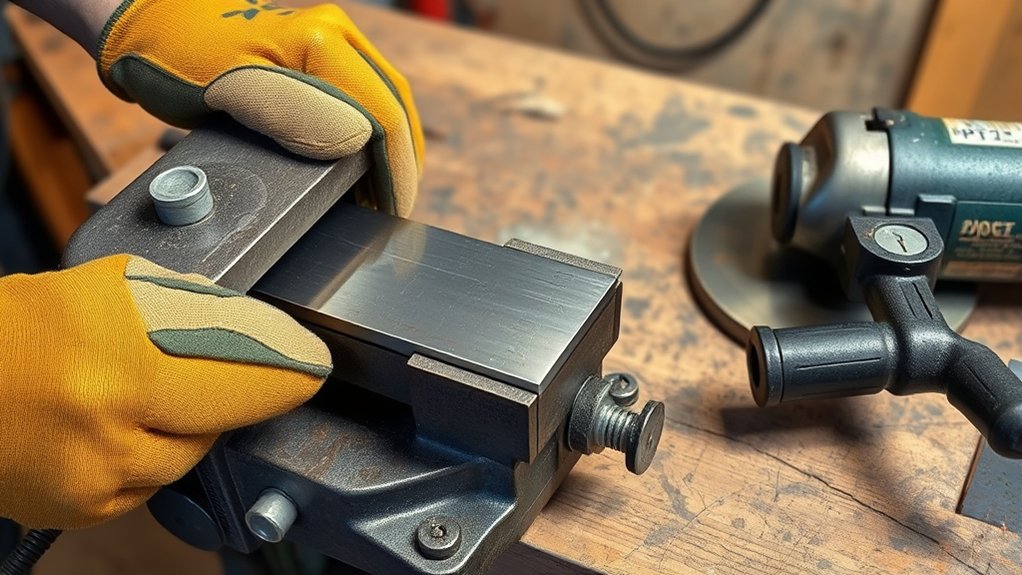
Even pressure keeps the workpiece flat and reduces twisting. Place clamps at balanced contact points instead of concentrating all force at one corner or unsupported edge.
When using two or more clamps, tighten each one in small steps. Check that the material remains seated against the bench, vise jaw, V-block, or fixture stop as pressure increases.
Use enough force to prevent movement, but do not continue tightening after the part is secure. Excess pressure can dent sheet, ovalize tubing, damage threads, crush softer materials, or pull the workpiece out of alignment.
Before cutting, check that the grinder body, guard, wheel, side handle, and your knuckles can move through the complete path without touching a clamp.
Pro Tip: Use clean scrap pads or soft jaws between the clamp and finished surfaces. Keep combustible pads away from the spark stream and far enough from the cut that the wheel cannot contact them.
What Mistakes Can You Make When Clamping?
Small clamping mistakes can produce inaccurate cuts or allow the wheel to bind. Check for these problems before connecting power.
| Mistake | Consequence | Prevention |
|---|---|---|
| Inadequate securing | Movement, vibration, or inaccurate cuts | Use a vise, multiple clamps, or a purpose-built fixture |
| Using an inappropriate clamp | Slipping, rolling, clamp damage, or poor contact | Match the clamp and jaw shape to the material |
| Relying on a welding magnet alone | The workpiece may shift when vibration breaks or weakens the hold | Use a mechanical clamp or rated fixture as the primary restraint |
| Ignoring clamp wear or damage | Weak or uneven holding pressure | Inspect frames, screws, threads, pads, jaws, and mounting bolts |
| Over-tightening | Dents, crushed tubing, warping, or misalignment | Tighten evenly and stop when the workpiece is secure |
| Unsupported offcut | The offcut may drop, twist, or pinch the wheel | Support the offcut without trapping it against the kerf |
| Clamp or support in the disc path | Wheel contact, breakage, or sudden tool movement | Dry-run the complete tool path with power disconnected |
| Cluttered workspace | Trip, fire, and access hazards | Clear the bench, floor, and spark path before cutting |
How to Prevent Wheel Pinching and Kickback
Wheel pinching often begins when a long workpiece sags, an offcut drops, or the kerf closes during the final part of the cut. Place supports near the cut and near the outer ends so neither section moves unexpectedly.
Keep the cutting wheel aligned with the kerf. Do not twist the grinder sideways to correct a wandering line. Reduce pressure as the wheel nears breakthrough because the workpiece may move when the last section separates.
If you stop before completing the cut, remove the wheel from the kerf and let it stop fully. Do not restart the grinder while the wheel is trapped inside the cut. Start outside the workpiece, allow the wheel to reach operating speed, and carefully re-enter the kerf. This restart method is included in Bosch’s proper-use guidance.
Warning: A clamp cannot compensate for the wrong wheel, missing guard, excessive pressure, side-loading, poor body position, or an unsuitable cutting method. Stop and change the setup whenever the cut cannot be made without forcing the grinder.
How to Ensure Stability Before Grinding
Before connecting power, use this final stability checklist:
- The workbench, vise, fixture, and support stands are stable and cannot slide.
- The main workpiece is secured against sliding, lifting, rolling, and twisting.
- Long or flexible material is supported near the cut and at its outer sections.
- The offcut is supported but can separate without closing the kerf.
- No clamp, screw, stand, bench edge, cord, hose, or hidden object crosses the wheel path.
- The workpiece remains still when pushed, pulled, and lightly twisted by hand.
- The cutting line remains visible from your operating position.
- You can maintain a balanced stance and control the grinder with both hands.
If the setup fails any check, reposition the clamps or choose a more suitable fixture. Adding force to an unstable arrangement is not a substitute for better contact and support.
Essential Safety Checks Before Operating the Angle Grinder
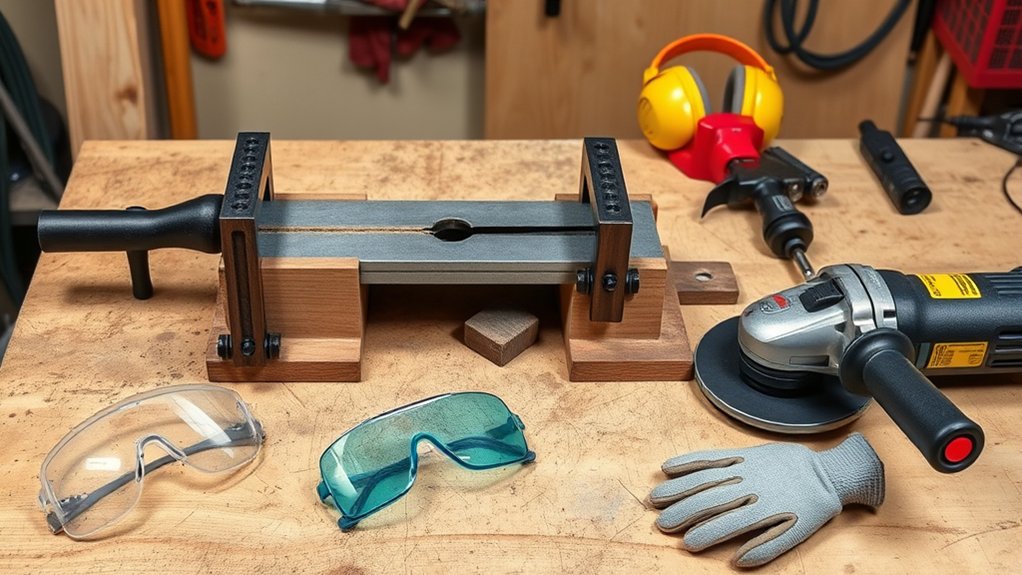
Inspect the grinder, cutting wheel, guard, side handle, power source, and workpiece setup before every use. OSHA’s portable abrasive-wheel requirements address wheel guarding, inspection, mounting, and speed compatibility.
| Safety Check | What to Look For | Why It Matters |
|---|---|---|
| Angle grinder | Cracks, loose parts, blocked vents, damaged spindle, or unusual wear | Helps prevent mechanical failure and loss of control |
| Cutting wheel | Correct material and application, correct size, intact edge and body, no cracks or chips, within any marked use-by date, and rated for at least the grinder’s speed | Reduces the risk of wheel breakage, binding, and incompatibility |
| Flanges and mounting | Clean, correct, undamaged parts with the wheel fitted as the manual directs | Prevents uneven clamping and wheel damage |
| Cutting guard | Correct guard for the wheel and application, securely locked, and positioned between the operator and wheel | Helps deflect fragments and sparks away from the operator |
| Side handle | Installed tightly in a position that allows two-handed control | Improves control during normal cutting and a bind-up event |
| Power source | Undamaged cord, plug, battery, switch, and extension lead where applicable | Reduces electrical, accidental-start, and interruption hazards |
| Workpiece | Stable, supported, shake-tested, and clear of the wheel and guard path | Reduces movement, pinching, and inaccurate cuts |
| PPE and surroundings | Eye and face protection, hearing protection, suitable gloves and clothing, clear spark path, dust controls, and no nearby bystanders | Reduces exposure to debris, noise, sparks, heat, and dust |
After completing the inspection, stand out of the wheel’s direct plane and run the grinder without contacting the workpiece for the period and method stated in its manual. Stop immediately if you notice wobble, unusual vibration, abnormal sound, loose parts, or wheel damage.
Let the wheel reach operating speed before it contacts the material. Use light, controlled pressure and allow the wheel to cut rather than forcing it.
What to Do if Your Workpiece Shifts During Cutting
If the workpiece shifts, lifts, rolls, or begins vibrating during the cut, stop immediately. Do not push harder or attempt to finish the cut before the material moves again.
- Release the trigger: Keep control of the grinder and wait for the wheel to stop completely.
- Remove the grinder from the workpiece: Do not leave the cutting wheel trapped inside the kerf.
- Disconnect power: Unplug the tool or remove and secure the battery before touching the clamps, guard, wheel, or material.
- Inspect the wheel: Replace it if you find cracks, chips, distortion, unusual wear, or other damage.
- Find the cause: Check for a loose clamp, poor jaw contact, rolling stock, sagging material, an unsupported offcut, or a flexible bench.
- Rebuild the setup: Reposition the clamps, add a V-block or fixture, and improve support on both sides of the cut.
- Repeat the path and shake tests: Restart only after the workpiece and supports remain stable.
- Restart outside the kerf: Bring the wheel to operating speed before carefully re-entering the existing cut.
If the material still cannot be secured without placing the clamps, supports, or your hands near the wheel, choose a different fixture or cutting method.
Frequently Asked Questions
What are 10 safety precautions before using a grinding machine?
Disconnect power during setup, inspect the grinder, install the correct guard, check the cutting wheel and speed rating, attach the side handle, clamp and support the workpiece, clear combustibles, control hazardous dust, wear suitable PPE, and keep bystanders away. Follow the grinder and wheel instructions for the exact application.
How do you safely cut metal with an angle grinder?
Use a cutting wheel and guard approved for the grinder and metal. Secure the retained workpiece, support the offcut, clear the wheel path, and wear eye and face protection. Let the wheel reach speed before contact, guide it with both hands, use light pressure, and avoid twisting the wheel in the kerf.
What safety precautions should you take when using an angle grinder?
Inspect the grinder and wheel, use the correct cutting guard, attach the side handle, secure the material, control sparks and dust, and wear suitable PPE. Keep the guard between you and the wheel, maintain a balanced stance, and stop if the tool, wheel, or workpiece begins vibrating or moving unexpectedly.
How do you use an angle grinder step by step?
Select the correct accessory, disconnect power, inspect the tool and wheel, install the proper guard and side handle, clamp the workpiece, support the offcut, and clear the cutting path. Reconnect power, start outside the workpiece, use two-handed control and light pressure, then let the wheel stop completely before setting the grinder down.
Can you hold a workpiece by hand while cutting with an angle grinder?
No. Secure small or movable workpieces in a vise, with mechanical clamps, or in a purpose-built fixture. This keeps your hands away from the cutting wheel and allows both hands to control the grinder.
Where should you place clamps before cutting?
Place clamps on broad, solid contact points that prevent the workpiece from sliding, lifting, rolling, or twisting. Keep them outside the full path of the cutting wheel, guard, grinder body, side handle, and your hands. Use more than one clamp when the material could pivot around a single contact point.
Should both sides of the cut be clamped?
The retained section normally needs firm clamping. The offcut must be supported so it cannot drop or twist, but it should not be trapped in a way that forces the kerf closed around the wheel. The correct arrangement depends on the workpiece size, shape, weight, and direction of the cut.
How do you clamp round pipe or tubing for angle grinder cutting?
Use pipe jaws, a V-block, a notched fixture, or opposing clamp surfaces that prevent rolling. Support long tube on both sides of the cut, and make sure the offcut cannot rotate or drop during the final part of the cut.
Safety Disclaimer: This article is for informational purposes only and does not replace professional safety training, a hazard assessment, or the instructions supplied with your grinder, wheel, clamps, and dust-control equipment. Follow applicable workplace rules and local safety requirements.
Conclusion
Safe angle grinder cutting starts with material that cannot slide, roll, lift, or twist. Use a mechanical clamp or vise as the primary restraint, support long workpieces and offcuts, keep the full grinder path clear, and test the setup before reconnecting power.
If the workpiece shifts, stop the grinder, wait for the wheel to stop, disconnect power, and correct the cause before continuing. A few minutes spent arranging clamps and supports can reduce wheel pinching, improve cut quality, and give you much better control throughout the job.
Sources
- Bosch Professional — Proper Use of Angle Grinders: Application — supports workpiece clamping, oversized-workpiece support, guard selection, wheel inspection, two-handed control, and restart guidance.
- Bosch Professional — Personal Protection — supports eye, face, hearing, hand, clothing, and footwear recommendations.
- OSHA 29 CFR 1910.243 — Guarding of Portable Powered Tools — supports portable grinder guarding, wheel inspection, mounting, and speed compatibility.
- OSHA 29 CFR 1926.303 — Abrasive Wheels and Tools — supports abrasive-wheel guarding and inspection requirements in construction work.
- NIOSH — Silica and Worker Health — supports the warning about respirable crystalline silica from cutting and grinding silica-containing materials.
- UK Health and Safety Executive — Safety in the Use of Abrasive Wheels — provides broader guidance on abrasive-wheel training, mounting, guards, portable grinders, and protective equipment.