Friction welding is a solid-state joining process that bonds materials with motion, pressure, and controlled heat instead of melting the base metal with an arc or torch. You press two surfaces together, create heat through rotation, oscillation, or a rotating stir tool, and then use forge pressure to form a dense joint. When the material pair and setup are right, this process can give you low distortion, repeatable weld quality, and strong joints in aerospace, automotive, rail, shipbuilding, electronics, and EV battery applications.
Quick Answer
Friction welding means joining materials in the solid state by using frictional heat and pressure. The parts soften at the joint face but do not fully melt. The main types include rotary friction welding, linear friction welding, friction stir welding, and friction stir spot welding.
Key Takeaways
- Friction welding uses mechanical friction and forge pressure, not bulk melting, to make the joint.
- Because it stays solid-state, it can reduce porosity, solidification cracking, distortion, and filler-metal issues.
- The main process families are rotary friction welding, linear friction welding, friction stir welding, and friction stir spot welding.
- It works best when material choice, surface prep, alignment, force, speed, and inspection are tightly controlled.
- It is powerful but not a casual DIY process. Most friction welding requires industrial machinery, guarding, qualified procedures, and trained operators.
What Is Friction Welding?
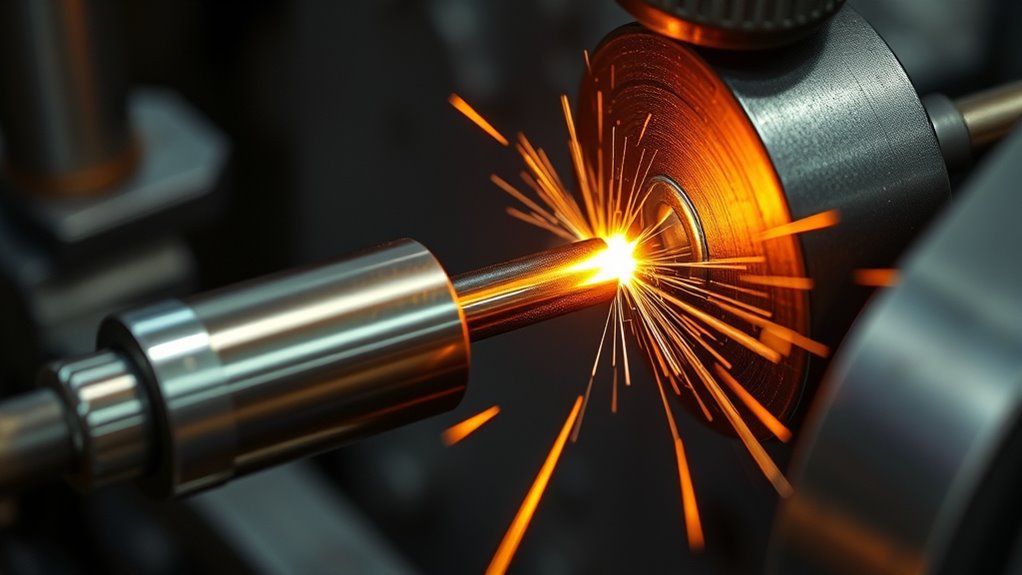
Friction welding is a solid-state joining method that creates heat through mechanical friction between surfaces in relative motion. The heat softens the joint interface, and pressure forces the softened material into intimate contact so the parts bond without fully melting.
The word solid-state is the key. In friction welding, the material near the joint becomes hot and plastic, but it does not turn into a molten weld pool like it does in many arc-welding processes. That is why friction welding can reduce problems linked to melting and freezing, such as porosity, solidification cracking, and heavy distortion.
You will usually see friction welding in controlled production settings, not small repair jobs. It is common where repeatability matters, such as shafts, rods, engine parts, aerospace components, rail parts, EV battery trays, and dissimilar-metal assemblies.
Note: Friction welding does not mean “cold welding.” The joint zone still gets very hot. The difference is that the base metals are softened and forged together rather than fully melted into a liquid weld pool.
How Friction Welding Works
Friction welding works by combining relative motion, compressive force, and forge pressure. The exact motion changes by process type, but the basic sequence is similar: the surfaces rub, heat builds, the interface softens, contaminants are pushed into flash, and pressure consolidates the joint.
1. Heat Builds From Friction
Even a smooth-looking metal surface has microscopic high points called asperities. When two surfaces move against each other under load, those asperities deform and generate heat. This localized heat softens the interface while the bulk of each part stays solid.
| Action | What It Does |
|---|---|
| Relative motion | Creates frictional heat at the joint face |
| Axial or clamping force | Keeps the surfaces in firm contact |
| Controlled heat input | Softens the interface without creating a molten pool |
| Upset or forge pressure | Consolidates the softened material into a solid-state bond |
2. The Interface Reaches a Plastic State
As heat builds, the metal at the joint face becomes plastic enough to flow under pressure. In rotary and linear friction welding, that flow pushes surface oxides and contaminants outward into the flash. In friction stir welding, a rotating tool shoulder and probe heat and mechanically mix the softened material along the joint line.
This plastic state is what makes the process useful for many demanding parts. You get enough movement for bonding and mixing, but you avoid the full liquid-solid cycle that can create many fusion-welding defects.
3. Forge Pressure Forms the Final Bond
Once the interface has softened enough, the process applies or maintains higher pressure to complete the weld. This pressure collapses surface irregularities, forces clean metal into contact, and consolidates the joint. In rotary and linear friction welding, you often measure burn-off length, which is the shortening that happens as softened material is displaced into flash.
| Stage | Control Point | Quality Goal |
|---|---|---|
| Friction phase | Speed, force, time, and alignment | Consistent heat at the joint face |
| Plastic flow | Softening without melting | Clean interface and stable material flow |
| Forge phase | Upset pressure and burn-off | Dense bond with controlled flash |
| Inspection | Visual, dimensional, NDT, and destructive tests as required | Verified strength, alignment, and integrity |
Rotary Friction Welding Basics
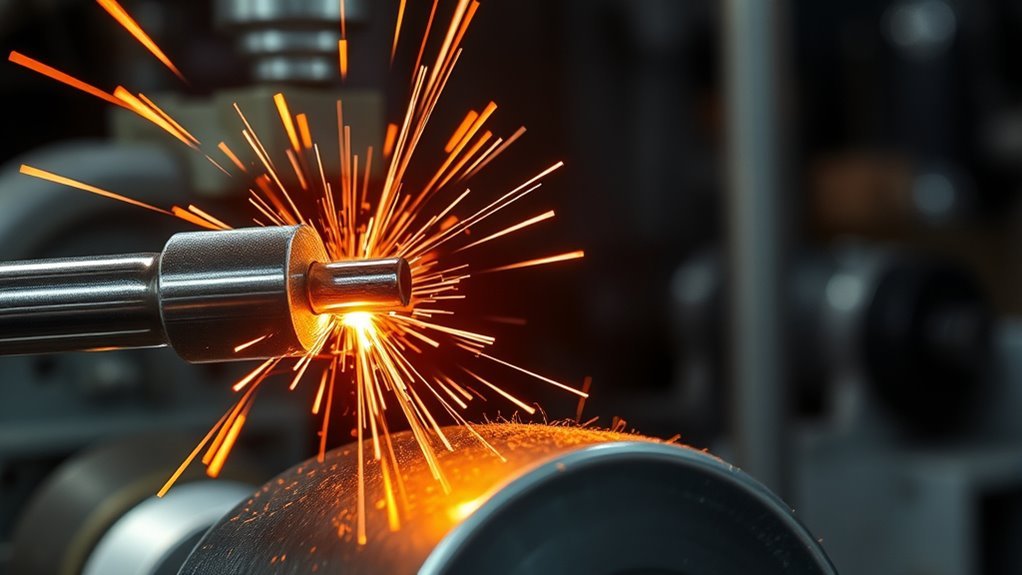
Rotary friction welding joins parts by spinning one component against another under axial force. The process is especially useful for round or axisymmetric parts such as shafts, rods, tubes, valves, and fittings. Heat forms at the contact face, the material softens, and forge pressure completes the joint.
Rotary friction welding is often automated, which helps keep cycle time, pressure, rotation speed, and burn-off consistent. It also does not require filler metal, shielding gas, or a flux. That makes it efficient for high-volume production when the part geometry fits the process.
- One part rotates while the mating part is held still or controlled.
- Axial force pushes the two faying surfaces together.
- Frictional heat softens the interface.
- Forge pressure consolidates the joint and forms flash.
- The finished weld is trimmed, inspected, or tested as required.
Pro Tip: Rotary friction welding is usually strongest as a production choice when the parts are round, repeatable, and easy to clamp on the same centerline. Poor alignment can create a weak or uneven joint even when the heat input is correct.
Products Worth Considering

【High Durability and Stability】The housing of the rotary welding positioner rotary table is made of cast iron, which has good wear resistance and corrosion resistance. This rotary welding positioner rotary table is made of high quality DC motor, which makes the table run smoothly and stably.

Power input : AC 110V 50/60Hz
Linear Friction Welding and Friction Stir Welding
Linear Friction Welding
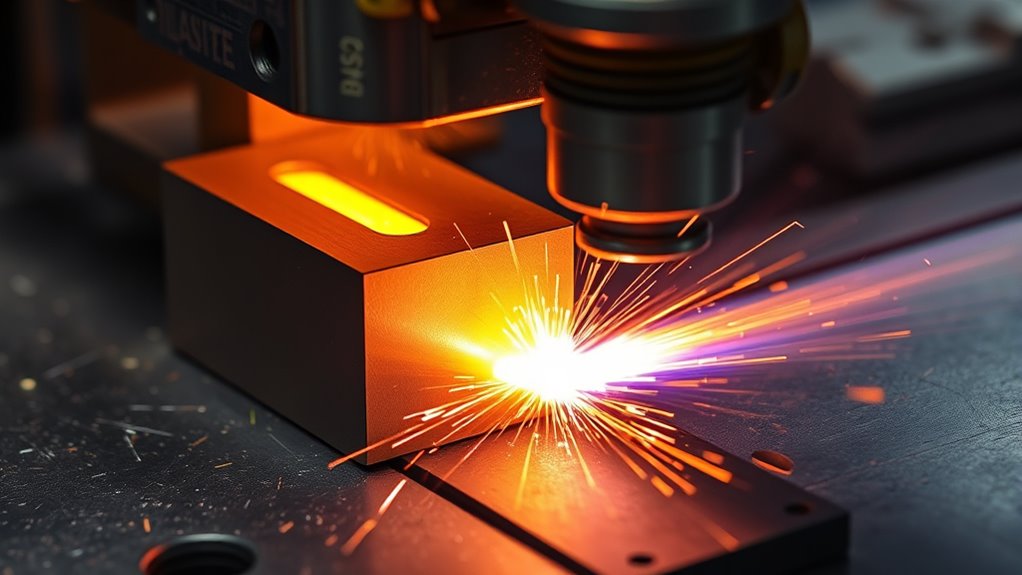
Linear friction welding moves one component back and forth across another under compressive load. The oscillation creates heat at the interface, and the final pressure locks the softened metal into a solid-phase bond.
This process is useful for rectangular, irregular, or complex parts that do not suit rotary motion. It is often associated with high-value parts such as aerospace blades and other components that need strong joints without filler metal.
Friction Stir Welding
Friction stir welding, often shortened to FSW, uses a non-consumable rotating tool with a shoulder and probe. The tool plunges into the joint, heats the material through friction, and travels along the seam while mechanically stirring the softened metal together.
FSW is widely used for aluminum alloys and is also used or explored for magnesium, copper, titanium, nickel, steel, plastics, metal matrix composites, and some dissimilar-metal combinations. It is especially valuable for aluminum structures that need long, consistent seams with low distortion.
Friction Stir Spot Welding
Friction stir spot welding is a spot-weld version of FSW. Instead of traveling along a long seam, the rotating tool plunges into overlapping sheets, stirs a localized spot, and retracts. It is useful where a series of discrete solid-state spots can replace or supplement resistance spot welds, especially in light-alloy sheet applications.
Friction Welding vs. Conventional Welding
Friction welding differs from conventional arc or torch welding because it creates the joint through solid-state plastic flow, not a molten weld pool. That changes the strengths, limits, and best use cases.
| Factor | Friction Welding | Conventional Fusion Welding |
|---|---|---|
| Heat source | Mechanical friction and pressure | Arc, flame, laser, electron beam, or resistance heat |
| Melting | No bulk melting of the base metal | Usually creates a molten weld pool |
| Filler metal | Usually none | Often required, depending on process and joint |
| Distortion risk | Often lower because heat is localized | Can be higher due to melting and cooling shrinkage |
| Best fit | Repeatable production parts, solid-state joints, certain dissimilar metals | Repair, fabrication, field welding, broad joint access |
| Main limit | Requires force, fixturing, machinery, and suitable geometry | More sensitive to heat input, fumes, filler choice, and fusion defects |
Friction welding is not automatically better than arc welding. It is better when the material pair, joint design, production volume, and inspection requirements match the process.
Advantages and Limitations of Friction Welding
Friction welding can be a strong choice when you need high repeatability and low distortion, but it is not the best fit for every job.
Advantages
- Lower distortion: Heat is concentrated near the joint instead of spread through a large molten weld area.
- No filler metal in most cases: The joint forms from the base materials themselves.
- Cleaner joint structure: Solid-state joining helps avoid many porosity and solidification-cracking problems.
- Good repeatability: Automated controls can repeat force, speed, time, and burn-off from part to part.
- Dissimilar-metal potential: Some material pairs that are difficult to fusion weld can be joined because the process limits melting and intermetallic growth.
- Reduced fumes and spatter in many cases: FSW in particular avoids arc radiation, spatter, and shielding gas for many aluminum applications.
Limitations
- Specialized machinery: The process needs equipment that can apply high force, motion, and precise control.
- Geometry restrictions: Rotary friction welding works best with round or axisymmetric parts.
- Strong fixturing requirements: Parts must be clamped, aligned, and supported during high-force loading.
- Fit-up sensitivity: Gaps, surface condition, coatings, and misalignment can reduce weld quality.
- Process-specific defects: FSW can leave exit holes unless run-on and run-off tabs or other design fixes are used.
- Inspection planning: High-integrity joints still need appropriate visual, dimensional, nondestructive, or destructive testing.
Best Materials for Friction Welding
You can friction-weld many similar and dissimilar metal combinations, but the best results come from matching the process to the material’s strength, thermal behavior, oxide behavior, and plastic-flow response.
Compatible Metal Pairs
Common candidates include aluminum alloys, steels, stainless steels, titanium alloys, nickel alloys, copper alloys, magnesium alloys, and selected dissimilar pairs. Aluminum alloys from the 2xxx and 7xxx families are especially important because many of them are difficult to weld cleanly with conventional fusion methods.
- Similar-metal examples: aluminum to aluminum, steel to steel, stainless to stainless, titanium to titanium.
- Dissimilar-metal examples: aluminum to steel, aluminum to copper, stainless to carbon steel, titanium to steel in selected engineered setups.
- High-value examples: turbine parts, shafts, drive components, aluminum panels, EV battery trays, aerospace structures, and rail components.
Material Selection Factors
Before choosing friction welding, check the material pair and the part design together. Similar melting points are not always required, but the two materials must respond well to pressure, heat, plastic flow, and surface cleaning during the cycle.
| Factor | Why It Matters |
|---|---|
| Strength and hardness | Affects pressure, tool wear, deformation, and final joint shape |
| Thermal conductivity | Controls how quickly heat leaves the joint zone |
| Surface oxides and coatings | Can interfere with bonding or create fumes when heated |
| Joint geometry | Determines whether rotary, linear, stir, or spot welding is realistic |
| Inspection requirements | High-integrity applications may require tensile, fatigue, hardness, macroetch, or NDT checks |
Common Applications and Weld Quality Checks
Friction welding is most valuable when a part needs repeatable strength, low distortion, and controlled metallurgy. You see it in automotive manufacturing, aerospace structures, rail parts, shipbuilding panels, electronics, EV battery trays, and dissimilar-metal assemblies.
NASA-linked space hardware has also used friction stir welding. For example, public reporting on the Marshall-built Orion Stage Adapter for Artemis II describes aluminum parts made with friction-stir welding.
Common Applications
- Automotive: drive shafts, axle parts, valves, gears, suspension parts, lightweight aluminum assemblies, and EV battery trays.
- Aerospace: aluminum panels, fuel tanks, turbine-related parts, structural adapters, and other high-integrity components.
- Rail and shipbuilding: long aluminum extrusions, panels, and low-distortion structural welds.
- Electronics and thermal systems: copper-aluminum joints, heat exchangers, and conductive assemblies.
- Oil, gas, and heavy industry: selected rods, tubes, fittings, and specialized repair or attachment applications.
Weld Quality Checks
A friction weld can look simple from the outside, but quality depends on the full process record. Good inspection plans usually combine dimensional checks, visual checks, and tests chosen for the part’s service risk.
- Visual and dimensional inspection: Check flash shape, alignment, burn-off, joint length, and surface condition.
- Macroetch or sectioning: Confirms the bond line, flash formation, and material flow pattern.
- Hardness testing: Finds excessive softening or hard zones near the weld.
- Tensile, bend, fatigue, or impact testing: Confirms mechanical performance for the application.
- Nondestructive testing: Ultrasonic, radiographic, or other NDT methods may be required for critical parts.
- Microstructural review: Checks grain refinement, heat-affected areas, and possible brittle phases in dissimilar-metal joints.
Common Defects to Watch For
- Incomplete bonding: Often caused by poor heat input, low pressure, short cycle time, or contamination.
- Misalignment: Creates uneven loading and can reduce fatigue life.
- Excessive flash: Can indicate too much upset, heat, or burn-off.
- Insufficient flash: May show poor plastic flow or inadequate contamination removal.
- FSW tunnel defects: Can happen when tool rotation, travel speed, plunge depth, or heat input is wrong.
- Exit holes in FSW: Often handled with run-on and run-off tabs or part-design planning.
Safety and Equipment Considerations
Friction welding can reduce fume, spatter, and UV exposure compared with many arc processes, but it is still industrial hot work with serious hazards. Machines apply high force, parts can rotate or oscillate, tooling gets hot, and clamps store energy. Coatings, oils, oxides, or nearby welding operations can also create air-quality concerns.
Warning: Do not treat friction welding as a handheld or casual shop process. Use guarded equipment, trained operators, verified clamping, lockout procedures, PPE, ventilation where needed, and an approved inspection plan.
For shop safety, follow applicable welding and hot-work requirements, including machine guarding, eye and hand protection, hearing protection where needed, fire prevention, and exposure controls. The OSHA welding, cutting, and brazing overview is a useful starting point for hazard awareness, and NIOSH welding guidance explains why metal fumes still deserve attention in welding environments.
Products Worth Considering

HIGH IMPACT FACE SHIELD - Sellstrom's Advantage Face Shield is ideal for various types of machinery, welding, cutting, grinding, woodworking, and other types of work that present potential hazards to the face

SUPERIOR PROTECTION — Experience all-around face protection thanks to the curved design of this faceshield. The visor of this face guard is ANSI Z87+ certified, and up to 2x thicker for increased durability. Plus, you can comfortably wear your grinding face shield over prescription glasses.

Full shield design provides built-in chin protection and extended top-of-head coverage; protects against falling or flying objects, impacts, chemical splashes and airborne debris; black matte color
Frequently Asked Questions
Does friction welding actually work?
Yes. Friction welding works by using controlled motion and pressure to heat, soften, and forge the joint interface while the base metals remain solid. It is used in real production work for automotive, aerospace, rail, shipbuilding, electronics, and other high-integrity parts.
Does NASA use friction welding?
Yes, NASA-linked space hardware has used friction stir welding, a major form of friction welding. A recent example is the Orion Stage Adapter built at Marshall, which public reporting describes as using friction-stir-welded aluminum parts.
Is friction welding stronger than arc welding?
It can be, but not automatically. Friction welding can produce mechanical properties that match or exceed parent materials or competing welds in suitable applications. Strength still depends on the alloy, joint design, process settings, heat treatment, and inspection standard.
Can friction welding join dissimilar metals?
Yes, many dissimilar-metal combinations can be friction welded because the process limits full melting and can reduce brittle intermetallic formation. However, each pair still needs procedure development, testing, and inspection before it is trusted in service.
What is the difference between friction welding and friction stir welding?
Friction welding is the broad family of solid-state joining processes that use frictional heat and pressure. Friction stir welding is one specific type. It uses a non-consumable rotating tool to heat, stir, and forge material along a joint line.
Is friction welding safe?
It can be safe when performed with proper industrial equipment, guarding, clamping, operator training, PPE, and inspection. The process may reduce some arc-welding hazards, but high force, hot parts, rotating tools, stored energy, and possible fumes from contaminants still require controls.
Conclusion
Friction welding gives you a way to join metals with motion, heat, and pressure instead of a molten weld pool. Rotary, linear, friction stir, and friction stir spot methods each solve different joining problems. The process can reduce distortion, avoid filler metal, and create strong repeatable joints, especially in production environments. For the best results, match the method to the material pair, control the process parameters, plan the inspection, and treat safety as part of the welding procedure from the start.
Sources
- TWI: What is Friction Welding? — supports the solid-state definition, primary process variants, advantages, and material claims.
- TWI: What is Friction Stir Welding? — supports FSW process description, applications, advantages, and limitations.
- TWI: What is Linear Friction Welding? — supports LFW motion, no-filler wording, suitable materials, and applications.
- CDC/NIOSH: Welding Fumes and Manganese — supports safety wording about welding fumes and exposure controls.
- OSHA: Welding, Cutting, and Brazing — supports hot-work and welding hazard awareness.
- Axios Huntsville: Orion Stage Adapter Reporting — supports the current NASA-linked friction stir welding example.