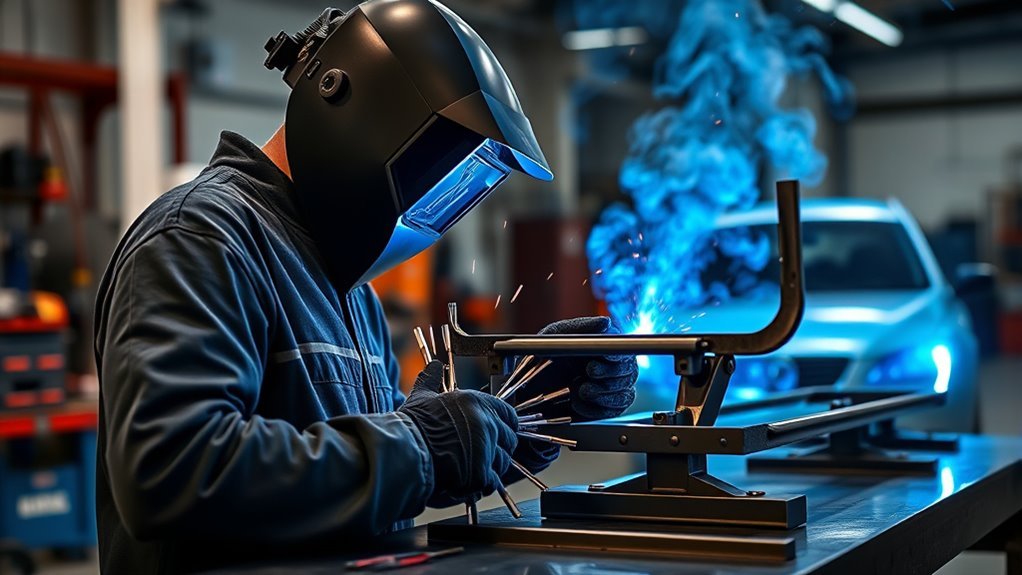
Laser welding gives automakers a fast, precise way to join thin metal, EV battery parts, body structures, and small precision components without putting as much heat into the surrounding material. It is not the right fit for every joint, but when the part is clean, well-fixtured, and tested, it can produce strong, repeatable welds with less distortion than many conventional welding methods.
Quick Answer
Laser welding uses a concentrated beam of light to melt and fuse metal in a small, controlled area. Automakers use it because it can create fast, narrow, repeatable welds on battery tabs, busbars, body panels, sensors, and precision parts while limiting heat damage and distortion.
Key Takeaways
- Laser welding is a non-contact process, so the beam does the work without an electrode touching the part.
- Its biggest automotive benefits are speed, tight heat control, low distortion, and good repeatability on well-prepared parts.
- Common uses include EV battery connections, body-in-white seams, tailored blanks, sensors, injectors, gears, and small precision assemblies.
- Fit-up, cleanliness, shielding gas, beam focus, and monitoring matter because laser welding is less forgiving of gaps and contamination.
- Industrial laser welding requires strict safety controls, including enclosure, interlocks, training, eyewear when needed, and fume extraction.
What Is Laser Welding?
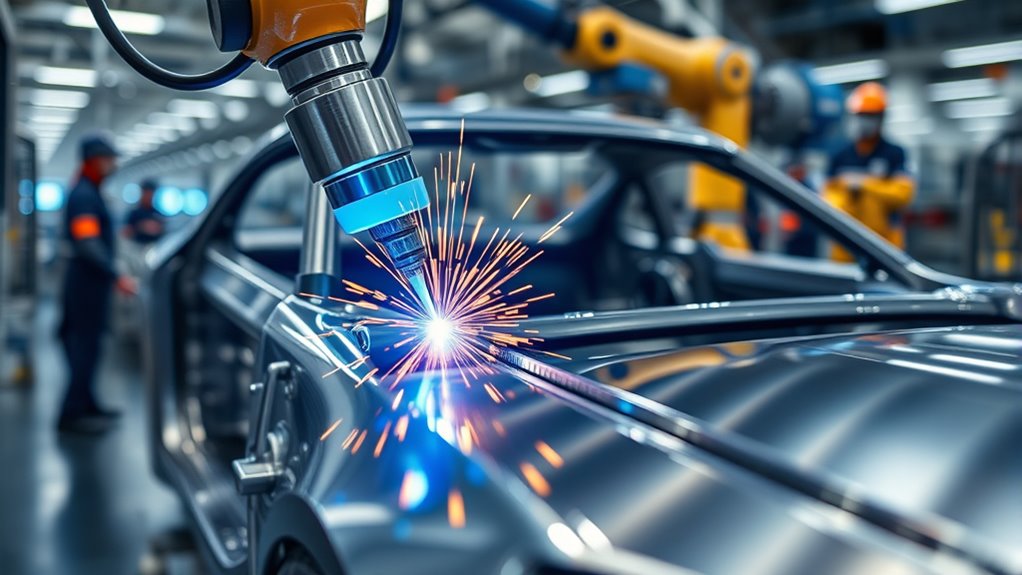
Laser welding is a joining process that uses a focused beam of light to melt the joint area and fuse the materials together. Because the beam can be concentrated into a small spot, you can make narrow welds with a smaller heat-affected zone than many arc welding methods.
In simple terms, the laser puts energy exactly where the joint needs it. That helps reduce warping, protects nearby features, and keeps the weld area cleaner when the process is set up correctly. This is why laser welding is useful for thin sheet metal, battery connections, precision components, and lightweight automotive structures.
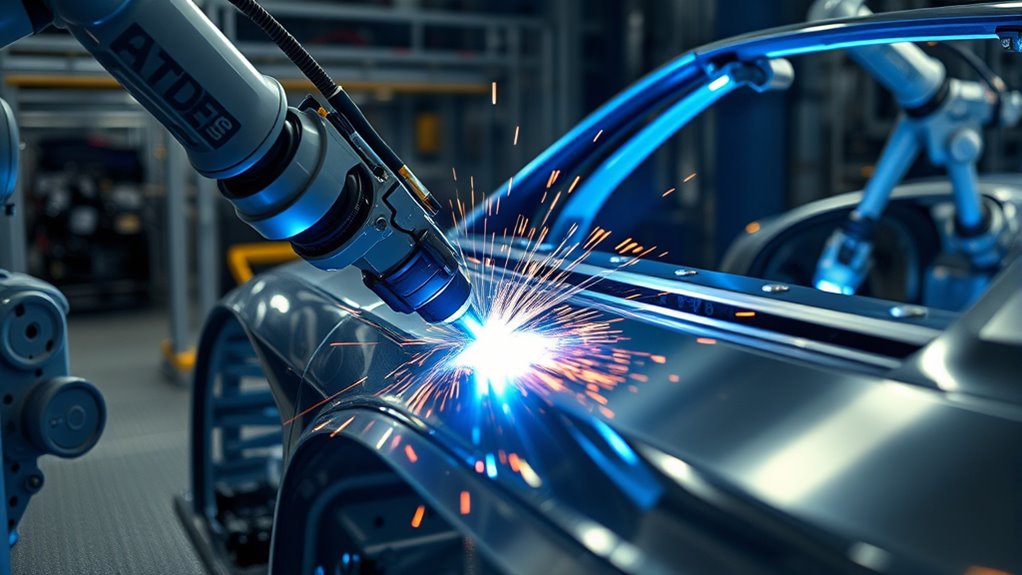
Most modern automotive systems use fiber lasers, disk lasers, or other solid-state laser sources because they can deliver high power through a controlled optical path. The laser head may be fixed, robot-mounted, or paired with scanner optics for remote laser welding.
How Laser Welding Works in Auto Production
In auto production, the part is clamped in a fixture, the laser beam is focused on the joint, and the system controls power, travel speed, focus position, and shielding gas. A robot, gantry, or scanner then moves the beam along the weld path.
The goal is controlled fusion. You want enough energy to form a sound weld, but not so much that you burn through the part, create excess spatter, crack the weld, or damage heat-sensitive material nearby.
Conduction Mode vs. Keyhole Mode
Laser welding usually works in one of two main modes:
- Conduction mode: The surface melts without deep vaporization. This creates a wider, shallower weld and is useful for thin materials or cosmetic seams.
- Keyhole mode: Higher power density vaporizes a small cavity in the metal. The beam energy penetrates deeper, creating a narrow, deeper weld. This is common in many production applications, but it needs tight control to avoid porosity and instability.
Both modes can be useful. The right choice depends on material thickness, joint design, strength target, appearance needs, and production speed.
Fit-Up, Cleanliness, and Shielding
Laser welding is precise, but that also means it is less forgiving. Gaps, poor clamping, oil, oxide, plating, or inconsistent part position can cause defects. In many automotive cells, vision systems check part location before welding, while fixtures hold the joint in a repeatable position.
Shielding gas may also be used to protect the molten pool, reduce oxidation, and improve weld consistency. The gas type, flow rate, nozzle position, and weld speed all need to match the material and joint design.
Pro Tip: In production laser welding, small setup errors can create big quality problems. Treat part fit-up, surface cleaning, focus position, and clamping as process-critical variables, not minor setup details.
Why Automakers Use Laser Welding
Automakers use laser welding because it can combine speed, accuracy, and low heat input in a way that fits high-volume production. When the process is dialed in, it can reduce distortion, shorten cycle time, and create consistent welds across thousands of parts.
The process is also non-contact. There is no electrode pressing into the joint, so tool wear is lower than in contact-based welding methods. That helps reduce downtime and keeps the weld process more stable over long production runs.
Laser welding can also support lighter vehicle design. It can join thin sheet, tailored blanks, selected dissimilar-material combinations, and compact subassemblies where bulky fasteners or larger weld beads would add weight or limit the design.
That said, laser welding is not magic. The design team still needs to confirm material compatibility, joint access, gap tolerance, coating behavior, and weld strength through testing before the process is released for production.
Common Automotive Uses for Laser Welding
Laser welding appears across automotive production wherever the joint needs high accuracy, limited heat input, and fast cycle time.
- EV battery packs: Laser welding can join tabs, busbars, current collectors, and interconnects where electrical resistance and heat input must be controlled.
- Body-in-white structures: It can be used on roof seams, tailored blanks, side panels, and structural sheet assemblies.
- Powertrain and drivetrain parts: Manufacturers use laser welding on gears, shafts, clutch parts, and other precision metal components.
- Fuel and fluid components: It can support precise welds on injectors, valves, sensors, and small sealed assemblies.
- Lightweight structures: Laser welding can reduce the need for some fasteners when the joint design and material combination support it.
For EVs, battery welding is one of the most important use cases. A poor battery tab or busbar weld can raise resistance, create heat, reduce pack efficiency, or cause quality failures. That is why EV battery welds often receive extra monitoring, electrical testing, and destructive validation during process development.
Products Worth Considering

Two types of Trigger Flexibility & Safety: The maximum current is 1,380 A, and the power is 11.5 KW. Seamlessly switch between hands-free foot pedal operation and precise hand control (Trigger) for versatile workflows and enhanced safety when handling sensitive batteries.
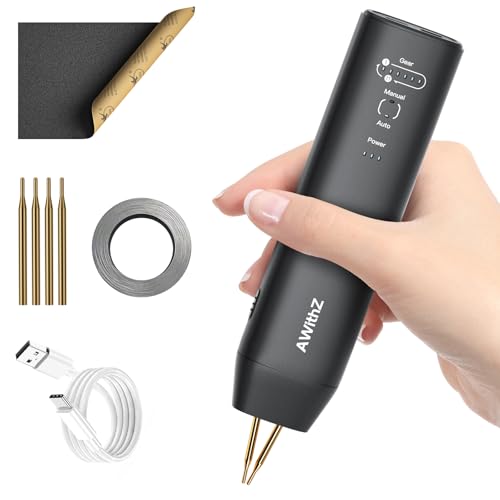
NO Spot Welding Pen------No need for a spot welding pen when going out or at home, handheld spot welder that does not require additional spot welding pens, carry it with you and it's convenient to go anywhere. It combines the built-in power supply and welding pen into one, making it easy to weld without the need for an external welding pen.
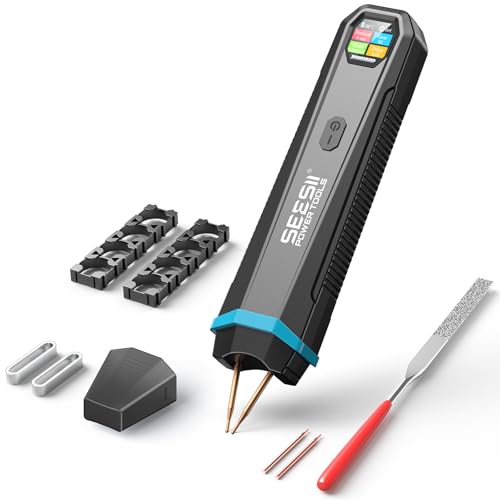
Fully Cordless: Say goodbye to tangled power cords—grab this spot welder and work anytime, anywhere; Note: For optimal performance, fully charge it to 100% before first use; If the product is left unused, please charge it monthly to preserve battery health
Key Components of an Automotive Laser Welding System
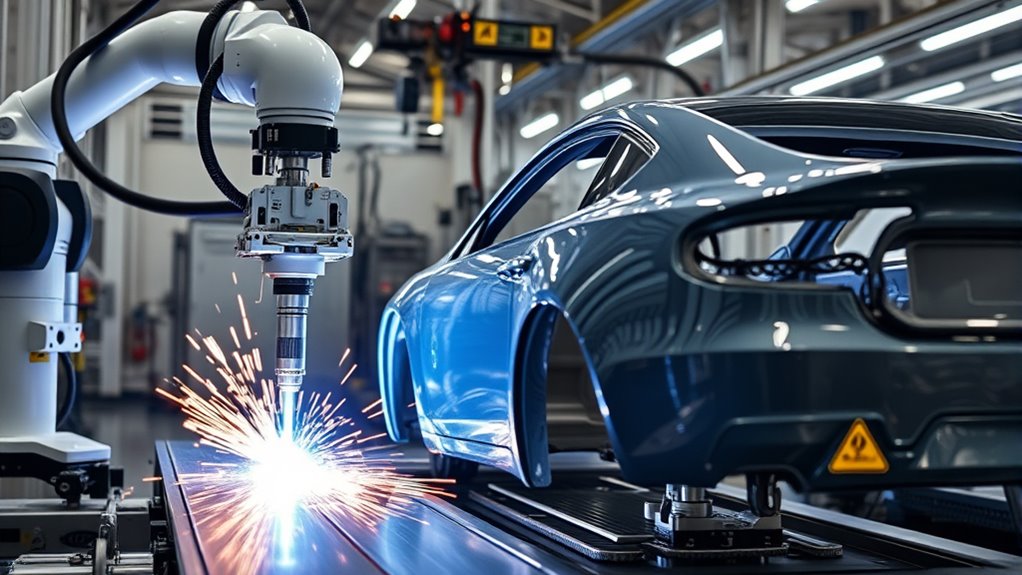
A production laser welding cell depends on more than the laser source. It works as a controlled system, and each component affects weld quality.
- Laser source: Provides the beam power needed for the material, thickness, and speed target.
- Beam delivery and optics: Focus the beam and control spot size, focal position, and working distance.
- Robot, gantry, or scanner head: Moves the beam or part along the programmed weld path.
- Fixture and clamps: Hold the parts in the correct position and reduce gap variation.
- Vision and seam tracking: Help locate the joint and adjust the path before or during welding.
- Process monitoring: Cameras, photodiodes, pyrometers, or other sensors can track the weld pool and flag defects.
- Safety enclosure and interlocks: Keep operators away from hazardous laser radiation during normal operation.
- Fume extraction: Removes fumes and vapors created when the laser interacts with metal, coatings, or surface contaminants.
These components work together. A high-power laser will not produce good welds if the fixture is weak, the surface is dirty, the focus drifts, or the monitoring system cannot detect process changes.
How Remote Laser Welding Speeds Production
Remote laser welding uses scanner optics to steer the beam quickly across the part. Instead of moving the entire robot arm for every small weld, the system can redirect the beam with mirrors and focusing optics.
This reduces non-welding time. On parts with many short welds, such as body structures or battery assemblies, that speed advantage can be significant. The beam can jump from one weld point to another quickly while keeping the laser head at a useful working distance.
Remote laser welding also helps with complex shapes because the head does not always need to sit close to the joint. However, it still needs accurate part location, a stable fixture, and a clear beam path. If the joint moves out of focus or the gap changes too much, weld quality can drop.
Quality Control and Common Defects
Automotive laser welding needs strong quality control because small defects can affect strength, sealing, appearance, or electrical performance. Common problems include:
- Porosity: Small gas pockets trapped in the weld.
- Cracking: A risk with some alloys, coatings, and cooling conditions.
- Incomplete fusion: The beam does not fully join the intended interface.
- Burn-through: Too much energy melts through thin material.
- Spatter: Ejected molten metal that can contaminate nearby parts.
- Underfill or undercut: The weld loses material at the seam or edge.
- High electrical resistance: A key concern in battery tab and busbar welding.
Manufacturers control these risks with weld schedules, sample testing, destructive cross-sections, electrical resistance checks, leak testing, pull testing, and real-time monitoring. Newer inspection work also uses camera data and machine-learning models to help predict penetration and detect process changes during laser welding.
Laser welding is only as reliable as the process window behind it. Power, speed, focus, shielding, material prep, and fixture repeatability all need to stay inside validated limits.
Materials and Joint Types
Automotive laser welding is often used on steel, stainless steel, aluminum, copper, nickel, and selected coated or plated materials. Each material behaves differently under the beam.
Steel is generally easier to weld than highly reflective materials. Aluminum and copper can be more challenging because they reflect more laser energy and conduct heat quickly. Coatings can also create vapor, porosity, or spatter if the joint design does not give gases a way to escape.
Common joint styles include lap joints, butt joints, edge welds, seam welds, spot-like laser welds, and tab-to-busbar welds. The best joint design depends on access, strength, sealing, appearance, and how much gap the process can tolerate.
Safety Requirements for Laser Welding
Laser welding systems can create serious hazards if they are not enclosed, interlocked, ventilated, and maintained correctly. Industrial laser welders often involve high-power Class IIIb or Class IV laser radiation, which can injure eyes or skin and can also create fire risk from direct or scattered radiation.
The OSHA Technical Manual on laser hazards notes that laser welding, cutting, and similar target interactions can produce fumes and vapors that require adequate ventilation. The same guidance also covers controlled areas, warning systems, eyewear, training, and engineering controls for higher-power laser systems.
Federal laser product requirements in 21 CFR Part 1040 also address protective housings, safety interlocks, remote interlock connectors, key controls, emission indicators, beam attenuators, and labeling for covered laser products.
Warning: Do not treat an industrial or handheld laser welder like a normal shop tool. Use only trained operators, approved eyewear when required, proper enclosure, interlocks, beam stops, fume extraction, fire controls, and written procedures.
Limitations of Laser Welding
Laser welding has major advantages, but it is not always the best process. The equipment can be expensive, the setup is sensitive, and the joint must be designed for the beam. If parts have large gaps, heavy contamination, poor access, or inconsistent positioning, another welding or joining method may be more practical.
You also need to consider material behavior. Some metals crack more easily, some coatings create gas, and some dissimilar-metal combinations form brittle intermetallic layers. In those cases, process development may require beam shaping, filler wire, wobble welding, hybrid welding, special shielding, or a different joining method altogether.
For repair work, laser welding can be useful in trained hands, but production-style claims do not always transfer to a small shop. Safety, training, and part validation matter even more when the setup is not inside a fully engineered production cell.
Frequently Asked Questions
Are Chinese laser welders any good?
Some Chinese laser welders can perform well, especially for light fabrication and cost-sensitive work, but quality varies widely by manufacturer. Judge the machine by weld samples, power stability, safety certification, interlocks, enclosure options, cooling system, spare parts, local support, training, and warranty terms. For automotive production, choose a vendor that can document process capability and safety compliance.
How thick of steel can a laser welder weld?
Laser welders can handle very thin sheet and, with enough power and the right setup, much thicker steel. There is no single universal limit. Thickness depends on laser power, beam quality, joint design, travel speed, focus, shielding, material grade, and whether the weld uses filler or a hybrid process. For production work, qualify the weld by testing rather than relying on a generic thickness claim.
Is laser welding stronger than MIG or TIG welding?
It can be, but not automatically. Laser welding can make narrow, deep, low-distortion welds, while MIG and TIG can be more forgiving and easier to use with filler metal. Strength depends on joint design, penetration, metallurgy, heat input, defects, and inspection. The best process is the one that meets the required strength, quality, cost, and safety targets.
Why is laser welding common in EV battery production?
EV battery parts need fast, precise, low-heat joining. Laser welding can join tabs, busbars, and current collectors while limiting heat spread into nearby cells. It also works well with automation and monitoring, which helps manufacturers track weld quality, electrical resistance, and consistency across high-volume battery packs.
Conclusion
In auto production, laser welding gives you speed, precision, and heat control that can be hard to match with conventional welding. It is especially valuable for EV battery connections, thin sheet metal, body structures, and precision parts where low distortion and repeatable quality matter.
The tradeoff is that laser welding demands a controlled process. You need clean parts, tight fit-up, stable fixturing, proper shielding, validated settings, real-time monitoring where needed, and strong safety controls. When those pieces are in place, laser welding can help build lighter, cleaner, and more efficient vehicle assemblies.
Sources
- OSHA Technical Manual, Laser Hazards — backs up laser welding ventilation, controlled areas, eyewear, training, and safety-control guidance.
- 21 CFR Part 1040, Performance Standards for Light-Emitting Products — backs up laser product housing, interlock, key-control, emission-indicator, and labeling requirements.
- Large-scale Thermo-Mechanical Simulation of Laser Beam Welding — backs up non-contact laser welding, short cycle times, small heat-affected zones, and cracking concerns.
- Welding Penetration Prediction Model for Laser Welding — backs up the importance of penetration control and intelligent monitoring in laser welding.