HGNVGZ-1011 Handheld Welding Machine Review
A full-size stick welder can be more machine than you need for a loose bracket, a gate repair, or practice on scrap steel. The HGNVGZ-1011 Handheld Welding Machine uses a 110V input, a 20-120A output range, and a gun-style body you can carry in one hand. Its simple controls and starter accessories are approachable, but the compact design and missing duty-cycle data make it better for short, light jobs than structural or production welding.
Quick Verdict
Rating: 7/10, Recommended with caveats
Best For: DIY repairs, beginner stick-welding practice, portable garage use, and short jobs on compatible steel or iron
Bottom Line: The HGNVGZ-1011 packs 20-120A adjustment, hot start, arc force, anti-stick control, and a starter kit into a compact 110V format. Its main tradeoffs are unclear duty-cycle information, conflicting published weight data, and limited suitability for thick, structural, or continuous work.
Key Specifications
| Specification | Detail |
|---|---|
| Brand | HGNVGZ |
| Model | HGNVGZ-1011 |
| Product Type | Portable handheld ARC/MMA stick welder |
| Input Power | 110V AC |
| Output Range | 20-120A |
| Current Control | Six-position adjustment knob |
| Arc Features | IGBT inverter, hot start, arc force, and anti-stick |
| Supported Rod Sizes | 1/16 to 1/8 inch (1.6 to 3.2 mm), according to the available manual information |
| Rod Types Listed | E6011, E6013, E6014, and E7018 |
| Materials Listed | Mild steel, stainless steel, and iron; not listed for aluminum |
| Published Weight | Listing copy says about 3.3 lb, while Amazon technical details list 6.78 lb; confirm the current variant before buying |
| Package Dimensions | Current Amazon technical details list 15.07 x 11.18 x 4.45 inches |
| Color | Grayish black for the linked ASIN |
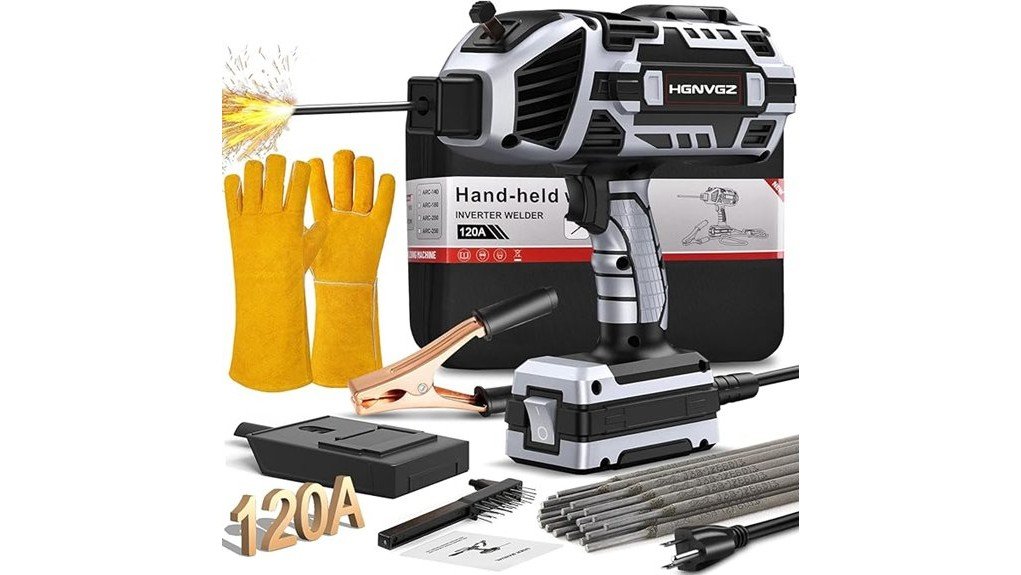
| Included Items Listed | Handheld welder, 20 rods, nylon gloves, ground lead, carrying case, handheld mask, instructions, and related kit items; verify the current package contents |
| Protection Features | Overheat, over-current, and overload protection |
| Best Use | Short DIY repairs, practice, maintenance, and light fabrication on compatible material |
Before You Buy: The published weight and package measurements are not consistent across the listing and manual-style sources. The listing also does not provide a clear duty-cycle percentage. Check the current Amazon details, package contents, circuit requirements, and warranty terms before treating this as a continuous-use or professional welder.
What Is the HGNVGZ-1011?
The HGNVGZ-1011 is a 110V handheld stick welder built around an IGBT inverter. Instead of placing the electrode holder at the end of a long lead like a traditional compact stick machine, the main welding controls and rod holder are integrated into a gun-style body. That layout reduces the number of separate parts you have to handle during a quick repair, although you still need a secure ground connection and a safe power source.
Its 20-120A range and six-position knob offer a simpler interface than a digital multiprocess machine. Hot start, arc force, and anti-stick can make practice less frustrating, but they do not replace proper rod selection, clean metal, a sound ground, or basic technique.
Who Should Buy It?
Best For
- Homeowners who need a compact welder for brackets, gates, light equipment, and noncritical repairs
- Beginners who want six simple current settings instead of a complex control panel
- DIY users who value a portable case and a starter kit with rods and basic accessories
Skip If
- You need verified performance on thick, load-bearing, structural, or safety-critical parts
- You need MIG, flux-core, TIG, aluminum welding, or precise digital amperage control
- You expect long daily weld sessions and need a clearly documented duty cycle and service network
Feature-by-Feature Review
20-120A Output and Six-Step Control
The six-step knob covers the machine’s listed 20-120A range. This is easier to understand than a menu-driven interface, and it lets you raise or lower heat as you move between smaller and larger compatible rods. The tradeoff is less precision than a welder with a digital amperage display, so you may need test beads on scrap metal before starting the actual repair.
The available manual information pairs smaller rods with lower current and larger rods with higher current, but those figures are only starting points. Joint design, thickness, position, rod condition, and travel speed still affect the setting. Too much heat can cause burn-through or poor control on thin material.
IGBT Inverter, Hot Start, Arc Force, and Anti-Stick
The IGBT inverter keeps the machine smaller than many transformer-style welders and supports its adjustable output. Hot start briefly helps when striking the arc, while arc force helps prevent the arc from going out when the electrode gets close to the work. Anti-stick is intended to reduce current when the rod freezes to the metal, making it easier to release the electrode.
These functions cannot correct poor preparation. Paint, rust, oil, scale, a weak ground, or damp electrodes can still cause an unstable arc, so clean the contact area and keep rods dry.
Handheld Design and Portability
The gun-style layout places the rod clamp, current control, start control, and cooling openings on the main body. That design can be convenient when you are moving between short jobs or working where bench space is limited. The linked listing also includes a carrying case, which helps keep the welder, rods, ground lead, and protective items together.
Holding the welder body can feel different from using a separate electrode holder. Practice the grip, cable routing, and start control with the machine disconnected before your first weld.
Rod and Material Compatibility
The available product information lists rods from 1/16 to 1/8 inch, including E6011, E6013, E6014, and E7018. It also lists mild steel, stainless steel, and iron as compatible materials. This range gives you several common stick-electrode options for repair and practice work.
Rod compatibility does not mean every electrode will behave the same. E7018 storage and technique differ from E6011, and smaller rods may be easier on a compact 110V machine. The available manual information says this unit is not suitable for aluminum.
Cooling and Electrical Protection
The listing describes overheat, over-current, overload, and 360-degree cooling features. These protections can reduce damage when the unit gets too hot or sees an electrical problem, but they are backup systems rather than permission to weld continuously. Blocked vents, hot weather, low voltage, or repeated high-output use can still trigger a shutdown.
No clear duty-cycle percentage was found for the linked model. Plan on short welds with cooling breaks, keep all intake and exhaust openings clear, and stop if the machine smells hot, cycles off, or behaves differently from normal. Never bypass a thermal shutdown or open the housing while it is connected to power.
How It Performs in Real Use
Small Home and Garage Repairs
The HGNVGZ-1011 makes the most sense for short beads on a light bracket, noncritical gate part, small frame, or shop hardware. Its 110V input and case are convenient near a suitable outlet, but you still need clean metal and a repairable part.
Beginner Practice on Scrap Metal
The simple knob and anti-stick function can reduce setup friction. Start with clean scrap, use a supported rod, and practice arc length, work angle, and travel speed before welding a useful part.
Portable Maintenance Work
The case and handheld form are useful between a garage, shed, or work area. Confirm the electrical requirements, avoid wet locations, and do not rely on a light-duty or damaged extension cord.
Longer or Heavier Jobs
This is the weakest use case. The 120A ceiling, small enclosure, and missing published duty-cycle percentage make the HGNVGZ-1011 a poor choice for continuous fabrication, thick structural steel, trailer frames, lifting points, roll cages, pressure vessels, or other safety-critical work. A conventional inverter stick welder with documented output and duty-cycle data is a better fit for those jobs.
Setup Tips and Common Mistakes
- Inspect the kit first. Check the power cord, ground lead, clamp, rod holder, vents, and case for shipping damage before connecting power.
- Confirm the circuit. Use the voltage and circuit arrangement stated in the current manual. Stop if plugs, receptacles, or cords become hot.
- Prepare a clean ground point. Clamp to clean bare metal connected to the workpiece. Paint, rust, and loose contact can cause weak or erratic arcs.
- Match the rod to the job. Confirm rod type, diameter, polarity guidance, and current range on the electrode package and product manual.
- Test on scrap. Make a short test bead on the same material and thickness before welding the final part.
- Keep vents open. Do not set the welder on cloth, dust, or a surface that blocks cooling airflow.
- Allow cooling time. Pause after short welds, especially near the top of the output range.
Pro Tip: Mark a few proven knob settings on a scrap reference card for the rod sizes and metal thicknesses you use most. This gives you a repeatable starting point without pretending the six-step dial is a precise amperage meter.
Welding Safety and Maintenance
Welding exposes you to electric shock, arc radiation, hot metal, fire, fumes, and flying slag. Wear a properly rated helmet, flame-resistant clothing, welding gloves, eye protection for cleanup, and suitable footwear. Keep people, pets, and flammable material away.
Work only in a dry, well-ventilated location. Do not weld in rain, on wet ground, or while wearing wet clothing. Keep your head out of the fume plume, and use local exhaust or other appropriate ventilation for the metal and coating involved. Never weld a closed container, fuel system, unknown tank, coated metal, or vehicle component until the hazards have been identified and controlled by a qualified person.
For maintenance, unplug the welder and let it cool. Wipe it with a dry cloth, keep vents clear, inspect cables for damage, and store the machine and rods in a clean, dry case.
Pros and Cons
Pros
- 20-120A range covers several common small stick-electrode sizes
- Six-step knob is easy to understand for basic practice and repair work
- Hot start, arc force, and anti-stick functions support easier arc control
- Gun-style body and carrying case reduce storage space and improve portability
- Starter package lists rods, gloves, a ground lead, a handheld mask, and related accessories
Cons
- No clear duty-cycle percentage is published for the linked model
- Published tool weight and package measurements conflict across sources
- Not intended for aluminum, multiprocess work, continuous fabrication, or safety-critical structural repairs
Is It Worth the Price?
The HGNVGZ-1011 sits in the budget, convenience-focused part of the stick-welder market. It can offer strong value for the price when your main priorities are compact storage, a simple control layout, and a kit that covers the basic hardware needed for short DIY jobs. Buyers who already own a proper helmet and protective clothing may find the included handheld mask less important than the rods, case, and ground lead.
Its value drops if you need documented continuous output, precise amperage control, or multiple processes. A larger inverter stick machine takes more space but often provides clearer performance data and better ergonomics for longer beads.
How It Compares to Alternatives
The Saker 110V handheld welder is worth comparing if you want a similar gun-style design with a different current-control layout. The Seesii 110V 120A handheld welder may appeal to buyers who want another compact option advertised for 3/32 to 1/8-inch rods. The FEMEROL 120A handheld welder is another close-format alternative, especially when you are comparing included eye protection and accessory packages.
The HGNVGZ-1011 makes the most sense when its kit contents and six-step control match your needs. Compare warranty terms, weight, rod range, duty-cycle information, and support instead of choosing only by the largest amperage number.
Frequently Asked Questions
Is the HGNVGZ-1011 suitable for beginners?
It can be a practical practice machine because the six-step control is simple and the hot start and anti-stick features can reduce common arc-start problems. A beginner still needs welding instruction, proper PPE, scrap-metal practice, and an understanding of electrical and fire hazards before using it on a real repair.
What rods can you use with this handheld welder?
The available information lists 1/16 to 1/8-inch rods, including E6011, E6013, E6014, and E7018. Confirm the rod package’s polarity and amperage guidance, then test the setting on scrap because the six-position dial is not a precise digital amperage display.
Can it weld aluminum?
No. The available manual information says the HGNVGZ-1011 is not suitable for aluminum. Use a machine and process specifically designed for aluminum, with the correct filler, shielding, and material preparation.
Does it run from a standard household outlet?
The linked model is listed for 110V AC input. You should still confirm the required branch-circuit capacity in the current instructions and avoid any cord, plug, adapter, or extension lead that is damaged, undersized, or not approved for the load.
How much does the HGNVGZ-1011 weigh?
The published data is inconsistent. Product copy describes the handheld unit as about 3.3 pounds, while Amazon’s technical details list 6.78 pounds, so confirm whether the current figure refers to the bare tool, the kit, or packaged shipping weight.
Can you use it for outdoor projects?
You can use it outside only in a dry, controlled area with safe power access and suitable ventilation. Do not use the welder in rain, on wet ground, or where wind can spread sparks toward dry grass, fuel, or other flammable material.
What is the biggest limitation of this welder?
The largest limitation is the lack of clear published duty-cycle data for the linked model. That uncertainty, combined with the 120A maximum and compact enclosure, makes it better for short repairs and practice than for continuous production or structural work.
The Bottom Line
The HGNVGZ-1011 is a reasonable choice for a DIY buyer who wants a compact 110V stick welder for practice, maintenance, and short repairs on compatible steel or iron. Its portability, six-step current control, and arc-assist features are useful, but buyers who need verified duty-cycle performance, precise controls, aluminum capability, or structural welding capacity should choose a more thoroughly documented machine.
Ready to Buy?
Check the latest package contents, specifications, warranty terms, and price before you decide.