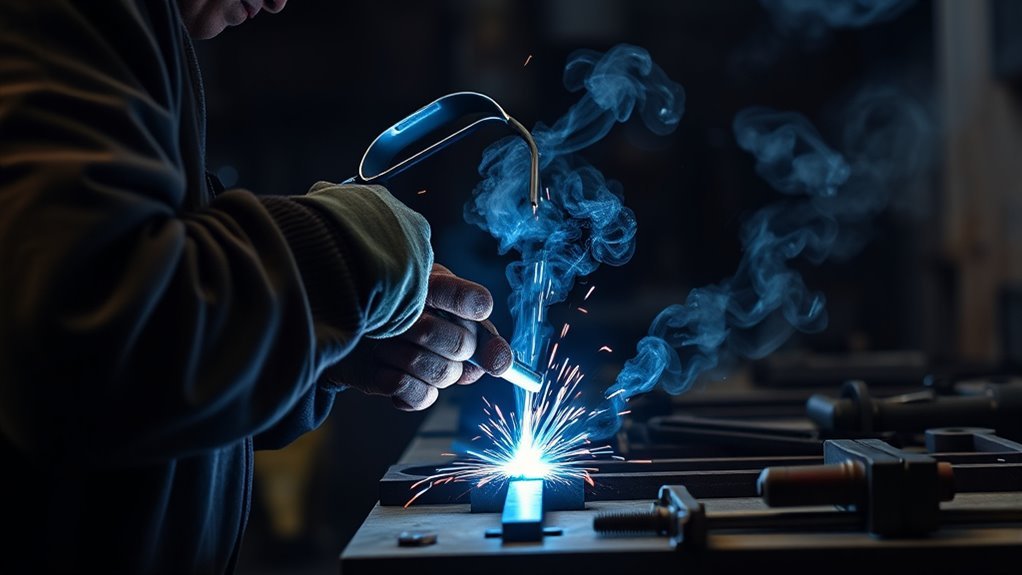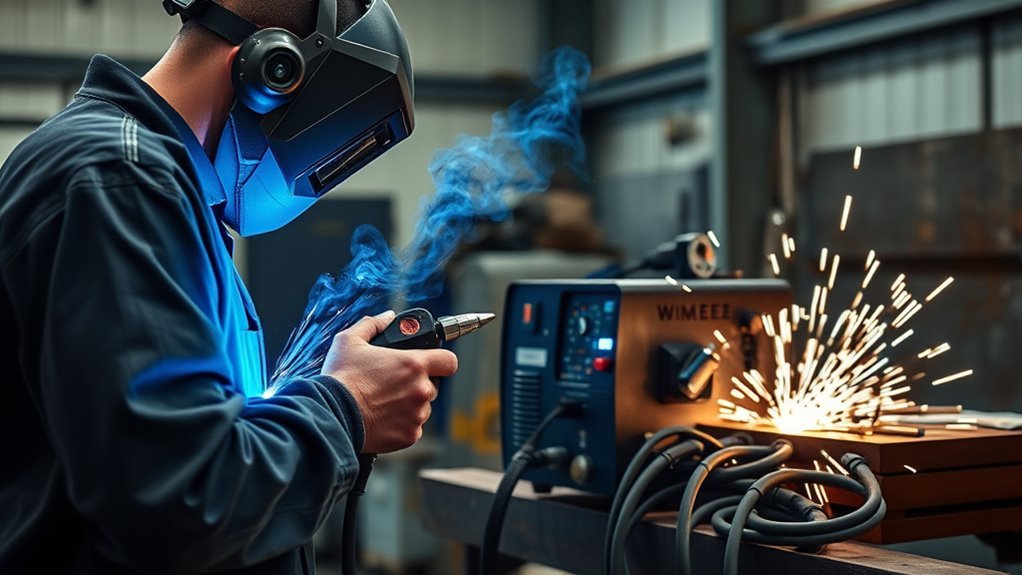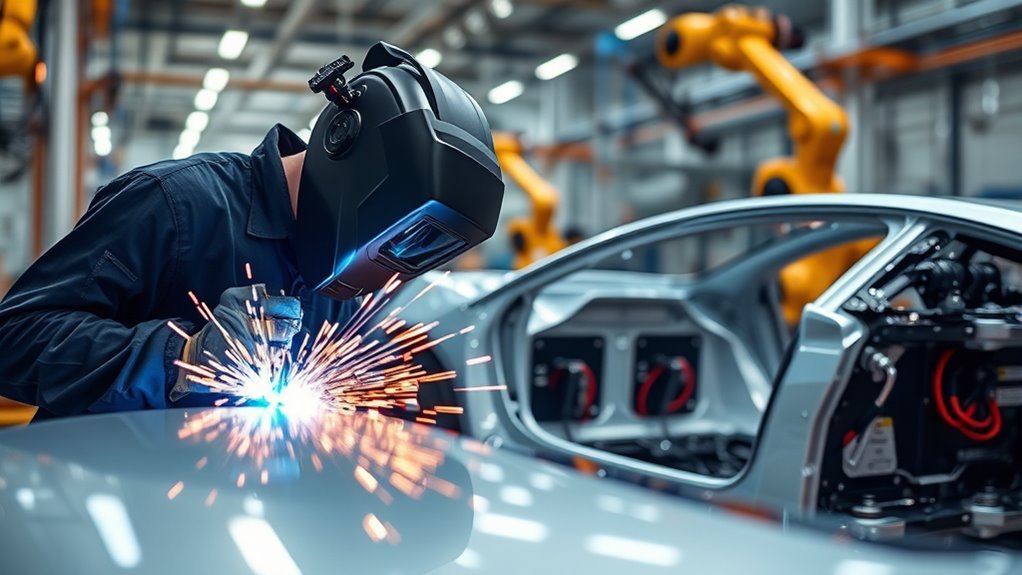
Electric vehicles have changed auto body welding because the repair is no longer just about joining steel panels. You now have to protect high-voltage systems, work with more aluminum and mixed materials, follow vehicle-specific OEM procedures, and verify cameras, radar, sensors, and control modules after the repair. The weld is only one part of the job; the safety setup, diagnostics, joining method, corrosion protection, and calibration steps matter just as much.
Quick Answer
Electric cars change auto body welding by adding high-voltage safety steps, more aluminum and mixed-material structures, stricter OEM repair procedures, and required post-repair diagnostics. A qualified EV repair must isolate the high-voltage system, choose the approved joining method, control heat carefully, and recalibrate affected ADAS sensors before the vehicle is released.
Key Takeaways
- EV welding and collision repair should start with high-voltage isolation, lockout/tagout, and voltage verification based on the OEM procedure.
- Aluminum, composites, adhesives, rivets, and ultra-high-strength steels can require different repair methods than traditional steel bodywork.
- Heat control matters because welding near battery structures, bonded joints, sensors, and coated panels can damage safety-critical parts.
- ADAS cameras, radar, lidar, steering angle sensors, and related modules may need scanning and calibration after even minor structural or panel repairs.
- The right EV repair shop should prove training, OEM repair access, scan-tool capability, ADAS calibration equipment, and aluminum repair discipline.
At a Glance
| Time Required | Initial safety checks and diagnostic scans may take less than a day; structural EV repairs can take several days or longer depending on parts, battery inspection, paint work, and calibration needs. |
| Difficulty | Advanced professional repair. High-voltage EV welding and structural collision repair are not safe DIY jobs unless you are trained and following the exact OEM procedure. |
| Tools Needed | OEM repair information, EV-rated PPE, insulated tools, high-voltage meter, scan tool, aluminum-capable welding equipment, dedicated aluminum tools, measuring equipment, and ADAS calibration equipment when required. |
| Cost | Varies widely by vehicle, damage location, battery involvement, required joining methods, scan/calibration work, and parts availability. A proper estimate should list diagnostics, OEM procedures, structural labor, corrosion protection, and calibrations separately. |
Why EVs Changed Auto Body Welding
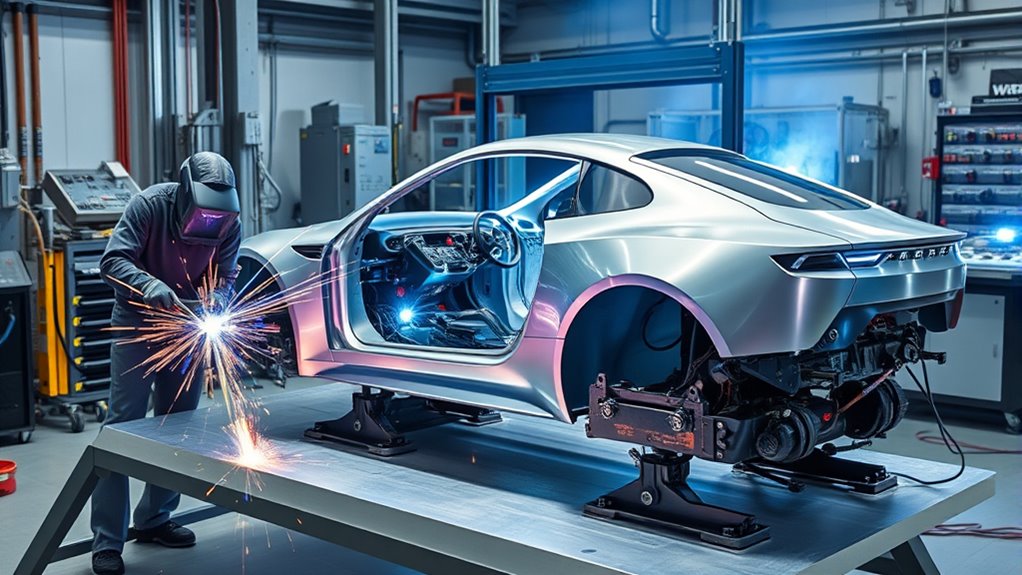
Electric vehicles changed auto body welding because their structures are designed around battery protection, crash load paths, lightweight materials, and sensitive electronics. You may still see familiar steel panels, but many EVs also use aluminum castings, extrusions, bonded panels, composite covers, ultra-high-strength steels, and mixed-material joints.
That mix changes the repair decision. You cannot assume that a damaged panel should be heated, pulled, and welded the same way a conventional steel body panel might be repaired. The approved repair may call for MIG/GMA welding, squeeze-type resistance spot welding, adhesive bonding, rivets, flow-form fasteners, sectioning, or full part replacement.
The biggest shift is not just the welding process. It is the need to treat the vehicle as a high-voltage, sensor-controlled structure before, during, and after the weld.
Advanced joining methods such as laser welding and friction stir welding are important in EV manufacturing and some specialized repair environments, but most collision repair decisions still come back to the vehicle maker’s published repair procedure. The technician has to match the repair method to the exact model, production date, material, and location on the body.
EV adoption also makes this knowledge more important. The International Energy Agency reported that global electric car sales exceeded 17 million in 2024 and represented more than 20% of new cars sold worldwide. More EVs on the road means more EV collision repairs, more aluminum body work, and more high-voltage safety planning in ordinary repair shops.
What Makes an EV Body Repair Different?
An EV body repair has more checkpoints than a traditional repair because the battery, cooling system, wiring, sensors, and structure can all affect safety. A clean repair plan should answer these questions before the first weld is made:
- Is the high-voltage system disabled and verified safe? The shop should follow the OEM disable procedure, use lockout/tagout, and verify voltage at approved points.
- Is the battery pack damaged? Impact near the floor, rocker panels, underbody, rear structure, or front rails can affect the pack or high-voltage cables.
- What material is being repaired? Aluminum, steel, ultra-high-strength steel, magnesium, plastic, and composite parts need different repair limits.
- What joining method is allowed? The repair may require welding, adhesive, rivets, a bonded patch, replacement, or a combination of methods.
- Will heat affect nearby systems? Welding heat can damage adhesive bonds, foam, corrosion coatings, wiring, battery cooling lines, sensors, and sealed modules.
- Which scans and calibrations are required? Pre-repair scans, post-repair scans, ADAS calibration, steering angle calibration, and battery or charging-system checks may all be needed.
Warning: Do not weld, cut, grind, or heat an EV structure until the vehicle has been inspected for high-voltage hazards and disabled according to the OEM procedure. A disconnected 12-volt battery does not make the high-voltage battery safe.
How Aluminum and Composites Change Repairs
EV makers use aluminum and composite materials to reduce weight, improve range, and manage crash energy around the battery pack. That helps vehicle efficiency, but it also changes the repair process.
Aluminum is not repaired like mild steel. It conducts heat quickly, forms a hard oxide layer, and is more sensitive to contamination. Aluminum grinding dust, steel dust, dirty wire brushes, and shared tools can weaken the repair or cause corrosion problems. A serious aluminum repair area should use dedicated abrasives, dedicated stainless-steel brushes, clean storage, and separation from steel grinding whenever possible.
For aluminum MIG/GMA welding, pure argon shielding gas is commonly used, and filler selection must match the base metal and OEM procedure. Common aluminum filler wires include ER4043 and ER5356, but the correct choice depends on the alloy, joint design, strength requirement, and manufacturer guidance. Miller’s aluminum MIG guidance notes that filler choice, joint type, fit-up, position, operator skill, and power source all affect weldability.
Composites add a different challenge. Many composite parts cannot be straightened with heat or welded. Depending on the part, the correct repair may be adhesive bonding, patch repair, refinishing, or replacement. If the part is structural or shields the battery, follow the OEM repair limit exactly.
Pro Tip: Before repairing any aluminum panel, confirm whether it is cosmetic, semi-structural, or structural. The same dent that might be repairable on an outer panel may require replacement if it affects a crash load path or battery protection zone.
When Welding Is Not the Right Repair
EV repair often involves welding, but welding is not always the approved fix. Many modern bodies use adhesives, rivets, self-piercing rivets, flow-form fasteners, and squeeze-type resistance spot welds because these methods control heat and preserve the original crash structure.
Welding may be restricted or prohibited near:
- high-voltage battery enclosures and battery support structures;
- sealed aluminum castings or extrusions;
- bonded joints where heat could weaken the adhesive;
- ultra-high-strength steel that loses strength when heated;
- foam-filled cavities, corrosion coatings, or sound-deadening materials;
- high-voltage cables, cooling lines, airbag sensors, and ADAS wiring;
- areas where the OEM procedure calls for part replacement instead of sectioning.
Public OEM repair information shows how detailed these requirements can be. For example, Tesla’s public collision repair procedures organize repairs around approved parts, tools, fasteners, adhesives, structural repair rules, welding equipment, and post-repair operations. That is the correct mindset for any EV: verify the allowed operation first, then choose the tool.
What High-Voltage Safety Means for Repairs
High-voltage safety changes EV collision repair from routine bodywork into a controlled technical process. A damaged battery pack can create shock, fire, stranded-energy, and thermal-runaway hazards. NHTSA provides vehicle-specific emergency response guides for electric-powered vehicles, and those guides are useful because each model can place cables, disconnects, and battery components differently.
Before welding or structural repair, a trained technician should identify the vehicle, inspect for crash damage near the battery system, follow the OEM high-voltage disable procedure, use lockout/tagout, wait the required discharge time, and verify voltage with properly rated equipment. OSHA’s lockout/tagout standard covers servicing and maintenance where unexpected energization or stored energy could injure workers.
Safe EV repair language matters. The goal is not to make the battery “powerless.” The goal is to isolate the high-voltage system, prevent re-energization, verify the approved test points, and keep the battery risk under control.
High-Voltage Red Flags
Stop the repair plan and isolate the vehicle if you see or smell signs of battery trouble, including:
- battery case damage or underbody impact near the pack;
- swelling, hissing, popping, smoke, or unusual odor;
- fluid leakage from the battery area or cooling system;
- abnormal heat around the battery, floor, rocker, or rear structure;
- saltwater or flood exposure;
- isolation fault codes or high-voltage interlock faults;
- damaged orange cables, connectors, service disconnects, or shields.
If any of these signs appear, the vehicle may need quarantine, fire watch, towing restrictions, or manufacturer guidance before repair continues. NHTSA’s Battery Safety Initiative reflects the same concern: lithium-ion battery safety is a live issue that requires coordinated research, procedures, and training.
Why Aluminum Welding Needs New Skills
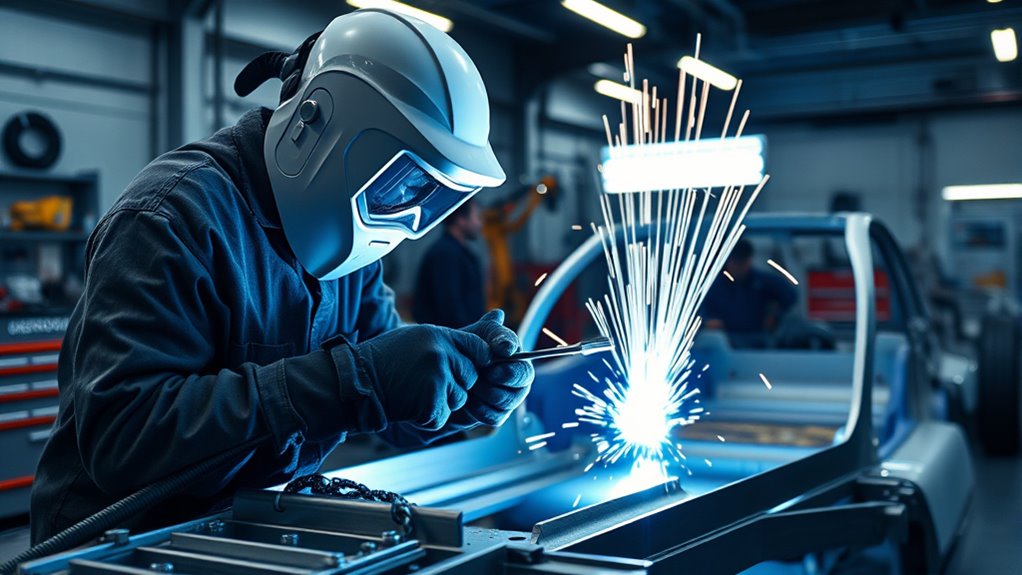
Aluminum welding matters more as EVs and modern vehicles use lightweight structures to reduce mass. You cannot rely on steel habits because aluminum melts differently, moves heat quickly, and needs cleaner prep.
A proper aluminum welding setup may include an aluminum-capable MIG/GMA welder, spool gun or push-pull system, clean shielding gas, correct filler wire, clean base metal, and a controlled weld area. The technician also needs to remove oxide properly, avoid cross-contamination, and protect the finished repair against corrosion.
Heat input is one of the biggest skills. Too little heat can cause lack of fusion. Too much heat can warp panels, weaken heat-sensitive material, damage nearby adhesives, and increase the risk of burn-through. On an EV, heat control also protects wiring, cooling lines, battery-related structures, and sensor brackets.
| Repair Factor | Why It Matters |
| Cleanliness | Oil, oxide, steel dust, and moisture can cause porosity, corrosion, and weak welds. |
| Filler choice | The filler wire must match the alloy, joint design, strength requirement, and OEM repair procedure. |
| Heat control | Aluminum can distort quickly, and nearby adhesives, electronics, coatings, and battery-related parts can be damaged by excess heat. |
| Corrosion protection | Bare aluminum and mixed-metal joints need the correct primers, sealers, coatings, and isolation steps after repair. |
EV Repair Workflow Before, During, and After Welding
A strong EV repair process is documented from intake to delivery. The exact order can vary by vehicle and damage, but the workflow should look like this:
- Identify the vehicle and powertrain. Confirm make, model, year, battery type, and whether the vehicle is battery electric, plug-in hybrid, hybrid, or fuel cell.
- Check OEM repair information. Pull the current procedure before writing the repair plan, not after the car is already apart.
- Perform a pre-repair scan. Record DTCs, safety-system faults, battery faults, and ADAS-related codes.
- Inspect for battery and high-voltage damage. Look at the pack area, orange cables, cooling lines, service disconnects, and underbody shields.
- Disable and verify the high-voltage system. Follow the OEM disable process, apply lockout/tagout, wait the specified time, and verify voltage safely.
- Choose the approved joining method. Confirm whether the repair uses welding, adhesive, rivets, sectioning, full replacement, or a combination.
- Control heat and contamination. Shield nearby components, clean the joint, protect wiring and coatings, and keep aluminum work separate from steel dust.
- Restore corrosion protection. Reapply primers, seam sealers, cavity wax, undercoating, and insulating materials where the OEM procedure calls for them.
- Run a post-repair scan. Confirm no new faults remain and verify system communication.
- Perform calibrations. Complete ADAS, steering angle, radar, camera, lidar, blind spot, parking sensor, or battery-system procedures as required.
- Document the repair. Save scan reports, calibration reports, measuring data, weld tests, photos, and OEM procedure references.
Note: EV collision repair documentation is not just paperwork. It protects the technician, the shop, the insurer, and the driver by proving that the repair followed the required safety and calibration steps.
How ADAS Changes Collision Repair
ADAS changes collision repair because sensors can be affected by repairs that look minor from the outside. Cameras, radar units, lidar sensors, ultrasonic sensors, blind-spot modules, steering angle sensors, and ride-height changes can all affect system performance.
The I-CAR OEM Calibration Requirements Search explains that ADAS systems often require post-repair calibration or aiming and that requirements can involve scan tools, special equipment, warning lights, DTCs, and vehicle-specific conditions.
Sensor Alignment Challenges
Even slight sensor misalignment can change how an ADAS-equipped vehicle sees the road. A radar bracket can shift in a bumper repair. A windshield camera can need aiming after glass replacement. A front-end repair can change the relationship between the radar, camera, grille opening, bumper cover, and wheel alignment.
That is why the shop should not guess. It should check the OEM procedure, measure the vehicle, confirm ride height and alignment when required, set targets at the proper distance, and use the required scan tool or calibration platform.
Calibration After Collisions
ADAS calibration may be static, dynamic, or both. Static calibration usually uses targets, fixtures, level floors, measurements, and controlled lighting. Dynamic calibration usually requires a road procedure under specific speed, lane marking, weather, and traffic conditions.
EVs add more sensitivity because structural repairs, bumper replacement, cooling-system work, and wiring repairs can affect sensor mounting or communication. A post-repair scan should confirm that the modules communicate correctly and that no relevant DTCs remain.
OEM Procedures Matter
OEM procedures matter because each vehicle can have different scan and calibration rules. Honda states that factory-authorized diagnostic software is the accurate way to determine the post-collision status of Honda and Acura electronic control systems. BMW’s collision repair position guidance addresses preliminary and post-repair diagnostic tests for vehicles involved in collisions. Those examples show the larger rule: follow the current procedure for the exact vehicle, not a generic shop habit.
| Checkpoint | Requirement |
| Pre-scan | Record existing DTCs, battery faults, safety-system codes, and ADAS faults before repair. |
| Repair | Follow OEM joining, sectioning, corrosion protection, and component replacement procedures. |
| Post-scan | Confirm repaired systems communicate correctly and no related faults remain. |
| Calibration | Perform static or dynamic calibration when the OEM procedure requires it. |
What EV Diagnostics to Run After a Crash
EV diagnostics after a crash should look beyond ordinary body damage. The scan and inspection process should check the high-voltage system, battery pack, charging system, safety interlocks, cooling circuits, supplemental restraint system, body control modules, and ADAS modules.
Products Worth Considering

CEL Doctor: The ANCEL AD310 is one of the best-selling OBD II scanners on the market and is recommended by Scotty Kilmer, a YouTuber and auto mechanic. It can easily determine the cause of the check engine light coming on. After repairing the vehicle's problems, it can quickly read and clear diagnostic trouble codes of emission system, read live data & hard memory data, view freeze frame, I/M monitor readiness and collect vehicle information

NOTE: This device requires a compatible third-party app to operate and is primarily designed for standard OBD-II diagnostics (excluding ABS/SRS, oil light or service reset, etc.). Please check the product description for compatible apps and supported functions.

【Diagnose Check Engine Light in Seconds – No Mechanic Needed】The FOXWELL NT301 OBD2 scanner instantly reads & clears engine fault codes (DTCs) with one click. Simply plug into the 16-pin DLC port, turn ignition on, and get accurate results within seconds—No prior car knowledge required. Save hundreds on dealership fees by knowing exactly what’s wrong before you visit a shop. The #1 choice car scanner for DIYers and car owners who want to take control of their vehicle’s health
Pre-Repair Safety Scan
A pre-repair scan helps identify electronic faults before the vehicle is disassembled. This matters because many faults do not turn on a dashboard warning light. The scan can reveal high-voltage interlock faults, isolation faults, airbag system faults, sensor communication problems, charging-system faults, and ADAS DTCs.
A good pre-scan report should be saved with the estimate and repair file. It helps the shop decide which repairs are body-related, which are electrical, and which may need a dealer-level tool or OEM subscription.
Battery and HV Checks
Once the vehicle is safe to approach, inspect the battery pack and high-voltage circuit for impact damage, isolation faults, connector damage, cooling-system damage, and thermal risk. Use the OEM procedure to disable the system and verify that the repair area is safe before cutting, welding, or grinding.
| Check | Purpose |
| Battery pack | Detect case damage, deformation, leakage, heat, swelling, and impact near protected zones. |
| High-voltage cables | Confirm orange cables, shields, connectors, and routing are not crushed, cut, pulled, or exposed. |
| Isolation and interlocks | Verify the high-voltage system is isolated and that crash shutdown logic is understood before repair. |
| Cooling system | Check for damaged battery cooling lines, pumps, plates, and leaks that could create later overheating. |
Post-Repair ADAS Calibration
After structural repairs, panel replacement, bumper work, windshield replacement, suspension work, or sensor bracket repair, the shop should check the ADAS procedure. A correct calibration may require wheel alignment, level floor space, target placement, scan-tool commands, road conditions, and proof that the calibration completed successfully.
The post-repair scan and calibration report should be part of the final documentation. Without it, the vehicle may look repaired while lane keeping, adaptive cruise control, emergency braking, blind spot monitoring, or parking systems remain inaccurate.
How to Choose the Right EV Repair Shop
When you choose an EV repair shop, start by verifying training and equipment. A shop that can repair a gasoline vehicle well is not automatically ready for high-voltage EV collision work.
A competent EV collision shop should be able to explain its high-voltage safety process, OEM repair access, scan-tool process, aluminum capability, and ADAS calibration plan before work begins.
Ask these questions before approving the repair:
- Do you have current EV or hybrid repair training? I-CAR offers EV and hybrid repair training and safety resources, including OEM disable information.
- Do you use the OEM repair procedure for my exact vehicle? The answer should be yes, and the shop should document it.
- Can you perform high-voltage disable and verification? The shop should have EV-rated PPE, insulated tools, and trained staff.
- Can you repair aluminum correctly? Look for dedicated aluminum tools, clean work areas, and aluminum-capable welders.
- Can you scan and calibrate ADAS? The shop should either perform calibrations in-house or document the qualified sublet provider.
- Will you provide scan and calibration reports? Final documentation should show what was checked and what passed.
- How do you handle damaged batteries? The shop should know when to isolate, quarantine, stop work, or seek manufacturer guidance.
Choose a facility that can show its process, not just promise that it “works on EVs.” A strong repair plan protects the technician, the vehicle, and the driver.
Products Worth Considering

CERTIFIED: Powerbuilt VDE Tools meet the stringent IEC60900 standards and are certified for service or repair applications rated up to 1000V AC / 1500V DC. Ensure your safety with tools specifically designed for high-voltage environments


CERTIFIED FOR HIGH-VOLTAGE APPLICATIONS: Powerbuilt VDE Tools comply with IEC60900 standards and are certified for service or repair applications rated up to 1000V AC / 1500V DC, ensuring your safety during electrical work
Why Training Matters for EV Welding
Training matters in EV welding because the risks are different from traditional body repair. A technician must understand high-voltage isolation, battery hazards, aluminum repair, structural adhesives, advanced steels, scan tools, and ADAS calibration.
Training also keeps the repair current. EV platforms change quickly, and even the same model can have different body materials, battery layouts, fasteners, and calibration procedures depending on production year. A technician who repaired one EV safely should still check the latest procedure for the next one.
Good training also teaches when to stop. If the battery pack shows damage, if the OEM procedure does not allow sectioning, if the shop lacks the correct weld test coupon process, or if ADAS calibration equipment is unavailable, the safe decision may be to sublet, refer, or replace instead of forcing a repair.
Frequently Asked Questions
Which country has the highest share of electric cars sold?
Norway remains the clearest leader. According to the Norwegian EV Association, 95.9% of new passenger cars sold in Norway in 2025 were fully electric, up from 88.9% in 2024. That is much higher than the older 76% figure often quoted from earlier years.
Is Elon Musk moving away from electric cars?
No. Tesla still sells electric vehicles, battery systems, charging products, and software-driven vehicle features. The bigger point for repair shops is that Tesla and other EV makers continue to use vehicle-specific structures, sensors, and battery systems that require OEM repair information.
What is the biggest repair challenge with electric cars?
The biggest repair challenge is the combination of battery safety, high-voltage isolation, mixed-material structures, and electronic calibration. A repair may need body skills, welding skills, electrical safety training, scan-tool work, and ADAS calibration in the same job.
Will mechanics still be needed for electric cars?
Yes. EVs reduce some traditional engine-related service work, but they increase demand for technicians who understand diagnostics, high-voltage safety, battery cooling, software updates, suspension, brakes, tires, collision repair, welding, and sensor calibration.
Can a regular body shop weld on an EV?
Only if the shop has the proper training, OEM repair information, high-voltage safety process, EV-rated equipment, and approved joining tools for that specific vehicle. A regular body shop should not weld on an EV structure by using generic steel repair habits.
Do EVs always need ADAS calibration after body repair?
Not always, but many repairs can trigger calibration requirements. Bumper removal, windshield replacement, sensor replacement, structural repair, suspension work, wheel alignment, ride-height change, or DTCs can all require calibration depending on the OEM procedure.
Conclusion
If you are repairing an EV, you cannot treat it like a conventional vehicle. Aluminum structures, composite parts, high-voltage batteries, OEM joining rules, scan tools, and ADAS calibration all change the repair path. Extra training does not slow the job down; it prevents unsafe work, rework, failed calibrations, battery risk, and liability. The right repair restores the body structure, protects the battery system, verifies the electronics, and returns the vehicle to the road with its safety systems working as intended.
Sources
- NHTSA Emergency Response Guides — vehicle-specific EV emergency, towing, battery, and high-voltage safety information.
- OSHA 29 CFR 1910.147 Lockout/Tagout — hazardous energy control during servicing and maintenance.
- I-CAR EV & Hybrid Repair Training and Safety Resources — training and OEM disable resources for electric and hybrid vehicle repair.
- I-CAR OEM Calibration Requirements Search — ADAS scan, calibration, aiming, and special-equipment requirements by vehicle.
- Miller: How to Successfully MIG Weld Aluminum — aluminum MIG welding factors including filler selection, fit-up, technique, and power-source considerations.
- Norwegian EV Association: Norwegian EV Market — updated Norway electric vehicle sales share data.