In a modern car factory, car bodies are welded and joined with a mix of resistance spot welding, robotic arc welding, laser welding, adhesives, and mechanical fasteners. Spot welding does most of the work on steel body panels because it is fast, repeatable, and easy to automate. Aluminum parts, mixed-metal joints, and high-strength steel areas often need different methods so the body stays strong, accurate, and ready for crash protection.
Quick Answer
Modern cars are welded mostly with robotic resistance spot welding in the body shop. Factories also use laser welding, GMAW/MIG, GTAW/TIG, adhesive bonding, weld-bonding, rivets, and self-piercing rivets where the material or joint design needs a different approach.
Key Takeaways
- Resistance spot welding is the main joining method for steel body-in-white structures.
- Robots place thousands of welds with controlled current, pressure, timing, and position.
- Aluminum and mixed-material joints may need pulsed GMAW, GTAW, adhesives, rivets, or self-piercing rivets.
- Factories check weld quality with sensors, inspections, destructive samples, and traceable process data.
- Repair shops should follow OEM repair procedures because factory welds, metals, and adhesives vary by vehicle.
How Are Modern Cars Welded in Factories?
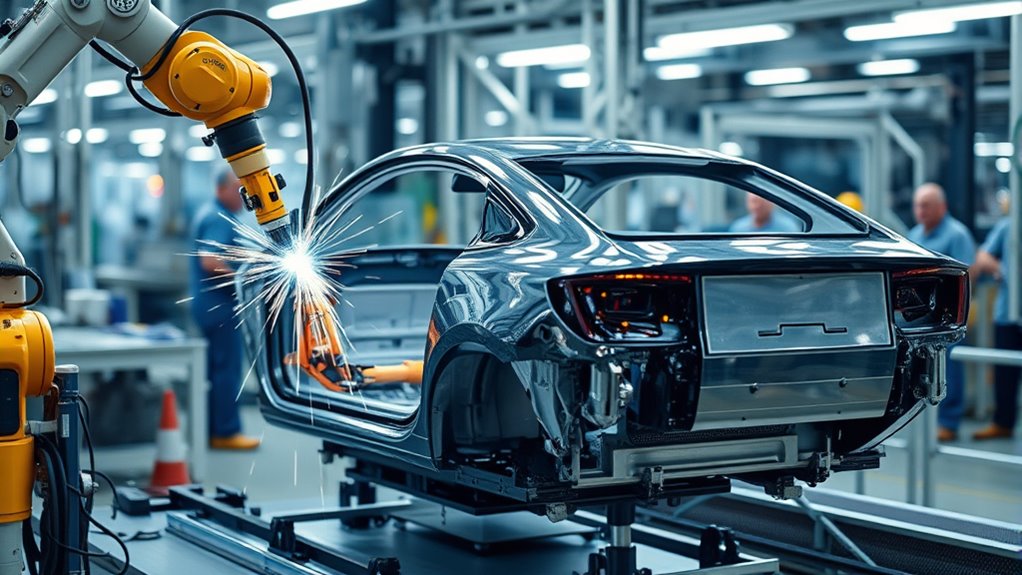
Modern cars are welded in the body shop, before paint, trim, glass, electronics, and final assembly are added. This stage is often called the body-in-white. Stamped panels, rails, pillars, floor sections, roof panels, and reinforcements are clamped in fixtures so robots can join them in the correct shape.
The most common method is resistance spot welding, where copper electrodes squeeze overlapping metal sheets while electric current forms a small fused nugget between them. The process is fast and fits high-volume production because the robot can repeat the same weld schedule again and again.
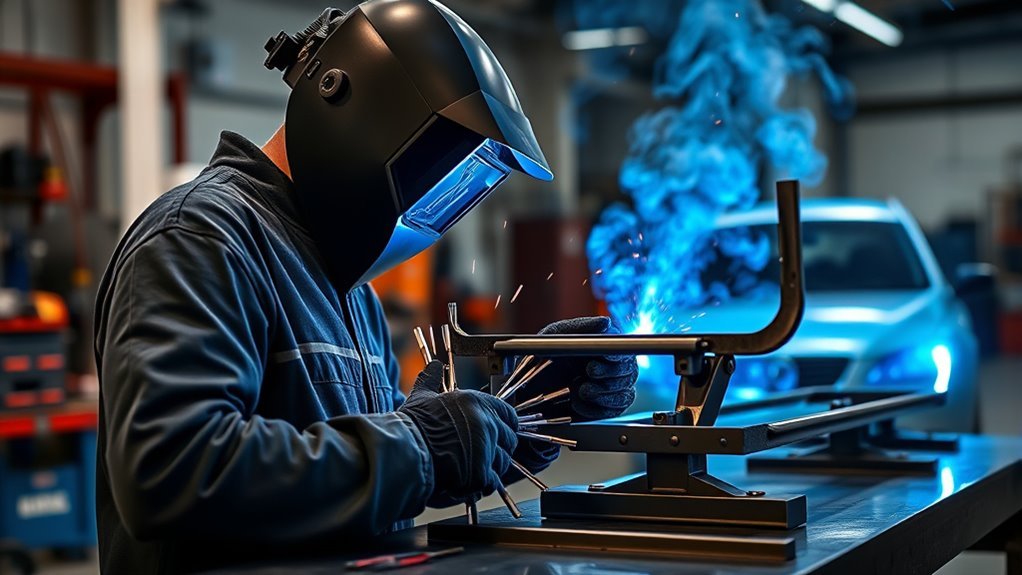
Factories also use laser welding for narrow seams, GMAW/MIG for arc-welded beads, GTAW/TIG for more controlled welds, and adhesive bonding where the joint needs stiffness, sealing, or mixed-material compatibility. No single process builds the whole car. The chosen method depends on the metal, thickness, coating, location, load path, and crash requirement.
Note: Factory welding is not the same as collision repair welding. A repair shop must follow the vehicle maker’s service information because high-strength steel, aluminum, adhesives, and heat-sensitive parts can require special procedures.
Why Spot Welding Dominates Auto Assembly
Spot welding dominates auto assembly because it joins thin sheet metal quickly, uses no filler wire, and keeps heat focused in a small area. That matters when a factory has to build a body shell with tight panel gaps, repeatable strength, and very little distortion.
| Advantage | What It Does for the Car Body |
|---|---|
| Fast cycle time | Keeps high-volume body production moving. |
| Low local heat | Reduces panel warping and fit problems. |
| Robotic control | Places welds with repeatable force, current, and position. |
| Strong lap joints | Supports body stiffness and crash load paths when used in the right pattern. |
Spot welding works especially well on overlapping steel panels. The weld nugget is small, but the body uses many welds in planned locations. Together, those welds help the body shell resist twisting, vibration, and crash forces.
Which Welding Methods Build Car Bodies?
Car bodies are not built with one welding process. Factories use a joining plan that matches the material, location, and strength requirement of each joint.
| Method | Common Factory Use | Main Benefit |
|---|---|---|
| Resistance spot welding | Steel body panels, rails, floors, pillars, and brackets | Speed and repeatability |
| Laser welding | Roof seams, tailored blanks, reinforcements, and high-precision seams | Narrow welds with controlled heat |
| GMAW/MIG | Aluminum parts, brackets, subframes, and areas needing filler metal | Good productivity on arc-welded joints |
| GTAW/TIG | Lower-volume, precision, or repair-sensitive welds | High control of heat and weld puddle |
| Adhesive bonding and weld-bonding | Flanges, mixed materials, sealing zones, and stiffness-critical joints | Spreads load and helps seal joints |
| Rivets and self-piercing rivets | Aluminum and steel-aluminum mixed joints | Joins materials that are hard to fusion weld together |
This mix lets engineers build a lighter body without losing strength. It also lets them avoid overheating metals that can lose strength when welded with the wrong method.
Products Worth Considering

Highly Durable Design: The shell of stud welder kit is made of high-quality ABS body, has good stability under high temperature conditions, withstand temperature of 93-118℃, and the movement is pure copper electrode. This welder stud kit is wear-resistant, strong and sturdy.

Rugged and Reliable: The dent puller rings are made of copper material, sturdy construction, high strength, not easy to damage, and can be used for a long time.

Versatile Tool Application: Expertly designed for automobile dent repair, wheel arch adjustments, and precise car body line marking.
Where Robots Weld Car Bodies?
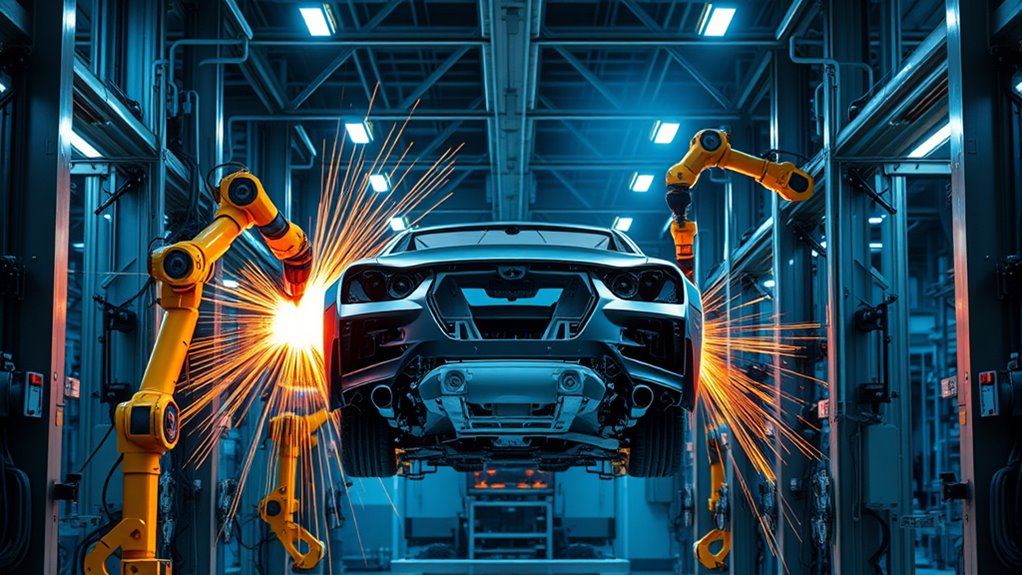
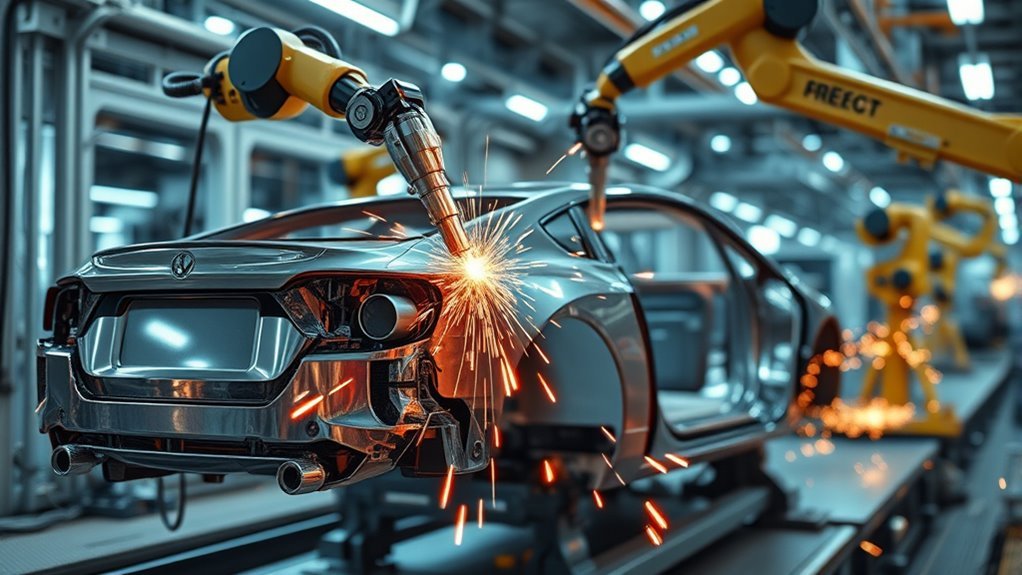
You’ll find robots welding car bodies in automated weld cells inside the body shop. These cells hold stamped panels in fixtures, clamp them into position, and let robots place welds with controlled movement.
Robots are used because body structures need repeatability. A small change in weld position, panel location, or heat input can affect door gaps, roof fit, seal quality, and crash performance. Automation reduces that variation.
Robot Weld Cells
A robot weld cell usually includes a fixture, clamps, one or more robots, weld guns or torches, sensors, safety guarding, and a control system. In resistance spot welding, the robot moves the weld gun to each programmed location and applies the correct force, current, and weld time.
- The fixture locates the panels.
- Clamps hold the panels in place.
- The robot places each weld or bead.
- Sensors confirm position, current, force, and timing.
- The cell releases the part for the next station.
This process keeps the body shell moving through production while still giving engineers control over each joint.
Body Shop Automation
Body shop automation does more than weld. It also moves parts, checks panel location, tracks serial data, and flags defects. Some lines can build more than one vehicle model by changing fixtures, programs, and part flow.
For the reader, the key point is simple: the robot does not decide where to weld. Engineers define the weld plan. The robot repeats that plan with the same motion, pressure, and energy so every body shell matches the design.
How Aluminum and Steel Get Joined?
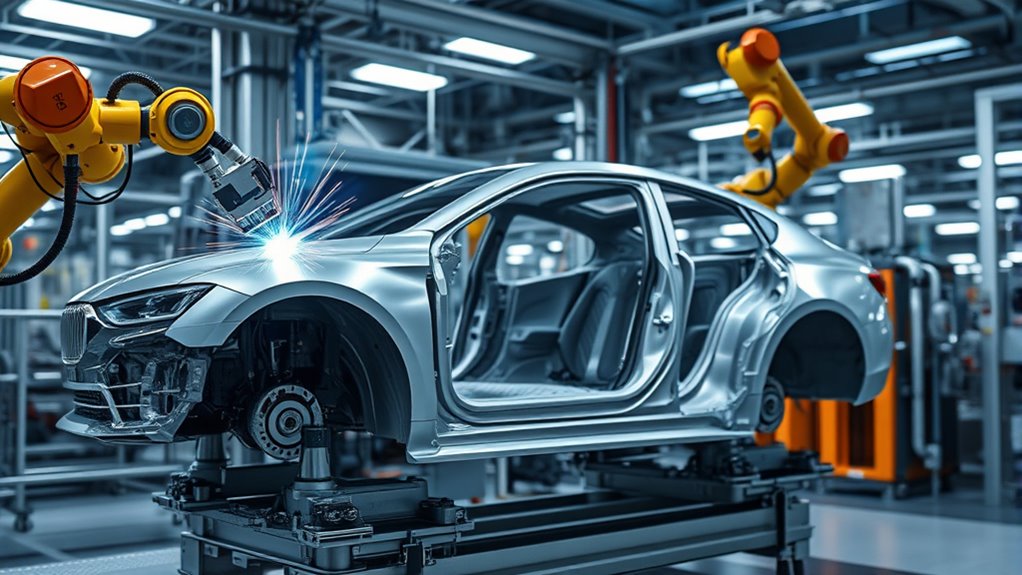
Factories first identify the material in each part. Mild steel, high-strength steel, ultra-high-strength steel, aluminum, magnesium, and composites do not react to heat in the same way. A weld that works well on mild steel can damage advanced high-strength steel or create problems on aluminum.
Material Preparation
Before joining, the factory controls surface condition, coating, fit-up, and part thickness. Steel may have zinc coating or other corrosion protection. Aluminum forms a hard oxide layer that must be managed before welding. Adhesive-bonded joints need clean, prepared surfaces so the adhesive can grip and seal correctly.
- Confirm the material grade and thickness.
- Clean oil, scale, oxide, or loose contamination where required.
- Set the correct weld schedule, adhesive, or fastener.
- Track the part and process data for quality control.
Joining Methods
Steel body panels are commonly joined with resistance spot welding. Aluminum parts may use pulsed GMAW, GTAW, laser welding, resistance spot welding with higher current, adhesives, rivets, or self-piercing rivets, depending on the vehicle design.
Steel-to-aluminum joints are more difficult because the metals have different melting points, heat flow, and expansion rates. Instead of forcing a standard fusion weld, factories often use mechanical fastening, adhesive bonding, or hybrid joining so the joint can hold without creating a weak brittle zone.
Pro Tip: If you are repairing a modern vehicle, do not assume every factory spot weld should be replaced with a plug weld. Check the OEM procedure for the exact location, metal type, sectioning point, adhesive, and corrosion protection steps.
Quality Checks
Quality checks confirm that aluminum and steel joints meet the factory standard before the shell moves forward. On spot welds, the factory may check nugget size, electrode wear, weld current, weld time, force, and part fit. On arc and laser welds, checks may focus on penetration, porosity, undercut, burn-through, seam shape, and distortion.
- Measure weld nugget size and position on resistance spot welds.
- Check aluminum seams for porosity, cracks, distortion, and burn-through.
- Confirm mixed-material joints match the design specification.
- Record process data so defects can be traced to a station, part, tool, or weld schedule.
Modern production lines can use online process data, such as dynamic resistance curves in resistance spot welding, to help identify weld behavior and reduce unnecessary destructive testing. Research on RSW process data shows how digital production data can support weld quality decisions.
How Factories Protect Electronics During Welding?
During factory body welding, most sensitive electronics are not installed yet. That is one reason the body shop comes before final assembly. The bare body shell can be welded, cleaned, sealed, painted, and then fitted with wiring, modules, sensors, screens, seats, and trim later.
Repair welding is different. A finished vehicle already has control modules, harnesses, batteries, sensors, airbags, and driver-assistance parts installed. That is why repair procedures may require disconnecting power, removing nearby components, protecting wiring, controlling heat, and placing grounds correctly.
Factories and repairers also control fumes, sparks, and energized equipment. OSHA’s welding rules cover fire prevention, eye protection, ventilation, and resistance-welding equipment safeguards.
Warning: Welding can create fire, fume, eye, burn, crush, and electrical hazards. Use trained personnel, approved PPE, proper ventilation, fire protection, equipment guarding, and the correct OEM repair procedure before welding on any vehicle.
Why Precision Matters in Body Assembly?
Precision matters because the welded body shell controls how the rest of the vehicle fits. If the body is off by a few millimeters, doors may not close correctly, glass may not seal, panels may look uneven, and crash load paths may not perform as designed.
- Accurate fixtures keep panels in the right location.
- Repeatable weld schedules help joints meet strength targets.
- Inspection stations catch variation before it moves downstream.
- Traceability helps the factory find the source of a defect quickly.
Precision also affects comfort. A body shell with good geometry helps reduce wind noise, leaks, rattles, and uneven panel gaps. The goal is not just a strong structure. It is a structure that lets every later part fit correctly.
How Laser Welding Strengthens Key Joints?
Laser welding uses a concentrated beam of energy to melt and fuse metal along a narrow path. Because the heat is focused, laser welding can create a slim weld with less surrounding heat than many wider arc-welding processes.
Laser welding is valuable in car body production because it can create narrow, precise seams while helping control heat input and distortion.
Factories may use laser welding on roof seams, tailored blanks, reinforcements, and joints where appearance or precision matters. Current research also focuses on laser-welding penetration prediction, which shows how monitoring can support more reliable automated welding.
Laser welding still needs tight process control. Poor fit-up, contamination, wrong power, wrong travel speed, or poor focus can cause defects. That is why fixtures, sensors, and inspection systems matter as much as the laser itself.
How Weld Defects Get Caught?
Factories catch weld defects with layered checks. The goal is to find problems at the station where they happen instead of letting a weak joint move into paint or final assembly.
- Process monitoring: The system tracks settings such as current, voltage, time, force, travel speed, or laser power.
- Visual checks: Operators or cameras check obvious burns, gaps, missing welds, and part misalignment.
- Destructive samples: Selected parts may be peeled, sectioned, or tested to confirm weld nugget size and strength.
- Nondestructive checks: Some factories use imaging, laser scanning, ultrasonic checks, or other tools where appropriate.
- Traceability: Weld data can be tied to a station, robot, part batch, and vehicle body.
Common weld defects include missing welds, undersized nuggets, expulsion, cracks, porosity, lack of fusion, burn-through, and panel misalignment. When a trend appears, the factory can stop the process, adjust the weld schedule, dress or replace electrodes, fix a fixture, or remove defective parts from the flow.
Factory Welding vs. Collision Repair Welding
Factory welding happens on clean new parts in controlled fixtures before the car is fully assembled. Collision repair welding happens after the vehicle has paint, seam sealer, adhesives, corrosion protection, electronics, and trim. That makes repair more complex.
A repair technician may need to duplicate factory spot welds with squeeze-type resistance spot welding, plug welds, MIG brazing, rivets, adhesive, or another OEM-approved method. The correct method depends on the vehicle maker’s instructions, the part location, the metal type, and the allowed heat input.
After repair welding, corrosion protection matters. Bare welded flanges, cut edges, and heat-affected areas need the correct primer, seam sealer, cavity wax, and coating steps so the repair does not rust from the inside.
Frequently Asked Questions
Are cars welded together?
Yes. Most modern car bodies are welded and joined together in the factory body shop. Resistance spot welding is the main method for steel body panels, while laser welding, arc welding, adhesives, and fasteners are used where the design requires them.
Why do car factories use spot welding?
Factories use spot welding because it is fast, repeatable, and well suited to overlapping sheet metal. It also uses no filler wire and keeps heat focused in a small zone, which helps control distortion.
How many welds are in a car body?
The number varies by vehicle, body design, and material mix. A modern body shell can contain thousands of spot welds, plus laser seams, arc welds, adhesive bonds, rivets, and other joining points.
Is aluminum welded or glued in cars?
Aluminum can be welded, bonded, riveted, or joined with self-piercing rivets. Many vehicles use a mix of methods because aluminum behaves differently from steel and needs tighter control of heat, surface preparation, and joint design.
How do factories know a weld is good?
Factories check weld quality through process monitoring, visual checks, destructive samples, nondestructive inspections, and traceable production data. For spot welds, nugget size and weld position are especially important.
Is the 30-60-90 rule a factory welding rule?
No. The 30-60-90 phrase is more commonly used for vehicle maintenance intervals or general planning. It is not a standard rule for welding car body structures in factories.
Conclusion
Modern car factories weld and join body shells with a planned mix of spot welding, robotic arc welding, laser welding, adhesives, and mechanical fasteners. Spot welding does most of the steel body work because it is fast and repeatable, while laser welding, GMAW, GTAW, rivets, and bonding handle areas that need a different approach. The result is a body structure built for fit, stiffness, safety, and repeatable production quality.
Sources
- OSHA 1910.252, General welding, cutting, and brazing requirements — fire prevention, PPE, ventilation, and welding safety requirements.
- OSHA 1910.255, Resistance welding — resistance-welding equipment safety, operator competence, guarding, and interlocks.
- Improved Training Strategies for Physics-Informed Neural Networks using Real Experimental Data in Aluminum Spot Welding — resistance spot welding dominance in automotive body-in-white and nugget diameter as a quality metric.
- Functional clustering methods for resistance spot welding process data in the automotive industry — online RSW process data and quality monitoring.
- A welding penetration prediction model for laser welding process based on self-supervised learning using physics-informed neural networks — current research on laser-welding penetration monitoring.