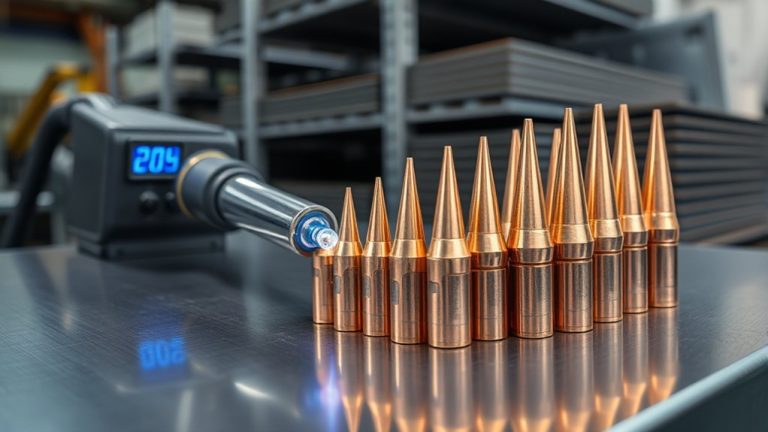
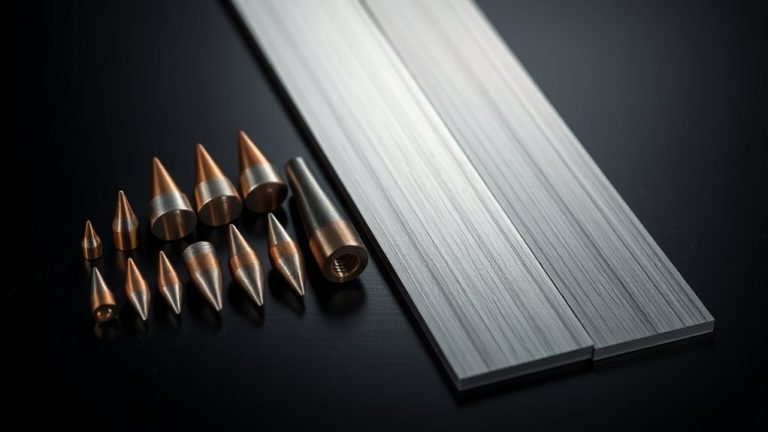
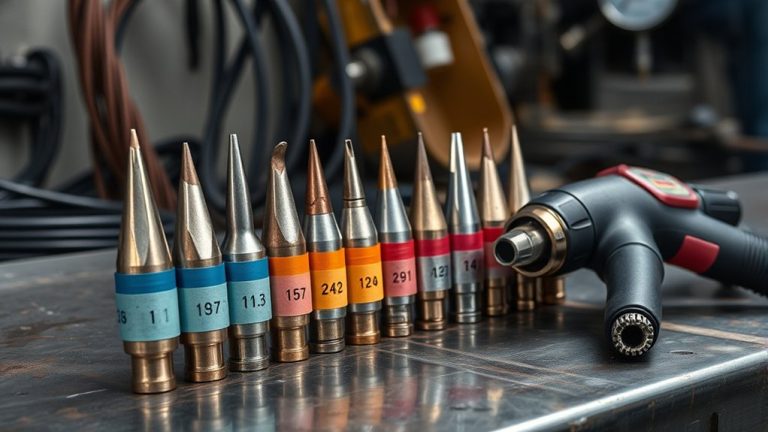
Up to 70% of cut-quality issues trace back to mismatched consumables. You’ll get consistent results only when nozzle size, amperage, and electrode material align with your machine’s cut charts and the metal’s thickness. Pick a nozzle rated for the exact current, set pierce and cut heights to spec, and match copper or silver/hafnium electrodes to the amp load. Then confirm air quality, pressure, and flow against standards—because the next variable often overlooked is…
Match Consumables to Your Owner’s Manual and Cut Charts
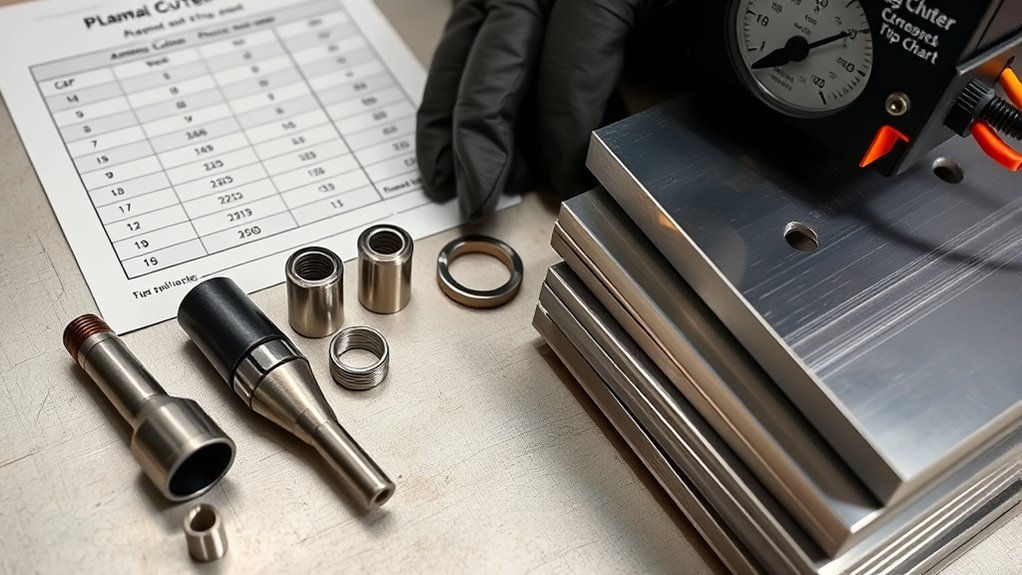
Before you load a torch, verify your consumables against the owner’s manual and its cut charts. Confirm part numbers for electrodes, nozzles, and shields to guarantee consumable compatibility with your plasma cutter’s torch model and power supply. Cross-check each item against the manual’s bill of materials before installation.
Use the cut charts to select the prescribed consumable set for the material type—mild steel, stainless, or aluminum—and the specified process (air plasma, shielded, gouge). Start with the charted parameters and consumable types; they’re validated for arc stability, kerf geometry, and cut quality. Record the recommended gas, standoff, and travel speed, then fine-tune only within the manual’s tolerances to address alloy variations or surface conditions.
Audit consumables routinely. Mismatched electrodes or nozzles degrade cut quality, increase dross, and can damage the torch. Familiarize yourself with electrode insert composition and nozzle orifice specifications to maintain performance consistency, extend consumable life, and protect equipment.
Choose Nozzle Size by Amperage Rating and Material Thickness
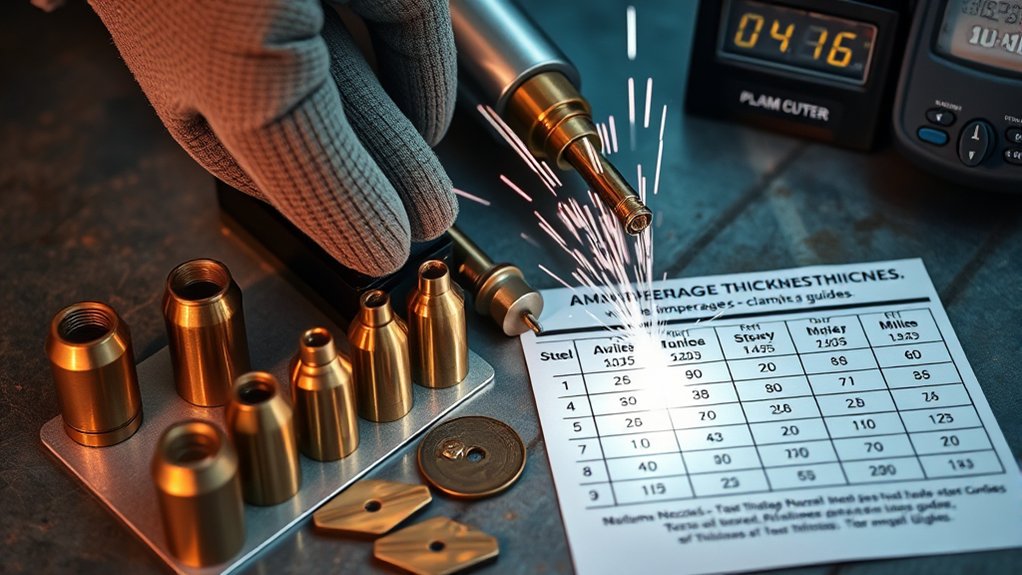
Nozzle selection starts with amperage and thickness alignment: match the nozzle’s amp rating to the machine output and the workpiece. For data-driven nozzle selection, treat the nozzle’s rated current as a hard limit. A 45‑amp nozzle is engineered for 45 A; under‑ or overdriving it degrades jet stability, increases dross, and shortens life.
Validate material compatibility by correlating thickness to amperage: for 14‑gauge steel, a 40‑amp nozzle (0.9 mm / .035) performs best at 31–40 A. For very thin stock, step down to a 20‑amp tip (0.6 mm / .025) and lower gas pressure to 50–55 psi to maintain a constricted arc and prevent warping.
As thickness increases, scale to larger nozzles and higher current to maintain penetration without lag lines. Use manufacturer cut charts to confirm nozzle orifice size, current window, gas pressure, and speed for each material.
Aligning amperage, nozzle size, and thickness delivers repeatable cut quality and consumable longevity.
Select Electrodes: Copper vs. Silver/Hafnium Interfaces
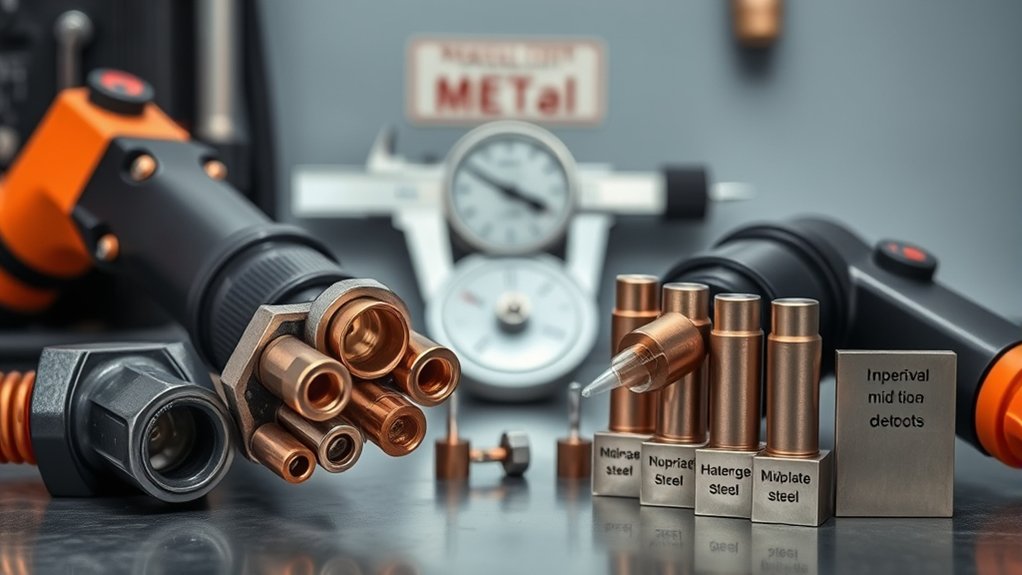
Although both electrode types conduct the arc, you should select copper for low-to-moderate amperage work and silver/hafnium interfaces for high-amperage, high-speed cutting where wear and precision are critical.
Match electrode type to your amperage setting to maximize cut quality and cutting efficiency. Copper electrodes perform reliably at lower currents and are the baseline for standard applications. For sustained high current, choose silver/hafnium interfaces to improve electrode longevity, stabilize the arc, and hold tighter kerf geometry during fast feeds.
Apply objective wear limits. Replace standard all-copper electrodes at 0.040 in pit depth; replace silver/hafnium electrodes at 0.080 in. Exceeding these thresholds increases misfire risk, dross, and taper.
Verify pit depth with a pin gauge or optical comparator, and log hours, starts, and amperage to correlate wear with duty cycle.
Inspect electrodes routinely. Look for centered pits, smooth edges, and consistent hafnium button integrity.
Replace at spec to maintain consistent pierce reliability, energy transfer, and repeatable dimensional accuracy across materials.
Shielded vs. Unshielded Consumables
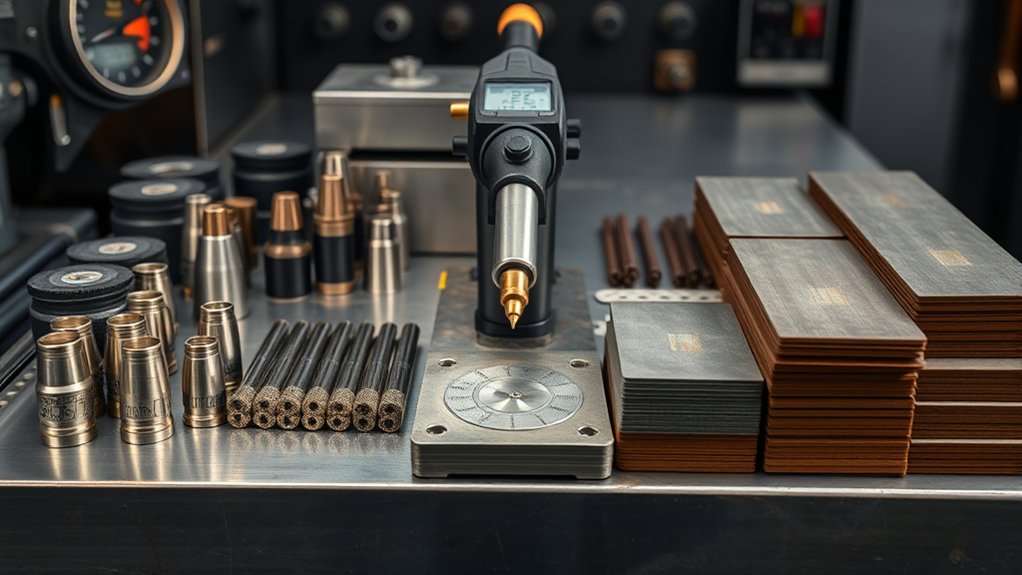
When you need reliable ohmic sensing, choose shielded consumables; their protective cap isolates the electrical path, stabilizes the arc, and meets OEM specs for automated height control.
For manual cutting where cost per cut matters, unshielded parts can work if you accept tighter standoff tolerances and potentially higher dross.
Always verify consumable type against the operator’s manual and material/amp settings to maintain correct standoff and minimize rework.
Ohmic Sensing Compatibility
For ohmic sensing systems, choose shielded consumables; for non-ohmic setups, use unshielded. You’ll match ohmic sensing and consumable compatibility by following your cutter’s operator manual.
Shielded parts interface cleanly with sensing circuits, stabilize arc transfer, and protect the torch during long duty cycles. Unshielded parts suit controllers that don’t probe electrically, tolerating modest surface variation without false triggers.
- Verify controller type: ohmic-enabled CNC requires shielded; manual or basic CNC often uses unshielded.
- Check OEM part numbers; consumable families aren’t interchangeable across torches.
- Confirm electrical path isolation on shielded caps to prevent sensing faults and arc instability.
- Select shielded sets for better thermal shielding and reduced molten splash ingress.
- Monitor wear patterns; mismatched types accelerate nozzle erosion and shorten component life.
Standoff and Dross Control
With sensing compatibility established, focus on standoff and dross control because consumable shielding changes how the arc behaves at distance.
Use shielded consumables when you need maximum arc stability and robust dross management, especially on thick plate or heat‑prone material. The shield protects the plasma column from airflow and spatter, maintaining energy density and reducing re‑solidified slag. Target the manufacturer’s standoff range; shielded tips tolerate slight variation without destabilizing the arc.
Use unshielded consumables for simple cuts where tight tolerance isn’t critical. Expect higher dross due to exposed arc edges and stricter standoff sensitivity.
Calibrate torch height control to hold standoff within spec, verify cut current versus nozzle rating, and monitor kerf angularity. Correct standoff typically reduces secondary grinding and increases throughput.
Set Amperage to the Nozzle Rating
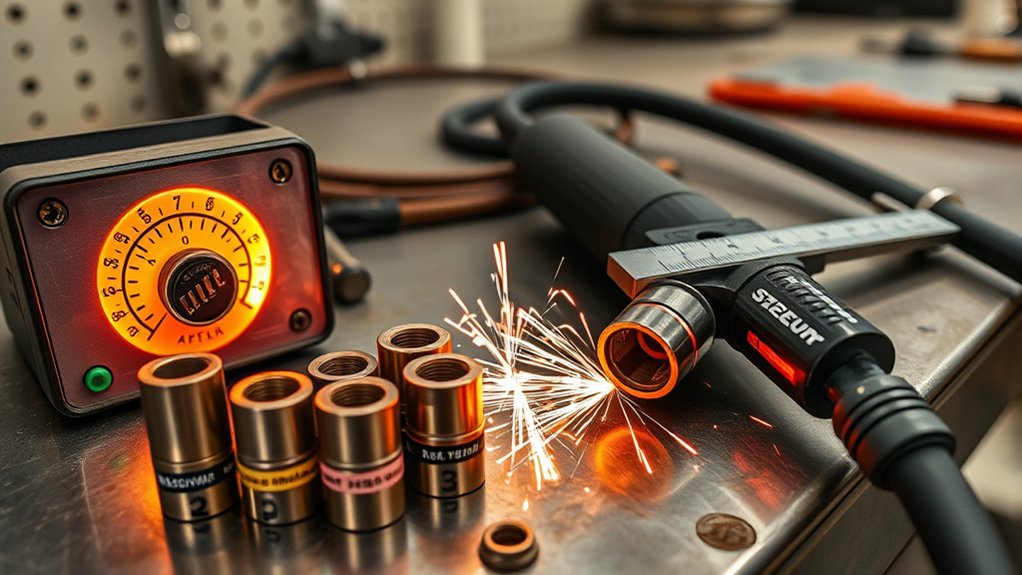
Set your amperage to the nozzle’s rating—e.g., pair a 45‑amp nozzle with 45 A or a 50‑amp tip with 41–50 A per the cut chart.
If you exceed the rating, expect accelerated nozzle erosion and premature failure; if you run too low, you’ll see dross and poor penetration.
Matching amps to the nozzle improves cut quality and extends consumable life, validated by manufacturer specifications and process data.
Match Amps to Nozzle
A core rule in plasma cutting is to match the amperage to the nozzle’s rated current—e.g., run a 45‑amp nozzle at 45 A. This standards-based approach stabilizes arc density, preserves nozzle lifespan, and delivers predictable kerf geometry.
Use precise amperage adjustment rather than “close enough” settings.
- Set current to the nozzle rating; reference the operator manual and cut charts for each thickness.
- Underamping increases dross and causes shallow penetration; correct by aligning amps with the rated nozzle.
- Correct amperage improves cut speed and quality, lowering consumable cost per foot.
- Verify nozzle condition regularly; replace worn nozzles and re-confirm amperage to maintain process capability.
- Log settings, material, and results to build reliable, data-driven parameters across jobs and alloys.
Risks of Overamping
Though it can seem harmless to “bump the amps,” overamping a nozzle drives thermal and mechanical overload that rapidly destroys consumables and degrades cut quality. When you exceed the nozzle’s maximum rating, arc energy density and gas temperature spike, elevating overheating risks.
Expect accelerated nozzle degradation: orifice growth, edge rounding, microcracks, and warpage. A 45‑amp nozzle run at 60 amps typically deforms or cracks quickly, slashing consumable life and destabilizing the arc column.
Set amperage to the nozzle rating to maintain proper energy balance, stable plume geometry, and consistent penetration. You’ll reduce dross formation, avoid double-arcing, and protect the shield and electrode from collateral damage.
Verify settings against the manufacturer’s cut charts, then monitor kerf appearance, noise, and heat tint. Adjust immediately if you see excessive spatter or widening kerf.
Benefits of Underamping
When you match or slightly underamp relative to the nozzle rating, you stabilize arc energy density and gas temperature, which tightens kerf geometry and reduces dross.
You’ll align output with the nozzle’s flow design, delivering precision cutting without overdriving the orifice. Running a 45‑amp nozzle at 45 amps maintains penetration for the intended thickness while minimizing rapid wear.
Dropping a few amps on thin stock lowers thermal stress, curbs excessive melting, and extends consumable life.
- Match nozzle rating to achieve stable arc, consistent kerf, and minimal dross
- Slight underamping improves edge smoothness and detail fidelity on thin materials
- Reduced amperage decreases thermal stress on nozzle and electrode, extending service intervals
- Rated settings guarantee penetration without accelerated nozzle erosion
- Fine-tune down for smoother edges, tighter tolerances, and repeatable precision cutting
Dial In Cut Height, Pierce Height, and Arc Voltage
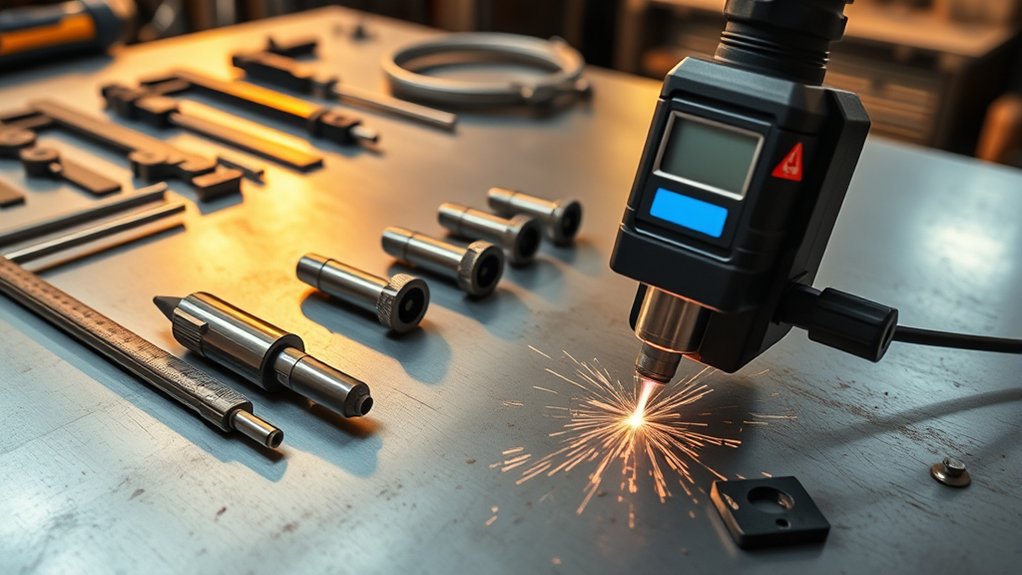
Because torch-to-work distance drives cut geometry and consumable life, you need to lock in three parameters: cut height, pierce height, and arc voltage. Set cut height per the operator’s manual and hold it within ±0.005 in. Deviations increase angularity, dross, and warpage.
Establish pierce height at 1.5–2.0× the cutting height for nozzle protection and reliable starts. After pierce, shift to the programmed cut height before motion stabilizes.
Use arc voltage adjustments to maintain standoff automatically. Reference the manual’s voltage for each material and thickness, then trim as needed: lower voltage slightly to tighten kerf and improve edge quality; raise cautiously if the torch rides low.
Monitor cut face: excessive bevel indicates too high voltage; top spatter can indicate too low.
Continuously verify torch-to-work distance with your height control. Audit actual standoff during test cuts and correct offsets. Document material-specific settings so you can reproduce uniform cut quality across jobs.
Air and Coolant Quality: Pressure, Flow, and Cooling
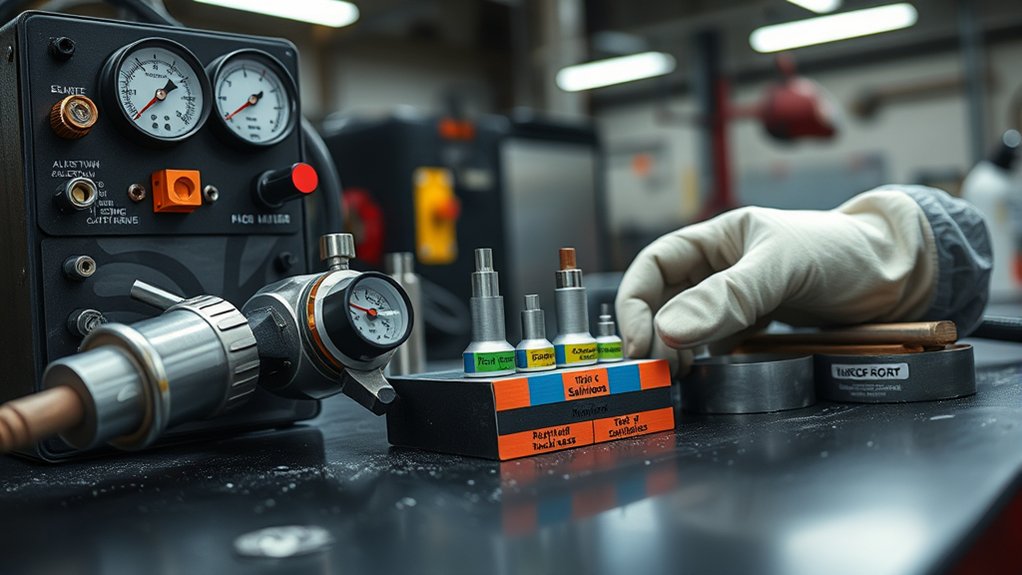
Even with perfect height control, poor air and coolant management will shorten consumable life and distort cut quality. You need stable air pressure, specified gas flow, and verified coolant flow to keep the arc constricted and the torch thermally balanced.
Stable air, correct gas flow, and verified coolant keep arcs tight and torches balanced.
Target 50–75 psi at the torch inlet, adjusted to consumable size and duty cycle. Validate with a calibrated gauge at operating flow, not static.
- Verify air pressure and gas flow match the operator’s manual; low supply accelerates nozzle and electrode wear.
- Measure pressure under load; aim for 50–75 psi with adequate SCFM to prevent arc blowout or excessive dross.
- Dry, oil-free air protects swirl rings and orifices; use filtration and dryers to ISO 8573-1 appropriate classes.
- Confirm coolant flow meets OEM GPM/LPM; low flow spikes heat, reducing cut speed and part accuracy.
- Maintain coolant level and clear restrictions; inspect pumps, hoses, and strainers to sustain design heat removal.
Inspect, Measure, and Replace Worn Consumables
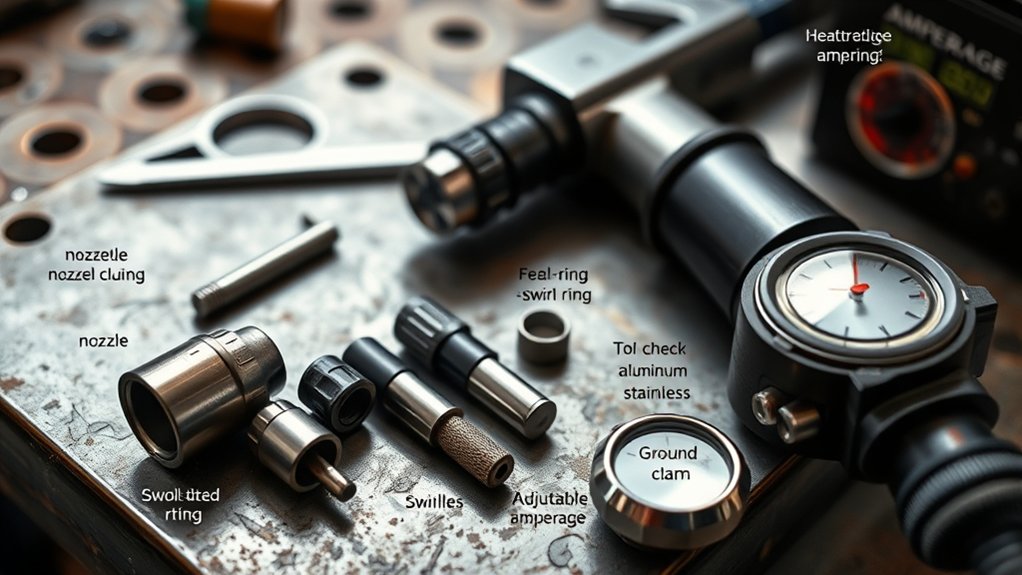
Start with objective inspection and quantified limits to decide if a part stays in the torch or goes in the bin. Use measurable wear indicators to protect consumable longevity and cut consistency.
Verify electrode pit depth with a depth gauge: replace standard all‑copper electrodes at 0.040 in; replace silver/hafnium interface electrodes at 0.080 in. Record values per shift or per defined arc‑on hours per the operator’s manual.
Measure nozzle orifice roundness and diameter growth with pin gauges; retire nozzles that exceed the manufacturer’s tolerance. Inspect swirl rings for cracks, erosion, or out‑of‑round locating features; replace on any deviation from spec.
Correlate inspection data with process signals: increased dross, erratic arc starts, or unstable arc voltage indicate excessive wear and imminent failure.
Follow manual-defined intervals and replacement thresholds to prevent collateral torch damage and avoid scrap. Keep a labeled stock of electrodes, nozzles, and swirl rings to enable immediate changeout, minimizing downtime and preserving productivity.
Kerf Width and Speed: Optimize for Quality and Cost
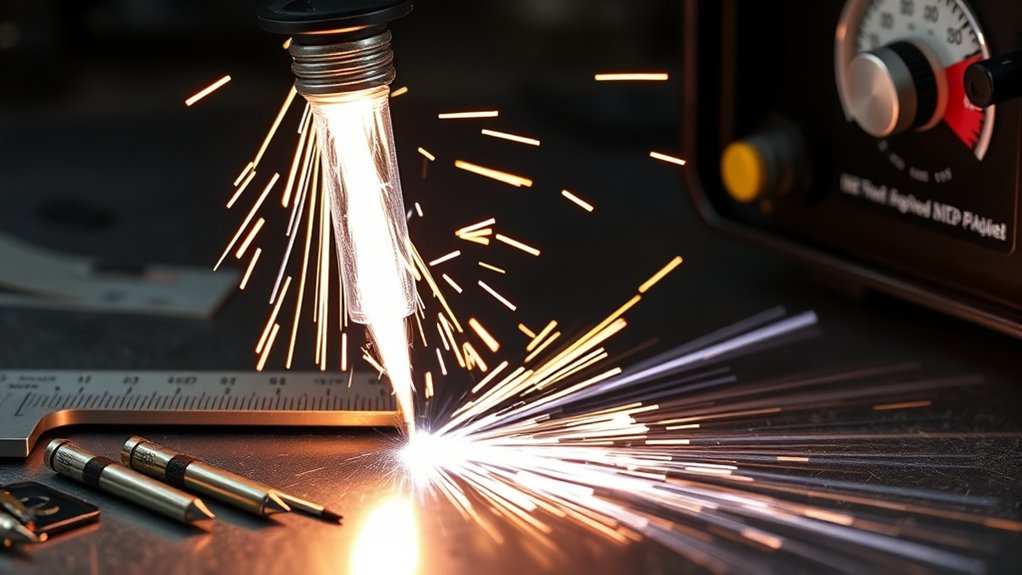
While kerf is just the plasma arc’s gap, treating it as a controlled variable drives both part accuracy and cost. You’ll improve kerf optimization and cutting efficiency by pairing the right consumables with verified speed, voltage, and standoff. Compensate kerf in your CAD/CAM offsets so nested parts remain intact, and validate with test coupons before production.
Treat kerf as controllable: match consumables, calibrate speed, voltage, standoff, and validate with test coupons.
- Target speed: 10–15 IPM for manual cuts; automated tables can exceed 100 IPM to shrink HAZ and distortion.
- Hold arc voltage per the kerf chart to stabilize arc length; deviations widen kerf and increase angularity.
- Maintain torch-to-work distance with height control; ±0.005 in stability preserves consistent kerf.
- Reference the material-specific plasma kerf chart to set nozzle size, amperage, and speed for minimal waste.
- Inspect edge quality: low speed shows dross/lag lines; high speed shows bevel/undercut—adjust in 5–10% increments.
Document your validated parameters by material and thickness. This disciplined approach aligns consumable choice with predictable, low-cost, high-quality results.
Frequently Asked Questions
How Do Ambient Temperature and Humidity Affect Consumable Life?
Ambient temperature and humidity directly affect consumable longevity: you’ll see faster wear in hot, humid ambient conditions due to increased oxidation, condensation, and arc instability. Maintain 20–25°C, <50% RH, desiccant-dried air, ISO 8573-1 Class 2, to stabilize performance.
Are There Consumables Optimized for CNC vs. Handheld Cutting?
Yes. You’ll select CNC consumables with long-life electrodes, precision nozzles, and machine torch geometry; they support height control and tight kerf. You’ll choose Handheld consumables with drag tips, wider standoff tolerance, ergonomic shields, prioritizing visibility, durability, and mixed-angle cuts.
What Storage Conditions Prevent Nozzle and Electrode Corrosion?
Keep nozzles and electrodes at 20–25°C, <40% RH, sealed with desiccant. Why risk oxidation? Use airtight containers, VCI papers, and oil-free handling. Guarantee clean, dust-free storage; avoid chlorides. Implement FIFO rotation—corrosion prevention demands proper storage per manufacturer specs.
Can Different Swirl Rings Alter Dross Formation and Edge Angularity?
Yes. You’ll see measurable differences: swirl ring design controls gas vortex stability, affecting dross reduction and edge angularity. Match orifice geometry and port count to amperage, gas, and standoff; validate via cut-voucher inspection, kerf-angle measurements, and slag mass quantification.
How Do Duty Cycle Limits Influence Consumable Selection?
Measure twice, cut once: you align duty cycle with amperage ratings to prevent thermal overload. You choose robust electrodes/nozzles for long-duty-cycle tasks, lighter sets for intermittent work, validating consumable selection against OEM duty-cycle charts, cooling capacity, and arc-on time.
Conclusion
You don’t guess—you spec. Match consumables to the manual and cut charts, size the nozzle to amperage and thickness, and pair electrodes to heat load. Set amperage to the nozzle rating, then dial heights and arc voltage. Keep air/coolant clean and in spec, and replace parts before the kerf tells on you. Think of it like torqueing head bolts: one skipped step warps results. In shop trials, a 45 A nozzle cut 3/16-in steel 18% faster with 22% less dross.