Thin steel can warp before a plasma cut is finished because the sheet has little mass to absorb heat. The solution is not one magic amperage or speed. You need a compatible fine-feature process, manufacturer cut-chart settings, stable torch height, clean air, firm support, and a cut sequence that prevents heat from building in one area.
Last updated: July 20, 2026
Quick Answer
To plasma cut 0.5–1.5 mm steel without excessive warping, start with your plasma manufacturer’s thin-sheet cut chart, use compatible fine-feature consumables, hold the specified cut height, secure the sheet, and distribute heat through the toolpath. On compatible Hypertherm FineCut systems, 22-gauge steel uses a charted 40 A and 350 IPM high-speed process.
Key Takeaways
- Use the exact consumable, current, cut height, pierce height, delay, and speed listed for your machine and material.
- Do not treat 350 IPM as a universal setting. It is a documented FineCut high-speed value for specific Hypertherm processes.
- Keep the sheet flat with clean slats, edge clamps, tabs, and a heat-balanced cutting sequence.
- Use clean, dry, oil-free air at the plasma inlet and verify pressure and flow while gas is moving.
- Use a purpose-built water or downdraft table. Do not pour or spray water beside an energized plasma torch.
- Change one setting at a time and record the result before adjusting anything else.
At a Glance
| Time Required | About 20–45 minutes for setup and test cuts, plus the actual cutting time |
| Difficulty | Intermediate; advanced when tuning CNC motion and automatic torch height control |
| Tools Needed | Compatible plasma cutter and consumables, adequate air supply, clamps, flat cutting support, test coupons, calipers, PPE, and optional CNC THC and water or downdraft table |
| Cost | Low for test material and consumables when equipment is already available; CNC, THC, filtration, and table upgrades vary widely |
Warning: Plasma cutting exposes you to electricity, ultraviolet radiation, sparks, hot metal, sharp edges, noise, and metal or coating fumes. Identify the material and coatings before cutting, remove combustibles, provide suitable ventilation, wear the protection required by your equipment manual, and follow applicable workplace rules.
Why Thin Steel Warps During Plasma Cutting
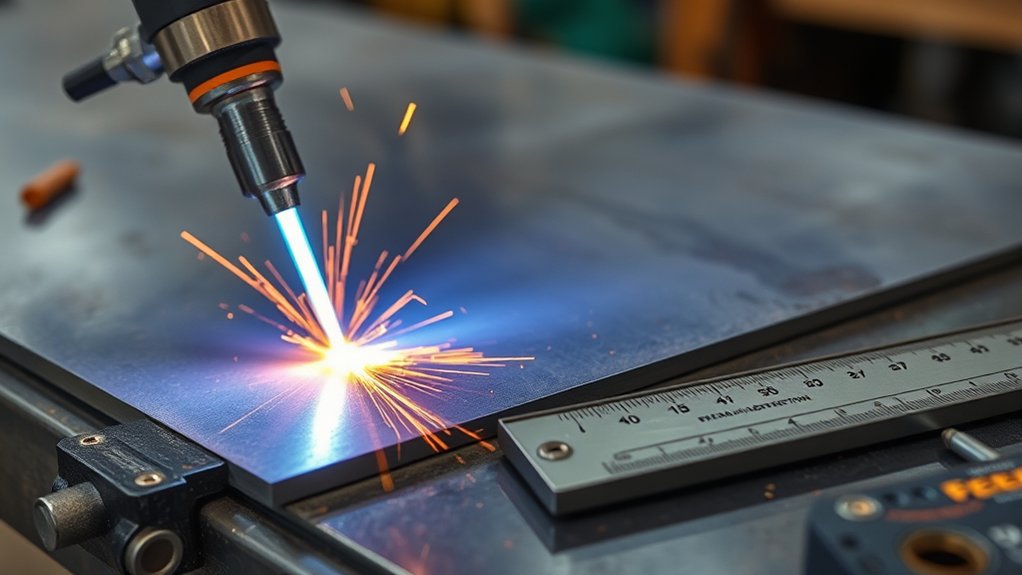
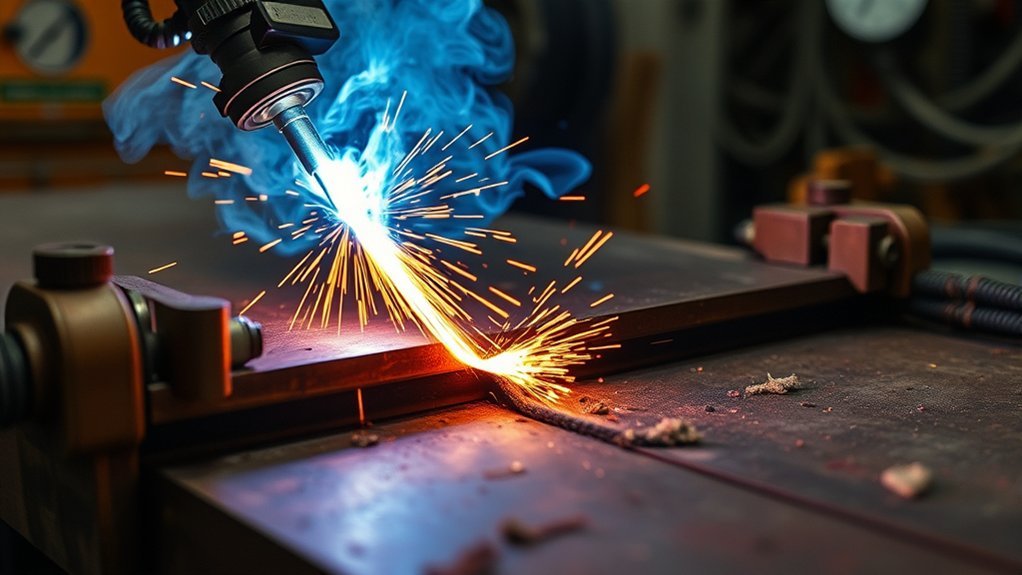
Thin steel has little mass and limited stiffness. A plasma arc heats a narrow line quickly, but the surrounding sheet stays cooler. The hot area expands, the cooler area restrains it, and the sheet moves as the cut cools and contracts.
The result may appear as bowing, oil-canning, edge curl, or a full panel that twists after the final perimeter cut. The risk increases when you:
- Travel too slowly for the selected current and consumable.
- Pause at corners or pierce in the finished edge.
- Cut several nearby features without allowing heat to spread.
- Use an incorrect torch height that stretches the arc.
- Leave the sheet unsupported or allow small parts to tip upward.
- Use worn consumables that widen or destabilize the arc.
Thin sheet stays flatter when each cut uses the least practical dwell time and the toolpath avoids concentrating heat in one area.
Your main controls are the selected cutting process, travel speed, torch height, pierce timing, sheet support, and path order. A water table can also reduce warpage and camber on thin plate, but it does not correct an incorrect cut process or poor motion control.
Choosing a Plasma Cutter for 0.5–1.5 mm Steel
Do not choose a plasma cutter by maximum severance thickness alone. Thin-sheet work depends more on stable low-current output, compatible fine-feature consumables, repeatable starts, suitable mechanized connections, and reliable torch-height control.
Products Worth Considering

20Pcs 220930 Fine Cut Nozzle Tip 45A Fit for Hypertherm PMX 45 Plasma Cutting Torch Consumables

PT31 Plasma Torch: standard length: 16ft; air pressure: 4.5-5.5bar; duty cycle for 60% with 30A
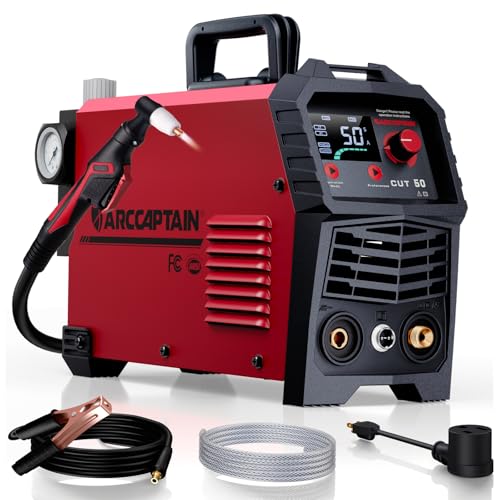
【Powerful Cutting Ability】Switch effortlessly between 110V and 220V for home or workshop use. Achieve professional 1/2" clean cuts on steel, aluminum, and copper with advanced LGBT technology. Perfect for DIY projects and heavy-duty tasks. Recommended maximum cutting thickness: 12mm @ 35A / 110V / 55 PSl; 18mm @ 50A / 220V / 75 PSI. Note: Requires compressed air (compressor sold separately).
Handheld Versus Mechanized Cutting
A handheld cutter can make clean straight cuts in thin sheet when you use the correct guide, travel steadily, and keep the torch at its specified relationship to the work. However, handheld motion cannot reproduce CNC speeds, cut heights, and corner behavior with the same consistency.
A CNC system provides controlled feed rate and path order. A suitable automatic torch height control system can find the sheet surface, move to pierce height, descend to cut height, and adjust height from arc voltage during suitable portions of the cut.
Note: The Powermax30 XP supports FineCut hand consumables and is useful for portable handheld work. The Powermax45 SYNC supports documented mechanized FineCut cartridges and THC integration, making it a more direct example for CNC thin-sheet cutting.
Duty Cycle Needs
Duty cycle describes how long a machine can operate at a stated output, ambient temperature, input voltage, and phase configuration before it requires cooling. Always read the complete rating rather than quoting the percentage alone.
| Example system | Output range | Published duty-cycle example | Thin-sheet use |
|---|---|---|---|
| Powermax30 XP | 15–30 A | 35% at 30 A on 240 V; 20% on 120 V | Portable hand cutting with FineCut hand consumables |
| Powermax45 SYNC | 9–45 A | 50% at 45 A and 100% at 32 A under listed configurations | Handheld or mechanized FineCut work |
| Powermax65 SYNC | 20–65 A | 50% at 65 A and 100% at 46 A under listed configurations | Higher-throughput table work; more capacity than thin sheet alone requires |
| Powermax85 SYNC | 25–85 A | Up to 60% at 85 A and 100% at 66 A under listed configurations | Production platform when the shop also cuts thicker plate |
Thin sheet cuts quickly, so a small shop may not need a high-output machine solely for duty cycle. Production nests, repeated starts, shared air demand, shop temperature, and other material thicknesses still affect the correct choice.
Precision, Kerf, and Consumable Compatibility
For intricate profiles, choose a torch and consumable system designed for fine-feature cutting. FineCut consumables are intended to produce a narrow kerf and better detail on thin mild and stainless steel.
Do not assume every nozzle marked for a low amperage fits every torch. Match the cartridge, nozzle, electrode, retaining cap, shield, swirl ring, and torch exactly as the manufacturer specifies.
Kerf width changes with material, thickness, process, consumable condition, height, speed, gas flow, and table motion. Measure a test coupon instead of copying a kerf value from another machine.
Verified FineCut Starting Settings for 0.5–1.5 mm Steel
The following values come from the Hypertherm Powermax45/65/85/105 SYNC Cut Charts Guide, Revision 4. They are shown as a verified example of complete process data.
Warning: These values apply to the Powermax45 SYNC FineCut high-speed mechanized process with the specified cartridge and compliant air, power, and table conditions. Do not copy them to a different plasma cutter. Use the chart supplied for your exact system.
Mild Steel FineCut High-Speed Starting Values
| Thickness | Current | Cut height | Pierce height | Pierce delay | Cut speed | Reference kerf |
|---|---|---|---|---|---|---|
| 0.5 mm | 40 A | 3.5 mm | 3.5 mm | 0.0 s | 8,900 mm/min | 0.9 mm |
| 0.6 mm | 40 A | 3.5 mm | 3.5 mm | 0.0 s | 8,900 mm/min | 0.8 mm |
| 0.8 mm | 40 A | 3.5 mm | 3.5 mm | 0.0 s | 8,900 mm/min | 0.7 mm |
| 1.0 mm | 40 A | 3.5 mm | 3.5 mm | 0.0 s | 8,900 mm/min | 0.6 mm |
| 1.5 mm | 45 A | 3.5 mm | 3.5 mm | 0.2 s | 6,500 mm/min | 0.7 mm |
Stainless Steel FineCut High-Speed Starting Values
| Thickness | Current | Cut height | Pierce height | Pierce delay | Cut speed | Reference kerf |
|---|---|---|---|---|---|---|
| 0.5 mm | 40 A | 0.5 mm | 3.5 mm | 0.0 s | 8,900 mm/min | 0.6 mm |
| 0.6 mm | 40 A | 0.5 mm | 3.5 mm | 0.0 s | 8,900 mm/min | 0.6 mm |
| 0.8 mm | 40 A | 0.5 mm | 3.5 mm | 0.0 s | 8,900 mm/min | 0.5 mm |
| 1.0 mm | 40 A | 0.5 mm | 3.5 mm | 0.1 s | 8,900 mm/min | 0.3 mm |
| 1.5 mm | 45 A | 0.5 mm | 3.5 mm | 0.3 s | 6,300 mm/min | 0.4 mm |
These charts also show why a single universal cut height is inaccurate. The example mild-steel and stainless-steel processes use very different cut heights, even though they use the same nominal FineCut cartridge family.
Essential Setup: Air, Power, Work Lead, and Torch Height
Thin steel gives you little room for setup errors. Check the complete system before changing amperage or blaming the consumables.
Air Quality and Flow
Your plasma inlet needs clean, dry, oil-free air or the gas specified by the manufacturer. Moisture, oil mist, and particles can reduce cut quality and consumable life.
An oil-free compressor is not mandatory when an oil-lubricated compressor is followed by effective separation, drying, and filtration. What matters is the air that reaches the plasma cutter.
- Confirm the required inlet pressure and flow in the operator manual.
- Check pressure while gas is flowing, not only while the machine is idle.
- Drain the receiver and moisture separators.
- Replace filter elements at their specified interval.
- Use a refrigerated or desiccant dryer when humidity overwhelms the existing system.
- Keep hoses large enough and short enough to avoid excessive pressure loss.
Electrical Supply and Work-Lead Contact
Use the circuit, conductor size, disconnect, and overcurrent protection required by the equipment manual and local electrical rules. A long undersized extension lead can cause voltage drop and poor operation.
Attach the work lead to clean bare metal on the sheet or cutting table as directed by the system manufacturer. Paint, rust, mill scale, loose slats, or a distant current path can interfere with arc transfer and create unpredictable starting problems.
Torch Height Control
Cut height and pierce height serve different purposes:
- Pierce height protects the consumable from molten material during arc start.
- Cut height positions the torch for the specified kerf, bevel, and arc voltage after motion begins.
A mechanized THC may use ohmic sensing, a floating head, arc voltage, or a combination of methods. Configure the surface-sensing method, pierce height, pierce delay, transition, cut height, voltage, and anti-dive behavior according to the plasma and table manuals.
Do not allow THC to chase voltage while the machine slows sharply for corners or small features. Many controllers provide corner lockout or anti-dive logic for this reason.
Pre-Cut Checklist
- Confirm the material type, thickness, and any coating.
- Install the exact consumable or cartridge listed for that process.
- Check that the torch is square to the sheet.
- Inspect the nozzle or cartridge opening for damage or loss of roundness.
- Verify clean-air pressure and flow while gas is moving.
- Clean and secure the work-lead connection.
- Check slats, rails, bearings, belts, gears, and gantry motion.
- Secure the sheet and confirm that clamps are outside the torch path.
- Load the manufacturer’s current, speed, height, delay, and kerf values.
- Run a straight test cut before loading a full nest.
Pro Tip: Save a separate process record for every material, thickness, consumable, and table. Record actual kerf, dross type, bevel, arc voltage, flatness, and consumable condition. This is more reliable than trying to remember which unrecorded adjustment worked.
FineCut Consumables for Narrow Kerfs and Detailed Edges
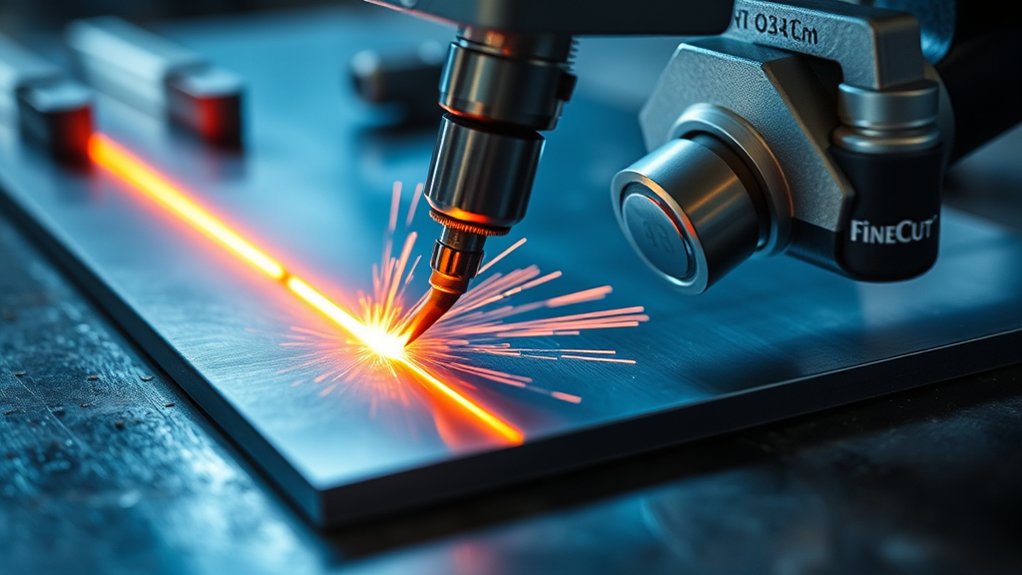
FineCut consumables are designed for intricate shapes and thin mild or stainless steel. Their documented process window can provide a narrower kerf than a general-purpose higher-current process.
Use the complete consumable set intended for your torch. Traditional multi-piece systems may use a nozzle, electrode, swirl ring, retaining cap, and shield or deflector. Cartridge systems combine several of these parts, but they must still match the torch, amperage, and cutting method.
Validate a new set with a straight-line coupon:
- Confirm that the arc transfers cleanly.
- Inspect the top edge for spatter or rounding.
- Inspect the bottom edge for low-speed or high-speed dross.
- Measure the kerf at several points.
- Check whether the cut face is square enough for the part’s purpose.
- Compare the result with the good side and scrap side of the intended travel direction.
Consumable wear can widen the kerf, increase bevel, change voltage, and shorten start reliability. Inspect traditional parts according to their manual. On cartridge systems, use the manufacturer’s end-of-life indication and physical inspection guidance.
Do not continue using a nozzle with an elongated or damaged opening just because the arc still starts. A distorted opening can produce an angled or unstable arc and add heat to the sheet.
Products Worth Considering

Package Include: 10 Shield Cups, 50 Nozzles, 20 Swirl Baffle, and 30 Electrodes.

[Achieve Precise Cuts] PT31 Plasma Cutting Consumables – Your Essential Tool for Efficient Cutting! Whether you're working with sheet metal, steel, or any other material, superior cutting performance ensure clean, accurate, and smooth cuts.

⚡【Precision Compatibility】 Exact fit for YESWELDER CUT 55DS Pro & 65DS (2019-2024 models). Replaces OEM# IPT40-55DS/65DS.
Speed and Amperage Settings That Limit Heat Input
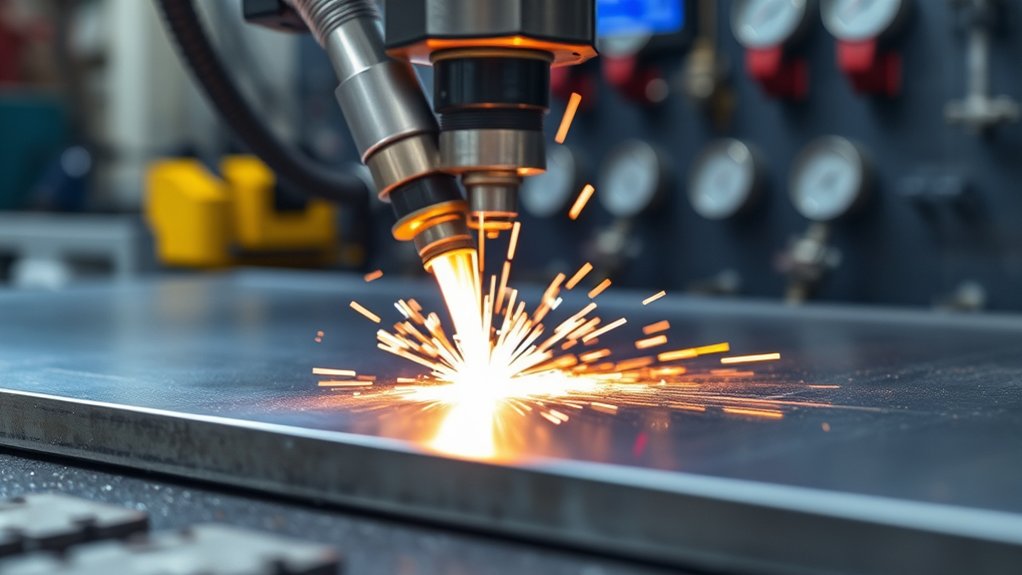
Start with the current assigned to the selected consumable and material thickness. Do not begin by turning the amperage down randomly. A current that is too low for the process may fail to clear the kerf or create high-speed dross.
On the documented Hypertherm FineCut high-speed process, 22-gauge mild and stainless steel use 40 A and 350 IPM. The complete chart also specifies the cut height, pierce height, arc voltage, delay, and reference kerf. Those related values are part of the process.
Use This Controlled Tuning Order
- Return to the book settings. Install a serviceable consumable and load the documented current, speed, height, delay, and gas settings.
- Verify the mechanical system. Check torch squareness, motion, slats, work-lead contact, and sheet flatness.
- Identify the defect. Decide whether you have low-speed dross, high-speed dross, top spatter, bevel, a wide kerf, missed penetration, or heat distortion.
- Change one variable. Adjust speed or height in a small controlled step appropriate to the machine manual.
- Repeat the same coupon. Keep the geometry and travel direction unchanged.
- Record the result. Revert failed changes before trying a different variable.
| Observed result | Likely checks | First controlled response |
|---|---|---|
| Heavy, easy-to-remove bottom dross | Travel may be too slow; height or current may be outside the process window | Increase speed slightly while staying near the charted process |
| Thin, hard bottom whiskers and incomplete exit | Travel may be too fast; current may be insufficient; air flow may be low | Verify air and consumables, then reduce speed slightly |
| Wide kerf or excess positive bevel | Worn consumable, high standoff, excessive speed, low current, or poor gas flow | Inspect the consumable and confirm actual cut height |
| Bluing and sheet movement | Excess dwell, repeated nearby cuts, corner slowdown, or incorrect process | Review speed and path order before reducing current |
Fixturing and Clamping Thin Sheets
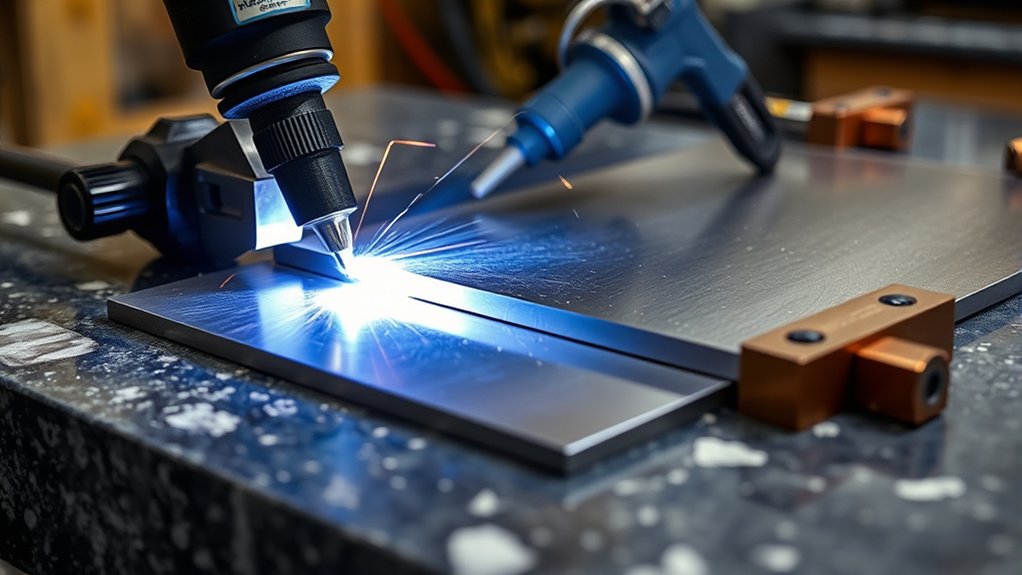
Begin with the flattest sheet available. If the panel already has a crown or oil-can condition, correct it before loading when the material and final part requirements allow.
Support the sheet on clean, reasonably level slats. Heavy slag buildup or bent slats can lift the material, interfere with ohmic sensing, change torch height, and redirect the cutting plume.
Use low-profile edge clamps or table fixtures that cannot enter the gantry, torch, lead, or pierce path. Add enough restraint to prevent the sheet from lifting, but do not force a badly distorted sheet flat so aggressively that it springs out of shape when released.
- Place clamps near the outer sheet edges rather than inside the active nest.
- Keep magnets away from the immediate cut path unless the equipment manufacturer approves their use.
- Use CAM tabs or bridges to keep small parts from tipping into the torch.
- Leave enough skeleton between closely nested parts to support the sheet.
- Pause and remove loose tipped parts only after the machine is safely stopped.
A purpose-built vacuum table can hold thin sheet over a wide area, but the system must be rated and designed for plasma heat, sparks, molten metal, fumes, and fire prevention. A general woodworking vacuum table is not suitable.
| Component | Purpose | Practical note |
|---|---|---|
| Clean slats | Support the sheet and provide a predictable cutting gap | Rotate or replace heavily damaged slats |
| Edge clamps | Limit sheet lift and lateral movement | Keep them outside the programmed envelope |
| Tabs or bridges | Prevent small parts from tipping | Place them where removal will not damage a critical edge |
| Torch height control | Maintains the programmed torch relationship to the sheet | Configure corner lockout or anti-dive behavior correctly |
Using Water Tables and Safe Cooling Methods
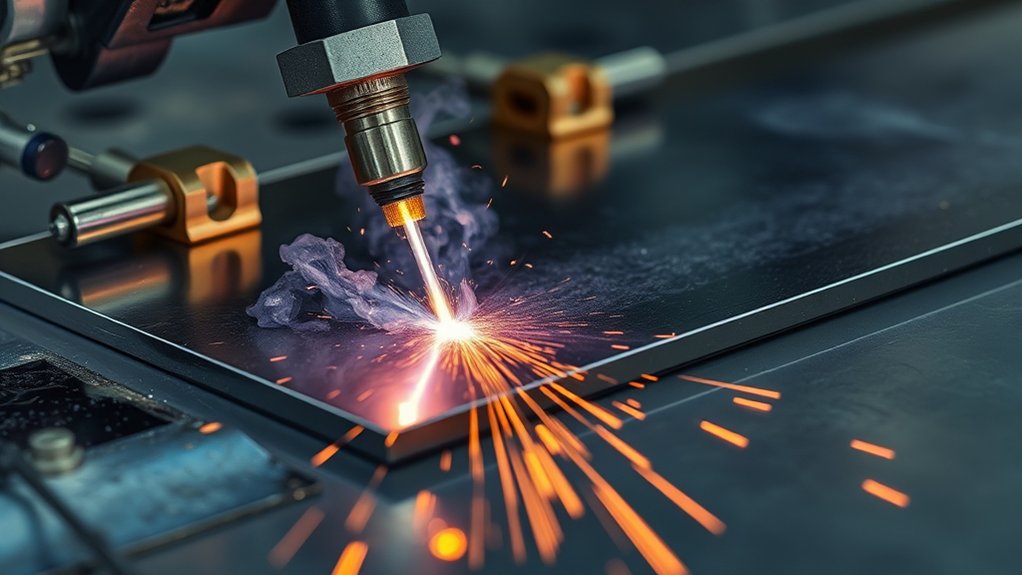
A purpose-built water table can capture much of the particulate produced below the sheet and reduce warpage and camber on thin parts. It can also reduce noise and glare in some configurations.
A water table is not a substitute for correct cutting parameters, ventilation, or maintenance. Residual gases and fumes still require control, and table water needs regular cleaning and treatment appropriate to the equipment and local disposal rules.
Water Table Benefits
- Reduces the amount of airborne particulate escaping from below the sheet.
- Absorbs some heat from the plate and newly cut parts.
- Can reduce warpage and camber on thin plate.
- Can reduce sound and glare depending on the water level and system design.
- Contains much of the slag below the cutting surface.
Water can also cause rust, table-maintenance work, and cut-quality changes. Hypertherm notes that water splashing onto the active cut can increase edge roughness and dross. Set the water level according to the table builder and plasma-system guidance.
Safe Water Table Setup
- Confirm that the table is designed for the material and plasma process.
- Set the water level as directed by the table manufacturer.
- Provide the required ventilation or fume extraction above the table.
- Keep the water free of excessive slag and contamination.
- Control corrosion on slats, fasteners, and machine components.
- Check that steam and splash do not interfere with the torch, ohmic sensing, or cut edge.
- Follow the manufacturer’s instructions before using additives or biocides.
Warning: Do not improvise by pouring, dribbling, or misting water beside an energized plasma torch. Do not cut aluminum underwater or over a water table unless the system prevents hydrogen accumulation and the table manufacturer has approved the process. Never cut aluminum-lithium alloys in the presence of water.
On-Workpiece Cooling Techniques
Direct water application at the cutting front is not a general-purpose cooling method. It can interfere with the arc, increase splash, affect sensing, and expose equipment to a condition the manufacturer did not design for.
Use these safer heat-control methods instead:
- Run the documented high-speed thin-sheet process.
- Cut internal features before releasing the outer profile.
- Alternate between separated areas of the nest.
- Use short programmed pauses only when the sheet needs time to equalize.
- Allow completed parts to cool on a heat-resistant surface.
- Use a purpose-built water table or properly designed downdraft table.
Heat Management Best Practices
- Start with the chart: Use the correct consumable, current, speed, height, and delay.
- Support the sheet: Clean the slats, secure the edges, and use tabs for small parts.
- Balance the path: Avoid completing all cuts in one small area before moving elsewhere.
- Control corners: Avoid excessive slowdown that lets the arc dwell in one spot.
- Use approved fume control: Set the water or downdraft table according to its design.
- Inspect the result: Check tint, dross, kerf, bevel, and flatness before changing settings.
Common Thin-Gauge Plasma Troubleshooting
Do not adjust several variables at once. Return to the documented baseline, inspect the machine, and then make one controlled change.
Heavy Low-Speed Dross
Low-speed dross often forms as larger deposits that are relatively easy to knock off. The torch may be moving too slowly, the standoff may be high, the current may be excessive for the selected process, or a lower-current consumable may be more suitable.
First inspect the consumable and actual cut height. Then increase speed slightly while keeping the other settings fixed.
High-Speed Dross or Bottom Whiskers
Thin hard whiskers can indicate that travel is too fast, the arc is not fully clearing the bottom, air flow is inadequate, or the consumable is damaged.
Verify air pressure, gas flow, work-lead contact, and the cartridge opening. Reduce speed slightly if the rest of the process is correct.
Wavy or Uneven Kerf
Check torch squareness, slat height, gantry motion, rail contamination, loose mechanical parts, sheet movement, and THC behavior. A worn or distorted nozzle can also deflect the arc.
Wide Kerf or Excess Bevel
Possible causes include a worn consumable, excessive cut height, inadequate current, excessive speed, restricted gas flow, or a torch that is not square to the sheet.
Top Spatter or Rounded Top Edge
Check whether the torch is too low, travel is too slow, the consumable is damaged, or the process current is too high for the selected consumable and thickness.
Edge Bluing and Sheet Distortion
Review dwell time, corner slowdown, repeated nearby cuts, pierce delay, path sequence, and water-table operation. A blue edge alone does not prove that amperage is the only problem.
Arc-Starting or Transfer Problems
Check the work lead, clean-air supply, consumable assembly, pierce height, torch-to-work distance, sheet coatings, and fault display. An excessive transfer distance can cause a pilot arc without a reliable cutting arc.
Lead-Ins, Pierce Timing, and Path Planning
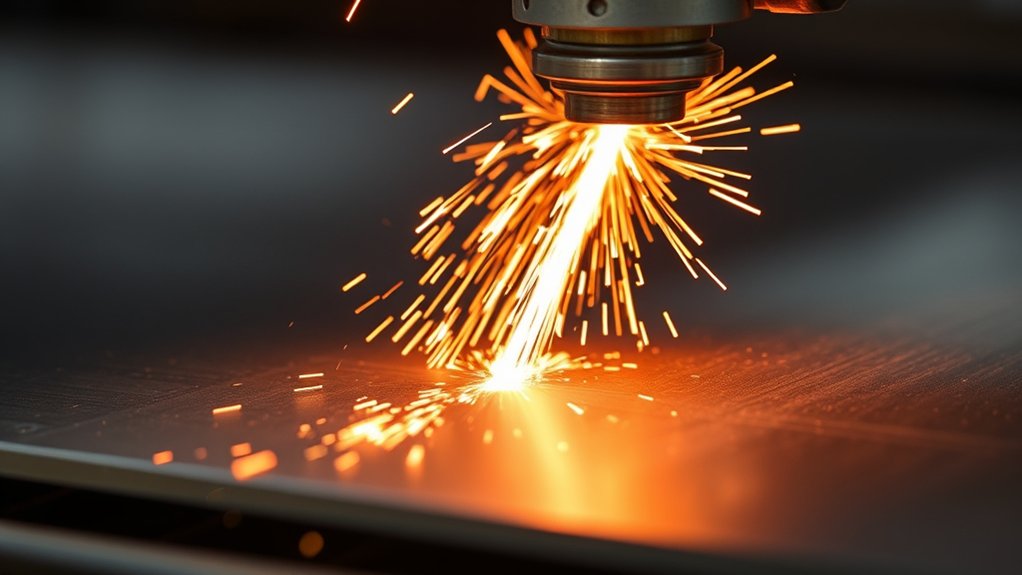
Place the pierce crater where it will not damage a finished edge. An internal contour normally starts in the scrap area and moves through a lead-in before entering the final geometry.
There is no universal lead-in length or angle for every plasma system and feature. Select the lead-in style from your CAM system and table builder’s recommendations, then verify it with a coupon.
Pierce Delay
Use the charted pierce delay. Thin material may require no stationary delay on some processes, while thicker material in the 1.5 mm range may use a short delay. Too much delay enlarges the pierce crater and adds heat. Too little delay can begin motion before the arc clears the sheet.
Small Features and Corners
Plasma has a finite kerf, directional bevel, and arc lag. Features near the kerf width cannot reproduce the original drawing exactly.
- Simplify unnecessary nodes in DXF or SVG geometry.
- Remove duplicate lines and tiny segments.
- Use kerf compensation based on a measured test cut.
- Avoid severe corner slowdown that overheats thin sheet.
- Use loops, overburn, or CAM-specific small-hole strategies only when supported by the controller.
- Test holes and slots before committing a full sheet.
- Use tabs to prevent small parts from tipping into the torch.
Heat-Balanced Path Order
- Cut small internal holes and slots first.
- Complete internal contours before each part’s outer perimeter.
- Alternate between separated areas of the nest.
- Leave large perimeter releases until later in the program.
- Avoid crossing directly over loose cut parts.
- Finish the largest outer sheet or skeleton release last.
| Control | Starting guidance | Purpose |
|---|---|---|
| Lead-in | Start in scrap and use a CAM-supported style appropriate to the feature | Keeps the pierce crater off the finished edge |
| Pierce delay | Use the exact charted value | Completes penetration without unnecessary dwell |
| Cut speed | Start at the charted best-quality speed | Controls dross, bevel, kerf, and heat input |
| Path order | Internal features first, distributed zones next, perimeters later | Maintains support and spreads heat |
Post-Cut Cleanup and Edge Finishing
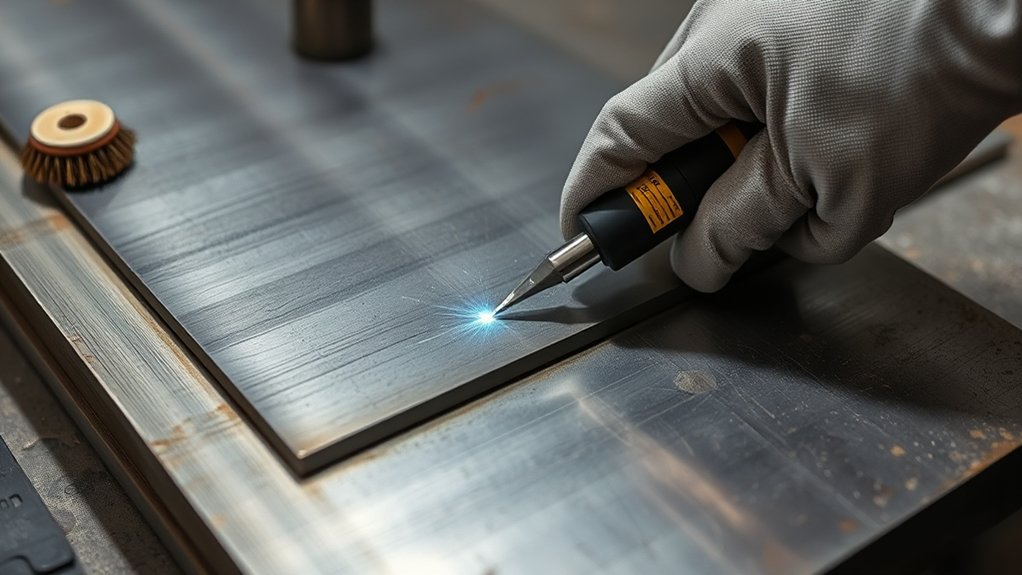
A correctly tuned thin-sheet process should leave limited cleanup. Let parts cool, identify sharp edges, and use the least aggressive method that produces the required finish.
- Remove loose dross: Use a scraper, chisel, or appropriate hand tool to remove brittle deposits without gouging the edge.
- Deburr sharp edges: Use a file, deburring tool, abrasive pad, or light flap-disc pass.
- Limit grinding heat: Keep the abrasive moving and avoid pressing hard enough to discolor or distort thin material.
- Inspect dimensions: Check kerf compensation, hole size, slot width, bevel, and overall flatness.
- Prepare for welding or coating: Remove oxide, contamination, and any nitrided or oxidized edge condition required by the next process.
If every part requires heavy grinding, correct the cut process rather than treating cleanup as normal production work.
Safety Practices for Cutting and Handling Thin Steel
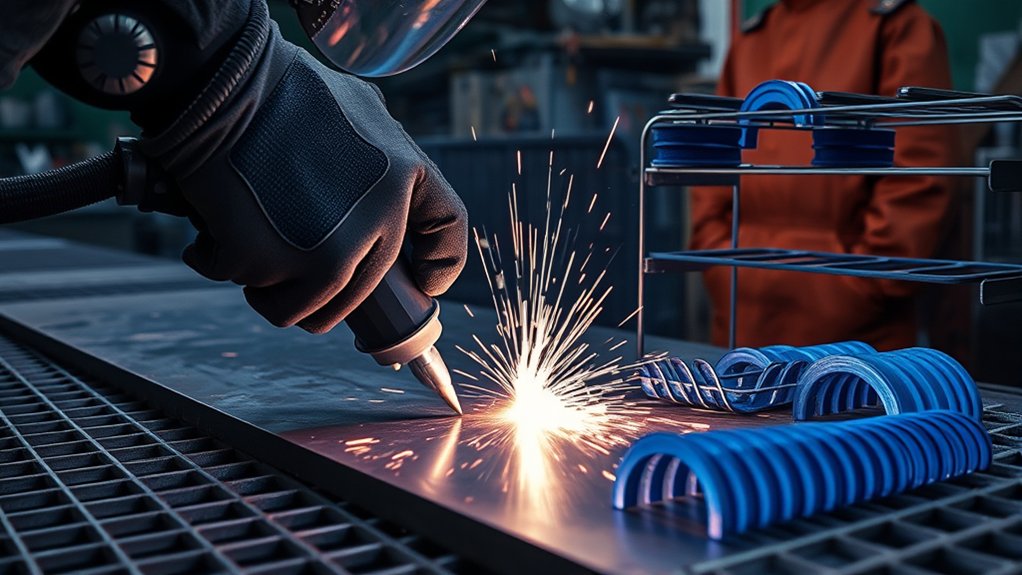
Follow the plasma system’s safety manual, your workplace procedures, and recognized guidance such as ANSI Z49.1 Safety in Welding, Cutting, and Allied Processes.
Personal Protective Equipment
- Wear eye and face protection with the shade specified by the plasma manufacturer.
- Wear flame-resistant clothing that covers exposed skin.
- Use dry, intact cutting gloves suitable for heat and sharp edges.
- Wear safety footwear and keep trouser cuffs from collecting sparks.
- Select hearing protection from measured exposure and required attenuation.
- Do not rely on ordinary sunglasses or a clear face shield as arc protection.
Fumes and Coatings
Plasma cutting produces metal fumes and particles. Stainless steel, galvanized steel, painted steel, plated metal, and unknown coatings need additional attention.
- Identify the base metal and coating before cutting.
- Review the coating’s safety data sheet.
- Remove coatings around the cut line when practical and permitted.
- Use local exhaust, a suitable downdraft system, or a properly designed water table.
- Do not assume a water table captures every gas or fume.
- Use respiratory protection only as part of a properly selected and managed respiratory-protection program.
OSHA’s Welding, Cutting, and Brazing hazards guidance identifies metal fumes and ultraviolet radiation as core hazards.
Fire, Electrical, and Hot-Part Safety
- Remove combustible material from the spark and slag area.
- Check below and behind the cutting table for hidden fire exposure.
- Keep an appropriate fire extinguisher available.
- Do not touch the torch, workpiece, water, or table with wet gloves.
- Turn off and isolate equipment before servicing the torch or changing internal parts.
- Treat newly cut parts as hot even when discoloration is limited.
- Use tongs or suitable lifting tools and place hot parts on a noncombustible surface.
- Mark or separate hot material so another person does not pick it up.
A noncontact thermometer can give misleading readings on shiny metal because emissivity varies. When temperature must be confirmed, use an appropriate contact method or temperature indicator and follow its instructions.
Noise Exposure
Plasma noise varies with current, material, table design, water level, enclosure, and operator position. Measure the actual exposure when workers may be exposed to harmful levels.
Under the OSHA general-industry noise standard, an effective hearing-conservation program is required when employee exposure reaches an eight-hour time-weighted average of 85 dBA. Protection and controls must meet the applicable exposure requirements. See OSHA 29 CFR 1910.95.
Frequently Asked Questions
Can I cut painted or coated thin steel without damaging the finish?
The plasma arc and hot ejecta will damage the finish near the kerf. Identify the coating, review its safety data sheet, and remove coating around the cut line when practical. Provide suitable ventilation because paint, plating, galvanizing, primers, and other finishes can release hazardous decomposition products. Do not increase torch standoff unless your cut chart or equipment manufacturer instructs you to do so.
How do ambient temperature and humidity affect thin-sheet plasma cutting?
Humidity can overload an inadequate air-treatment system and introduce moisture into the plasma gas. Cold material may also collect condensation when moved into a warmer shop. Keep the sheet dry, drain the compressor system, maintain filters and dryers, and verify pressure and flow under load. Do not preheat thin sheet merely because the shop is cold unless a documented process requires it, because added heat can increase distortion.
What file formats and CAM settings work best for tiny features?
DXF and SVG can work when the geometry contains clean curves, no duplicate lines, and no unnecessary nodes. Use the kerf, cut height, pierce height, delay, lead-in, corner, anti-dive, and tab settings recommended by the plasma and table manufacturers. There is no universal 0.06-inch cut height or fixed corner slowdown for every material. Test the smallest holes and slots before cutting a production sheet.
How loud is thin-sheet plasma cutting, and what hearing protection is best?
Noise varies too much to assign one reliable level to every plasma setup. Measure operator exposure with suitable instruments or dosimetry. Choose properly fitted hearing protection that provides the attenuation required by the measured exposure and your workplace hearing-conservation program. Dual protection may be appropriate for some high exposures, but it is not an automatic requirement for every thin-sheet cut.
Can I safely stack-cut several thin steel sheets?
Stack cutting is generally a poor choice for precise thin-sheet plasma work. Air gaps can interrupt arc transfer, trap molten metal, damage lower sheets, and produce inconsistent edges. Do it only when the plasma and table manufacturers publish an approved procedure for the material and stack arrangement. Cutting one secured sheet at a time gives more predictable kerf, flatness, and separation.
Can I cut thin steel by hand without automatic torch height control?
Yes. Use the hand-cutting consumables and technique specified for your torch, support the sheet, use a straightedge or template when needed, and maintain a steady travel speed. Do not copy mechanized cut heights or 350 IPM CNC speeds into a handheld process. Run a coupon and follow the hand-cutting section of the operator manual.
Is a water table required to stop thin steel from warping?
No. A water table can reduce warpage and capture particulate, but correct process selection, fast charted travel, sheet support, pierce timing, and heat-balanced path order remain essential. A well-designed downdraft table can also be used. Choose the fume-control system that suits the table, materials, shop ventilation, maintenance plan, and manufacturer requirements.
Conclusion
Clean thin-steel plasma cuts come from a complete process rather than one aggressive speed or low amperage setting. Match the machine, torch, consumable, material, and thickness. Load the manufacturer’s current, speed, pierce height, cut height, delay, and kerf values before making adjustments.
Keep the air clean and dry, provide a solid work-lead path, square the torch, support the sheet, and distribute cuts across the nest. Use a properly designed water or downdraft table for fume control, and never improvise by spraying water around the energized torch.
Run a test coupon, identify the actual defect, and change one variable at a time. That method gives you repeatable kerfs, less dross, lower distortion, safer operation, and fewer damaged sheets.
Sources
- Hypertherm Powermax45/65/85/105 SYNC Cut Charts Guide, Revision 4 — FineCut current, speed, cut height, pierce height, delay, and reference kerf values.
- Hypertherm Powermax SYNC Machine-Side Reference — Torch height, air quality, troubleshooting, dross, bevel, and kerf guidance.
- Hypertherm Water or Downdraft Fume Control Overview — Water-table benefits, disadvantages, particulate control, and warpage considerations.
- Hypertherm Water-Table Aluminum Safety Guidance — Hydrogen-accumulation and aluminum-water-table precautions.
- OSHA Welding, Cutting, and Brazing Hazards and Solutions — Fume, radiation, ventilation, and related workplace hazards.
- OSHA 29 CFR 1910.95 Occupational Noise Exposure — Noise exposure, monitoring, hearing conservation, and protection requirements.