A spatter-packed MIG nozzle can restrict shielding gas, create an electrical bridge to the contact tip, and make a stable weld harder to produce. Cleaning it is a short job, but the details matter: isolate the welder, let the gun cool, use the correct nozzle tool, protect the gas holes, and replace damaged consumables instead of drilling or reshaping them.
Last updated: July 19, 2026
Quick Answer
Turn off and isolate the welder, close the shielding-gas supply, and let the MIG gun cool. Remove the nozzle according to its design, loosen spatter with welding pliers or a purpose-built nozzle cleaner, wipe the parts, inspect the contact tip and diffuser, replace damaged consumables, and reinstall everything securely.
Key Takeaways
- Power down the welder, close the gas supply, and wait until the gun is cool before removing consumables.
- Use welding pliers, a soft brush, or the nozzle-cleaning tool recommended for your MIG gun.
- Do not drill, file, or enlarge the contact-tip bore. Replace the tip if wire will not pass freely or the bore is worn.
- Keep the diffuser gas holes and neck insulator clear and undamaged so shielding gas can flow evenly.
- Use anti-spatter only when it is compatible with your process, and follow the product label and safety data sheet.
At a Glance
| Time Required | About 5 to 10 minutes after the gun has cooled |
| Difficulty | Easy routine maintenance |
| Tools Needed | Safety glasses, heat-resistant gloves, welding pliers, soft wire brush, nozzle cleaner or reamer approved for the gun, and a clean shop towel |
| Cost | Usually no added cost when you already have basic MIG-gun maintenance tools; replace worn consumables as needed |
What’s in This Article
- Why a Clean MIG Nozzle Matters
- What You’ll Need to Clean a MIG Nozzle
- How to Clean a MIG Welding Nozzle
- Clean the Contact Tip and Diffuser Too
- Remove Stubborn MIG Spatter Safely
- Troubleshooting After Cleaning
- Anti-Spatter Tips to Prevent Buildup
- What Causes Excessive MIG Spatter
- Signs Your MIG Nozzle Needs Replacing
- How to Keep Your MIG Nozzle Cleaner Longer
- Frequently Asked Questions
- Conclusion
- Sources
Why a Clean MIG Nozzle Matters
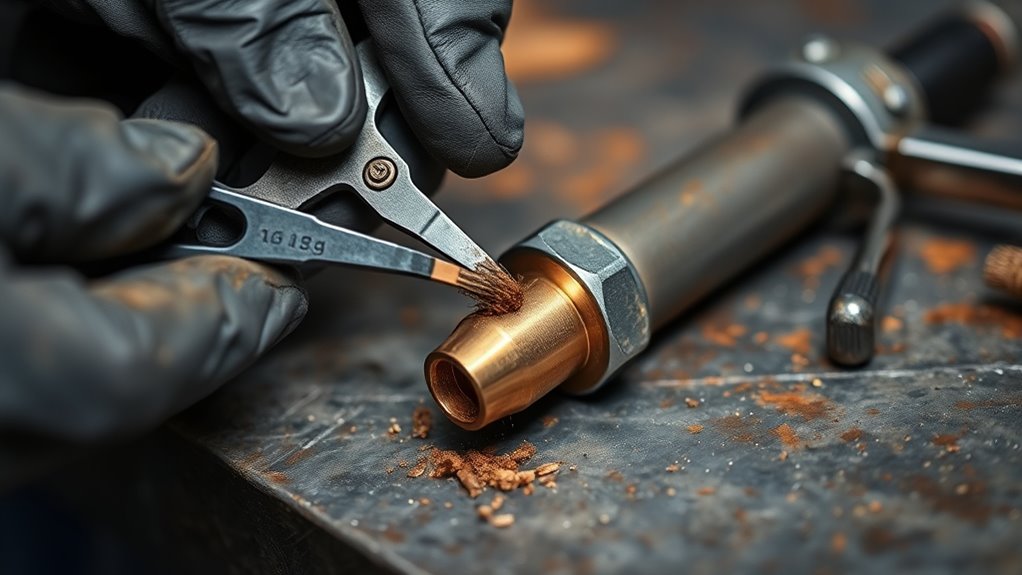
The nozzle directs shielding gas around the wire and weld puddle. When spatter narrows the opening or bridges the nozzle to the contact tip, gas coverage can become uneven and the gun may arc internally. That can contribute to porosity, an unstable arc, extra spatter, and inconsistent bead appearance.
Miller’s maintenance guidance recommends cleaning the nozzle with welding pliers, checking the contact tip for debris, and replacing consumables when they show wear. Regular inspection also helps you catch damaged threads, a cracked insulator, or blocked diffuser holes before they interrupt a weld.
A clean nozzle supports gas coverage, but cleaning cannot correct a worn contact tip, a damaged diffuser, a gas leak, or incorrect welding settings.
Nozzle care should be part of your normal MIG-gun routine, not a repair you delay until the opening is almost closed. Light deposits are easier to remove, and early inspection reduces the chance of damaging the nozzle while scraping hardened spatter.
What You’ll Need to Clean a MIG Nozzle
Gather the tools before you power down the machine. The exact consumable design varies by gun, so keep the owner’s manual nearby and use tools that fit the nozzle without cutting or reshaping it.
Products Worth Considering

Easy to Use: Cleans the hot MIG nozzle on the torch. Lightweight and compact, easy to carry and manoeuvre

Lightweight: The 7-inch MIG welding pliers have smaller jaws than normal welding pliers, suitable for welding small objects, easy to carry.

The blades cut away the built up spatter helping prolong the nozzle life, and reduces the chances of wire sticking.
Essential Cleaning Tools
- Welding pliers: Grip a hot-looking but fully cooled nozzle, loosen spatter, cut wire, and help remove some nozzle styles.
- Soft wire brush: Removes loose residue from the nozzle’s inside and outside surfaces without aggressive grinding.
- Purpose-built nozzle cleaner or reamer: Clears the nozzle bore when the tool size and design match the gun manufacturer’s instructions.
- Clean shop towels: Remove loose particles and excess anti-spatter compound.
- Replacement contact tips and nozzles: Let you replace a damaged part instead of forcing it back into service.
- Compatible anti-spatter product: Optional. Use it only as directed by the label and your shop procedure.
Safety and Prep Gear
- Safety glasses with side protection: Protect your eyes from loose spatter and brush debris.
- Heat-resistant work gloves: Protect your hands if the gun has retained heat.
- Good ventilation: Especially important when you use any spray, cleaner, or chemical product.
- A clean bench or metal tray: Keeps small consumables from rolling away and prevents dirt from entering the gas path.
Warning: Turn off the welding power source, disconnect it when the owner’s manual requires it, close the shielding-gas supply, and let the gun cool fully. Never clean the front end while the gun can feed wire or become electrically live.
How to Clean a MIG Welding Nozzle
Use this order for routine cleaning. If your gun manual gives different removal, torque, or anti-spatter instructions, follow the manual for your exact model.
Signs the Nozzle Needs Cleaning
- Spatter is visibly narrowing the nozzle opening.
- The arc sounds rough or starts popping more than usual.
- Porosity or uneven bead appearance appears without another clear cause.
- Spatter is beginning to bridge the nozzle and contact tip.
- Shielding gas sounds restricted or the diffuser holes look blocked.
These signs can also come from gas leaks, poor settings, contaminated metal, wire-feed trouble, or a worn contact tip. Clean and inspect the gun, then troubleshoot the full setup if the problem remains.
Step-by-Step Cleaning
- Shut down and isolate the welder. Release the trigger, turn off the power source, close the shielding-gas cylinder or supply valve, and follow the owner’s manual for disconnecting power. Let the gun cool completely.
- Identify the nozzle style. Some nozzles are slip-on and come off with a controlled twisting pull. Others are threaded and unscrew. Do not force the part or crush it with pliers.
- Remove loose spatter. Hold the nozzle over a tray and use welding pliers or a soft brush to break away loose deposits from the inside and outside.
- Clean the nozzle bore. Use a purpose-built nozzle cleaner or reamer only when it matches the nozzle and the manufacturer allows it. Keep the tool centered so you do not gouge the bore or damage the insulator.
- Wipe the nozzle. Remove loose particles and oily residue with a clean, dry shop towel.
- Inspect the front-end parts. Check the nozzle, contact tip, gas diffuser or retaining head, threads, O-rings if fitted, and neck insulator for wear, cracks, distortion, looseness, or blocked gas holes.
- Replace damaged consumables. Replace a contact tip with a worn, keyholed, obstructed, or wire-fused bore. Replace a cracked, distorted, badly pitted, or loose-fitting nozzle.
- Apply anti-spatter only if appropriate. Use a thin, even amount on the nozzle as directed by the product label. Do not flood the contact tip, wire path, diffuser holes, or workpiece.
- Reassemble and test. Seat or tighten the parts according to the gun manual. Restore gas and power, confirm normal wire feed and gas flow, and make a test weld on scrap before returning to critical work.
Pro Tip: Keep a clean spare nozzle and the correct contact tips at the bench. Swapping a damaged consumable is faster and more reliable than overworking it with an improvised tool.
Clean the Contact Tip and Diffuser Too
The nozzle is only one part of the gas and current-transfer path. Remove loose spatter from the outside of the contact tip and inspect its bore. The wire should pass freely, and the opening should remain round and correctly sized for the wire.
Do not insert a drill bit, file, or powered tool into the contact-tip bore. Removing metal can enlarge or roughen the precision opening, weaken current transfer, and make arc behavior less stable. If the wire is fused into the tip, the bore is keyholed, or the tip repeatedly causes burnback, replace it.
Next, inspect the gas diffuser or retaining head. Brush away loose debris and clear the gas holes without enlarging them. Confirm that the diffuser is tight and that its threads, sealing surfaces, and insulator are intact. Official Tregaskiss MIG-gun maintenance guidance directs users to inspect the contact tip and diffuser for wear and tightness and replace or tighten parts as needed.
Note: Self-shielded flux-cored setups may use a different front-end arrangement because they do not rely on external shielding gas. Follow the gun and wire manufacturer’s instructions rather than applying gas-nozzle advice to every flux-cored setup.
Products Worth Considering

Package Including 10pcs x 0.035" Contact Tip, 2pcs x Gas Nozzle, 2pcs x Gas Diffuser.
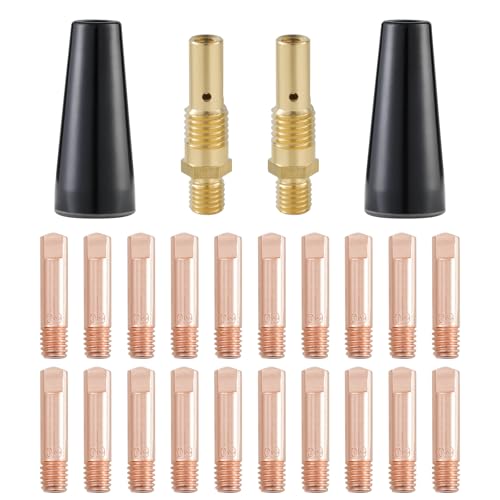
Package Including 20 x .035" (0.9mm) contact tips, 2 x flux core gasless nozzles, 2 x gas diffusers

COMPATIBILITY: Designed for Lincoln Magnum 100L (K530 series) and Tweco Mini/#1 welding torches. This kit is also a direct fit for YESWELDER FLUX-135PRO Old Version/MIG-140DS PRO/YWM-160/MIG-165DS PRO/MIG-185DS PRO/MIG-205DS PRO/MIG-250PRO/MCT-520.
Remove Stubborn MIG Spatter Safely
Hardened rings of spatter need controlled mechanical cleaning, not aggressive drilling. After the gun is cool and isolated, use welding pliers to break the ring, then use a correctly sized nozzle cleaner if the manufacturer permits it. Work from the open end and keep the tool away from the contact tip, diffuser threads, and insulating material.
If the deposit will not release without bending, gouging, or thinning the nozzle, replace the nozzle. Consumables are designed to be replaced; reshaping a damaged nozzle can change gas coverage and may leave an unsafe electrical path.
Warning: Do not use chlorinated brake cleaner or other chlorinated degreasers on welding parts or where their vapors can reach an arc. OSHA requires chlorinated-hydrocarbon cleaning operations to be kept away from gas-shielded welding atmospheres. Use only a manufacturer-approved product, follow its safety data sheet, and let cleaned parts dry completely.
Cleaning light buildup during normal breaks is safer and faster than waiting for a thick ring to harden. It also reduces the force needed to clean the bore.
Troubleshooting After Cleaning
If the weld still looks or sounds wrong after the nozzle is clean, check the rest of the system. Nozzle cleaning will not fix a gas leak, a worn liner, bad work-clamp contact, incorrect polarity, or mismatched voltage and wire-feed settings.
| Symptom | What to Check Next |
|---|---|
| Porosity continues | Gas supply, flow setting, drafts, hose leaks, loose fittings, blocked diffuser holes, nozzle seating, and workpiece contamination |
| Arc pops or wanders | Worn contact tip, wire drag, liner condition, drive-roll tension, work-clamp contact, stickout, voltage, and wire-feed speed |
| Arcing inside the nozzle | Remaining spatter bridge, damaged neck insulator, loose consumables, or a nozzle bore that is too small for the application |
| Contact tip overheats | Loose tip or diffuser, worn tip, poor electrical connections, excessive duty cycle, wrong tip size, or restricted wire feed |
| Spatter returns immediately | Welding parameters, polarity, excessive stickout, dirty metal, poor ground, unstable wire feed, and shielding-gas choice or flow |
For broader diagnosis, review your machine manual and a systematic guide to MIG welding problems and solutions. Change one variable at a time so you can identify the actual cause.
Anti-Spatter Tips to Prevent Buildup
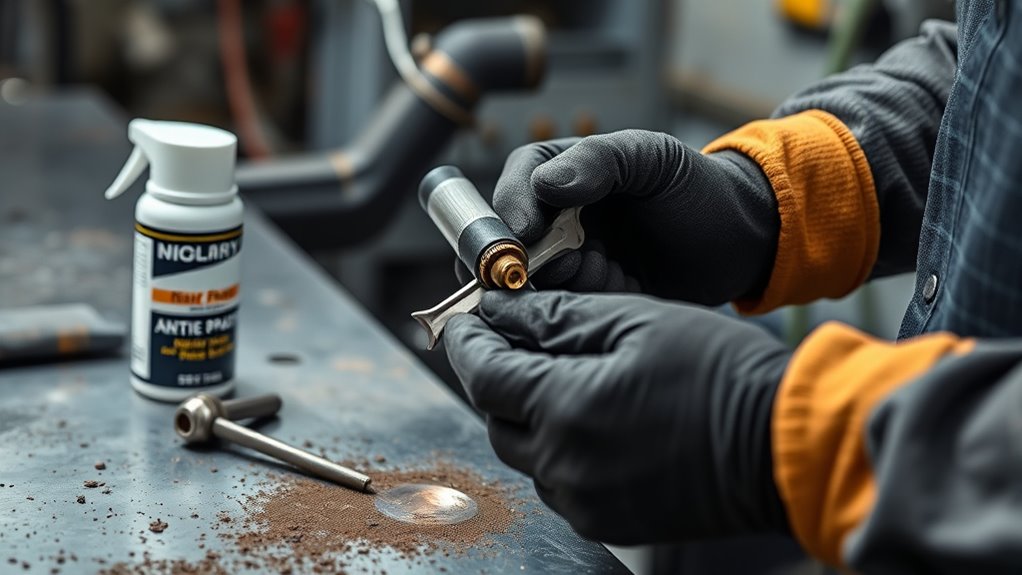
Anti-spatter compound can create a sacrificial barrier that helps deposits release from the nozzle. It does not correct poor settings or replace cleaning, and not every product is suitable for every process or shop.
- Choose a product that is compatible with the nozzle, welding process, downstream coating or painting, and your shop rules.
- Read the label and safety data sheet before use. Control spray mist and provide ventilation.
- Apply a thin, even film to the nozzle. Avoid soaking the wire path, contact-tip bore, diffuser gas holes, and joint.
- Wipe away excess product and residue before welding.
- Reapply only when the protective film has worn away and the product instructions allow it.
Tregaskiss recommends uniform nozzle coverage, product compatibility, ventilation, suitable gloves and eye protection, and following the safety data sheet. Those precautions matter even when a product is water-based.
What Causes Excessive MIG Spatter
A clean nozzle can still foul quickly when the welding process produces excess spatter. Common causes include:
- Voltage and wire-feed speed that do not match the wire, material, joint, and transfer mode
- Excessive contact-tip-to-work distance or inconsistent stickout
- Incorrect polarity for the wire being used
- A dirty, rusty, painted, or oily work surface
- Poor work-clamp contact or loose electrical connections
- Worn contact tips, a dragging liner, or unstable wire feed
- Wrong shielding gas, incorrect flow, leaks, or strong drafts
Start with the settings chart inside your welder or the wire manufacturer’s data, then fine-tune on scrap. A MIG wire-speed and voltage chart can help you understand the relationship, but the machine, wire, gas, and joint still determine the final setting.
Signs Your MIG Nozzle Needs Replacing
Replace the nozzle when cleaning no longer restores a sound, correctly shaped part. Warning signs include:
- Cracks, deep pitting, burn-through, or severe heat distortion
- A dented or out-of-round bore
- Damaged threads or a slip-on nozzle that no longer seats securely
- A cracked, missing, or carbon-tracked insulator
- Repeated internal arcing after spatter has been removed
- Gas coverage that remains uneven after the diffuser and gas supply are checked
- Spatter that returns unusually fast because the surface is badly damaged
Replace the contact tip separately when its bore is worn, keyholed, blocked by fused wire, or no longer holds steady electrical contact. Replace the diffuser or retaining head if its gas holes, threads, or seating surfaces are damaged.
How to Keep Your MIG Nozzle Cleaner Longer
Preventing buildup starts with the whole welding setup, not the nozzle alone.
- Prepare the joint. Remove oil, paint, rust, scale, and moisture from the weld area.
- Use the correct polarity and settings. Match them to the wire, shielding gas, metal thickness, and transfer mode.
- Control stickout. Keep a steady contact-tip-to-work distance instead of welding too far from the joint.
- Maintain wire feed. Check the contact tip, liner, drive rolls, spool brake, and gun-cable routing.
- Inspect during breaks. Remove thin spatter before it becomes a hard ring.
- Store the gun properly. Keep the front end dry and protected, and avoid crushing or tightly coiling the cable.
- Use anti-spatter carefully. Apply only a compatible product and only as much as the label recommends.
If the welder still behaves poorly after these checks, use a complete MIG welder troubleshooting process rather than assuming the nozzle is the only cause.
Frequently Asked Questions
How often should you clean a MIG nozzle?
Inspect it before welding and during normal breaks. Clean it when spatter begins to narrow the opening, block gas holes, or bridge toward the contact tip. High-amperage or high-spatter work may require several checks per shift, while light work may require less.
Can you clean a MIG nozzle with a drill bit?
Do not use a powered drill, and do not ream the contact-tip bore with a drill bit. Use welding pliers or a purpose-built nozzle cleaner approved for your gun. Replace the contact tip if its bore is fused, obstructed, worn, or out of shape.
What is the correct way to clean a clogged MIG nozzle?
Turn off and isolate the welder, close the gas supply, let the gun cool, remove the nozzle according to its design, loosen spatter with welding pliers or a suitable nozzle cleaner, wipe and inspect all front-end parts, replace damage, then reassemble and test on scrap.
How do you know when a MIG nozzle is bad?
Replace it when it is cracked, deeply pitted, distorted, out of round, unable to seat securely, or damaged at the threads or insulator. Repeated internal arcing or poor gas coverage after proper cleaning can also point to a bad nozzle.
Should you use anti-spatter spray inside the nozzle?
Use only a product approved for the application and follow its label. A thin, even nozzle coating may help, but do not flood the contact-tip bore, wire path, diffuser holes, or joint. Control spray mist, provide ventilation, and follow the safety data sheet.
Can you soak a MIG nozzle to remove heavy spatter?
Only use a cleaning product and soaking method approved by the nozzle or gun manufacturer. Avoid flammable or chlorinated cleaners around welding. If mechanical cleaning cannot restore the nozzle without damaging it, replacement is the safer choice.
Why does my MIG nozzle clog so quickly?
Frequent clogging often points to excess spatter from mismatched voltage and wire-feed speed, long stickout, poor ground, dirty metal, unstable wire feed, wrong polarity, or shielding-gas problems. Correct the process cause instead of relying only on anti-spatter.
Conclusion
Cleaning a MIG nozzle is simple when you use the right sequence: isolate and cool the gun, remove the nozzle correctly, clear spatter with proper tools, inspect the contact tip and diffuser, replace damaged parts, and test the setup before welding critical work.
The most important limit is also the easiest to remember: clean the nozzle, but do not drill or reshape the contact-tip bore. A new tip or nozzle costs less than the downtime and poor welds caused by a damaged consumable.
Keep welding pliers, a suitable nozzle cleaner, clean towels, and spare consumables close to the machine. Regular checks will help you maintain gas coverage, stable wire feed, and more predictable welds.
Sources
- Miller: Welder Maintenance Checklists — supports cleaning the nozzle with welding pliers, checking contact tips, shutting off power and gas, and replacing worn consumables.
- Tregaskiss: TOUGH GUN G2 Series Owner’s Manual — supports nozzle removal methods, front-end inspection, wear checks, spatter removal, and troubleshooting unstable arcs.
- Tregaskiss: Understanding MIG Welding Nozzles — supports periodic nozzle inspection, proper cleaning, and anti-spatter use.
- Tregaskiss: How to Select and Use Anti-Spatter Liquid — supports compatibility, uniform coverage, ventilation, protective equipment, and SDS precautions.
- OSHA: Welding, Cutting, and Brazing Hazards and Solutions — supports protection from burns, eye injury, electrical shock, fumes, and other welding hazards.
- OSHA Standard 1910.252 — supports welding PPE requirements and keeping chlorinated-hydrocarbon cleaning vapors away from gas-shielded welding.