Measuring weld bead width is a simple quality-control check, but it only works when you measure the same way every time. Use a calibrated caliper, weld gauge, bridge cam gauge, or optical system, then compare the reading with the drawing, welding procedure specification, inspection plan, or applicable code. For most shop checks, the goal is not to chase a universal “perfect” number. The goal is to confirm that the bead is consistent, properly fused, and within the acceptance range for that specific weld.
Quick Answer
Measure weld bead width across the visible face of the bead, from one toe to the other, using a calibrated caliper, weld gauge, or optical sensor held square to the weld. Take readings at several points, record the locations, and compare the results with the WPS, drawing, or inspection acceptance criteria.
Key Takeaways
- Measure the bead face from toe to toe unless the drawing or inspection plan defines a different dimension.
- Use the WPS, drawing, project specification, or code as the acceptance reference, not a universal bead-width rule.
- Keep the tool perpendicular to the bead and take more than one reading so one high or low spot does not mislead you.
- Clean spatter, slag, loose coating, and soot before measuring, but do not grind away the bead profile unless the inspection procedure allows it.
At a Glance
| Time Required | 1–5 minutes for a short weld; longer for documented QC sampling on production parts |
| Difficulty | Easy for basic checks; moderate when documenting to a formal inspection plan |
| Tools Needed | Digital or dial caliper, fillet weld gauge, bridge cam gauge, light, marker, inspection sheet, and PPE |
| Cost | Low for manual tools; higher for optical, laser, or automated inspection systems |
Warning: Do not put calipers, gauges, fingers, or a camera close to an active arc unless the inspection method is designed for live welding. Let the weld cool, wear eye and hand protection, and control fumes when inspecting near freshly welded metal. OSHA requires proper eye protection for welding and cutting, and its welding fume guidance notes that welding can produce hazardous metal fumes and gases.
How to Measure Weld Bead Width
To measure weld bead width, first identify the dimension you are checking. For a raised bead or butt weld cap, bead width is usually the visible distance from one weld toe to the other. For a fillet weld, the specified size may be the leg length or throat rather than the face width, so check the drawing before you record the number.
- Let the weld cool and make it safe: Hot metal can burn you and distort some readings. Wait until the part is safe to touch or follow the approved inspection procedure for hot work.
- Clean the surface: Remove loose slag, spatter, soot, paint flakes, and dirt. Do not grind or reshape the bead unless the procedure allows it.
- Check the reference document: Use the WPS, drawing, job specification, inspection and test plan, or code acceptance criteria.
- Zero and check the tool: Close the caliper jaws to confirm zero, or check a gauge against a known reference if your shop procedure requires it.
- Hold the tool square: Place the caliper jaws or gauge perpendicular to the bead face. An angled tool makes the bead look wider than it is.
- Measure toe to toe: Touch the left and right weld toes lightly. Do not dig into undercut or ride over spatter.
- Take several readings: Measure the midpoint, then measure near each end or at set intervals along longer welds.
- Record the result: Write down the value, location, tool used, inspector, date, and whether the weld passed the acceptance range.
Pro Tip: Mark each measurement point with a soapstone or paint marker before you start. This makes repeat checks easier and helps another inspector verify the same locations.
Tools for Measuring Weld Bead Width
You can measure weld bead width with several tools, depending on the weld type, access, tolerance, and inspection record you need. Manual tools work well for most shop and field checks. Optical and laser systems are better for high-volume production, robotic welding, and automated traceability.
| Tool | Best Use | Main Caution |
| Digital or dial caliper | Fast toe-to-toe bead-width readings on accessible welds | Jaws must sit square to the bead and avoid spatter |
| Fillet weld gauge | Checking fillet leg size, convexity, concavity, and fit against common sizes | Do not confuse fillet leg size with bead face width |
| Bridge cam gauge | Weld reinforcement, undercut depth, misalignment, and general visual inspection checks | Needs steady contact and a trained reader |
| Optical or laser system | Automated inspection, production trend tracking, and robotic welding | Requires calibration, stable lighting, validated software, and a reference method |
For fast manual checks, calipers and weld gauges are usually enough. For automated lines, laser triangulation and optical inspection systems can inspect weld seams quickly, but they still need controlled setup and validation. If you measure near active welding, proper eye protection matters. Tools such as auto darkening goggles may help with visibility, but they must match the hazard and shade requirements for the task.
Products Worth Considering

7piece Fillet Weld Set Gage Rl Gauge

Popular Weld Measuring Fillet Gauges: Fillet Weld Leg, Throat and Theoretical Throat
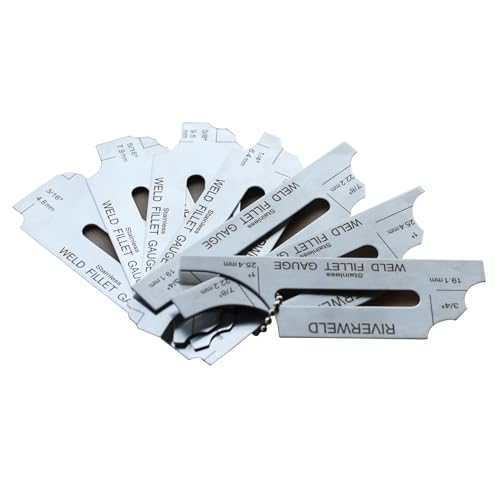
7piece Fillet Weld Set Gage Rl Gauge
Where to Measure Along the Weld Bead
Measure at more than one point because weld bead width can change with travel speed, torch angle, heat input, starts, stops, and fit-up. For a short bead, take at least three readings: one near the start, one at the midpoint, and one near the end. For a long production weld, follow the inspection plan. If no plan is given, use consistent intervals such as every 6 to 12 inches and record the exact spacing.
Use the midpoint as a stable reference only when the bead is uniform. Treat starts, stops, crater areas, tie-ins, repairs, and corners as separate inspection points because they often show different bead shape. If the weld has undercut, overlap, missed fusion at the toe, or heavy spatter, record that condition instead of forcing the caliper over it.
Note: If you are welding galvanized steel or coated material, control fume exposure before inspection and repair work. OSHA advises cleaning coatings that could create toxic exposure, and NIOSH notes that welding fumes are made of metals and may contain manganese. For related prep work, review safe coating removal before welding galvanized parts, including proper zinc removal methods.
Weld Bead Width Standards
There is no single weld bead width that is correct for every weld. The acceptable width depends on the joint type, material, process, filler metal, position, service load, drawing, and welding procedure specification. Start with the WPS and drawing, then apply the inspection plan and the governing code.
- Check the drawing first: It may specify fillet leg size, groove weld reinforcement, contour, length, pitch, or finish instead of bead face width.
- Check the WPS: It may define process, current, voltage, travel speed, pass sequence, electrode or wire size, and technique limits.
- Check the acceptance standard: For many fusion-welded steel, nickel, titanium, and related alloy joints, ISO 5817:2023 provides quality levels for weld imperfections. It is not a universal bead-width table for every job.
- Check the project code: Pressure vessels, piping, bridges, structural steel, automotive parts, and repair work may all use different acceptance rules.
Process settings also affect bead width. A study on GMAW fillet weld bead-shape parameters considered welding voltage, welding current, and moving heat-source speed as key process inputs. In practical terms, higher heat input or slower travel often makes the bead wider, while faster travel can narrow the bead and increase the risk of poor fusion if settings are not balanced. Understanding welding parameters helps you keep bead width consistent.
A bead-width reading only has meaning when it is tied to the WPS, drawing, inspection plan, and acceptance criteria for that specific weld.
Manual vs. Optical Weld Bead Measurement
Manual measurement is best when you need a quick check, a repair inspection, or a small-batch QC record. It is low cost, portable, and easy to repeat if the inspector uses the same tool and locations each time.
Optical measurement is better when you need automated data on many parts. Structured light, laser triangulation, and camera-based systems can capture bead profile, track trends, and reduce operator bias. Active visual sensing methods are widely used in robotic welding for tasks such as seam tracking, weld bead defect detection, and 3D weld pool geometry measurement. However, image-based systems must be calibrated, shielded from glare, and validated against a known reference before you rely on their numbers.
For image-based measurement, avoid changing the threshold, exposure, camera angle, or lighting between runs unless the procedure requires it. A small change in camera angle can create perspective distortion and shift the apparent bead edge. A poor threshold can also mistake soot, spatter, or glare for the weld toe.
Products Worth Considering

Package Includes: you will receive 3 piece welding measuring tools, including 1 piece single fillet weld depth gauge measured 4.72 x 1.26 inches/ 12 x 3.2 cm in length and width, 0.04 inches/ 1 mm in thickness, 1 piece 7 piece fillet weld gauge set measured 4.33 x 1.26 inches/ 11 x 3.2 cm in length and width, 0.31 inches/ 8 mm in thickness, and 1 piece bridge cam welding gauge measured 3.94 x 2.76 inches/ 10 x 7 cm in length and width, and 0.51 inches/ 1.3 cm in thickness

V-WAC single weld gauge undercuts / pits to 0.240", Crowns to 0.240" by 0.020" Increments, Made in Stainless Steel, Markings Inch
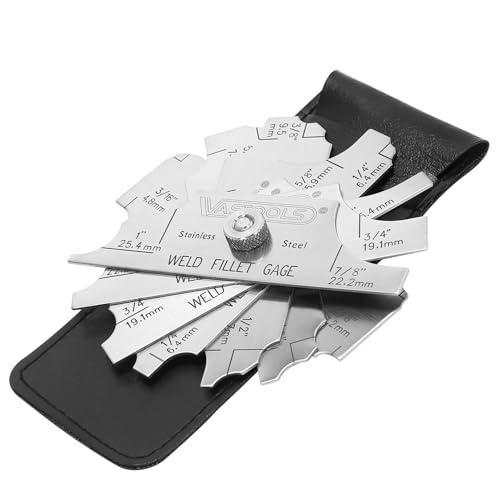
·High quality stainless steel blades to resist rust and for longer life
How to Record Weld Bead Width for Quality Control
A good measurement record should let another inspector repeat your check. Keep the record simple but complete:
- Part or weld ID: Drawing number, joint number, or repair location.
- Weld type: Fillet, groove, butt weld cap, overlay, lap joint, or other joint type.
- Reference document: WPS number, drawing revision, inspection plan, or code requirement.
- Tool used: Caliper, fillet gauge, bridge cam gauge, or optical system ID.
- Measurement points: Start, midpoint, end, or set interval locations.
- Readings: Record each width, not only the average.
- Surface condition: Note spatter, undercut, overlap, grinding, crater, repair, or coating.
- Result: Pass, reject, repair, or hold for additional inspection.
If a bead is too wide, too narrow, or inconsistent, do not adjust the weld based on width alone. Review the full weld condition, including penetration, fusion, profile, undercut, overlap, and porosity. Width is one clue in the inspection, not the whole inspection.
Common Weld Bead Width Measurement Errors
Even with the right tool, weld bead width readings can drift when the setup changes. The most common errors are simple: the tool is angled, the bead has not been cleaned, the caliper catches spatter, or the inspector measures different locations each time.
- Angled tool: Hold the caliper or gauge square to the bead. A diagonal reading is longer than the true width.
- Wrong dimension: Do not report fillet leg size as bead width unless the inspection plan asks for that dimension.
- Dirty surface: Slag, soot, zinc residue, spatter, and paint can hide the true weld toe.
- Measuring over defects: Undercut, overlap, and craters can make the bead look wider or narrower than the sound weld area.
- Poor lighting: Shadows and glare can hide the toe line during visual measurement.
- Uncalibrated tool: A caliper that does not return to zero can create a repeatable false reading.
- Changing camera setup: In optical systems, camera angle, focus, lighting, glare, and threshold settings can shift edge detection.
Environmental factors also matter. Arc glare, reflective surfaces, and fumes can add optical noise for cameras. Welding fume is also a health issue, not just a visibility issue. OSHA’s welding fume guidance recommends ventilation, positioning, and respiratory protection when work practices and ventilation do not reduce exposures to safe levels. When working with galvanized steel, understand the risk of metal fume fever and use proper fume control.
Frequently Asked Questions
How is the width of the weld bead controlled?
You control weld bead width by balancing current, voltage, wire feed speed, travel speed, torch angle, arc length, filler size, joint fit-up, and welding technique. Slower travel and higher heat input usually make the bead wider. Faster travel can narrow the bead, but it can also reduce fusion if the rest of the settings are not correct.
How do you measure bead width?
Clean the bead, identify the two weld toes, place a calibrated caliper or gauge square to the weld, and measure across the visible face from toe to toe. Take several readings along the bead, record the locations, and compare the values with the WPS, drawing, or inspection criteria.
What is the recommended width of the bead for a good weld?
There is no universal recommended bead width for every good weld. The right width depends on the joint, material thickness, process, filler metal, position, and service requirement. Use the drawing, WPS, and acceptance code. A bead that is wider than needed can point to slow travel or excessive heat, while a very narrow bead can point to fast travel or low heat input.
What is the maximum weld bead width for ASME?
ASME does not give one universal maximum weld bead width for every weld. The limit depends on the applicable ASME construction code, joint design, material, WPS, drawing, and inspection acceptance criteria. For ASME work, do not use a generic bead-width multiple. Verify the project documents and the specific code section that governs the job.
Should I measure the start and stop of the weld bead?
Yes, but treat starts, stops, craters, and tie-ins as separate inspection points. They often have a different profile than the steady middle of the bead. Record them separately so they do not distort the average width of the main weld run.
Can a weld bead be too wide?
Yes. A bead that is too wide for the WPS or drawing may point to slow travel, excessive heat input, too much weaving, poor fit-up, or wrong settings. A wide bead is not automatically stronger. It can increase distortion, hide poor fusion, or fail visual acceptance if the profile is excessive.
Conclusion
Accurate weld bead width measurement starts with a clean weld, a calibrated tool, and a clear reference document. Measure toe to toe, keep the tool square, take readings at consistent locations, and document each value. Then compare the results with the WPS, drawing, inspection plan, or applicable code. When you measure the same way every time, bead width becomes useful quality-control data instead of a guess about appearance.
Sources
- ISO 5817:2023 — current quality levels for imperfections in fusion-welded joints.
- OSHA 29 CFR 1910.252 — welding, cutting, brazing safety and eye-protection requirements.
- OSHA Fact Sheet: Controlling Hazardous Fume and Gases during Welding — fume hazards, ventilation, and respiratory-protection guidance.
- CDC/NIOSH Welding Fumes and Manganese — welding fume and manganese exposure information.
- Pradhan et al., 2022 — GMAW weld bead shape parameters and process variables.
- Spruck et al., 2022 — laser triangulation imaging for weld seam quality assurance.