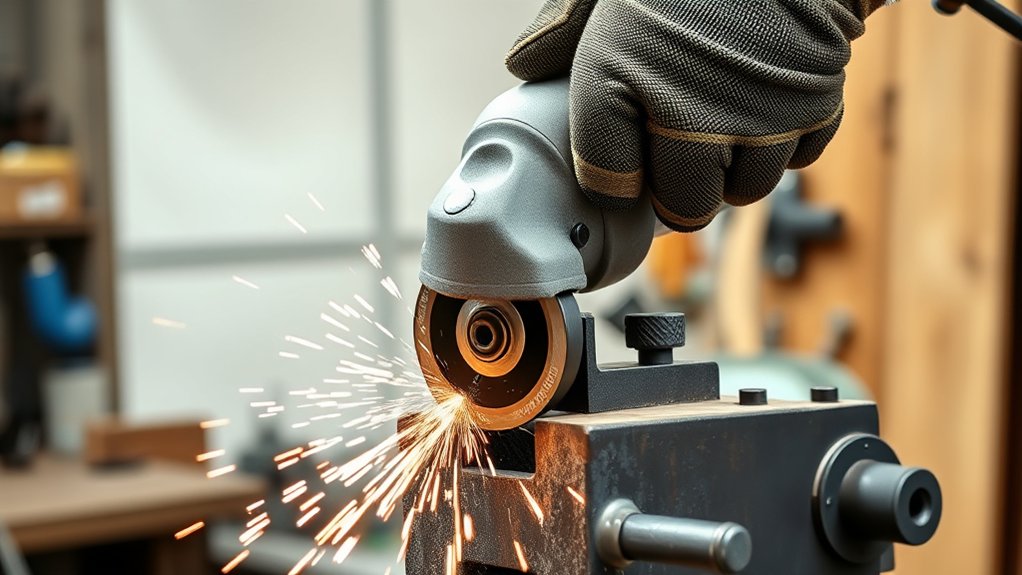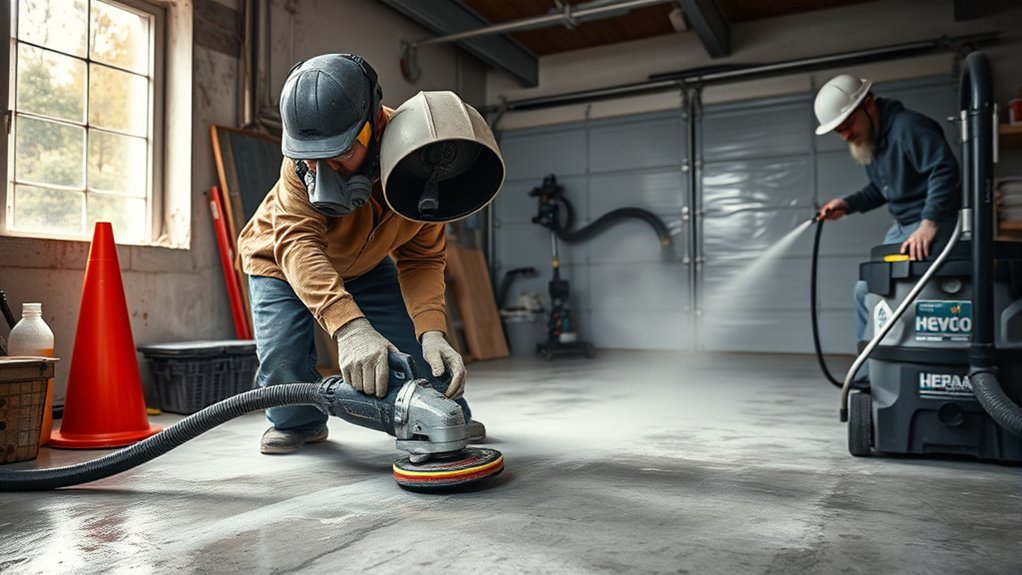
Concrete grinding can release respirable crystalline silica before the dust cloud looks serious. The safest approach is to control dust at the wheel, match the control method to the grinder and work location, protect everyone nearby, and use cleanup methods that do not put settled dust back into the air.
Quick Answer
Control silica dust at the source. For most concrete-grinding jobs, use either an OSHA Table 1-compliant water-delivery system or a shroud and dust collector matched to the grinder. Follow task-specific airflow and respirator rules, isolate the area, and clean with wet methods or a HEPA-filtered vacuum.
Key Takeaways
- Choose controls by grinder type, work location, and task duration. One setup does not fit every concrete-grinding job.
- A handheld grinder dust collector must meet OSHA Table 1 airflow and filtration requirements. A HEPA label alone is not enough.
- Wet grinding is an OSHA Table 1 option for handheld grinders used outdoors, while walk-behind floor grinders have different rules.
- Use respirators only as part of the required selection, medical evaluation, fit testing, and respiratory-protection program.
- Clean with wet methods or a HEPA-filtered vacuum. Do not let slurry dry, and do not spread dust with a broom, blower, or compressed air.
At a Glance
| Time Required | About 15 to 30 minutes for setup and testing, plus the full grinding and cleanup time |
| Difficulty | Moderate to advanced; workplace jobs require trained workers and an OSHA-compliant exposure-control approach |
| Tools Needed | Concrete grinder, correct wheel and guard, shroud and dust collector or approved water-delivery system, cleanup vacuum, PPE, barriers, and GFCI protection when water is used |
| Cost | Varies by grinder size, control system, PPE, and whether you rent or own the equipment |
What’s in This Article
- Before You Begin
- Why Silica Dust Is Dangerous
- Choose the Right Control Method
- Essential PPE for Silica Dust
- Select Grinding and Dust-Control Equipment
- Steps to Reduce Silica Dust
- Wet Grinding Techniques
- Set Up a Dust Collection System
- Maintain a Safe Workspace
- Clean Up Silica Dust and Slurry
- Training and Exposure Control
- Common Mistakes and Troubleshooting
- Frequently Asked Questions
- Conclusion
- Sources
Before You Begin
First, identify the exact task. OSHA treats handheld surface grinding, mortar removal or tuckpointing, and walk-behind floor grinding differently. Also note whether the work is outdoors, indoors, or in an enclosed area and how long workers will perform Table 1 tasks during the shift.
For occupational work, review the employer’s written exposure-control plan and the manufacturer’s instructions for the grinder, wheel, shroud, water system, and dust collector. OSHA standards apply to employers and workers; home users should still follow the same source-control principles and all equipment instructions.
Prepare these items before the wheel touches concrete:
- A concrete grinder with the correct guard and a wheel rated for the grinder, material, speed, and intended operation
- A commercially available shroud and matching dust collector, or an integrated water-delivery system allowed for the task
- Hoses, adapters, collection bags, filters, and a filter-cleaning mechanism or cyclonic pre-separator as required
- A HEPA-filtered vacuum or wet-cleanup equipment for loose dust and final cleaning
- Required respiratory protection, eye protection, hearing protection, gloves, sturdy footwear, and work clothing
- Barriers, signs, and ventilation equipment for controlling access and air movement
- A ground-fault circuit interrupter and watertight electrical connections when using water with electric equipment
Warning: Do not begin grinding if the shroud does not fit, the water system is not approved for the tool, the vacuum cannot meet the required airflow, electrical connections are not protected, or you cannot keep other people out of the dust zone.
Why Silica Dust Is Dangerous
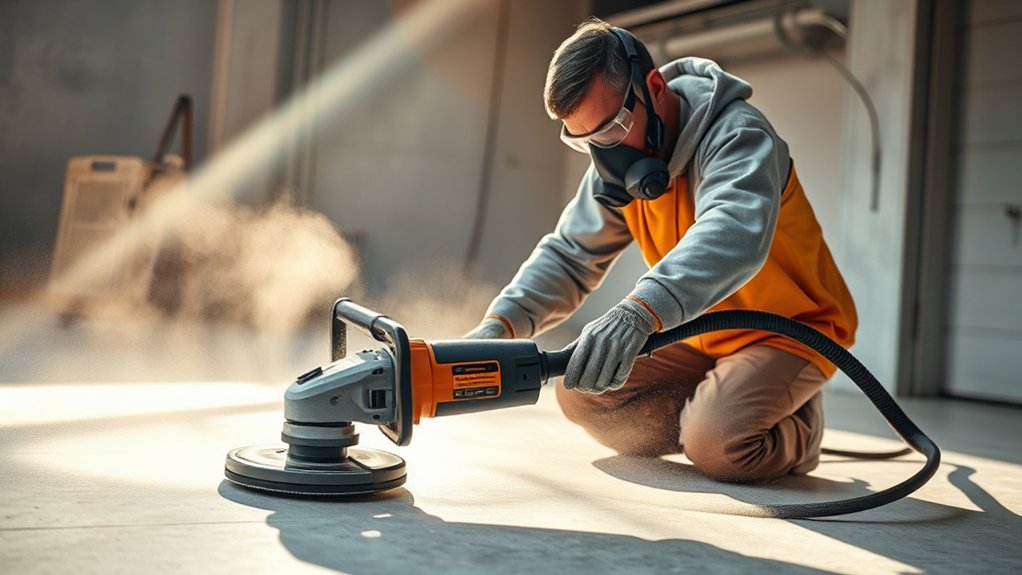
Grinding concrete can release respirable crystalline silica, a fraction of dust small enough to reach deep into the lungs. Excessive exposure can cause silicosis and is also associated with lung cancer, chronic obstructive pulmonary disease, kidney disease, and some autoimmune diseases. Silicosis has no known cure, so prevention depends on reducing exposure before damage occurs. Fine concrete dust can also irritate the eyes and airways during or soon after exposure. See the NIOSH silica health guidance.
Under OSHA’s construction standard, the action level is 25 micrograms per cubic meter of air and the permissible exposure limit is 50 micrograms per cubic meter, both calculated as an 8-hour time-weighted average. Employers that fully and properly follow the applicable Table 1 controls can use that specified-control path. Otherwise, they must assess exposure and keep it at or below the PEL through feasible engineering and work-practice controls. The requirements appear in 29 CFR 1926.1153.
NIOSH reported that uncontrolled concrete-smoothing work with handheld grinders produced exposures 35 to 55 times its recommended limit in the study it summarized. Source control at the grinder is essential.
Visible dust is a warning sign, but the absence of a visible cloud does not prove the air is safe. If dust escapes continuously, suction drops, or conditions change, stop and correct the setup before continuing.
Choose the Right Control Method
Use the task-specific controls in OSHA Table 1 instead of applying one general rule to every grinder. The table below summarizes the main concrete-grinding entries. Always read the full standard and your employer’s exposure-control plan.
| Task and Location | Specified Control | Respirator Under Table 1 |
|---|---|---|
| Handheld grinder, uses other than mortar removal, outdoors | Integrated water delivery that continuously feeds the grinding surface, or a commercially available shroud and compliant dust collector | None specified |
| Handheld grinder, uses other than mortar removal, indoors or enclosed | Commercially available shroud and dust collector providing at least 25 cfm per inch of wheel diameter, with a filter rated at 99% or greater efficiency and a cyclonic pre-separator or filter-cleaning mechanism | None for 4 hours or less; APF 10 for more than 4 hours |
| Handheld grinder used for mortar removal or tuckpointing | Commercially available shroud and dust collector providing at least 25 cfm per inch of wheel diameter, with a filter rated at 99% or greater efficiency and a cyclonic pre-separator or filter-cleaning mechanism | APF 10 for 4 hours or less; APF 25 for more than 4 hours |
| Walk-behind milling machine or floor grinder | Integrated water delivery that continuously feeds the cutting surface, or the dust-collection system recommended by the manufacturer. Indoors or enclosed, use a HEPA-filtered vacuum to remove loose dust between passes. | None specified when Table 1 is fully followed |
For the respirator-duration columns, OSHA counts the combined time spent on all Table 1 tasks during the shift. If an employer uses a different method or does not fully implement Table 1, the alternative exposure-control requirements apply, including exposure assessment where required.
Note: For handheld grinders used for surface grinding rather than mortar removal, OSHA’s integrated-water Table 1 option is for outdoor work. Indoor wet grinding may be possible with equipment designed for it, but it is not that specific Table 1 option and must be covered by a compliant alternative approach.
Essential PPE for Silica Dust
Personal protective equipment supports engineering controls. It does not replace a properly fitted shroud, continuous water delivery, adequate vacuum airflow, safe ventilation, or housekeeping.
- Respiratory protection: Use the assigned protection factor required by Table 1 or by the exposure assessment. Required respirators must be NIOSH-certified, selected for the hazard, and used under a written respiratory-protection program.
- Medical evaluation and fit testing: Before an employee is required to use a tight-fitting respirator, the employer must provide the required medical evaluation and fit test. The wearer must also perform a seal check each time the respirator is put on.
- Eye and face protection: Wear safety glasses or goggles that protect against fine dust and flying concrete fragments. Add a face shield when the task creates a greater impact or splash hazard.
- Hearing protection: Use earplugs or earmuffs when the measured or expected noise exposure requires them.
- Hands, feet, and clothing: Wear gloves suited to the tool and material, sturdy footwear, and tightly woven work clothing. Remove dusty clothing without shaking it.
A disposable N95 filtering facepiece may provide APF 10 when it is appropriate for the hazard and is properly selected, medically cleared, fit-tested, and used under the required program. The N95 label by itself does not make an unsafe grinding setup acceptable. Review OSHA’s respiratory-protection standard for program requirements.
Select Grinding and Dust-Control Equipment
Treat the grinder, wheel, guard, shroud, hose, and dust collector as one system. A mismatch at any point can reduce capture and release dust into the breathing zone.
| Component | What to Check |
|---|---|
| Grinder and guard | Correct size, intact guard, working controls, undamaged cord or battery, and compatibility with the selected shroud or water system |
| Diamond grinding wheel | Rated for concrete, the grinder’s maximum speed, the intended operation, and the wheel size specified by the tool manufacturer; replace damaged or excessively worn wheels |
| Dust shroud | Commercially available, sized for the grinder and wheel, able to stay close to the surface, and free from cracks or worn seals |
| Handheld-grinder dust collector | At least 25 cfm per inch of wheel diameter, a 99% or greater efficiency filter, and a cyclonic pre-separator or filter-cleaning mechanism |
| Floor-grinder dust collector | The airflow recommended by the manufacturer or greater, a 99% or greater efficiency filter, and a filter-cleaning mechanism |
| Hose and adapters | Tight connections, no cracks, clogs, kinks, or sharp bends, and a diameter and length that maintain the manufacturer’s required airflow |
| Variable-speed control | Use only within the wheel and tool manufacturer’s permitted range; speed control cannot compensate for weak dust collection |
| Cleanup vacuum | HEPA-filtered and maintained so collected fine dust is not exhausted back into the work area |
A standard shop vacuum should not be assumed suitable for on-tool silica control. Even a HEPA-equipped unit may fail the Table 1 requirements if it lacks the necessary airflow, filter efficiency, filter cleaning, pre-separation, or compatible shroud connection.
Products Worth Considering
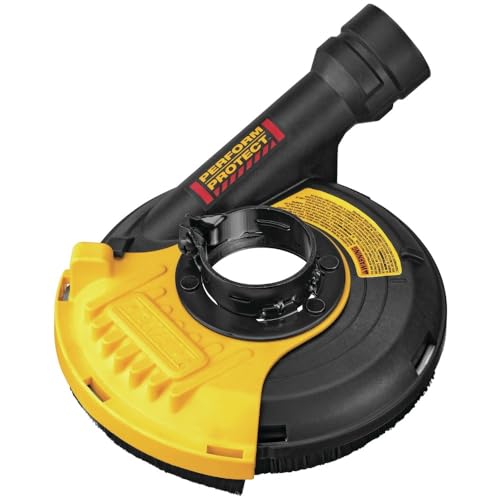
Designed to contain grinding dust

High Compatibility:Suitable for Angle Grinder under main brand 4-1/2''/5",adapt to 48-51mm Angle grinder front cap and easy to install.Allows collection of harmful dust suface grinding application.

Angle grinder dust extraction suitable for the front cover of most 48-51mm angle grinders. Can be installed on most 5"/4.5" angle grinders.The thickness of Diamond Grinding Disc should not more than 25mm or less than 15mm.
Steps to Reduce Silica Dust While Grinding Concrete
- Review the task and plan. Confirm the grinder type, material, location, expected duration, Table 1 entry, exposure-control plan, and required respirator.
- Restrict the work zone. Remove unnecessary people, protect adjacent areas and air intakes, post signs or barriers, and plan a clean path for entry and exit.
- Inspect the equipment. Check the grinder, guard, wheel, shroud, hoses, filters, water lines, cords, batteries, and connectors for damage or mismatch.
- Install the source control. Seat the shroud close to the surface or connect the approved integrated water-delivery system. Do not improvise a water feed on a dry-only tool.
- Connect and verify the dust collector. Confirm the required airflow, filter, filter-cleaning feature or pre-separator, collection capacity, and tight hose connections.
- Set up ventilation and electrical protection. Move contaminated air away from breathing zones and occupied spaces. Use GFCI protection and watertight connections when water is present.
- Put on required PPE. Wear respiratory, eye, hearing, hand, foot, and clothing protection before entering the active zone.
- Test a small area. Start the collector or water before the grinder contacts concrete. Check for escaping dust, leaks, poor shroud contact, weak suction, or unsafe slurry flow.
- Grind with controlled movement. Keep the shroud against the surface, maintain continuous water where required, and use steady pressure rather than forcing the wheel.
- Stop and correct failures. Pause if visible dust persists, the hose clogs, suction drops, water stops, the shroud lifts, the wheel vibrates, or electrical protection trips.
- Clean before removing barriers. Collect loose dust and slurry, clean the equipment and work zone safely, and remove PPE and clothing without spreading contamination.
Pro Tip: Start the dust collector or water flow before the wheel touches concrete, and keep it running briefly after the wheel stops. This helps capture the dust released at startup and shutdown.
Wet Grinding Techniques
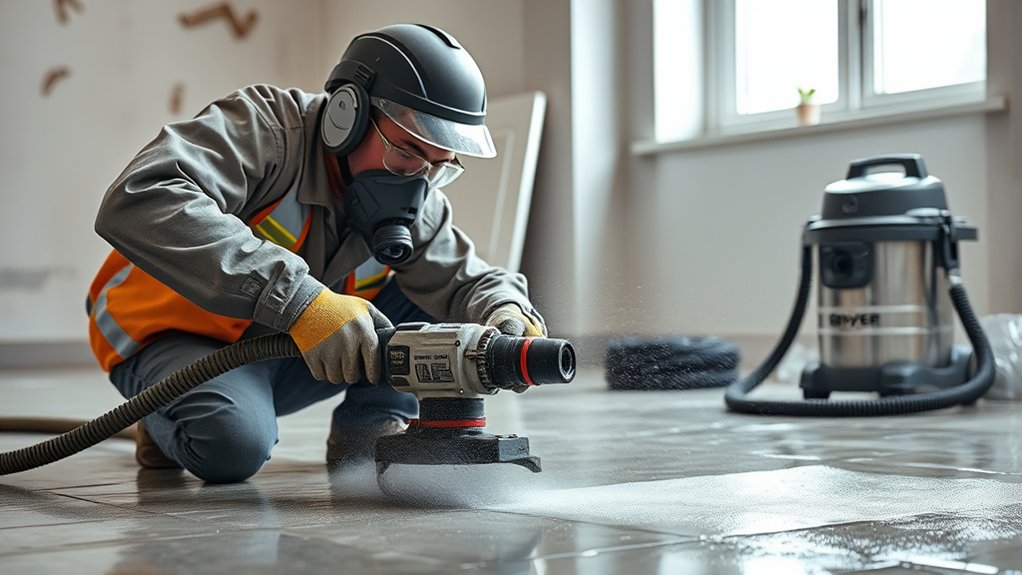
Wet grinding controls dust by delivering water continuously at the grinding surface. It can be effective, but the grinder and water-delivery system must be designed for wet use, and the method must be allowed for the task and location.
- Check that water hoses and fittings are secure and undamaged.
- Adjust the nozzle so water reaches the wheel-to-concrete contact point.
- Maintain enough flow to minimize visible dust without creating uncontrolled runoff or hiding the work surface.
- Use a GFCI and watertight, sealable electrical connectors on construction sites.
- Keep cords and connections out of standing water.
- Collect slurry before it dries and becomes a new dust source.
- Follow the manufacturer’s cleaning and maintenance schedule for the grinder and water system.
Water may also cool the grinding interface, but do not use it merely to reduce heat unless the grinder, wheel, and electrical setup are approved for wet operation.
Set Up a Dust Collection System That Works
A dust collector must capture dust at the wheel and continue moving it through the hose without losing suction. For handheld grinders covered by the Table 1 entries above, the collector must provide at least 25 cfm per inch of wheel diameter. A 5-inch wheel therefore requires at least 125 cfm.
Follow this setup sequence:
- Install the commercially available shroud specified for the grinder and wheel size.
- Connect a compatible hose with tight adapters and no cracks, clogs, kinks, or tight bends.
- Confirm the collector’s rated airflow at or above the required level for the task.
- Verify the required filter efficiency and the cyclonic pre-separator or filter-cleaning mechanism.
- Install the collection bag or container correctly and confirm it has enough capacity for the job.
- Start the collector first and check suction at the shroud before grinding.
- Watch for changes in sound, airflow, filter loading, and dust escape while working.
- Change bags and service filters in a way that limits worker contact with collected dust.
For walk-behind floor grinders, use the dust-collection system and airflow recommended by the manufacturer. Indoors or in an enclosed area, OSHA Table 1 also requires a HEPA-filtered vacuum to remove loose dust between passes. OSHA’s handheld-grinder fact sheet and floor-grinder fact sheet summarize these controls.
Products Worth Considering

Adjustable shoe provides easy depth-of-cut adjustment

Soft brushes prevent dust from escaping and help move the tool over the surface
Maintain a Safe and Ventilated Workspace
Ventilation supports source control, but it should not replace a shroud, dust collector, or continuous water delivery. The goal is to move contaminated air away from workers and prevent dust from entering occupied rooms, vehicles, break areas, or ventilation intakes.
Proper Ventilation Techniques
- Use local exhaust or portable exhaust equipment positioned to pull contaminated air away from the operator’s breathing zone.
- Provide exhaust indoors or in enclosed areas as needed to minimize visible airborne dust.
- Discharge contaminated air where it will not expose other workers or re-enter the building.
- Do not aim a fan across settled dust or directly through the grinding plume.
- Keep doors, ducts, and air paths arranged so normal movement does not defeat the airflow plan.
- Reassess the setup if doors open, walls are added, workers move, or other site conditions change.
Workspace Organization Tips
- Remove trip hazards, loose materials, and unnecessary tools from the grinding zone.
- Route hoses and cords so they do not pull the shroud away from the surface.
- Use signs or barriers to limit access to people who need to be there.
- Separate clean PPE, drinking areas, and personal items from dusty equipment.
- Plan where full bags, used filters, slurry, and disposable clothing will go before work begins.
- Clean tools and footwear before leaving so dust does not spread to vehicles or homes.
Clean Up Silica Dust and Slurry Safely
Cleanup is part of exposure control. A good grinding setup can still fail if settled dust is swept, blown, or allowed to dry and become airborne again.
- Use a HEPA-filtered vacuum, wet sweeping, wet wiping, or another method that minimizes exposure.
- Do not dry sweep or dry brush where it could add to silica exposure unless safer methods are not feasible under OSHA’s limited exception.
- Do not use compressed air on clothing or surfaces unless an effective ventilation system captures the dust cloud or no alternative is feasible.
- Do not use a leaf blower or ordinary fan to clean the floor, equipment, clothing, or filters.
- Collect wet slurry with a shovel, squeegee, or wet vacuum before it dries.
- Seal collected dust, bags, filters, and slurry containers before moving them through clean areas.
- Follow the project plan, product information, and local requirements for disposal. Do not discharge concrete slurry into drains or onto the ground unless the applicable rules allow it.
Avoid shaking dusty clothing. Use the site’s approved cleaning method, change before leaving when needed, and store contaminated workwear separately from clean clothing.
Training and Exposure Control
Workers need task-specific training before they operate a grinder around silica-containing concrete. Training should explain the health hazard, the selected control method, the limits of PPE, equipment checks, cleanup, and what to do when the control fails.
Key Training Objectives
- Recognize the hazard: Know which tasks and materials can release respirable crystalline silica.
- Select the correct control: Distinguish handheld surface grinding, tuckpointing, and walk-behind floor grinding.
- Set up equipment: Fit the shroud, verify airflow, check filters, connect water, and inspect electrical protection.
- Use PPE correctly: Understand respirator selection, medical evaluation, fit testing, seal checks, storage, and replacement.
- Respond to failures: Stop work when dust escapes, suction drops, water stops, or equipment is damaged.
- Clean safely: Use wet methods or HEPA-filtered vacuuming without spreading dust to clothing or clean areas.
Practical Demonstration Sessions
Hands-on training should show each worker how to attach the shroud, connect and test the collector, establish water flow, inspect the filter system, position ventilation, and clean the area. When exposure monitoring is required, explain what the sampler measures and how workers will receive the results.
Continuous Skills Assessment
- Observe setup and cleanup during real jobs, not only in a classroom.
- Review recurring problems such as lifted shrouds, clogged hoses, full bags, poor airflow, and rushed housekeeping.
- Repeat training when equipment, materials, work practices, or site conditions change.
- Document corrective actions and confirm that workers understand the revised process.
Written Plan, Competent Person, and Medical Surveillance
For covered construction work, the employer must establish and implement a written exposure-control plan, review it at least annually, and designate a competent person to make regular jobsite inspections. The plan must describe silica tasks, controls, housekeeping, and procedures for restricting access when needed.
OSHA also requires medical surveillance to be made available at no cost to each employee who must use a respirator under the silica standard for 30 or more days per year. The employer must provide silica hazard information and training so covered employees can explain the risks, tasks, controls, competent person, and medical-surveillance program.
Common Mistakes and Troubleshooting
Most dust-control failures come from an incorrect system, lost airflow, poor shroud contact, weak water delivery, or unsafe cleanup.
- Dry grinding without the required shroud and dust collector
- Assuming any HEPA shop vacuum meets on-tool Table 1 requirements
- Using a handheld wet-grinding setup indoors as though it were the outdoor Table 1 option
- Choosing a collector with too little airflow for the wheel diameter
- Running with a clogged filter, full bag, damaged hose, or loose adapter
- Lifting the shroud to reach an edge without another compliant control method
- Using compressed air, a dry broom, or a blower for cleanup
- Allowing slurry to dry on the floor or equipment
- Letting untrained people enter or work inside the active dust zone
| Problem | Likely Cause | Corrective Action |
|---|---|---|
| Dust escapes around the wheel | Poor shroud contact, worn seal, wrong shroud, weak suction, or blocked hose | Stop, inspect fit and airflow, clear the hose, service the filter, and replace damaged parts |
| Suction drops during grinding | Loaded filter, full bag, kinked hose, leak, or failing filter-cleaning system | Stop work, isolate the collector, clean or replace components as instructed, and retest before restarting |
| Visible dust appears with wet grinding | Low water flow, blocked nozzle, poor nozzle position, or interrupted supply | Stop the wheel, restore continuous water at the contact point, and test again |
| Slurry spreads into clean areas | Too much water, no containment, or delayed pickup | Reduce flow while maintaining dust control, add containment, and collect slurry promptly |
| Dust increases near an edge or corner | The shroud no longer seals against the surface | Use an approved edge-grinding shroud or another compliant method rather than lifting the shroud |
Frequently Asked Questions
How do you minimize dust when grinding concrete?
Control dust at the wheel with the task-specific water-delivery or vacuum system, keep other people out of the area, use any required respirator and PPE, provide suitable ventilation, and clean with wet methods or a HEPA-filtered vacuum.
What are the OSHA guidelines for silica dust?
For construction, OSHA sets an action level of 25 micrograms per cubic meter and a PEL of 50 micrograms per cubic meter as 8-hour time-weighted averages. Employers may fully follow the applicable Table 1 controls or use the alternative exposure-control path with exposure assessment and feasible controls.
Can you grind concrete without water?
Yes, when the task uses a compliant shroud and dust-collection system or another properly assessed control method. Dry grinding without effective source control can create very high silica exposure.
Does a regular shop vacuum remove silica dust?
Do not assume it does. On-tool control requires the airflow, filtration, filter cleaning or pre-separation, and shroud compatibility specified for the task. Cleanup should use a properly maintained HEPA-filtered vacuum or wet method.
Does grinding concrete cause silica dust?
It can. Concrete commonly contains silica-bearing aggregate, and grinding can release respirable crystalline silica. Treat the material as a potential silica source unless reliable product or test information shows otherwise.
How much vacuum airflow does a handheld grinder need?
The OSHA Table 1 entries for handheld grinders require at least 25 cfm per inch of wheel diameter. A 5-inch wheel requires at least 125 cfm, along with the specified filter efficiency and pre-separator or filter-cleaning feature.
Do you always need a respirator when grinding concrete?
No. Table 1 respirator requirements depend on the task, location, and shift duration. A respirator is required when Table 1 specifies one or when engineering and work-practice controls cannot keep exposure at or below the PEL. Required use must follow OSHA’s respiratory-protection program rules.
Can you wet grind concrete indoors?
A walk-behind floor grinder may use integrated water delivery under its Table 1 entry. For a handheld grinder used for tasks other than mortar removal, the Table 1 water option is outdoors only. Any indoor wet handheld method must be supported by the applicable alternative exposure-control approach and equipment instructions.
Safety Disclaimer: This article provides general information and does not replace OSHA requirements, the employer’s written exposure-control plan, equipment instructions, exposure assessment, or advice from a qualified industrial hygienist or safety professional.
Conclusion
The most reliable way to reduce silica dust while grinding concrete is to stop it at the source. Match the control to the exact grinder and task, verify airflow or water delivery before starting, use the respirator specified by Table 1 or the exposure assessment, and stop work when the control fails.
Finish the job with the same care. Collect dust with a HEPA-filtered vacuum or wet method, remove slurry before it dries, and keep contaminated clothing and equipment out of clean areas. A short setup and cleanup check protects your lungs, your team, and the rest of the worksite.
Sources
- OSHA, 29 CFR 1926.1153: Respirable Crystalline Silica — PEL, action level, Table 1 controls, housekeeping, plans, training, and medical surveillance
- OSHA, Handheld Grinders for Tasks Other Than Mortar Removal — water, vacuum, airflow, electrical safety, respirator, and indoor-control guidance
- OSHA, Walk-Behind Milling Machines and Floor Grinders — wet methods, dust collection, HEPA cleanup between passes, and ventilation
- OSHA, 29 CFR 1910.134: Respiratory Protection — respirator selection, medical evaluation, fit testing, and written programs
- NIOSH, Control of Crystalline Silica Dust When Grinding Concrete — exposure findings and local-exhaust control research
- NIOSH, Silica Symptoms and Medical Monitoring — silicosis and other health effects