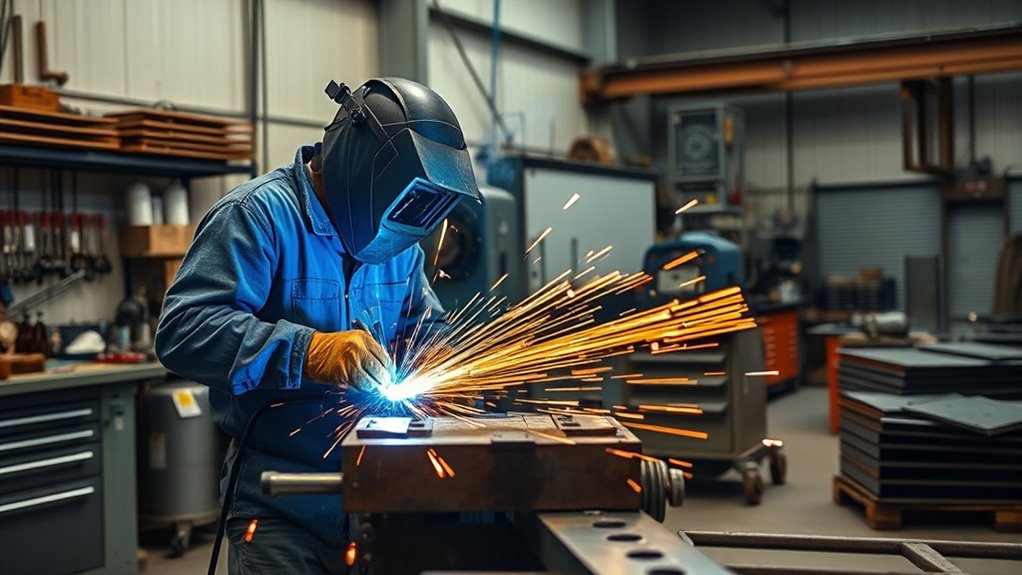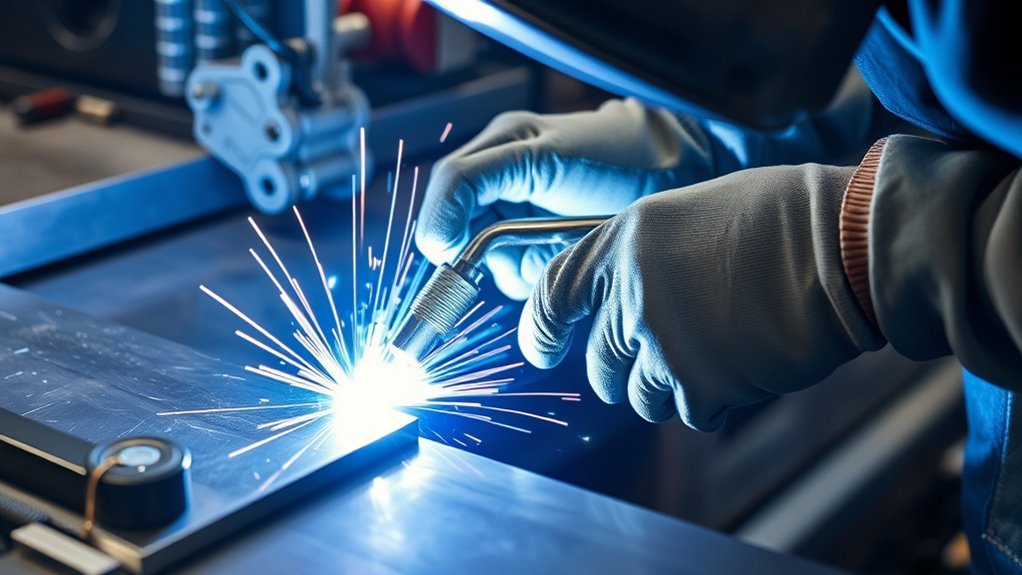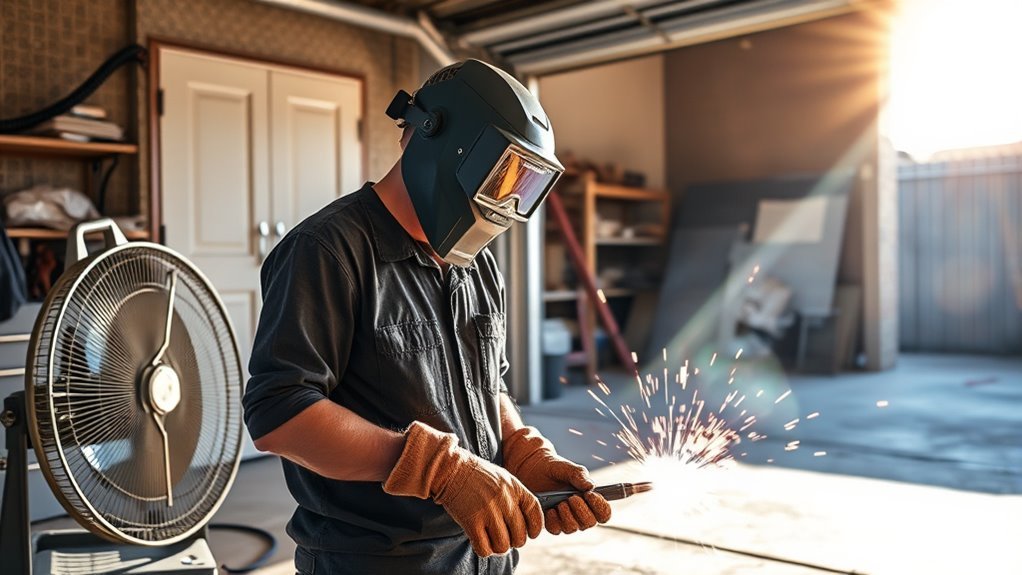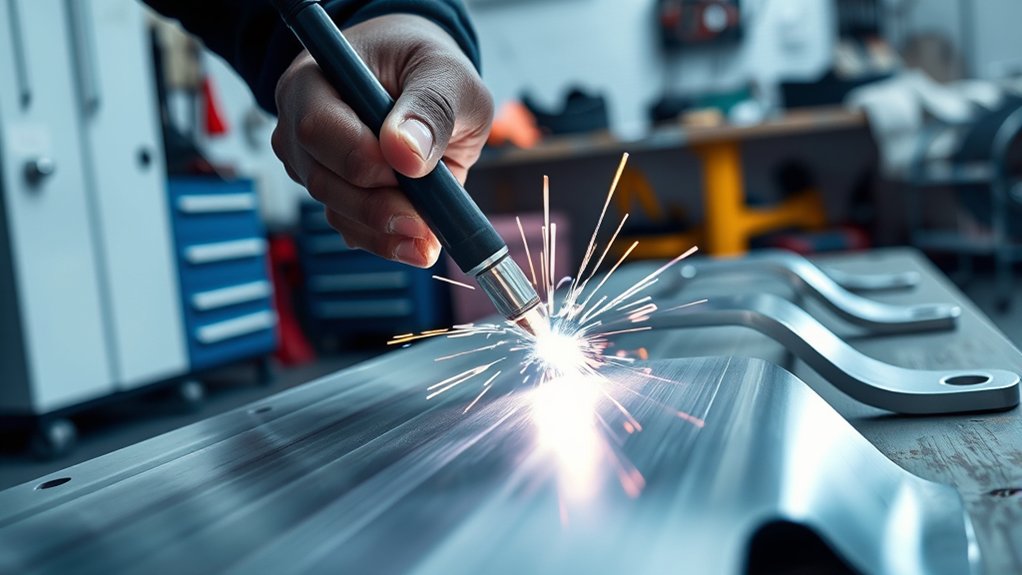
TIG welding thin aluminum automotive parts can produce clean, precise joints, but only when the repair method is allowed for that part. Thin aluminum spreads heat quickly, hides its molten edge, and can lose strength or distort if you stay in one place too long. Start by checking the vehicle maker’s repair procedure, then control cleanliness, fit-up, shielding gas, arc length, and pedal input.
Quick Answer
To TIG weld a thin aluminum automotive part, first confirm that TIG is an approved repair method. Use AC, 100% argon, a clean ceriated or lanthanated tungsten, tight fit-up, and a foot pedal. Keep a short arc, push the torch 5 to 15 degrees, and add small filler dabs at the leading edge of the puddle.
Key Takeaways
- Check the OEM body repair manual before welding. Many structural collision repairs require a different joining method, such as pulse GMAW, rivet bonding, or part replacement.
- Use AC TIG, 100% argon, clean aluminum, and a remote amperage control.
- Degrease first, remove oxide with aluminum-only tools, and keep filler rod clean.
- Use a short arc, steady travel, small filler dabs, and less pedal as the panel heats up.
- Practice on matching scrap and inspect the back side, crater, distortion, and fusion before accepting the repair.
At a Glance
| Time Required | 30 to 60 minutes for setup and scrap practice, plus repair and inspection time |
| Difficulty | Advanced beginner to experienced, depending on thickness, access, and repair type |
| Tools Needed | AC/DC TIG welder, pedal or fingertip control, argon, torch, suitable tungsten, filler rod, cleaning tools, clamps, and PPE |
| Cost | Varies by welder, gas, filler, consumables, and whether OEM training or certified repair equipment is required |
Warning: Do not TIG weld a structural body, suspension, restraint, battery enclosure, fuel-system, pressure, or safety-critical part unless the vehicle maker or an approved repair procedure specifically permits it. Remove fire hazards, protect electronics, use proper ventilation and PPE, and follow the welder manual and local hot-work rules.
Estimated Time and Before You Begin
Plan for 30 to 60 minutes of setup and practice before you weld the actual automotive part. The repair itself may take longer because thin aluminum needs careful cleaning, fit-up, tacking, cooling, and inspection.
Before you begin, identify the part, alloy if known, thickness, coating, joint type, and service conditions. Match the filler rod to the aluminum alloy and repair goal when possible. Test the complete setup on scrap aluminum with the same alloy, thickness, joint, orientation, and backing before touching the final part.
Confirm That TIG Is an Approved Repair Method
TIG is useful for controlled fabrication and for some removable, non-structural aluminum parts. It is not automatically acceptable for collision repair. I-CAR’s welding guidance notes that safe vehicle repairs depend on OEM procedures and that aluminum collision repairs commonly use OEM-approved pulse GMAW processes instead of TIG. Review the vehicle maker’s body repair manual before choosing the process, filler alloy, joint design, or heat input.
Note: A neat-looking bead does not prove that a vehicle repair is safe. The approved joining method, heat-affected zone, corrosion protection, and inspection requirements matter as much as bead appearance.
Key Equipment Needed for Successful TIG Welding of Aluminum
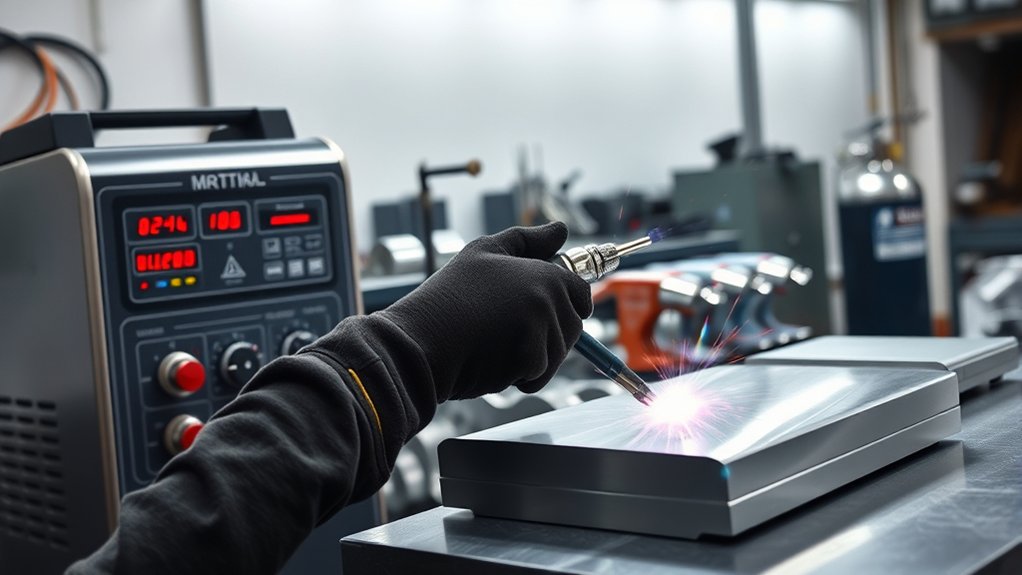
Use a TIG welder with AC output because the electrode-positive part of the AC cycle helps remove aluminum oxide while the electrode-negative part directs more heat into the work. Modern AC balance and frequency controls can help you tailor cleaning and arc focus, but they do not replace surface preparation. Miller’s AC balance guide recommends cleaning first and using the machine controls as the final adjustment.
Use 100% argon for most thin aluminum TIG work. An argon and helium blend can add heat for thicker sections, but it is usually unnecessary for thin automotive sheet. A foot pedal or fingertip remote lets you start the puddle quickly and reduce current as heat builds.
Choose a tungsten that matches your machine and current range. Two-percent ceriated or lanthanated tungsten is a practical choice for many inverter AC machines. Pure tungsten is mainly associated with older transformer machines. Thoriated tungsten can work in some applications, but it contains thorium and creates avoidable dust concerns during grinding. The ATSDR toxicological profile for thorium notes occupational exposure potential during thoriated-tungsten grinding, so many shops choose non-thoriated alternatives.
Products Worth Considering

【Born for Aluminum Welding】AC TIG mode is perfect for dealing with Aluminum and Aluminium alloy.

Large LED Display: Features a large LED screen for enhanced visibility and a clear display of welding parameters and settings. Its intuitive interface ensures effortless operation, enabling precise welding of diverse metals

6-in-1 Welding Modes: The TOOLIOM TL-200TP ACDC PRO welder features six versatile welding modes: AC TIG, DC TIG, AC Pulsed TIG, DC Pulsed TIG, Stick, and TIG Spot Welding, making it suitable for a wide range of welding applications and conditions.
What You’ll Need
- AC/DC TIG welder with high-frequency start and a foot pedal or fingertip remote
- 100% argon cylinder, regulator or flowmeter, and leak-free gas hoses
- Air-cooled or water-cooled TIG torch sized for the required current
- Suitable ceriated or lanthanated tungsten, often 1/16 inch for very thin work or 3/32 inch for higher current
- ER4043, ER5356, or the OEM-specified aluminum filler rod
- Correct collet, collet body or gas lens, and a clean ceramic cup
- Dedicated stainless steel brush and non-ferrous abrasive tools used only on aluminum
- Acetone or another approved non-chlorinated aluminum cleaner
- Clean lint-free wipes, clean gloves, clamps, and matching scrap aluminum
- Copper or aluminum backing bar when the joint design allows it
- Welding helmet, safety glasses, leather gloves, flame-resistant clothing, hearing protection, and suitable respiratory protection when required
- Fire extinguisher, welding blanket, and fire-watch equipment for vehicle work
Products Worth Considering

Complete Set for Practice: you will get 3 welding coupons with 3 different styles: 2 square dice and 1 triangular dice, enriching your welding experience; This assures you of getting a comprehensive array of shapes to meet your individual creative needs

Complete 123-Piece Set:All necessary TIG torch accessories and consumables for WP-17, WP-18, and WP-26 torches.

Detailed Dimensions with Ample Quantity: Our package includes 20 pieces of aluminum sheet welding kit, each crafted to precise dimensions of 2 x 4 inches (5 x 10 cm) with a thickness of 1/8 inches (3 mm). These plates are perfect for tasks demanding precision, such as laser cutting and professional welding, delivering consistent results every time.
Protect the Vehicle and Work Area Before Welding
Vehicle preparation is different from bench fabrication. Heat, ultraviolet light, sparks, and welding current can damage trim, glass, sealers, wiring, modules, batteries, sensors, and nearby coatings. Follow the OEM shutdown and battery-disconnect procedure, especially on hybrid and electric vehicles. Do not guess at high-voltage isolation steps.
- Move the part off the vehicle when possible. Bench welding gives you better access, shielding, cleaning, and fire control.
- Remove nearby combustible materials. Take out foam, seam sealer, adhesive, sound deadener, trim, carpet, and undercoating as directed by the repair procedure.
- Protect electronics. Disconnect power and remove or shield nearby modules, wiring, sensors, and batteries according to OEM instructions.
- Place the work clamp close to the weld. Attach it to clean metal on the part or approved work surface so welding current has a short, controlled return path.
- Provide ventilation. Position local exhaust so it removes fumes without pulling shielding gas away from the puddle.
- Prepare for fire. Keep an extinguisher ready and inspect hidden areas during and after welding. OSHA’s welding and hot-work standard requires a fire watch in conditions where more than a minor fire could develop.
Choose the Right Filler Metal for the Aluminum Alloy
ER4043 and ER5356 are common aluminum filler rods, but they are not interchangeable in every repair. ER4043 is an aluminum-silicon filler that flows easily and is widely used with many 6xxx-series alloys. ER5356 is an aluminum-magnesium filler often selected for many 5xxx-series alloys and for some 6xxx-series applications that need different strength, ductility, or finish characteristics. Lincoln Electric’s TIG aluminum guidance lists both as common filler families while stressing alloy-dependent selection.
The correct choice depends on the base alloy, desired strength, crack resistance, service temperature, corrosion exposure, anodized color match, and OEM procedure. When the alloy is unknown, do not choose filler only by bead appearance. Use the vehicle maker’s repair information or a verified filler rod selection guide, then confirm the choice on matching scrap.
How to Prepare Your Aluminum Surface for TIG Welding
Surface preparation has a direct effect on fusion, porosity, arc stability, and bead appearance. Aluminum oxide melts at a much higher temperature than the aluminum under it, so the surface must be cleaned before AC cleaning action can finish the job.
- Remove coatings as required. Strip paint, primer, adhesive, oxidation, and sealers far enough from the joint to meet the repair procedure and prevent fumes or contamination.
- Degrease before brushing. Wipe oil, wax, silicone, grease, and dirt away with acetone or an approved aluminum cleaner. Use clean lint-free wipes and let the solvent fully evaporate.
- Never use chlorinated brake cleaner near welding. OSHA warns that chlorinated degreasing vapors must be kept away from gas-shielded welding and its ultraviolet radiation.
- Remove oxide with aluminum-only tools. Use a dedicated stainless steel brush, clean hand file, carbide burr, or approved non-ferrous abrasive. Brush in one direction with light pressure.
- Clean the filler rod. Wipe the rod with an approved cleaner if it has been handled or exposed to shop dirt.
- Assemble and weld soon after cleaning. Wear clean gloves so you do not put skin oil back on the joint.
Check both joint edges for burrs, cracks, corrosion, and uneven gaps. Smooth, square edges make the puddle easier to control. Do not use a carbon-steel brush or a sanding disc that has touched steel because it can embed contamination in the aluminum.
Starting AC TIG Settings for Thin Aluminum
No single amperage formula works for every thin aluminum automotive part. Joint type, alloy, machine waveform, AC balance, fit-up, backing, torch access, and operator speed all change the result. Use the settings chart in your welder manual or the Miller TIG welding calculator, then test on matching scrap.
| Setting | Practical Starting Point | What to Watch |
| Polarity | AC | DCEN does not provide the normal AC oxide-cleaning action used for this work. |
| Shielding Gas | 100% argon, often about 15 to 20 CFH | Too much flow can create turbulence and pull air into the shield. |
| AC Balance | About 75% EN on clean aluminum, or the machine’s preset | Peppering can mean more cleaning is needed. Excess EP overheats and erodes the tungsten. |
| AC Frequency | Start at the factory default | Higher frequency narrows and focuses the arc; lower frequency makes it wider. |
| Tungsten | Ceriated or lanthanated, sized to the current | A contaminated, split, or oversized tip makes low-current starts less stable. |
| Amperage | Set a maximum that forms the puddle promptly, then control actual current with the pedal | A slow puddle start can soak the whole panel with heat. Too much current causes a wide puddle and burn-through. |
| Pulse | Optional; start with it off unless your procedure or practice coupon shows a clear benefit | Pulse can help rhythm and average heat input, but poor fit-up or technique still causes defects. |
Treat every machine setting as a starting point. The matching scrap coupon tells you more than a generic amperage rule.
Steps to TIG Weld Thin Aluminum Automotive Parts
- Verify the repair method. Confirm that TIG, the joint design, and the filler alloy are allowed for the part.
- Protect the vehicle and work area. Remove fire hazards, follow battery and high-voltage shutdown procedures, and provide ventilation.
- Clean the base metal and filler. Degrease first, then remove oxide with aluminum-only tools.
- Fit the joint tightly. Align the edges and keep the gap as small and even as the approved joint design requires.
- Clamp and support the panel. Use a backing bar or heat sink only when it does not change the required penetration or joint profile.
- Set up AC TIG mode. Use 100% argon, the correct tungsten, and the machine’s recommended starting controls.
- Run a complete scrap test. Copy the real joint, orientation, backing, tack spacing, and travel direction.
- Tack in a balanced sequence. Place small tacks at intervals that hold alignment without creating large heat spots.
- Start the puddle promptly. Use enough pedal to form a small shiny puddle, then begin moving.
- Hold a short, steady arc. Keep the tungsten roughly 1/16 to 1/8 inch from the work without touching it.
- Add filler at the leading edge. Dab small amounts while the torch moves forward.
- Reduce current as heat builds. Back off the pedal before the puddle grows wider than the joint.
- Fill the crater. Add a final small dab while tapering the current down so the end does not sink or crack.
- Let the part cool naturally. Do not quench the weld unless an approved procedure specifically calls for it.
- Inspect and protect the repair. Check fusion, porosity, cracks, distortion, and the back side, then restore corrosion protection as required.
How to Control Heat and the Weld Puddle
Thin aluminum pulls heat away quickly at the start, then becomes easier to overheat as the weld continues. Set enough maximum current to establish the puddle without waiting, but use the pedal to control the current you actually deliver. As the panel warms, reduce pedal pressure and keep moving.
Build a puddle that matches the joint instead of a large puddle that spreads across the panel. Hold the torch with a slight backward tilt of about 5 to 15 degrees and push it in the direction of travel. Keep the tungsten close, usually about 1/16 to 1/8 inch from the workpiece for thin material. A long arc widens the heat pattern, raises voltage, and makes the puddle harder to direct.
Brace your torch hand so the arc length stays steady. Watch the front and both sides of the puddle, not the bright center of the arc. If one edge does not wet in, correct the torch position or joint fit-up instead of washing a large arc across the panel.
Pro Tip: If the puddle starts to widen faster than your travel speed, back off the pedal before adding more filler. Filler can cool the puddle briefly, but it should not be used to hide excessive heat.
Steps to Effectively Introduce Filler Metal
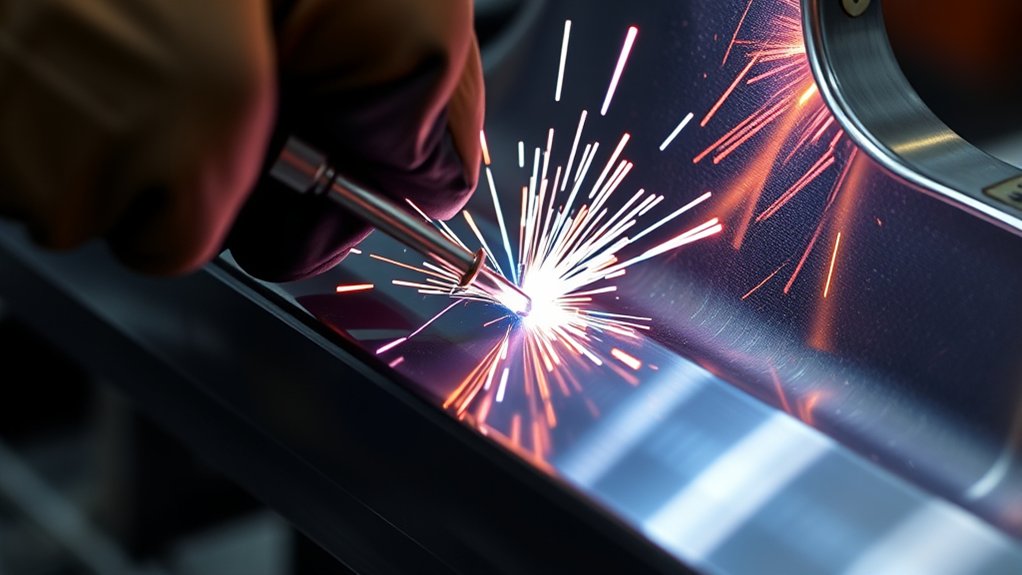
Hold the filler rod low, close to the joint, and inside the shielding-gas envelope. Keep the torch and filler in roughly a 90-degree relationship, with the filler rod about 10 to 20 degrees above the work surface. Feed the rod into the leading edge of the puddle, not into the arc and not far ahead on cold metal.
- Form a small shiny puddle. Do not add filler while a dull oxide skin still covers the joint.
- Move the torch slightly forward. Keep the arc centered on the joint.
- Dab a small amount of filler. Touch the rod to the front edge of the puddle and withdraw it without pulling it out of the gas shield.
- Repeat with a steady rhythm. Coordinate torch travel, pedal pressure, and filler dabs instead of moving both hands at once.
- Keep the rod end clean. If it touches the tungsten, bench, glove, or dirty surface, clip or clean the end before continuing.
Use a filler diameter that melts without forcing you to pause. A rod that is too large can chill the puddle and require extra heat; a rod that is too small may require too many dabs and can be harder to control.
Control Fit-Up, Tacks, and Panel Distortion
Tight, even fit-up is critical because thin aluminum edges can melt back before a wide gap closes. Clean and align the joint before clamping. Do not force misaligned panels together with weld metal.
- Butt joints: Keep the root gap uniform and use backing only if the repair procedure allows it.
- Lap joints: Remove contamination between the sheets and direct the arc so both edges fuse without melting away the top sheet.
- Fillet joints: Aim the arc at the root and confirm that both members wet in.
- Tack sequence: Use small, spaced tacks and alternate locations to hold alignment while spreading heat.
- Weld sequence: Use short sections or skip around only when that sequence is allowed and does not create start-stop defects in a critical area.
A copper backing bar can support the puddle and draw away heat, but it may also change penetration and bead shape. Treat it as part of the tested procedure, not as an automatic cure for burn-through.
How to Fix Common TIG Welding Problems on Thin Aluminum
Thin aluminum usually shows problems quickly. Stop and correct the cause instead of continuing over a dirty, unstable, or overheated puddle.
| Problem | Likely Causes | Fix |
| Burn-through or collapsing edge | Too much current, slow travel, long arc, wide gap, or heat buildup | Reduce pedal, shorten the arc, improve fit-up, move faster, and retest the sequence on scrap. |
| Black soot or peppering | Dirty metal or filler, poor gas coverage, wrong polarity, or insufficient cleaning action | Stop, clean again, confirm AC, check gas type and leaks, shorten the arc, and adjust AC balance only after cleaning. |
| Porosity or pinholes | Oil, moisture, coating residue, drafts, gas leaks, or turbulent gas flow | Remove the defective weld as the procedure allows, clean the joint, stop drafts, repair leaks, and use the correct flow. |
| No puddle or lack of fusion | Maximum current too low, arc too long, poor work connection, oxide, or incorrect torch aim | Improve the connection and cleaning, shorten the arc, increase the starting maximum, and aim at the joint root. |
| Tungsten balls, splits, or burns back | Too much EP, tungsten too small, poor gas coverage, wrong preparation, or contamination | Regrind with a dedicated wheel, correct the size and gas flow, and move the balance toward more EN if the metal is already clean. |
| Crater crack at the end | Current stopped too quickly or crater left underfilled | Add a final filler dab while tapering the current down or use the welder’s crater-control function. |
| Panel warping | Long continuous passes, poor clamping, uneven tack pattern, or excess heat | Use the approved weld sequence, improve support, reduce heat input, and allow natural cooling between sections. |
For additional process-specific practice, review these TIG welding aluminum tips and tricks.
Common Mistakes to Avoid
- Welding before confirming that TIG is permitted for the automotive part
- Starting the weld before removing coating, oil, oxide, and sealer contamination
- Using a carbon-steel brush or shared abrasive on aluminum
- Using chlorinated brake cleaner near the welding area
- Holding the tungsten too far from the workpiece
- Trying to run low maximum amperage so slowly that the whole panel heat-soaks
- Moving too slowly after the aluminum becomes hot
- Adding filler outside the leading edge of the puddle
- Pulling the filler rod completely out of the shielding gas between dabs
- Stopping the arc suddenly and leaving an unfilled crater
- Quenching the weld to make it cool faster
- Judging a safety-critical repair only by how smooth the bead looks
Inspect and Finish the Repair
Let the part cool naturally, then inspect it under good light. Look for cracks, crater defects, pinholes, soot, undercut, overlap, missed edges, and uneven bead width. Check the back side when accessible. A cosmetic bead can still hide incomplete fusion.
Compare the finished joint with the approved practice coupon and OEM acceptance criteria. Leak-test tanks or fluid parts only with an approved low-pressure method. Do not pressure-test a repaired part with compressed air unless the procedure specifically allows it and provides safe containment.
Remove only the weld reinforcement that the repair procedure permits. Over-grinding can thin the parent metal and erase evidence of undercut or poor fusion. Restore primer, seam sealer, cavity wax, paint, and galvanic isolation exactly as the vehicle maker requires.
Frequently Asked Questions
Can You TIG Weld Thin Aluminum?
Yes. TIG gives precise heat and filler control on thin aluminum, but automotive use depends on the part and repair procedure. Use AC, clean metal, 100% argon, remote amperage control, tight fit-up, and matching scrap practice.
What Is the Thinnest Aluminum You Can TIG Weld?
There is no universal minimum. Skilled welders with a stable low-amperage inverter, small tungsten, tight fit-up, and good backing may weld aluminum near 0.020 inch, but that is an advanced task. The practical limit depends on the machine, alloy, joint, access, and operator control.
How Many Amps Do You Need to Weld 2mm Aluminum?
A maximum setting around 80 to 100 amps is a common trial range for 2mm aluminum, but it is not a fixed rule. Set enough maximum current to form the puddle promptly, control the actual current with the pedal, and confirm the result on matching scrap. Joint type, backing, AC balance, and travel speed can change the needed current.
What Is the Rule of 33 in TIG Welding?
There is no recognized TIG rule that says to use 33 amps per 1/8 inch of aluminum. That value is far too low for most 1/8-inch aluminum joints and should not guide setup. Use the welder manufacturer’s chart or calculator, then verify the settings on a matching practice coupon.
Why Does My Aluminum TIG Weld Look Black or Sooty?
Black soot or peppering usually points to contamination, poor gas coverage, wrong polarity, too much torch angle, a long arc, or insufficient AC cleaning. Stop, clean the metal and filler, confirm 100% argon and AC, check for leaks or drafts, and retest before continuing.
Can You TIG Weld a Structural Aluminum Body Panel?
Only when the vehicle maker’s repair information specifically approves TIG for that part and joint. Many structural aluminum collision repairs use OEM-approved pulse GMAW, rivet bonding, adhesive bonding, or complete part replacement. A qualified collision technician should handle safety-critical repairs.
Should You Use ER4043 or ER5356 Filler Rod?
Choose filler by base alloy and repair requirements, not by habit. ER4043 is common with many 6xxx-series alloys and flows easily. ER5356 is common with many 5xxx-series alloys and some 6xxx applications. Follow the OEM procedure or a verified filler chart when strength, corrosion, appearance, or service temperature matters.
Does Pulse TIG Prevent Burn-Through?
Pulse TIG can lower average heat input and make filler timing easier, but it does not fix a wide gap, dirty metal, a long arc, or slow travel. Learn to control a stable puddle first, then compare pulse settings on matching scrap before using them on the part.
Safety Disclaimer: This article is for informational purposes only and does not replace professional welding training, OEM body repair information, approved repair standards, equipment manuals, or workplace safety rules. Use proper PPE and ventilation, and consult a qualified welding or collision-repair professional for structural, fuel-system, pressure, high-voltage, restraint, suspension, or other safety-critical repairs.
Conclusion
Strong TIG welds on thin aluminum automotive parts come from the right repair method, clean metal, tight fit-up, steady heat control, and careful filler timing. Confirm OEM approval first, protect the vehicle, and prove the settings on matching scrap. Keep the arc short, push the torch, reduce pedal pressure as heat builds, and fill the ending crater. After welding, inspect the joint and restore every required corrosion-protection layer before returning the part to service.
Sources
- Miller, TIG Welding Aluminum for Beginners — torch angle, close arc control, filler position, and practice technique
- Miller, AC Balance Control for TIG Aluminum — oxide cleaning, EN and EP balance, and manual cleaning
- Miller, Common TIG Welding Problems — gas flow, polarity, porosity, crater control, arc length, and excessive heat
- Lincoln Electric, The Best Way to Clean Aluminum Before Welding — degreasing and oxide-removal order
- OSHA 29 CFR 1910.252 — hot-work fire prevention, PPE, ventilation, and cleaning-compound precautions
- I-CAR, Vehicle Protection When Welding — protecting trim, coatings, electronics, batteries, and nearby vehicle components