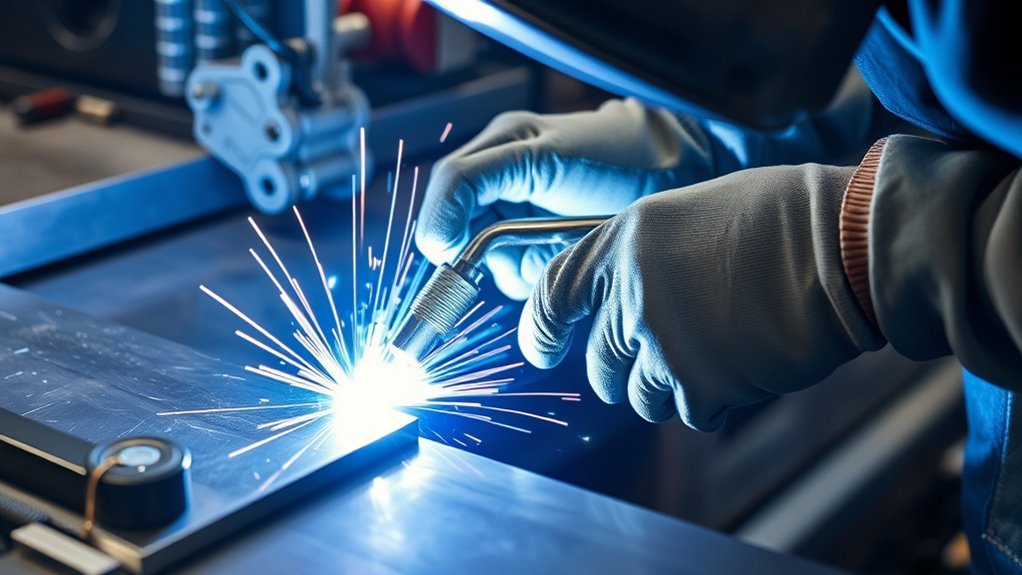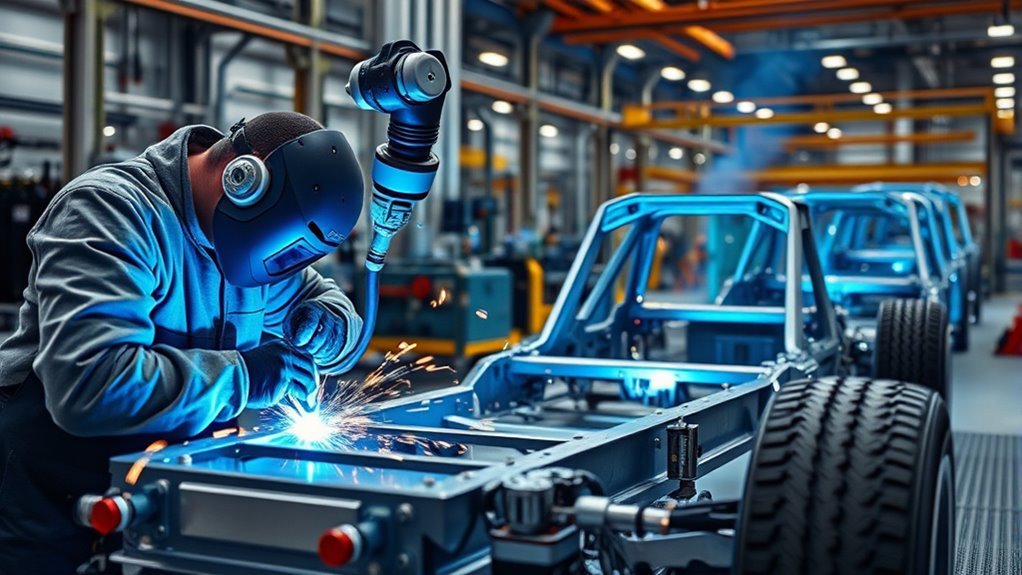
You use welding in electric vehicle production to join battery tabs, bus bars, enclosures, cooling parts, power-electronics housings, and lightweight structures that must carry current, resist vibration, seal out moisture, and survive years of heat cycling. The right welding method depends on the material, joint shape, heat sensitivity, electrical-resistance target, and production speed.
Quick Answer
Welding is used in EV batteries, bus bars, motor and power-electronics connections, sealed enclosures, cooling-system plastics, and lightweight structures. Laser, resistance spot, ultrasonic, friction, infrared, hot plate, and spin welding are chosen by material, heat sensitivity, conductivity, leak-tightness, joint shape, and production speed.
Key Takeaways
- Battery tabs and bus bars need welds with low electrical resistance, strong mechanical retention, and controlled heat input.
- Laser welding is common for precise, fast battery and enclosure joints, but dissimilar metals still need careful process validation.
- Resistance spot welding is useful for high-volume metal strip and tab joining when materials, force, current, and timing are tightly controlled.
- Ultrasonic welding helps join thin metals, foils, wires, thermoplastics, and sensitive assemblies with less heat than many fusion processes.
- Infrared, hot plate, and spin welding are mainly used for plastic EV parts such as cooling components, housings, ducts, and reservoirs.
- EV welds should be checked with electrical, mechanical, visual, leak, and traceability controls before they are trusted in production.
EV Welding in Production
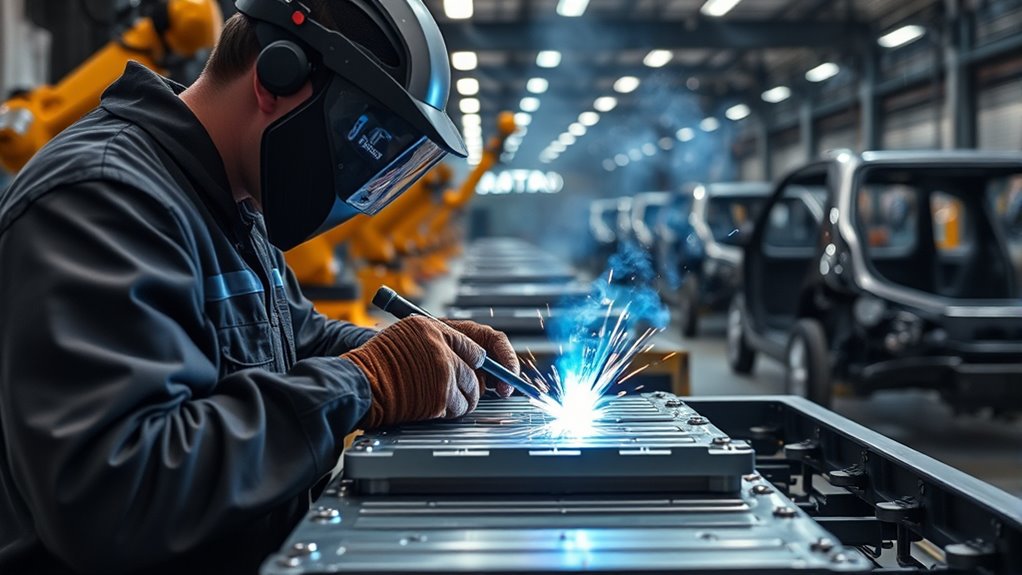
In EV production, welding is used anywhere a joint has to do more than simply hold two parts together. A battery weld may need to carry high current. An enclosure weld may need to keep moisture out. A structural weld may need to support crash loads, fatigue loads, and corrosion protection.
Modern electric vehicles rely heavily on lithium-ion battery systems because they offer high energy density, strong power-to-weight performance, and good efficiency for vehicle use, according to the U.S. Department of Energy Alternative Fuels Data Center. That puts extra pressure on every welded joint around the battery pack, because a weak connection can affect heat, voltage drop, service life, and safety.
You’ll see welding in these EV areas:
- Battery cells, tabs, and bus bars: low-resistance electrical connections that must stay stable under vibration and thermal cycling.
- Battery enclosures and covers: sealed joints that help protect electronics from water, dust, and corrosion.
- Cooling system parts: plastic or metal joints used in coolant paths, manifolds, reservoirs, and thermal-management assemblies.
- Power electronics and motor assemblies: conductive and structural joints around inverters, terminals, housings, and brackets.
- Lightweight structures: aluminum, steel, and mixed-material parts where strength and mass both matter.
EV Welding Process Selection
No single welding process is best for every EV part. The best choice depends on whether you are joining thin battery tabs, copper bus bars, aluminum structures, thermoplastic housings, or circular plastic components.
| EV Component | Common Welding Method | Why It Fits | Main Control Point |
| Cell tabs and nickel strips | Resistance spot, laser, ultrasonic | Fast joining with low resistance and small heat-affected zones | Current, force, energy, heat input, and weld location |
| Bus bars | Laser, ultrasonic, resistance welding | Strong current path with controlled electrical resistance | Surface preparation, clamping, resistance, and metallurgy |
| Battery enclosures | Laser, friction stir, arc processes where specified | Sealed seams and controlled distortion in aluminum or steel parts | Leak tightness, distortion, corrosion protection, and heat input |
| Cooling plastics and reservoirs | Infrared, hot plate, ultrasonic, spin welding | Clean plastic joints with repeatable sealing | Melt depth, pressure, alignment, and leak testing |
| Lightweight metal structures | Friction welding, laser, resistance, arc processes | Strong joints in aluminum, steel, and selected mixed materials | Fatigue strength, corrosion protection, and material compatibility |
EV Battery Packs and Bus Bars
Battery pack welding is one of the most important joining tasks in EV manufacturing. Cell tabs, nickel strips, copper conductors, aluminum terminals, and bus bars must form joints that carry current efficiently without adding excess heat or resistance.
When you join cells to bus bars, the weld has to meet three basic goals:
- Electrical performance: the joint should keep resistance low so less energy is lost as heat.
- Mechanical durability: the joint should resist vibration, thermal expansion, and handling loads.
- Cell protection: the process should avoid overheating the cell, separator, vent area, or nearby insulation.
Products Worth Considering

Two types of Trigger Flexibility & Safety: The maximum current is 1,380 A, and the power is 11.5 KW. Seamlessly switch between hands-free foot pedal operation and precise hand control (Trigger) for versatile workflows and enhanced safety when handling sensitive batteries.

Wireless, Portable Design: Built-in battery supports cordless operation and easy portability, eliminating cable constraints and enabling flexible use anytime, anywhere
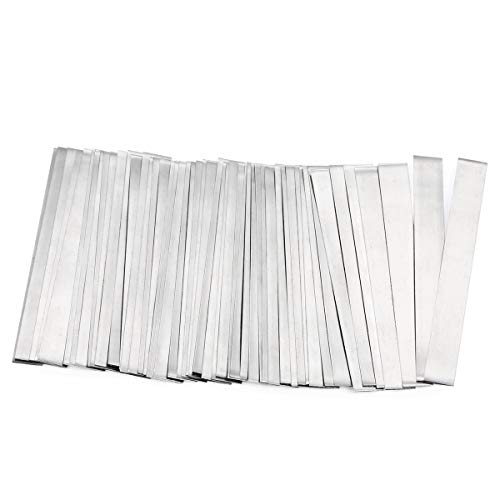
99.6% PURITY: 99.6% pure nickel strip is the material you want, the nickel strip here will never corrode and come loose after welded to a 18650 cell, lithium-ion batteries, and any other circuit systems. Nickel strip is commonly used in battery building due to its ease of use in spot welding and soldering as well its high corrosion resistance over time. Nickel is magnetic at or near room temperature.
Cell-to-Bus Bar Joining
Cell-to-bus-bar joining directly affects pack efficiency, heat generation, and long-term reliability. You’ll typically see resistance spot welding, laser welding, or ultrasonic welding depending on the cell format, tab material, conductor thickness, and production layout.
Resistance spot welding is common where similar thin metals are being joined. Laser welding is useful when you need a focused, automated weld with small heat input and high speed. Ultrasonic welding can help when the joint needs solid-state bonding with less melting and less bulk heat.
Dissimilar combinations, such as copper-to-aluminum or nickel-to-copper, need extra care. These metals behave differently under heat, and poor parameter control can cause brittle intermetallic layers, weak bonding, high resistance, or spatter. For this reason, EV battery welds should be developed through testing, not guessed from a general welding chart.
Low-Resistance Electrical Connections
Low-resistance electrical connections matter because every extra bit of resistance can turn useful battery energy into heat. In a high-current EV pack, heat can reduce efficiency, stress nearby materials, and make thermal management harder.
Bus bars are often copper or aluminum because those metals conduct current well. The weld must keep enough contact area, clean surface condition, and stable pressure during joining. Oxide layers, contamination, poor clamping, wrong weld energy, or misalignment can all raise resistance.
A good battery weld is not judged by appearance alone. It should pass electrical checks, mechanical checks, and process monitoring standards set by the manufacturer.
Battery Weld Quality Checks
Quality control is where EV welding moves from “joined” to “trusted.” The exact tests depend on the manufacturer, part design, and weld process, but common checks include:
- Electrical resistance testing: confirms the joint is not adding too much voltage drop or heat.
- Pull, peel, or shear testing: checks whether the weld can survive handling, vibration, and load.
- Visual and camera inspection: looks for wrong weld position, surface damage, spatter, burn-through, or missing welds.
- Cross-section analysis: confirms weld nugget shape, penetration, and bonding during development or audits.
- Leak testing: checks sealed enclosures, coolant parts, and housings.
- Process traceability: records parameters such as weld current, force, energy, laser power, speed, and part ID.
Pro Tip: In battery production, treat weld resistance and mechanical strength as a pair. A joint can look clean but still run hot if contact resistance is too high.
Why Laser Welding Is Common in EV Battery Assembly
Laser welding is common in EV battery assembly because it offers speed, precision, automation, and a narrow heat-affected area when the process is designed correctly. TWI describes laser welding as a process that can produce narrow, deep welds at high speed with low heat input compared with many arc-welding methods.
That makes laser welding useful for battery tabs, bus bars, module frames, enclosure seams, and selected power-electronics parts. You can tune beam power, speed, focus, pulse shape, shielding, and clamping to match the part design.
Laser welding also works well with automation. A programmed system can follow tight weld paths, repeat the same energy delivery, and record process data for traceability. In high-volume EV production, that repeatability matters as much as the weld itself.
Laser welding is valuable in EV production because it can deliver fast, precise, repeatable welds while limiting unnecessary heat around sensitive battery and electronic components.
Still, laser welding is not magic. Highly reflective metals such as copper and aluminum can be challenging. Dissimilar-metal welds can also form brittle phases if the process is not controlled. You need validated parameters, good part fit-up, clean surfaces, and proper monitoring.
Products Worth Considering
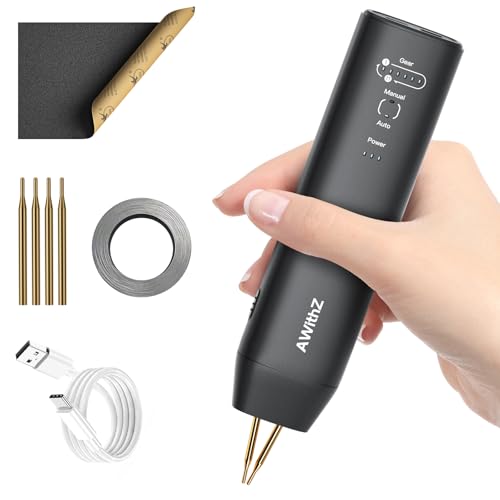
NO Spot Welding Pen------No need for a spot welding pen when going out or at home, handheld spot welder that does not require additional spot welding pens, carry it with you and it's convenient to go anywhere. It combines the built-in power supply and welding pen into one, making it easy to weld without the need for an external welding pen.

POWERFUL 10000W CORDLESS SPOT WELDER: This high-performance battery spot welder delivers up to 10000W output, making it ideal for battery pack building, nickel strip welding, and DIY repair projects. Cordless design gives you total freedom—no messy cables, work anytime, anywhere

⚡ Dual-Pulse Welding Technology: Our advanced dual-pulse system releases two pulses during operation: the first removes oxidation for cleaner contact and reduces sparks, while the second delivers consistent energy for stronger, more stable welds. This innovative design ensures minimal splash and maximum welding precision
Where Ultrasonic Welding Fits in EVs
Ultrasonic welding fits EV production when you need fast, clean joining with limited heat input. TWI defines ultrasonic welding as a solid-state joining process that uses high-frequency mechanical vibration to create a bond under pressure.
In EVs, ultrasonic welding can be used for thin metal foils, battery tabs, wires, terminals, thermoplastic housings, sensors, and electrical assemblies. It is especially useful when you want to avoid excess heat around sensitive parts.
For metals, ultrasonic welding breaks up surface films and creates bonding through pressure and vibration. For plastics, it creates localized heating at the joint interface. In both cases, tooling design, part alignment, amplitude, pressure, and weld time control the result.
Ultrasonic welding is not ideal for every joint. Thick, stiff, dirty, or poorly supported parts can be difficult. Joint design matters, and the process should be validated with electrical, mechanical, and visual tests before production use.
Resistance Spot Welding for Cell Connections
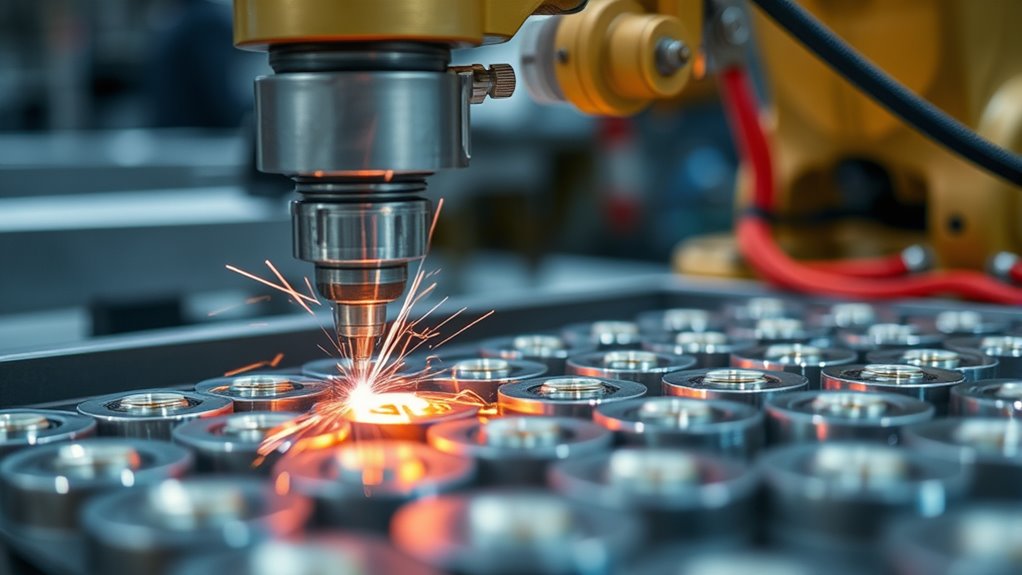
Resistance spot welding is widely used where thin metal parts can be clamped between electrodes and joined quickly. TWI explains resistance welding as a process that sends strong electrical current through the joint, generating heat through electrical resistance while force is applied through electrodes.
Spot Welding Basics
In battery work, the electrodes press the tab, strip, or bus-bar material together. Current flows through the stack, heat forms at the contact area, and a small weld nugget or bonded area forms. The main variables are current, time, electrode force, electrode shape, surface condition, and part fit-up.
Resistance spot welding can be fast and economical for high-volume lines, but it is not forgiving. Too little energy can create a weak weld. Too much energy can cause expulsion, burn-through, cell damage, or high resistance. Worn electrodes can also change the weld result even when the machine settings look the same.
Cell and Bus Bar Bonds
For cell and bus-bar bonds, resistance spot welding works best when the material stack is consistent and the joint can be reached cleanly by the electrodes. Similar metals are usually easier to weld than dissimilar combinations.
You need dedicated fixtures to hold cells, tabs, and bus bars in the right position. Good fixturing reduces contact resistance, keeps weld placement consistent, and helps prevent heat from traveling into areas that should stay cool.
The finished joint should be strong enough for vibration and handling while keeping electrical resistance low. That is why production systems often pair spot welding with monitoring, destructive sample testing, and regular electrode maintenance.
Infrared, Hot Plate, and Spin Welding for EVs
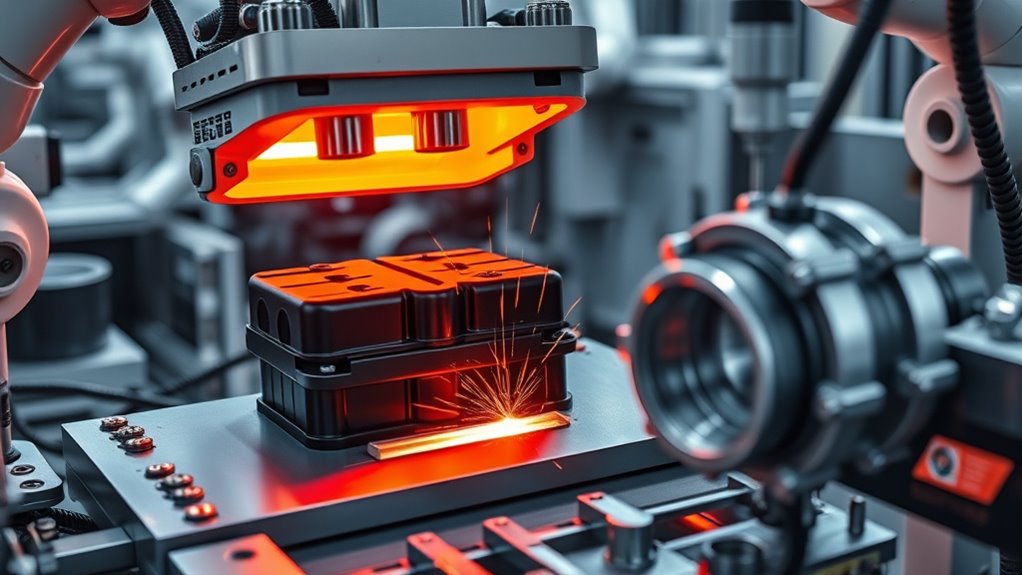
Infrared, hot plate, and spin welding solve different joining problems than metal battery-tab welding. These processes are often used for plastics, reservoirs, ducting, housings, coolant paths, and other nonmetal EV components.
Infrared welding heats plastic surfaces without direct tool contact. That can help reduce contamination and particle generation, which matters for clean assemblies and complex cooling components.
Hot plate welding uses a heated platen to soften mating surfaces before they are pressed together. It can create strong, leak-resistant joints in plastic housings, tanks, reservoirs, and larger parts where a broad sealing surface is needed.
Spin welding uses rotational friction to heat circular joint surfaces. It works best on round or axisymmetric parts such as caps, fittings, filters, and some duct or reservoir features.
These plastic welding methods need the same discipline as metal welding: good joint design, controlled melt depth, accurate alignment, stable pressure, cooling time, and leak testing.
Friction Welding for Lightweight EV Metals
Friction welding is useful when EV manufacturers want strong joints in lightweight metals without melting the entire joint like a conventional fusion weld. TWI describes friction welding as a solid-state process that uses mechanical friction and pressure to generate heat and bond parts.
Because the process stays below the full melting point of the workpieces, friction welding can reduce some problems linked to fusion welding, such as solidification cracking or large heat-affected zones. It can also help join selected dissimilar materials when the joint design and process are suitable.
In EV production, friction-based methods may be used for aluminum parts, shafts, connectors, structural parts, and mixed-material designs. The goal is not simply to “make the vehicle lighter.” The real value is that it gives designers more freedom to choose the right material for each function while still creating a durable joint.
Friction welding still needs careful control. Pressure, speed, travel, upset, tool design, and surface condition all affect joint strength. Like battery welds, friction welds should be validated through mechanical testing and production monitoring.
Laser Welding for High-Performance Battery Joints
Laser welding plays a critical role in high-performance battery joints because it can focus energy into a small area and move quickly across the joint. You may use it for battery tabs, bus bars, module frames, enclosure covers, current collectors, and selected terminal connections.
The main advantage is control. You can adjust beam power, travel speed, focus position, wobble pattern, shielding, and fixture pressure to match different materials and thicknesses. This helps preserve nearby cell parts while still creating a strong connection.
Laser welding can also support sealed battery enclosures because it can create continuous seams with controlled distortion. For sensitive electronics, less distortion and cleaner fit-up can improve downstream assembly and sealing.
The main risks are poor fit-up, surface contamination, reflectivity, porosity, spatter, cracking, and unstable penetration. Copper and aluminum can be difficult because they conduct heat quickly and reflect laser energy. Dissimilar metals need testing because the weld can become brittle if the wrong phases form.
Note: A laser weld that works on one battery tab design may not transfer safely to a different cell, coating, bus-bar thickness, or supplier material without fresh validation.
EV Welding Requirements for Safety and Sealing
EV welding has to support safety, sealing, conductivity, and durability at the same time. A battery pack may face road splash, vibration, salt, temperature swings, charging heat, crash loads, and service handling. Welded joints need to survive those conditions without leaking, cracking, loosening, or overheating.
For sealed assemblies, the weld must prevent moisture and contamination from reaching high-voltage electronics, battery modules, and coolant paths. For conductive assemblies, the joint must keep resistance low. For structural parts, the weld must meet strength, fatigue, and corrosion requirements.
Warning: Do not weld on an electric vehicle, battery pack, high-voltage cable, or nearby structure unless you are trained, the system is isolated according to the manufacturer’s procedure, stored energy is controlled, and the work area has proper fire, fume, and electrical-safety controls.
Welding safety also includes fumes, gases, ultraviolet radiation, heat, noise, fire risk, and ergonomic strain. The OSHA welding fume fact sheet explains that welding can produce hazardous fumes and gases, so ventilation, exposure control, and proper protective equipment matter.
In production, safety and quality are built into the process through fixtures, interlocks, sensors, monitoring, leak testing, destructive sample checks, and traceable records. In repair, safety starts with the OEM service procedure. EV welding is not a place for guesswork.
Common EV Welding Defects and Prevention
EV weld defects are not always visible. Some defects show up as heat, voltage drop, leaks, or early fatigue rather than an obvious crack. That is why production controls and testing matter.
- High electrical resistance: caused by poor contact, contamination, oxide layers, weak bonding, or undersized weld area. Prevent it with clean surfaces, proper clamping, validated parameters, and resistance testing.
- Spatter or expulsion: often caused by too much energy, poor fit-up, surface contamination, or unstable contact. Prevent it with controlled current, laser power, force, speed, and surface preparation.
- Burn-through: common risk on thin tabs and foils when heat input is too high. Prevent it with proper energy control, backing support, and fixture design.
- Weak plastic seals: caused by poor melt control, uneven pressure, short hold time, or contamination. Prevent it with correct joint design, melt depth, cooling time, and leak testing.
- Brittle dissimilar-metal joints: caused by poor metallurgy control. Prevent it with process development, sectioning, mechanical testing, and material-specific procedures.
- Leaks in enclosures or cooling parts: caused by gaps, porosity, uneven seams, or poor plastic bonding. Prevent them with fit-up control and pressure, vacuum, or helium leak testing where required.
Frequently Asked Questions
Where is welding used in electric vehicles?
Welding is used in EV battery tabs, bus bars, module frames, enclosures, cooling parts, power-electronics housings, motor-related assemblies, brackets, and lightweight structures. Each location has different needs for strength, conductivity, sealing, heat control, and production speed.
Which welding process is best for EV battery packs?
There is no single best process for every battery pack. Laser welding, resistance spot welding, and ultrasonic welding are all common choices. The best method depends on the cell type, tab material, bus-bar design, heat sensitivity, weld strength target, electrical-resistance target, and production volume.
Can you weld on an electric car?
You should only weld on an electric car if you are trained and following the vehicle maker’s service procedure. High-voltage systems, battery packs, stored energy, fire risk, and sensitive electronics make EV welding different from ordinary body repair.
Why do EV battery welds need low resistance?
Low resistance helps current move through the battery pack with less heat and less voltage drop. A high-resistance weld can waste energy, raise local temperatures, stress nearby materials, and reduce long-term reliability.
What welding methods are used for EV plastic parts?
EV plastic parts may use ultrasonic welding, infrared welding, hot plate welding, or spin welding. These methods are common for housings, ducts, reservoirs, coolant components, and other parts where sealing, cleanliness, and repeatability matter.
How are EV welds checked for quality?
EV welds can be checked with electrical-resistance tests, pull or shear tests, peel tests, visual inspection, camera monitoring, cross-section analysis, leak testing, thermal cycling, vibration testing, and production traceability records.
Conclusion
Welding in electric vehicle production is used wherever strength, conductivity, sealing, and repeatability have to work together. Battery tabs and bus bars need low-resistance joints. Enclosures and cooling parts need leak-resistant seams. Lightweight metal structures need strength without unnecessary mass. Plastics need clean, repeatable bonding.
Laser, resistance spot, ultrasonic, friction, infrared, hot plate, and spin welding each solve a different EV manufacturing problem. The safest and most reliable choice is the one matched to the material, joint design, heat limit, electrical target, sealing requirement, and inspection plan. In EV production, the joint is small, but its effect on safety and performance can be huge.
Sources
- U.S. Department of Energy Alternative Fuels Data Center — EV battery system context and lithium-ion battery performance factors.
- TWI: Laser Welding — laser welding process, speed, heat input, and dissimilar-metal cautions.
- TWI: Resistance Joining — resistance welding basics, copper electrodes, current, heat generation, and production use.
- TWI: Ultrasonic Welding — ultrasonic welding process, applications, and low-heat joining context.
- TWI: Friction Welding — solid-state friction welding and dissimilar-material joining context.
- OSHA: Controlling Hazardous Fume and Gases during Welding — welding fume, gas, exposure-control, and safety guidance.