Choosing between a butt joint and a lap joint affects fit-up, finish work, heat control, and corrosion protection. A butt joint often gives visible sheet metal the cleanest surface, while a lap joint can make alignment easier on hidden patches. For vehicle repairs, though, personal preference comes second to the vehicle maker’s repair procedure.
Quick Answer
For visible, non-structural sheet-metal repairs, a butt joint usually gives the flattest finish and the fewest hidden moisture traps. A lap joint is easier to fit and can suit floors or factory-style seams. On a vehicle, however, the manufacturer’s repair procedure must decide the joint, overlap, weld type, and corrosion protection.
Key Takeaways
- Use a butt joint when a flush, easy-to-finish surface is the main goal and the repair procedure allows it.
- Use a lap joint when the design calls for overlap, easier alignment, plug welds, or a factory-style flange.
- Do not assume either joint is stronger. Strength depends on the load, material, weld size, fusion, and joint design.
- Follow the vehicle maker’s body repair manual for quarter panels, pillars, rockers, floors, and other structural or safety-related areas.
- Protect every repaired seam with the specified primer, sealer, coating, and cavity protection.
- Control heat with clean metal, tight fit-up, small spaced welds, and cooling time between welds.
Quick Verdict: Butt Joint vs Lap Joint
Pick a butt joint when the repair procedure permits it and the repaired area needs to look flat after paint. The edges meet in the same plane, so you do not have to hide an overlap.
Pick a lap joint when the repair design calls for overlapping sheets, a flange, plug welds, easier alignment, or added backing at the seam. You must protect the mating surfaces and seal the finished joint against water.
| Feature | Butt Joint | Lap Joint |
|---|---|---|
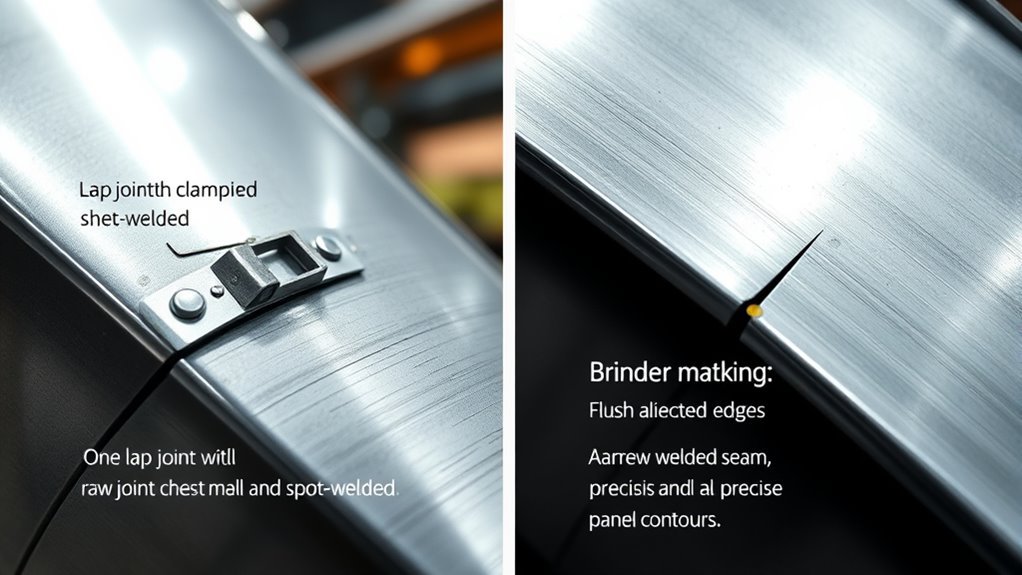
| Panel finish | Flush and usually easier to hide | Creates a step or double-layer area unless the panel is flanged |
| Fit-up | Needs accurate trimming and controlled gaps | More forgiving during alignment, but mating surfaces must sit tight |
| Common weld form | Butt seam weld, sometimes with an OEM-specified backing insert | Fillet, plug, slot, spot, or seam weld, depending on the design |
| Corrosion concern | Fewer hidden mating surfaces, but the weld and backside still need coating | The overlap can become a corrosion hot spot if coatings or sealer are missing |
| Typical use | Visible non-structural patches and OEM-specified sectioning joints | Floors, flanges, factory-style seams, and OEM-specified overlap joints |
| Best choice | When finish quality and a single-ply surface matter | When the design requires overlap or easier positioning |
Note: On a vehicle, the correct joint is the one shown in the current body repair manual. I-CAR warns that a removal diagram can appear to show a butt joint while the installation procedure actually creates a lap joint, so read the complete procedure before cutting.
Follow the OEM Repair Procedure First
A quarter panel, rocker, pillar, roof rail, floor, or uniside is not just a flat piece of steel. It may be connected to reinforcements, crush zones, adhesives, foams, electrical parts, and corrosion-protection systems. Changing the joint type or sectioning location can change heat flow and load transfer.
I-CAR’s sectioning guidance explains that the specified joint may only become clear after you read both the removal and installation procedures. Some vehicle makers specify open butt joints, some use butt joints with backing, and some call for overlap joints, plug welds, weld bonding, or resistance spot welding.
Use the exact sectioning location, overlap length, backing method, weld type, weld spacing, adhesive, and corrosion-protection sequence in the current vehicle-specific instructions. Do not create a sectioning repair where the manufacturer does not permit one.
Warning: Do not improvise joint design on structural, restraint-related, high-strength-steel, or crash-management parts. A visually smooth weld does not prove that the repair will carry crash loads as intended.
What’s the Difference Between Butt and Lap Joints?
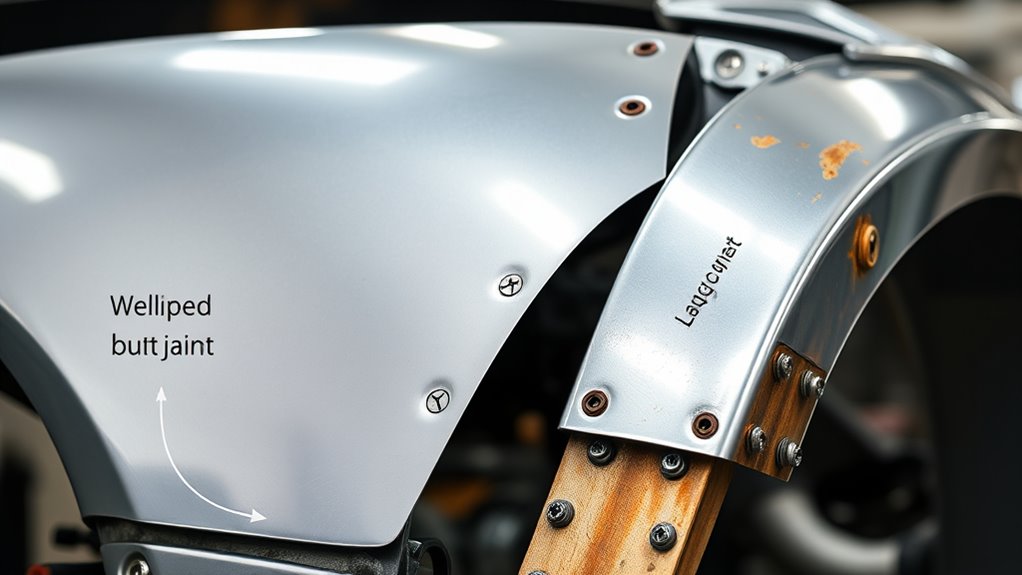
A butt joint places two panel edges in line, usually in the same plane. A lap joint places one sheet over another. The lap is commonly joined with a fillet, plug, slot, spot, or seam weld. These joint and weld terms are explained in TWI’s welding-joint design guide.
With a butt joint, the finished repair can stay close to a single sheet thickness. That makes it easier to level a visible panel without hiding a raised overlap under extra filler.
A butt joint usually wins on surface finish. A lap joint usually wins on fit-up tolerance. Neither wins automatically on strength or safety.
A lap joint gives you more material to position and clamp, so small trimming errors are easier to manage. Clecos, panel clamps, or temporary fasteners can hold the sheets while you confirm alignment. The mating surfaces still need close contact. A gap between overlapped sheets can reduce fusion in plug or spot-style welds.
Butt joints demand more precise cuts. A wide or uneven gap increases burn-through risk, makes weld-pool control harder, and can increase grinding and filler work.
Lap joints create a hidden interface where moisture can travel if the joint is not protected. Butt joints avoid that double-layer channel, but the weld face, heat-affected area, and backside still need primer and coating.
Use each weld joint with intent, not habit. On load-carrying fabrication, the designer must also specify the weld size and load path. Your existing guide to maximum fillet weld size provides more background, but vehicle repairs must still follow OEM instructions.
How Joint Strength Really Compares
A butt joint is not automatically stronger than a lap joint, and a lap joint is not automatically safer because it has two layers. Joint strength depends on:
- The grade, thickness, and condition of the base metal
- The direction and type of load
- The weld type, length, throat, penetration, and spacing
- Fit-up, clamping, fusion, porosity, undercut, and burn-through
- Heat damage to nearby material or reinforcements
- Adhesives, fasteners, and coatings required by the design
A full-penetration butt weld can restore a continuous section when it is properly designed and made. A lap joint can carry substantial shear load when its fillet, plug, spot, or slot welds are correctly designed and fused. Poor workmanship can weaken either joint.
For general fabrication, use a drawing, welding procedure specification, or qualified design instead of choosing by appearance. For a vehicle, the body repair manual is the controlling document.
Choose a Butt Joint If…
Choose a butt joint when the repair procedure allows it and you want the cleanest finish on a visible panel. It works best when you can trim accurately, hold the panel edges flush, and control heat with small, spaced welds.
- You want a flush surface with less filler buildup.
- You need clean paint preparation on a visible panel.
- You want to avoid a hidden overlapping seam.
- You can take time to trim, clamp, and verify the patch.
- The OEM procedure, fabrication drawing, or repair plan specifies a butt joint.
When Is a Butt Joint Best?
A butt joint is often best for a cosmetic patch in a visible, non-structural panel because it leaves little seam buildup. It can also be correct for an OEM-approved sectioning repair when the procedure specifies an open butt joint or a butt joint with a backing insert.
Do not assume a tight, zero-gap fit is always required. The correct root opening depends on the material, thickness, process, backing, and repair procedure. Use the stated dimension or confirm the fit on scrap of the same thickness.
When you fit and weld the joint correctly, the repair is easier to finish smoothly. Careful control of heat input also helps limit distortion, although automotive sheet steel is normally repaired with the process specified by the manufacturer rather than by choosing a process from a general welding guide.
Cleaner Paint Prep
A butt joint gives you a single-ply surface across most of the repair. After the weld is dressed correctly, the panel can require less filler than a raised overlap.
Without an overlapping channel, there are fewer hidden mating surfaces to protect. You still need to coat the backside, weld area, and any bare steel exposed by grinding.
Grind only enough to level the weld without thinning the surrounding sheet or removing needed weld metal. Overgrinding can weaken the seam and create a low spot that needs more filler.
The smooth profile makes blocking and refinishing easier because there is no step to hide. Paint adhesion still depends on correct cleaning, abrasion, primer, and coating procedures, not on the joint type alone.
High-Visibility Panel Repairs
When the repair sits in plain view, a butt joint often gives the best cosmetic result if the repair plan permits it.
- Trim the patch so the edges follow the panel shape without forcing them into place.
- Hold both panels flush with suitable clamps or magnets placed away from the weld path.
- Tack at separated points and recheck the body line after each round.
- Fill the spaces gradually, allowing the panel to cool between welds.
- Dress the weld without overheating or thinning the panel.
This method can produce a professional result on doors, quarters, roofs, and other visible sheet metal. On vehicles, use it only where the current OEM procedure allows that joint and sectioning location.
Choose a Lap Joint If…
Choose a lap joint when the design needs an overlap, flange, plug-weld area, or easier alignment. It can work well on hidden panels, but only when the mating surfaces and finished edges receive the specified corrosion protection.
- You need a faster fit-up on a floor or hidden patch.
- You need a flange or overlap for plug, slot, spot, or fillet welds.
- The panel shape makes an open butt joint difficult to hold flush.
- The repair procedure specifies an overlap joint or factory-style seam.
- You can access the joint well enough to prime, seal, coat, and protect the backside.
Warning: Do not leave a lap seam open to water. Protect the mating surfaces before assembly when required, then restore primer, seam sealer, topcoat, underbody coating, and cavity protection in the correct order.
When Should You Use a Lap Joint?
Use a lap joint for a floor patch or hidden section when the repair plan permits an overlap and you can protect it from both sides. The overlap can make positioning easier and can provide backing during welding, but it does not excuse loose fit-up or poor fusion.
Lap joints are also common in factory-style repairs where flanges receive spot welds, plug welds, adhesive, or seam sealer. On collision repairs, match the original or specified attachment method rather than substituting a continuous seam weld.
Clean the surface before welding to help prevent porosity and inclusions. Remove paint, rust, oil, undercoat, seam sealer, and other contamination far enough from the hot-work area to prevent weld defects and fire.
Floor Patches and Floors
For a non-structural floor patch, a lap joint is often easier to align and clamp than a butt joint. It also forgives small trimming errors, especially where the floor has ribs or complex curves.
- Cut back to solid metal and confirm that no wiring, fuel lines, brake lines, carpet, insulation, adhesive, foam, or undercoat remains in the hot-work zone.
- Shape the patch to match the floor before creating the overlap or flange.
- Use the overlap dimension and weld pattern required by the repair plan. There is no universal overlap width for every vehicle or fabrication job.
- Clamp the mating surfaces tightly so plug or spot-style welds can fuse to the lower sheet.
- Weld one or both sides only when the drawing or OEM procedure requires it. Extra welding adds heat and is not automatically stronger.
- Restore primer, seam sealer, topcoat, underbody protection, and cavity wax as specified.
Factory-Style Body Repairs
Factory-style repairs may use a lap joint because the overlap matches an original flange or an OEM-designed sectioning joint. Some procedures use plug welds to replace factory spot welds, while others require resistance spot welding, weld bonding, rivets, or a combination of methods.
The overlap can act as backing and can reduce the chance of cutting a replacement panel too short. It may also change how heat reaches nearby reinforcements, which is one reason the vehicle maker controls the joint design.
It can reduce burn-through risk in some setups because the arc is supported by metal below the seam, but poor settings can still melt the panel edge or fail to fuse the lower sheet.
Use a lap joint when you want speed and alignment forgiveness only after confirming that it matches the original build or the approved repair procedure.
Butt vs Lap Joints for Quarter Panels
For a handmade cosmetic patch in an older, non-structural outer skin, a butt joint often gives the cleanest finish and the fewest hidden moisture pockets. That does not make butt welding the universal answer for replacement quarter panels.
Modern vehicle makers may specify an open butt joint, a butt joint with backing, an overlap joint, plug welds at flanges, weld bonding, or complete replacement at factory seams. I-CAR has documented OEM overlap joints used in some quarter-panel sectioning procedures, which shows why the vehicle-specific instructions must control the repair.
- Butt joints: Useful for flush cosmetic repairs and approved sectioning joints that call for a butt seam.
- Lap joints: Useful when the OEM procedure or repair design specifies an overlap, flange, or backed seam.
- Weld control: Butt welding needs accurate edge fit-up; lap welding needs tight contact and full fusion to the lower sheet.
- Surface risk: Overlaps need careful corrosion protection, while butt seams need backside coating and protection after grinding.
- Safety rule: Do not section a quarter panel in a location the manufacturer has not approved.
If you want the cleanest quarter-panel result, choose the approved joint that supports both the finish and the vehicle’s repair requirements. Do not choose a joint only because it covers a trimming gap.
Many automotive panels are zinc coated. Before welding galvanized steel, follow the repair manual and product instructions for coating removal, ventilation, and corrosion restoration. Your guide to grinding zinc near the weld zone can help with preparation, but zinc fumes remain hazardous and require effective controls.
Products Worth Considering

COST-EFFECTIVE DIY REPAIRS: Quick repairs of bumpers and other car parts, kayaks, canoes and boat parts, ATVs, plastic tanks, containers and bins, outdoor furniture, and plastic toys

UL CERTIFIED: Our Plastic Welder, the factory, and the process have been tested, approved, and Certified by Underwriters Laboratories (UL). Safety is our number one priority

New Brand Design:New design, Hot Stapler Plastic Repair Kit can meet your different needs, easily weld cracked and damaged plastic parts, support more professional DIY making and save cost.
How Do You Prep Sheet Metal for Either Joint?
Start by inspecting the entire repair area, including the backside. Confirm the metal is sound and identify coatings, adhesives, seam sealer, foam, wiring, fuel or brake lines, trim, glass, and interior material that heat or sparks could damage.
Strip the weld zone to clean, bare metal as required by the welding process. Rust, paint, oil, scale, and coating residue can cause porosity, lack of fusion, spatter, and unstable arc behavior.
For a butt joint, trim the edges accurately, remove burrs, and hold the panels in the required alignment and gap. Do not force a patch into place because stored stress can pull the panel out of shape as you weld.
For a lap joint, form the overlap or flange to the required dimension. Clamp the sheets tightly, especially where you will make plug or spot-style welds.
Rounded patch corners can be easier to fit and finish than sharp inside corners. They can also reduce abrupt stress concentration, but heat control still depends on weld length, sequence, settings, and cooling time.
Use weld-through primer only where the OEM and primer maker allow it. I-CAR advises that excess primer can increase resistance and spatter, and that weld-through primer should be removed from the direct weld zone before GMA welding because welding through it may cause porosity. Some manufacturers do not allow it at all.
Pro Tip: Make a practice joint from scrap that matches the panel’s material, thickness, coating condition, overlap, and backing. Adjust the welder until the test shows stable fusion without burn-through, then cut the test apart or inspect the backside before touching the vehicle.
Products Worth Considering

Value Pack: The package includes 24 packs of butt welding clamps, enough quantity to meet your daily needs and replacements. Each butt welding clamps is individually wrapped in a small bag, convenient to carry and use.

【Dual Pulling Power】The weyleity auto body clamp offers flexible two-way (top and straight) pulling operation, providing up to 5 tons of pulling force for straight repairs and 3 tons for top pulling. Its compact design ensures easy maneuverability in tight spaces.

Adaptability: Our butt welding clamps are suitable for both straight panels or curved panels. Maintains 0.40" gap between panels for edge-to-edge welding.They will work well in these 2 kinds of p
How Do You Control Heat and Warping?
Thin sheet metal distorts when too much heat is concentrated in one area. The safest control is to reduce total heat input and spread the welds around the seam.
- Set the machine on matching scrap before welding the repair.
- Use clean metal, a short stickout, and the correct wire, gas, polarity, and settings for the process.
- Place small tacks at separated points rather than running a long bead.
- Move to a distant part of the seam for the next weld.
- Pause long enough for the panel to cool before filling the spaces.
- Check alignment and panel shape after every round.
- Do not overweld, pile filler metal onto the seam, or grind the panel hot.
Some OEM procedures specify a skip or stitch sequence with exact weld lengths and spaces. Follow those dimensions when they are provided. Avoid aggressive water quenching unless the approved procedure specifically calls for it, because rapid cooling can affect coatings, panel shape, and some materials.
What Welding Mistakes Cause Rust?
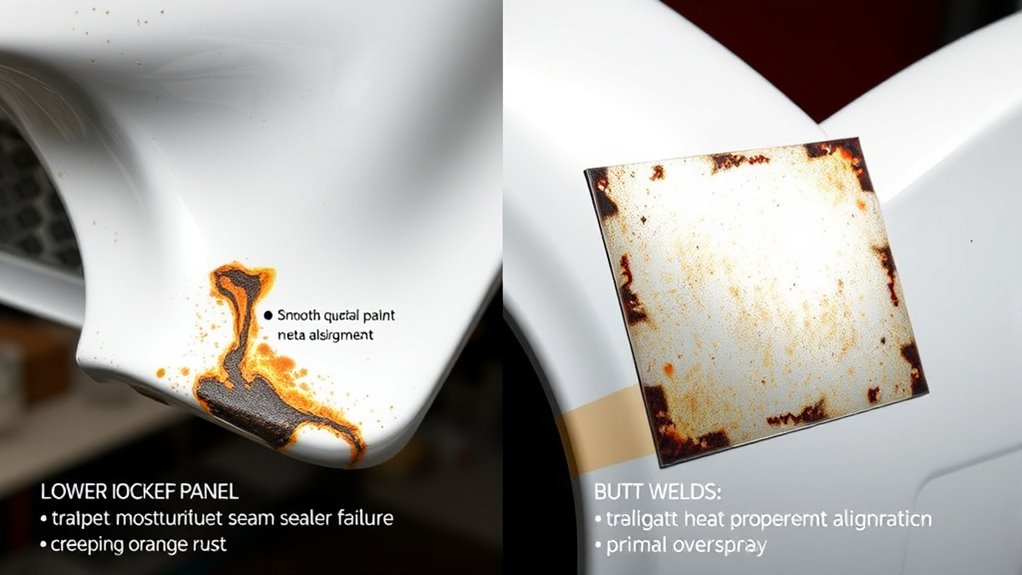
Rust often starts where welding removed the factory coating or created a hidden path for water. Common mistakes include trapping contamination in a lap joint, skipping protection on the backside, leaving pinholes, applying incompatible products, and leaving bare steel exposed after grinding.
Clean both mating surfaces before assembly. After welding, inspect the seam for holes and incomplete fusion, then restore protection in the sequence required by the OEM and coating maker.
Do not assume every seam sealer goes directly onto bare steel. Some products are direct-to-metal, while others must be applied over cured primer. 3M’s seam-sealer procedure separates direct-to-metal and primer-coated applications and stresses proper preparation and cleaning.
- Seal the specified lap edges and seams to block water paths.
- Remove rust, paint, oil, and burned coating before refinishing.
- Repair pinholes and incomplete welds before applying filler or sealer.
- Use compatible epoxy primer, seam sealer, topcoat, undercoat, and cavity wax in the required order.
- Protect the backside and enclosed cavities, not just the visible face.
- Recoat exposed metal as soon as the approved process allows.
Do not weld over heavy rust and expect the repair to last. If you simply cover heavy rust, weak or contaminated metal can remain under the coating and reduce the life of the repair.
How Should You Protect the Joint After Welding?
The exact sequence depends on the vehicle maker and product system, but a complete repair normally addresses every surface disturbed by cutting, welding, and grinding.
- Allow the metal to cool and inspect the weld.
- Dress the weld only as much as the repair procedure permits.
- Clean the area with products approved for the coating system.
- Apply the required primer to exposed steel and repaired surfaces.
- Apply seam sealer to the specified joints using the product maker’s substrate and cure instructions.
- Apply paint, underbody coating, stone protection, or sound-deadening material where required.
- Apply cavity wax to enclosed areas after refinishing and before trim blocks access, when specified.
I-CAR’s corrosion-protection guidance notes that seam sealers, adhesives, foams, and cavity waxes belong at different stages of the repair. Applying flammable cavity products before hot work is complete can create a fire or explosion hazard.
Common Problems and Fixes
| Problem | Likely Cause | Fix |
|---|---|---|
| Burn-through | Too much heat, slow travel, wide butt gap, or weak metal | Return to sound metal, improve fit-up, lower heat input, shorten weld time, and retest on scrap |
| Panel warping | Long beads, clustered welds, overwelding, or hot grinding | Use separated tacks, a skip sequence, cooling time, and lighter grinding pressure |
| Lap weld sits on top | Arc did not fuse the lower sheet or plug-weld wall | Tighten clamping, clean both sheets, direct the arc into the lower corner, and confirm fusion on a test piece |
| Pinholes or porosity | Rust, coating, oil, primer in the weld zone, poor shielding gas, or drafts | Remove contamination, correct gas coverage, repair the defective area, and inspect before coating |
| Rust returns at seam | Unprotected mating surfaces, open seam, missing backside coating, or trapped moisture | Remove corrosion fully and restore the complete OEM-approved coating and sealing system |
| Filler cracks over repair | Movement, poor fusion, excessive filler thickness, or weak overground metal | Correct the metal repair first, then use the refinishing system within its thickness limits |
Safety Before Welding Sheet Metal
Wear a welding helmet with the correct shade, safety glasses, flame-resistant clothing, welding gloves, and suitable hearing and respiratory protection. Keep a fire extinguisher nearby and maintain a fire watch after hot work.
Before welding a vehicle, disconnect or protect systems as the manufacturer directs. Remove nearby trim and combustible material, identify airbags and high-voltage components, shield glass and painted surfaces, and inspect both sides of the panel.
Galvanized steel and zinc-rich coatings produce zinc oxide fumes when heated. OSHA identifies zinc oxide from galvanized steel and zinc-enriched coatings as a cause of metal fume fever. Use effective local exhaust or mechanical ventilation, keep your head out of the plume, and follow workplace respiratory-protection requirements. See OSHA’s welding-fume guidance.
Safety Disclaimer: This article is for general information and does not replace hands-on welding training, a qualified welding procedure, or vehicle-specific OEM repair instructions. Wear proper personal protective equipment, control fumes and fire risk, inspect hidden areas, and follow the welder, primer, coating, adhesive, and vehicle manufacturer’s instructions before starting work.
Frequently Asked Questions
When would you use a lap joint?
Use a lap joint when the repair design needs an overlap, flange, plug weld, spot weld, or easier alignment. It often suits floors, hidden panels, and factory-style seams. On a vehicle, use it only when the current repair procedure permits it, and protect the mating surfaces and seam against corrosion.
What is a disadvantage of a lap joint?
A lap joint creates a hidden interface that can hold moisture if coatings and seam sealer are incomplete. It also adds thickness and can leave a visible step. Plug, spot, or fillet welds can fail to fuse the lower sheet when the panels are dirty, loose, or poorly clamped.
Are lap joints better for thicker plates?
Not automatically. Plate joints must be designed for the load, material, thickness, access, weld process, inspection needs, and fatigue conditions. A lap joint may be practical for some fillet-welded connections, while a properly designed butt joint may provide a more direct load path. Use an engineering drawing or welding procedure.
Is a butt joint stronger than a lap joint?
The joint name alone does not decide strength. A full-penetration butt weld can be very strong, and a correctly designed lap joint can carry substantial shear load. Material, load direction, weld size, fusion, spacing, defects, and corrosion protection determine the result.
Should you use weld-through primer on lap joints?
Use weld-through primer only when the OEM and product maker specify or permit it. Apply it to the approved clean mating surfaces, keep the coating thin, and remove it from the direct GMA weld zone when required. Some manufacturers prohibit it, and it does not replace primer, seam sealer, topcoat, or cavity protection.
How wide should a sheet-metal lap joint be?
There is no universal overlap width. The correct dimension depends on the vehicle repair manual, fabrication drawing, material, weld type, plug-weld size, and access for sealing. Use the stated measurement rather than a shop rule of thumb.
Can you use a lap joint on a quarter panel?
Yes, when the vehicle maker specifies an overlap sectioning joint or the repair is a suitable non-structural custom patch. Other vehicles require a butt joint, backing insert, weld bonding, or replacement at factory seams. Read the complete vehicle-specific procedure before cutting.
Should you weld both sides of a lap joint?
Only when the design or repair procedure requires it. Welding both sides adds heat and can increase distortion without improving a joint that was designed for one fillet, plug welds, spot welds, or weld bonding. Follow the specified weld locations and lengths.
Sources
- TWI: Design, Part 1: definitions of butt and lap joints, butt welds, and fillet welds.
- I-CAR: Identifying Sectioning Joint Type: why removal and installation procedures must both be read before choosing a joint.
- I-CAR: How to Use Weld-Through Primer: primer limits, GMA weld-zone preparation, and OEM exceptions.
- I-CAR: When to Apply Corrosion Protection: timing for seam sealer, foams, coatings, and cavity wax.
- 3M: General Seam Sealer Application SOP: surface preparation, cleaning, application, and curing practices.
- OSHA: Welding Fume Hazards and Controls: zinc oxide and other hazardous welding fumes.
Conclusion
Your best joint depends on the panel, load, finish requirement, welding process, corrosion access, and repair instructions. A butt joint often gives visible sheet metal a flatter, easier-to-finish surface. A lap joint offers easier fit-up and supports factory-style flanges, plug welds, and approved overlap repairs.
For general fabrication, use the joint shown on the drawing or welding procedure. For vehicle repairs, follow the current OEM body repair manual, even when it conflicts with a familiar shop habit.
Whichever joint you use, cut back to sound metal, confirm fit-up, control heat, verify fusion, and restore protection on every exposed and hidden surface. That complete process prevents more repeat repairs than the joint name alone.