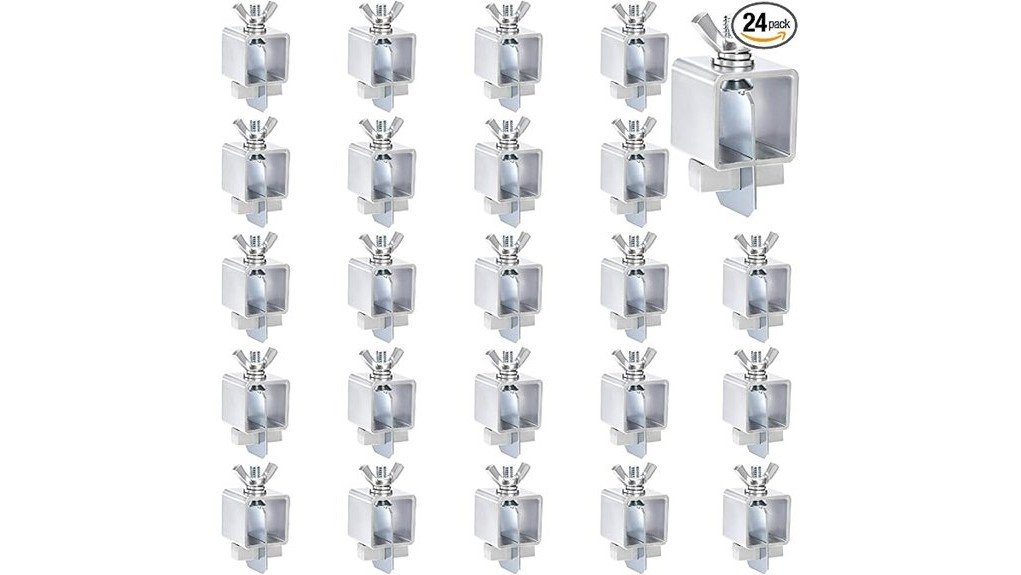
Quick answer: These butt welding clamps are a 24-piece set of small steel clamps that hold two sheet-metal edges in line while you tack. Per the listing each is about 2 x 1 x 1 inches and about 1.6 oz, with a 0.4 inch clamp block gap. They suit auto body patch panels and thin sheet. They are not for thick plate or structural fixturing.
Setting two sheet-metal edges flush is often harder than making the weld. Butt welding clamps hold the edges level so you can tack without the panels shifting. This page explains how this 24-piece set works, what the listing says, where it helps on auto body and fabrication jobs, and when a different clamp is the better choice. We have not tested these clamps, so specs are listing claims.
Specs at a glance (per the listing)
| Item | Per the listing |
|---|---|
| Product | Butt welding clamps for panel alignment |
| Count | 24 pieces |
| Material | Carbon steel, listed as rust resistant |
| Size | About 2 x 1 x 1 inches per clamp |
| Weight | About 1.6 oz per clamp |
| Clamp block gap | 0.4 inch |
| Tensile strength | 300 MPa listed (check what part this refers to) |
| Best use | Sheet-metal butt welds, patch panels, door skins, floor pans |
| Check before buying | How the gap works with your panel thickness, brand, warranty and return terms |
How butt welding clamps hold sheet metal
The clamp pulls two edges together and keeps them level while you place tack welds. Having a set of 24 lets you space the clamps along a seam, so one section cannot sit high while another sits low.
Because they are small, they fit around door openings, floor pans and curved panels where large clamps would block the torch. Heat still moves into steel clamps, so let them cool before you handle them.
Who should buy them
Best for
- Auto body patch panels and floor repairs.
- DIY fabricators doing thin sheet butt joints.
- Anyone who needs many small clamping points on a long seam.
Skip if
- You weld thick plate, tubing or structural parts.
- Your panel stack-up does not suit the listed 0.4 inch block gap.
- You need confirmed brand, warranty or replacement-part details.
How to use them
- Clean the edges so paint, rust and oil do not get in the way.
- Trim the panels so the seam fits closely before you clamp.
- Dry-fit the clamps along the seam and check that the faces sit flush with a straightedge or your fingers.
- Place short tack welds between the clamps, working in an order that spreads the heat.
- Move clamps as needed and finish the seam in short, controlled welds.
Pro tip: On thin panels, skip around the seam and let it cool between tacks. Heat distortion causes more misalignment than a poor clamp.
Safety
Safety note: Clamps do not replace welding PPE. Wear a helmet with the correct shade, gloves and flame-resistant clothing, protect nearby surfaces from sparks, and ventilate the area. Steel clamps near the weld get hot, so use pliers or wait until they cool.
Pros and limitations
Pros
- A 24-piece count covers long seams.
- Compact size suits tight auto body areas.
- Light enough for vertical panels.
- Useful for repeated panel setup.
Limitations
- The 0.4 inch gap may not suit every material thickness.
- Not a substitute for heavy clamps or a welding table.
- Brand and warranty details are not confirmed here.
Alternatives to consider
Locking pliers apply more force but can distort thin panels. Magnetic squares help with angles. For other butt clamp sets, compare the Toolly butt welding clamps, the Acrux7 set and the MYFULLY set.
Related guides: Toolly butt welding clamps · Acrux7 butt welding clamps · MYFULLY butt welding clamps · V-type magnetic welding clamps
Frequently Asked Questions
Are butt welding clamps suitable for auto body panels?
Yes, they are mainly for sheet-metal panel alignment on patch repairs, door skins and floor pans. Check the clamp gap against your panel thickness first.
What are these clamps made of?
The listing says carbon steel with a rust-resistant finish. Keep them dry and clean to protect the finish.
Will they mark the panel?
Any clamp can mark soft or finished metal if it is dirty or overtightened. Test on scrap first if the finish matters.
Can I use them on aluminum?
They may hold aluminum panels, but aluminum marks easily and needs the right welding process and cleaning. Test on scrap first.
Who should skip them?
Skip them if you mainly weld thick plate, tubing or structural parts. Those jobs need stronger clamps or a welding table.