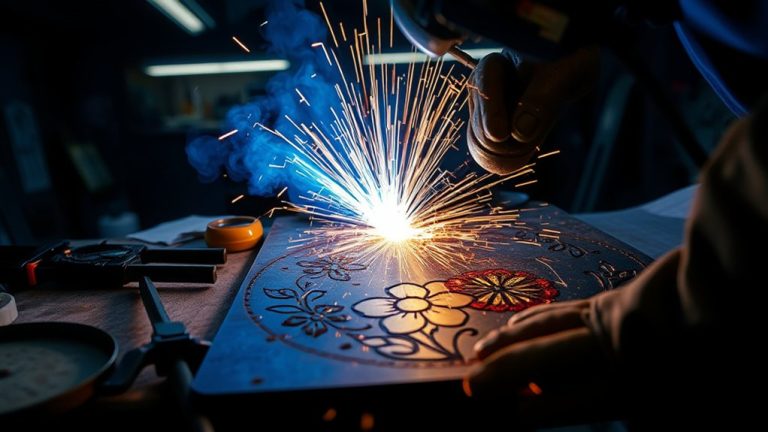
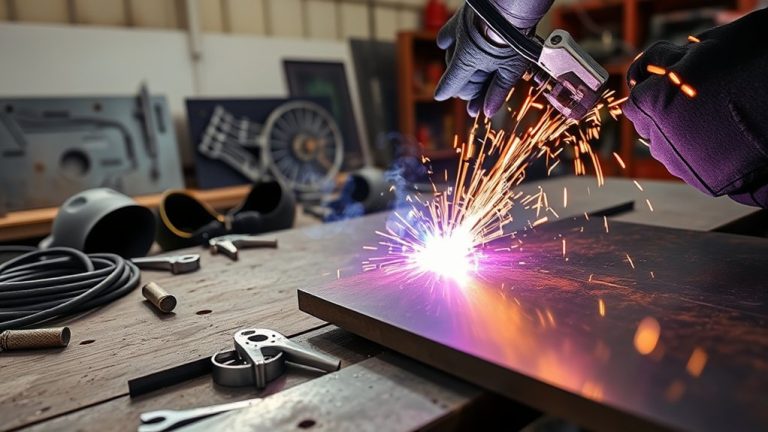
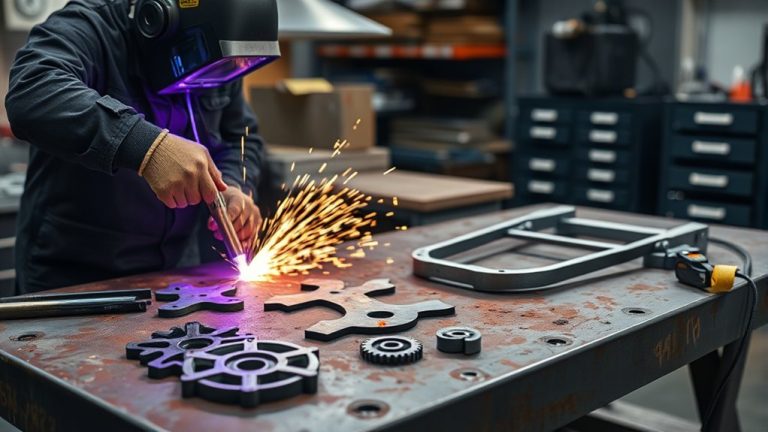
You can turn raw plate into tolerance-held parts in minutes, but only if you match the plasma process to the application. You’ll specify amperage to material thickness, choose air vs. mixed gases, and pair hand torches or CNC gantries with proper torch height control. Then you’ll manage kerf, heat-affected zones, and consumable life per standard procedures. From structural steel to farm repairs, your outcomes hinge on the setup choices you make next.
Industrial Metal Fabrication and CNC Integration
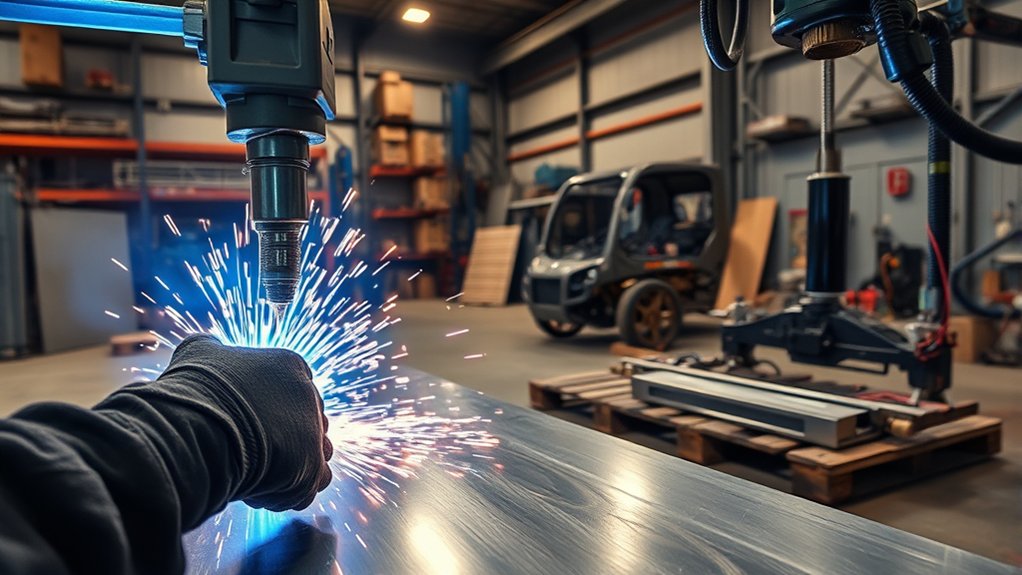
Although fabrication shops vary in scale and specialization, you’ll standardize quality and throughput by integrating high-definition plasma cutting with CNC control.
Specify torch height control, kerf compensation, and nesting algorithms to achieve precision cutting with minimal scrap. Program verified toolpaths and leverage post-processors aligned to your machine’s motion controller to guarantee repeatable results across shifts.
Integrate torch height control, kerf compensation, and smart nesting with verified, controller-aligned toolpaths for repeatable precision.
You’ll realize automation benefits by reducing manual handling, stabilizing cycle times, and cutting intricate geometries with clean edges that limit secondary finishing.
Define cut class requirements, amperage, gas mix, and feed rate per material thickness to maintain consistent edge quality on steel, stainless, and aluminum. Apply lead-ins, lead-outs, and corner loops to prevent heat-affected distortion.
Standardize workflows: import CAD, validate CAM, simulate, then execute via CNC with barcode-driven job release.
Monitor arc-on time, consumable wear, and utilization to optimize throughput. With streamlined setups and reduced waste, you’ll lower per-part costs while accelerating delivery across industrial assemblies.
Automotive Part Production and Customization
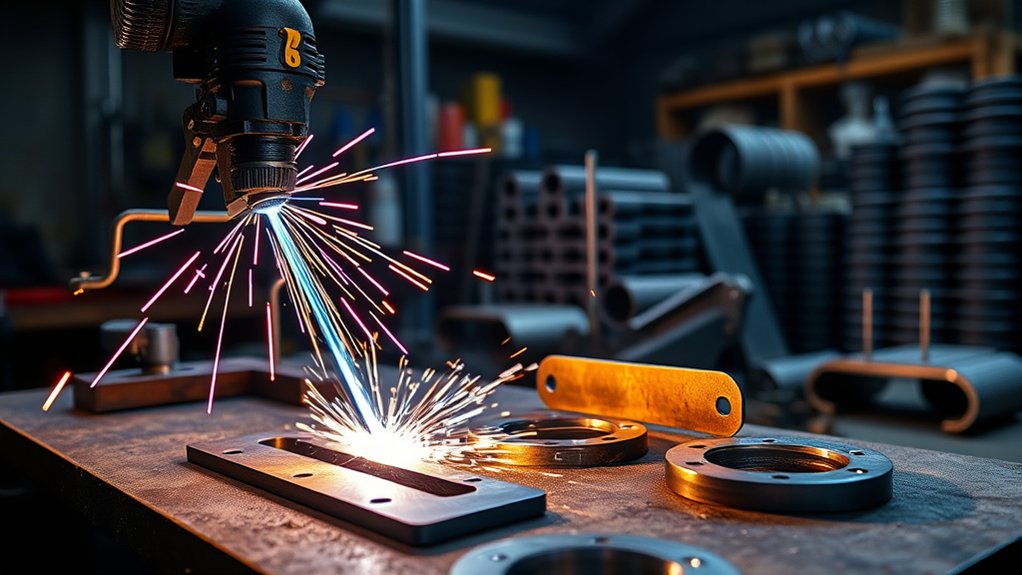
You apply high-definition plasma cutting to achieve precision chassis fabrication, holding tight tolerances while minimizing scrap per ISO/TS quality requirements.
For exhaust system customization, you cut both thin and thick alloys efficiently, producing complex geometries that reduce secondary finishing and guarantee repeatable fitment.
In high-speed panel cutting, you standardize toolpaths and pierce parameters to increase throughput, stabilize edge quality, and control cost per part.
Precision Chassis Fabrication
When precision and throughput drive chassis programs, high-definition plasma cutting delivers repeatable, standards-compliant results across thin and thick automotive-grade steels and aluminum.
You leverage advanced plasma technology to execute chassis design optimization with minimal kerf variance, tight tolerances, and stable heat-affected zones. Calibrated parameters—amperage, gas mix, standoff, and feed rate—ensure clean edges that reduce downstream deburr and machining.
You standardize cut sequences to control distortion, align hole quality with fastener specs, and preserve datum integrity for welding jigs. Nesting strategies minimize scrap, while real-time torch height control maintains cut consistency over varied plate flatness.
The process scales from prototype brackets to full-length rails without sacrificing accuracy. By accelerating cut cycles and eliminating rework, you meet aggressive takt times, protect structural integrity, and maintain repeatable, audit-ready quality.
Exhaust System Customization
Precision defines exhaust system customization, where CNC-integrated plasma cutters deliver high-speed, repeatable cuts in stainless steel, aluminum, and other conductive alloys to exact CAD profiles.
You translate digital fixtures, collectors, and muffler shells into tight-tolerance components that fit first time, protecting exhaust flow and enabling performance tuning without rework. High cutting speed compresses cycle time, so you iterate diameters, bend radii, and flange patterns rapidly to match customer specs.
Clean kerfs and minimal heat-affected zones reduce secondary finishing, stabilize weld quality, and lower labor cost. With consistent nesting and lot-to-lot repeatability, you maintain process capability across production runs and validate results against your quality plan.
- Optimize cross-sections to balance backpressure, scavenging, and noise targets.
- Standardize joints for leak-free welds and durable mounts.
- Document parameters for traceable, repeatable performance.
High-Speed Panel Cutting
Building on tight-tolerance exhaust work, high-speed panel cutting extends the same CAD-to-cut discipline to body, chassis, and bracket panels where throughput and repeatability govern cost.
You program nests, validate kerf offsets, and apply torch height control to sustain precision cutting across thin and thick gauges. With high-definition plasma, you achieve clean, smooth edges that reduce deburr steps, shorten takt time, and drive high speed efficiency.
You standardize parameters—amperage, gas mix, pierce delay, lead-ins—and verify cut quality against flatness, edge hardness, and dimensional tolerance.
Complex contours, louvers, and slot arrays are produced consistently, minimizing scrap and conserving sheet yield. Fast changeovers let you pivot from production runs to custom components without retooling.
The result: faster turnaround, stable Cpk, lower per-part cost, and competitive responsiveness.
Construction, Infrastructure, and Structural Steel
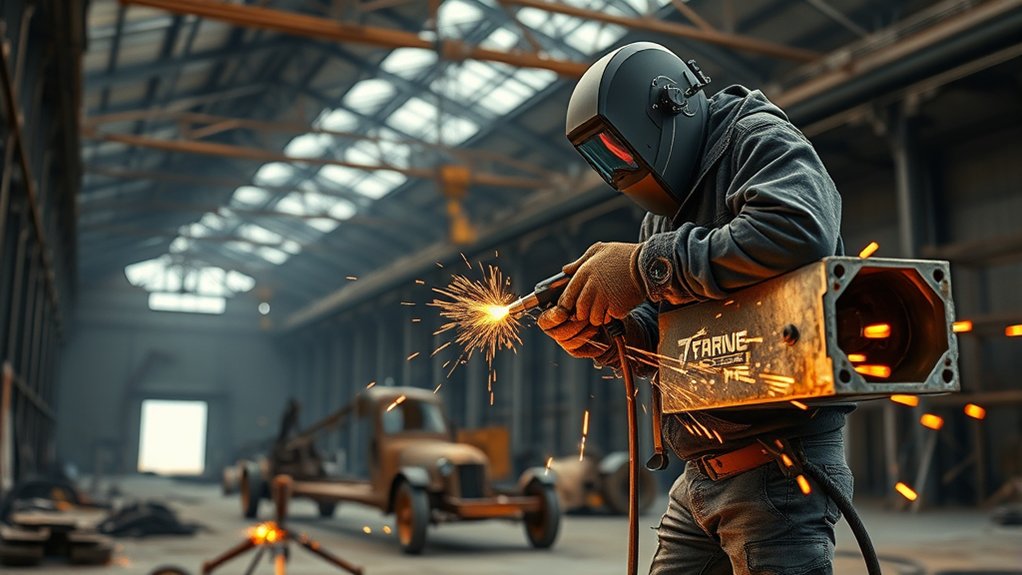
You use plasma cutters to execute beam and column cutting to spec, control heat input to limit distortion, and hold tolerances for fit-up per AISC and project QA/QC plans.
For pipe and plate fabrication, you select consumables, amperage, and cutting speed to achieve kerf accuracy and edge quality that minimize secondary finishing and meet weld-prep requirements.
During on-site structural repairs, you perform controlled sectioning and access cuts under strict safety and inspection protocols to restore integrity without compromising load paths.
Beam and Column Cutting
From bridge girders to high-rise columns, plasma cutting machines deliver code-compliant, repeatable cuts on structural steel with tight tolerances.
You’ll translate beam design requirements and column stability checks into precise profiles, copes, web openings, and flange bevels that fit first time. High-definition systems produce clean, square edges on thick sections with minimal heat input, limiting distortion and reducing grinding and rework.
Program nests, fixture the member, verify torch height, and run test coupons to validate kerf, angularity, and edge hardness before production. Document parameters to maintain traceability and accelerate approvals.
- Validate cut geometries against detailing models and erection tolerances to avoid field fit-up issues.
- Control consumables, gas mix, and standoff to stabilize arc quality on long cuts.
- Sequence cuts to manage heat, preserve straightness, and protect critical load paths.
Pipe and Plate Fabrication
Beyond beams and columns, the same code-compliant rigor carries into pipe and plate fabrication for construction and infrastructure. You’ll specify cut quality per AWS and AISC requirements, validate heat input, and document tolerances on ID/OD, bevel angles, and hole locations.
High‑definition plasma delivers tight kerfs and smooth edges, minimizing secondary grinding while preserving straightness and roundness critical to pipe jointing techniques.
For plate work, apply plate thickness considerations to choose amperage, gas mixes, and lead‑in strategies that limit thermal distortion on bridge decks, base plates, and gussets. Nest parts to optimize material yield and maintain grain orientation where required.
For pipe, use rotary fixtures or beveling heads to produce saddle cuts, miters, and cope profiles, ensuring fit‑up and weld accessibility. The result is repeatable productivity, precise geometry, and structurally sound assemblies.
On-Site Structural Repairs
Sometimes the fastest path to a safe structure is a clean, code‑compliant cut made in the field. With a high-definition plasma system, you’ll trim beams, plates, and pipe in seconds, limiting heat‑affected zones and distortion.
Rapid thick‑metal cutting boosts productivity on bridges and high‑rises, minimizing lane closures and crane time. Clean, smooth edges reduce grinding and prep, letting you proceed directly to fit-up, validated by WPS/PQR and compatible welding techniques.
Plan material selection, kerf width, and bevel angles to meet AISC and AWS tolerances, then verify with gauges before installation.
- Validate cut geometry against shop drawings and tolerance tables before lifting components into place.
- Sequence cuts to preserve load paths and temporary bracing requirements.
- Document parameters, consumables, and post‑cut inspections to guarantee traceable compliance.
Farming and Ranch Maintenance With Plasma-Cutting
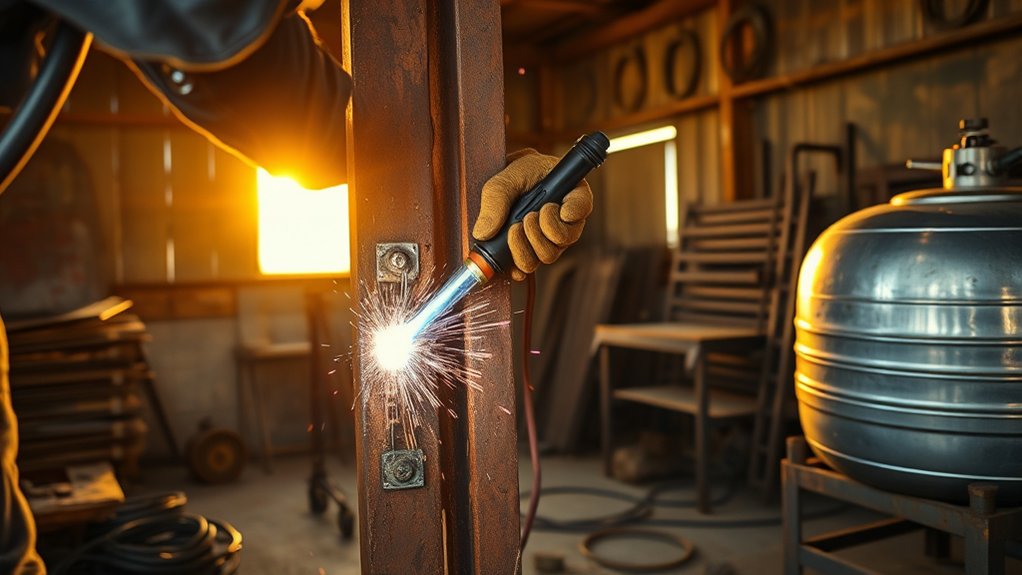
While uptime drives profitability in agriculture, plasma-cutting gives you a fast, standards-based way to keep trucks, tractors, combines, and balers in spec and back in service.
You’ll streamline crop maintenance and equipment repair by applying controlled amperage, correct standoff, and verified cut quality to restore brackets, guards, and chassis components without excess heat input. Use drag-shield techniques on painted or rusted steel to minimize prep and keep workflows moving.
Deploy a Hypertherm Powermax SYNC system to standardize consumables and traceability. Its single-piece cartridge logs arc starts, pierces, and arc-on time, letting you set preventive-maintenance intervals and select ideal current and gas settings for repeatable cuts.
For confined spaces—pickup frames, baler knotter housings, combine sieves—fit HyAccess extended-reach consumables to improve sightlines and torch access, reducing rework.
When removing cracked welds or seized fasteners, switch to plasma gouging. You’ll strip defective metal cleanly, maintain base-material integrity, and shorten repair cycles, returning assets to field service faster.
Heavy Machinery Manufacturing and Repair
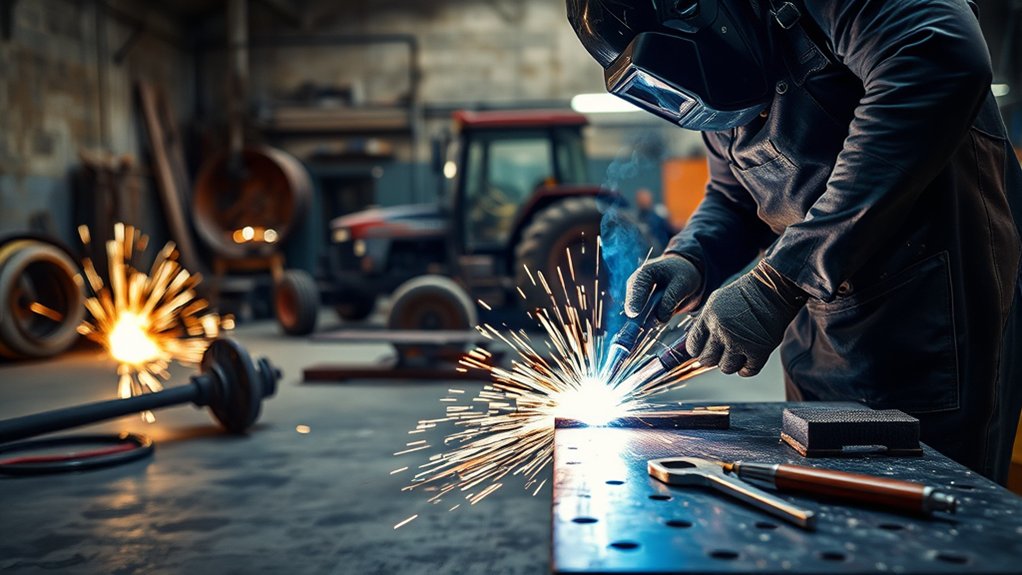
From field repairs to factory floors, plasma cutting scales to heavy machinery manufacturing where thick plate and complex geometries set the standard.
You cut structural and wear plate for agricultural, construction, and mining equipment with high-definition systems that hold tight tolerances and accelerate takt time. Plasma cutter efficiency delivers clean, square edges that reduce grinding and machining, so you meet dimensional and surface specs without excess rework.
High‑definition plasma cuts structural and wear plate fast, holding tight tolerances and minimizing rework
For heavy machinery innovations, you profile gussets, tabs, flanges, and repair patches rapidly, keeping assets online and downtime low.
- Specify material, thickness, and edge quality class; select amperage, consumables, and gas mix to meet code and OEM requirements.
- Program kerf compensation, lead‑ins/lead‑outs, and pierce sequencing to protect heat‑affected zones and maintain hole quality.
- Implement preventive maintenance: inspect torches, replace electrodes/nozzles by arc count, calibrate THC, verify grounding, and document parameters.
In the field, portable units enable precise crack removal and component fit‑up, extending equipment life and sustaining operational efficiency.
Artistic, Furniture, and Architectural Metalwork
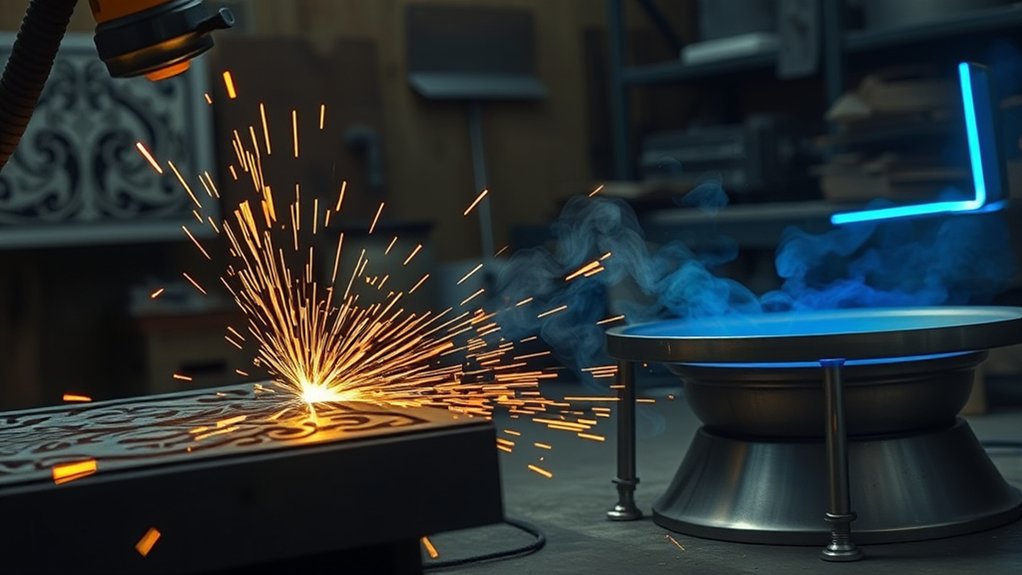
Even as aesthetics drive form, you apply plasma cutting to deliver precise, repeatable outcomes in artistic, furniture, and architectural metalwork. You translate vector drawings into toolpaths, set amperage and gas flow to match material type and thickness, and hold kerf width within tolerance to realize custom sculptures and intricate patterns.
With stainless steel and aluminum, you balance cut speed and pierce delay to minimize dross and heat-affected zones, preserving crisp edges that need minimal finishing.
For furniture, you nest components to optimize yield, then cut frames, gussets, and brackets with tab-and-slot features that self-locate during assembly. Consistent edge quality improves weld fit-up and reduces post-processing time.
In architectural work, you fabricate decorative elements, grills, and panels alongside light structural supports, aligning part IDs to drawing revisions for traceability.
You also produce unique lighting fixtures and ornamental designs, leveraging repeatable hole quality and smooth contours that integrate cleanly with downstream forming, welding, and coating processes.
Safety Practices, Optimization, and Consumable Management
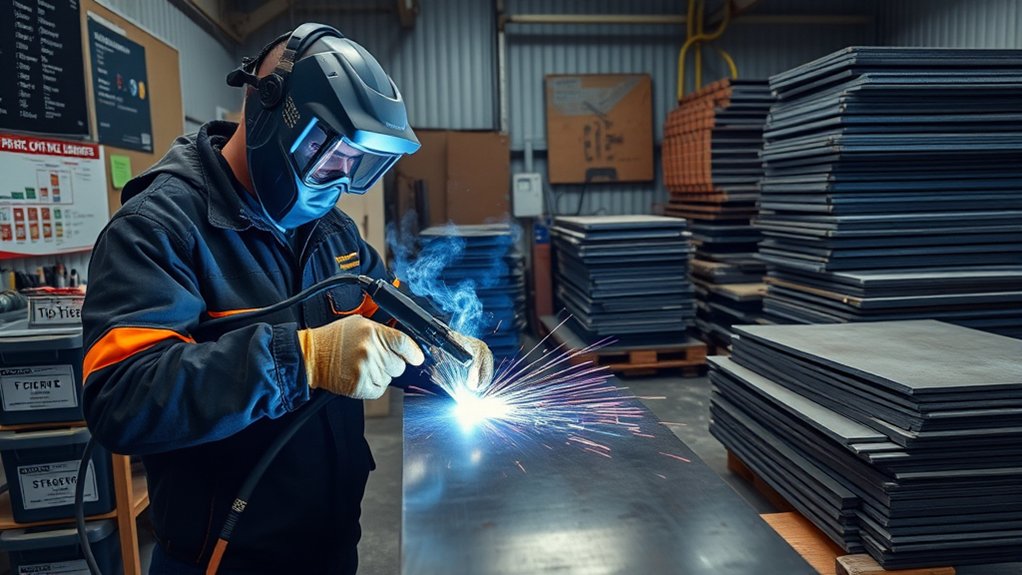
Before you strike an arc, establish controls that meet safety and quality objectives: fit ANSI Z87.1+ shade-rated eye protection, use localized fume extraction and shielding to mitigate radiation and airborne contaminants, and verify machine grounding.
Implement safety protocols with lockout/tagout, dry compressed air, and verified work clamp continuity. Maintain clear lead routing to prevent trip hazards and arc interruptions.
Implement lockout/tagout, dry air, and verified clamp continuity; route leads clearly to prevent trips and arc interruptions.
Apply equipment maintenance rigor: inspect torch leads, check gas flows, and replace nozzles and electrodes as a matched pair to stabilize arc geometry and reduce excessive wear.
Use consumable tracking—log pierces, arc-on time, and cartridge cycles—to forecast replacements and lower cost per cut.
Execute torch optimization: align standoff height, set travel speed to avoid drag lines or excess dross, and adjust direction of travel to match cut type for cleaner edges.
Validate parameters with test coupons, then document settings for repeatability.
- Standardize inspections and calibration intervals.
- Trend consumable life versus material thickness.
- Audit fume capture efficiency and adjust airflow.
Frequently Asked Questions
What Power Supply and Amperage Do Home Workshops Need for Plasma Cutters?
You typically need 120V for light-duty units and 240V for higher output. Match power requirements to circuit capacity; use dedicated circuits. Set amperage settings: ~20–30A for thin sheet, 40–60A for 1/4–1/2″, with proper duty cycle.
How Does Plasma Cutting Compare to Laser and Waterjet for Cost?
Like a scalpel versus a firebrand, you’ll find plasma most cost efficient overall, with fast cutting speed; lasers cost more but excel on thin tolerances; waterjet’s highest cost suits thick, exotic materials, prioritizing edge quality over throughput.
Can Plasma Cutters Handle Painted, Rusty, or Galvanized Metals Safely?
Yes, but you must control fumes and follow safety standards. Use local exhaust, respirators, and grounding. Expect extra spatter and dross; plan paint removal and metal preparation. For galvanized, prioritize ventilation and post-cut cleanup to manage zinc oxide.
What Air Quality and Filtration Requirements Do Shops Need?
You need to meet OSHA/ACGIH limits, design ventilation per ANSI Z49.1, and maintain negative-pressure capture. Specify filtration systems with MERV 13–16 or HEPA, adequate CFM, spark arrestors, prefilters, and gas-phase media. Monitor airflow, pressure differentials, and filter loading continuously.
How Do Ambient Temperature and Humidity Affect Cut Quality?
Like walking a tightrope, you balance environmental factors: ambient temperature and humidity directly affect cut quality. You maintain 10–35°C, 30–60% RH, prevent condensation, stabilize consumable temperature, guarantee dry, filtered air, and adjust amperage, speed, and gas flow per manufacturer specifications.
Conclusion
You’re the navigator of a ship forged from standards and process. With a plasma cutter as your compass, you chart precise routes through industrial steel, automotive alloys, and farm-worn iron. You calibrate consumables like provisions, follow safety as your maritime code, and integrate CNC as your celestial map. Each cut is a plotted waypoint—repeatable, minimal distortion, toleranced to spec. You keep uptime high, waste low, and quality verifiable. In this voyage, precision isn’t optional—it’s your North Star.