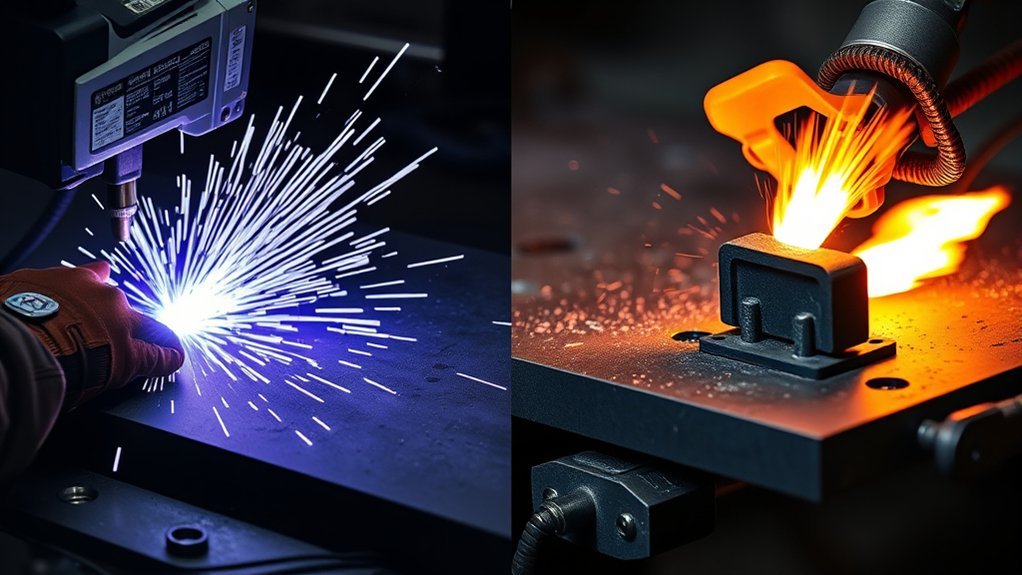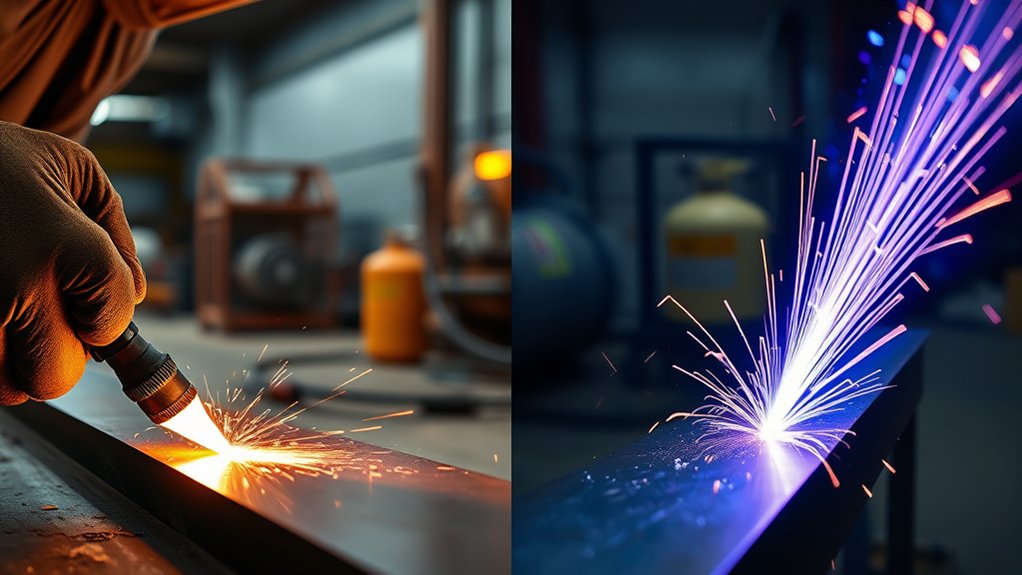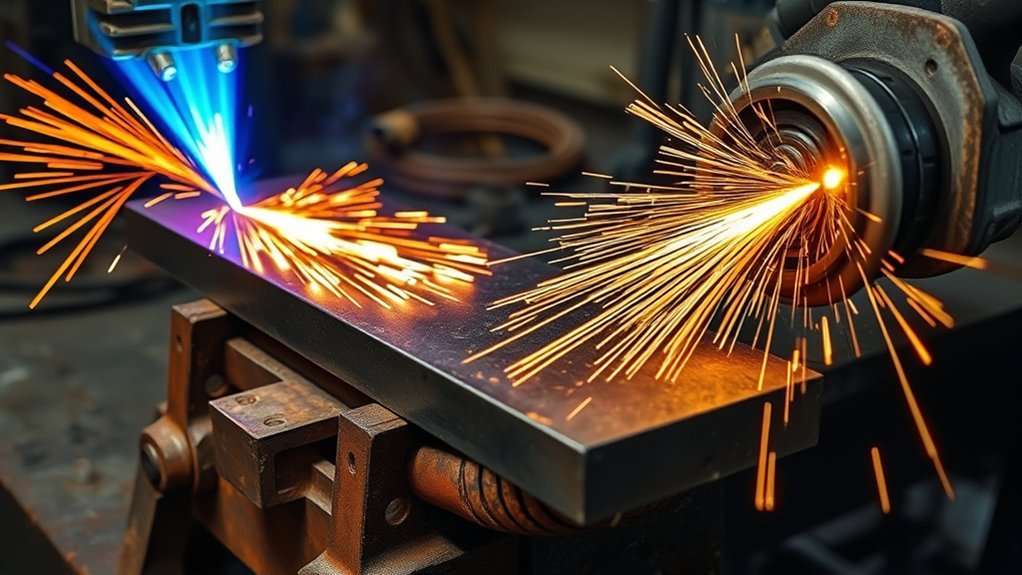
A plasma cutter is not automatically better than an angle grinder for every metal-cutting job. Plasma usually wins on long cuts, curves, repeated shapes, and plate within the machine’s rated capacity. A grinder is often faster to set up for short trims, small repairs, and jobs where compressed air is unavailable. The best choice depends on the metal, cut length, required accuracy, available power, cleanup, and safety controls.
Quick Answer
Choose a plasma cutter for fast cuts, curves, templates, and thicker conductive metal within the machine’s rated capacity. Choose an angle grinder for short straight cuts, thin stock, portability, and low setup cost. For weld-ready parts, plasma often makes the shape and a grinder removes dross, burrs, and bevels the edge.
Key Takeaways
- There is no universal thickness where plasma becomes the better tool; use the plasma cutter’s manual, rated cut capacity, duty cycle, and cut chart.
- Plasma cuts electrically conductive metal and normally needs suitable input power plus clean, dry compressed air.
- A grinder is cheaper and more portable, but wheel choice, rated speed, guard type, and cutting technique are critical.
- Plasma requires protection from arc radiation as well as sparks, fumes, noise, and hot metal.
- Many fabrication jobs use both tools: plasma for the main cut and a grinder for cleanup and weld preparation.
At a Glance
| Time Required | A few minutes for a short grinder cut; longer plasma setup if air, power, and consumables are not already ready |
| Difficulty | Moderate; both tools require steady control, safe workholding, and correct setup |
| Tools Needed | Plasma cutter with suitable power and air, or angle grinder with the correct cut-off wheel and guard; clamps, layout tools, and cleanup tools |
| Cost | Grinder: lower entry cost. Plasma: higher equipment and support cost but often lower labor time on repeated or complex cuts |
Warning: Both methods can start fires and create hazardous fumes. Remove combustibles, secure the work, control the spark and slag path, ventilate at the source, and use the eye and face protection specified for the operation. Do not cut sealed containers, fuel tanks, pressurized vessels, or unidentified coated metal.
Plasma Cutter vs Angle Grinder: Tool Capabilities
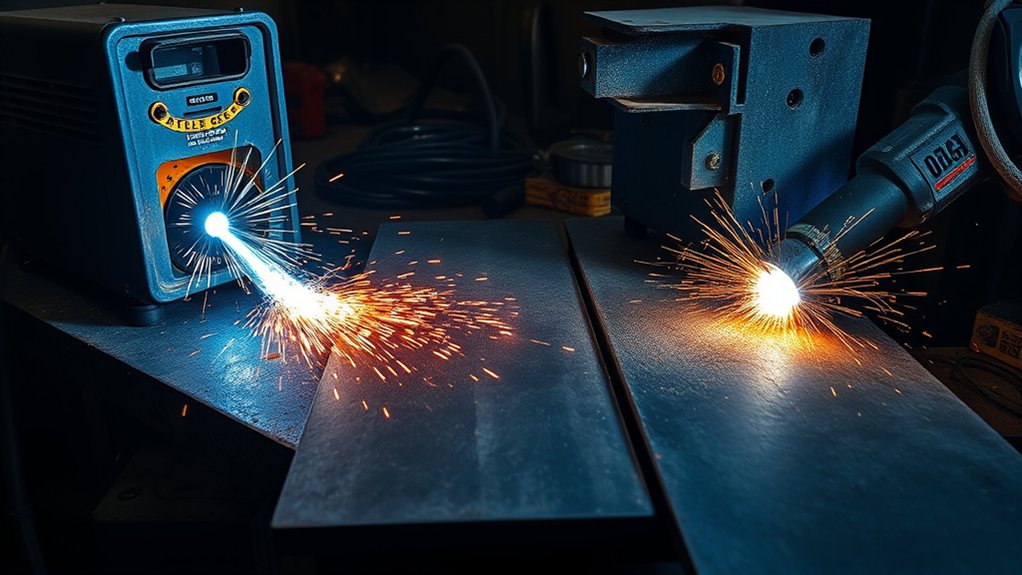
Both tools cut metal, but they remove material in different ways. A plasma cutter uses an electric arc and high-velocity gas to melt and blow away conductive metal. An angle grinder uses an abrasive cut-off wheel to wear through the work. That difference affects setup, speed, kerf, heat, noise, and cleanup.
A plasma cutter is usually the better production tool for long cuts, curves, templates, expanded metal, and repeated shapes. It can cut steel, stainless steel, aluminum, copper, brass, and other electrically conductive metals when the machine, torch, gas, and consumables are suitable. It cannot cut wood, glass, plastic, or other nonconductive material by the plasma-arc process.
An angle grinder is the more flexible general shop tool. With the correct accessory and guard, it can cut, grind, deburr, bevel, blend, and clean surfaces. For one short cut, the grinder may finish the job before a plasma system is connected to power and air.
| Factor | Plasma Cutter | Angle Grinder |
|---|---|---|
| Best use | Long cuts, curves, templates, repeated parts, and plate within rated capacity | Short cuts, trims, notches, field repairs, and edge finishing |
| Material limits | Electrically conductive metals | Material must match the wheel’s label and the tool manufacturer’s instructions |
| Setup | Power, work lead, torch consumables, and usually clean, dry compressed air | Correct wheel, compatible guard and flanges, side handle, and power or battery |
| Typical edge | Narrow kerf with possible bevel and dross | Straight slot with burrs; accuracy depends on wheel control and wear |
| Main limitation | Higher system cost and added power, air, fume, and arc-radiation controls | Slower on long or thick cuts; wheel binding, breakage, sparks, vibration, and noise |
The correct crossover point is not a fixed metal thickness. It is the point where the plasma cutter’s rated capacity and faster travel save more time than its added setup.
Products Worth Considering
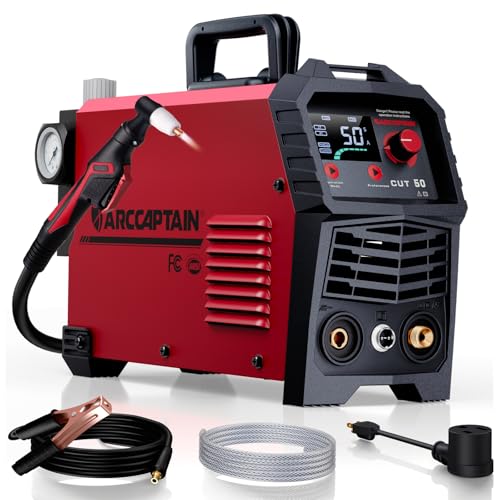
【Powerful Cutting Ability】Switch effortlessly between 110V and 220V for home or workshop use. Achieve professional 1/2" clean cuts on steel, aluminum, and copper with advanced LGBT technology. Perfect for DIY projects and heavy-duty tasks. Recommended maximum cutting thickness: 12mm @ 35A / 110V / 55 PSl; 18mm @ 50A / 220V / 75 PSI. Note: Requires compressed air (compressor sold separately).

[Powerful Cutting Ability] Dual voltage 110/220V good for home, workshop and hardware shop use. Professional performance 1/2" clean cuts on Iron, Steel aluminum and copper with Inverter IGBT Technology. Very powerful for DIY and heavy duty project. The Maximum cutting thickness is recommended to 1/2" @35A 110V 50PSI; 2/3" @50A 220V 65PSI. Dry and compressed air is required. Power breaker up to 60A@110V 35A; Up to 50A@220V 50A.

CUTTING THICKNESS UP TO 20MM: Featuring a brand-new MCU technology upgrade, the plasma cutter machine has a high degree of internal integration, combining full digitalization for more precise control of cutting parameters such as current and voltage. This results in better cutting effects and improved stability. Cutting thickness: Quality 12mm (1/2"), maximum 20mm (3/4").
Safety and PPE Essentials
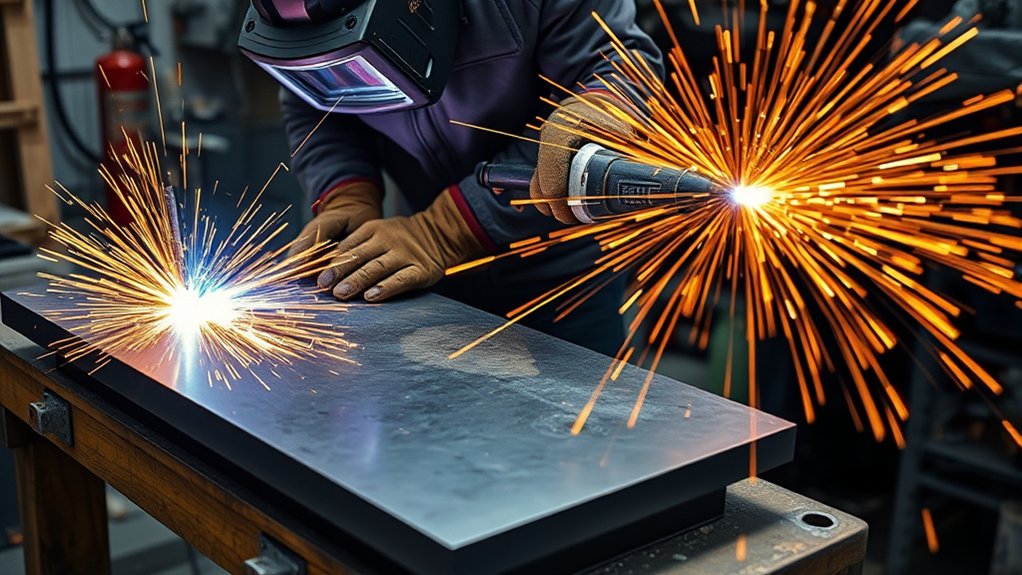
Safety is not the same for both tools. A grinder throws fragments, sparks, and debris from a high-speed wheel. Plasma cutting adds electric shock risk, ultraviolet and infrared radiation, hot slag, compressed gas, and metal fumes. Follow the tool manual, site rules, and applicable hot-work procedures.
Essential Protective Gear
Wear safety glasses with side protection under a suitable face shield. For plasma cutting, use filter lenses or a cutting helmet with the shade required for the arc current and operation. OSHA’s eye and face protection table lists minimum protective shades for arc processes; the plasma cutter manual may require a darker shade.
Use snug flame-resistant clothing that covers exposed skin, heat-resistant gloves appropriate for handling hot metal, hearing protection, and sturdy closed footwear. Avoid cuffs, loose sleeves, jewelry, and synthetic clothing that can melt. Respiratory protection is not a substitute for controlling fumes at the source. Select a respirator only through a proper hazard assessment, fit-testing process, and cartridge or supplied-air selection for the contaminant.
| Hazard | Minimum Control | Important Detail |
|---|---|---|
| Flying particles and wheel fragments | Safety glasses plus a face shield | The face shield does not replace safety glasses |
| Plasma arc radiation | Correct filter shade and full skin coverage | Select shade by amperage and the machine manual |
| Hot sparks and slag | Flame-resistant clothing, gloves, footwear, and spark containment | Hot particles can travel into cracks and smolder out of view |
| Noise | Hearing protection selected for measured exposure | Do not guess solely from the tool’s advertised sound level |
| Fumes and dust | Source capture or local exhaust ventilation | Coatings and alloying elements can change the hazard |
Safe Operating Practices
Set up the work area before starting either tool. Clamp the work so the offcut cannot pinch the wheel, fall on a cable, or trap hot slag. Keep hoses and cords outside the cutting path. Remove flammable liquids, paper, sawdust, rags, gas cylinders, and other combustibles from the spark zone. Use screens to protect nearby people from plasma arc radiation and flying debris.
For an angle grinder, inspect the wheel for damage and confirm that its maximum rated speed is at least the grinder’s no-load speed. Use the wheel type, flanges, and guard required by the grinder manufacturer. Position the guard between your body and the wheel, use the side handle, and hold the tool with both hands. Let the wheel reach operating speed before contact. Do not twist, jam, or side-load a thin cut-off wheel, and do not use it as a grinding wheel. OSHA’s rule for portable powered tools and abrasive wheels addresses guarding, mounting, and inspection.
For plasma, inspect the torch, lead, work cable, and consumables. Connect the work clamp to clean bare metal as close to the cut as practical, following the machine manual. The work lead completes the cutting-current circuit; it is not a substitute for the equipment’s protective earth connection. Confirm the required gas pressure and flow, drain moisture from the air system, and keep the operator and equipment dry.
Note: Never cut a container that held fuel, solvent, refrigerant, oil, or another hazardous substance unless it has been cleaned, tested, and released under an approved procedure. An “empty” container can still contain an explosive atmosphere.
Choosing the Right Tool by Material, Thickness, and Cut Shape
Do not use a single 4–5 mm rule for every machine and job. Small 120-volt plasma cutters, dual-voltage hobby systems, and industrial units have very different recommended cut, severance, and pierce ratings. The manufacturer’s recommended cut capacity is the useful starting point; a severance rating only means the machine can separate the metal, usually at a much slower speed and with a rougher edge.
For a grinder, thickness is only one factor. Cut length, wheel diameter, access, battery capacity, wheel wear, and the chance of binding can matter more. A grinder may be practical on a short cut in thick stock but inefficient for a long contour in thinner plate.
Products Worth Considering

This sheet metal cutter drill attachment is installed on the electric drill, and uses the power of the electric drill to drive the circular gear cutter to cut the metal sheet. The outer edge of the circular gear cutter head and the inner edge of the sub circular cutter head form a cutter cut to the iron sheet.

Cuts Up To 18 Ga. Material Including But Not Limited To - Sheet metal, corrugated sheet metal, duct, asphalt shingles, steel mesh, vinyl siding, wire, plastics, cardboard and rubber

[POWERFUL CUTTING PERFORMANCE] : Get clean, efficient cuts with up to 3/10" clean cut at 110V and 1/2" at 220V, with a maximum cutting thickness of 1/2" at 110V and 2/3" at 220V. Designed for smooth and effective cutting across a variety of metalworking, repair and DIY applications.
Thin Sheet Scenarios
When cutting thin sheet metal, support the panel close to the cut and use a guide when straightness matters. A thin, manufacturer-approved cut-off wheel can make short trims with little setup. Use light pressure and several controlled passes rather than forcing the wheel deep into a flexible panel.
Plasma is also effective on thin conductive sheet when the machine has the correct low-amperage consumables and cut chart. Fast, steady travel can limit heat input, while moving too slowly widens the kerf and increases dross. Test on scrap of the same alloy and thickness before cutting the finished part.
- Choose the grinder for a short straight trim, a small notch, or a repair away from compressed air.
- Choose plasma for long lines, curves, templates, repeated shapes, or interior openings that are safe to pierce.
- Watch the offcut: thin sheet can vibrate, drop, and close the kerf around a grinder wheel.
- Protect coatings: painted, plated, galvanized, or unknown surfaces require a fume assessment before hot work.
Heavy Plate Choices
Plasma usually gains a clear productivity advantage as cuts become longer, more complex, or closer to the machine’s recommended capacity. Set amperage, consumables, gas pressure, torch height, and travel speed from the cut chart. If the edge shows heavy dross, severe bevel, or incomplete penetration, stop and correct the setup rather than slowing down blindly.
A grinder can still make a short cut in heavy stock, especially during field repair, but expect more wheel wear, heat, noise, and operator time. Deep cuts also increase the chance that the kerf will close and bind the wheel. Support both sides of the cut so the gap opens rather than pinches as the cut progresses.
Material-Specific Considerations
- Mild steel: Both tools work well when the wheel or plasma process is intended for the thickness.
- Stainless steel: Use abrasives labeled for stainless when contamination matters. Plasma fumes can contain hazardous chromium compounds, so source capture and exposure controls are important.
- Aluminum: Plasma can cut it, but edge appearance and dross differ from mild steel. Use an abrasive specifically labeled for nonferrous metal if grinding or cutting aluminum; unsuitable wheels can load up.
- Galvanized, painted, plated, or coated metal: Identify and control the coating hazard before cutting. Do not assume ordinary room ventilation is enough.
- Rusty metal: Pilot-arc plasma systems may start through surface contamination, but the work clamp still needs a sound electrical connection. Clean the layout and clamp areas for reliable operation.
Speed, Cut Quality, Heat, and Cleanup
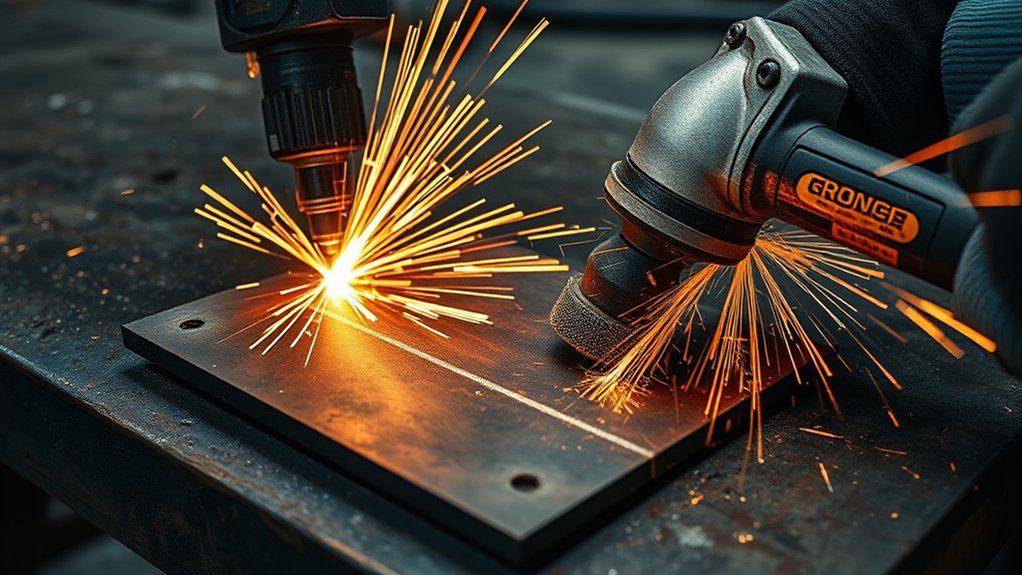
Plasma is normally faster on long cuts and profiles because the torch does not physically rub through the metal. A grinder can be faster on one small trim because setup is minimal. Actual performance depends on machine output, alloy, thickness, consumables, power supply, operator technique, and the finish you need.
Plasma commonly produces a narrow kerf, but the cut is not automatically square or weld-ready. Torch height, travel direction, worn consumables, gas quality, speed, and amperage affect bevel and dross. A grinder’s slot is influenced by wheel thickness, wheel wear, hand position, and whether the cut is made in one pass or several.
Heat comparison also needs context. Plasma is a thermal process with a localized heat-affected zone. A grinder does not create a plasma HAZ, but friction can still overheat, discolor, or distort thin metal when the operator pushes too hard or lingers. Judge the finished edge instead of assuming one method is always “cold.”
Common Cut-Quality Problems
| Problem | Likely Causes | Correction |
|---|---|---|
| Heavy plasma dross | Travel too slow or too fast, wrong amperage, incorrect height, wet air, or worn consumables | Return to the cut chart, inspect consumables, and test on scrap |
| Plasma edge bevel | Torch not square, wrong travel direction, excessive height, or worn nozzle | Square the torch, verify direction and height, and replace damaged consumables |
| Grinder cut wanders | Too much pressure, poor sight line, flexible sheet, or worn wheel | Score the line, support the work, use light pressure, and make controlled passes |
| Wheel binds or kicks | Kerf closes, wheel twists, offcut shifts, or cut is misaligned | Stop, disconnect power, re-support the work, and restart with the wheel square |
| Blue or warped grinder edge | Excess pressure, slow feed, dull or wrong wheel, or poor support | Reduce pressure, use the correct fresh wheel, and pause between passes |
Pro Tip: Make a short test cut in scrap from the same material. It reveals wheel loading, plasma dross, kerf allowance, and heat distortion before you risk the finished part.
Cost, Consumables, and Long-Term Value
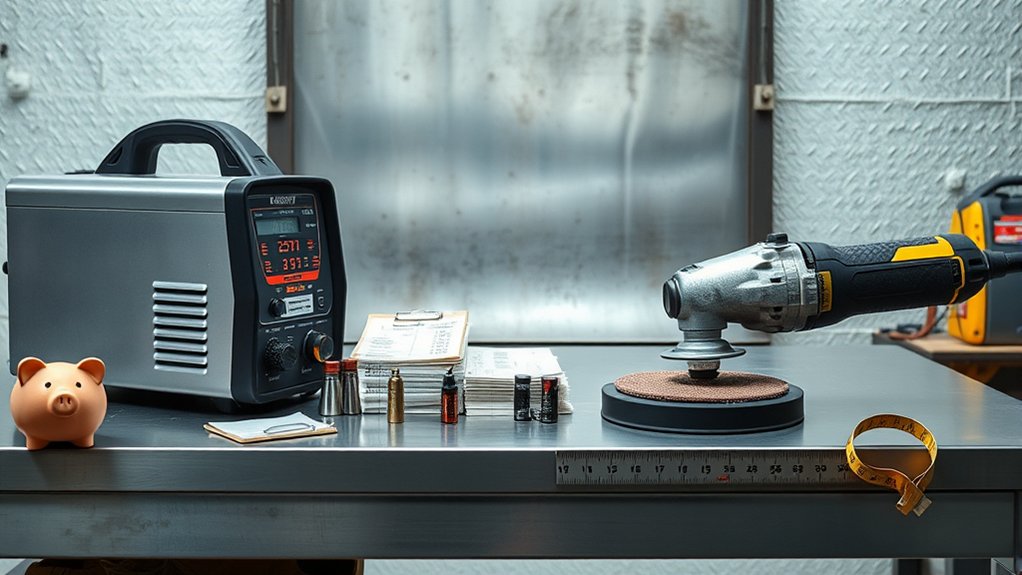
An angle grinder has the lower entry cost and remains useful after the cut for deburring, beveling, blending, and surface preparation. Its ongoing costs include cut-off wheels, grinding wheels, flap discs, batteries, chargers, guards, and replacement tools after heavy service.
A plasma cutter adds the power supply, torch parts, electrodes or cartridges, air filtration, compressor capacity, electrical installation, and possibly a cutting table or fume-control system. Consumable life falls when the operator pierces too close to the work, uses wet or dirty air, exceeds the rated duty cycle, or runs damaged parts.
Labor often changes the result. A plasma system can have a lower cost per finished part when it cuts long contours quickly and reduces wheel changes. A grinder may remain the better value for occasional straight cuts because it has almost no system setup and performs several finishing jobs.
- Occasional repair work: A quality grinder and proper accessories usually provide the broadest value.
- Frequent profiles or brackets: Plasma can save substantial layout and cutting time.
- Remote work: A cordless grinder is simple to deploy; plasma requires a compatible generator or electrical source and, for most systems, adequate air.
- Weld fabrication: Budget for both processes because cut edges often need cleaning or beveling.
Techniques, Tips, and When to Switch Tools
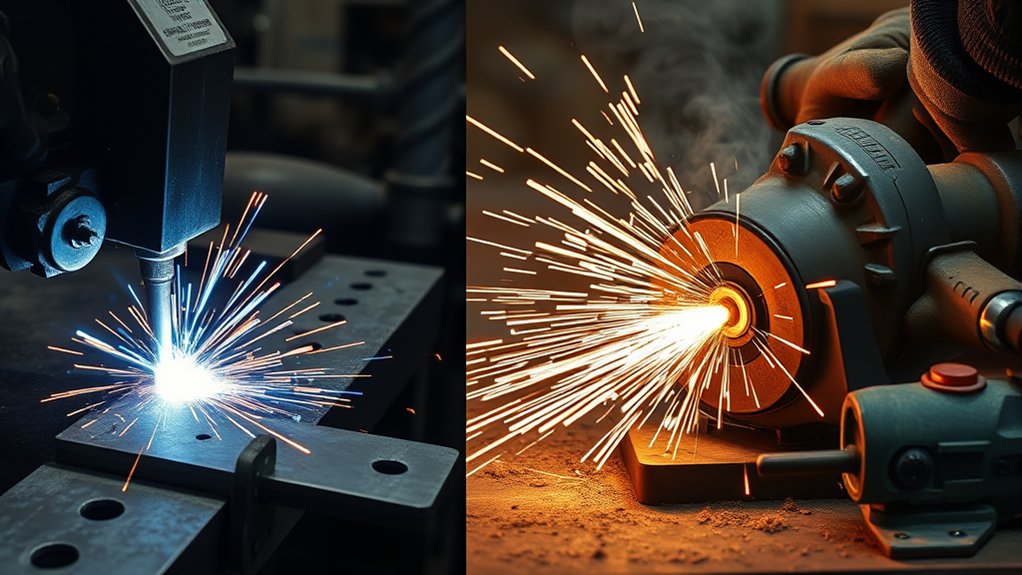
Plasma-Cutting Technique
- Identify the alloy and thickness, then install the consumables specified for the job.
- Confirm input power, duty cycle, gas pressure, airflow, and clean, dry air.
- Attach the work clamp to clean metal and keep the torch lead away from the cut path.
- Set amperage and torch height from the machine’s cut chart. Use a guide for straight lines or circles.
- Hold the torch square to the work and move at a steady speed. Watch the sparks below the plate; they should generally trail through the cut rather than spray back at the torch.
- Let the arc stop before lifting the torch away, then treat the part and offcut as hot.
For edge starts, begin at the edge when practical. Piercing thick plate throws molten metal upward and can damage consumables if the torch is too close. Follow the manual’s pierce capacity, pierce height, and delay requirements.
Angle-Grinder Cutting Technique
- Select a cut-off wheel labeled for the material, grinder size, arbor, and speed. Install the required cutting guard and correct flanges.
- Clamp and support the work so the kerf opens as the offcut separates.
- Stand out of the wheel’s plane, start the grinder clear of the work, and allow it to reach speed.
- Keep the wheel square to the cut. Use light, steady pressure and avoid twisting.
- On sheet or long cuts, score the line first and deepen it in controlled passes.
- Wait for the wheel to stop before setting the grinder down. Disconnect power or remove the battery before changing accessories.
When to Switch Tools
Switch from the grinder to plasma when the cut is becoming slow, wheel wear is high, the line is too complex, or repeated parts need consistent shape. Switch from plasma to the grinder when the remaining job is edge blending, a small correction, a bevel, coating removal, or dross cleanup.
Do not keep forcing a poor process. If plasma cannot pierce or maintain the cut within its rated settings, use a higher-capacity machine or another approved process. If a grinder wheel repeatedly binds, change the work support or cutting method instead of applying more pressure.
Power, Air, Generators, and Shop Setup
Check the nameplate and manual before connecting either tool. Corded grinders vary in current draw, and plasma cutters may offer 120-volt, 240-volt, dual-voltage, single-phase, or three-phase configurations. A machine that operates on 120 volts may have reduced output or duty cycle compared with its higher-voltage setting. Do not use an undersized extension cord or defeat a breaker because a tool trips the circuit.
Most air-plasma cutters need a minimum pressure and flow while cutting, not merely a compressor with a large advertised tank. Compare the cutter’s required flow to the compressor’s delivered cubic feet per minute at the specified pressure. Use filtration and moisture control recommended by the cutter manufacturer. Hypertherm notes that shop air for plasma cutting should be cleaned of particulate, oil mist, and moisture in its plasma gas selection guidance.
Generator sizing is machine-specific. Required power can vary from a compact plasma system to a high-output industrial unit, and full rated output may need much more generator capacity than reduced output. Use the plasma manufacturer’s engine-drive or generator table and include any separate compressor load. Confirm voltage, frequency, continuous power, grounding and bonding instructions, and compatibility with electronic inverter equipment.
Cold weather can stiffen cables and increase moisture problems when warm compressed air enters cold lines. Store consumables dry, drain the air system, allow equipment to reach its approved operating temperature, and follow the manual. Do not compensate for cold weather by increasing amperage beyond the cut chart.
Plasma systems can produce electromagnetic interference. Keep work and torch leads close together where the manual recommends, route them away from sensitive signal cables, and follow the manufacturer’s grounding and shielding instructions. Do not improvise protective-earth connections or assume a ferrite alone will correct an installation problem.
Best Sequence for Weld-Ready Edges
If the cut edge will be welded, plan the sequence before cutting. The goal is not merely to separate the metal; it is to produce the correct dimensions, joint angle, cleanliness, and fit-up without overheating the part.
- Lay out the finished dimension. Account for kerf location and identify which side of the line is scrap.
- Make the main cut. Use plasma for long cuts, plate, curves, and templates within rated capacity. Use a grinder for short trims where setup is simpler.
- Remove dross and burrs. Let the metal cool, then chip or scrape loose plasma dross. Use a file or suitable grinding accessory for the remaining high spots.
- Prepare the joint. Bevel only as required by the weld procedure or joint design. Keep the bevel even and preserve the root face and gap.
- Clean the weld zone. Remove oil, paint, rust, plating, oxide, and abrasive residue by an approved method for the alloy.
- Check fit-up. Confirm dimensions, squareness, gap, and alignment before tacking.
Note: Plasma-cut stainless and aluminum edges may need additional cleaning for the selected welding process. Follow the filler-metal, welding-procedure, and equipment guidance for the alloy rather than relying on appearance alone.
Fume, Fire, and Environmental Controls
Plasma cutting and abrasive cutting can release metal particles and contaminants from coatings. Stainless plasma fume may contain hexavalent chromium and other toxic substances. NIOSH has documented these hazards in research on stainless steel plasma-cutting emissions. Galvanized, lead-painted, cadmium-plated, and other coated metals can require special controls.
Use local exhaust ventilation or another engineered system that captures fumes near the source without pulling the plasma arc toward the operator. General fans may spread contamination through the shop. OSHA’s welding and cutting requirements in 29 CFR 1910.252 address fire prevention, ventilation, confined spaces, and toxic coatings.
Control sparks and slag above, below, and on the far side of the work. Check wall cavities, floor openings, cable trays, and hidden spaces where hot particles can collect. Use a hot-work permit and fire watch when required by the workplace or local rules. Keep suitable fire-extinguishing equipment immediately available, but do not rely on an extinguisher as a substitute for removing combustibles.
Frequently Asked Questions
Can either tool run on a standard household circuit without tripping breakers?
Sometimes. Many small corded grinders fit a properly wired household branch circuit, but current draw varies by model. Some compact plasma cutters operate on 120 volts with reduced output, while others require 240 volts or a dedicated circuit. Compare the tool’s nameplate and manual with the circuit rating, receptacle, breaker, and extension-cord limits.
How does cold weather affect plasma-cutter performance and arc stability?
Cold can stiffen leads, affect displays or electronics outside their rated range, and increase condensation or moisture problems in compressed-air systems. Keep equipment within the manufacturer’s storage and operating limits, drain moisture, protect consumables, and let the machine stabilize before use. Do not raise amperage beyond the cut chart to compensate for temperature.
What generator is suitable for mobile plasma cutting or grinding?
Use the tool manufacturer’s generator or engine-drive requirements. A grinder may need extra starting headroom, while a plasma cutter’s requirement changes with model and output setting. Add the compressor load if it is powered by the same generator. Verify continuous watts or kVA, voltage, frequency, receptacles, grounding and bonding, and compatibility with inverter electronics.
Are there ventilation requirements for indoor plasma cutting?
Yes. The required control depends on the metal, coating, process, room, and exposure. Capture fumes at the source and assess the breathing zone. Stainless, galvanized, lead-painted, cadmium-coated, and unknown materials need special attention. Confined spaces require a formal procedure, atmospheric controls, and trained personnel; never use oxygen for ventilation.
Can plasma cutters or grinders interfere with nearby electronics or Wi-Fi?
Plasma equipment can create electrical noise, and motor-driven tools can also disturb sensitive circuits. Separate power and signal wiring where practical, keep cutting leads away from data cables and antennas, and follow the equipment maker’s grounding, shielding, and electromagnetic-compatibility instructions. Troubleshoot the installation rather than adding random grounds.
Which tool makes the cleaner cut?
A properly set plasma cutter often makes a narrow, fast profile with little dross, especially on longer cuts. A grinder can make a very straight short cut but usually leaves burrs and depends heavily on wheel control. Neither edge is automatically weld-ready; inspect dimensions, bevel, dross, burrs, oxides, and contamination.
Can a plasma cutter cut painted or rusty metal?
Many pilot-arc systems can start through light rust or paint, but performance varies and the work clamp still needs a reliable conductive connection. More importantly, heated coatings can release hazardous fumes. Identify the coating, remove it by an approved method where required, and provide suitable ventilation and exposure controls.
Conclusion
Choose the tool by the whole job, not one thickness number. A plasma cutter usually earns its keep on long cuts, curves, templates, repeated parts, and plate within its rated capacity. An angle grinder remains the practical choice for short trims, portable repairs, and final edge work.
For the best weld-ready result, use each tool where it is strongest: make the main profile with plasma when it saves time, then remove dross, burrs, and prepare the joint with the correct grinding accessory. Verify power, air, workholding, wheel or consumable condition, ventilation, fire controls, and PPE before every cut.
Sources
- OSHA 29 CFR 1910.133 — Eye and Face Protection — filter shades and protection from flying particles and arc radiation
- OSHA 29 CFR 1910.243 — Guarding of Portable Powered Tools — portable grinder guards, wheel mounting, and inspection
- 29 CFR 1910.252 — Welding, Cutting, and Brazing — fire prevention, ventilation, confined spaces, and hazardous coatings
- NIOSH-indexed study on stainless steel plasma-cutting fume — particulate emissions and potential hexavalent chromium exposure
- Hypertherm Plasma Gas Selection Guide — air quality and gas selection for plasma cutting
- Hypertherm Powermax30 AIR Specifications — example of model-specific cut capacity and generator requirements