Choosing between stitch welding and continuous welding starts with one question: what must the finished joint do? Intermittent stitch welds can reduce deposited weld metal, total heat, and distortion when the design permits gaps. A continuous weld is normally required when the seam must seal, transfer load along its full length, or satisfy a drawing, code, or qualified welding procedure.
Quick Answer
Use intermittent stitch welding only when the approved design allows separated weld segments and reduced weld length still meets the load. Use continuous welding when the joint must seal, resist demanding cyclic service, or carry load along the full seam. For structural or safety-critical work, follow the drawing, code, and WPS.
Key Takeaways
- Intermittent stitch welding leaves designed gaps between short weld segments, which can reduce weld metal, cumulative heat, and distortion.
- Continuous welding leaves no unwelded gap along the specified seam, but the final weld may still be made in planned sections rather than one uninterrupted pass.
- Strength depends on weld size, effective length, joint geometry, loading, material, workmanship, and the governing design—not the label “stitch” or “continuous” alone.
- Intermittent welds are not leak-tight and create more starts and stops, which deserve close inspection in cyclic or vibration service.
- “Stitch welding” can also mean overlapping short welds used to complete a sheet-metal seam. Confirm which meaning the drawing, repair manual, or shop procedure uses.
At a Glance
| Time Required | No fixed time. A simple noncritical joint may take only minutes to review, while engineered, code, repair-manual, or inspection-controlled work requires formal planning and approval. |
| Difficulty | Moderate for general fabrication; advanced for structural, pressure-retaining, vehicle, aluminum, stainless, fatigue-sensitive, or code-regulated work. |
| Tools Needed | Welder and consumables matched to the material, PPE, ventilation or fume control, clamps, layout tools, cleaning tools, suitable fire-extinguishing equipment, and the drawing or WPS when required. |
| Cost | Intermittent welds may use less filler and arc time, but layout, repeated starts and stops, cleaning, and inspection can offset some savings. Actual cost depends on the process and acceptance requirements. |
Warning: Welding is hot work. Wear suitable PPE, control fumes, protect nearby people from arc radiation, remove or shield combustibles, and keep fire-extinguishing equipment ready. OSHA requires a fire watch under specified conditions, including appreciable combustibles within 35 feet (10.7 m), and requires it to continue for at least 30 minutes after the work. Never weld a used tank, drum, pipe, or container until it has been properly cleaned, isolated, vented, and prepared under an approved procedure.
What Is Stitch Welding?
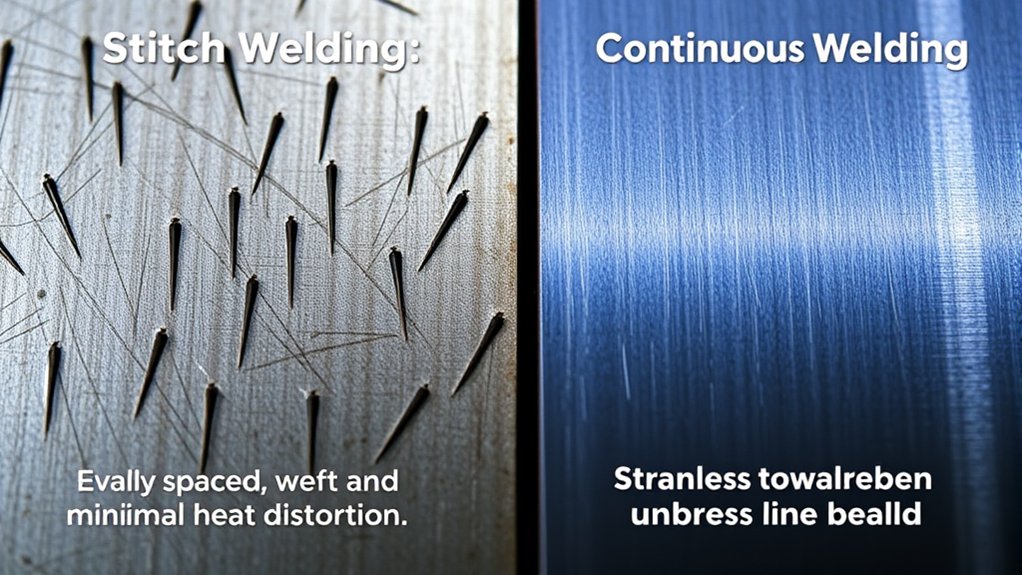
In structural and general fabrication, stitch welding commonly means intermittent welding: a series of short final welds separated by unwelded gaps. A drawing may specify each segment’s weld size, length, pitch, side of joint, and whether welds on opposite sides are arranged in a chain or staggered pattern.
Pitch is the spacing used to locate repeated weld segments. Under the AWS symbol system, the length and pitch appear to the right of the weld symbol, with length first. Pitch is generally measured center to center, not as the clear gap between adjacent segments. Always use the symbol standard named by the project because AWS and ISO drawing conventions are not identical.
This method is useful when a full-length weld is unnecessary and the designer wants to limit deposited weld metal, cumulative heat, shrinkage, or production time. Common examples include some stiffeners, covers, non-sealed brackets, light frames, and sheet assemblies.
Stitch welding is not permission to place random short beads. Segment size, effective length, pitch, end location, and pattern must transfer the required load and satisfy any minimum-size or minimum-length rules in the governing design standard.
Note: In auto-body and thin-sheet work, “stitch welding” may instead describe a sequence of short, often overlapping welds used to complete a continuous seam while allowing cooling between welds. That technique does not leave permanent design gaps. This article uses “stitch weld” to mean an intermittent final weld unless stated otherwise.
What Is Continuous Welding?
Continuous welding means the specified seam has weld metal along its full required length, with no designed unwelded gaps. It does not necessarily mean the welder must travel from one end to the other in a single pass without stopping. A continuous final seam may be completed in sections, with backstepping, balanced sequencing, or planned starts and stops when the procedure permits.
Continuous welds are commonly selected when a joint must seal, provide stiffness along a full edge, transfer load over the entire specified length, or meet a code, drawing, repair-manual, or inspection requirement. Examples can include tanks, piping, enclosures, pressure-retaining seams, structural connections, and parts exposed to demanding vibration or cyclic service.
The tradeoff is not simply “more weld equals better.” A longer weld deposits more metal and can add cumulative heat and shrinkage. On thin or heat-sensitive material, poor sequence, fit-up, settings, or restraint can cause burn-through, angular distortion, buckling, residual stress, or an unnecessarily large heat-affected zone.
Stitch Welding vs. Continuous Welding: Main Differences
| Factor | Intermittent Stitch Welding | Continuous Welding |
| Final weld pattern | Short weld segments with designed gaps | Weld metal along the full specified seam |
| Deposited weld metal | Usually less over the same joint length | Usually more over the same joint length |
| Heat and shrinkage | Can reduce cumulative heat and shrinkage because less length is welded | Usually needs more attention to sequence, restraint, travel speed, and fit-up |
| Load capacity | Adequate only when weld size and total effective length are designed for the load | Provides full specified weld length; capacity still depends on weld size, joint geometry, material, and loading |
| Cyclic or fatigue service | More weld ends and local stress concentrations; use only when the fatigue design permits it | Fewer designed weld ends, but fatigue performance still depends on the complete joint detail and weld quality |
| Sealing | Not leak-tight because gaps remain | Can form a sealed seam when the procedure, penetration, and inspection are suitable |
| Corrosion and cleanliness | Gaps can admit or trap moisture, dirt, or chemicals in some joint shapes | May close a crevice, but poor profiles, pinholes, and inaccessible backsides can still create corrosion risks |
| Production cost | May reduce filler and arc time, but adds layout and repeated starts and stops | Uses more weld length, but may be simpler to automate or inspect as one complete seam |
How Heat Input and Distortion Compare
Welding applies concentrated heat, then the weld and nearby base metal cool and contract. Uneven heating, cooling, and restraint can make a part pull, shrink, twist, or bow. The amount of deposited weld metal, total weld length, process efficiency, current, voltage, travel speed, joint design, and sequence all affect the result.
Intermittent welding often reduces cumulative heat and shrinkage because less of the joint is welded. That can help on thin panels, long attachments, light brackets, and parts where alignment or appearance matters. It does not guarantee a straight part: poorly balanced stitches, oversized welds, excessive restraint, or welding every segment in the same direction can still cause distortion.
A continuous seam usually adds more total weld length, so tack spacing, clamping, preset, backstepping, skip sequence, balanced welding, travel speed, and pass count may matter more. The heat delivered to the workpiece also influences the heat-affected zone, where the base metal does not melt but its properties can change.
The goal is not to deposit the most weld metal. It is to deposit the weld the design requires while controlling distortion, defects, and unnecessary rework.
Pro Tip: On thin noncritical practice pieces, tack the joint, verify alignment, and alternate weld locations instead of concentrating heat in one area. Use scrap of the same alloy and thickness to confirm settings before welding the part.
How Strength, Fatigue, Sealing, and Corrosion Compare
A continuous weld is not automatically stronger merely because it is continuous. Weld capacity depends on effective throat, effective length, weld metal strength, base metal strength, joint geometry, load direction, eccentricity, and workmanship. An engineered intermittent weld can safely carry a specified static load, while an undersized or defective continuous weld can fail.
For cyclic loading, every weld toe, root, start, stop, profile change, and local discontinuity can influence crack initiation. Intermittent patterns add more weld ends along the joint, so they need special caution in fatigue-sensitive service. A continuous weld removes the designed gaps, but it does not erase fatigue risk; abrupt terminations, undercut, poor transitions, residual stress, and an unfavorable joint detail can still control life.
For sealing, intermittent welds are normally unsuitable because the gaps provide a direct leak path. A continuous seam can be leak-tight only when the joint design, welding process, penetration, and inspection are appropriate. A bead that looks continuous can still contain pinholes, porosity, cracks, incomplete fusion, or an unsealed root.
Service environment matters too. Intermittent welds on lap joints can leave crevices that collect water, salt, dirt, or chemicals. Continuous welding may close an exposed edge, but welding can also damage coatings and create areas that need cleaning, passivation, sealing, or recoating. Follow the material and corrosion-control specification rather than treating either pattern as universally better.
Best Applications for Stitch and Continuous Welding
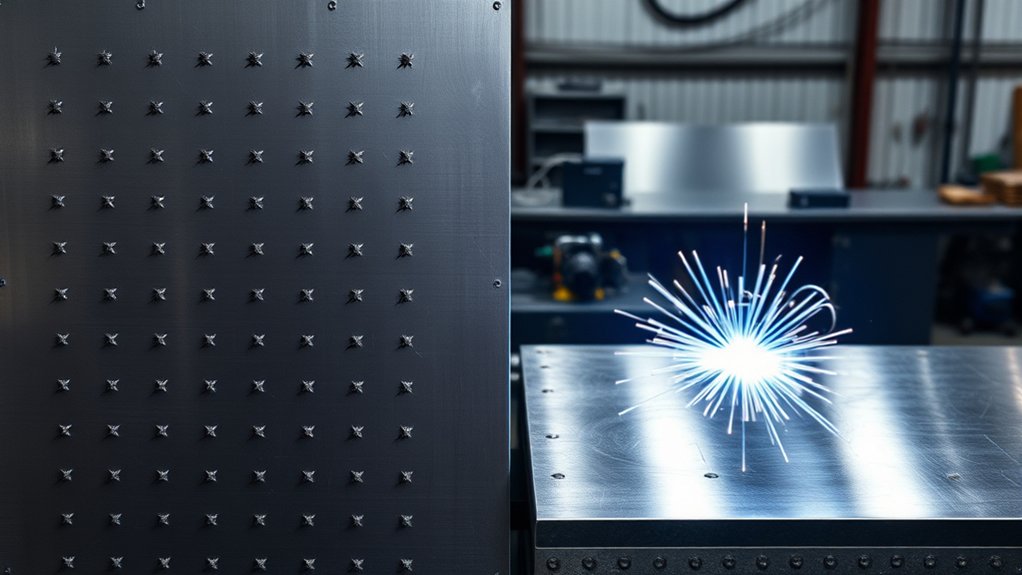
The best welding method depends on the joint’s required load path, service environment, sealing duty, material thickness, fatigue exposure, inspection method, and governing documents.
Products Worth Considering

💪200A POWER & PORTABLE DESIGN: Weld metals up to 1/4" thick (0.06-0.2") including stainless steel, alloy steel, carbon steel, and copper. Compact size (8.6x4.1x5.5") and ultra-lightweight (5 lbs) with shoulder strap make it easy to carry for jobs anywhere – high altitude, indoors, or outdoors. Enjoy extended welding sessions without overheating, backed by a solid 60% duty cycle for professional results.

3-in-1 metal workshop — weld, cut & clean with the xTool MetalFab, a complete fabrication solution. Seamlessly switch between a steady 1200W fiber laser welder for flawless seams, a high-performance cutter for on-the-spot cuts up to 5 mm, and a 3× wider, high-efficiency 45 mm laser cleaner for fast surface prep. Save hours on metal welding and finishing, and upgrade easily to automated, precision CNC metal cutting when you need full automation.

[ 1200W DOUBLE WOBBLE LASER WELDER ] Equipped with dedicated welding / cutting / cleaning / weld seam cleaning nozzles. 7 Welding modes with welding width up to 8 mm; 10 Cleaning modes with cleaning width up to 100 mm; Laser cutting thickness up to 4 mm; Laser weld seam cleaning width up to 12mm
Use Stitch Welding When
- The approved design permits intermittent welds.
- The joint does not need to be watertight, airtight, sanitary, or pressure-retaining.
- The calculated weld size and total effective length can carry the required static load.
- Reducing deposited weld metal and cumulative heat will help control distortion.
- The gaps will not create an unacceptable corrosion, contamination, or cleaning problem.
- The weld ends are acceptable for the expected vibration and fatigue service.
- The pattern can be laid out and inspected consistently.
Use Continuous Welding When
- The drawing, code, WPS, repair manual, or engineer requires a continuous seam.
- The joint must contain liquid, air, gas, or pressure.
- Load must transfer along the full specified joint length.
- The service is fatigue-sensitive and the approved design does not permit intermittent weld ends.
- A continuous edge closure is needed for stiffness, hygiene, weather exposure, or corrosion control.
- The part is a safety-critical structural connection, lifting attachment, pressure component, vehicle structure, protective cage, or other regulated assembly whose approved design calls for full-length welding.
How to Choose the Right Welding Method
Do not choose a weld pattern from speed or appearance alone. Use the following checks to decide whether intermittent or continuous welding is permitted.
Products Worth Considering

Richard Finch, Welder's Handbook: A Complete Guide to MIG, TIG, Arc & Oxyacetylene Welding, "Completely Revised and Updated Edition!" paperback


1. Start With the Drawing, Code, Repair Manual, or WPS
If a drawing calls for a continuous weld, make the completed weld continuous. If it calls for an intermittent weld, follow the specified weld size, segment length, pitch, side, pattern, and extent. Do not convert one pattern to the other without approval.
For U.S. structural steel work, the applicable contract may reference AWS D1.1/D1.1M:2025-AMD1 for welding requirements and ANSI/AISC 360-22 for structural design requirements. Other materials and industries use different codes. The project documents control.
2. Match the Weld to the Load Path
Check where the force enters the joint, how it leaves, and whether loading is static, impact, reversing, or cyclic. Intermittent welds provide less total effective length than a same-size continuous weld over the same seam. That can be acceptable only when the design calculation and minimum-detailing rules allow it.
3. Check Material Thickness and Heat Sensitivity
Thin steel, aluminum, stainless steel, and heat-treated alloys can distort or lose important properties when heat is poorly controlled. An intermittent pattern may reduce cumulative heat, but correct joint preparation, process, settings, travel speed, filler, shielding, sequence, and interpass control still matter.
4. Decide Whether the Joint Must Seal
If the seam must hold water, oil, fuel, exhaust, air, gas, or pressure, an intermittent final weld normally leaves unacceptable leak paths. Use the specified continuous joint design and required leak or pressure test. Never assume a visually continuous bead is leak-tight.
5. Check Fatigue, Vibration, and Impact Service
Starts and stops can create local profile changes and defect-prone areas. For machinery, trailers, vehicles, cranes, lifting devices, bridges, frames, and other cyclic applications, use the approved fatigue detail and inspection requirements. Do not substitute a shop rule for an engineered joint.
6. Check Corrosion, Hygiene, and Coating Requirements
Gaps in lap joints can trap moisture or contaminants and may be difficult to clean or coat. In food, chemical, marine, outdoor, or sanitary service, the required edge treatment and surface finish may decide the weld pattern. Stainless work may also require proper cleaning or passivation after welding.
7. Plan Access, Sequence, and Inspection
Confirm that the torch or electrode can reach the root, each segment can be measured, and both sides remain visible where inspection is required. Continuous seams need inspection for full-length discontinuities; intermittent patterns need close checks at every start, stop, and missed segment.
Note: Do not use an intermittent pattern on a pressure part, lifting point, vehicle frame, roll cage, or structural member unless the approved design or repair procedure specifically permits it. Welding can also change heat treatment, crash behavior, alignment, and corrosion protection.
How to Lay Out Stitch Welds Correctly
An intermittent weld is useful only when the pattern is deliberate and repeatable. Random short beads can create missed load paths, uneven shrinkage, inconsistent spacing, and hard-to-inspect defects.
Read Weld Size, Segment Length, and Pitch
Under AWS A2.4:2020, an intermittent fillet-weld symbol can show the weld size to the left and the segment length followed by pitch to the right. For example, “2-6” commonly means 2-inch-long segments on 6-inch pitch when the drawing uses inch units. Pitch is not automatically a 6-inch clear gap.
Projects using ISO 2553:2019 may use different symbolic conventions. Never translate a weld symbol by memory when the drawing standard is unknown.
Understand Chain and Staggered Patterns
When intermittent fillet welds are required on both sides of a joint, a chain pattern places opposing segments across from one another. A staggered pattern offsets the segments. The designer chooses the arrangement based on load transfer, geometry, distortion, access, and code rules; the welder should not change it in the field.
Place End Segments as Detailed
The distance from a part end, corner, opening, or change in section can affect load transfer and local stress. Follow dimension lines, contour limits, and end-return requirements on the drawing. Do not center a repeating pattern and leave arbitrary unwelded ends unless the detail permits it.
Control Starts and Stops
Every segment has a start and a stop. Establish the arc on clean metal, achieve fusion before moving too quickly, maintain the required profile, and fill the crater as the process allows. Remove slag where applicable and inspect each segment for cracks, undercut, overlap, porosity, incomplete fusion, and missed length.
Stitch Welding Is Not the Same as Tack Welding
Tack welds temporarily hold parts in position before the production weld is completed. Some approved procedures allow sound tacks to become part of the final weld; others require removal or special preparation. An intermittent stitch weld is part of the final joint and remains as a designed series of segments.
In sheet-metal repair, overlapping short welds may be called stitch welds even though the finished seam becomes continuous. That is a heat-control technique, not an intermittent structural weld pattern. The same casual term can therefore describe two different results.
Practical Workflow for a Noncritical Shop Joint
- Identify the service: Confirm the part is not structural, pressure-retaining, lifting-related, crash-related, or otherwise safety-critical unless you have the approved documents and qualifications.
- Read the joint requirements: Check weld size, length, pitch, side, contour, material, filler, process, and inspection notes.
- Prepare the metal: Remove oil, moisture, rust, paint, plating, and mill scale as required by the process and procedure. Use safe coating-removal controls.
- Fit and tack: Set the root opening or overlap, clamp the part, and place adequate tacks without forcing a poor fit closed.
- Mark the pattern: Lay out every intermittent segment before welding so length and pitch remain consistent.
- Choose a balanced sequence: Alternate locations or sides when permitted instead of building all the heat at one end.
- Inspect before coating: Verify dimensions, fusion, profile, starts, stops, cracks, undercut, porosity, missed segments, and distortion against the acceptance criteria.
Material and Process Considerations
The weld pattern is a design choice; MIG, TIG, stick, flux-cored, laser, and other processes can make either intermittent or continuous welds when the process and procedure are suitable. The best process depends on material, thickness, position, access, productivity, and quality requirements.
- Thin carbon steel: Short, balanced weld sequences can reduce burn-through and buckling, but cold starts and poor fusion remain risks.
- Aluminum: High thermal conductivity and expansion make fit-up, cleaning, sequence, and restraint important. Use the specified filler and procedure.
- Stainless steel: Control heat and contamination, use suitable shielding, and restore the required corrosion-resistant finish. Welding fumes can contain hazardous chromium compounds.
- Galvanized or coated metal: Coatings can contaminate the weld and create hazardous fumes. Follow an approved coating-removal and ventilation plan; do not simply weld through unknown coatings.
- Stick and flux-cored welding: Clean slag between passes and at segment ends where the process produces slag.
- MIG and TIG sheet-metal work: A machine’s stitch or spot-timer mode controls arc-on and pause time, but it does not decide whether permanent gaps are allowed. The drawing or repair procedure decides the final weld pattern.
NIOSH recommends controlling welding-fume exposure with effective engineering controls and work practices. Keep your head out of the plume and use local exhaust ventilation or other controls appropriate to the material and workspace.
Cost Considerations: Stitch vs. Continuous Welding
Intermittent welding can reduce filler metal, shielding gas, electricity, deposited weld volume, and cumulative heat because fewer inches are welded. It may also reduce straightening or rework when distortion is the main production risk.
Those savings are not automatic. Each segment adds a start, stop, crater, repositioning step, and inspection point. Manual layout can take time, and some automated systems are more efficient on a continuous path. Short segments may also produce a lower operating factor than a steady production weld.
Continuous welding uses more weld length and may need stronger fixturing, staged sequence, extra cleaning, leak testing, or more distortion control. It can still be the lowest total-cost choice when it prevents leaks, corrosion entry, fatigue cracking, rejected work, or service repairs.
The lowest-cost weld is the least amount of welding that fully meets the design, service, safety, and acceptance requirements—not simply the shortest or longest bead.
Common Mistakes to Avoid
- Confusing intermittent stitches with overlapping sheet-metal stitches: One leaves designed gaps; the other can produce a continuous final seam.
- Using stitch welds on sealed joints: Permanent gaps create leak paths unless a separate approved sealing system is part of the design.
- Assuming continuous always means stronger: Capacity depends on weld size, effective length, joint detail, loading, and quality.
- Overwelding thin material: Oversized or unnecessary weld metal can increase shrinkage, distortion, and burn-through.
- Reading pitch as clear spacing: Under AWS notation, pitch is normally center-to-center spacing.
- Ignoring chain versus staggered symbols: The two patterns are not interchangeable without design approval.
- Skipping tack welds and fit-up control: A poor joint cannot be fixed reliably by adding more weld metal.
- Failing to clean between passes or segments: Rust, paint, oil, slag, mill scale, and coatings can cause porosity or incomplete fusion.
- Not inspecting starts and stops: Craters, cracks, undercut, overlap, and incomplete fusion often appear at weld ends.
- Welding on used containers: Residues and trapped vapors can cause fire, explosion, or toxic exposure.
- Treating a rule of thumb as a code: Shop sayings do not replace a qualified WPS, repair manual, code, or engineer-approved design.
Frequently Asked Questions
When should you use stitch welds?
Use intermittent stitch welds when the approved design allows gaps, the specified segments provide enough effective weld length, the seam does not need to seal, and the added weld ends are acceptable for the service. They can help reduce deposited weld metal, cumulative heat, and distortion on noncritical fabrication.
When should you use continuous welding?
Use continuous welding when the drawing or procedure requires it, the seam must contain fluid or gas, load must transfer along the full specified length, or the approved fatigue, corrosion, hygiene, or stiffness detail calls for a closed seam. Control sequence and heat to limit distortion.
Is stitch welding weaker than continuous welding?
A same-size intermittent weld has less total effective weld length than a continuous weld over the same seam, so it normally carries less total load. It can still be fully adequate when an engineer has sized the weld length, pitch, and pattern for the joint. A defective continuous weld is not automatically stronger.
Can stitch welding prevent warping?
It can reduce distortion by reducing total weld length and cumulative heat, but it cannot eliminate shrinkage. Weld size, sequence, restraint, fit-up, travel speed, material, and joint geometry still matter. Balance the sequence and verify alignment as the work progresses.
Is stitch welding the same as tack welding?
No. Tack welds hold parts in position before the production weld. Intermittent stitch welds are permanent, designed segments in the finished joint. In sheet-metal slang, however, “stitch welding” may describe overlapping short welds used to complete a continuous seam, so context matters.
Does a continuous weld have to be made in one pass without stopping?
No. “Continuous” describes the completed seam, not necessarily one uninterrupted travel movement. A qualified procedure may use multiple passes, backstepping, skip sequence, or planned stops as long as the final weld is continuous and every tie-in meets the acceptance criteria.
What is the Rule of 33 in TIG welding?
The “Rule of 33” is not a universal AWS or ISO TIG requirement, and the phrase is used inconsistently in shop discussions. Do not use it to set required penetration, weld size, amperage, or structural capacity. Base TIG variables on the alloy, thickness, joint design, equipment guidance, test welds, and approved WPS.
What is the golden rule in welding?
Make the weld fit the job. Prepare and fit the joint correctly, use the specified process and consumables, control heat, protect people from fire and fumes, and inspect the result. For critical work, the governing drawing, code, repair manual, and WPS take priority over personal preference.
Conclusion
Stitch welding and continuous welding both have valid uses. Choose intermittent stitch welding when the approved design permits separated segments and reducing weld length helps control heat, distortion, or production cost. Choose continuous welding when the joint must seal, transfer load along the full seam, satisfy demanding service, or meet a specific code or procedure.
The best weld is not automatically the longest, shortest, or fastest one. It is the correctly sized, correctly placed, properly executed weld that meets the joint’s load, material, fatigue, corrosion, safety, and inspection requirements.
Sources
- OSHA 29 CFR 1910.252: General Requirements — hot-work fire prevention, fire-watch conditions, PPE, and used-container precautions.
- AWS D1.1/D1.1M:2025-AMD1 — current AWS structural steel welding-code information, including qualification, fabrication, inspection, and acceptance.
- AWS A2.4:2020 — standard welding-symbol system used to specify weld size, length, pitch, side, and other drawing requirements.
- ISO 2553:2019 — international symbolic representation of welded joints on drawings.
- TWI: Distortion Control—Prevention by Fabrication Techniques — causes of welding distortion and practical sequence and fabrication controls.
- NIOSH: Welding Fumes and Manganese — welding-fume health risks and exposure-control guidance.