Thin auto body panels can warp after only a few seconds of excess arc time. A clean repair starts before the first tack: confirm that welding is allowed, identify the panel material, prepare a nearly closed joint, test the settings on matching scrap, and control where each small deposit goes. The process below is intended mainly for suitable mild-steel exterior patch panels, restoration work, and other nonstructural repairs.
Quick Answer
To weld auto body panels without warping, first verify the OEM repair method, then use a tight, even fit and small initial tacks. Close the seam with isolated tack-sized welds while skipping around the panel. Let each area cool fully, correct alignment early, and grind in short passes without thinning the surrounding metal.
Key Takeaways
- Check the vehicle-specific body repair manual before welding a late-model, structural, aluminum, high-strength, or mixed-material panel.
- Make the butt-joint fit nearly closed, even, clean, and flush instead of treating a 1/16-inch opening as the target.
- For MIG body-panel work, use isolated tack-sized deposits rather than one-inch beads or a continuous seam.
- Skip around the repair and allow complete cooling before welding near the same area again.
- Inspect the weld, protect the backside, and restore every primer, sealer, and corrosion coating removed during the repair.
At a Glance
| Time Required | About 3–8 hours for a small nonstructural patch, excluding paint and curing time; complex panel replacement can take much longer. |
| Difficulty | Advanced. Practice on matching scrap before working on the vehicle. |
| Tools Needed | OEM repair information, suitable MIG or TIG welder, clamps, scriber, straight edge, cutting tools, grinder, hammer and dolly, welding PPE, local fume extraction, fire-resistant covers, and a fire extinguisher. |
| Cost | Varies widely. Budget for wire, shielding gas, abrasives, primer, seam sealer, cavity wax, and the replacement metal; tools, paint, and professional labor are extra. |
What’s in This Article
- Before You Begin
- Verify the Panel and OEM Repair Method
- Choose the Welding Process and Settings
- Prep a Tight Panel Fit
- Tack Weld the Panels First
- Stitch Weld in Short Bursts
- Avoid Full Seams on Thin Panels
- Move Around to Spread Heat
- Cool Welds With Care
- Check Alignment With Hammer and Dolly
- Trim and Retack for Final Fit
- Follow a Balanced Welding Sequence
- Grind Welds Without Distorting Panels
- Inspect and Troubleshoot the Weld
- Restore Corrosion Protection
- Frequently Asked Questions
- Sources
- Conclusion
Before You Begin
Estimated total time: Plan on several hours for a careful patch repair. Panel size, access, fit-up, cooling time, weld finishing, corrosion protection, and paint preparation can extend the job.
Gather the welder, clamps, straight edge, scriber, cutting tools, grinder, hammer, dolly, matching scrap metal, fire-resistant blankets, local fume extraction, and proper safety gear before you start. Remove paint, rust, oil, adhesive, seam sealer, undercoating, and other contamination far enough from both sides of the weld area to prevent fumes, porosity, and hidden ignition.
Follow the welder manufacturer’s instructions and use an approved helmet, safety glasses, welding gloves, hearing protection, flame-resistant clothing, and suitable footwear. OSHA requires eye protection during arc welding and calls for fire prevention, ventilation, and control of combustible materials around hot work. Review the applicable OSHA welding, cutting, and brazing requirements before setting up the work area.
Warning: Welding on a vehicle can ignite foam, seam sealer, sound deadener, carpet, wiring insulation, fuel vapors, or coatings on the opposite side of the panel. Inspect both sides, remove or shield combustibles, keep suitable extinguishing equipment ready, and maintain a fire watch during and after welding.
Do not weld near a fuel tank, fuel line, pressurized coolant line, battery-cooling line, brake line, or air-conditioning refrigerant line until the vehicle-specific procedure has been reviewed and the hazard has been made safe. Do not cut or heat a sealed cavity, container, or tube that may hold flammable vapor or pressure.
Verify the Panel and OEM Repair Method
Before cutting the vehicle, use the VIN, model year, make, model, and exact panel location to obtain the vehicle-maker’s body repair information. The I-CAR OEM Technical Information Matrix can help locate published material, attachment, sectioning, weld-through-primer, and corrosion-protection guidance.
Confirm all of the following:
- Whether the part is cosmetic, structural, or attached to a structural reinforcement.
- Whether the metal is mild steel, galvanized steel, high-strength steel, ultra-high-strength steel, stainless steel, or aluminum.
- Whether sectioning or partial replacement is permitted at that location.
- Whether the required attachment is resistance spot welding, MIG plug welding, MIG brazing, TIG welding, rivet bonding, adhesive bonding, or another method.
- Whether nearby foams, adhesives, electronics, glass, sensors, or reinforcements must be removed.
- Which primers, seam sealers, adhesives, and cavity coatings must be restored after welding.
Note: Do not use this generic patch-panel method on pillars, rockers, frame rails, roof rails, restraint mounts, battery enclosures, suspension mounting areas, intrusion beams, or other safety-critical parts unless the exact OEM procedure authorizes the joint and welding process.
Disconnect and isolate vehicle power exactly as the manufacturer directs. I-CAR recommends keeping the welding-current path short, placing the work clamp close to the weld on the same panel, isolating battery cables, protecting sensitive electronics, and disabling the high-voltage system when applicable. Review its guidance on battery and electronic protection during welding.
Only a properly trained and qualified person should disable or verify an electric or hybrid vehicle’s high-voltage system. Follow the vehicle-maker’s waiting period, testing procedure, lockout process, and component-removal requirements before welding.
Choose the Welding Process and Settings
For a suitable mild-steel exterior patch, short-circuit GMAW, commonly called MIG welding, is often practical because it places metal quickly and lets you make brief tack-sized deposits. TIG can produce a small, workable bead in skilled hands, but slow travel or excessive torch time can put more total heat into the panel.
There is no single process that always creates the least distortion. Use the process required by the OEM, then control total heat through fit-up, settings, travel speed, deposit size, weld order, and cooling time.
For light-gauge mild steel, a common MIG starting point is:
- Small solid wire, commonly .023 or .024 inch, when supported by the machine and procedure.
- The polarity required for solid-wire MIG, normally direct-current electrode positive.
- An argon-rich shielding-gas mixture suitable for mild steel.
- A clean contact tip, smooth wire feed, stable ground connection, and manufacturer-recommended stickout.
- Voltage and wire-feed settings based on the actual panel thickness and the welder’s chart.
Miller’s light-gauge sheet-metal guidance recommends small solid wire for most thin-sheet work and emphasizes tight fit-up, fast travel, and skip welding. Self-shielded flux-core wire usually adds more heat, smoke, slag, and spatter than gas-shielded solid wire, making it harder to control on thin exterior sheet.
Before welding the vehicle, prepare scrap coupons from the same type and thickness of metal. Reproduce the joint, clamp it the same way, tune the welder, and check the backside of the test weld. The arc should start cleanly, fuse both edges, and avoid blowing a hole or leaving a tall, cold lump.
Pro Tip: Tune the machine on matching scrap until you can make a flat, fully fused tack with one quick trigger pull. Learning the required trigger time on scrap is much cheaper than learning it on the finished panel.
Products Worth Considering

Includes 2 pre-cut steel sheets that detach into 24 parts—weld them to build 2 hollow cubes and 2 dice.

Quality Aluminum Welding Plates:you will receive 20 pieces of rectangle aluminum welding plates, measuring about 2 x 4 inches/ 5 x 10 cm, and the thickness is about 1/8 inches/ 3 mm, which is the right size to meet your needs, and you can use them for precision laser cutting, welding TIG & MIG welding practice, training, testing and fabrication projects

【Powerful 3-in-1 Welding Machine】BESTMIG FLUX-135 offers robust output with a true current of 135A, capable of welding materials up to 1/8 inch thick. Enjoy versatile functionality with MIG, Lift TIG, and Stick welding capabilities for various metal job.
Prep a Tight Panel Fit
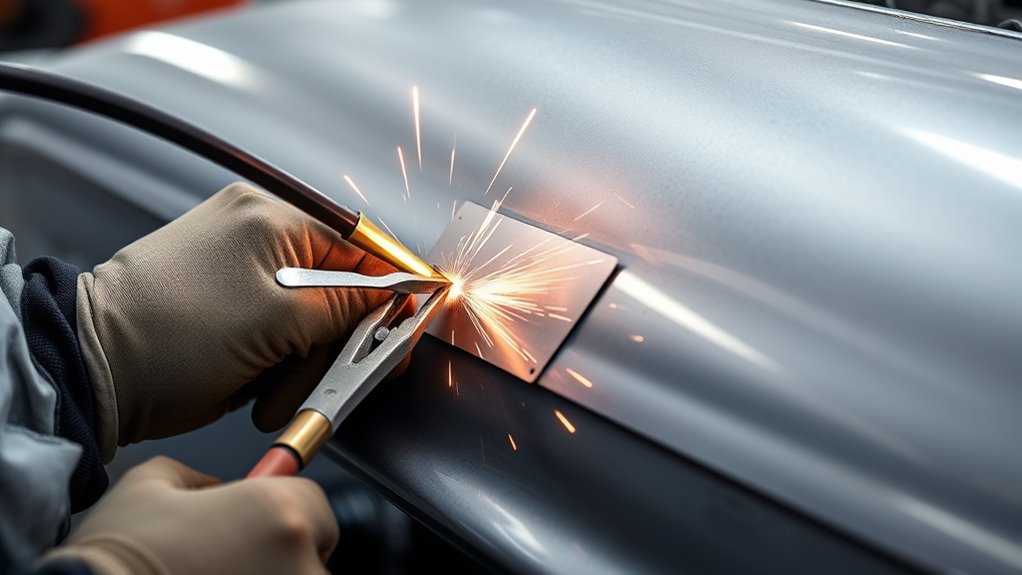
Before welding, create a tight and even panel fit. On a butt-welded mild-steel cosmetic patch, the edges should be nearly closed without being forced together or stacked on top of each other. Do not treat a 1/16-inch opening as the target; on very thin sheet, that size opening can already invite burn-through.
Trim accurately to the scribed line. Keep both edges consistent in thickness and remove burrs that prevent the panels from sitting flush. Check the joint from the front and back wherever access allows.
Test-fit the patch often and correct high spots, edge mismatch, or open areas before committing to a tack. Use suitable panel clamps, magnets, Cleco-style fasteners, or temporary backing only where they will not contaminate the weld or lock the panel in the wrong position.
A copper or aluminum backing bar can support the puddle, help fill a small accidental opening, and draw heat away when backside access allows. It is a helper, not a substitute for accurate trimming.
Clean the weld zone to bright, sound metal. The site’s guide to cleaning mild steel for welding provides additional preparation detail, but vehicle-specific coating and corrosion requirements still take priority.
Use steady torch movement and a consistent gun angle. Fit-up, not filler metal, should establish the final panel shape.
Products Worth Considering

Value Pack: The package includes 24 packs of butt welding clamps, enough quantity to meet your daily needs and replacements. Each butt welding clamps is individually wrapped in a small bag, convenient to carry and use.

16-Pack Welding Clamps Set: Includes 16 butt welding clamps designed for precise edge-to-edge welding, ideal for body repair, floor patching, door skins, and sheet metal alignment.
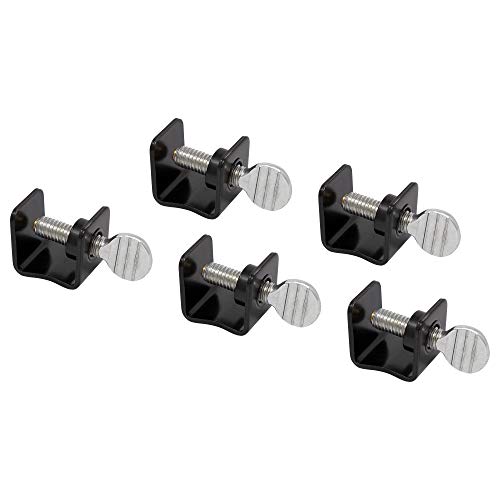
Use clamps to hold panels in place for welding
Tack Weld the Panels First
Start with small tack welds that lock the patch in place while leaving room for correction. Confirm that the edges are flush before striking the arc. A gap or offset that is ignored now can become harder to correct as the weld shrinks.
- Place the first tacks at separated or opposing points to hold the overall position.
- Add intermediate tacks until they are no more than about 1 inch apart.
- Skip to a cool area instead of placing the next tack beside the last hot one.
- Let each area cool before welding near it again.
- Check the seam with a straight edge and by touch after every round.
- Cut a tack and reposition the panel if alignment is wrong; do not try to force a bad fit closed with more weld.
Miller’s auto body sheet-metal procedure uses initial tacks no more than about one inch apart, followed by very short weld additions after alignment has been checked.
Keep wire stickout consistent with the wire, process, machine, and manufacturer’s instructions. Excessive or constantly changing stickout makes arc starts and penetration less predictable.
Stitch Weld in Short Bursts
On thin MIG-welded body panels, “stitch welding” should normally mean a controlled series of tack-sized deposits, not a one-inch continuous bead. Add a brief weld at the edge of an existing tack, stop, then move to a distant, cool part of the seam.
Short-burst control: Keep each trigger pull only long enough to fuse both panel edges and form a small, flat deposit. Do not whip or weave the gun. Use the fastest controlled movement that creates fusion without leaving a cold, tall tack.
Cooling between deposits: Allow the area to cool fully before adding another weld beside it. A few seconds may be enough for one tiny tack, while a larger panel or thicker deposit may need much longer. Do not use a fixed stopwatch interval as a substitute for checking the metal.
Closing the seam: Continue dividing the remaining openings with separated welds. As the gaps become shorter, resist the urge to run a bead across them. A chain of small, overlapping deposits gives you more chances to stop heat buildup.
- Make one brief deposit.
- Move to a separated location.
- Check panel temperature and alignment.
- Return only after the first area has cooled.
- Continue until the seam is fully joined, if a continuous welded seam is required.
TIG welding requires different timing. A skilled TIG welder may use short segments on a suitable flat mild-steel panel, but longer arc-on time is not a universal shortcut. Follow the approved process and practice on matching scrap first.
Avoid Full Seams on Thin Panels
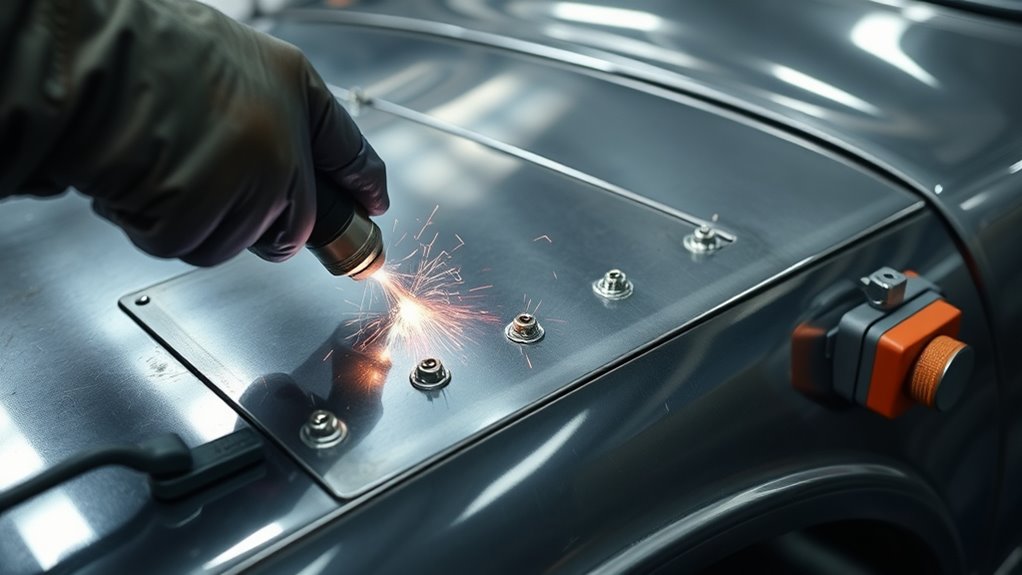
Do not run a long continuous MIG bead across a thin exterior body panel. The surrounding sheet expands while it is hot, then the weld and heat-affected area shrink as they cool. A long bead concentrates that shrinkage and can pull the panel into a low spot, ridge, wave, or oil-can shape.
Use intermittent deposits and skip welding to spread heat. Initial tacks about one inch apart stabilize the seam, but the final closure should use much smaller additions rather than one-inch MIG beads.
The goal is not to weld faster in one location. It is to finish the entire seam while giving every location time to cool.
Backstep sequencing can help in some straight seams: make a short deposit in the direction opposite the overall progression, then move ahead to a separated location. On very thin automotive sheet, however, deposit size and cooling time matter more than trying to run a formal backstep bead.
If a drawing or OEM procedure calls for plug welds, resistance spot welds, MIG brazing, adhesive, or an intermittent seam, reproduce that specified attachment method instead of converting it to a continuous butt weld.
Move Around to Spread Heat
Move around the panel deliberately instead of finishing one end first. Alternating between separated zones prevents heat from concentrating in one narrow section and gives each tack time to cool.
- Divide the seam into several zones.
- Place one small weld in the first zone.
- Move to a distant zone for the next deposit.
- Check the straight edge, body line, and panel crown after each round.
- Do not stack several nearby welds because the surface no longer looks red.
Visible color is not a reliable temperature gauge. Thin sheet can remain hot enough to distort even after the glow disappears. Use patient pauses and work across the whole repair.
Galvanized and coated panels require extra fume controls and the correct coating preparation. Review the site’s background guide to MIG welding galvanized steel, then follow the vehicle maker’s coating-removal and corrosion-restoration instructions.
Cool Welds With Care
Natural cooling is the safest general default. Stop welding, move to another location, and allow the panel to shed heat without soaking it with water or another liquid.
A dry compressed-air gun may shorten the pause in some nonstructural mild-steel work, but it should not be treated as a universal requirement. Use it only when the OEM procedure, equipment manufacturer, or qualified repair training permits it.
If compressed air is allowed:
- Wait until the molten weld has fully solidified.
- Use clean, dry, low-pressure air in brief passes.
- Avoid holding the nozzle close to one small spot.
- Do not blast dust, coating residue, or fumes toward your breathing zone.
- Stop if forced cooling begins pulling the seam or changing its shape.
Do not quench a hot body-panel weld with water. Sudden uneven cooling can move the panel, trap moisture in seams, contaminate later welds, and complicate corrosion protection.
Note: High-strength steel, ultra-high-strength steel, aluminum, and heat-treated parts may have strict temperature and repair limitations. Do not apply generic cooling, heating, or hammering methods to them.
Ventilation must control fumes at the source. OSHA advises cleaning hazardous coatings from the weld area, keeping your head out of the plume, and using local exhaust close to the fume source. Review its welding-fume control fact sheet.
Check Alignment With Hammer and Dolly
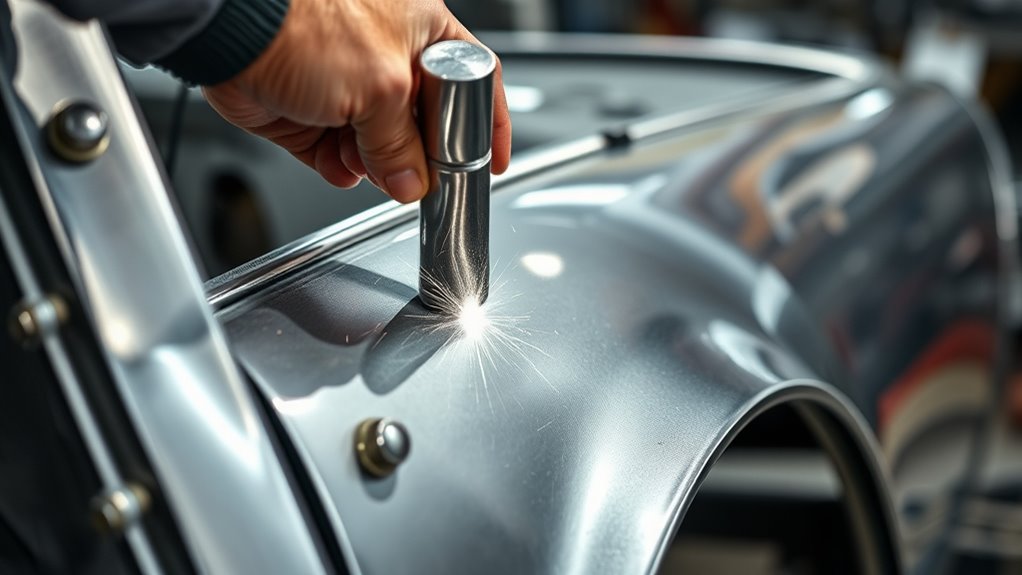
Check panel alignment after each tack-welding round. Use a straight edge, contour gauge, body line, reflected light, and your fingertips to find an offset before it becomes locked into the seam.
On suitable mild-steel cosmetic sheet, a hammer and dolly can bring the edges flush and lightly planish shrinkage. Let the tack solidify first. Hold the dolly firmly behind the seam and use measured taps instead of heavy blows.
On-dolly tapping places the hammer strike directly over the dolly and can stretch the metal. Use it sparingly when a welded area has shrunk.
Off-dolly tapping places the dolly beside the hammer strike and is often better for moving a high spot toward a low area without stretching as aggressively.
Correct a small alignment error while only a few tacks hold the panel. After the seam is closed, the same correction can require much more stretching, shrinking, and refinishing.
Do not hammer or heat-strengthen a modern structural or high-strength panel unless the body repair manual explicitly permits it. Wear suitable protective clothing for arc welding while checking or correcting a hot seam.
Trim and Retack for Final Fit
If the joint opens, overlaps, or steps out of alignment, stop before adding more weld. Cut the problem tack if necessary, trim the edge in small amounts, and restore the original panel contour.
Trim for a tight fit: Cut close to the scribed profile, then refine the edge with a file or controlled abrasive. Avoid widening the joint by repeatedly grinding both edges.
- Trim to the traced profile and deburr the edge.
- Clamp the panels without forcing either panel out of shape.
- Use a butt joint where a flush cosmetic patch calls for one.
- Use the OEM-specified lap, flange, plug-weld, bonded, or brazed joint when required.
Recheck panel alignment: Measure across the joint horizontally and vertically. Check the crown, body line, adjacent panel gap, and backside access before retacking.
| Check | Action |
|---|---|
| Edge flushness | Check with a straight edge and fingertips; release or reposition clamps if the edge steps up. |
| Gap size | Trim only the high or interfering area; do not widen the whole seam. |
| Clamp pressure | Use enough pressure to hold position without flattening the panel crown. |
| Panel contour | Compare the patch with nearby body lines and an undamaged reference area. |
| Final fit | Retack only after the joint sits naturally in the correct position. |
Retack before final welding: Place new tacks in cool, separated positions. Keep them small and accessible for later grinding. Recheck both sides after each round and correct any movement before closing the remaining openings.
Follow a Balanced Welding Sequence
A balanced sequence controls how weld shrinkage acts on the panel. For a straight mild-steel patch, you may begin near the middle, lock the ends, and then divide the remaining distances. For a curved or complex patch, follow the contour and fixture points that hold the panel naturally.
| Action | Effect |
|---|---|
| Lock separated reference points first | Holds the overall patch position without heating one end heavily. |
| Alternate distant zones | Spreads heat and shrinkage across the repair. |
| Use tack-sized intermittent deposits | Limits arc time and gives frequent stopping points. |
| Avoid nearby weld stacking | Reduces local heat soak and concentrated shrinkage. |
| Clamp to the natural contour | Holds alignment without forcing stress into the panel. |
Do not use preheating as a general solution for thin exterior body panels. These panels normally need less concentrated heat, not more. Any required preheat, interpass-temperature limit, or heat restriction must come from the material and OEM repair procedure.
Grind Welds Without Distorting Panels
A disc grinder can flatten the weld crown, but friction can warp the panel just as surely as the welding arc. Work in short, deliberate passes and let the surface cool between them.
- Remove only the raised weld crown first.
- Keep the disc moving instead of holding it over one tack.
- Use light pressure and a controlled angle.
- Avoid grinding deeply into the surrounding base metal.
- Check panel temperature, thickness, contour, and alignment after each pass.
- Stop if the surface discolors, becomes too hot to control, or begins to move.
Do not grind a weld completely flat by thinning both the weld and the original sheet. A small amount of careful hammer-and-dolly work may reduce how much metal must be removed.
Pro Tip: Grind the weld crown in several small areas rather than making one long sweep. Let the abrasive do the cutting; heavy pressure creates heat quickly and can make a straight panel wavy.
Inspect and Troubleshoot the Weld
Clean the seam and inspect it under bright light before applying filler, primer, or sealer. Check the front and backside wherever access allows.
- Look for pinholes, porosity, cracks, undercut, missed openings, and cold deposits sitting on top of the panel.
- Confirm that both panel edges fused instead of one edge merely receiving filler metal.
- Check that grinding did not thin or groove the surrounding sheet.
- Use a straight edge and reflected light to find waves, ridges, and low spots.
- Verify that the repaired panel fits adjacent doors, hoods, deck lids, lamps, glass, moldings, and trim.
| Problem | Likely Cause | Correction |
|---|---|---|
| Burn-through | Open joint, excessive voltage or trigger time, slow movement, or repeated welding in one area | Stop and cool the panel. Improve the fit, retune on scrap, shorten the deposit, and use a copper backing bar when appropriate. |
| Tall or cold tack | Low heat, poor ground, excessive stickout, contamination, or unstable wire feed | Clean the joint and ground, correct wire feed and stickout, then retest the settings on matching scrap. |
| Porosity or pinholes | Paint, oil, zinc residue, inadequate shielding gas, wind, or a contaminated nozzle | Remove the defective weld, clean both sides, correct gas coverage, and reweld with proper ventilation. |
| Panel edge shifts | Weak clamping, poor initial fit, or too many nearby welds | Stop, cut the problem tack if needed, restore alignment, and retack in separated positions. |
| Ridge, low spot, or oil-canning | Concentrated weld or grinding heat and resulting shrinkage | Stop adding heat. Diagnose the panel shape before careful planishing; obtain professional help if the panel or material cannot be safely corrected. |
| Crack beside the weld | Wrong process or filler, contaminated metal, excessive restraint, or unsuitable high-strength material | Stop the repair and verify the material and OEM procedure before proceeding. |
Restore Corrosion Protection
Grinding and welding remove factory coatings and can create corrosion hot spots. The repair is not complete until every required protective layer has been restored.
Follow the vehicle-specific repair procedure for:
- Epoxy or other approved primer on bare metal.
- Weld-through primer on mating flanges when specifically required.
- Seam sealer at factory seams and water-entry points.
- Cavity wax on enclosed or backside surfaces.
- Approved adhesives, foams, undercoating, chip protection, and sound-control materials.
- Drain openings and water paths that must remain clear.
I-CAR advises checking seam sealer, cavity wax, adhesives, and other corrosion-protection materials throughout the repair and consulting the body repair manual before, during, and after the work. See its guidance on corrosion protection inspection.
Do not apply flammable primer, solvent, adhesive, seam sealer, or cavity wax until welding and spark-producing grinding are complete and the panel is cool.
Frequently Asked Questions
Which welding process creates the least distortion on body panels?
No process always creates the least distortion. A properly set short-circuit MIG process can place small deposits quickly, while TIG provides precise amperage control but may add more total heat if travel is slow. Use the OEM-required process and control fit-up, arc time, weld order, and cooling.
What is the golden rule for welding thin auto body panels?
Control total heat input. Verify the repair method, make the joint fit tightly, use small deposits, skip around the seam, allow full cooling, and correct alignment before adding more weld.
How do you weld sheet metal without distortion?
You cannot remove all weld shrinkage, but you can limit distortion with accurate fit-up, low arc time, tack-sized deposits, skip sequencing, patient cooling, suitable backing bars, light alignment corrections, and short grinding passes.
How do you MIG weld body panels without warping?
Tune the machine on matching scrap, tack the panel at separated points, and close the seam with brief tack-sized welds. Move to a distant area after each deposit and return only after the previous location has cooled.
Should you cool welds with water on auto body panels?
No. Do not soak or quench a hot body-panel weld with water unless a specific qualified procedure requires it. Natural cooling is the safest general method. Brief dry compressed air may be used only when the approved procedure or training permits it.
How long should you wait between tack welds?
There is no universal number of seconds. Move to another part of the seam and wait until the previous area has cooled enough that welding beside it will not build heat. Panel size, thickness, deposit size, access, and ambient conditions all affect the pause.
Can you weld galvanized auto body steel?
Only when the vehicle-maker permits the repair and the coating is prepared as directed. Welding galvanized steel can produce zinc-oxide fumes, so use source-capture ventilation, keep your head out of the plume, and follow the applicable respiratory-protection requirements.
When should a body-panel weld be left to a professional?
Use a qualified collision-repair technician when the panel is structural, high-strength, aluminum, bonded, riveted, near a battery enclosure or restraint mount, or covered by an OEM procedure you cannot safely reproduce. Professional help is also appropriate when the vehicle has high-voltage damage or the panel has already warped badly.
Safety Disclaimer: This article is for informational purposes and does not replace hands-on welding training, an exposure-control program, vehicle-maker repair information, or professional collision-repair procedures. Use proper PPE and ventilation, and consult a qualified technician whenever the repair affects vehicle structure, restraints, electronics, high-voltage systems, fuel systems, cooling systems, refrigerant lines, or crash performance.
Sources
- I-CAR OEM Technical Information Matrix — OEM material, sectioning, attachment, primer, and corrosion-protection information.
- Miller: How to MIG and TIG Weld Auto Body Sheet Metal — patch fit-up, tack spacing, short deposits, cooling, hammer-and-dolly work, and grinding.
- Miller: Successfully Welding Sheet Metal With MIG and TIG — wire selection, fit-up, skip welding, travel technique, and backing bars.
- OSHA 29 CFR 1910.252 — hot-work fire prevention, eye protection, ventilation, and welding safety.
- I-CAR: Vehicle Protection When Welding — protection of electronics, glass, trim, foams, sealers, wiring, and nearby components.
- I-CAR: Corrosion Protection Inspection During the Repair Process — restoration of seam sealer, cavity wax, adhesives, and other corrosion protection.
Conclusion
The best way to weld an auto body panel without excessive warping is to manage the entire repair, not only the arc. Start by confirming that the panel may be welded and identifying the required OEM attachment method. Prepare a clean, nearly closed fit and prove the settings on matching scrap.
Lock the patch with small separated tacks, then close an approved MIG seam with tack-sized deposits while moving around the panel. Let each area cool completely, check alignment after every round, and correct small errors before they become permanent.
Finish with short grinding passes, a careful weld inspection, and complete restoration of primer, seam sealer, cavity wax, and other corrosion protection. A patient, balanced sequence produces a straighter panel and a safer, longer-lasting repair.