Choosing the wrong TIG tungsten electrode can make a clean automotive weld much harder than it needs to be. The right type, diameter, and tip shape help you start the arc cleanly, control heat, and avoid tungsten contamination. This guide covers practical choices for steel, stainless steel, chromoly, aluminum, exhaust parts, brackets, and thin auto body metal.
Quick Answer
For most automotive TIG work, use 2% lanthanated blue tungsten. It starts well on DC steel and stainless and also works on AC aluminum with modern inverter machines. Use ceriated tungsten for low-current work or zirconiated tungsten for AC aluminum, then match the diameter to your machine and peak amperage.
Key Takeaways
- 2% lanthanated tungsten is the best all-around choice for most AC and DC automotive TIG jobs.
- Use DCEN for steel, stainless steel, chromoly, titanium, and nickel alloys; use AC for most aluminum and magnesium work.
- Choose diameter by peak current, polarity, AC balance, and machine guidance, not material thickness alone.
- Grind the electrode lengthwise on a dedicated wheel and use a pointed or slightly truncated tip for most modern TIG work.
- Treat thoriated-electrode grinding dust as a controlled hazard and use non-radioactive alternatives when practical.
- Before welding on a vehicle, follow its OEM repair procedure and protect the battery, modules, airbags, wiring, fuel system, and nearby combustible material.
At a Glance
| Time Required | About 10–20 minutes to select, cut, grind, inspect, and install an electrode |
| Difficulty | Beginner to intermediate |
| Tools Needed | Welder manual, tungsten electrodes, dedicated grinder, abrasive cutoff wheel, eye protection, gloves, and labeled storage tube |
| Cost | Low for replacement electrodes; higher if you add a dedicated enclosed tungsten grinder |
Why Tungsten Electrodes Matter in Automotive TIG Welding
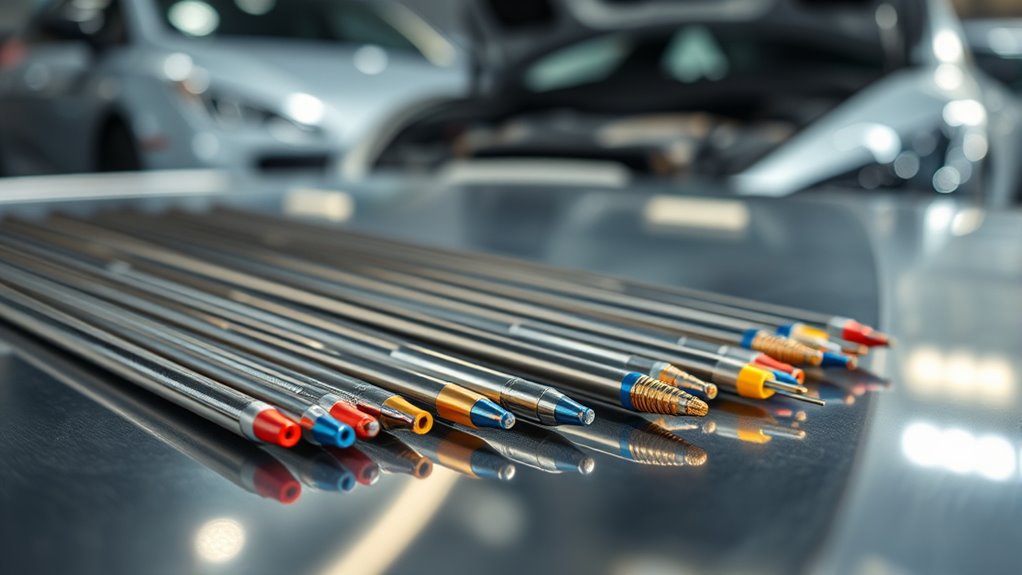
The tungsten electrode carries the TIG arc between the torch and the workpiece. It is called a non-consumable electrode because it is not intended to melt into the joint like a stick electrode or MIG wire. However, an overheated or contaminated tip can still erode and leave tungsten in the weld.
Its composition, diameter, cleanliness, and tip shape affect how easily the arc starts and how tightly you can control it. That matters when welding thin body sheet, exhaust tubing, stainless components, aluminum brackets, intake parts, chromoly tubes, or small repair pieces.
A clean, correctly prepared electrode helps prevent:
- Arc wander and difficult starts
- A wide or poorly controlled arc
- Premature tip melting
- Tungsten inclusions in the weld
- Unnecessary heat and distortion
- Repeated stops to regrind a contaminated tip
Miller’s tungsten guide identifies 2% lanthanated tungsten as a versatile option for high- and low-amperage AC and DC welding. That makes it a strong starting point when you want one electrode type for several automotive materials.
Best TIG Tungsten Electrode for Automotive Welding
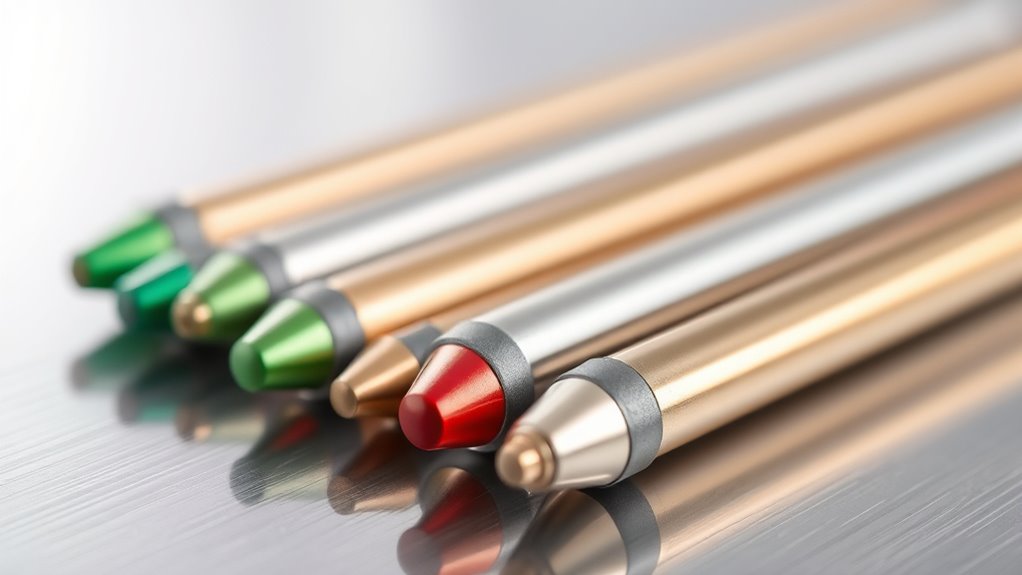
For a modern AC/DC inverter welder, 2% lanthanated tungsten, identified by a blue tip under the common classification system, is the most practical general-purpose choice. It works well for DCEN welding on steel and stainless steel and for AC welding on aluminum.
Other tungsten types still have useful roles. The best choice depends on the material, current type, peak amperage, machine design, and the arc behavior you need.
| Tungsten Type | Common Color and Class | Best Automotive Uses | Important Limits |
|---|---|---|---|
| 2% lanthanated | Blue, EWLa-2 | General AC/DC work, mild steel, stainless, chromoly, aluminum, titanium, and nickel alloys | Still must be matched to the correct diameter, tip, and current |
| 2% ceriated | Gray, EWCe-2 | Low- to medium-current work, thin sheet, small stainless parts, and precise DC starts | May lose tip quality sooner than lanthanated tungsten at sustained high current |
| 0.8% zirconiated | White, EWZr-8 | AC aluminum and magnesium, especially when resistance to contamination is important | Primarily an AC electrode; not the best all-purpose DC choice |
| Pure tungsten | Green, EWP | Traditional AC aluminum work on some older transformer machines | Lower current capacity and generally not preferred for modern inverter TIG unless the manual specifies it |
| 2% thoriated | Red, EWTh-2 | Legacy DC work on steel, stainless, nickel, and titanium | Contains radioactive thorium; grinding creates dust that requires specific controls |
| Mixed rare-earth oxide | Often EWG; color depends on the product classification | AC/DC work, automated welding, and low-current precision work where approved | Check the package and manufacturer chart because proprietary blends are not all identical |
Note: Read the classification printed on the package instead of relying only on the painted tip. Proprietary mixed-oxide electrodes may use colors that differ from the standard blue, gray, green, red, and white types.
Products Worth Considering

BLUE-2% LANTHANATED: Lanthanated electrodes are popular due to the relative ease of striking an arc and lower amperage required. They perform exceptionally well in both AC and DC applications
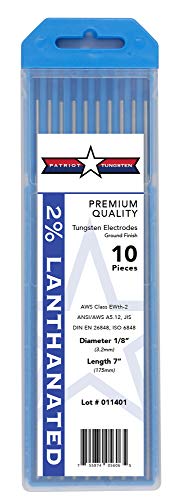
Ten (10) Pack of 2% Lanthanated Tungsten Electrodes

BLUE-2% LANTHANATED: Lanthanated electrodes are popular due to the relative ease of striking an arc and lower amperage required. They perform exceptionally well in both AC and DC applications.
Selecting Tungsten by Automotive Material
The base metal helps determine whether you use AC or DCEN, but it does not set the electrode diameter by itself. Diameter should be selected from the peak current and your machine manufacturer’s chart.
| Automotive Material or Job | Usual Current | Practical Tungsten Choice | Setup Notes |
|---|---|---|---|
| Mild steel body sheet and brackets | DCEN | 2% lanthanated or 2% ceriated | Use a clean pointed tip and a small diameter for low-current sheet-metal work |
| Stainless exhaust and tubing | DCEN | 2% lanthanated or ceriated | Control heat, maintain gas coverage, and back-purge tubing when the procedure requires it |
| 4130 chromoly | DCEN | 2% lanthanated | Follow the engineering or sanctioning-body procedure for critical chassis and cage work |
| Aluminum brackets, tanks, and castings | AC in most cases | 2% lanthanated or zirconiated | Use the machine’s recommended AC balance, frequency, diameter, and tip preparation |
| Magnesium components | AC in most cases | Lanthanated or zirconiated | Confirm the alloy and approved repair procedure before applying heat |
| Titanium or nickel-alloy parts | DCEN | 2% lanthanated or approved mixed oxide | Cleanliness and complete shielding are critical because hot metal reacts readily with air |
The electrode does not replace correct filler-metal selection. Match the filler to the alloy, joint design, and approved procedure. The right aluminum TIG technique and filler setup must work together with the tungsten choice.
Warning: Do not assume TIG is approved for a structural collision repair simply because you can make the weld. Use the vehicle maker’s repair information for the exact VIN, model year, material, sectioning location, corrosion protection, and required joining process.
Products Worth Considering

BLUE-2% LANTHANATED: Lanthanated electrodes are popular due to the relative ease of striking an arc and lower amperage required. They perform exceptionally well in both AC and DC applications.
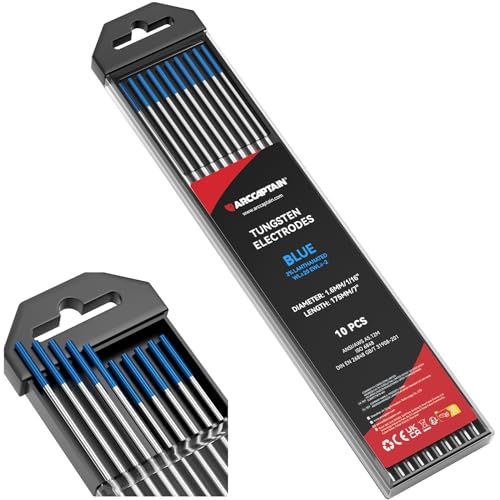
TOP QUALITY: This 10-pack of 2% Lanthanated tig tungsten electrodes 1/16"x7"(Blue, WL20/EWLa-2) adhere to Standard AWS A5.12M/A5.12:2009 and DIN EN 26848 GB/T 31908-201. All our tungsten has 100% traceability.

TOP QUALITY: This 10-pack of 2% Lanthanated tungsten electrodes 3/32"x7"(Blue, WL20/EWLa-2) adhere to Standard AWS A5.12M/A5.12:2009 and DIN EN 26848 GB/T 31908-201. All our tungsten has 100% traceability.
AC, DCEN, and Machine Type
Current type changes how the electrode behaves and how much heat it must carry.
- DCEN, or direct current electrode negative: Use it for most mild steel, stainless steel, chromoly, titanium, nickel, and copper-alloy TIG welding. Most arc heat is directed into the workpiece, which supports deeper penetration and keeps the tungsten cooler.
- DCEP, or direct current electrode positive: This is not a normal setting for automotive TIG welding. It puts much more heat into the tungsten and can quickly overheat an undersized electrode.
- AC: Use it for most aluminum and magnesium welding because the electrode-positive part of the cycle helps break up surface oxide while the electrode-negative part provides penetration.
AC balance matters. More electrode-positive time increases oxide cleaning but also increases heat at the tungsten. More electrode-negative time reduces tungsten heating and generally allows a more focused arc, but excessive adjustment can reduce cleaning. Start with the machine manufacturer’s recommendation and change the balance only after the material has been cleaned correctly.
On a modern inverter, lanthanated or another approved blended electrode is usually ground to a point or a slightly truncated point for AC. It may round slightly during use. A deliberately balled pure-tungsten tip is mainly an older transformer-machine practice.
Tungsten Diameter and Amperage Chart
Tungsten diameter determines how much current the electrode can carry without becoming unstable or overheating. Use the smallest diameter that starts reliably and safely handles your peak amperage.
The following values come from an official Lincoln Electric tungsten guide. They are typical operating ranges for its listed lanthanated, ceriated, and mixed-oxide electrodes. They are not universal limits.
| Electrode Diameter | Typical DCEN Range | Typical AC Range | Common Automotive Use |
|---|---|---|---|
| .020 inch (0.5 mm) | 2–20 amps | 2–15 amps | Specialized micro-TIG and extremely low-current work |
| .040 inch (1.0 mm) | 10–75 amps | 25–80 amps | Very thin sheet, small tabs, sensors, and delicate repair pieces |
| 1/16 inch (1.6 mm) | 60–150 amps | 40–115 amps | Thin body metal, exhaust tubing, small brackets, and low- to medium-current jobs |
| 3/32 inch (2.4 mm) | 150–250 amps | 60–175 amps | General fabrication, thicker brackets, medium-current aluminum, and versatile shop use |
| 1/8 inch (3.2 mm) | 225–330 amps | 75–250 amps | Heavy brackets, thick aluminum, high-current fabrication, and long high-output welds |
Note: These ranges overlap and are not hard minimums or maximums for every machine. A sharply prepared 1/16-inch electrode may start below a published range on a capable inverter, while AC balance, pulse current, helium content, tip geometry, and electrode composition can change capacity. Follow your welder manual first.
For many automotive shops, keeping both 1/16-inch and 3/32-inch 2% lanthanated electrodes covers more work than relying on one diameter. The smaller size gives better low-current behavior on thin metal, while 3/32-inch provides more reserve for moderate and high-current jobs.
A separate guide to matching TIG tungsten size to amperage can help when your work falls near the edge of a diameter’s normal range.
Choosing Tungsten Size by Job
- Thin auto body sheet: Start with .040-inch or 1/16-inch tungsten when the required current is low. A sharply prepared 1/16-inch electrode is often easier to handle and less fragile than .040-inch.
- Exhaust tubing and small stainless parts: A 1/16-inch lanthanated or ceriated electrode is a practical starting point for many low- and medium-current joints.
- General brackets and repair fabrication: Use 1/16-inch or 3/32-inch depending on peak amperage and duty cycle.
- AC aluminum brackets and castings: A 3/32-inch lanthanated electrode is a common general choice, but the machine chart and actual peak current control the decision.
- Heavy, high-current work: Move to 1/8-inch when the current approaches or exceeds the practical capacity of 3/32-inch tungsten.
If the tip swells, splits, sheds particles, or melts back at the intended setting, the electrode may be too small, the polarity may be wrong, the AC balance may place too much heat on the electrode, or shielding gas may be inadequate.
Preparing and Sharpening Tungsten Electrodes
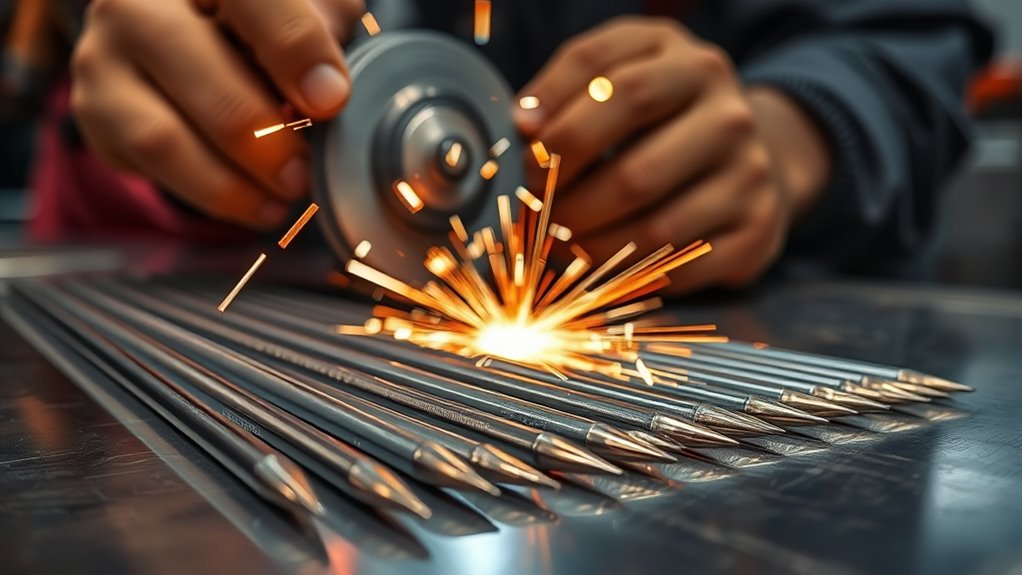
Correct preparation helps the arc start in the center of the electrode and remain steady. Prepare several electrodes before beginning a long repair so a contaminated tip can be replaced without stopping to grind.
- Inspect the electrode. Do not install tungsten that is cracked, deeply notched, bent, or contaminated far above the tip.
- Cut it with an abrasive wheel. Use a thin cutoff wheel or the approved cutting feature on a tungsten grinder. Do not use wire cutters or bend the electrode until it snaps because that can create hidden fractures.
- Use a dedicated grinding surface. A diamond or aluminum-oxide wheel of about 60 grit or finer is a common starting point. Do not use a wheel covered with steel, aluminum, or other shop debris.
- Grind lengthwise. Hold the electrode so the scratches run parallel with its centerline. Rotate it evenly while grinding. Circular scratches can encourage an unstable or wandering arc.
- Choose the taper for the current. A general starting taper is about two to three times the electrode diameter. Use a longer, sharper taper for low-current precision and a shorter, blunter taper with a small flat for higher current.
- Remove loose grinding debris. Handle the finished electrode with clean gloves and place it directly in a clean holder or torch.
- Run a test arc on scrap. Confirm that the arc starts cleanly and remains centered before welding the actual part.
The CK Worldwide technical guide recommends longitudinal grinding, a truncated end, and a general taper of two to three electrode diameters. It also notes that increasing the included tip angle generally increases penetration and reduces bead width.
Pro Tip: Mark storage tubes by electrode type, diameter, and intended material. Keeping a separate group for aluminum work reduces the chance of carrying steel contamination into an aluminum weld.
Tungsten Tip Shape for DC and AC
| Application | Starting Tip Shape | Why |
|---|---|---|
| Low-current DCEN | Long, sharp, even point | Supports easy starts and precise control on thin material |
| Medium-current DCEN | Point with a small flat | Protects the very end from overheating while keeping the arc focused |
| High-current DCEN | Shorter taper with a larger truncated flat | Improves current capacity and reduces the chance of the point shedding particles |
| Modern inverter AC | Pointed or slightly truncated, as the manual specifies | Modern square-wave and adjustable-balance machines can maintain a focused arc without a large ball |
| Older transformer AC | Rounded or balled tip when specified | Traditional transformer equipment may be designed around a balled pure- or zirconiated-tungsten tip |
Do not create a ball larger than the electrode diameter. An oversized ball can become unstable, wander, or fall into the weld. Never form the ball on carbon steel that will transfer contamination to an aluminum job.
Tungsten Contamination and Arc Troubleshooting
A poor arc does not always mean the electrode type is wrong. Check polarity, work connection, shielding gas, torch parts, base-metal cleanliness, and tip preparation before changing tungsten blends.
| Symptom | Likely Causes | What to Check |
|---|---|---|
| Arc wanders | Radial grind marks, contaminated tip, poor work connection, long arc, wrong tip shape, or magnetic arc blow | Regrind lengthwise, shorten the arc, clean the work clamp location, and verify current settings |
| Tip melts or balls unexpectedly | DCEP selected, tungsten too small, excessive AC electrode-positive balance, poor gas coverage, or too much current | Confirm polarity, diameter, AC balance, gas flow, and torch assembly |
| Difficult arc starts | Oversized tungsten, dull or dirty tip, weak work connection, incorrect start setting, or damaged torch parts | Use a smaller or sharper electrode if appropriate and inspect the collet, body, cables, and clamp |
| Gray, black, or oxidized tungsten | Insufficient post-flow, air leak, empty cylinder, excessive stickout, or shielding-gas interruption | Check post-flow time, fittings, cup size, gas lens, hoses, and cylinder supply |
| Tungsten inclusions or spitting | Tip touched the puddle, filler contacted the electrode, current is too high for the point, or the tip has split | Stop, cut behind the contamination, regrind, add a small flat, or move to a larger diameter |
| Porosity or poor bead color | Dirty metal, moisture, incorrect gas, inadequate coverage, wind, or a contaminated filler rod | Clean and dry the joint, verify gas type and flow, shield drafts, and keep filler inside the gas envelope |
More gas is not always better. Excess flow can create turbulence and pull air into the shielding envelope. Use the torch and cup manufacturer’s recommended range, then adjust for cup size, gas lens, joint shape, and drafts. Review how shielding-gas flow affects TIG welding before blaming the electrode.
Automotive TIG Welding Safety Before You Start
Electrode selection is only one part of a safe automotive weld. Welding current, heat, sparks, ultraviolet radiation, fumes, coatings, fuel, and electronic systems can all create serious hazards.
Warning: Before arc welding on an assembled vehicle, obtain the OEM procedure for the exact vehicle. Electric and hybrid vehicles can retain dangerous high voltage after the ignition is switched off. High-voltage disabling, airbag disabling, module protection, and battery disconnection must follow manufacturer instructions.
GM’s published welding precautions include placing the work clamp as close as possible to the weld, disconnecting battery-negative cables, protecting nearby wiring, disabling the airbag system as directed, and disconnecting nearby electronic modules when required. It also warns against using a suspension component as the welding return point.
- Place the work clamp on clean metal close to the repair so current does not travel through bearings, control modules, wiring, brake components, or suspension joints.
- Protect fuel lines, brake lines, wiring, glass, upholstery, seam sealer, paint, undercoating, and components on the opposite side of the panel.
- Remove loose combustibles and keep suitable fire-extinguishing equipment ready.
- Check cavities and the back of the panel for insulation, foam, adhesive, wax, or trim that can ignite from conducted heat.
- Do not weld while gasoline, brake cleaner, degreaser, paint, or other flammable or harmful vapors are present. Follow each chemical’s safety data sheet and allow approved cleaners to evaporate fully.
- Use suitable eye, face, skin, hearing, and respiratory protection for the process and materials.
- Provide ventilation appropriate for the base metal, coatings, plating, filler, and confined-space conditions.
OSHA’s welding requirements call for removing or protecting combustible material and prohibit welding in explosive atmospheres or on inadequately cleaned containers that held flammable substances.
Warning: Never weld on a fuel tank, fuel container, or part that may hold flammable vapor merely because it appears empty. Empty containers can remain explosive. Cleaning, purging, testing, venting, and repair must follow the applicable professional hot-work procedure.
Thoriated Tungsten Safety
Red 2% thoriated tungsten can provide stable DC performance, but it contains thorium, a radioactive material. Normal handling of an intact electrode is different from grinding it. Grinding creates fine dust that can be inhaled or spread around the shop.
The U.S. Nuclear Regulatory Commission material on thoriated electrodes identifies radioactive grinding dust as a potential internal-exposure hazard.
- Use lanthanated, ceriated, or another approved non-radioactive alternative when it meets the procedure.
- Read the electrode manufacturer’s safety data sheet before grinding or disposing of thoriated tungsten.
- Use a dedicated enclosed grinder or effective local dust extraction designed for the operation.
- Wear the eye and respiratory protection required by the hazard assessment and applicable respiratory-protection program.
- Do not blow dust away with compressed air or dry-sweep it into the shop.
- Collect grinding residue and discarded electrodes as directed by the supplier and local rules.
- Wash your hands before eating, drinking, or touching your face.
Top Tungsten Electrode Mistakes
- Choosing by material thickness alone: Thickness affects required current, but polarity, joint design, duty cycle, AC balance, and machine capacity also matter.
- Using pure green tungsten on every aluminum job: Modern inverter welders usually perform better with a blended electrode recommended by the manufacturer.
- Running DCEP by mistake: Electrode-positive DC can overheat the tungsten quickly.
- Using the same dirty grinder as the rest of the shop: Embedded steel or aluminum particles can contaminate the electrode and the weld.
- Grinding around the electrode: Radial scratches can make the arc wander. Grind parallel to the centerline.
- Using a needle-sharp point at high current: The fine tip can overheat and shed particles. Add a small flat or use a larger diameter.
- Continuing after touching the puddle: Stop and regrind rather than trying to finish the joint with a contaminated tip.
- Forcing a large ball on an inverter: Use the tip shape recommended for the specific AC waveform and electrode.
- Ignoring gas and torch problems: A discolored or unstable electrode may be caused by a leaking hose, damaged collet, poor post-flow, or excessive stickout.
- Mixing unlabeled electrodes: Similar-looking tungsten types can behave differently. Store them by classification and diameter.
Maintaining, Storing, and Reusing Tungsten Electrodes
You can reuse a tungsten electrode many times when it remains long enough to hold securely and the damaged area can be removed completely.
Regrind or cut back the electrode when you notice:
- Base metal or filler stuck to the tip
- A split, swollen, or uneven point
- Poor arc starts after the other settings have been checked
- Gray or black oxidation that does not clean up
- Contamination extending beyond the original taper
Replace the electrode when it is cracked, bent, too short for safe torch installation, or contaminated too deeply to clean without leaving an unsafe length.
Store prepared electrodes in a clean, dry tube or compartment. Keep different types and diameters separated. Protect the sharpened ends from impact and keep the color-coded end visible. A simple label such as “Blue 1/16—steel” or “Blue 3/32—aluminum” can prevent mistakes and cross-contamination.
Do not leave electrodes loose in a toolbox with grinding dust, steel filings, oily tools, or moisture. Inspect the collet and collet body as well; worn torch parts can create poor electrical contact even when the tungsten is correct.
Frequently Asked Questions
What is the best all-around TIG tungsten for automotive welding?
For most modern AC/DC inverter machines, 2% lanthanated blue tungsten is the most practical all-around choice. It works well on DCEN steel, stainless, chromoly, titanium, and nickel alloys and can also be used for AC aluminum. Always confirm that choice in the welder manual.
Can I reuse tungsten electrodes after multiple welds?
Yes. Reuse the electrode while it remains clean, straight, free of cracks, and long enough to hold safely in the torch. Cut behind deep contamination and regrind the tip when it becomes dull, split, oxidized, or difficult to start.
Can I use the same tungsten type for steel and aluminum?
Yes. A suitable lanthanated electrode can be used for both DCEN steel and AC aluminum. However, keeping separately labeled, prepared electrodes for ferrous metal and aluminum helps prevent steel contamination from carrying into an aluminum weld.
Should I ball the tungsten for AC aluminum?
Usually not on a modern inverter unless the machine manufacturer specifically says to do so. Most inverter machines use a pointed or slightly truncated lanthanated electrode that rounds naturally during use. A deliberately balled pure- or zirconiated-tungsten tip is more closely associated with older transformer equipment.
How do I know when to replace my tungsten electrode?
Replace it when it is cracked, bent, too short to secure safely, repeatedly unstable after correct regrinding, or contaminated too deeply to remove. A damaged electrode should not be kept in service merely to avoid opening a new one.
Are there special precautions for grinding tungsten electrodes?
Use eye protection, guard the grinding wheel, keep your hands clear, and use a dedicated grinding surface with suitable dust control. Thoriated tungsten requires additional precautions because its grinding dust contains radioactive thorium. Follow the manufacturer’s SDS and applicable workplace rules.
Can different tungsten types be used in one welding project?
Yes, when different joints or current types justify the change. Label the electrodes and record the setup because changing tungsten composition can alter starting behavior, current capacity, tip life, and the machine adjustments that produce the best arc.
How should used tungsten electrodes be disposed of?
Keep used electrodes and grinding residue out of ordinary shop dust. Follow the product SDS, supplier guidance, recycler requirements, and local waste rules. Thoriated electrodes and their grinding dust may require different handling from non-radioactive tungsten blends.
Conclusion
For most automotive TIG welding, 2% lanthanated tungsten gives the best mix of AC/DC versatility, reliable starts, current capacity, and electrode life. Ceriated tungsten remains useful for low-current precision, while zirconiated tungsten is a strong AC aluminum option. Pure tungsten is mainly a traditional transformer-machine choice, and thoriated tungsten requires added dust controls.
Choose the diameter from peak current and the welder manufacturer’s chart. Grind the electrode lengthwise, match the tip shape to the current and machine, and regrind it as soon as contamination occurs.
When welding on a vehicle, electrode selection comes after the OEM repair procedure and safety plan. Protect the electrical system, high-voltage components, fuel system, wiring, coatings, and nearby combustibles before striking an arc.
Sources
- Miller Electric: All About Tungsten in TIG Welding — electrode types, modern inverter guidance, sizing, cutting, and contamination
- Lincoln Electric: Tungsten Electrodes Product Information — classifications, sharpening methods, and typical AC/DC operating ranges
- CK Worldwide TIG Technical Guide — color classifications, current ranges, taper geometry, longitudinal grinding, and tip preparation
- U.S. Nuclear Regulatory Commission: Thoriated Tungsten Electrode Information — radioactive grinding-dust exposure considerations
- OSHA 29 CFR 1910.252 — welding fire prevention, combustible materials, eye protection, and container precautions
- General Motors Electrical Best Practices — vehicle welding precautions for batteries, modules, airbags, wiring, and work-clamp placement