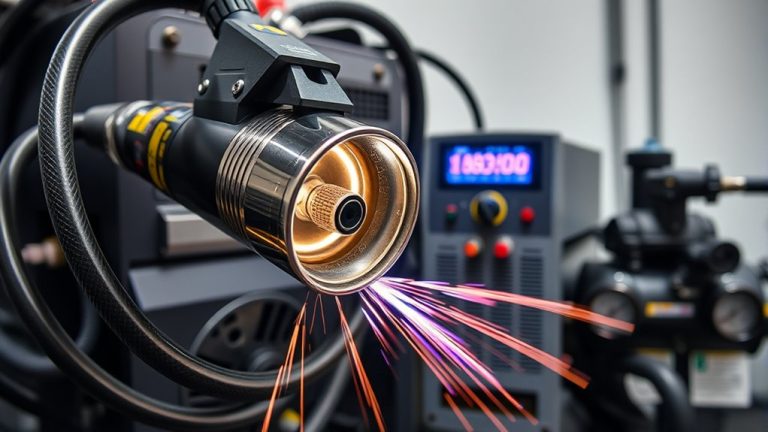
Like a compass that points different ways, your choice of plasma torch directs the whole job. You’ll need to know the practical differences between handheld and machine torches, and between drag and standoff tips, because each affects cut speed, amperage limits, and edge quality. Pick wrong and you’ll fight consumable wear or poor tolerances; pick right and you’ll save time and material—so keep going to see which fits your work.
Types of Plasma Cutter Torches and How They Work
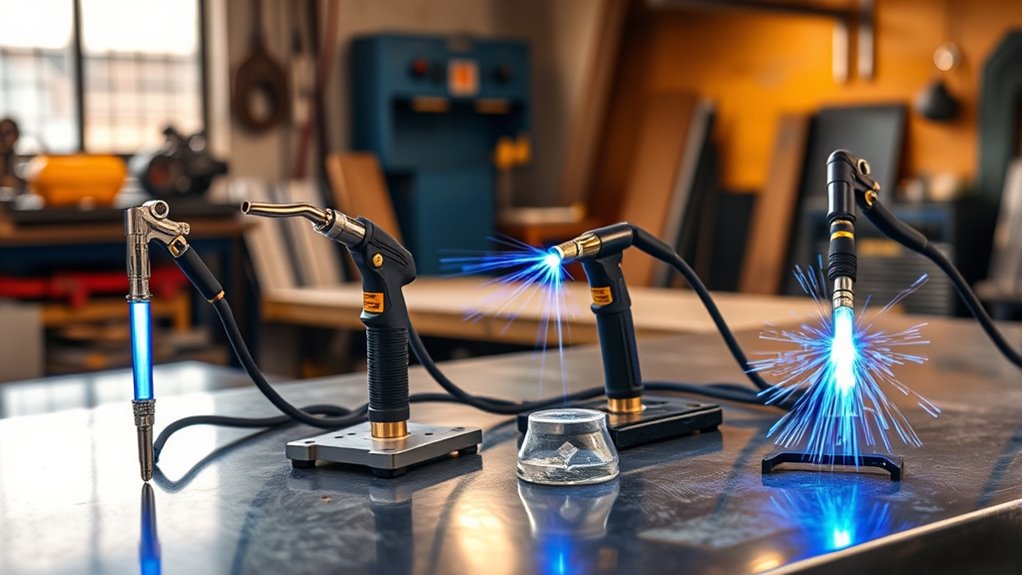
Plasma cutter torches come in two primary formats—handheld and machine-mounted—and they use different tip styles and arc-starting systems to match job demands.
You’ll operate handheld torches manually for freehand plasma cutting techniques on thinner stock, benefitting from drag tips that simplify positioning and produce cleaner cuts at lower amperages.
Machine-mounted torches integrate with CNC systems for automated, high-repeatability cutting of thicker materials using standoff tips held 3–4 mm off the work to support higher amperage and faster traverse rates.
You’ll choose among arc-starting methods—high-frequency, pilot arc, or blowback—based on surface condition and duty-cycle needs; each torch technology advancement offers trade-offs in contamination tolerance, consumable life, and ease of arc initiation.
When selecting hardware, match tip style and starting system to material thickness, desired speed, and amperage range to optimize cut quality and reduce downtime from slag or clogged consumables.
Drag Tips Vs Standoff Tips: Key Differences
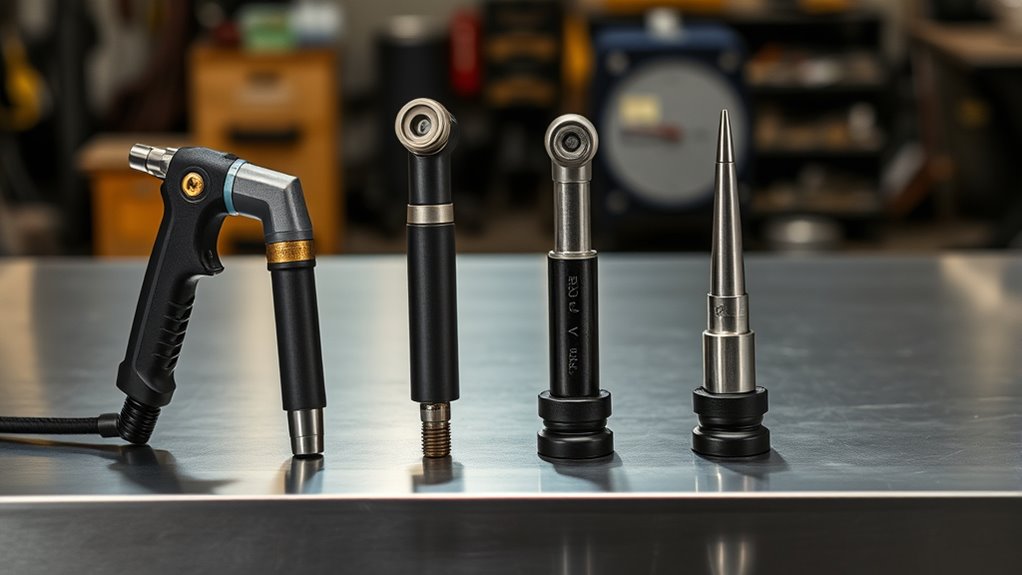
While both tip types guide the arc, drag tips sit on the work and are optimized for low‑power, beginner‑friendly cuts up to about 40 A, using grooves to channel slag and maintain arc stability.
Standoff tips, held 3–4 mm above the surface, support much higher currents (into the hundreds of amps), faster traverses, and CNC automation but demand more skill and strict ceramic matching to avoid clogging and poor edge quality.
Standoff tips, held 3–4 mm above the work, enable high‑current, high‑speed CNC cuts but require skill and precise ceramic matching.
You’ll find drag tips advantages in straightforward, low‑amperage jobs: the grooved face stabilizes the plasma, reduces blowback, and produces consistent edges on thin metals with minimal operator training.
Conversely, standoff tips deliver speed and thickness capacity but carry standoff tips disadvantages — they clog or scorch if you touch the surface, require precise ceramic/nozzle selection for your amperage, and need steady hand or mechanized control to prevent uneven kerfs.
Match tip design and ceramic to amperage; misuse yields poor focus, clogging, or degraded cut quality.
Choosing the Right Torch for Your Application
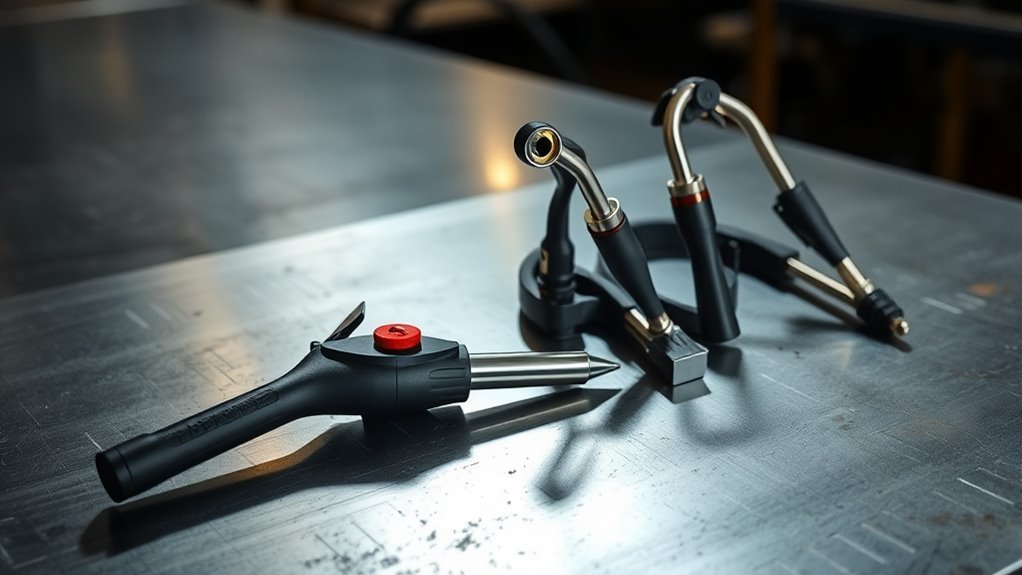
Because the right torch directly affects cut quality and productivity, you should match torch type, tip style, and amperage to your workpiece and workflow: choose handheld torches for freehand jobs and small batches, pairing drag tips and lower‑amp (110V) systems for thin metals and ease of use, or opt for machine torches with standoff tips and higher‑amp (220V–900A) setups when you need thicker cuts, faster traverses, and CNC accuracy.
Assess application requirements: material thickness, desired edge quality, cycle time, and production volume. Use torch selection criteria that prioritize amperage compatibility — 110V for up to ~1/4–3/8″ and 220V for thicker sections.
Select drag tips for precision on thin sheets (≤40A); choose standoff tips when you need 3–4mm separation, improved accuracy, and high‑amp capacity for rapid penetration. Verify the cutter’s output matches the tip rating to prevent undercutting or slag.
Finally, align torch ergonomics and mounting options with your workflow to maximize uptime and repeatable results.
Maintenance, Consumables, and Best Practices
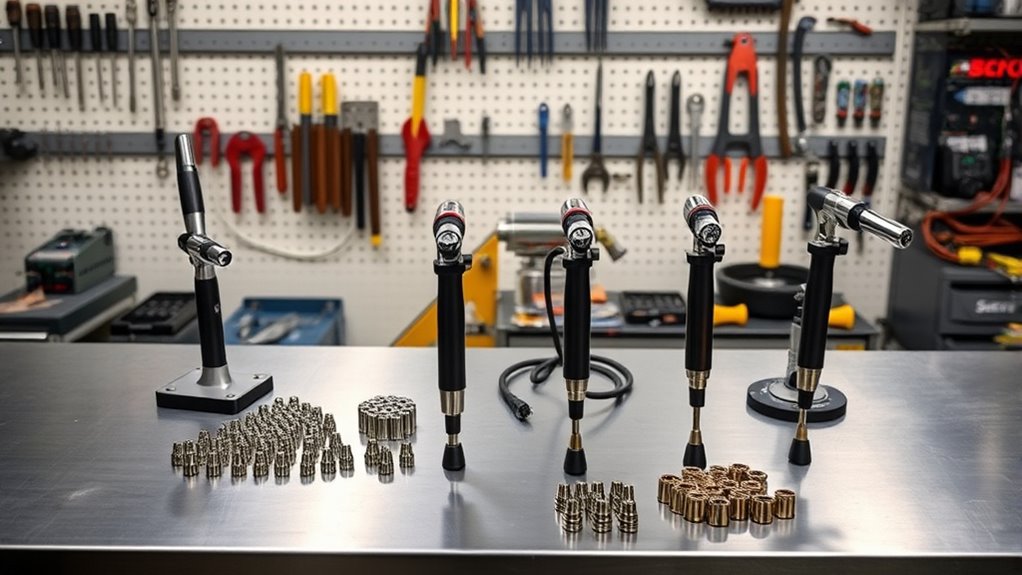
Choosing the right torch only gets you part of the way — maintaining it and managing consumables keeps cuts consistent and machines running.
You’ll perform torch maintenance by inspecting tips and electrodes frequently: replace the electrode when the Hafnium divot reaches 1/16 inch or the tip orifice is no longer round. Keep the air supply clean and dry and set pressure between 60–80 psi; use a compressor that delivers at least 5 cfm at 90 psi or higher.
Use drag shields on drag tips to reduce electrical interference and extend consumable longevity, especially on units >40 amps.
Track duty cycle to match job scope: choose longer cycles for extended cuts and shorter cycles for quick, intermittent work.
After cutting, remove dross with a chipping hammer or angle grinder, striking at 45 degrees to avoid deforming edges and to prolong consumables.
Follow these practices consistently to minimize downtime, stabilize cut quality, and lower operating cost.
Frequently Asked Questions
Can I Use a Handheld Torch for CNC Cutting With Adapters?
Yes — you can adapt a handheld torch for CNC cutting, but you’ll need proper mounts, motion-compatible trigger or THC, and matched consumables; confirm handheld versatility and cnc compatibility with manufacturer specifications to guarantee safe, accurate operation.
Are Plasma Torches Safe to Use in Confined Spaces?
A glowing ember warns: you shouldn’t use plasma cutters in confined spaces without controls. You’ll need strict plasma safety—ventilation, PPE, permits, monitoring—because fumes, fumes, heat, and arc hazards amplify rapidly in confined spaces.
How Does Altitude Affect Plasma Cutter Performance?
Altitude reduces air density, so you’ll need altitude adjustments to maintain arc stability; you’ll see performance variations like reduced cutting speed, thicker kerfs, and increased dross, so you’ll recalibrate gas flow and amperage for consistent cuts.
Can I Retrofit a Drag Torch to Function as Standoff?
Yes — you can, but only with proper parts and calibration; 78% of retrofit attempts fail without OEM specs. Use certified drag torch modifications, verify torch-to-work spacing, and you’ll gain typical standoff benefits like consistent cut height and life.
What Protective Gear Differs Between Torch Types?
You’ll need different protective gloves and eye protection based on heat, spatter and duty cycle: heavier gauntlets for handheld, lighter gloves for machine torches; upgraded weld-rated eye protection and side shields for higher exposure.
Conclusion
You’ll pick the right torch by matching torch type and tip style to material thickness, tolerance and workflow. For example, a fabricator replacing 1/4″ mild steel hand-trim jobs switched from a handheld drag torch to a CNC machine-mounted torch with standoff tips and saw a 40% productivity gain while keeping kerf tolerance within 0.5 mm. Maintain consumables, inspect nozzles, and follow amperage and gas specs to preserve cut quality and torch life.