Welding near airbag sensors is a high-risk repair task because the supplemental restraint system uses sensitive electronics, crash sensors, wiring, and pyrotechnic airbag modules. Before you strike an arc, confirm the vehicle-specific OEM procedure, disable the SRS exactly as directed, protect nearby wiring and modules, keep the welding current path short, and scan the restraint system before and after the repair.
Quick Answer
You can weld near airbag sensors only when the OEM repair procedure allows it and the SRS is disabled correctly. Disconnect power as instructed, wait the specified reserve-energy time, remove or shield nearby modules, keep the ground clamp close to the weld, protect the cabin from heat, and perform pre- and post-repair scans.
Key Takeaways
- The OEM service information for the exact year, make, and model is the controlling rule.
- Do not rely on a universal battery wait time. Wait the reserve-energy period listed by the manufacturer.
- Use a short, clean current path by placing the work clamp on the same panel and close to the weld.
- Remove or shield airbag sensors, modules, trim, carpet, and wiring when heat or current could reach them.
- Hybrids and EVs require extra high-voltage isolation steps and qualified service procedures.
- Scan the SRS before and after welding, then resolve warning lights or trouble codes before returning the vehicle to service.
At a Glance
| Time Required | 15 to 45 minutes for research, disabling, shielding, and scanning, plus the actual welding time |
| Difficulty | Advanced. Best handled by a trained collision repair technician, especially on vehicles with SRS or high-voltage systems. |
| Tools Needed | OEM service information, scan tool, battery terminal tools, insulated covers, welding blankets, heat shields, PPE, and a clean work clamp |
| Cost | Usually labor and scan time. OEM information access, diagnostic scans, or high-voltage service may add cost. |
Warning: Airbag modules and seat-belt pretensioners contain pyrotechnic devices. Do not probe SRS connectors, apply power to airbag circuits, weld with the system energized, or improvise around yellow SRS wiring. Follow the OEM disable and handling procedure for the exact vehicle.
Why Welding Near Airbag Sensors Is Risky
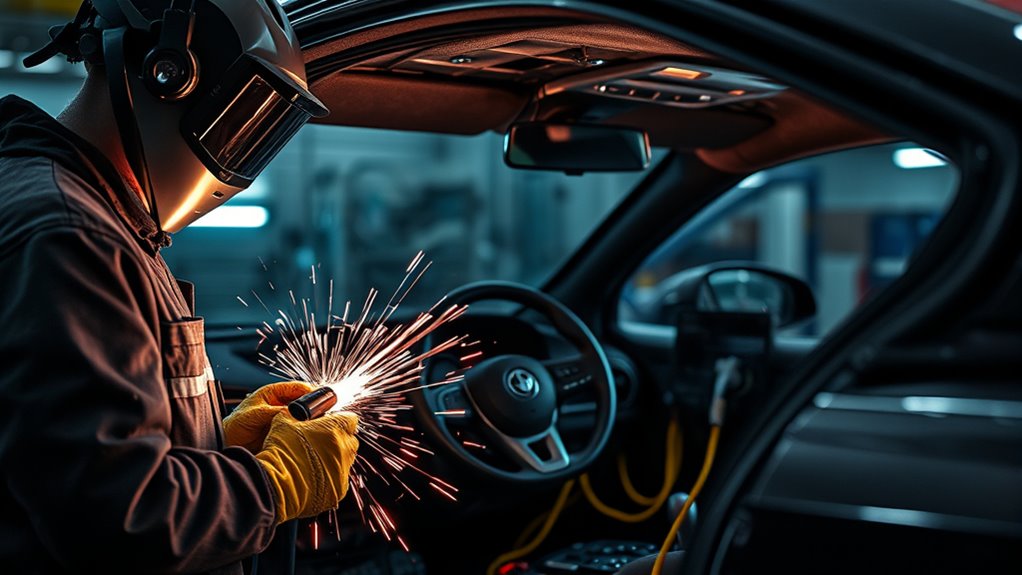
Welding near airbag sensors is risky because heat, electrical noise, and stray current can affect the SRS module, crash sensors, wiring harnesses, and connectors. The airbag system is designed to react quickly during a crash, so the repair area must be controlled before welding starts.
The National Highway Traffic Safety Administration explains that an airbag system uses an electronic control unit to send a signal to the inflator, and the airbag can inflate in less than 1/20 of a second. That speed is why accidental deployment, damaged wiring, or a stored SRS fault is such a serious problem during body repair.
The safest welding setup near SRS components is one that keeps heat, current, sparks, and diagnostic uncertainty away from the restraint system.
Even if an airbag does not deploy, welding damage can still leave a hidden problem. A melted connector, overheated harness, disturbed sensor mount, or poor ground path can trigger a warning lamp or prevent the system from working correctly in a crash.
Check OEM Procedures Before Any Welding
Before you disconnect anything, pull the latest OEM repair procedure for the exact year, make, model, body location, and powertrain. Do not rely on a generic chart, memory, or a single rule from another vehicle.
OEM1Stop states that collision repairs must follow the repair procedures issued by the original equipment manufacturer for that specific vehicle, including any directions related to pre- and post-scanning. For welding near airbag sensors, that means the OEM procedure decides the disable steps, waiting time, sensor removal rules, weld limits, and post-repair checks.
Note: A 12-inch clearance is a useful conservative working minimum in many shop situations, but it is not a replacement for OEM service information. If the manufacturer gives a different distance, removal step, shielding method, or weld restriction, follow the manufacturer.
Stop-Work Checklist
Stop and research the repair before welding if any of these conditions apply:
- You do not know the exact location of the airbag sensor, SRS module, seat-belt pretensioner, or yellow SRS harness.
- The weld area is near a pillar, rocker, floor pan, seat mount, front rail, radiator support, or door area that may contain crash sensors or SRS wiring.
- The airbag warning lamp is already on.
- The vehicle is a hybrid or EV and high-voltage isolation has not been verified.
- The OEM procedure says to remove a module, sensor, trim piece, battery, or high-voltage component before welding.
Pre-Scan the SRS Before Disassembly
Run a pre-repair scan before welding when the vehicle condition allows it. Record any SRS, body control, seat occupancy, pretensioner, or communication codes before you disconnect modules. This helps you separate pre-existing damage from welding-related faults.
A pre-scan is especially important after collision damage because the restraint system may already have stored impact, sensor, or circuit codes. Save the scan report with the repair file, then follow OEM instructions for disabling the system.
Products Worth Considering
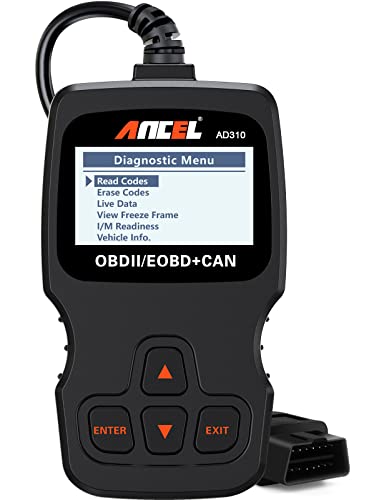
CEL Doctor: The ANCEL AD310 is one of the best-selling OBD II scanners on the market and is recommended by Scotty Kilmer, a YouTuber and auto mechanic. It can easily determine the cause of the check engine light coming on. After repairing the vehicle's problems, it can quickly read and clear diagnostic trouble codes of emission system, read live data & hard memory data, view freeze frame, I/M monitor readiness and collect vehicle information

Understand Your Check Engine Light – The ANCEL AD410 OBD2 scanner helps everyday drivers quickly read and clear engine-related fault codes, view code definitions, and understand why the check engine light is on before visiting a repair shop. With 42,000+ built-in DTC lookups, this car code reader helps reduce guesswork and makes basic vehicle diagnostics easier for beginners and DIY users

[Easy to Use—Work Out of the Box] + [FOXWELL 2026 New Version] FOXWELL NT604 Elite scan tool is the 2026 new version from FOXWELL, designed for car owners who want to figure out the cause of issues before fixing car problems by scanning common systems like ABS, SRS, engine, and transmission. The NT604 Elite obd2 scanner diagnostic tool comes with the latest software—no need to waste time downloading software first. Plug the scanner into the OBDII port with OBDII cable to start the diagnosis.
Disconnect the Battery Before Welding
Disconnecting battery power helps reduce the chance that welding voltage or a short circuit will reach sensitive electronics. In many vehicles, the disable process begins with the negative battery cable, but the exact order and waiting period must come from the OEM service procedure.
After the required cable or service disconnect is removed, wait the full OEM-specified time so reserve energy in the SRS can discharge. Do not shorten this wait. Some vehicles require only a short period, while others require longer. Treat the listed wait time as a safety step, not a suggestion.
Battery Disconnect Steps
| Step | Action | Why It Matters |
|---|---|---|
| 1 | Read the OEM SRS disable procedure. | The battery order, wait time, and module handling steps vary by vehicle. |
| 2 | Disconnect the specified battery cable or service disconnect. | This helps isolate the SRS and other control modules from welding current. |
| 3 | Cover exposed terminals with non-conductive material. | This reduces accidental contact while tools, panels, and leads are moving. |
| 4 | Wait the OEM reserve-energy discharge time. | The SRS may retain energy briefly after power is disconnected. |
| 5 | Document every connector, fastener, and removed component. | Accurate reinstallation prevents swapped connectors, loose grounds, and post-repair faults. |
Protecting Airbag Electronics
Once power is isolated, protect the airbag control module, satellite sensors, seat occupancy wiring, pretensioner connectors, and nearby harnesses from heat and current. Do not let welding leads rest on yellow SRS wiring. Do not use the SRS harness as a convenient route for cables, clamps, or shielding.
If the OEM procedure requires a module or sensor to be removed, remove it before welding. If a component can stay in place, shield it from sparks, heat, and impact.
Remove Airbag Modules and Nearby Sensors
Remove airbag modules, satellite sensors, or nearby SRS components when the OEM procedure requires it or when the weld area is close enough for heat, sparks, or current to reach them. Label every connector and fastener so each part returns to its original location.
Store removed components away from heat, sparks, static risk, and impact. Keep trim pieces, carpets, foam, and insulation clear of the welding zone so hidden material does not smolder after the repair.
If a sensor cannot be removed, protect it with a heat shield and keep the weld path as far away as the OEM procedure requires. After welding, inspect the sensor mount, fasteners, connector lock, and harness routing before reassembly.
Pro Tip: Take photos before removing SRS connectors, brackets, and trim. Photos make it easier to restore harness routing, clip positions, and sensor orientation exactly as they were.
Keep Welding Cables Away From Electronics
Route welding cables away from the SRS module, airbag sensors, body control modules, seat wiring, antennas, and main harnesses. The goal is to keep welding current from finding an unintended path through electronics.
As a conservative shop practice, keep welding leads at least 12 inches (300 mm) from SRS components when possible. If the OEM procedure gives a greater distance or requires removal, follow that instruction instead.
Cable Routing Practices
- Route the electrode lead and work lead on the shortest practical path to the weld area.
- Keep cables off SRS wiring, sharp panel edges, moving parts, and hot metal.
- Do not loop welding cables around control modules or harness bundles.
- Use non-conductive protective covers where cables could touch trim, wiring, or exposed metal edges.
- Recheck cable position before every tack and after repositioning the torch or panel.
Protect Sensitive Electronics
Welding current follows the easiest path back to the work clamp. If the clamp is far away, loose, painted, or attached to another panel, current may travel through hinges, spot welds, brackets, bearings, or wiring paths. That is how sensitive electronics can be damaged even when the torch is not directly touching them.
Keep the work area clean, clamp to bare metal, and avoid letting the current pass through bolted joints or modules. If a cable shifts during welding, stop and reset it before continuing.
Stay at Least 12 Inches From Sensors When OEM Instructions Allow
Use 12 inches (300 mm) as a practical minimum working clearance from airbag sensors, SRS wiring, and control modules only when the OEM procedure does not require more. This distance helps reduce heat exposure and electrical interference, but it is not a universal permission to weld.
If the weld must be closer than that, stop and reassess the job. The safer option may be to remove the sensor, remove trim, install a heat barrier, change the weld sequence, or use a different OEM-approved attachment method.
- Measure the distance before striking an arc.
- Confirm what sits behind the panel, not just what is visible from the outside.
- Recheck clearance after pulling, clamping, or repositioning panels.
- Do not weld near unknown yellow wiring or unidentified sensor brackets.
Ground the Welder on the Same Panel
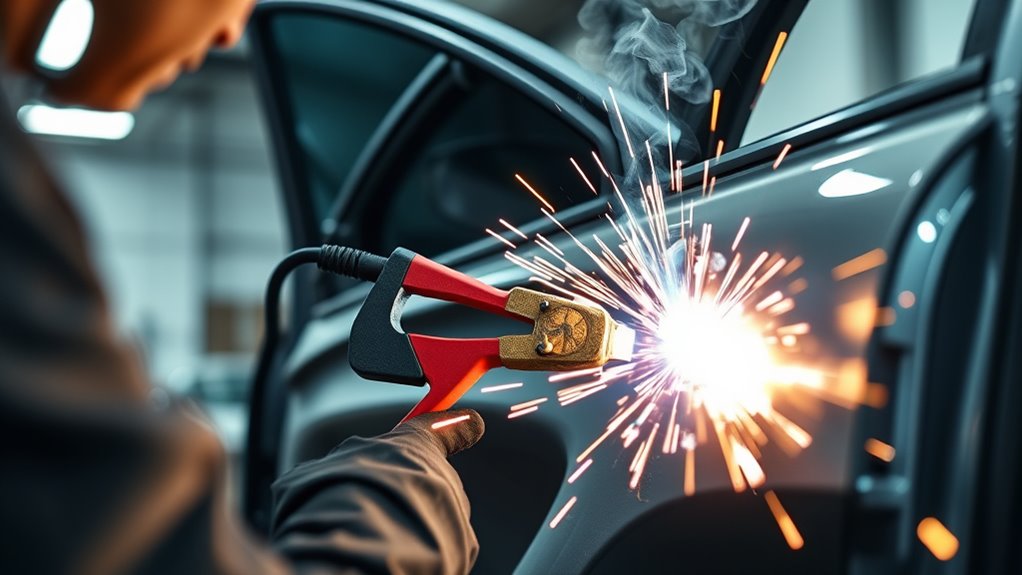
You should ground the welder on the same panel as the weld site whenever the OEM procedure and repair setup allow it. This keeps the return path short, direct, and easier to control.
A short return path helps reduce stray current and voltage spikes that could disturb airbag sensors, SRS wiring, control modules, or other sensitive electronics. Before welding, verify that the ground clamp is tight, clean, and attached to bare metal.
Same-Panel Grounding
Clamp the welder to clean bare metal on the same panel or structure being welded. Place the clamp as close to the weld area as practical, while keeping it out of the heat zone and away from SRS wiring.
- Clean paint, coatings, rust, and seam sealer from the clamp contact area.
- Clamp close to the weld zone, not across the vehicle.
- Make sure the clamp cannot loosen from vibration or torch movement.
- Never use brackets, hinges, or modules as the return path.
Short Current Paths
A long current path can send welding current through areas you did not intend to energize. That can include welded seams, bolted joints, wiring retainers, or sensor brackets. A short current path keeps the weld circuit more predictable.
If you move to a different panel, move the work clamp too. Do not leave the clamp in one location while welding around the vehicle.
Protect Sensitive Modules
Protect the SRS module, body control module, powertrain control module, and sensor wiring from both heat and current. If a module is close to the weld area, follow the OEM procedure for removal, disconnection, or shielding.
After welding, inspect the clamp area and nearby harnesses for burn marks, softened insulation, melted clips, loose grounds, and disturbed connectors.
Protect the Cabin From Sparks and Heat
Before you strike an arc, remove or shield interior trim, carpet, insulation, sound deadener, seat material, plastic panels, and wiring near the weld zone. Use flame-retardant welding blankets and metal heat shields where needed.
Welding sparks can travel through seams, holes, pillar openings, rocker cavities, and gaps behind trim. Heat can also transfer through thin sheet metal and damage wiring or foam on the cabin side of the panel.
OSHA welding standards address welding, cutting, brazing, PPE, ventilation, and fire-prevention requirements. In a vehicle cabin, that means you should control sparks, fumes, heat, and combustible materials before welding starts.
- Remove loose paper, rags, upholstery scraps, and solvent containers.
- Shield carpet, seats, headliner, wiring, glass, and painted surfaces.
- Keep a suitable fire extinguisher nearby.
- Use ventilation when welding fumes can collect inside the vehicle.
- Inspect the interior after welding and again after a short cool-down period.
Follow Extra Steps for Hybrids and EVs
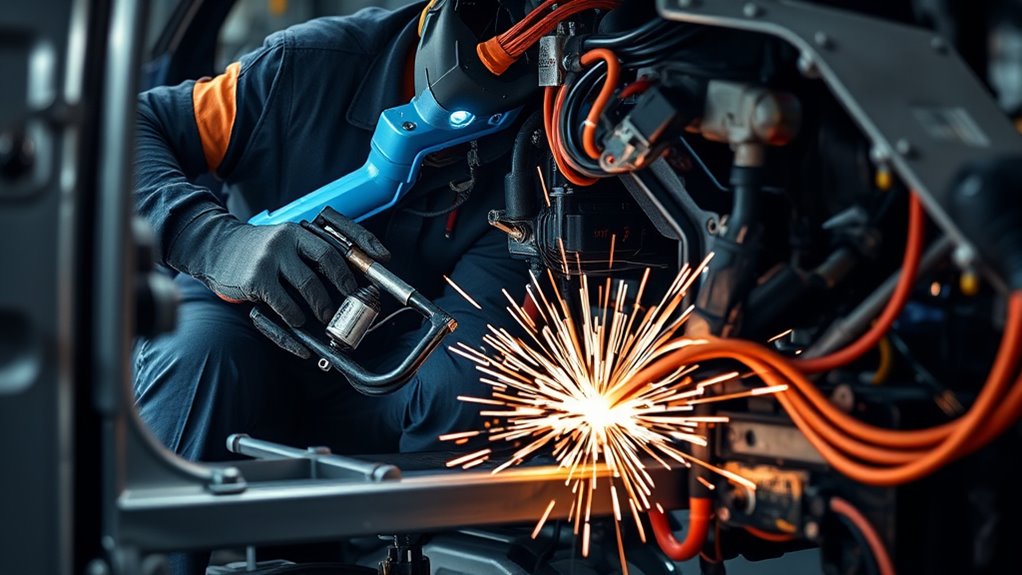
Hybrids and EVs need extra precautions because they have both low-voltage systems and high-voltage traction systems. The NHTSA electric and hybrid vehicle guidance explains that high-voltage traction batteries are different from 12-volt batteries and should not be serviced without proper training and specialized equipment.
Do not treat high-voltage isolation as a basic battery disconnect. Follow the OEM high-voltage shutdown procedure, use the required PPE and test equipment, and verify zero potential when the procedure requires it. If you are not trained for high-voltage service, stop and have a qualified technician handle the isolation steps.
| Action | Why It Matters |
|---|---|
| Follow OEM high-voltage disable steps | Prevents electric shock, module damage, and unsafe repair conditions. |
| Disable the 12-volt system as instructed | Many control modules and SRS circuits depend on the low-voltage system. |
| Verify isolation when required | High-voltage parts can remain hazardous if shutdown is incomplete. |
| Use heat shields near battery cases and orange cables | Heat damage to high-voltage insulation or battery enclosures can create serious hazards. |
| Document every service plug, connector, and warning tag | Clear documentation supports safe reassembly and final inspection. |
Scan and Test the Airbag System Afterward
After welding and reassembly, scan the airbag system with a capable diagnostic tool. Do not simply clear codes and return the vehicle. First, inspect the SRS module, sensors, wiring harnesses, connector locks, grounds, and trim areas affected by the repair.
If the scan shows stored or current faults, diagnose the cause before clearing anything. A code that returns after clearing is not a nuisance code. It means the system still sees a problem.
- Compare the post-scan to the pre-scan.
- Inspect the weld area for heat damage, pinched wiring, missing clips, and loose connectors.
- Confirm sensors are installed in the original orientation and location.
- Clear codes only after the repair is complete and the fault cause is corrected.
- Verify that the airbag warning lamp proves out normally and stays off.
- Perform any OEM-required calibration, initialization, or functional check.
Troubleshooting After Welding Near SRS Components
If the SRS warning lamp stays on after welding, do not guess. Use the scan tool and service information to trace the fault.
| Problem | Likely Area to Check | Next Step |
|---|---|---|
| Airbag warning lamp stays on | Stored SRS code, loose connector, damaged harness, or uninitialized component | Read codes, inspect the repair zone, and follow OEM diagnostics. |
| No communication with SRS module | Power, ground, network wiring, fuse, or module connector | Check power and ground only by the OEM test method. |
| Code returns after clearing | Active circuit fault or damaged component | Do not release the vehicle until the root cause is repaired. |
| Melted clip, insulation, or trim smell | Heat transfer behind the weld area | Remove trim as needed and inspect for hidden smoldering or wire damage. |
Products Worth Considering
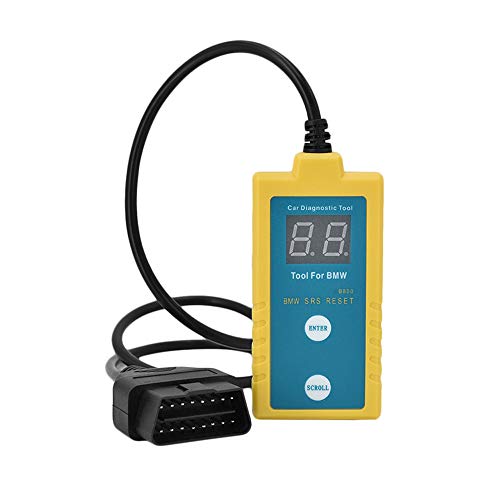
✔️【Professional SRS Reset for 1994-2003 BMW】 Designed specifically for classic BMW models (1994-2003). This B800 scanner reads & clears SRS airbag fault codes, turns off the warning light, and saves you a costly dealer visit. Confirmed compatible with: E36, E46 (EXCEPT 2001 330i), E34, E38, E39, Z3, and X5 (E53). NOT compatible with any BMW built before 1994 or after 2003.

Compatible with Multiple Models: Perfectly suitable for a wide range of vehicles including E36 and E46 series, such as Saloon, Coupe, Compact, Convertible, and Touring models. Please check the detailed application model before purchasing.

The only official protective EVA bag for ANCEL AD310, AD410, AD530, VD500, VD700, HD601, JP700, BD310 FX2000 FX3000 OBD2 scanner and BST200, BA101, BM200 PRO battery tester. (Scanner and accessories in the photos are not included).
Frequently Asked Questions
What are five welding safety precautions near airbag sensors?
Check the OEM procedure, disable the SRS as directed, wait the specified reserve-energy time, keep the work clamp close to the weld on the same panel, and shield or remove nearby sensors, modules, trim, and wiring.
What safety precautions should you follow when working around an airbag?
Treat the airbag system as a sensitive pyrotechnic safety system. Do not probe SRS connectors, do not apply power to airbag circuits, disconnect power only by the OEM procedure, wait the required time, and keep heat, sparks, and welding current away from sensors and wiring.
What precautions should be taken when welding a vehicle?
Disconnect or isolate systems as the manufacturer requires, remove flammable materials, protect the cabin, use proper PPE and ventilation, place the work clamp close to the weld, keep cables away from electronics, and scan affected systems before and after the repair.
Do you need to disconnect a car battery before welding?
Usually yes, but follow the vehicle-specific OEM procedure. Many repairs require disconnecting the 12-volt battery before welding, then waiting for reserve energy to discharge. Hybrids and EVs may also require high-voltage isolation by a qualified technician.
Is 12 inches enough clearance from an airbag sensor?
Use 12 inches as a conservative working minimum only when OEM instructions allow it. Some repairs may require more clearance, sensor removal, module disconnection, special shielding, or a different attachment method. The manufacturer’s procedure controls the final decision.
What should you do if the airbag light comes on after welding?
Scan the SRS, record the codes, inspect nearby wiring and connectors, and diagnose the fault with OEM service information. Do not clear the code and ignore it. The vehicle should not be returned to service until the warning lamp proves out normally and stays off.
Conclusion
When you weld near airbag sensors, small shortcuts can create serious safety problems. Start with the OEM repair procedure, disable the SRS correctly, wait the specified reserve-energy time, protect wiring and modules, keep the welding current path short, and control heat inside the cabin. For hybrids and EVs, add the required high-voltage isolation steps and use qualified help when needed. A careful pre-scan, clean weld setup, and complete post-scan help protect the vehicle and everyone who rides in it.
Sources
- National Highway Traffic Safety Administration: Air Bags — supports airbag operation, deployment speed, and occupant safety risk.
- OEM1Stop: Statement on Use of OEM Repair Procedures — supports using vehicle-specific OEM procedures and pre/post scans.
- OSHA: Welding, Cutting, and Brazing Standards — supports welding PPE, fire prevention, ventilation, and safety controls.
- OSHA: Welding, Cutting, and Brazing Hazards and Solutions — supports fume, PPE, and general welding hazard control.
- NHTSA: Electric and Hybrid Vehicles — supports high-voltage battery safety and the need for trained EV service procedures.