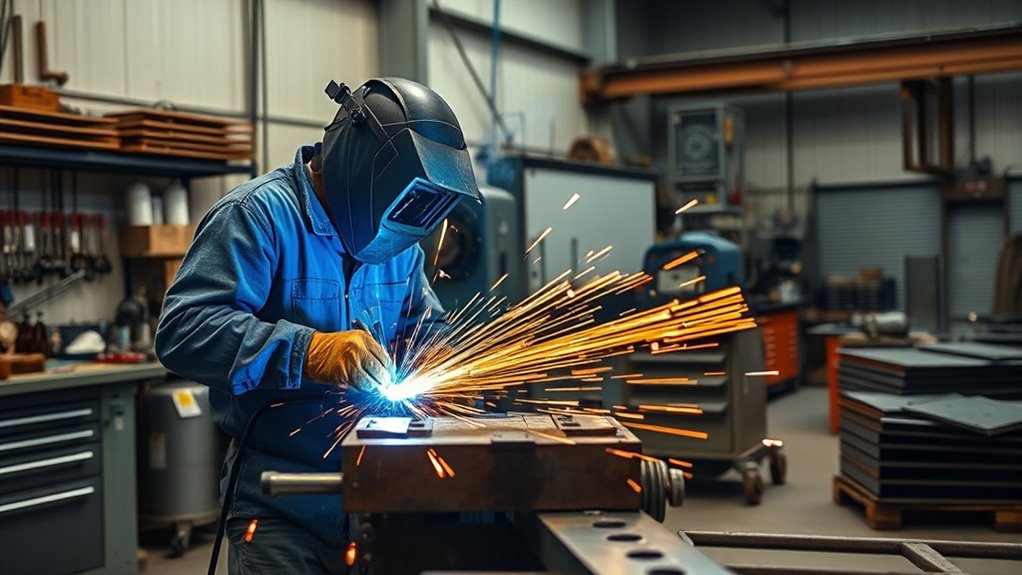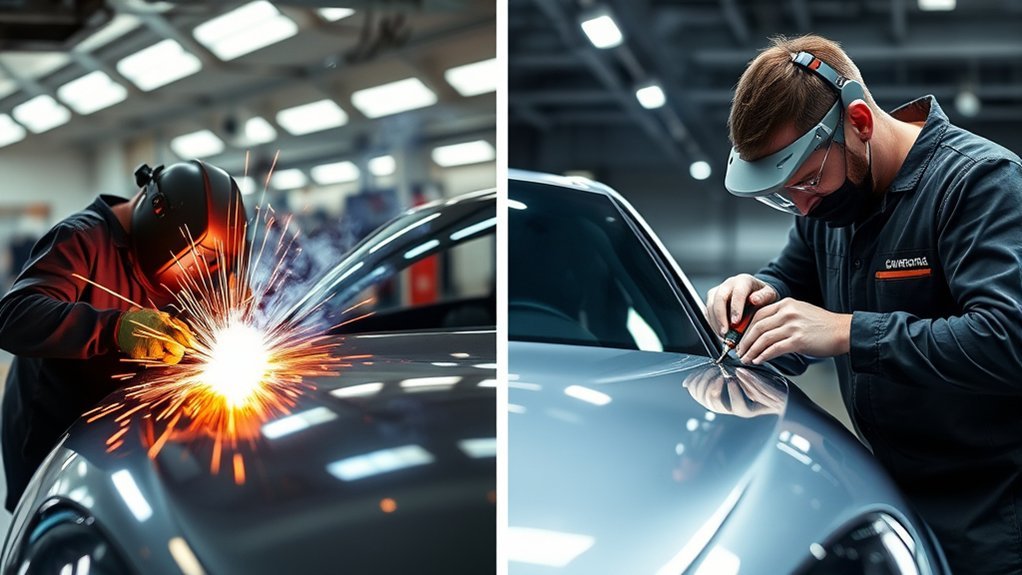
When you compare welding and riveting for auto body panels, the right choice depends on the panel location, material, factory repair procedure, access, heat sensitivity, and whether the joint must be permanent or serviceable. Welding can create a strong, smooth joint when the metal and procedure allow it. Riveting can reduce heat distortion and help join dissimilar materials, especially when used with an approved panel bonding adhesive.
Quick Answer
Use welding when the OEM repair procedure calls for a permanent metal-fused joint in steel or aluminum. Use riveting, often with adhesive, when the repair involves heat-sensitive panels, dissimilar materials, limited access, or OEM-approved rivet-bonding. For structural collision repairs, the vehicle maker’s procedure should decide the method.
Key Takeaways
- Welding is best for many permanent steel repairs when the panel, thickness, and OEM procedure support it.
- Riveting limits heat distortion and can work well on aluminum, mixed-material panels, and areas where access is limited.
- Rivet-bonding and weld-bonding are common in modern collision repair, but only where the manufacturer approves them.
- Structural areas such as rails, pillars, rockers, and crash-load paths should never be guessed. Follow the OEM repair manual.
- Corrosion protection matters with both methods because bare metal, drilled holes, weld heat, and trapped moisture can all shorten repair life.
Key Differences Between Welding and Riveting Methods
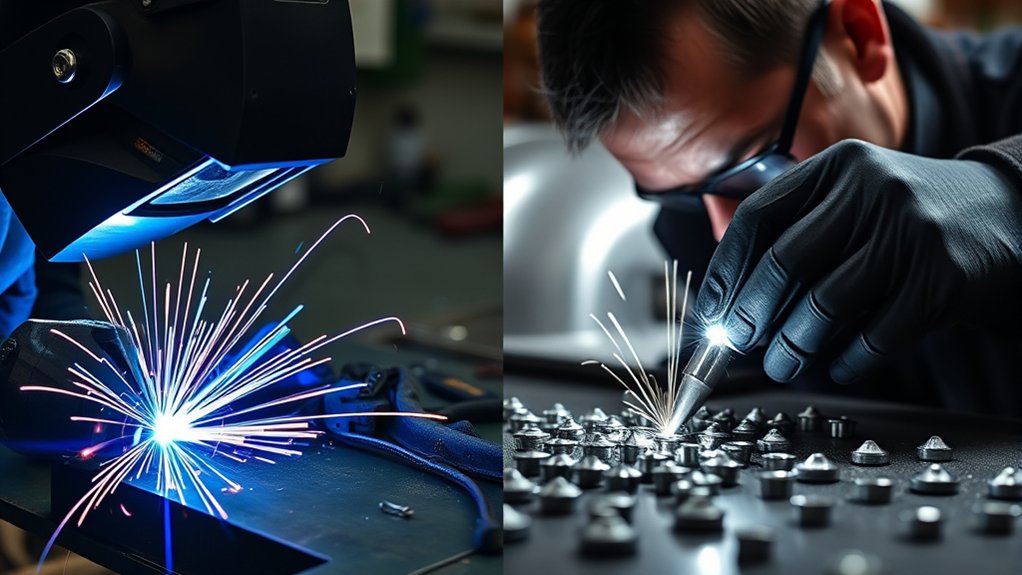
Welding joins metal by using heat to fuse the parts together. In auto body work, common methods include MIG welding, resistance spot welding, plug welding, TIG welding, and, in some repair settings, flux core welding. A proper weld can be strong, permanent, and smooth after grinding and finishing, but it also adds heat to thin sheet metal.
Riveting joins panels with mechanical fasteners. A rivet passes through drilled or punched holes and clamps the panels together. In collision repair, rivets are often paired with structural adhesive, creating a rivet-bonded joint that adds sealing, load distribution, and corrosion protection when the product and procedure are approved for that location.
| Factor | Welding | Riveting |
| Joint type | Permanent fused joint | Mechanical fastened joint, often adhesive-assisted |
| Heat effect | Can warp thin panels if heat is not controlled | No weld heat, so distortion risk is lower |
| Best materials | Similar weldable metals, matched to the OEM method | Aluminum, mixed materials, and panels approved for rivet-bonding |
| Appearance | Can be finished smooth with no visible fastener | Fasteners may be visible unless hidden by trim or finish work |
| Repairability | Harder to undo without cutting or grinding | Often easier to drill out and replace when access is available |
Warning: Structural collision repairs can affect crash performance, airbag timing, seat belt loads, and corrosion protection. Do not choose welding or riveting by preference alone. Follow the vehicle maker’s repair manual, especially around pillars, rockers, rails, frame sections, suspension mounts, and battery or fuel areas.
Strengths of Welding for Auto Body Repairs
Welding is valuable when you need a permanent joint that becomes part of the metal structure. It is common for steel body panels, plug welds that replace factory spot welds, patch panels, brackets, and many structural repairs where the manufacturer allows welding.
The main advantage is continuity. A properly prepared weld can transfer load through the joint without relying on a row of separate fasteners. It can also be ground and finished for a clean appearance, which matters on exposed panels. Welding also avoids extra fastener heads and overlap bulk in areas where clearance is tight.
| Welding Strength | Why It Helps |
| Permanent joint | Useful where the repair must act like a continuous metal connection. |
| Smooth finish | Can be ground, feathered, sealed, primed, and painted without visible fasteners. |
| No drilled fastener holes | Reduces one source of water entry when the weld and surrounding metal are sealed correctly. |
| Factory-style replacement | Resistance spot welding and plug welding are often used to replace original spot weld locations when approved. |
The tradeoff is heat. Thin sheet metal can warp, coatings can burn away, and nearby trim, foam, wiring, glass, fuel lines, high-voltage cables, or interior parts can be damaged. Welding also requires clean metal, correct settings, proper duty cycle, good fit-up, and the right PPE.
Benefits of Riveting in Auto Body Panels
Riveting is useful when you need to fasten panels without adding welding heat. This is why rivets are common in aluminum repair, mixed-material construction, outer body panels, and tight areas where a welding gun or torch cannot safely reach.
- Less heat distortion: Riveting does not shrink the metal the way welding heat can, so it helps protect large, thin panels from warping.
- Good for dissimilar materials: Rivets can join aluminum to steel or other approved combinations when the correct rivet, adhesive, isolation, and repair procedure are used.
- One-sided access: Blind rivets can be installed from one side, which helps in boxed sections or covered areas.
- Repair access: Many rivets can be drilled out later, making some future panel service easier than cutting out a welded joint.
- Hybrid strength: Rivets can provide clamp-up while adhesive spreads load and seals the joint when rivet-bonding is specified.
Riveting still needs careful prep. The holes must be correct, the panels must fit tightly, and bare edges need primer, adhesive, seam sealer, or corrosion protection. Without the right seal, rivet holes can invite water, corrosion, and noise. Reduced heat input is helpful, but it does not replace proper joint design.
Pro Tip: If a repair procedure calls for rivet-bonding, treat the adhesive as part of the joint, not as optional glue. Use the specified adhesive, rivet type, clamp time, cure time, surface prep, and corrosion protection steps.
Follow OEM Repair Procedures First
The safest rule is simple: choose the method the vehicle manufacturer specifies for that exact panel and location. Many late-model vehicles use different grades of steel, aluminum, castings, adhesives, sealers, and reinforcements in the same body shell. A method that works on a door skin may be wrong for a rocker panel or rail.
For example, 3M Panel Bonding Adhesive is designed for many non-structural replacement panels and can be used with welds or rivet bonds. 3M also notes that structural components should be bonded only when the OEM specifies it, and otherwise structural components should be welded. That is the kind of instruction you should follow before deciding between welding and riveting.
In practical terms, check the repair manual for:
- where to section or replace the panel;
- which weld type, rivet type, adhesive, or seam sealer to use;
- minimum spacing and number of welds or rivets;
- whether squeeze-type resistance spot welding is required;
- whether MIG plug welds are allowed as a substitute;
- whether heat is restricted in that area;
- which corrosion protection must be restored after the repair.
Key Factors in Choosing Welding vs. Riveting
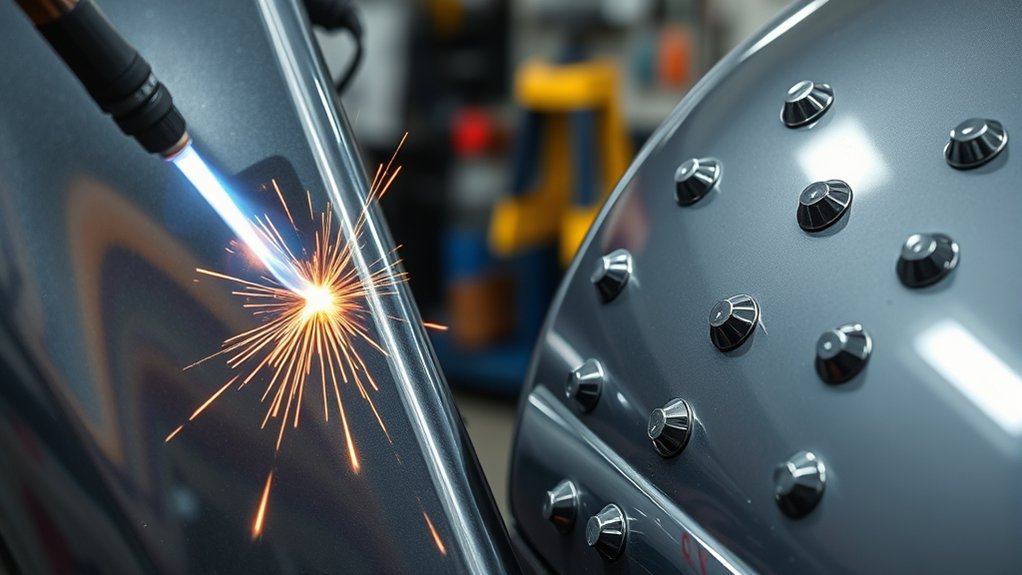
Start with the panel’s job. If the part carries crash loads, supports suspension, anchors restraints, or forms a major structural path, do not improvise. Use the OEM procedure. For cosmetic or outer panels, you may have more options, but the repair still needs a tight fit, corrosion protection, and a finish that will last.
Next, look at the material. Steel panels are often welded when the grade and location allow it. Aluminum panels may be welded, riveted, or bonded depending on the repair procedure. Dissimilar materials need extra care because direct metal contact can cause galvanic corrosion when moisture is present.
Access is another major factor. Welding may require access for the gun, torch, backing, clamps, and fire protection. Riveting may be better in a closed section where a blind fastener is approved. Appearance also matters: welding can hide the joint, while rivets may need to be covered by trim, filler, or panel design.
Note: Riveting is not automatically weaker and welding is not automatically better. The correct method is the one tested and approved for the panel, material stack, joint design, and repair location.
Products Worth Considering

COMPLETE KIT: 100-piece automotive trim clip assortment featuring 6 different push-type retainers from 6mm to 20mm, removal tool, and organized storage case for car repairs

🔧 12 Essential Retainer Clip Sizes for Cars - Includes 12 of the most commonly used automotive push retainer clip sizes. Compatible with GM, Ford, Toyota, Mazda, Hyundai, Kia, Jeep, and more. Perfect for car panel clip removal and interior trim repair across a wide range of vehicle models.
Applications of Welding and Riveting in Auto Body Work
In auto body work, welding and riveting often serve different jobs. Welding is common for steel patch panels, spot weld replacement, brackets, frame-related work, and structural joints where the repair procedure allows heat. Riveting is common for aluminum panels, outer skins, blind-access areas, and repairs that call for adhesive plus fasteners.
- Door skins and roof skins: These may use adhesive bonding, weld-bonding, hemming, or rivets depending on the vehicle.
- Quarter panels: These may require a mix of plug welds, spot welds, adhesive, and seam sealing.
- Aluminum panels: These often use self-piercing rivets, blind rivets, or bonding methods approved by the OEM.
- Steel structural areas: These often require specific weld types, weld spacing, and heat-control rules.
- Mixed-material joints: These may need isolation, adhesive, special rivets, and corrosion protection to prevent galvanic corrosion.
Good surface preparation is critical for both methods. Remove paint, rust, sealers, and coatings only where the procedure allows. After joining, restore epoxy primer, weld-through primer where specified, seam sealer, cavity wax, and topcoat protection so the repair does not fail from corrosion.
Safety and Tool Requirements
Welding requires a welder suited to the material, correct wire or filler, shielding gas, clamps, panel-cleaning tools, PPE, ventilation, and fire protection. Riveting requires the right rivet gun, drill or punch system, approved rivets, adhesive equipment when bonding, clamps, surface prep tools, and corrosion protection materials.
Hot work is the bigger safety issue. OSHA’s welding, cutting, and brazing requirements call for fire hazards to be moved or guarded, suitable extinguishing equipment to be ready, and fire watch when conditions require it. OSHA also requires helmets or hand shields for arc welding and proper eye protection for helpers and attendants.
- Disconnect the battery or follow the OEM high-voltage disable procedure on hybrid and EV vehicles.
- Remove or shield trim, carpet, foam, wiring, glass, fuel lines, and modules near the work area.
- Keep a suitable extinguisher nearby and inspect the backside of the repair area.
- Use welding helmets, gloves, sleeves, respiratory protection, and ventilation as needed.
- Do not weld near fuel vapors, uncleaned tanks, or hidden combustible material.
The best joint is not the one that looks strongest on paper. It is the one that matches the vehicle maker’s tested repair procedure and restores strength, corrosion protection, and panel fit.
Products Worth Considering
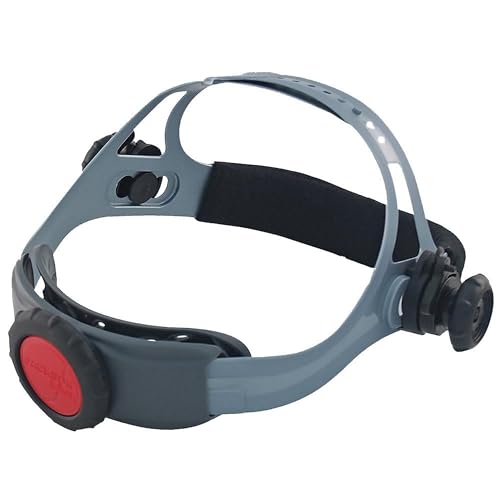
REPLACEMENT WELDING HELMET HEADGEAR - Jackson Safety's Premium 370 Speed Dial Replacement Headgear offers a perfect fit and secure hold for your welding hood


EXTRA LEATHER PROTECTION - Our jacket is made from leather and cotton. Split cowhide leather is incorporated on the arms sleeves, shoulders and chest which are high impact and key protection areas from heat and spatter
Frequently Asked Questions
How do welding and riveting affect vehicle weight?
Welding can reduce extra fastener weight because the joint is fused into the metal. Riveting adds fasteners and often overlap material, but it may support lighter aluminum or mixed-material designs. In real repairs, the weight difference is usually less important than following the OEM procedure and restoring crash performance.
Can welding and riveting be combined in auto body work?
Yes. Many repairs use hybrid joining, such as weld-bonding or rivet-bonding. The adhesive can seal the joint and spread load, while welds or rivets provide mechanical attachment. Use this only when the repair procedure or product instructions allow it.
What tools are required for welding versus riveting?
Welding usually requires a MIG, TIG, resistance spot, or approved welding setup, plus shielding gas, wire or filler, clamps, cleaning tools, PPE, and fire protection. Riveting requires the correct rivet tool, approved rivets, drilling or punching tools, clamps, adhesive equipment when specified, and corrosion protection products.
Is one method more cost-effective than the other?
Riveting may cost less in heat-sensitive or hard-to-access areas because it can reduce panel warping and disassembly. Welding may cost less when the shop already has the right equipment and the repair is straightforward. The lowest-cost method is not always the right method if it conflicts with the OEM repair procedure.
How do environmental factors influence welding and riveting choices?
Humidity, road salt, temperature swings, and moisture exposure matter because both welds and rivets can corrode if bare metal is not sealed. Riveted mixed-metal joints need extra attention to galvanic corrosion. Welded areas need restored primer, seam sealer, and cavity wax after heat burns away factory coatings.
Is riveting better than welding for aluminum body panels?
Riveting is often preferred for aluminum panels when the OEM calls for self-piercing rivets, blind rivets, or rivet-bonding. Aluminum can also be welded in some repairs, but it needs the right equipment, filler, cleaning, and heat control. Always check the repair manual for that panel.
Can I rivet a structural auto body repair instead of welding it?
Only if the vehicle manufacturer allows riveting for that exact structural location. Some structural repairs use rivets and adhesive, but others require welding. Guessing can weaken the crash structure, create corrosion problems, and make the repair unsafe.
Conclusion
Welding and riveting both have a place in auto body repair. Welding is best when the repair calls for a permanent fused joint, a smooth finish, and controlled heat on a weldable material. Riveting is best when the repair calls for low heat, one-sided access, mixed materials, aluminum panels, or approved rivet-bonding. The final choice should come from the OEM repair procedure, not habit or convenience.
Sources
- 3M Panel Bonding Adhesive — backs panel bonding, rivet-bonding, weld-bonding, and OEM-use limits.
- OSHA 1910.252 Welding, Cutting, and Brazing General Requirements — backs fire prevention, hot-work precautions, extinguishers, fire watch, and welding eye protection.
- OSHA 1910.133 Eye and Face Protection — backs eye and face protection requirements.
- Improved Training Strategies for Physics-Informed Neural Networks using Real Experimental Data in Aluminum Spot Welding — backs the importance of resistance spot welding in automotive body-in-white manufacturing.