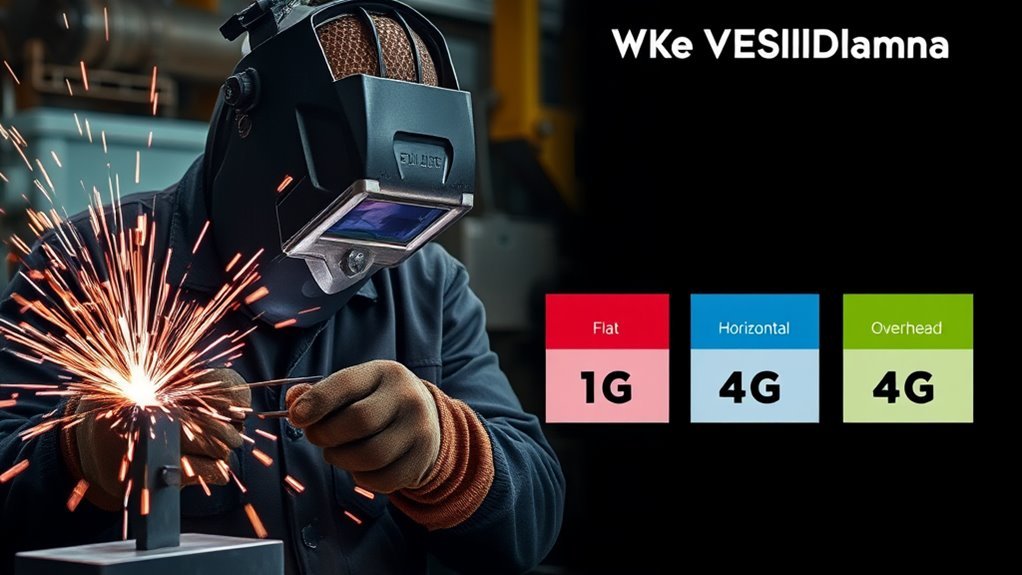
Welding position numbers tell you how the joint sits while you weld. For plate groove welds, 1G, 2G, 3G, and 4G mean flat, horizontal, vertical, and overhead. The letter G means groove weld, while fillet welds use F. Once you understand the code, you can choose better settings, filler metal, body position, and safety gear for cleaner welds.
Quick Answer
In welding position numbers, 1 means flat, 2 means horizontal, 3 means vertical, and 4 means overhead. The letter G means groove weld, so 3G is a vertical groove weld. The higher positions usually need more puddle control because gravity pulls molten metal downward.
Key Takeaways
- 1G, 2G, 3G, and 4G are groove-weld positions: flat, horizontal, vertical, and overhead.
- The number tells you the position. The letter tells you the weld type: G for groove and F for fillet.
- Out-of-position welding, especially 3G and 4G, often needs a smaller puddle, cooler settings, and steadier travel.
- Filler metal must be rated for the position. Some wires and rods are all-position, while others are flat and horizontal only.
- Overhead welding needs extra PPE because sparks, slag, and molten metal can fall toward you.
At a Glance
| Time Required | 30 to 60 minutes of focused practice per position, then repeated sessions for consistency |
| Difficulty | 1G is beginner-friendly; 2G is moderate; 3G and 4G are advanced for new welders |
| Tools Needed | Welder, position-rated filler metal, clean scrap coupons, clamps, wire brush or grinder, helmet, gloves, jacket, and ventilation |
| Cost | Varies by machine and PPE; position practice usually adds only scrap metal, gas, wire, rods, or electrodes |
Why Welding Position Numbers Matter
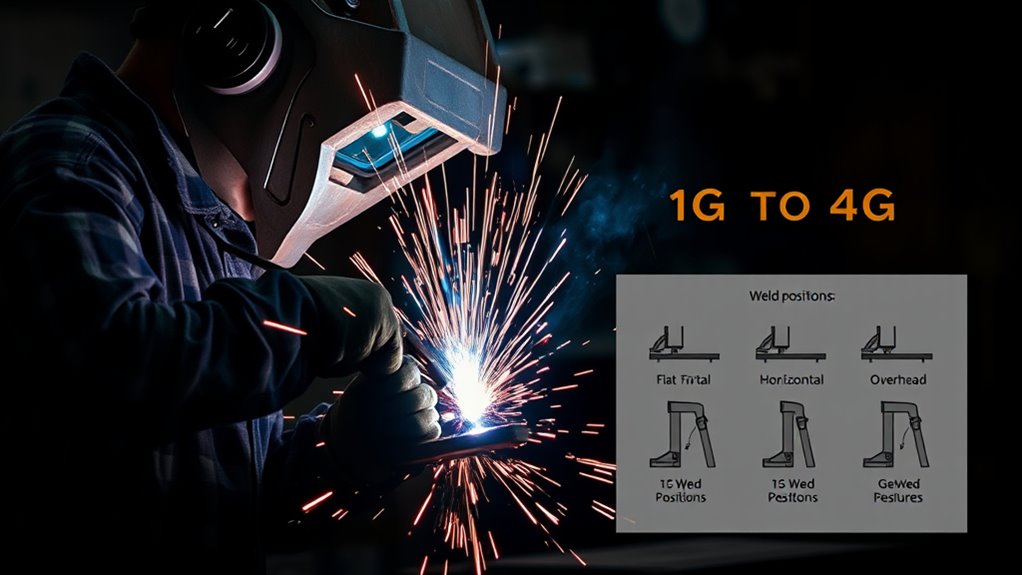
Welding position numbers matter because they describe the position of the joint in relation to gravity. That changes your torch angle, heat input, travel speed, filler metal choice, and body position.
The standard position designations use numbers for position and letters for weld type. In 1G, 2G, 3G, and 4G, the G means groove weld. In 1F, 2F, 3F, and 4F, the F means fillet weld.
This matters on real projects because a welding procedure specification, filler-metal data sheet, or test plate may call for a specific position. It also helps you understand why a weld that looks good flat may sag, undercut, or drip when you try it vertical or overhead.
Note: Position numbers help describe the weld, but they do not replace the welding code, WPS, procedure qualification, or employer requirements for a job.
What Do 1G, 2G, 3G, and 4G Mean?
The numbers 1 through 4 describe the basic plate welding positions. The same number system also appears with fillet welds, but the letter changes from G to F.
| Position | Meaning | Main Challenge | Best Practice |
| 1G | Flat groove weld | Avoiding excessive heat or a wide bead | Use steady travel and keep the arc centered in the joint |
| 2G | Horizontal groove weld | Puddle sag on the lower side of the groove | Favor the upper edge slightly and avoid running too hot |
| 3G | Vertical groove weld | Molten metal wants to run downward | Use controlled heat, smaller passes, and steady puddle support |
| 4G | Overhead groove weld | Sparks, slag, and hot metal can fall | Keep the puddle small, reduce heat as needed, and use full PPE |
1G vs 1F: Why the Letter Matters
The number alone is not the full code. A 1G weld and a 1F weld are both flat-position welds, but they are not the same weld type.
- G means groove weld: The weld is made in a prepared groove between workpiece edges.
- F means fillet weld: The weld joins two surfaces that meet at an angle, often around 90 degrees.
- The number means position: 1 is flat, 2 is horizontal, 3 is vertical, and 4 is overhead.
For example, 2G is a horizontal groove weld. 2F is a horizontal fillet weld. This distinction matters when reading a WPS, a test requirement, or a filler-metal data sheet.
Techniques for Each Welding Position
Each position changes how the weld puddle behaves. Start with clean metal, correct joint fit-up, and the recommended settings for your process. Then adjust from there based on what the puddle is doing.
1G Flat Position
The 1G flat position is the easiest place to build basic control because gravity helps the puddle settle into the joint. Use this position to practice travel speed, arc length, bead tie-in, and proper weld sizing.
Watch for too much heat. A flat weld can still fail if you move too slowly, overfill the joint, or let the bead get too wide. Keep your arc centered and aim for even tie-in on both sides of the groove.
2G Horizontal Position
In the 2G horizontal position, the weld axis is roughly horizontal and the groove face is vertical. Gravity pulls the puddle toward the lower side, so heat control becomes more important.
Use a steady hand, keep the puddle small enough to control, and avoid running so hot that the bead rolls over. A slight angle toward the upper edge can help the weld wash into the top side instead of sagging.
3G Vertical Position
The 3G vertical position can be welded vertical-up or vertical-down, depending on the process, material thickness, and procedure. Vertical-up is common on thicker material because it helps build fusion and support the puddle. Vertical-down can be faster on thinner material, but it can also hide lack of fusion if used incorrectly.
For vertical welding, reduce heat when needed and use a controlled pattern that supports the puddle. Miller recommends lower wire feed speed and voltage for vertical welds to help keep the puddle from falling out of the joint. You should also understand heat input control, especially when welding thin metal.
4G Overhead Position
The 4G overhead position is one of the hardest plate positions because you weld from below the joint. You must keep the puddle small enough to stay in place while still getting enough fusion.
Use a comfortable stance before you strike an arc. If your shoulder, wrist, or helmet angle is awkward, your bead will usually show it. Use short practice beads first, then increase bead length as your control improves.
Warning: Overhead welding sends sparks, slag, and hot metal downward. Wear a properly rated welding helmet, flame-resistant jacket, gloves, closed boots, and head protection under the hood. Follow your workplace safety rules and never weld without proper ventilation and fire protection.
Filler Metal Selection for Welding Positions
Filler metal selection depends on the base metal, process, joint, code, and welding position. Do not assume every rod or wire works in every position. Always check the manufacturer data sheet and the WPS before welding critical work.
For flux-cored wire, position capability is often built into the classification. For example, Miller explains that E70T-XX with a zero is generally for flat and horizontal positions, while E71T-XX with a one is rated for all positions. Stick electrodes also use classification digits to show position capability, and Lincoln Electric’s AWS classification guide explains how those digits work.
- Flat and horizontal work: You often have more filler and process options because gravity is easier to manage.
- Vertical and overhead work: Choose filler metal rated for out-of-position welding and use settings that keep the puddle small and stable.
- MIG transfer mode: Short-circuit MIG and pulsed MIG can often be used out of position, while spray transfer is generally limited to flat and horizontal work.
- Flux-cored and stick welding: These can work well out of position when the electrode or wire is designed for it.
Pro Tip: If a vertical or overhead weld is sagging, do not only move faster. First check whether the wire, rod, transfer mode, amperage, voltage, and travel angle are suitable for that position.
Products Worth Considering

Commonly used for general shop applications with poor fit-up

Welding Easy and Quick: AWS E71T-GS 030” Flux Core welding wire (The actual Net Weight of Wire is 2LB), no need for shielding gas, install it then you can welding all positions, single and multi pass welding. Great for T-joints, butt welds & lap welds.

SMOOTH, EASY TO RUN: This ER70S-6 MIG wire runs clean and steady, helping you keep a smooth arc without constantly adjusting your machine. It handles mild steel with light rust or mill scale without giving you trouble
Common Applications and Safety Considerations for 1G, 2G, 3G, and 4G Welding
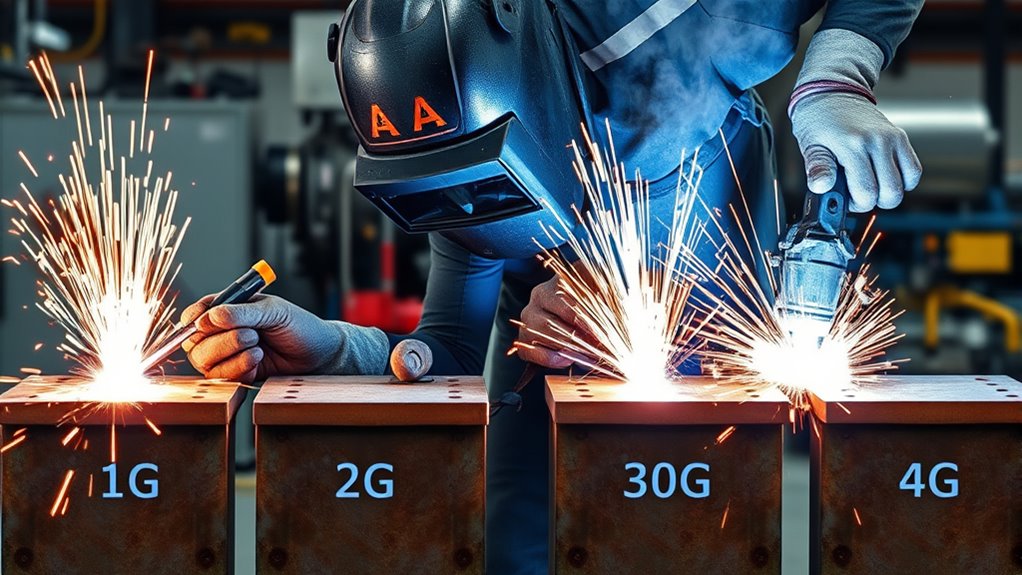
Each welding position appears in different shop, structural, repair, and fabrication work. When you can choose the work angle, it is often easier to rotate the part into the flat position. When the part is fixed, you may have to weld horizontal, vertical, or overhead.
- 1G flat: Practice coupons, bench fabrication, plate work, and parts that can be positioned flat.
- 2G horizontal: Fixed plates, beams, frames, and groove welds that cannot be rolled flat.
- 3G vertical: Columns, vertical seams, structural repairs, and field work where the part is fixed upright.
- 4G overhead: Undersides of fixed structures, overhead repairs, bridge work, and equipment that cannot be moved.
OSHA’s welding, cutting, and brazing requirements cover fire protection, eye protection, protective clothing, ventilation, and other hazards. For arc welding, use a helmet or hand shield with the correct filter lens, protect nearby workers from arc rays, and keep ventilation strong enough to control fumes.
Be especially careful with coated metals. If you weld galvanized steel, zinc fumes can affect both health and weld quality, so review safe procedures before starting. This is especially important when using out-of-position techniques on fixed parts where your head may be closer to the plume. See these galvanized steel welding precautions before welding zinc-coated material.
1G, 2G, 3G, 4G vs 5G and 6G Pipe Welding
Plate welding and pipe welding use related position language, but the codes are not identical. For plate groove welds, the common positions are 1G, 2G, 3G, and 4G. For pipe, common positions include 1G, 2G, 5G, and 6G.
In pipe welding position guidance, TWI describes 5G as a fixed horizontal pipe where the welder moves around the pipe. It describes 6G as a fixed pipe set at about a 45-degree angle, which makes it one of the most demanding pipe tests.
- Pipe 1G: Pipe is horizontal and can be rotated while the welder stays in a comfortable position.
- Pipe 2G: Pipe is vertical and the weld is made horizontally around it.
- Pipe 5G: Pipe is horizontal and fixed, so the welder moves around it.
- Pipe 6G: Pipe is fixed at about 45 degrees, forcing position changes around the joint.
Troubleshooting Common Position Welding Problems
Most position-welding problems come from too much heat, poor body position, the wrong filler metal, or trying to use flat-position habits out of position.
| Problem | Common Position | Likely Cause | Fix |
| Sagging bead | 2G, 3G, 4G | Too much heat or too large a puddle | Reduce heat, shorten the puddle, and check travel angle |
| Undercut | 2G, 3G | Fast travel or poor edge pause | Slow slightly and pause at the toes of the weld |
| Lack of fusion | All positions | Poor angle, dirty joint, or low heat | Clean the joint, aim into both sidewalls, and verify settings |
| Slag inclusions | 3G, 4G stick or flux-core | Poor slag control between passes | Chip and brush fully, then adjust angle and bead placement |
Practice Plan for Learning Welding Positions
Learn the positions in order. Start flat, then move to horizontal, then vertical, then overhead. Do not rush into 4G before you can run consistent beads in 1G and 2G.
- Start with 1G beads on clean scrap: Focus on arc length, travel speed, bead width, and tie-in.
- Move to 2G grooves: Watch the lower edge and learn how heat affects sagging.
- Practice 3G vertical-up: Use small passes and pause at the sidewalls to avoid a rope-like bead.
- Try short 4G beads: Keep the puddle small and stop if sparks, slag, or body position become unsafe.
- Record your settings: Note amperage, voltage, wire speed, rod type, travel angle, and what the bead looked like.
Regular practice on scrap material helps you learn how each position feels before you weld on a real project. It also lets you test flux core welding techniques, stick angles, and MIG settings without risking a finished part.
Frequently Asked Questions
What do 1G, 2G, 3G, and 4G mean in welding?
They are groove-weld position codes. 1G means flat groove weld, 2G means horizontal groove weld, 3G means vertical groove weld, and 4G means overhead groove weld.
What is the difference between 3G and 4G welding?
3G is vertical groove welding, where you weld up or down a vertical joint. 4G is overhead groove welding, where the joint is above you. 4G is usually harder because gravity pulls the puddle, sparks, and slag downward toward the welder.
What is the difference between G and F in welding positions?
G means groove weld, and F means fillet weld. The number tells the position, while the letter tells the weld type. For example, 2G is a horizontal groove weld, and 2F is a horizontal fillet weld.
What are 5G and 6G welding positions?
5G and 6G are pipe welding positions. In 5G, the pipe is fixed horizontally and the welder moves around it. In 6G, the pipe is fixed at about a 45-degree angle, which forces the welder to handle multiple positions around one joint.
Does passing a 3G or 4G test qualify you for every welding job?
Not automatically. Qualification depends on the welding code, process, base metal, thickness range, filler metal, test type, and employer requirements. Always check the WPS and the governing standard for the job.
Which welding position should a beginner learn first?
Start with 1G flat welding because gravity helps the puddle settle into the joint. Once your bead shape and travel speed are consistent, move to 2G horizontal, then 3G vertical, and finally 4G overhead.
Conclusion
Welding position numbers are a simple code with a big impact on weld quality. For plate groove welds, 1G is flat, 2G is horizontal, 3G is vertical, and 4G is overhead. As the position gets harder, gravity has more effect on the puddle, so your settings, filler metal, travel speed, and body position matter more.
Use 1G to build control, 2G to learn sag control, 3G to manage vertical puddle support, and 4G to practice overhead safety and precision. When the job involves pipe, learn how 5G and 6G differ from plate positions. Most importantly, follow the WPS, use position-rated filler metal, and protect yourself from arc rays, fumes, sparks, and falling slag.
Sources
- American Welding Society, AWS A3.0M/A3.0:2025 — current welding terminology standard and welding test position terminology context
- MillerWelds, 4 Basic Welding Positions — 1G through 4G, F vs G, filler metal position capability, and technique guidance
- Lincoln Electric, AWS Classifications — electrode classification and position capability
- OSHA 1910.252 Welding, Cutting, and Brazing — PPE, eye protection, fire prevention, ventilation, and safety requirements
- TWI, Pipe Welding Positions — 1G, 2G, 5G, and 6G pipe-position definitions