Dirty, rusty, or thick steel can make a clean weld harder to produce with solid wire. Flux-cored wire is often a better fit because it can deliver strong penetration, high weld-metal output, and reliable performance in field conditions.
Once you understand what flux-cored wire is used for, you can choose the right type with more confidence. This guide explains where flux-core welding works best, how it compares with MIG and stick welding, and how to set up your machine for safer, cleaner results.
Quick Answer
Flux-cored wire is mainly used for welding carbon steel in outdoor repairs, construction, heavy fabrication, and jobs involving thicker material or light surface contamination. Self-shielded wire works without a gas cylinder, while gas-shielded wire is commonly used indoors for higher productivity and smoother welds. The exact wire must match the metal, position, polarity, and required code.
Key Takeaways
- Use self-shielded flux-cored wire for portable repairs and outdoor work where external shielding gas is impractical.
- Use gas-shielded flux-cored wire for shop fabrication, higher deposition rates, and controlled production work.
- Never assume polarity, shielding gas, wind tolerance, or welding position from the words “flux core” alone; check the product data sheet.
- Remove oil, paint, heavy rust, moisture, and unknown coatings before welding whenever possible.
- Set the machine from the welder chart and wire data sheet, then confirm the setup with a test bead on matching scrap.
At a Glance
| Time Required | About 30–60 minutes for setup and practice; project time varies |
| Difficulty | Beginner to intermediate |
| Tools Needed | Compatible wire-feed welder, correct flux-cored wire, work clamp, wire brush or grinder, chipping hammer, pliers, and welding PPE |
| Cost | Consumable and preparation costs vary by wire, spool size, gas requirement, and project |
What’s in This Article
- Why Flux-Cored Wire Matters in Welding
- What Is Flux-Cored Wire and How Does It Work?
- When and Where to Use Flux-Cored Wire
- Flux-Cored Wire vs. Other Welding Processes
- Choosing the Right Flux-Cored Wire
- Machine Settings and Setup Tips
- How to Weld With Flux-Cored Wire
- Pros and Cons
- Real-World Applications
- Common Problems and Fixes
- Frequently Asked Questions
Image by nsarc
Why Flux-Cored Wire Matters in Welding
Flux-cored wire matters because it keeps wire-feed welding practical when the work area is not ideal. Depending on the wire, it can handle outdoor work, thicker steel, and light mill scale better than a typical solid-wire MIG setup.
Self-shielded flux-cored arc welding, or FCAW-S, can make field work easier because it does not need an external shielding-gas cylinder. That helps with farm repairs, construction, trailer work, fencing, and heavy-equipment maintenance.
Gas-shielded flux-cored arc welding, or FCAW-G, is common in fabrication shops because many wires provide high deposition rates, good out-of-position capability, and strong mechanical properties. The process can save time on larger joints, but results depend on using a wire approved for the base metal, position, shielding gas, and service conditions.
Flux-cored wire is not automatically gasless, all-position, or suitable for dirty steel. The classification and manufacturer data sheet determine how each wire must be used.
What Is Flux-Cored Wire and How Does It Work?
Flux-cored wire is a tubular electrode with fluxing and alloying ingredients inside its metal sheath. A wire feeder pushes it through the gun while an electric arc melts both the wire and the joint.
The core ingredients help stabilize the arc, protect the molten weld metal, control the bead, and form slag. Self-shielded wires create the needed protection from ingredients in the core. Gas-shielded wires use both the core and an external shielding gas.
After the bead cools, you must remove slag before inspection or another pass. Trapped slag between passes can create an inclusion and weaken the joint.
Self-Shielded vs. Gas-Shielded Flux-Cored Wire
| Feature | Self-Shielded FCAW-S | Gas-Shielded FCAW-G |
|---|---|---|
| External gas | Not required | Required |
| Typical setting | Outdoor repairs, construction, portable work | Indoor fabrication and production |
| Wind sensitivity | More tolerant than gas-shielded processes, but not windproof | Needs protection from drafts and wind |
| Cleanup | Slag and usually more visible smoke | Slag; bead and spatter depend on wire and gas |
| Polarity | Often DCEN, but some wires require DCEP | Often DCEP, but verify the data sheet |
Common FCAW-G shielding gases include 100% carbon dioxide and argon/carbon-dioxide blends. Never switch gases without checking the wire classification and data sheet because the gas can change arc behavior and weld properties.
How to Read a Flux-Cored Wire Classification
AWS classifications give important clues, but the full product data sheet remains the final setup guide. For a classification such as E71T-11:
- E identifies an electrode.
- 7 indicates a minimum tensile-strength class of 70 ksi.
- 1 indicates all-position capability for that classification.
- T identifies a tubular, flux-cored electrode.
- The final usability designator identifies operating characteristics such as shielding method, polarity, and application limits.
Letters and added designators can specify shielding gas, impact toughness, diffusible hydrogen, or other requirements. The Lincoln Electric usability-designator guide explains why wires with similar-looking names may need different setups.
Note: “All-position” does not mean every technique works in every direction. Some wires allow vertical-up, vertical-down, or both, and parameter ranges may change by position.
When and Where to Use Flux-Cored Wire
Flux-cored wire is most useful when you need portability, higher weld-metal output, good performance on thicker steel, or better outdoor capability than gas-shielded MIG can provide.
Welding Thick Steel and Larger Joints
Flux-cored wire works well on steel plate, beams, brackets, frames, and equipment parts. Many FCAW wires provide high deposition rates, so you can fill larger joints faster than with a small stick electrode or light-duty solid-wire setup.
Larger wire diameters can carry more current, but the machine, gun, feeder, duty cycle, and electrical supply must support them. Do not choose 0.045-inch wire only because the metal looks thick; confirm that the machine can feed and power it.
Outdoor Welding and Field Repairs
Wind can strip shielding gas from a MIG or FCAW-G weld and cause porosity. Self-shielded wire is more tolerant because it does not rely on a gas cloud from the nozzle.
That does not make FCAW-S windproof. Strong or turbulent air can still disturb the arc and shielding reactions. Use a safe wind barrier when the bead shows pinholes, worm tracks, or other signs of poor protection.
Warning: Never build a windscreen that traps welding fumes around your face or creates a fire hazard. Keep ventilation moving contaminants away from your breathing zone.
Repairs on Rusty, Scaled, or Coated Metal
Some flux-cored wires tolerate light mill scale or minor surface contamination better than solid wire. That can help on old machinery, trailers, gates, and field repairs.
Still, remove oil, grease, water, heavy rust, and paint from the weld area. Unknown coatings may contain lead, zinc, cadmium, chromium, or other hazardous materials. Welding through paint can also create porosity, unstable arc behavior, and lack of fusion.
For galvanized steel or known coatings, identify the coating first and follow the applicable ventilation, respiratory-protection, and work-practice requirements. OSHA lists special controls for several coated metals in its welding, cutting, and brazing requirements.
All-Position and Production Welding
Many flux-cored wires support flat, horizontal, vertical, and overhead welding. Fast-freezing slag helps support the molten pool when welding out of position.
Gas-shielded flux-cored wire is also widely used for structural fabrication, shipbuilding, railcar work, heavy equipment, and other jobs where production speed and repeatable mechanical properties matter.
When Flux-Cored Wire Is Not the Best Choice
Flux-cored wire may be a poor fit for very thin sheet metal because its heat and penetration can cause burn-through. Solid-wire MIG is often easier for thin, clean steel indoors. TIG may be better when appearance, precise heat control, or a slag-free finish matters most.
Do not use a general-purpose carbon-steel flux-cored wire for aluminum, cast iron, stainless steel, pressure vessels, lifting points, vehicle safety structures, or code work unless the filler metal and procedure are specifically approved for that application.
Flux-Cored Wire vs. Other Welding Processes
Flux-cored wire is not better for every job. Compare it with MIG and stick welding so you can match the process to the work.
| Process | Flux-Cored (FCAW) | MIG (GMAW) | Stick (SMAW) |
|---|---|---|---|
| Shielding | Self-shielded or externally gas-shielded | External shielding gas | Electrode coating provides shielding |
| Output | Often high, depending on wire and equipment | Moderate to high, depending on transfer mode | Lower because electrodes must be changed |
| Outdoor use | Good with suitable FCAW-S wire | Poor without wind protection | Good with a suitable electrode |
| Surface condition | Some wires tolerate light scale or contamination | Best on clean metal | Some electrodes tolerate less-than-perfect surfaces |
| Learning curve | Moderate; slag can hide the puddle | Often easiest for beginners | More practice needed for arc length and starts |
| Cleanup | Slag removal required | Usually no slag | Slag removal required |
| Best fit | Thicker steel, outdoor work, repairs, production | Thin to medium clean metal in controlled conditions | Portable field repairs and simple equipment |
Choose MIG when you weld thin, clean metal indoors and want minimal cleanup. Choose flux-cored wire when you need field portability, higher buildup, or a wire qualified for thicker steel and demanding positions. Choose stick when rugged simplicity and electrode flexibility matter more than continuous wire feeding.
Products Worth Considering

E71T-GS FLUX CORE WIRE: This self-shielding, AWS E71T-GS flux-cored wire excels due to its advanced core design, delivering exceptional arc stabilization and high feedability for effortless welding. The core also incorporates powerful deoxidizing agents, ensuring clean, reliable welds even when welding through light rust or mill scale.

E71T-GS FLUX CORE WIRE: This self-shielding, AWS E71T-GS flux-cored wire excels due to its advanced core design, delivering exceptional arc stabilization and high feedability for effortless welding. The core also incorporates powerful deoxidizing agents, ensuring clean, reliable welds even when welding through light rust or mill scale.

High Quality & Reliable Welds: VEVOR 0.03" 2 lbs E71T-GS flux core MIG welding wire ensures steady arc performance with low spatter for smooth, clean weld beads. Suitable for thin-gauge carbon steel and delivers consistent results across various metal fabrication tasks
Choosing the Right Flux-Cored Wire for Your Project
The best wire depends on the base metal, required strength and toughness, welding position, shielding method, machine capacity, and applicable code. The package label and manufacturer data sheet should guide the final choice.
Products Worth Considering

Welding Easy and Quick: AWS E71T-GS 035” Flux Core welding wire(The actual Net Weight of Wire is 2LB), no need for shielding gas, install it then you can welding all positions, single and multi pass welding. Great for T-joints, butt welds & lap welds.

Lincoln ED030584 .035", NR-211, LB Spool, Inner Shield Flux-Core Welding Wire

Gasless Flux Core Welding Wire .035 This .035 flux core welding wire is designed for gasless MIG welding, removing the need for shielding gas. Ideal for outdoor jobs, repairs, and general welding tasks.
Match the Wire to the Base Metal
Mild steel: E71T-11 is one common self-shielded classification for general carbon-steel work, while E71T-1 classifications are common among gas-shielded wires. These are examples, not universal substitutes.
Stainless steel: Use a stainless flux-cored wire selected for the base-metal grade, service temperature, corrosion exposure, and required ferrite or mechanical properties. Mild-steel wire can contaminate the joint and reduce corrosion resistance.
Low-alloy or high-strength steel: Match tensile strength, impact toughness, hydrogen designation, heat input, and preheat requirements to the engineering specification.
Galvanized or coated steel: Confirm that the wire and procedure permit the coating, remove coating from the weld zone when required, and control hazardous fumes.
Choose a Diameter the Machine Can Run
Wire diameter affects current range, deposition rate, and puddle control. Common small-machine sizes include 0.030 and 0.035 inch; heavier equipment may run 0.045 inch or larger.
- 0.030 inch: Often easier to control on lighter material and lower-output machines.
- 0.035 inch: A common general-purpose size for many home, repair, and light-fabrication machines.
- 0.045 inch and larger: Common in higher-output equipment and heavier fabrication.
These are broad use patterns, not thickness limits. Check the machine chart and wire data sheet for the supported diameter and parameter range.
Choose Self-Shielded or Gas-Shielded Wire
- Choose FCAW-S when portability and outdoor use matter most.
- Choose FCAW-G when the work is protected from wind and the job calls for high production, specific mechanical properties, or a smoother-operating wire.
If the wire requires gas, use only the gas or gas range listed by the manufacturer. Too little flow, excessive flow, leaks, drafts, or the wrong gas can cause defects or change weld properties.
Check Position, Pass Limits, and Approvals
Confirm whether the wire is rated for flat-only or all-position work, vertical-up or vertical-down travel, and single-pass or multipass welding. Also check thickness limits, impact requirements, hydrogen designation, and code approvals.
For structural, pressure, lifting, seismic, or other critical work, use an approved welding procedure specification and qualified personnel. A consumer wire that makes a good-looking bead is not automatically acceptable for code work.
Machine Settings and Setup Tips
Good settings make flux-cored welding easier and safer. Start with the chart inside the welder door and the wire data sheet, then fine-tune on scrap that matches the joint.
Confirm Polarity Before Loading the Wire
Many common self-shielded wires run on direct-current electrode negative, or DCEN. Many gas-shielded wires run on direct-current electrode positive, or DCEP. Those patterns have exceptions, so the wire data sheet controls.
Pro Tip: If the arc sputters, produces heavy spatter, or refuses to settle into a stable bead, verify polarity before changing several other settings.
Use the Correct Drive Roll, Liner, and Contact Tip
Match the drive-roll groove, liner, and contact tip to the wire diameter. Many small welders use a knurled groove for tubular wire because it grips with less crushing pressure.
Set only enough drive-roll tension to feed the wire without slipping. Too much pressure can deform the hollow wire and create feeding problems. Keep the gun cable as straight as practical while setting up.
Set Voltage, Wire Speed, and Gas Flow
Voltage affects arc length, bead profile, and how the toes wet into the base metal. Wire-feed speed strongly affects amperage on constant-voltage wire-feed machines.
Use the welder chart as a starting point. Run a test bead, then change one setting at a time. A stable arc and a bead that ties into both sides of the joint are more useful than chasing a particular sound.
For FCAW-G, set gas flow to the wire and equipment recommendation. Check for leaks and drafts. Excess flow can create turbulence and pull air into the shielding zone, while low flow may not protect the puddle.
Control Stickout and Gun Angle
Flux-cored wire commonly uses a longer stickout than solid-wire MIG. Miller’s flux-cored welding guide gives about 3/4 inch as a general starting point, but the wire data sheet may call for a different contact-tip-to-work distance.
Use a drag, or pull, technique unless the wire procedure says otherwise. A travel angle of about 5 to 15 degrees is a common starting range. Excessive angle can increase spatter, reduce penetration, and make slag control harder.
Prepare the Joint
Clean the surface: Remove oil, grease, paint, moisture, heavy rust, and loose scale. Place the work clamp on clean metal with a solid electrical path.
Fit the joint: Control the root opening and alignment. Bevel thick edges when the joint design requires access for full fusion.
Tack securely: Use enough tacks to control movement and distortion. Clean slag from tacks that will be welded over.
Keep the Wire Dry and Clean
Store spools in a dry area and protect opened wire from moisture, dust, and corrosion. Rusty or contaminated wire can damage the liner, feed poorly, destabilize the arc, and contribute to weld defects.
Safety Considerations
Flux-cored arc welding can generate substantial fume, ultraviolet radiation, sparks, hot slag, noise, and electric-shock hazards. OSHA’s welding-fume fact sheet lists FCAW as a high-fume arc process and recommends controls that keep fumes out of the breathing zone.
- Ventilation: Use local exhaust or effective general ventilation. Do not place your face in the fume plume.
- Respiratory protection: Use it when required by the hazard assessment and applicable regulations; a welding hood is not a respirator.
- Eye and skin protection: Wear a properly shaded welding helmet, safety glasses, gloves, hearing protection as needed, and flame-resistant clothing.
- Fire prevention: Remove or shield combustibles, control sparks and slag, and use a fire watch when conditions require one.
- Confined spaces: Do not weld in a tank, vessel, or confined space without atmospheric testing, ventilation, entry controls, and a rescue plan.
- Containers: Never weld a drum, tank, or closed part that held flammable or unknown material until a qualified procedure has made it safe.
Warning: Do not weld on unknown paint, plated metal, fuel containers, pressurized parts, or vehicle safety components based only on a general online guide. Identify the material and use the required professional procedure.
Step-by-Step Guide to Welding With Flux-Cored Wire
Use this workflow for practice and noncritical work. Your welder manual, wire data sheet, approved procedure, and site safety rules take priority.
- Assess the job: Identify the base metal, coating, thickness, joint type, position, service load, and work environment.
- Select the wire: Choose FCAW-S or FCAW-G with the required classification, diameter, position rating, and mechanical properties.
- Prepare the area: Remove hazards, establish ventilation, put on PPE, and protect nearby people from arc radiation and sparks.
- Prepare the metal: Clean the joint, create the required bevel or root opening, and attach the work clamp to clean metal.
- Set up the feeder: Install the correct drive roll, liner, contact tip, polarity, and shielding gas when required.
- Set starting parameters: Use the machine chart and wire data sheet for voltage, wire speed, gas flow, and stickout.
- Run a test bead: Weld matching scrap in the same position. Adjust one setting at a time until the bead is stable and ties in at both toes.
- Weld the joint: Use a steady travel speed and controlled drag angle. Keep the arc near the leading edge of the puddle.
- Clean between passes: Remove all slag and inspect each pass before adding another.
- Inspect the finished weld: Look for cracks, pinholes, undercut, overlap, trapped slag, poor tie-in, and excessive distortion.
What a Useful Practice Bead Should Show
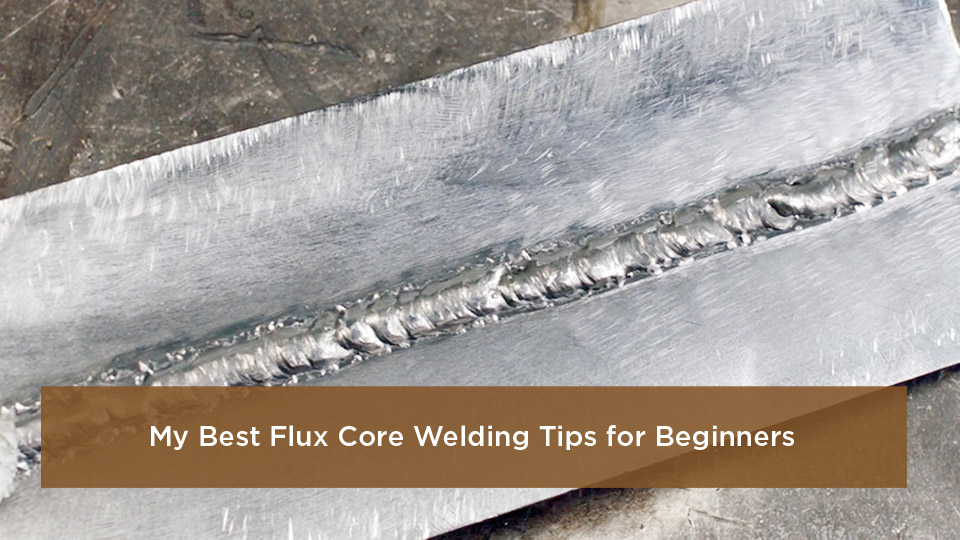
A good practice bead has consistent width, even ripple spacing, smooth tie-in at the toes, and no visible cracks, pinholes, or trapped slag. The back side or cut section may be needed to judge penetration; bead appearance alone cannot prove full fusion.
For critical work, visual inspection is only one part of acceptance. The governing code or procedure may require bend tests, macroetching, magnetic-particle testing, ultrasonic testing, radiography, or other examination.
Pros and Cons of Flux-Cored Wire
Flux-cored wire gives you speed and versatility, but it also creates slag and more fume than many solid-wire setups.
Pros
- High deposition potential: Many wires fill larger joints quickly.
- Outdoor capability: FCAW-S works without external shielding gas.
- Good performance on thicker steel: Suitable wires can provide deep fusion and strong mechanical properties.
- Out-of-position options: Many classifications are designed for vertical and overhead work.
- Portability: Self-shielded setups avoid gas-cylinder handling.
Cons
- Slag removal: Every pass must be cleaned before inspection or rewelding.
- Fume and spatter: FCAW can require stronger fume controls and more cleanup.
- Wire cost: Tubular wire often costs more per pound than solid wire.
- Feeding sensitivity: Wrong rolls or excess tension can crush the wire.
- Thin-metal control: Burn-through can be harder to prevent on light sheet.
The benefits often outweigh the drawbacks for heavy-duty and outdoor work. Plan for ventilation, slag removal, wire storage, and practice before the final weld.
Real-World Applications in the USA
Flux-cored wire supports many welding jobs in the United States, from portable repair work to high-output fabrication.
- Construction: Structural steel, beams, columns, connections, and heavy plate when the procedure permits FCAW.
- Shipbuilding: Long welds on plate and assemblies where deposition rate and position capability matter.
- Heavy equipment repair: Field work on buckets, frames, farm equipment, and machinery using an approved repair procedure.
- Railcar and trailer fabrication: Production welding of carbon-steel components.
- DIY projects: Gates, tables, brackets, carts, and noncritical repairs within the welder’s capacity.
- Fabrication shops: Repeatable multipass welds and high-volume production with FCAW-G.
For structural work, the wire, welding procedure, base metal, joint design, preheat, inspection, and welder qualification must meet the governing code and contract documents. Do not substitute a different wire classification because it appears similar.
Common Mistakes and How to Fix Them
Most flux-cored welding problems come from setup, preparation, shielding, or technique. Stop and correct the cause instead of covering a defective bead with another pass.
| Problem | Likely Causes | What to Check |
|---|---|---|
| Porosity or pinholes | Dirty metal, moisture, wind, gas leak, wrong gas, or poor flow | Clean and dry the joint; verify gas, hoses, flow, nozzle, and wind protection |
| Excessive spatter | Wrong polarity, poor voltage/wire-speed balance, long or unstable arc | Confirm polarity and return to the data-sheet starting range |
| Slag inclusions | Poor cleaning, wrong angle, low heat, oversized weave, bad bead placement | Remove slag fully; narrow the weave; improve access and toe tie-in |
| Lack of fusion | Low heat, fast travel, poor joint design, arc aimed at the puddle instead of the joint | Increase heat within limits, slow down, correct bevel and work angle |
| Undercut | High voltage, fast travel, excessive angle, poor pause at the toes | Reduce travel speed or voltage as appropriate and hold the correct angle |
| Burn-through | Too much heat, large wire, slow travel, excessive gap | Reduce heat, increase travel speed, use a smaller wire, or improve fit-up |
| Worm tracks | Gas escaping through solidifying slag, moisture, contamination, or unsuitable parameters | Dry and clean materials; verify wire storage and manufacturer parameter guidance |
| Birdnesting or slipping | Wrong drive roll, excess tension, kinked liner, worn tip, bent gun cable | Match feed components, reduce tension, and inspect the liner and contact tip |
| Warping | Excess heat input or poor weld sequence | Use shorter beads, balanced sequencing, clamps, and cooling time |
A test bead can prevent many problems. Use scrap of the same alloy, thickness, joint type, and position as the real work whenever possible.
Frequently Asked Questions
What’s the difference between flux-cored and solid wire?
Flux-cored wire is tubular and contains fluxing ingredients. Some types shield themselves, while others use external gas. Solid MIG wire requires external shielding gas and normally produces no slag. Flux-cored wire is often chosen for outdoor work, thicker steel, high deposition, or demanding positions; solid wire is often easier on thin, clean steel indoors.
Can I use flux-cored wire in a MIG welder?
Many wire-feed welders can run flux-cored wire, but compatibility is not automatic. Check supported wire diameter, polarity switching, output range, drive-roll type, contact tip, liner, gun rating, and duty cycle. A machine designed only for one polarity or light solid wire may not run the flux-cored product you want.
Is flux-cored welding good for beginners?
Yes, especially for outdoor practice and medium-thickness carbon steel. Beginners must learn to see the puddle through slag and smoke, maintain stickout, and clean between passes. Start on clean scrap in the flat position before attempting vertical, overhead, or critical joints.
What’s the best flux-cored wire for outdoor welding?
A self-shielded wire approved for the base metal, thickness, position, and required mechanical properties is usually the right starting point. E71T-11 is common for general carbon-steel work, but it is not the correct wire for every structural, low-temperature, multipass, or code application.
How do I reduce spatter with flux-cored wire?
Confirm polarity first. Then check voltage, wire-feed speed, stickout, travel angle, metal cleanliness, work-clamp connection, contact-tip condition, and drive-roll tension. For FCAW-G, also check the shielding gas, leaks, nozzle condition, and drafts. Change one variable at a time on scrap.
Can flux-cored wire weld galvanized steel?
Some wires are marketed for coated steel, but zinc fumes and weld defects remain serious concerns. Identify the coating, remove it from the weld area when the procedure requires, provide effective ventilation, and follow OSHA and manufacturer controls. Never treat galvanized steel as ordinary clean mild steel.
Do I push or pull flux-cored wire?
Use a drag, or pull, technique for most slag-forming flux-cored wires. A 5- to 15-degree travel angle is a common starting point. Follow the wire procedure when it specifies a different technique, especially for a particular position or joint.
Conclusion
Flux-cored wire is most useful when you need strong, productive welds on thicker steel, outdoor jobs, or repairs that cannot be done in perfect shop conditions. Choose self-shielded wire for portable field work and a suitable gas-shielded wire for controlled production welding.
Before the next project, identify the metal and coating, match the wire classification to the job, confirm polarity and feed components, and run a test bead on matching scrap. The right wire and setup can improve productivity, but safe preparation and an approved procedure matter more than bead appearance alone.
Sources
- Miller — Flux-Cored Welding: The Basics for Mild Steel — setup, stickout, gun angle, and basic technique
- Hobart Brothers — Common Questions About Filler Metals — FCAW-S/FCAW-G differences and polarity cautions
- Lincoln Electric — Flux-Cored Electrode Usability Designators — classification and operating characteristics
- Hobart Brothers — Fabshield 21B E71T-11 Data — example diameters, positions, and applications for one E71T-11 product
- OSHA 29 CFR 1910.252 — fire prevention, eye protection, ventilation, and coated-metal requirements
- OSHA — Controlling Hazardous Fume and Gases During Welding — welding-fume hazards and exposure controls