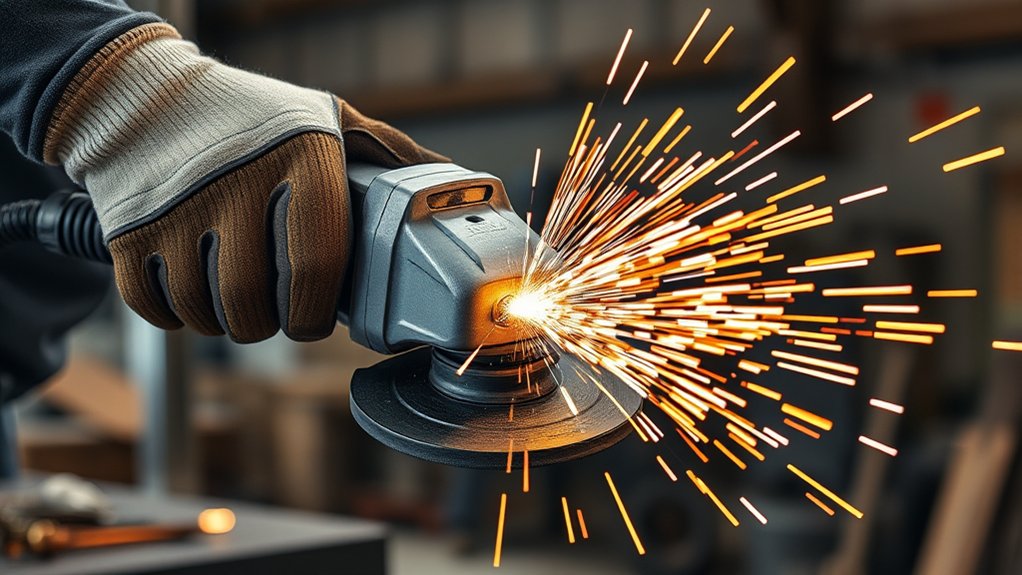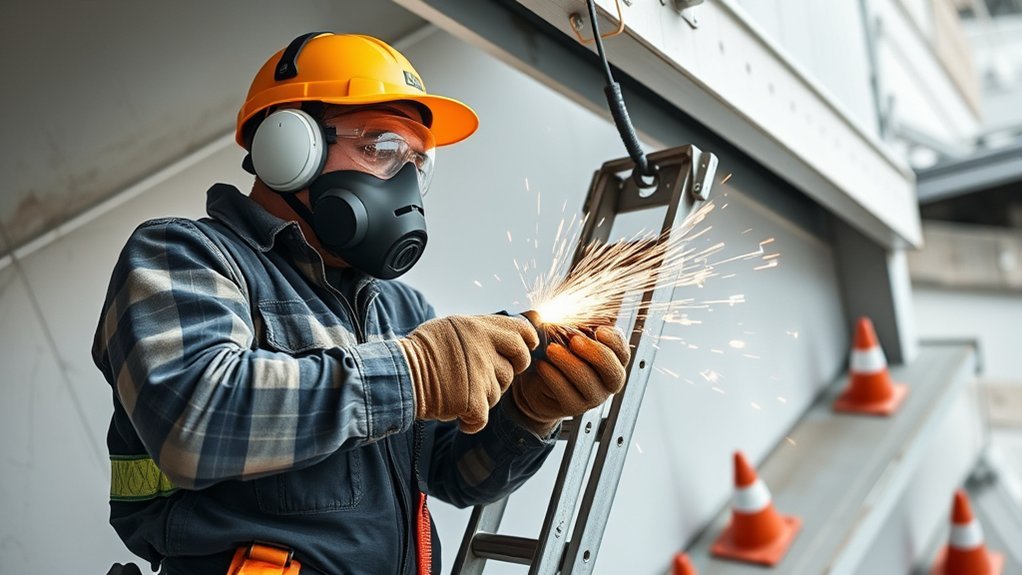
To prevent angle grinder kickback, stop the wheel from binding in the first place: use the correct wheel and guard, clamp and support the work so the cut stays open, keep a cut-off wheel straight, and hold the grinder with both hands while standing outside its likely recoil path. If the wheel binds, switch off the tool, hold it still, and wait for a complete stop before removing it from the cut.
Last updated: July 22, 2026. Safety guidance and source links were rechecked against current OSHA, CCOHS, manufacturer, and government safety information.
Quick Answer
Angle grinder kickback happens when a rotating wheel is pinched, snagged, twisted, or suddenly stalled and the tool is driven opposite the wheel’s motion at the bind point. Reduce the risk by matching the wheel and guard to the job, supporting the work so the kerf stays open, gripping both handles, avoiding side pressure, and keeping your body outside the likely kickback path. If the wheel binds, switch off and wait for it to stop before pulling it free.
Key Takeaways
- Kickback starts when the wheel is pinched, snagged, stalled, or twisted.
- Use only a wheel, guard, flange, and backing pad approved for the grinder and the job.
- Grinding and cutting need different angles: use a shallow angle for surface grinding, but keep a cut-off wheel straight in the cut.
- Secure and support the workpiece so the cut stays open instead of closing on the wheel.
- Use both hands, the auxiliary handle, proper PPE, and a body position outside the wheel’s plane and likely recoil path.
At a Glance
| Time Required | About 2–5 minutes for the pre-use safety check |
| Difficulty | Intermediate; hands-on training is recommended |
| Tools Needed | Angle grinder, auxiliary handle, correct guard, compatible wheel, mounting hardware, clamps, and task-specific PPE |
| Stop Immediately If | The wheel binds, wobbles, rubs the guard, cracks, vibrates unusually, or the grinder loses speed or control |
Warning: This is general safety guidance, not a substitute for the grinder and accessory manuals, workplace training, or local rules. Do not use a grinder with a missing or damaged guard, a loose handle, a damaged wheel, or an accessory that is not rated for the tool’s maximum speed.
What Is Kickback on an Angle Grinder and Why Does It Happen?
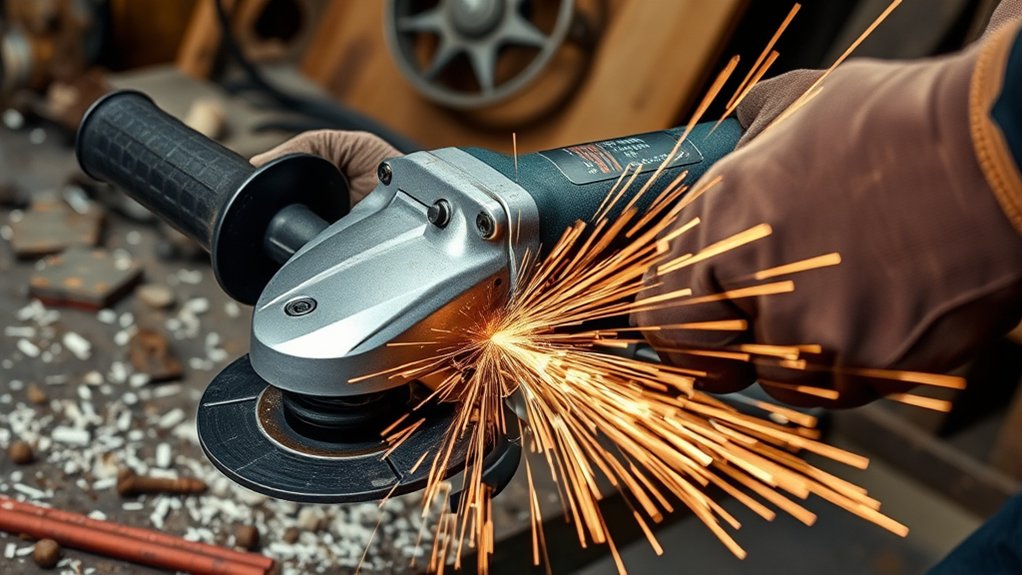
Kickback is a sudden reaction to a pinched or snagged rotating wheel, backing pad, brush, or other accessory. The bind rapidly slows or stalls the accessory, and the grinder is forced in the opposite direction of the wheel’s movement at that point. The tool may jump toward or away from the operator. This matches the kickback definition and precautions in the Makita XAG25 instruction manual.
Kickback can also break an abrasive wheel. That is why wheel choice, mounting, guard position, body position, and workpiece support all matter. Manufacturer warnings describe kickback as a result of misuse, incorrect procedures, or unsafe conditions that can often be reduced with proper precautions.
The safest place to stand is outside the plane of the wheel and outside the path the grinder would travel if the wheel snagged.
Identifying and Avoiding Common Causes of Kickback
Kickback usually has a mechanical cause. Look for the condition that can pinch, snag, twist, or overload the wheel.
- The cut closes on the wheel: Unsupported stock, pipe, sheet, or offcuts can move and pinch a cut-off disc.
- The disc is twisted or side-loaded: Changing the angle during a cut can bind or crack a thin cut-off wheel.
- The wrong accessory is fitted: A wheel with the wrong size, speed rating, arbor, guard, flange, or intended use may be difficult to control.
- The wheel is damaged or worn out: Cracks, chips, warping, heavy wear, wobble, or unusual vibration are reasons to stop and replace the accessory.
- The operator forces the tool: Excess pressure, deep cuts, and rushing corners increase the chance of binding.
- The wheel catches an edge: Corners, sharp edges, welds, and slots can snag the accessory.
- The grinder starts in the cut: A cut-off wheel can bind, walk up, or kick back if the tool is started while the wheel is trapped in the kerf.
- The workpiece moves: Hand-held or poorly clamped material can shift into the wheel.
- A blind cut hits a hidden object: A pocket cut can contact wiring, pipe, fasteners, or another obstruction and suddenly stop or deflect the wheel.
Pro Tip: Before cutting, picture where each part will move after separation. Place supports so the kerf stays open and the offcut can fall or move without trapping the wheel.
For wheel-mounting details, see how to install a cut-off wheel on an angle grinder.
How Grip and Stance Influence Kickback Risk
A firm two-handed grip gives you the best chance of controlling a torque reaction. Keep one hand on the main grip or housing and the other on the securely installed auxiliary handle. Do not remove the handle for convenience.
Stand with your feet apart, knees slightly bent, and weight balanced. Keep your face and torso out of the wheel’s plane. Position your arms so you can resist the direction the tool would move if the wheel binds. Never place a hand near the rotating accessory or reach across the cutting path.
Keep handles dry and free of oil or grease. Do not overreach, and do not work from a ladder or unstable platform when the reaction force could make you lose balance.
High-risk setup: Do not move to a larger grinder simply to finish faster when the cut requires a ladder, overhead work, or an unstable stance. A 2025 NT WorkSafe safety alert identified a 9-inch grinder, ladder use, overhead cutting, and material sag that may have pinched the disc as key hazards in a severe kickback incident.
Effective Techniques to Prevent Kickback When Grinding and Cutting
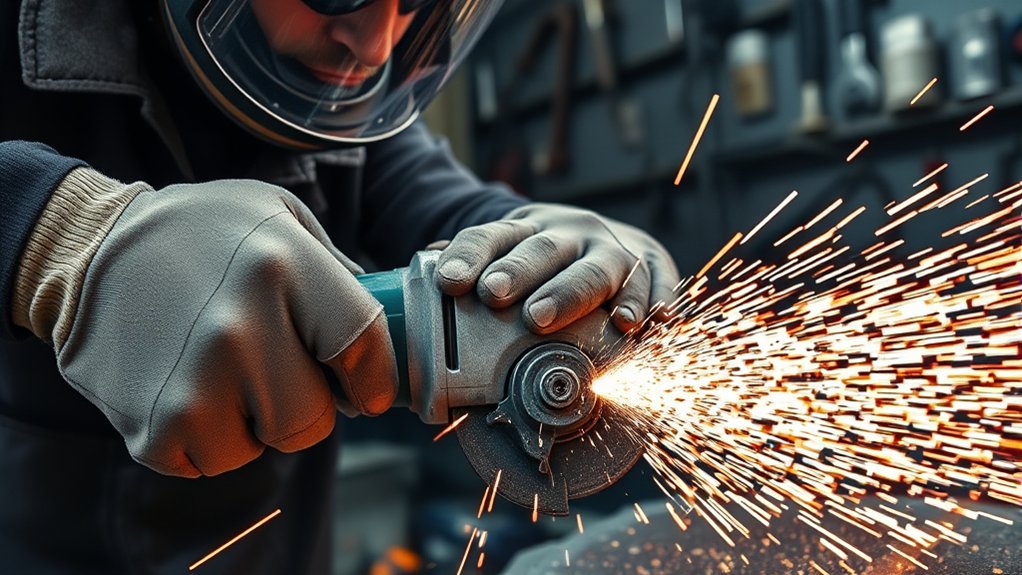
Preventing kickback depends on matching the accessory and technique to the job. Surface grinding and cutting are not the same operation, so they should not use the same wheel angle or guard setup.
Choose the Correct Wheel and Guard
Use only wheel types recommended for your grinder and intended for the material and operation. Check the wheel diameter, thickness, arbor or thread, and maximum revolutions per minute. The wheel’s rated speed must be equal to or higher than the grinder’s maximum rated speed.
Use the guard specified for that accessory. A grinding guard is not automatically suitable for a thin cut-off wheel. Many grinders require a closed or special cut-off guard for abrasive cut-off and diamond wheels. The guard should be securely attached with its closed side between you and the wheel. In covered U.S. workplaces, OSHA 29 CFR 1910.243 requires portable abrasive wheels to be guarded and places the guard between the operator and wheel for right-angle grinders.
Do not fit saw-chain cutters, toothed circular-saw blades, or other unapproved woodcutting blades to an angle grinder. The UK Office for Product Safety and Standards warns that toothed saw-blade attachments create an increased risk of kickback, loss of control, serious injury, or death. Use only attachments recommended by the grinder manufacturer. See the official product safety alert.
For a wider accessory comparison, see angle grinder wheel types, uses, and safety rules.
Inspect and Mount the Wheel Correctly
- Disconnect the plug or remove the battery before changing accessories.
- Inspect the wheel for cracks, chips, warping, water damage, heavy wear, or an expired date where one is marked.
- Clean the flange and mounting surfaces. Use the correct inner flange, lock nut, backing pad, and blotters where the manufacturer requires them.
- Make sure the wheel sits flat and fits the spindle or locating flange without force. Never enlarge an arbor hole.
- Tighten the hardware only as directed. Overtightening can damage the wheel or mounting parts.
- Install the auxiliary handle and position the guard before reconnecting power.
- Stand away from the wheel’s plane and run a newly mounted wheel at no-load speed in a safe area for the time required by the grinder or wheel instructions. CCOHS advises one minute for a newly mounted wheel. Stop if there is wobble, rough running, unusual noise, or vibration.
Maintain Controlled Pressure
Let the grinder and wheel do the work. Use light, steady pressure instead of forcing the tool. Heavy pressure can load the wheel, increase heat, slow the motor, and make binding more likely.
Avoid bouncing the wheel into corners or sharp edges. Approach carefully, keep the tool stable, and stop if the wheel begins to chatter or the motor speed drops sharply.
Use the Correct Angle for Grinding and Cutting
For surface grinding with a right-angle grinder, CCOHS gives a working angle of 5–15 degrees, while the cited Makita manual shows about 15 degrees for its documented grinding setup. Treat these as accessory-specific instructions, not a universal angle for every wheel. Follow the grinder and wheel manuals because flap discs, sanding discs, and specialty wheels may require another angle.
For abrasive cut-off or diamond cutting, keep the wheel in the plane of the cut, generally perpendicular to the work surface. Do not twist the grinder, change the wheel angle, or apply side pressure. Let the wheel reach full speed before entering the cut, and never restart while the wheel is trapped in the kerf.
| Operation | Correct Setup | Working Angle | Avoid |
|---|---|---|---|
| Surface grinding | Approved grinding wheel or flap disc with the specified grinding guard | Follow the wheel and tool manual; 5–15° is common for right-angle surface grinding | Digging in the wheel edge, bouncing, or excessive pressure |
| Cutting | Approved cut-off or diamond wheel with the specified cut-off guard | Straight in the cut; generally 90° to the work surface | Side pressure, twisting, deep forced cuts, or restarting in the kerf |
| Fiber-disc sanding | Compatible fiber disc, backing pad, and guard as required by the manual | Follow the disc and backing-pad instructions | Using a fiber disc as a cut-off wheel |
What Should You Do If the Wheel Binds?
If a cut-off wheel binds or the cut must be interrupted, do not pull the spinning wheel out of the kerf. A moving wheel can climb out, break, or drive the grinder toward you.
- Release the switch or turn the grinder off while keeping both hands on the tool.
- Hold the grinder motionless until the wheel stops completely.
- Disconnect the plug or remove the battery before checking the wheel, cut, supports, or workpiece.
- Correct the cause of the bind. Restart outside the cut, let the wheel reach full speed, and carefully re-enter only if the wheel and setup remain safe.
Support the Workpiece to Keep the Cut Open
Clamp the workpiece to a stable surface whenever possible. Support panels, pipe, bar, and sheet near the cut so they do not sag and pinch the wheel. The support pattern depends on which part will remain and which part will become the offcut.
Keep both sides of the cut stable, but do not place supports in a way that forces the kerf closed. For hollow or round material, prevent rolling. Before a blind or pocket cut, check for electrical wiring, gas lines, water pipes, fasteners, and other hidden objects. Keep the cord, hose, and battery away from sparks, sharp edges, and the wheel.
Note: Sparks and hot metal can start fires. Remove flammable materials, control combustible dust, direct sparks away from people and property, and follow hot-work permit and fire-watch rules where they apply.
When Should You Choose a Different Tool?
Do not force an angle grinder into a setup that defeats its safety features. Choose another cutting method, reposition the work, or obtain trained help when:
- The cut requires removing or defeating the guard.
- You cannot clamp or support the material so it stays stable and the kerf remains open.
- You would need to stand on a ladder, work above shoulder height, or overreach.
- The cut is blind and you cannot rule out wiring, pipe, gas lines, or another hidden obstruction.
- The wheel or accessory is not specifically approved for the grinder, material, and operation.
- A larger grinder would add power, torque, and weight without giving you a stable working position.
Risk reduction starts with tool selection. A saw, chop saw, band saw, nibbler, reciprocating saw, or purpose-built cutting tool may give better support and control for some tasks.
Kickback Risks From Incorrect Disc Types
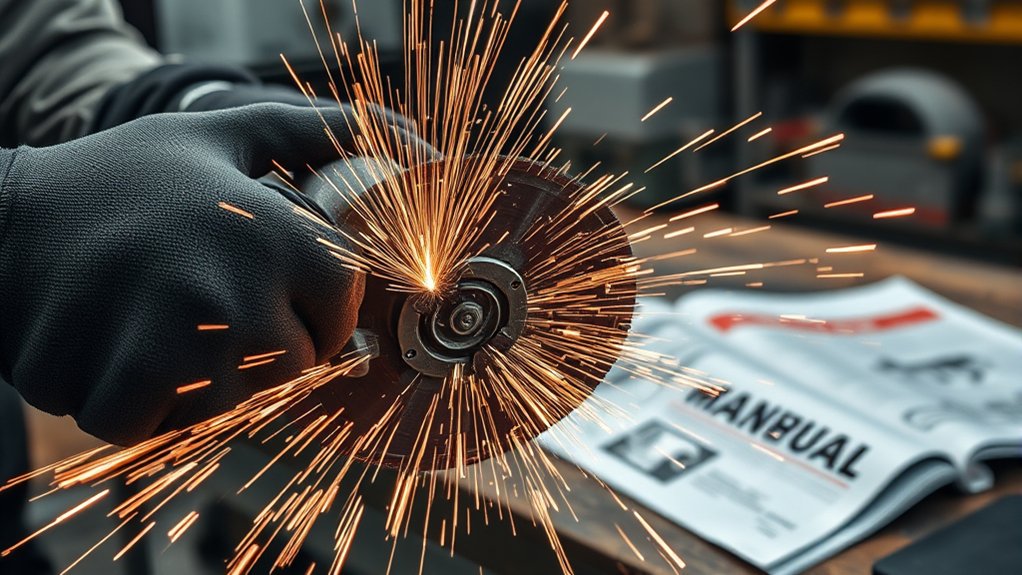
The safe choice is not “hard disc versus fiber disc.” Each accessory has a specific purpose. A bonded grinding wheel is for approved grinding surfaces. A thin cut-off wheel is for edge cutting only. A fiber disc is a sanding or stock-removal accessory used with the correct backing pad. A wire brush and a diamond wheel also need their own compatible setup.
Never grind on the side of a cut-off wheel. Side force can crack the wheel and can also twist it into the cut. Do not use an accessory simply because it fits on the spindle. It must also match the tool’s speed, size, mounting system, guard, and intended operation. For cutting-wheel selection and thickness guidance, see the angle grinder cut-off wheel guide.
- Wrong speed rating: The accessory may break if it runs faster than its rated speed.
- Wrong diameter or thickness: The guard may not cover the wheel correctly, and the tool may be harder to control.
- Wrong arbor or flange: The wheel can run off-center, vibrate, or loosen.
- Wrong guard: A broken wheel or stream of debris may not be directed away from the operator.
- Wrong application: Side-grinding with a cut-off disc or cutting with a sanding disc can cause failure and loss of control.
Kickback Control and Other Safety Features
Some newer grinders include electronic kickback control, a brake, restart protection, a paddle or constant-pressure switch, and drop control. These features can reduce risk in certain events, but they do not make poor technique safe.
Kickback control may respond when a wheel is forcibly stopped, yet it may not activate for every twist, snag, or side-load. Bosch states that its system can engage when a cutting wheel is pinched, but may not engage when the wheel is twisted or canted; the wheel must be forcibly stopped for activation. A brake can shorten coast-down time, but you must still hold the grinder until the wheel stops. See Bosch’s explanation of angle grinder protection technology.
Products Worth Considering

Brushless motor of the angle grinder requires no brush changes.

COMPACT POWERHOUSE: The highly efficient brushless motor delivers the equivalent of 8 amps of corded power and a potent 11,000 RPM, providing maximum productivity and an outstanding power-to-weight ratio for a variety of light grinding and cutting tasks.

POWERFUL 11-AMP MOTOR: Delivers 11,000 rpm in a compact design
Responding to Kickback Incidents
If the grinder kicks, keep both hands on the tool and resist the reaction without reaching toward the wheel. Switch the tool off or release the control if you can do so without losing your grip. Do not drop the grinder or step into the wheel’s path. Hold it away from your body and the work until the wheel stops completely.
Immediate Safety Measures
- Stop the tool and wait for the accessory to come to a complete stop.
- Disconnect the plug or remove the battery before touching the wheel or workpiece.
- Check yourself and nearby people for injuries. Follow the site emergency plan and seek urgent medical help for serious bleeding, eye injury, or any other severe injury.
- Inspect the wheel, guard, handle, flanges, spindle, switch, cord or battery, and work support.
- Remove a damaged wheel or tool from service. Do not restart the same cut until the cause of the bind is found and corrected.
Report and Document the Incident
At work, report kickback, wheel damage, and near misses to the supervisor or safety lead. Record the tool model, accessory type, material, task, guard and support setup, and what happened immediately before the bind.
Incident records can reveal repeated equipment, accessory, work-support, or training problems. Correct those causes before the grinder returns to service.
Essential Safety Gear for Angle Grinder Work
PPE does not prevent the wheel from binding, but it can reduce the harm caused by sparks, fragments, dust, noise, and hot metal.
- Eye and face protection: Wear safety glasses or goggles. Add a face shield when flying particles or wheel fragments are possible; a face shield does not replace primary eye protection.
- Hearing protection: Use protection suited to the measured or expected noise level.
- Respiratory protection: Use dust control, ventilation, and the correct respirator when the material or process creates hazardous dust or fumes.
- Hands and body: Wear task-appropriate, close-fitting gloves and nonflammable work clothing where required. Avoid loose cloth gloves, loose sleeves, jewelry, and anything that can catch in moving parts.
- Foot and head protection: Wear protective, slip-resistant footwear. Use a hard hat only when overhead or impact hazards and site rules require it.
Keep bystanders outside the work area. Anyone who must enter should wear appropriate protection. For task-by-task selection guidance, see the angle grinder PPE guide.
Products Worth Considering

SUPERIOR PROTECTION — Experience all-around face protection thanks to the curved design of this faceshield. The visor of this face guard is ANSI Z87+ certified, and up to 2x thicker for increased durability. Plus, you can comfortably wear your grinding face shield over prescription glasses.

Included: (1) DeWalt N441218 Angle Grinder Guard Replacement for Angle Grinder DCG414B

HIGH IMPACT FACE SHIELD - Sellstrom's Advantage Face Shield is ideal for various types of machinery, welding, cutting, grinding, woodworking, and other types of work that present potential hazards to the face
Importance of Proper Tool Maintenance in Reducing Kickback
Inspect the grinder before every use. Check the guard, auxiliary handle, switch, spindle, flanges, mounting system, power cord or battery, and air vents. A grinder that runs roughly, vibrates, smells hot, has a damaged guard, or has a switch problem should be removed from service.
Clean the air vents as the manufacturer directs. Built-up metal dust can contribute to overheating and electrical hazards. Replace damaged accessories rather than trying to straighten, repair, or modify them. Repairs should be completed by qualified personnel using approved parts. After every cut or grinding pass, keep control of the tool until the wheel stops completely before setting it down.
Keep the work area clear and dry. Good lighting, stable footing, and enough room to move make it easier to control the grinder if the wheel meets resistance.
Pre-Use Angle Grinder Kickback Checklist
- The grinder and accessory manuals allow the planned operation, and a safer purpose-built tool is not more appropriate.
- The wheel type, diameter, thickness, arbor, and RPM rating match the grinder.
- The correct guard is installed, locked, and positioned between you and the wheel.
- The auxiliary handle is installed securely.
- The wheel has no cracks, chips, warping, heavy wear, or expired marking.
- The flanges, nut, backing pad, and mounting surfaces are correct and clean.
- A newly mounted wheel has completed the no-load test required by the grinder or wheel instructions.
- The workpiece is clamped and supported so the cut will not close.
- The wheel path, spark path, bystanders, cord, hose, and flammables are controlled.
- You can use a balanced stance with both hands and stay out of the kickback path.
- Eye protection and all other task-specific PPE are in place.
Frequently Asked Questions
What causes angle grinder kickback?
Kickback happens when the rotating accessory is pinched, snagged, twisted, or rapidly stalled. Common triggers include a closing kerf, side pressure on a cut-off wheel, catching a corner, forcing the tool, starting in the cut, an unstable workpiece, or an incorrect accessory setup.
How do you prevent angle grinder kickback?
Use the correct wheel and guard, inspect and mount the accessory correctly, secure and support the work, keep both hands on the grinder, avoid excess pressure, and keep your body outside the likely recoil path. Keep a cut-off wheel straight and never side-load it.
What is a kickback-control grinder?
It is an angle grinder with electronics designed to detect certain sudden binding or stall conditions and shut down the motor. The feature can reduce risk, but it may not respond to every twist or snag and does not replace safe technique, guards, or PPE.
What injuries can an angle grinder cause?
Possible injuries include cuts, punctures, eye injuries, burns, impact injuries from wheel fragments, hearing damage, electric shock, and harmful dust exposure. The exact risk depends on the accessory, material, work area, and protective measures.
Should an angle grinder be held at 15 degrees or 90 degrees?
It depends on the operation. A depressed-center wheel used for surface grinding is commonly held at a shallow angle, often about 5–15 degrees. A cut-off or diamond wheel should stay straight in the cut, generally perpendicular to the work surface, without twisting or side pressure.
Can you use a cutting disc for grinding?
No. Thin cut-off wheels are designed for edge cutting, not side grinding. Side force can damage or break the wheel. Use a wheel made for grinding and the guard specified for that operation.
What should you do after angle grinder kickback?
Switch off the grinder while maintaining control, wait for the wheel to stop, disconnect power, check for injuries, and inspect the entire setup. Do not restart until you know why the wheel bound and have corrected the cause.
What should you do if an angle grinder wheel binds in a cut?
Release the switch or turn the grinder off, keep both hands on the tool, and hold it motionless until the wheel stops. Disconnect power before inspecting the wheel and workpiece. Correct the support, alignment, or accessory problem before restarting outside the cut and carefully re-entering at full speed.
Conclusion
Angle grinder kickback is serious, but many causes are preventable. Before each use, complete the checklist: confirm the wheel and guard, inspect the mounting system, support the work so the kerf stays open, and plan a stable two-handed stance outside the recoil path. During the job, stop immediately if the grinder binds, vibrates, slows sharply, or feels unstable. Let the wheel stop, disconnect power, and correct the cause before continuing.
Sources
- OSHA 29 CFR 1910.243 — Guarding of Portable Powered Tools — guard position, wheel inspection, mounting, and speed requirements.
- CCOHS — Use of Portable Grinders — two-handed control, workpiece security, PPE, grinder angle, and general operating precautions.
- CCOHS — Use of Grinder Attachments — cutting-disc inspection, mounting, guards, pressure, and side-load warnings.
- Makita XAG25 Instruction Manual — manufacturer kickback definition, body position, wheel selection, cutting technique, and guard guidance.
- Bosch Professional — Angle Grinder Protection Technology — capabilities and limits of kickback control, brakes, restart protection, and guard types.
- NT WorkSafe — 9-Inch Angle Grinder Kickback Safety Alert — larger-grinder control, stable footing, work support, and alternative-tool assessment.
- UK Office for Product Safety and Standards — Toothed Saw Blade Attachments — official warning against toothed and chainsaw-style attachments on angle grinders.