If your welding arc keeps going out, start with the simple causes first: a loose work clamp, dirty metal, worn consumables, poor cable connections, low input power, wrong polarity, or technique that keeps the arc too long. A stable arc needs a clean current path, correct settings, dry consumables, and steady movement. Work through the checks below before you blame the welder itself.
Quick Answer
A welding arc usually keeps going out because the work clamp has poor contact, the metal is dirty, the amperage or voltage is too low, the electrode or wire is wrong for the job, the contact tip or liner is worn, or the machine is losing power. Check the work lead, cables, consumables, settings, and technique in that order.
Key Takeaways
- Most arc outages come from poor contact, dirty metal, worn consumables, weak input power, or incorrect settings.
- The clamp on the workpiece is the work clamp or current return lead, not the same thing as the machine safety ground.
- For MIG welding, check the contact tip, wire feed, drive roll tension, liner, polarity, and shielding gas.
- For stick welding, check rod type, rod condition, polarity, amperage, arc length, and electrode angle.
- Stop using the welder if cables are damaged, the machine is wet, breakers keep tripping, or you suspect an internal electrical fault.
At a Glance
| Time Required | 10 to 30 minutes for basic checks; longer if the machine needs repair |
| Difficulty | Beginner to intermediate |
| Tools Needed | Wire brush, clean rag, pliers, replacement contact tips or rods, clamp, multimeter if trained to use one, and the welder manual |
| Cost | Usually $0 to $25 for cleaning and consumables; more if cables, torch parts, or machine repair are needed |
Warning: Turn off and unplug the welder before inspecting cables, internal parts, or the wire-feed path. Do not use a welder with damaged insulation, exposed conductors, wet equipment, repeated breaker trips, or signs of overheating. OSHA says damaged welding cables must be replaced and wet machines must be dried and tested before use. Keep combustibles away from the work area, use proper PPE, and ventilate welding fumes.
How to Diagnose and Fix an Erratic Welding Arc
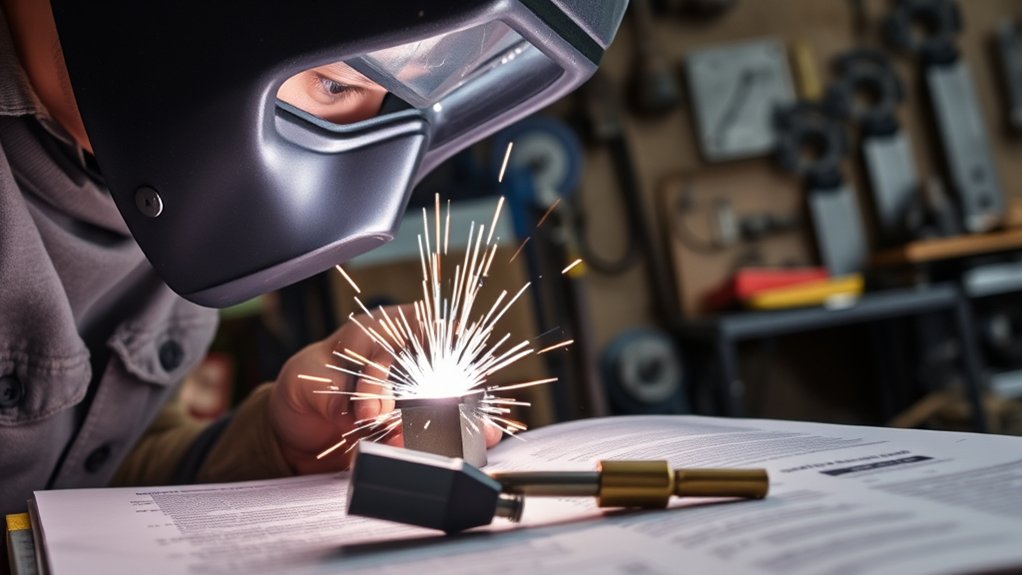
Use this order when your arc starts, flickers, and then dies. It keeps you from changing machine settings before you fix a basic contact problem.
| Check | What to Look For | Fix |
|---|---|---|
| Work clamp | Clamp on paint, rust, scale, a dirty table, or a loose part | Clamp directly to clean bare metal on the workpiece or a bonded fixture |
| Cables and plugs | Loose lugs, hot plugs, cracked insulation, corroded terminals | Tighten safe external connections and replace damaged leads |
| Base metal | Paint, mill scale, oil, grease, moisture, heavy rust | Clean the joint and clamp area before welding |
| Consumables | Wrong rod, damp rod, worn contact tip, wrong tip size, rusty wire | Use dry rods, clean wire, and a tip that matches the wire size |
| Settings | Low amperage, wrong voltage, wrong wire speed, wrong polarity | Return to the chart inside the welder door or the rod package |
| Technique | Arc too long, fast travel, steep angle, poor stickout | Shorten the arc, steady your hand, and slow down slightly |
For MIG welding, also confirm the wire feed mechanism is feeding smoothly. A slipping drive roll, clogged liner, worn contact tip, or bird-nested wire can make the arc stop even when the machine still powers on.
Pro Tip: Clean both the weld joint and the clamp spot. A shiny joint will not help much if the work clamp is still biting through paint, rust, or a dirty table.
Products Worth Considering


Amp & Jaw Capacity: Rated 400A with 2.01 inch jaw opening, providing a strong grip on thick plates and reliable grounding stability.

【Good Conductivity】The welding ground clamp is made of quality copper, which has good electrical conductivity and is not easy to break.
Power Supply Issues That Make the Arc Go Out
Power problems can make a welder act like it has a bad arc when the real issue is weak input power. A long, undersized extension cord can cause voltage drop. A shared circuit can sag when another tool starts. A breaker that trips under load can stop the weld in the middle of a bead.
Before welding, check that the welder is plugged into the correct input voltage, the circuit can handle the machine, and the extension cord matches the manual. OSHA’s arc welding standard says the rated current-carrying capacity of conductors for individual welding machines must not be less than the rated primary current of the machines. It also requires proper disconnect and overcurrent protection for portable welding outlets. You can review the safety language in OSHA 1910.254.
| Issue | How It Shows Up | What to Do |
|---|---|---|
| Low input voltage | Weak arc, hard starts, poor penetration | Use the correct outlet and avoid overloaded circuits |
| Undersized extension cord | Arc fades when load increases | Use a shorter, heavier cord rated for the welder |
| Exceeded duty cycle | Machine stops after several minutes | Let the welder cool and reduce continuous weld time |
| Faulty breaker or outlet | Frequent trips, heat, buzzing, or power loss | Stop welding and have the circuit checked by a qualified person |
Work Clamp and Return Lead Checks
A poor return path is one of the most common reasons an arc keeps stopping. The clamp should bite into clean metal and the work lead should be tight at both ends. Do not rely on a painted welding table, rusty fixture, loose hinge, or bearing path to carry welding current.
The clamp attached to the work is often called a ground clamp, but the more accurate troubleshooting term is work clamp or current return lead. TWI notes that the current return lead is clamped to the workpiece and is often wrongly called the earth lead. That distinction matters because the machine frame safety ground is a separate safety issue.
- Attach the work clamp directly to the workpiece when possible.
- Clamp as close to the weld area as practical without putting the clamp in the heat zone.
- Remove paint, primer, rust, heavy scale, oil, and spatter from the clamp spot.
- Check the clamp spring, copper jaws, cable lug, and lead connection.
- Do not use chains, wire ropes, cranes, hoists, elevators, or conduits as the welding current path.
OSHA says all ground connections must be checked to confirm they are mechanically strong and electrically adequate for the required current. It also says the work lead must be firmly attached to the work and magnetic work clamps should be cleaned of metal particles on contact surfaces.
Products Worth Considering
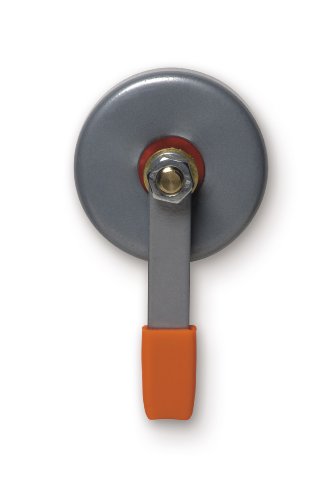
Allows you to ground your work piece with ease.

Value Pack: The package includes 24 packs of butt welding clamps, enough quantity to meet your daily needs and replacements. Each butt welding clamps is individually wrapped in a small bag, convenient to carry and use.

19 feet 5 AWG Ground Cable 10-25 Ground Clamp for Lotos Plasma Cutter LTP7000 LTP8000 TIG Welder TIG200 TIG200DC
Maintenance Tips to Prevent Arc Outages
Maintenance keeps the arc stable because most small electrical problems grow slowly. A loose lug, dirty liner, worn tip, or weak clamp may work for a few seconds, then fail once the weld heats up.
| Maintenance Task | Frequency | Why It Helps |
|---|---|---|
| Clean the work clamp jaws | Before each session | Improves current flow and reduces arc dropouts |
| Inspect cables and plugs | Before each session | Finds cracked insulation, loose lugs, and hot spots early |
| Replace worn contact tips | As needed | Keeps MIG wire in steady electrical contact |
| Clean the MIG nozzle and liner | Weekly or when feed feels rough | Prevents wire feed pauses that make the arc stop |
| Store stick electrodes dry | Always | Reduces hard starts, porosity, and hydrogen-related problems |
For MIG welding, keep the drive rolls clean and set the tension only high enough to feed the wire smoothly. Too little tension slips. Too much tension can deform the wire and increase liner drag. Also make sure your gas flow is steady, since poor shielding can create porosity and make the arc sound harsh or unstable.
Adjusting Your Welding Technique
If the machine, cables, clamp, and consumables check out, look at your technique. A long arc is one of the easiest ways to make a stick weld sputter and die. A fast travel speed can outrun the puddle. A poor angle can push the arc away from the joint.
- Keep stick arc length short: A common starting point is about the diameter of the electrode core wire, often near 1/16 to 1/8 inch for common rods.
- Use steady travel speed: Move slowly enough for the puddle to wet into both sides of the joint.
- Hold a consistent angle: Do not let the rod or gun wander as your wrist gets tired.
- Watch stickout on MIG: Too much contact-tip-to-work distance can make the arc sputter and reduce heat at the joint.
- Match heat to the job: Low amperage or voltage can make the arc weak, while too much heat can cause burn-through and spatter.
A stable arc is not just a machine setting. It is the result of clean metal, a solid return path, correct consumables, proper power, and a steady hand working together.
Stick Welding Arc Keeps Going Out
With stick welding, the most common causes are a long arc, low amperage, damp rods, wrong polarity, dirty base metal, or a loose electrode holder. Start by checking the rod package for the recommended amperage and polarity. Then clean the joint and clamp area.
Do not coat welding rods with WD-40 or oil before welding. Store rods dry instead. TWI explains that electrode flux coating should not be chipped, cracked, or allowed to become damp, and that drying requirements depend on electrode type. Low-hydrogen rods such as many 7018 electrodes need more careful storage than general-purpose rods.
| Symptom | Likely Cause | Fix |
|---|---|---|
| Rod sticks often | Amperage too low or arc too short | Raise amps in small steps and restart with a light scratch or tap |
| Arc wanders or blows sideways | Magnetism, clamp placement, or long arc | Move the work clamp, shorten the arc, or change weld direction |
| Hard starts and porosity | Damp rods or dirty metal | Use dry electrodes and clean the joint |
| Arc will not stay lit | Wrong rod for AC/DC or wrong polarity | Match the rod to the machine output and polarity |
MIG Welding Arc Starts Then Stops
With MIG welding, an arc that starts then stops usually points to wire feed, contact tip, work clamp, polarity, or input power. If the wire keeps feeding but the arc dies, check the work clamp and contact tip first. If the wire stops too, inspect the drive rolls, liner, spool tension, and gun lead.
- Contact tip: Replace it if the hole is worn, burned, clogged, or the wrong size for the wire.
- Drive rolls: Match the groove to the wire type and size. Do not overtighten.
- Liner: Blow out or replace a dirty liner if wire feed feels rough.
- Polarity: Solid wire with shielding gas commonly uses DCEP, while many flux-core wires use DCEN. Always check the wire label.
- Gas: Wind, blocked nozzle, low gas, or too much gas turbulence can make the arc harsh and the weld porous.
If your MIG welder wire feeds but no arc forms, do not keep pulling the trigger. Stop and check the work lead, trigger circuit, contact tip, gun connection, and output studs before you waste wire or overheat the machine.
TIG Welding Arc Keeps Cutting Out
For TIG welding, arc outages often come from poor work clamp contact, contaminated tungsten, wrong tungsten size, poor gas coverage, a loose torch part, or foot-pedal and torch-switch problems. Clean the tungsten, tighten the collet body and back cap, and make sure the work clamp is on clean metal.
- Use the correct tungsten type and diameter for the amperage range.
- Grind the tungsten clean if it touches the puddle or filler rod.
- Check gas flow, cup size, and drafts around the weld area.
- Inspect the torch cable, pedal cable, and remote-control plug.
- Confirm AC/DC mode and polarity match the material.
Note: Welding fumes can contain metal particles. CDC/NIOSH notes that welding fumes may contain manganese and that exposure can vary by wire, rods, flux, base metal, and confined-space conditions. Use ventilation and respiratory protection appropriate for the job.
The Role of Electrode Compatibility in Arc Stability
Electrode compatibility affects arc stability because each rod or wire is built for a certain current type, polarity, material, position, and amperage range. If those do not match, the arc can become weak, loud, hard to start, or easy to lose.
Electrode Type Selection
Choose the electrode by the base metal, thickness, position, and machine output. A 6013 rod is often easier for beginners on thinner mild steel. A 7018 rod can produce strong welds, but low-hydrogen rods need better storage and may require specific polarity or an AC-rated version if you use an AC machine.
- Check the package: Follow the manufacturer’s amperage and polarity range.
- Match the material: Do not use a rod or wire just because it fits the holder or gun.
- Use dry consumables: Damp rods and rusty wire can cause porosity, spatter, and poor starts.
- Replace damaged rods: Do not weld with rods that have cracked or missing flux.
Material Compatibility Factors
Dirty, coated, galvanized, painted, or oily metal can make the arc unstable and create unsafe fumes. Remove coatings before welding when safe and appropriate. If you weld galvanized or coated metal, use the right procedure and ventilation because coatings can produce hazardous fumes.
Proper Size Usage
Electrode size should match the material thickness and joint design. A rod that is too large can be hard to control on thin metal. A rod that is too small may not carry enough current for a thick joint. For MIG, wire size, contact tip size, and drive roll groove must all match.
Welding Machine Failures That Cause Arc Issues
Sometimes the setup is correct and the machine is the problem. Internal relays, capacitors, boards, thermal switches, fans, output studs, or rectifiers can fail. Do not open the machine unless you are qualified to service welding equipment. Stored electrical energy can be dangerous even after the machine is turned off.
Common Machine Defects
- Thermal overload: The arc stops after the machine exceeds its duty cycle.
- Bad output connection: Loose output studs or internal lugs cause heat and voltage drop.
- Faulty fan: The machine overheats faster than normal.
- Damaged torch or holder: Internal breaks can make contact intermittent.
- Control-board fault: Output may start and then shut down without a clear external cause.
Electrical Connection Problems
Electrical connection problems are often easier to fix than machine failures. Look for loose cable lugs, corrosion, hot plugs, cracked insulation, damaged torch leads, worn electrode holders, and poor work clamp bite. TWI states that poor electrical connections between electrode, holder, and cable can cause resistance heating and arc instability through voltage fluctuations.
OSHA says workers should report equipment defects or safety hazards, and equipment use should stop until safety has been assured. Repairs should be made only by qualified personnel. That is the right line to follow when the issue appears to be inside the welder.
When to Call in the Pros for Welding Help
Call a qualified welding repair technician or electrician if the arc keeps going out after you have checked the clamp, cables, consumables, settings, and technique. Do not keep welding through repeated electrical faults.
- The breaker trips repeatedly under normal settings.
- The welder, plug, outlet, or cable gets hot.
- You see cracked insulation, exposed conductors, smoke, arcing, or melted connectors.
- The machine was wet or stored in a damp area.
- The fan does not run or the machine shuts off from heat quickly.
- The wire feeds normally but there is no output arc after basic checks.
- You need code-quality welds on a structural, pressure, suspension, frame, or safety-critical part.
Professional help can save time and material, but more importantly, it prevents unsafe guessing around high-current welding equipment.
Frequently Asked Questions
Should welders coat welding rods with WD-40?
No. Do not coat welding rods with WD-40 before welding. Oil or lubricant can contaminate the weld. Keep rods dry, protect the flux coating, and follow the electrode manufacturer’s storage or redrying instructions.
What is the golden rule for keeping a welding arc stable?
Keep the current path clean and the arc length steady. For stick welding, a short arc is usually easier to control. For MIG welding, keep a steady contact-tip-to-work distance and make sure the wire feeds smoothly.
How long do arc welding rods last?
Unopened rods can last a long time when stored dry and protected from damage. Once opened, shelf life depends on the rod type, humidity, and storage method. Low-hydrogen rods need more careful storage than general-purpose rods.
What causes the arc to stop and start during welding?
Common causes include a poor work clamp connection, dirty metal, low amperage or voltage, wrong polarity, worn contact tip, inconsistent wire feed, damp electrodes, loose cable connections, or a machine that is overheating.
Should the work clamp go on the table or the workpiece?
Clamp directly to the workpiece when possible. A welding table can work only when the table, fixture, and workpiece make a clean, tight, bonded current path. Paint, rust, loose contact, or bearings can interrupt the return path.
Why does my MIG wire feed but the arc goes out?
Check the work clamp, contact tip, gun connection, polarity, output lead, and trigger circuit. A worn contact tip or poor work clamp can let wire feed while the electrical circuit fails to maintain a strong arc.
Can a bad extension cord make the arc unstable?
Yes. A long or undersized extension cord can create voltage drop, especially when the welder draws high current. Use the outlet, breaker, and cord size recommended in the welder manual.
Conclusion
When your welding arc keeps going out, do not guess at the machine first. Start with the work clamp, clean metal, cable connections, consumables, and settings. Then check your technique, input power, and process-specific parts such as MIG tips or stick electrodes. If the welder still shuts down, overheats, trips breakers, or shows damaged cables, stop and get qualified help. A stable arc starts with a safe setup and a clean electrical path.
Sources
- OSHA 1910.254, Arc Welding and Cutting — supports work-lead attachment, machine grounding, cable safety, maintenance, and qualified repair guidance.
- OSHA 1910.252, Welding, Cutting, and Brazing General Requirements — supports fire precautions, combustible-material clearance, and fire watch guidance.
- OSHA Welding, Cutting, and Brazing Overview — supports safety and hazard context for welding operations.
- CDC/NIOSH Welding Fumes and Manganese — supports ventilation and welding-fume health guidance.
- TWI, Equipment for Manual Metal Arc Welding — supports work return lead terminology, electrode holder contact, cable voltage drop, and electrode storage guidance.