Disclosure: As an Amazon Associate, we earn from qualifying purchases. If you click a link on this page and make a purchase, we may receive a small commission at no extra cost to you.
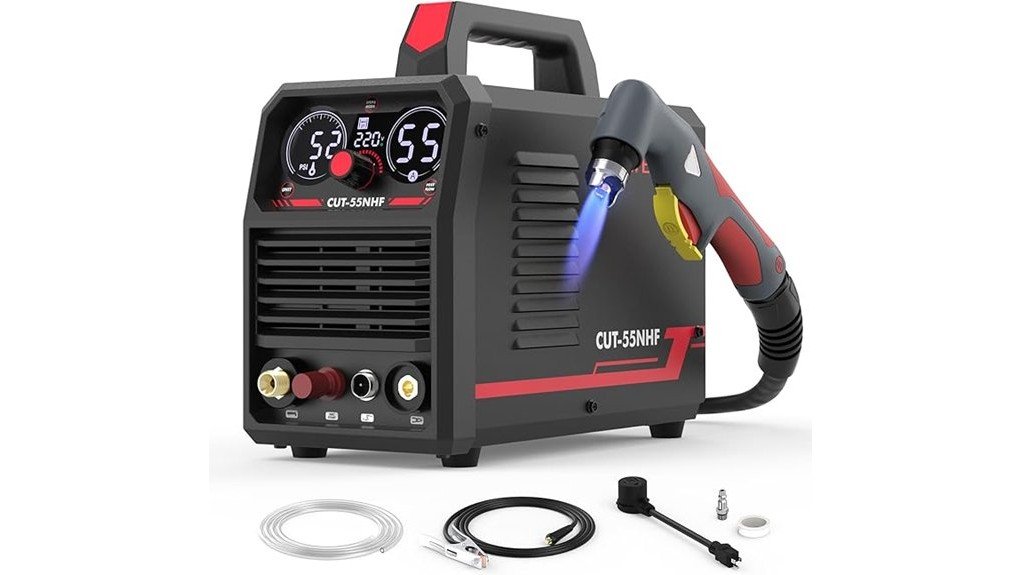
A 55A label does not tell you how a plasma cutter will behave on a household 110V circuit, rusty metal, or a long series of cuts. The YESWELDER CUT-55NHF is aimed at buyers who want dual-voltage flexibility, a non-touch pilot arc, and more headroom than a basic hobby cutter. This review explains where its controls and cutting power help, what air and electrical setup it needs, and which Amazon variant details you should confirm before ordering. Its main strengths are flexible cutting and easier arc starts, while its main limits are reduced performance on 110V and dependence on clean, steady compressed air.
Quick Verdict
Rating: 8.5/10 · Recommended with caveats
Best For: DIY fabrication, automotive repair, exhaust work, and intermittent cutting in a home or small shop
Bottom Line: The YESWELDER CUT-55NHF combines an advertised 55A maximum on 220V with dual-voltage input, non-touch pilot arc starting, and digital controls. It is a practical mid-range cutter when you have the right air supply, but it is not a substitute for a production-grade machine and you should confirm the CUT-55NHF style is selected on Amazon.
| Specification | Detail |
|---|---|
| Brand | YESWELDER |
| Model / Style | CUT-55NHF, confirm this style is selected on the Amazon page |
| Product Type | External-air plasma cutter |
| Advertised Maximum Output | Up to 55A on 220V; lower output on 110V |
| Voltage Support | Dual voltage 110V / 220V |
| Advertised Clean-Cut Capacity | Up to 1/2 inch on 220V under suitable conditions; 110V capacity is lower |
| Arc Start | Non-high-frequency, non-touch pilot arc |
| Display | Digital interface for setup information such as air pressure, input voltage, and current |
| Torch Controls | 2T and 4T trigger modes |
| Cooling Control | Adjustable post-flow timer |
| Compatible Material Type | Conductive metals, including common steel and stainless-steel workpieces |
| Air Requirement | Clean, dry, stable compressed air from an external compressor |
| Best Use | DIY fabrication, brackets, sheet metal, exhaust repair, body-panel removal, and intermittent shop cutting |
| Protection | Overload and overheating protection |
| Main Limitation | Not intended for nonstop industrial production cutting |
What Is the YESWELDER CUT-55NHF Plasma Cutter?
The YESWELDER CUT-55NHF is a dual-voltage air plasma cutter for conductive metal. Its non-touch pilot arc starts without dragging the torch tip on the workpiece, which is useful when you are cutting rusty, painted, expanded, or uneven material. The digital panel also gives you more setup feedback than a basic cutter with only a current knob.
This model sits between small entry-level cutters and larger production machines. It makes the most sense when you cut metal for home projects, vehicle repair, or light fabrication and can give the machine rest between longer jobs. You still need an external compressor, a suitable electrical circuit, a clean work-clamp connection, and safe ventilation.
Before You Buy: Amazon pages can group more than one cutter style under one listing. Confirm that the selected option says CUT-55NHF and matches the advertised 55A, dual-voltage, non-touch pilot arc configuration before you place the order.
Cutting Performance and Power Output
The CUT-55NHF is marketed around a maximum 55A output on 220V. That is the setting to use when you need its strongest cutting performance or want to approach the advertised 1/2-inch clean-cut capacity. Actual results still depend on metal type, air quality, consumable condition, torch angle, and travel speed.
On 110V, the cutter runs at reduced output and has less thickness headroom. That can still be useful for sheet metal, brackets, exhaust tubing, and lighter repair work, but you should not expect the same speed or edge quality that you get on 220V. Also distinguish a clean cut from a severance cut: a machine may separate thicker metal than it can cut neatly.
Pilot Arc Performance on Dirty or Rusted Metal
The non-touch pilot arc is one of the strongest reasons to choose this model over a contact-start cutter. It can establish the arc without pressing the tip against the surface, which helps on rust, paint, grating, and uneven stock. That can reduce repeated restarts during repair work and limit direct tip contact.
Pilot arc does not remove the need for preparation. Heavy scale, thick coatings, and loose rust can still slow the cut and create more slag. Clean the work-clamp contact point to bare metal, and remove coatings when fumes, fire risk, or cut quality make that necessary.
Digital Controls, 2T/4T Modes, and Post-Flow
The digital interface shows setup information such as pressure, input voltage, and cutting current. This helps you spot a weak air supply or the wrong input mode before you judge the machine by a rough test cut. It is especially useful when you switch between thin sheet and thicker stock.
The 2T and 4T settings control how the torch trigger works. In 2T mode, you hold the trigger during the cut. In 4T mode, the torch can stay active through a longer cut without constant trigger pressure, then stop through the selected trigger sequence. PT refers to the post-flow timer, not a third trigger mode.
Air Supply, Cooling, and Consumable Life
This cutter needs clean, dry, steady compressed air. Low flow can make the arc unstable, while moisture or oil in the air can shorten consumable life and leave a rougher edge. Use the pressure range stated on the selected machine label or manual, drain the compressor tank, and service the filter or moisture separator as needed.
Adjustable post-flow keeps air moving through the torch after the arc stops. That cooling period helps protect the torch and consumables after repeated cuts. It cannot make up for worn parts, dirty air, excessive stand-off distance, or trying to force the cutter through material beyond its practical range.
Safety and Build Reliability
Overload and overheating protection can shut the machine down when internal temperature or electrical load moves outside its safe range. Treat that protection as a backup, not a work plan. Follow the duty-cycle guidance in the manual and let the cutter cool when the warning indicator appears.
Plasma cutting creates ultraviolet radiation, sparks, hot slag, sharp edges, noise, and metal fumes. Wear suitable eye, face, hand, hearing, and body protection. Use local exhaust or strong ventilation, keep flammable material away, and never cut a sealed container or a tank that held fuel or another combustible substance.
For vehicle work, inspect both sides of the panel before cutting. Fuel lines, brake lines, wiring, airbags, insulation, undercoating, and interior trim may sit close to the cut path. Follow the vehicle service information, isolate electrical power when appropriate, and use a qualified technician when the job affects a fuel, restraint, structural, or high-voltage system.
Who Should Buy It?
Best For
- DIY users cutting sheet metal, brackets, repair plates, and garage project parts
- Automotive work such as exhaust removal, rust-panel cutting, and controlled body-panel trimming
- Small shops that need intermittent plasma cutting and already have a suitable compressor and 220V access
Skip If
- You need verified production duty for long, repeated cuts every day
- You do not have clean, stable compressed air or an adequate electrical circuit
- You regularly need neat cuts through steel beyond the machine’s advertised range
Setup Tips Before First Use
First, confirm the selected Amazon variant, input plug, adapter, torch connection, and consumable type against the product page and manual. Then check that your circuit can support the cutter without a light-duty extension cord or overloaded shared outlet. Use a qualified electrician for a new 220V circuit or any uncertain wiring.
Connect clean, dry air and set pressure while air is flowing if the manual directs you to do so. Clamp to clean bare metal close to the cut, install the correct consumables, and make a short test cut on scrap of the same material and thickness. Adjust one variable at a time, such as current, travel speed, pressure, or stand-off distance.
Pro Tip: Label one scrap piece with the settings that produced the cleanest edge. That gives you a useful starting point the next time you cut the same material and thickness.
Common Mistakes to Avoid
Do not assume the 55A claim applies on 110V. The strongest output is tied to 220V, while 110V is better treated as a convenience mode for lighter work. Do not use the maximum thickness claim as the normal clean-cut target for every metal or every setup.
Do not confuse post-flow time with trigger mode, and do not shorten cooling just to move faster. Avoid dragging worn consumables across the work, cutting with a poor clamp connection, or running wet compressor air. Most rough-cut complaints start with setup, air quality, travel speed, or consumables rather than the current knob alone.
Pros and Cons
Pros
- Advertised 55A maximum on 220V gives more headroom than many basic hobby cutters
- Non-touch pilot arc is useful on rust, paint, grating, and uneven surfaces
- Dual 110V / 220V input supports lighter portable work and stronger shop use
- Digital pressure, voltage, and current information helps with setup
- 2T/4T trigger control and adjustable post-flow improve longer-cut usability
Cons
- Amazon variant naming needs careful checking before purchase
- Requires an external compressor with clean, dry, stable airflow
- 110V performance is lower, and the machine is not intended for nonstop industrial duty
How It Performs in Real Use
For DIY Garage Projects
For brackets, repair plates, and general fabrication, the CUT-55NHF gives you enough control to move between thin and moderate stock. A test cut matters because the same current can behave differently when air quality, material coating, or consumable wear changes.
For Automotive Repair
The pilot arc helps when you remove rusted panels or cut old exhaust parts that are not perfectly clean. Its value is control and restart reliability, not permission to cut blindly. Check the reverse side of every panel and protect nearby hoses, wiring, glass, trim, and combustible coatings.
For Expanded Metal and Rough Surfaces
A non-touch pilot arc is better suited than a basic contact-start design to surfaces with gaps or uneven contact. It can re-establish the arc as you cross openings in grating or expanded metal. Consumable wear and technique still affect how smoothly it handles repeated gaps.
For Small Workshop Fabrication
In a small shop, this model is best used for intermittent cutting rather than continuous production. The 220V input gives you its strongest performance, while the cooling system and duty-cycle limits determine how long you can keep cutting before a rest period.
Is It Worth the Price?
The CUT-55NHF fits the mid-range value tier. You are paying for the combination of 220V 55A capability, 110V flexibility, non-touch pilot arc starting, and digital setup information. It is worth considering when those features match regular repair or fabrication work.
The total setup cost matters. A capable compressor, moisture control, correct circuit, protective equipment, spare consumables, and ventilation may cost as much as or more than the difference between two cutter models. It is less attractive when you need production duty, verified CNC integration, or frequent clean cuts near the upper thickness claim.
How It Compares to Alternatives
A lower-output 40A or 50A cutter may cost less and may be enough when you mainly cut thin sheet, exhaust tubing, and small brackets. A larger 60A-class professional cutter may offer more thickness headroom and stronger duty-cycle performance, but it usually needs more electrical and air capacity.
The CUT-55NHF makes the most sense in the middle. Choose it when pilot arc convenience, dual-voltage input, and stronger 220V output matter more than industrial run time. Compare the selected Amazon style carefully because a different model in the same listing family may change the output and cut ratings.
Frequently Asked Questions
Is the Amazon listing definitely the CUT-55NHF?
The listing may group more than one YESWELDER cutter style. Check the selected style, model name, maximum output, and product images before ordering, and confirm that the cart still shows CUT-55NHF.
Can the YESWELDER CUT-55NHF cut rusty or painted metal?
Yes, the non-touch pilot arc is designed to start without direct tip contact and can help on rust, paint, and uneven surfaces. Remove loose scale and hazardous coatings when needed, and always place the work clamp on clean metal.
Do you need an air compressor for this plasma cutter?
Yes. The CUT-55NHF needs an external source of clean, dry, stable compressed air. Check the selected model’s manual for the required pressure and flow before choosing a compressor.
What thickness can the CUT-55NHF cut cleanly?
The product-family claim is up to a 1/2-inch clean cut on 220V under suitable conditions. Real cut quality depends on the selected variant, metal type, air supply, consumables, and travel speed, and 110V capacity is lower.
Should you use 110V or 220V?
Use 220V when you need the machine’s strongest output and best thickness capacity. Use 110V for lighter work when portability or outlet access matters, but confirm that the circuit can handle the load.
What do PT, 2T, and 4T mean?
PT is the post-flow timer that keeps cooling air moving after the arc stops. The 2T and 4T settings change how the torch trigger starts, maintains, and ends a cut.
How can you make plasma consumables last longer?
Use clean, dry air, keep the work clamp connection solid, and match current and travel speed to the metal. Replace damaged electrodes and tips as a set when the manual calls for it, and allow the selected post-flow cycle to finish.
Who should skip this plasma cutter?
Skip it if you need nonstop production cutting, verified CNC compatibility, or clean cuts through metal beyond its advertised range. It is also a poor fit when you cannot provide the required air, electrical circuit, ventilation, and protective equipment.
The Bottom Line
The YESWELDER CUT-55NHF is a strong fit for DIY metalwork, automotive repair, and intermittent small-shop cutting when you have 220V access and a suitable compressor. Its main strengths are non-touch pilot arc starting, dual-voltage flexibility, and useful digital controls. Skip it for nonstop industrial production, and confirm the exact CUT-55NHF Amazon style before buying.
Ready to Buy?
Confirm the selected CUT-55NHF style, then check the latest price and product details.