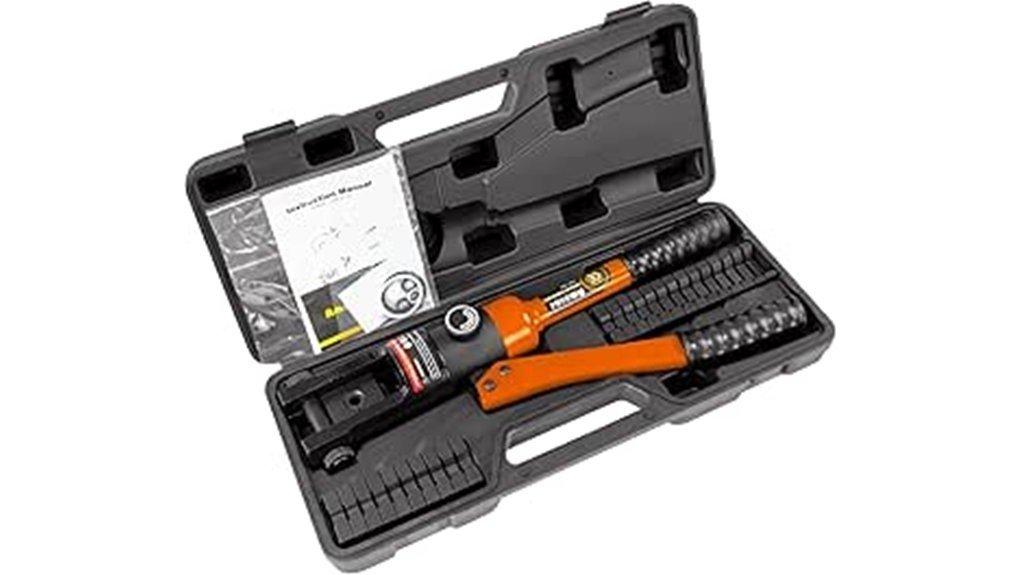
The AMZCNC 16 ton hydraulic crimper is a hand-pumped lug crimper listed for wire from 6 AWG up to 600 MCM, with 13 pairs of hexagon dies. It suits battery cables, welding leads and heavy electrical lugs where a hammer or small plier crimper cannot deliver enough force. The key is die-to-lug matching: the wrong die gives a loose or crushed crimp even with 16 tons of force. The AMZCNC 16 ton hydraulic wire crimper makes tight crimps on large battery and welding lugs.
Per the listing it weighs about 7.6 lb and measures roughly 16.89 x 7.01 x 3.19 inches. Confirm the die set and lug types against the current listing.
AMZCNC 16 Ton Hydraulic Crimper at a Glance
| Item | Per the listing |
|---|---|
| Type | Hand-operated hydraulic cable lug crimper |
| Force | 16 tons, per the listing |
| Wire range | 6 AWG to 600 MCM, per the listing |
| Dies | 13 pairs of hexagon dies, per the listing |
| Size | About 16.89 x 7.01 x 3.19 inches |
| Weight | About 7.6 lb |
| Case | No carrying case is listed in the product details |
Who Should Buy It
- Home-shop users making large battery, inverter and welding-lead cables.
- Mechanics and RV or marine owners who crimp heavy lugs occasionally.
- Anyone who wants a single tool for many cable sizes instead of buying fixed-size crimpers.
Skip it if
- You only crimp small wire. A hand ratchet crimper is cheaper and easier.
- You need production speed. Powered crimpers are faster.
- You use specialty lugs whose maker specifies a particular die and tool.
How to Make a Good Crimp
- Choose a lug rated for your cable size and strip only the length of the barrel.
- Select the die marked for that size and seat it fully in the head.
- Insert the cable to the bottom of the barrel and position the lug so the crimp lands on the barrel, not the palm.
- Pump until the die closes and the tool releases, then open the release valve.
- Pull-test the lug, inspect the crimp, and add heat-shrink or adhesive-lined sleeve for protection.
Wear eye protection and gloves. Always disconnect a battery before working on its cables, and use lugs and cable that are rated for the current and temperature of your application.
Pros and Limitations
Pros
- Large size range covers most battery and welding-lead cables.
- Hydraulic force handles heavy lugs with less effort.
- Included die set avoids buying dies separately.
Limitations
- Wrong die choice causes poor crimps.
- Heavy compared with a hammer crimper.
- No case listed; keep dies organized yourself.
Alternatives
A hammer lug crimper is cheaper for 8 AWG to 4/0 lugs and needs a hammer or vise. A ratcheting crimper is more portable for smaller wire. If you crimp lugs often, a dedicated hydraulic crimper like this one is the more repeatable choice.
Related reading: AMZCNC hammer lug crimper review | Hydraulic crimping tool review | Hammer lug crimper tool review | Anxingo hammer lug crimper review
Frequently Asked Questions
What wire sizes does the AMZCNC 16 ton crimper handle?
The listing says 6 AWG to 600 MCM, using 13 pairs of hexagon dies. Check the current listing and the markings on the dies.
Is hydraulic better than a hammer crimper?
It gives more even pressure and handles larger cable, but costs more and weighs more. A hammer crimper is cheaper for mid sizes.
Does it come with a case?
No case is listed in the product details, so plan on storing the dies yourself.
Can I use it for welding cable?
Yes, if the lug and die match the cable size. Use rated lugs and follow the cable maker guidance.
How do I know the crimp is good?
The lug should be tight and not pull off by hand, the barrel should be evenly compressed, and a pull-test should hold. Use heat-shrink for protection.
The Bottom Line
If you make heavy cable ends regularly, the AMZCNC 16 ton crimper is a practical way to cover many sizes with one tool. Match every die to the lug, pull-test your crimps, and choose a smaller crimper if you only work with thin wire.