The amp number on a corded angle grinder is useful, but it does not tell you everything about the tool’s strength. Amperage shows how much electrical current the motor is designed to draw under rated conditions. Wheel size, motor efficiency, gearing, speed control, and overload protection also affect how well the grinder performs when the wheel meets the workpiece.
Quick Answer
A 6- to 8-amp corded angle grinder is usually enough for occasional cutting, sharpening, rust removal, and light grinding. A 9- to 11-amp model provides more load capacity for regular metalwork. Consider 12 to 15 amps for sustained stock removal, production work, or larger wheels.
Key Takeaways
- Amps measure electrical current, not spindle torque or mechanical output power.
- Compare amperage only among grinders with a similar voltage, wheel diameter, and intended use.
- A 6.7-amp grinder is not a special heavy-duty category; it falls within the general 6- to 8-amp compact-grinder range.
- The correct wheel, guard, arbor fit, and maximum RPM rating matter more to safety than the grinder’s amp number.
- Cordless voltage and battery amp-hours cannot be converted directly into a corded amp rating.
What Is Angle Grinder Amperage and Why Does It Matter?
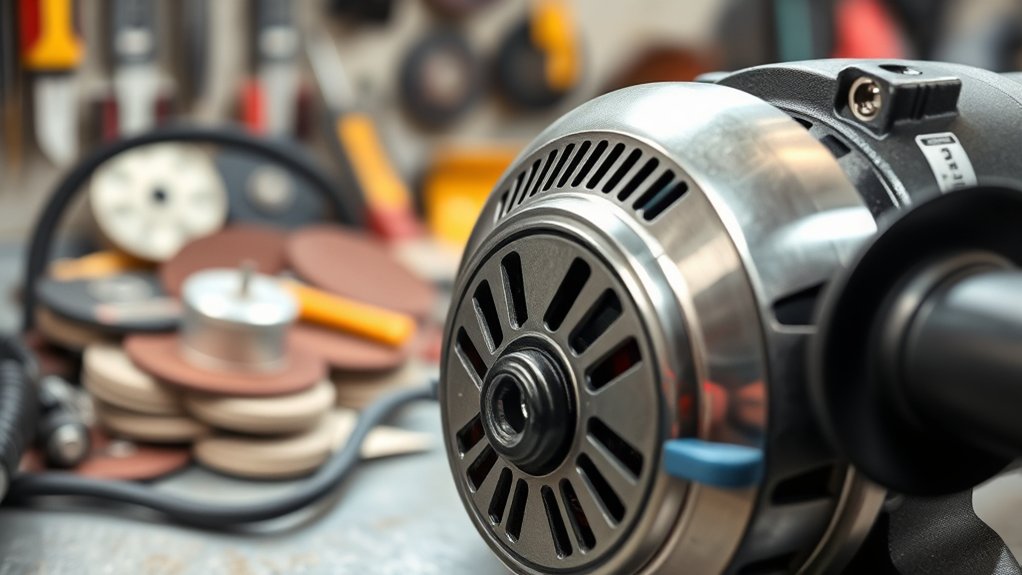
An angle grinder’s amperage is its electrical current rating. On a corded grinder made for a 120-volt supply, the nameplate may show 6, 7.5, 9, 11, 13, or 15 amps. This rating helps describe how much electrical input the motor can use, but it is not a direct measurement of cutting speed, torque, or power at the spindle.
When two grinders have the same wheel size, voltage, and general design, the model with the higher amp rating will often have more capacity to maintain speed under load. It may bog down less during sustained grinding or a long cut. However, that comparison becomes less reliable when the grinders have different wheel sizes, gearing, motor types, or electronic controls.
For example, current manufacturer specifications include compact 4-1/2-inch grinders with ratings from about 6 to 15 amps. Large 7-inch grinders may also use 15-amp motors but run at much lower RPM because a larger wheel has greater rim speed at the same spindle speed. The amp rating must therefore be read with the wheel diameter and maximum RPM.
Amperage tells you about electrical input capacity. It does not replace the wheel-size, speed, accessory, and safety information on the grinder’s nameplate and in its manual.
How Angle Grinder Amperage Affects Performance and Efficiency
A grinder’s motor draws more current as the work places it under load, up to the limits of the motor and its control system. A higher-current motor often has more reserve for demanding work, but amperage alone does not determine how efficiently the tool converts electrical input into useful spindle power.
Motor construction, cooling, gearing, electronic constant-speed control, and overload protection can make two grinders with similar amp ratings perform differently. A well-designed lower-amp grinder may outperform a poorly designed higher-amp tool during some tasks.
| Corded Amp Range | Practical Use | What to Expect |
|---|---|---|
| 6–8 amps | Occasional DIY cutting, mower-blade sharpening, rust removal, light weld cleanup, and short grinding sessions | Compact size and lower weight, with less reserve for long cuts or heavy pressure |
| 9–11 amps | Regular cutting and grinding, fabrication, automotive work, and repeated weld preparation | More load capacity without automatically moving to a large grinder |
| 12–15 amps | Sustained stock removal, demanding fabrication, masonry work with proper dust controls, or larger 6- to 9-inch grinders | Greater potential output, but often more weight, heat, vibration, current demand, and cost |
Note: These ranges are practical shopping guidelines, not industry standards. Some professional compact grinders are rated at 6 to 8 amps, while some 4-1/2-inch high-output models reach 13 or 15 amps.
Ideal Amperage Ratings for Common Angle Grinder Tasks
The best amperage depends on how long you run the grinder, how much material you remove, and which wheel the operation requires. Material thickness alone is not enough to choose a grinder. A thin cut made with the wrong wheel can be more demanding and dangerous than a properly planned cut through thicker stock.
| Task | Suggested Corded Range | Other Important Features |
|---|---|---|
| Rust removal and wire brushing | 6–8 amps for occasional work | Correct wire accessory, suitable guard, side handle, and speed compatibility |
| Sharpening mower blades or garden tools | 6–8 amps | Good balance, secure work holding, and a suitable grinding wheel or flap disc |
| Occasional cutting of bolts, rod, or thin steel | 7–9 amps | Cutting-wheel guard, thin cut-off wheel, stable support, and correct cutting technique |
| Frequent fabrication and weld preparation | 9–11 amps | Overload protection, comfortable switch, anti-restart protection, and good cooling |
| Sustained heavy grinding or stock removal | 12–15 amps | Electronic speed control, overload protection, low-vibration handle, and suitable duty cycle |
| Precision finishing or polishing | Amperage is secondary | Variable speed, approved backing pad, correct abrasive, and manufacturer approval for the operation |
A 6-amp compact grinder can be a capable professional tool for shorter tasks. A 13- or 15-amp model may be a better choice when the work repeatedly loads the wheel. The higher rating does not give permission to force the wheel into the material. Excess pressure can overheat the motor, damage the accessory, increase kickback risk, and make the grinder cut more slowly.
Products Worth Considering

7 amp AC/DC, 12,000 rpm motor of the angle grinder is designed for faster material removal and higher overload protection

7-amp motor generates up to 11,000 RPM

[Powerful Motor] The angle grinder quipped with a powerful 7.5 amp motor and can produce a no-load speed of up to 12,000 rpm for professional cutting and grinding hard case.
Comparing Lower- and Higher-Amp Angle Grinders
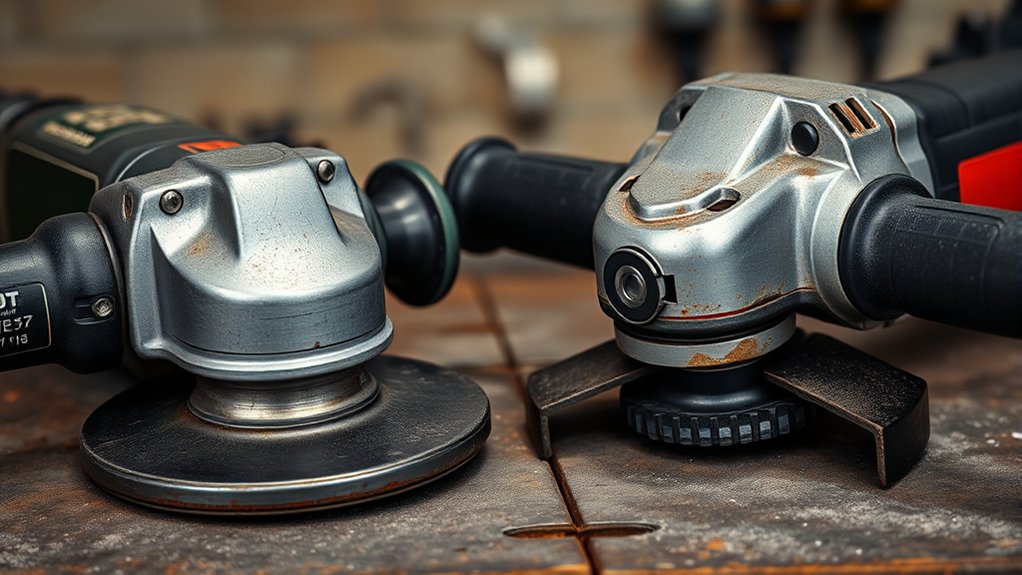
Lower-amperage grinders usually appeal to users who value compact size, low weight, and a lower purchase price. Higher-amperage models are useful when the work demands sustained output, but they can also be heavier and place more demand on the electrical circuit.
| Feature | Lower-Amp Example | Higher-Amp Example |
|---|---|---|
| Typical compact range | About 6–8 amps | About 9–15 amps |
| Best fit | Intermittent maintenance and light-to-moderate work | Frequent cutting, sustained grinding, and demanding fabrication |
| Load capacity | May slow sooner if the user applies excessive pressure | Often maintains speed better when comparing similar tools |
| Weight and handling | Usually smaller and easier to control for long periods | May be larger or heavier, although compact high-output models exist |
| RPM | Can be high or variable; amperage does not set RPM | Can also be high, low, or variable depending on wheel size and design |
| Durability | Depends on build quality, cooling, maintenance, and workload | Not automatically longer-lasting merely because the amp number is higher |
The Link Between Amps, Watts, and RPM
Amps, watts, and RPM measure different things:
- Amps: Electrical current drawn by the tool.
- Volts: Electrical potential supplied to the tool.
- Watts: The rate of electrical energy transfer.
- RPM: How many revolutions the spindle makes per minute.
- Torque: Rotational force at the spindle.
The basic electrical-power relationship is power = voltage × current. On a simple 120-volt calculation, a 6.7-amp rating gives approximately 804 volt-amperes:
120 volts × 6.7 amps = 804 VA
This calculation is useful for estimating electrical demand, but it is not necessarily the grinder’s real input wattage or mechanical output. Angle grinders use AC motors, so power factor, motor efficiency, electronics, and the actual load affect the result. Mechanical output is lower than electrical input because some energy becomes heat, sound, and friction. The underlying electrical relationship is explained by OpenStax’s electric power reference.
| Nameplate Current | Simple 120V Calculation |
|---|---|
| 6 amps | 720 VA |
| 6.7 amps | 804 VA |
| 8 amps | 960 VA |
| 11 amps | 1,320 VA |
| 13 amps | 1,560 VA |
| 15 amps | 1,800 VA |
RPM is not determined by amperage. A compact grinder may run near 10,000 or 11,000 RPM, while a larger grinder with a more powerful motor may run at 6,000 to 9,000 RPM. Variable-speed models can operate across a wide range so the user can match speed to an approved accessory and application.
Warning: Never install a wheel or accessory with a maximum-speed rating below the grinder’s maximum RPM. The wheel must also match the tool’s permitted diameter, thickness, arbor or thread, flange system, guard, and intended operation. An accessory that merely fits on the spindle is not necessarily safe.
Corded vs. Cordless: Understanding Power Ratings
Corded and cordless grinders use different specifications, so their numbers cannot be compared directly.
- Corded grinders: Usually list supply voltage, amps, and no-load RPM.
- Cordless grinders: Usually list the battery platform voltage, wheel size, no-load RPM, and compatible battery packs.
- Amp-hours: Describe battery charge capacity. They do not directly state motor power or guarantee a specific runtime.
- Watt-hours: Provide a better estimate of stored battery energy because they account for both voltage and amp-hours, although actual runtime still depends on load and system efficiency.
Do not assume that every 18V or 20V maximum grinder equals a 6-amp corded tool. Current high-output 18V grinders can be marketed as providing the power of an 11- or 13-amp corded grinder. For example, Milwaukee states that its M18 FUEL 4-1/2- to 6-inch braking grinder generates 13-amp corded-equivalent power.
The opposite assumption is also unreliable: a higher-voltage cordless platform is not automatically stronger than every lower-voltage system. Compare the manufacturer’s sustained-power claims, wheel capacity, approved battery, overload behavior, cut performance, weight, and runtime.
How to Pick the Right Amperage for Your Projects
Use the following process instead of choosing the largest amp number on the shelf.
- Choose the wheel size first. A 4-1/2- or 5-inch grinder is suitable for many home, automotive, and fabrication jobs. Larger grinders remove material faster but are heavier and use larger wheels.
- Identify the main operation. Cutting, grinding, wire brushing, sanding, and polishing can require different guards, accessories, and speed ranges.
- Estimate the workload. Occasional short tasks need less sustained output than repeated cuts or long grinding sessions.
- Select a practical amp range. Consider 6–8 amps for occasional light-to-medium work, 9–11 amps for regular fabrication, and 12–15 amps for sustained high-load work.
- Check the RPM and accessory requirements. The accessory must be approved for the grinder’s speed, diameter, arbor, flange, guard, and operation.
- Compare performance features. Look for overload protection, electronic constant speed, soft start, anti-restart protection, a brake, kickback control, and a comfortable side handle where useful.
- Check the power supply. Make sure the outlet, circuit, and extension cord meet the manual’s requirements.
Pro Tip: Compare grinders with the same wheel diameter and similar features. A 13-amp 5-inch variable-speed grinder and a 15-amp 7-inch grinder are built for different operating speeds and handling demands, so the amp numbers alone do not identify the better tool.
Products Worth Considering
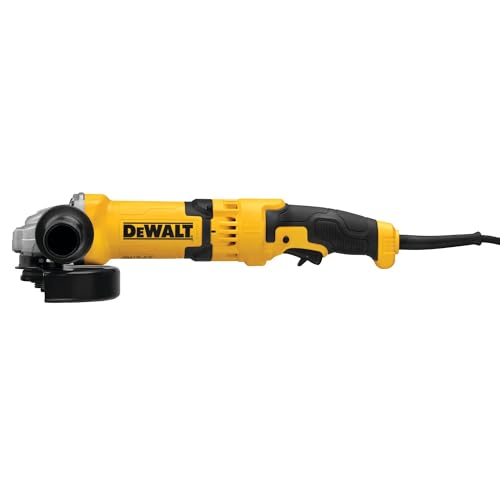

Electronic Clutch for Kickback Protection

Part of our most powerful line of 20V Max* angle grinders**
Extension Cords and Circuit Capacity
A grinder may feel weak even when its motor is large enough if the power supply cannot deliver adequate voltage. A long or undersized extension cord causes voltage drop, which can reduce performance and increase heating.
Use the extension-cord gauge table in the grinder’s manual because the required wire size depends on the nameplate amperage and cord length. The Makita angle-grinder manual also warns that accessories must match the tool’s speed and mounting system.
- Use the shortest suitable extension cord.
- Choose a heavier wire gauge as the cord becomes longer or the grinder’s amp rating increases.
- Replace damaged, hot, loose, or cracked cords and plugs.
- Do not remove a grounding prong or defeat another electrical-safety feature.
- Keep cord connections dry and away from sparks, sharp edges, and the rotating wheel.
- Avoid sharing the circuit with heaters, compressors, welders, or other large loads.
- If the breaker repeatedly trips, stop using the grinder until the tool, cord, outlet, and circuit have been checked. Never install a larger breaker without confirming that the wiring is rated for it.
Angle Grinder Wheel and Operator Safety
Amperage affects tool selection, but it does not change the basic safety rules. OSHA’s Hand and Power Tools guidance explains that portable abrasive-wheel tools require guards and that the grinder must not exceed the wheel’s maximum operating speed.
- Use the guard specified for the wheel and operation. Do not remove it for clearance.
- Inspect abrasive wheels for cracks, chips, moisture damage, or other defects before installation.
- Confirm the wheel’s maximum RPM equals or exceeds the grinder’s maximum no-load RPM.
- Confirm the diameter, thickness, arbor, thread, flange, and wheel type match the grinder.
- Unplug the cord or remove the battery before changing accessories.
- Use the side handle and maintain a firm two-handed grip where the tool is designed for it.
- Clamp or otherwise secure the workpiece so both hands can control the tool.
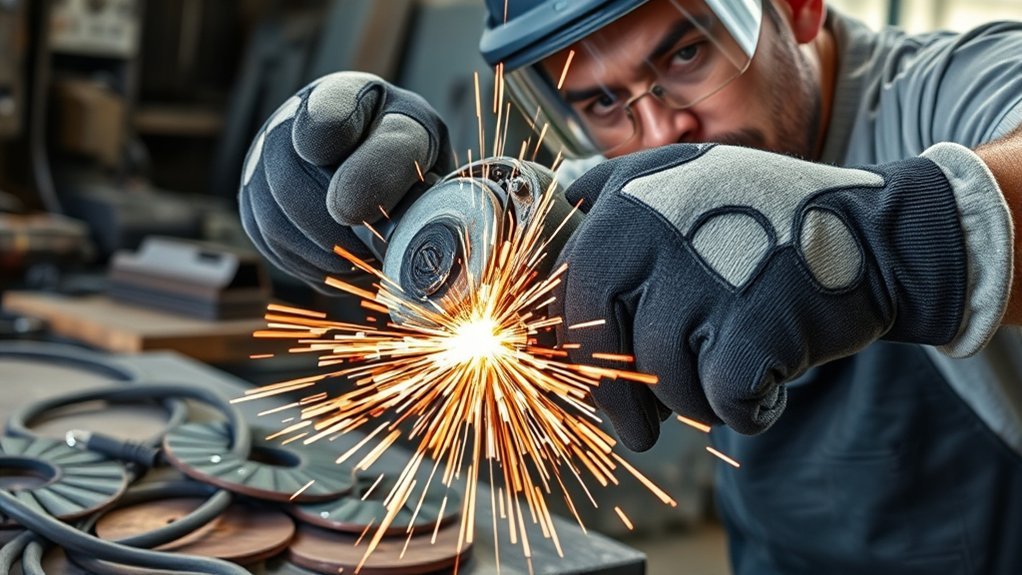
- Wear safety glasses and appropriate face, hearing, hand, foot, and body protection.
- Position the guard between your body and the wheel when the design permits.
- Keep yourself and bystanders away from the wheel’s plane during startup.
- Direct sparks away from people, fuel, solvents, sawdust, batteries, and other flammable materials.
- Let the wheel reach operating speed before contacting the workpiece.
- Do not twist or side-load a cut-off wheel.
- Wait for the accessory to stop completely before setting the grinder down.
Warning: Grinding or cutting concrete, brick, mortar, stone, and some masonry products can release respirable crystalline silica. Use a manufacturer-approved shroud and dust collector or an integrated wet-control system designed for that grinder and task. Do not improvise by applying water to an ordinary electric grinder.
Workplace users should follow the controls in the OSHA respirable crystalline silica standard when it applies.
What to Do if an Angle Grinder Bogs Down
Bogging means the wheel slows sharply when it contacts the work. It does not always mean the grinder needs more amps. Check the complete setup before replacing the tool.
- Reduce pressure: Let the abrasive do the cutting instead of forcing the wheel.
- Inspect the wheel: A glazed, loaded, worn, damaged, or incorrect accessory can cut slowly.
- Check the technique: Binding a cut-off wheel or using the wrong grinding angle increases the load.
- Check the extension cord: An undersized or excessively long cord can reduce voltage at the tool.
- Check the circuit: Other high-current equipment may be sharing the branch circuit.
- Clean the vents: Follow the manual and disconnect power before removing loose debris. Do not drive dust deeper into the housing.
- Watch for heat or odor: Stop immediately if the housing becomes unusually hot, smoke appears, or there is a burning smell.
- Check cordless batteries: A cold, overheated, discharged, damaged, or undersized battery may limit output.
If a properly equipped grinder repeatedly stalls during normal use, a higher-output model may be appropriate. Continued stalling can also indicate a worn or defective tool that needs inspection or service.
Common Misconceptions About Angle Grinder Amperage
Myth: The highest amp rating is always best.
A larger motor may add weight, cost, and electrical demand that provide little benefit for short household jobs.
Myth: Amps are the same as torque.
Amps measure electrical current. Torque is rotational force and depends on the complete motor, gearing, control system, and load.
Myth: A low-amp grinder is unsafe for every difficult job.
A lower-amp grinder can safely complete many jobs when it is within its design limits and fitted with the correct accessory. The problem is forcing or overheating it.
Myth: More RPM always means faster work.
Wheel diameter, abrasive type, material, contact pressure, and loaded speed all affect removal rate. The highest speed is not appropriate for every accessory.
Myth: Battery voltage reveals cordless grinder power.
Voltage identifies the platform, not the grinder’s complete output. Motor design, electronics, battery cells, pack condition, and current delivery all matter.
Myth: A 6.7-amp grinder forms its own heavy-duty class.
It does not. It simply falls between common 6- and 7.5-amp compact models. Judge the complete grinder rather than treating a decimal amp difference as a performance category.
Frequently Asked Questions
Is a higher-amp grinder always better?
No. A higher-amp grinder may maintain speed better during demanding work when compared with a similar lower-amp model. It may also be heavier, more expensive, and harder on the electrical circuit. Wheel size, motor design, electronics, ergonomics, and safety features are equally important.
What is a good amperage for an angle grinder?
For a corded 4-1/2- or 5-inch grinder, 6 to 8 amps suits occasional light-to-medium work, while 9 to 11 amps provides more reserve for regular fabrication. Consider 12 to 15 amps for sustained heavy grinding, high-output compact tools, or larger grinders. These are practical ranges rather than fixed industry rules.
How many amps is 5,000 watts at 240 volts?
Dividing 5,000 watts by 240 volts gives about 20.8 amps when the calculation assumes a single-phase load with a power factor of 1. An AC motor or other real-world load may draw a different current because power factor and efficiency also affect the calculation.
Does a higher amp rating mean more power?
At the same supply voltage, a higher amp rating indicates that the tool can accept more electrical input current. It does not reveal the exact mechanical power reaching the wheel. Efficiency, gearing, cooling, electronics, wheel size, and the load determine how much useful output the grinder delivers.
Can a 15-amp grinder run on a standard 15-amp circuit?
Use the voltage, outlet, and circuit specified by the grinder manufacturer. A shared circuit, poor connection, long extension cord, or another large load can cause voltage drop or breaker trips. If tripping continues, stop and have the tool and circuit checked. Never replace the breaker with a larger one unless the wiring and installation are properly rated.
Does a higher amp-hour battery make a cordless grinder more powerful?
Not automatically. A higher-capacity battery often stores more energy and may support longer runtime. Some tool systems also allow larger packs to deliver more current, but the result depends on the battery cells, electronics, temperature, charge level, and grinder design. Use a battery specifically approved by the manufacturer.
Should I push harder when the grinder slows down?
No. Reduce pressure and check the wheel, cutting angle, power supply, extension cord, and material support. Pushing harder can increase heat, bind a cut-off wheel, raise kickback risk, and make the tool cut less efficiently.
Conclusion
The best angle grinder is not automatically the one with the highest amp rating. For occasional home and maintenance tasks, a 6- to 8-amp compact grinder may provide all the performance you need. Regular fabrication often benefits from a 9- to 11-amp model, while sustained heavy grinding or larger wheels may justify 12 to 15 amps.
Use amperage as one part of the decision. Check the wheel diameter, maximum RPM, variable-speed range, guard system, overload protection, ergonomics, cord requirements, and approved accessories. Matching the complete tool to the job provides better performance and a much safer setup than choosing by amperage alone.
Sources
- OSHA Hand and Power Tools — guarding, electrical safety, abrasive-wheel inspection, maximum wheel speed, and operator protection.
- OSHA Respirable Crystalline Silica Standard — dust-control requirements for grinding silica-containing materials.
- Makita XAG25 Angle Grinder Instruction Manual — accessory speed, dimensions, mounting compatibility, PPE, and kickback precautions.
- OpenStax: Electric Power and Energy — the relationship between voltage, current, and electrical power.
- Makita Corded Angle Grinder Reference Catalog — examples of current amp, wheel-size, and RPM combinations.
- Milwaukee M18 FUEL Braking Grinder — an example of manufacturer-stated cordless-to-corded power equivalency.