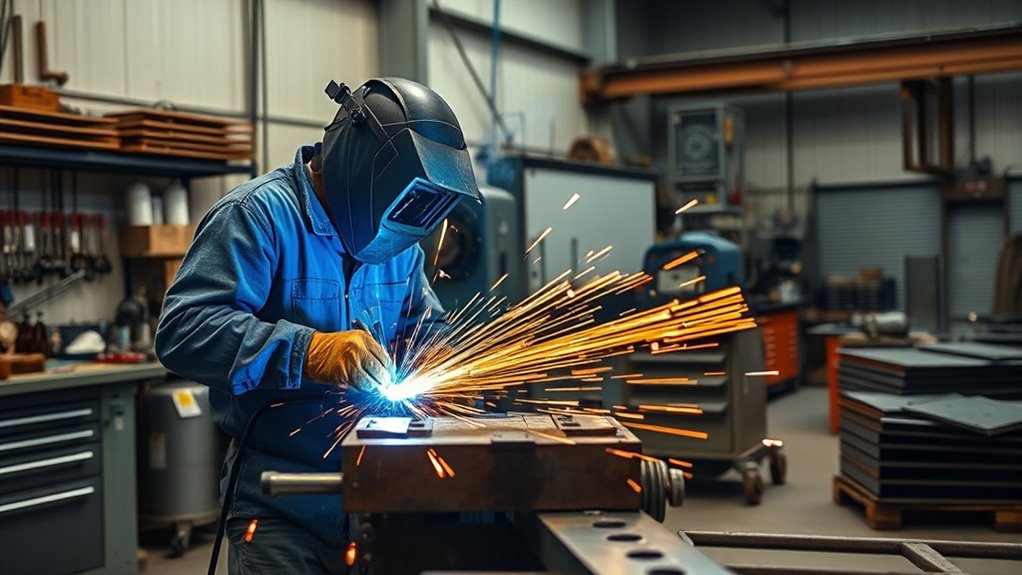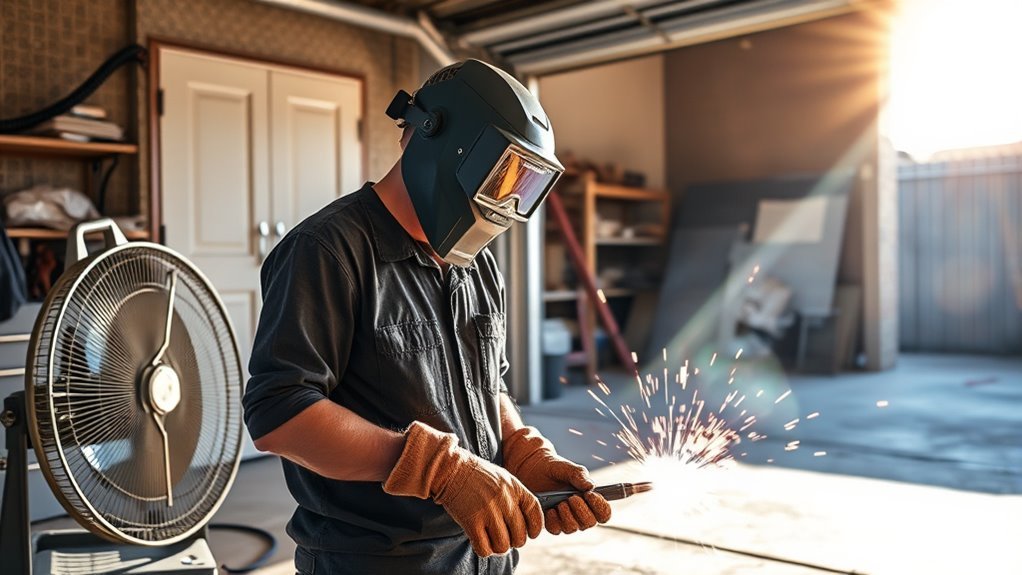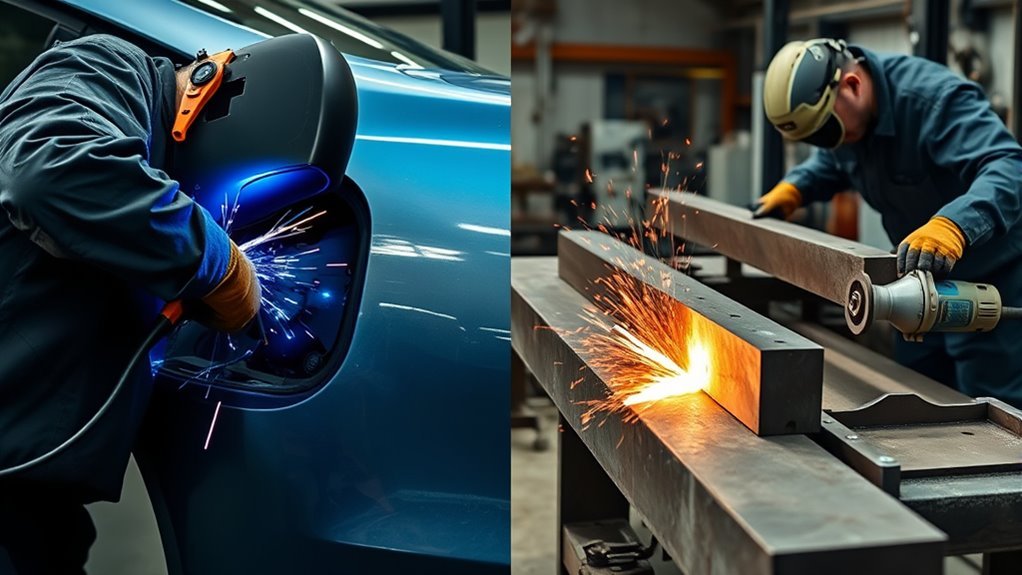
If you are comparing auto body welding with metal fabrication, start with the job you need done. Auto body welding repairs or joins existing vehicle metal so panels, seams, brackets, and structural areas fit safely again. Metal fabrication builds a new metal part or assembly from raw stock. Both can involve welding, but they solve different problems.
Quick Answer
Choose auto body welding for vehicle repair, rust repair, panel attachment, frame-related work, and body seams. Choose a metal fabrication shop when you need a custom bracket, guard, mount, prototype, structure, or part made from raw metal through cutting, bending, machining, welding, and finishing.
Key Takeaways
- Auto body welding is best for repairing or joining existing vehicle metal while protecting fit, strength, and appearance.
- Metal fabrication is best when you need a new part, bracket, frame, panel, or assembly built to a design.
- Welding is one joining process; fabrication is the wider workflow that may include cutting, bending, machining, welding, grinding, coating, and inspection.
- For vehicle structural repairs, ask whether the shop follows OEM repair procedures and uses the correct joining method for that material.
- For custom parts, bring measurements, drawings, material requirements, load expectations, and finish preferences before asking for a quote.
Auto Body Welding vs. Metal Fabrication: Which Do You Need?
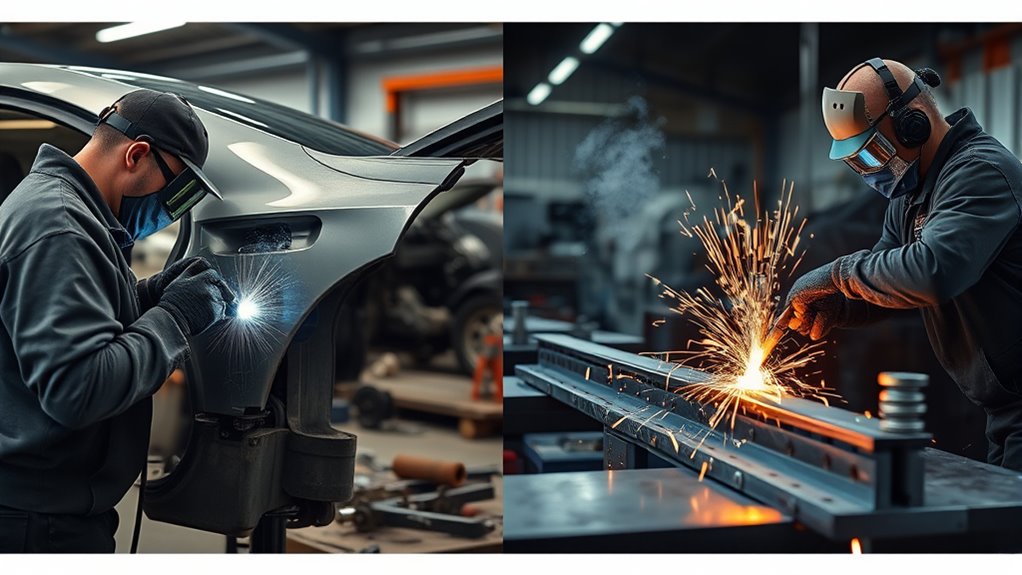
The key difference is scope. Auto body welding repairs, joins, or restores metal that is already part of a vehicle. Metal fabrication creates a new metal component or assembly from sheet, plate, tube, bar, or structural stock.
| Need | Choose Auto Body Welding | Choose Metal Fabrication |
| Main goal | Restore damaged vehicle metal | Build a new metal part or assembly |
| Common work | Rust patches, panel seams, brackets, floor pans, quarter panels, body mounts | Custom brackets, racks, guards, fixtures, frames, prototypes, production parts |
| Typical equipment | MIG welder, TIG welder, spot welder, clamps, grinders, body hammers, panel tools | Shears, press brake, tube bender, saws, CNC machines, laser or plasma cutters, welders |
| Best question to ask | “Can you repair this vehicle area using the correct OEM method?” | “Can you build this part to my drawing, tolerance, material, and finish?” |
Use auto body welding when the work must restore a vehicle’s fit, appearance, and strength. Use metal fabrication when the work starts with an idea, drawing, sample, or measurement and ends with a newly made component.
Note: A welding shop and a fabrication shop can overlap. Many fabricators weld, and many body shops fabricate small patches or brackets. The deciding factor is whether the job is mainly a vehicle repair or a custom metal build.
You may rely on different welding techniques in both services. Understanding electrode selection helps, but a good shop should choose the process, filler, and settings based on the base metal, thickness, access, and required strength.
What Is Auto Body Welding?
Auto body welding is a specialized vehicle repair process that joins, patches, or restores metal panels and structural areas. It is used when collision damage, rust, cracking, or previous poor repairs have weakened or separated metal on a vehicle.
MIG welding is common in body repair because it works well on many steel panels when the machine is set correctly. TIG welding may be used when extra control is needed, especially on cleaner, thinner, or more delicate work. Resistance spot welding may be required where the original vehicle used factory spot welds.
Before welding, the shop should remove paint, seam sealer, rust, oil, coatings, and other contaminants from the repair area. Proper surface preparation helps reduce porosity, weak fusion, and premature corrosion.
Auto body welding often includes:
- Replacing rusted rocker sections, floor pans, or wheel arches
- Repairing cracked brackets, tabs, or mounts
- Joining patch panels after cutting out damaged metal
- Restoring seams after collision or corrosion repair
- Grinding, sealing, priming, and protecting repaired areas from corrosion
Warning: Do not guess on structural vehicle welding. Modern vehicles may use high-strength steel, aluminum, adhesives, rivets, squeeze-type resistance spot welds, or specific sectioning locations. Ask the shop to follow the correct repair procedure for your vehicle before welding, cutting, or heating a structural area.
Good auto body welding protects more than the weld bead. It also protects panel alignment, crash performance, corrosion resistance, paint quality, and long-term durability.
What Does a Metal Fabrication Shop Do?
A metal fabrication shop turns raw metal into custom parts and assemblies. Instead of only repairing existing metal, the shop cuts, bends, shapes, machines, welds, fastens, and finishes material to match a design.
You use a metal fabrication shop when you need a part that does not already exist, does not fit off the shelf, or must be stronger, cleaner, or more precise than a quick repair. Fabrication shops may work from a sketch, CAD file, template, sample part, or measured drawing.
Common fabrication work includes:
- Custom brackets, mounts, plates, tabs, and gussets
- Tool racks, guards, shelves, cages, and shop fixtures
- Exhaust hangers, skid plates, bumpers, and off-road accessories
- Prototype parts for testing before production
- Small-batch or production metal assemblies
Many shops use shears, saws, press brakes, tube benders, CNC machines, laser cutters, plasma cutters, and welders. Some also offer powder coating, paint prep, polishing, machining, or assembly. Shops may also use advanced welding and cutting equipment when a project needs clean edges, repeatable dimensions, or stronger joints.
The best fabrication shop for your job depends on the material, thickness, tolerance, finish, quantity, and load. A shop that builds architectural railings may not be the right shop for tight-tolerance brackets, and a precision CNC shop may not be the most cost-effective choice for a simple welded guard.
Welding vs. Fabrication: Key Differences
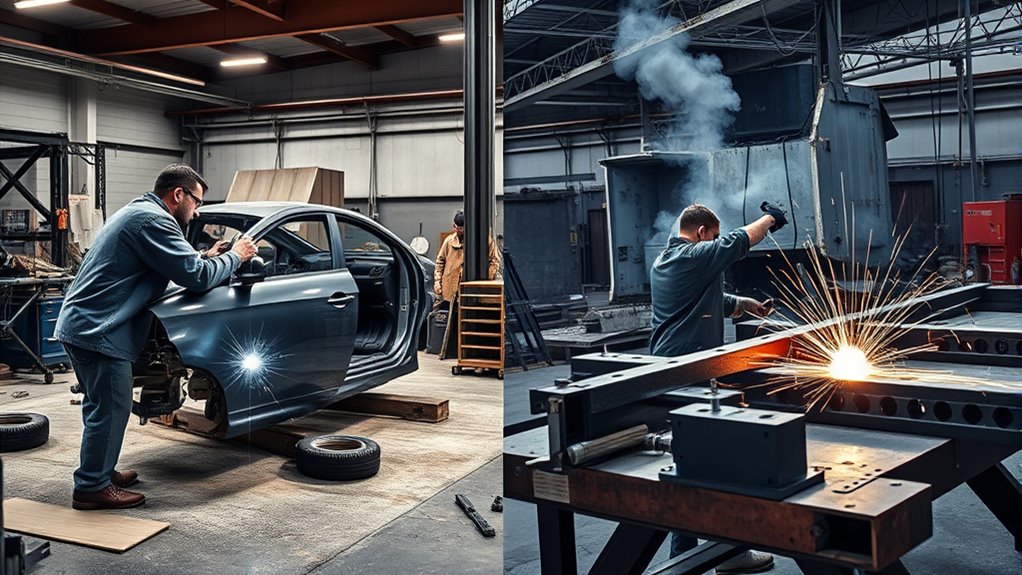
Welding is a joining process. It uses heat, pressure, filler metal, or a combination of these to join metal parts. Fabrication is the wider build process. It may include welding, but it also includes cutting, bending, machining, drilling, fitting, grinding, coating, and final inspection.
| Category | Welding | Fabrication |
| Purpose | Join or repair metal | Create a finished part or assembly |
| Workflow | Prep, fit, weld, clean, inspect | Design, measure, cut, bend, fit, weld, finish, inspect |
| Quality check | Focuses on penetration, fusion, bead quality, distortion, and joint integrity | Checks dimensions, hole locations, bends, fit-up, welds, finish, and function |
| Best fit | Cracks, seams, patch panels, brackets, and local repairs | Custom parts, assemblies, repeat production, and complex shapes |
Welding can move quickly once the metal is cleaned, aligned, and clamped. Fabrication usually takes longer because it may require design review, measuring, material sourcing, cutting, forming, test fitting, welding, finishing, and quality checks.
That is why the advantages and disadvantages of welding depend on the project. A simple weld repair may be faster and cheaper than a fabricated replacement. A fabricated part may be better when the original part is missing, weak, badly designed, or no longer available.
When to Choose Welding or Fabrication
Choose welding when the main job is to join or repair metal that already exists. Choose fabrication when the main job is to create a part, change a design, or build an assembly from raw material.
Products Worth Considering

Value Pack: The package includes 24 packs of butt welding clamps, enough quantity to meet your daily needs and replacements. Each butt welding clamps is individually wrapped in a small bag, convenient to carry and use.

Adaptability: Our butt welding clamps are suitable for both straight panels or curved panels. Maintains 0.40" gap between panels for edge-to-edge welding.They will work well in these 2 kinds of p

Choose Auto Body Welding When
- You have rust holes in a rocker panel, floor pan, wheel arch, or lower body panel.
- A vehicle bracket, mount, tab, or seam has cracked.
- A body panel needs a patch section welded in after damaged metal is removed.
- You need thin sheet metal joined with controlled heat and minimal distortion.
- The repair must match factory body lines, gaps, and corrosion protection.
Choose Metal Fabrication When
- You need a custom bracket, guard, plate, mount, rack, or fixture.
- The original part is unavailable or too weak for the job.
- You need thicker material, a different alloy, or a stronger design.
- The project requires cutting, bending, drilling, machining, welding, and finishing.
- You need repeatable parts for a small batch or production run.
Pro Tip: If you are not sure which shop to call, describe the result you want. Say “I need this rusted panel repaired on my vehicle” for body welding, or “I need this bracket made from 1/8-inch steel with two holes and a 90-degree bend” for fabrication.
If you weld at home or want to understand the shop’s approach, learning flux core welding, MIG settings, joint prep, and heat control can help you ask better questions. Still, structural and safety-related work should be handled by a qualified shop.
Materials, Tolerances, and Cost Drivers
The right service also depends on material and tolerance. A thin automotive panel, a galvanized patch, an aluminum bracket, and a stainless guard do not behave the same under heat. The shop should know how the metal reacts, which filler or fastener is suitable, and how to prevent distortion or corrosion.
Material Considerations
- Mild steel: Common in both body repair and fabrication; usually easier to weld than many specialty metals.
- Galvanized steel: Needs coating removal in the weld area and proper fume control because zinc coating can create hazardous fumes.
- Aluminum: Often needs cleaner prep, different filler, different machine setup, and stronger distortion control.
- Stainless steel: Needs careful heat control and compatible filler to protect corrosion resistance.
- High-strength vehicle steel: May require OEM-approved sectioning, spot welding, rivets, adhesives, or replacement instead of ordinary welding.
Tolerance and Fit
Auto body welding is often judged by fit and finish: panel gaps, seam quality, door alignment, and paint-ready surface. Fabrication is often judged by dimensions: hole spacing, bend angle, flatness, load capacity, and repeatability.
Cost usually rises when the job needs more prep, tighter tolerances, rare material, special fixturing, corrosion protection, finishing, inspection, or design time. A clean, measured drawing can lower fabrication cost because the shop spends less time guessing.
Safety, Standards, and Shop Qualifications
Welding, cutting, and grinding create real hazards. OSHA lists hazards from welding, cutting, and brazing that include metal fumes, ultraviolet radiation, burns, eye damage, electrical shock, cuts, and crushed fingers or toes. A qualified shop should control those risks with ventilation, PPE, fire prevention, safe electrical practices, and trained workers.
For welding safety basics, review OSHA’s welding, cutting, and brazing hazards guidance. For fire prevention, OSHA’s general welding and cutting standard says movable fire hazards should be taken to a safe place when possible, and guards should be used when hazards cannot be moved.
Shop qualifications vary by job. Some projects may only need a skilled repair welder. Others may require documented procedures, certified welders, inspection records, or compliance with a specific code or OEM repair method. BLS notes that some employers require job-specific certification and that licensing requirements may vary by state or locality.
Ask the shop:
- Have you repaired or fabricated this type of part before?
- Which welding process will you use, and why?
- What material and thickness do you recommend?
- How will you control heat distortion?
- How will you inspect the finished weld or part?
- Will the repair be primed, sealed, painted, coated, or otherwise protected from corrosion?
- For vehicle work, will you follow the OEM repair procedure?
- For fabrication work, can you work from a drawing, CAD file, or sample part?
Also confirm that the shop follows proper protective clothing, ventilation, and fire-control practices before any welding or cutting starts.
How to Choose a Quality Shop
To choose a quality shop, match the shop to the work. A collision-focused body shop is usually better for panel repair and vehicle structure. A fabrication shop is usually better for custom metal parts, repeatable brackets, fixtures, guards, racks, and assemblies.
Products Worth Considering

Multipurpose Fit: Repairs at least 98% of the plastics on the market. Suitable for repairing: bumper, dashboard, lamp holder, plastic ring, radiator, spoiler, handles, headlights, plastic wings, car and motorcycle plastic device, etc

【Paintless Dent Repair Kit】2 in 1 Slide Hammer T-Bar, Bridge Puller kit, Dent Lifter, 3pc Suction Cup(1black+2blue), Hot-Melt Glue Gun, Rubber Hammer, Tap Down Pen, 10pcs Glue Sticks, 100pcs Puller Tabs and so on. This 140pcs car dent puller kit makes it easy for anyone, even beginners, to fix You can fix dents effortlessly.(Please read the manual before use)

7 Piece Auto Repair Kit: Each pack comes with a standard bumping hammer, pick & finish hammer, reverse curve hammer, curved dolly, utility dolly, double end hand dolly, and shrink dolly to provide the perfect fit both large and small body car dent repairs.
Shop Capabilities
Ask what the shop can do in-house. A body shop should be able to cut out damaged metal, fit panels, weld or spot weld correctly, grind carefully, restore corrosion protection, and prepare the area for finishing. A fabrication shop should be able to measure, cut, bend, drill, weld, finish, and inspect the part.
Useful shop capabilities may include:
- MIG, TIG, spot welding, or stick welding where appropriate
- Plasma, laser, saw, shear, or waterjet cutting
- Press brake bending and tube bending
- Drilling, tapping, machining, and fixture building
- Grinding, deburring, coating, painting, or powder coating
- Measurement tools for checking fit and tolerance
Certification And Equipment
Equipment matters, but it does not replace skill. A shop with CNC equipment, robotic welders, or a large press brake can still produce poor work if the design, setup, fit-up, or inspection is weak. A smaller shop can produce excellent work when it has the right experience and quality controls.
For vehicle repairs, ask about OEM repair information, collision repair training, and experience with your vehicle’s material. For structural fabrication, ask whether a welding procedure, certified welder, or inspection record is required. For precision fabrication, ask about tolerances, measuring tools, and whether the first part will be test-fit before a batch is made.
Before approving the job, get a written quote that explains the material, process, finish, timeline, and any limits. If the shop cannot explain how it will protect strength, fit, safety, and corrosion resistance, keep looking.
Frequently Asked Questions
What is the difference between metal fabrication and welding?
Welding joins metal pieces together. Metal fabrication is the wider process of making a finished part or assembly, which may include design, measuring, cutting, bending, drilling, welding, grinding, coating, and inspection.
Who gets paid more, a welder or a fabricator?
It depends on the exact job. A pipe welder, certified structural welder, sheet metal worker, CNC fabricator, and production assembler can all earn different pay. Location, overtime, union status, industry, certification, and experience matter more than the simple title. The U.S. Bureau of Labor Statistics lists wage data for welders, cutters, solderers, and brazers and for sheet metal workers, but local pay can vary widely.
Is MMA stronger than MIG?
Not automatically. MMA, also called stick welding, can be a strong choice for outdoor work, heavier steel, and less-than-perfect conditions. MIG can also make strong welds when the metal is clean, the settings are correct, and the joint is designed properly. Strength depends on material, filler, preparation, settings, joint design, welder skill, and inspection.
Why do some people say welding is hard on your health?
Welding can expose workers to fumes, UV radiation, heat, noise, awkward positions, and electrical hazards. Those risks are why trained welders use ventilation, helmets, gloves, protective clothing, hearing protection, fire controls, and respirators when needed. The safer question is not whether welding is always harmful, but whether the job is being done with the right controls.
Can a fabrication shop repair a car?
Sometimes, but not always. A fabrication shop may be able to build brackets, patch pieces, skid plates, exhaust parts, or custom mounts. For collision repair, rust repair, panel alignment, or structural vehicle work, a qualified auto body shop is usually the safer choice because vehicle repair often requires OEM procedures, corrosion protection, and paint-ready finishing.
Conclusion
Auto body welding and metal fabrication are related, but they are not the same service. Choose auto body welding when the job is to repair, join, or restore vehicle metal. Choose a metal fabrication shop when the job is to build a new part or assembly from raw metal. Before you approve the work, ask about material, welding process, fit, inspection, corrosion protection, safety controls, and any OEM or code requirements. The right shop should be able to explain the plan before it strikes an arc.
Sources
- OSHA Welding, Cutting, and Brazing Hazards and Solutions — backs up welding hazard and PPE guidance.
- OSHA 29 CFR 1910.252 General Welding and Cutting Requirements — backs up fire prevention and hot-work precautions.
- U.S. Bureau of Labor Statistics: Welders, Cutters, Solderers, and Brazers — backs up welding duties, pay context, training, and work environment.
- U.S. Bureau of Labor Statistics: Sheet Metal Workers — backs up fabrication duties, tools, pay context, and work environment.