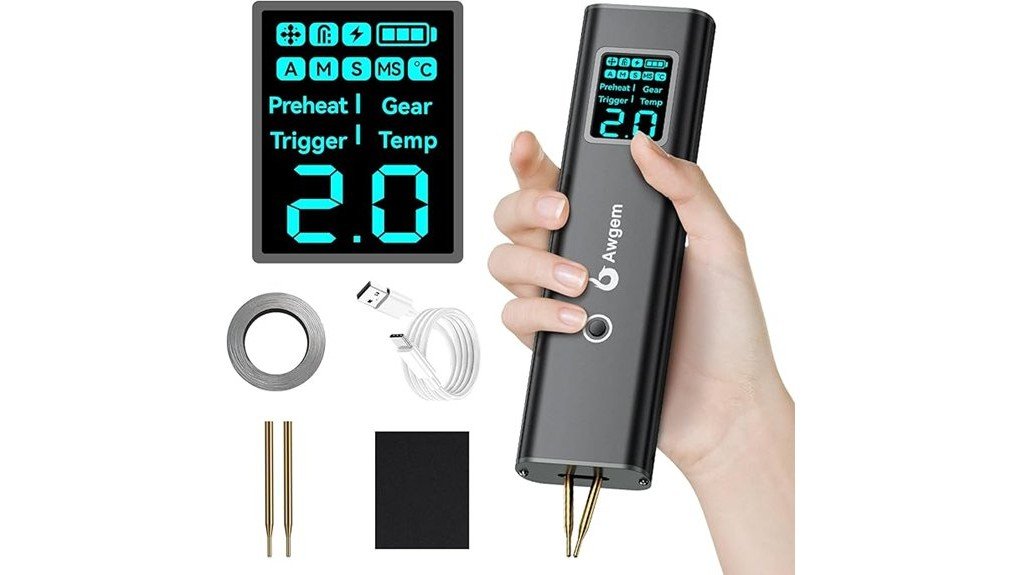
Building or repairing a small battery pack calls for controlled heat, steady contact, and a tool that does not crowd your work area. The Awgem AS2 Battery Spot Welder combines its power supply and welding tips in one handheld body, so you can position a battery strip with one hand and trigger the weld with the other. Its 99 output levels, automatic and manual modes, and LCD controls give you more adjustment than a fixed-output mini welder. The tradeoff is that it is designed for thin battery tabs and small repair jobs, not thick metal, copper sheet, or continuous shop production.
Quick Verdict
Rating: 7.8/10, recommended with caveats
Best For: DIY battery builders, electronics hobbyists, and occasional battery-tab repairs
Bottom Line: The Awgem AS2 gives you fine output control, two trigger modes, and a compact all-in-one design. It makes the most sense for thin nickel-plated or stainless battery strips, but you still need careful setup, test welds, and realistic material limits.
Key Specifications
| Specification | Detail |
|---|---|
| Brand | Awgem |
| Model | AS2 |
| ASIN | B0F1MSYC4S |
| Product Type | Rechargeable handheld battery spot welder |
| Design | Integrated power supply and welding pen for one-handed use |
| Output Adjustment | 99 selectable power levels with dual-pulse output |
| Welding Modes | Automatic contact-triggered mode and manual button-triggered mode |
| Display | LCD screen for mode, gear, preheat, delay, and other operating data |
| Battery | Built-in rechargeable battery, listed as 1,800mAh |
| Charging | USB Type-C cable included |
| Body Material | Aluminum-alloy housing |
| Supported Materials | Nickel-plated and stainless steel battery strips up to 0.2mm, according to the product listing |
| Typical Applications | Cylindrical cells, button cells, small lithium battery packs, and electronics battery repair |
| Included Accessories | Welder, two spare copper needles, 2-meter nickel roll, frosted paper, and Type-C cable |
| Important Limit | Not listed for copper, gold, silver, jewelry, or thick fabrication metal |
Before You Buy: Confirm the current Amazon variant, battery-strip material, thickness limit, charger requirements, and package contents. Do not assume that a setting that works on nickel-plated strip will also work on pure nickel, copper, or a different cell design.
What Is the Awgem AS2 Battery Spot Welder?
The Awgem AS2 is a rechargeable spot welder for attaching thin metal tabs to battery terminals. Unlike a bench unit with a separate power box and welding pen, the AS2 places the power source, controls, display, and copper tips in one compact tool. That layout is aimed at small-scale battery pack assembly, cell replacement, and electronics repair.
Its main selling point is control. You can select from 99 power levels, choose automatic or manual triggering, and monitor the selected settings on the LCD. The tool is supplied with spare copper needles, a short nickel roll, frosted paper for tip or surface preparation, and a Type-C charging cable.
This is still a light-duty battery tool. It is not a replacement for a high-output bench welder when you need thick pure nickel, copper sandwich work, repeated production welds, or documented duty-cycle performance.
Who Should Buy It?
Best For
- Hobbyists assembling or repairing small cylindrical-cell battery packs.
- Electronics owners replacing tabs on button cells or compact device batteries.
- Beginners who want visible settings and both automatic and manual trigger control.
Skip If
- You need to weld copper, jewelry metals, or metal thicker than the listed limits.
- You build packs every day and need a verified duty cycle or high-volume workflow.
- You are not comfortable identifying safe battery cells and preventing electrical shorts.
Design and Build Quality
The integrated body is the AS2’s clearest practical advantage. You do not have to manage a separate welding pen, heavy cable, and power unit while holding a strip against a cell. The aluminum-alloy housing should also feel more rigid than a basic plastic-only shell, although the copper welding needles remain wear items.
The needle spacing is adjustable, and the pins can be replaced when they become worn or damaged. That matters because dirty, oxidized, or uneven tips can create weak contact, excess sparking, or inconsistent weld marks.
Controls, Display, and Welding Modes
99 Adjustable Power Levels
The wide adjustment range helps you tune the pulse for a thin strip instead of relying on one fixed output. More levels do not remove the need for testing. Strip coating, thickness, cell surface condition, pin pressure, battery charge, and contact angle can all change the result.
Automatic and Manual Modes
Automatic mode triggers after the tips make firm contact with the workpiece. This can speed up repeated tab placement, but it also requires steady positioning because the weld may fire as soon as contact is detected. Manual mode waits for a button press, which gives you more control while learning the correct pin angle and pressure.
LCD Digital Display
The display shows operating information such as the selected mode, output level, preheat setting, and trigger delay. That makes it easier to repeat a setting after a successful test weld and to reduce output in small steps when a strip shows burn-through.
Material Compatibility and Limits
The listing supports nickel-plated and stainless steel strips up to 0.2mm. Those materials cover many small battery-tab jobs, but they are not the same as pure nickel or copper. Pure nickel usually demands more energy than nickel-plated steel at the same thickness, so you should not treat the 0.2mm figure as a universal limit for every strip type.
The product description also warns against copper, gold, silver, and jewelry welding. Choose a different welder when your project requires those materials or when the pack design uses a copper-nickel sandwich.
How It Performs in Real Use
For Small Cylindrical Battery Packs
The one-handed shape is useful when you need to hold a strip flat across a row of cells. Start with a conservative setting, make a test weld away from a live pack when possible, and check whether the strip tears around the weld points during a controlled pull test.
For Button Cells and Compact Electronics
The smaller body and adjustable output suit short tabs and tight work areas better than a large bench machine. Manual mode is the safer starting point because it gives you time to position both pins before the pulse fires.
For Appliance Battery Repair
The AS2 may help with battery tabs inside handheld fans, small tools, earbud cases, watches, or similar devices. You still need to match cell chemistry, voltage, polarity, protection circuitry, and tab material. A good weld does not correct an unsafe cell choice or an incorrect pack layout.
For Repeated Hobby Work
The included rechargeable battery and integrated tips make the tool easy to move between a workbench and a repair kit. For long sessions, watch for heat buildup, falling battery charge, and changing weld strength. A production builder will likely prefer a larger welder with more documented output and cooling capacity.
Setup Tips Before Your First Weld
- Charge the welder fully. A low internal battery can reduce output and make test results harder to repeat.
- Inspect the cell. Do not weld a cell that is swollen, leaking, dented, corroded, overheated, or otherwise damaged.
- Clean the contact surfaces. Remove oxidation and debris from the strip and welding tips. Use the included frosted paper lightly on the copper tips when needed.
- Secure the strip. Keep it flat against the terminal without an edge hanging over the cell.
- Begin in manual mode. Set both tips firmly on the strip, then trigger the pulse. Increase output gradually only when the weld is too weak.
- Inspect each result. Reduce power if the strip burns through, sparks heavily, or leaves a deep crater. Increase it in small steps if the tab lifts with little resistance.
Pro Tip: Record the strip type, thickness, mode, output level, and test result on a small workshop card. That gives you a reliable starting point when you repeat the same cell and tab combination later.
Battery and Workshop Safety
Battery spot welding can create heat, sparks, and a short-circuit path if the tips or strip bridge the wrong terminals. Work on a clean, nonflammable surface with eye protection, insulated tools, and enough space to keep loose metal away from exposed cells. Remove rings, watches, and other conductive jewelry before handling an open pack.
Do not hold a welding pulse longer than the tool instructions allow, and do not keep firing on the same cell terminal while it is hot. Stop immediately if a cell becomes unusually warm, swells, vents, leaks, or gives off an odor. Keep an appropriate battery-fire plan for your workspace and follow the cell manufacturer’s handling guidance.
When you are repairing a multi-cell pack, preserve the original series and parallel layout, polarity, insulation rings, temperature sensors, and battery-management connections. A battery technician is the better choice when you cannot identify the pack design or confirm the replacement cells.
Cleaning, Tip Care, and Storage
Wipe the housing with a dry cloth and keep metal dust away from the charging port and controls. Polish light oxidation from the copper needles with the supplied frosted paper, then replace the needles if they become badly pitted, bent, loose, or uneven.
Power the welder off before storage. Keep it in a dry place away from metal scraps, direct sunlight, heat, and moisture. Recharge it periodically rather than leaving its internal battery fully depleted for long periods.
Pros and Cons
Pros
- 99 output levels allow smaller adjustments than a fixed-power mini welder.
- Automatic and manual modes support faster repetition or more deliberate control.
- Integrated one-handed design leaves your other hand free to position the tab.
- LCD controls help you repeat a successful setting and spot incorrect mode changes.
- Spare copper needles, nickel strip, frosted paper, and Type-C cable are included.
Cons
- The listed 0.2mm limit applies only to supported strip materials, not every metal.
- Correct output still requires scrap testing, clean tips, and steady contact pressure.
- No verified duty-cycle or detailed U.S. warranty terms were available during this review.
Is It Worth the Price?
The Awgem AS2 offers the most value when you need a portable, self-contained tool for occasional battery-tab work. Its adjustable output, two trigger modes, display, and included starter materials reduce the number of separate items you need for a first project.
It is not the best fit when your work involves thick pure nickel, copper, frequent pack production, or strict process documentation. In those cases, a larger bench welder with published output data, replaceable leads, and a clearer duty cycle is worth the extra cost.
How It Compares to Alternatives
The SUNKKO 737G is worth comparing when you prefer a bench-style machine and do not need the smallest handheld format. Kerpu mini spot welders offer another portable route, while SeeSii sells several battery-powered models with larger external welding pens or higher-capacity designs.
The Awgem AS2 makes the most sense when one-handed operation and a compact integrated body matter more than production speed. Compare the exact strip-thickness limits, battery capacity, controls, accessories, and warranty of the current variants before deciding.
Frequently Asked Questions
Can the Awgem AS2 weld 18650 battery tabs?
Yes, it is marketed for cylindrical battery cells and small lithium battery-pack work, including common 18650-style projects. Confirm the cell condition, tab material, strip thickness, and pack design before welding.
What thickness can it weld?
The listing states support for nickel-plated and stainless steel strips up to 0.2mm. Do not apply that limit to copper or every grade of pure nickel because different materials require different energy.
Should a beginner use automatic or manual mode?
Manual mode is the better starting point because you control when the weld fires. Move to automatic mode only after you can place both tips with steady pressure and repeat a safe setting.
Can it weld pure nickel or copper strips?
The exact listing supports nickel-plated and stainless material and warns against copper. Pure nickel may require more output than nickel-plated steel, so confirm the current manual and test the exact strip before using it on a pack.
What comes in the package?
The listed kit includes the AS2 welder, two spare copper needles, a 2-meter nickel roll, frosted paper, and a Type-C charging cable. Package contents can change, so check the Amazon page before ordering.
Why are my welds weak or inconsistent?
Common causes include a low tool battery, dirty pins, oxidation, uneven tip contact, loose strip placement, or an output level that is too low. Clean the surfaces, recharge the welder, and increase power in small steps on scrap material.
Is it suitable for professional battery production?
It is better suited to hobby, repair, and light workshop use. Professional production usually calls for a documented duty cycle, repeatable fixtures, process controls, and a welder sized for the exact tab material.
What should I check before welding a battery cell?
Confirm the cell is undamaged, correctly matched to the pack, properly oriented, and free from heat or leakage. Also verify the strip material, insulation rings, polarity, battery-management connections, and safe output setting.
The Bottom Line
The Awgem AS2 is a practical choice for DIY battery builders who want an integrated handheld welder with 99 output levels, an LCD, and both automatic and manual modes. Skip it for copper, thick metal, or high-volume production, and plan to spend time testing settings and maintaining the copper tips.
Its strongest feature is fine control in a compact body. Its main limitation is the narrow material and thickness range, which makes careful project matching essential.
Ready to Buy?
Check the latest price, variant, package contents, and material limits before you decide.