Disclosure: As an Amazon Associate, we earn from qualifying purchases. If you click a link on this page and make a purchase, we may receive a small commission at no extra cost to you.
Building or repairing lithium-ion battery packs takes more than a strong power source. You need a spot welder that can make firm nickel-strip connections without overheating the cell or burning through the tab. The ALIESTFDNO Battery Spot Welder uses a 3000F capacitor system, 25 adjustable power levels, and dual operation modes for 18650 battery pack work. This review helps you decide whether its power, setup process, and safety tradeoffs fit your workshop.
Quick Verdict
Rating: 8/10 (Recommended with caveats)
Best For: DIY battery pack builders, 18650 repair work, hobby electronics users, and small-batch nickel strip welding
Bottom Line: The ALIESTFDNO Battery Spot Welder offers strong capacitor-based output and useful adjustment control for nickel strip welding. It is not a plug-and-play tool, so you should expect testing, careful setup, and safe handling before working on real cells.
| Specification | Detail |
|---|---|
| Brand | ALIESTFDNO |
| Model | 3000F Capacitor Battery Spot Welder |
| ASIN | B0DCBVB8XF |
| Product Type | Capacitor-based battery spot welder |
| Capacitor | 3000F super capacitor system |
| Peak Output | Up to 2100A |
| Power Settings | 25 adjustable levels |
| Nickel Strip Range | 0.1mm to 0.3mm nickel strip welding |
| Operating Modes | Automatic contact sensing and foot switch operation |
| Display | LCD color display |
| Color | Black |
| Listed Dimensions | 7.28 x 3.93 x 5.9 inches |
| Listed Weight | 4.63 pounds |
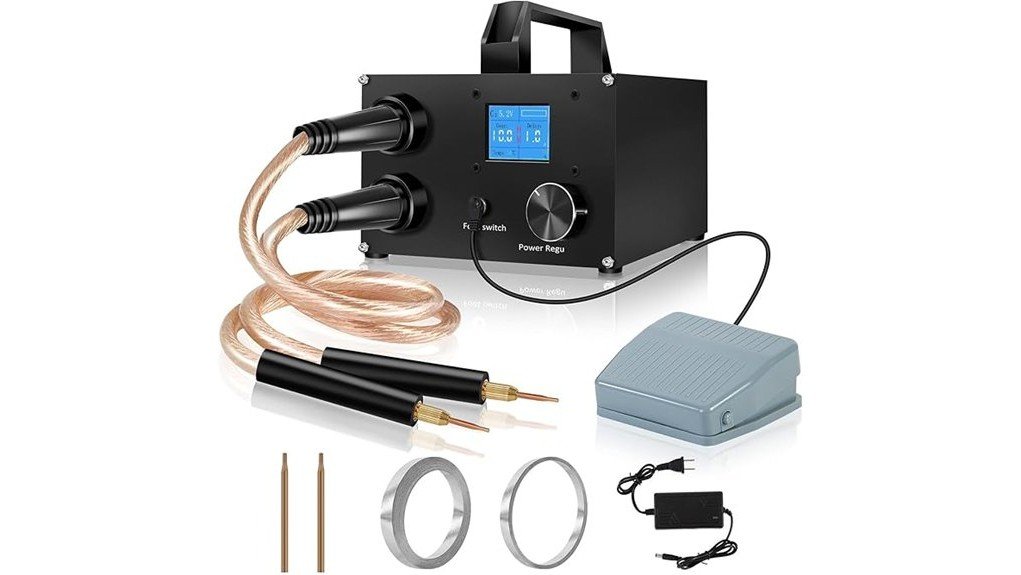
| Included Components | 4 soldering pen needles, foot switch, and 39 ft nickel sheet |
| Best Use | 18650 battery pack building, lithium-ion pack repair, and hobby electronics projects |
| Safety Note | Requires careful setup, test welds, proper insulation, and safe lithium battery handling. |
What Is the ALIESTFDNO Battery Spot Welder?
The ALIESTFDNO Battery Spot Welder is a portable capacitor-discharge welding tool made for joining nickel strips to battery cells. It stores energy in a 3000F capacitor system, then releases short high-current pulses through the welding probes.
That design makes it different from small handheld welders that rely on internal batteries. A capacitor setup can deliver strong bursts for tab welding, but you still need to match the power level to the strip thickness and cell type.
The product listing focuses on 0.1mm to 0.3mm nickel strip welding, which covers many DIY 18650 battery pack projects. It is better suited to controlled battery-tab work than general metal fabrication.
Who Should Buy It?
Best For
- DIY users building 18650 battery packs with nickel strip
- Repair technicians replacing tabs on small lithium-ion battery packs
- Electronics hobbyists who want more control than basic handheld welders offer
Skip If
- You need an industrial machine for daily high-volume production
- You want a beginner tool that needs almost no testing or adjustment
- You plan to weld thick copper, thick steel, or general shop materials
Key Feature Breakdown
3000F Super Capacitor System
The 3000F capacitor system is the main reason to consider this welder. It stores energy first, then releases it in a short burst so the weld forms quickly at the nickel strip contact point.
This approach helps reduce extended heat exposure compared with holding a constant output on the cell. That matters because lithium-ion cells can be damaged by too much heat near the terminal.
Up to 2100A Peak Output
The advertised peak output gives the welder enough strength for thin nickel strips used in battery pack assembly. You should not treat the highest setting as the default, since too much current can burn holes in nickel strip or damage the cell casing.
The safest approach is to start low, test on scrap nickel, and increase power only until the weld passes a light pull test. Strong output is useful only when you can control it.
25 Adjustable Power Levels
The 25 power levels help you tune the welder for different nickel thicknesses between 0.1mm and 0.3mm. Lower settings make sense for thinner strip, while thicker strip may need more energy.
This adjustment range is one of the better buyer benefits, because weak welds and burned tabs often come from poor calibration. You still need trial and error because nickel quality, cell surface condition, and probe pressure can change the result.
Automatic and Foot Switch Modes
Automatic contact sensing can help when you want the welder to fire after both probes touch the workpiece. Foot switch mode gives you more timing control, especially when you are lining up repeated welds across a battery pack.
Beginners may prefer automatic mode while learning probe placement. More experienced users may prefer the foot switch because it separates probe positioning from the firing action.
Display and Controls
The LCD color display gives you a clearer way to view settings than simple knob-only welders. That can make setup easier when you change strip thickness or switch between test pieces and real battery cells.
The controls still require attention. Keep the manual nearby, confirm the selected mode before welding, and avoid changing settings while the probes touch conductive material.
Build Quality and Materials
The housing is described as rugged and portable, with listing language referencing an aviation-grade aluminum shell. Some specification fields may list ABS as the material, so you should confirm the exact housing details on the current Amazon listing before buying if shell material matters to you.
The listed dimensions, 7.28 x 3.93 x 5.9 inches, make it compact enough for a bench, tool cabinet, or small repair space. At a listed 4.63 pounds, it is portable, but it is still more of a bench-top tool than a pocket-size battery welder.
The included foot switch, soldering pen needles, and nickel sheet help you start testing sooner. Still, included nickel strips may not always match the quality or purity you want for a final battery pack, so inspect and test your materials before using them in a serious build.
Before You Buy: This is a high-current battery spot welder, not a general-purpose welder. It is designed around thin nickel strip work, and poor settings, weak insulation, or bad battery handling can damage cells or create unsafe heat.
Safety and Battery Handling
Battery spot welding involves high current and lithium-ion cells, so you should treat setup as part of the job. Work in a clear area, keep metal tools away from exposed cell terminals, and never weld on swollen, leaking, punctured, or unknown cells.
Use proper eye protection, keep the probes insulated where your hands touch them, and avoid resting the probes across conductive surfaces. A short circuit can happen quickly when you work around battery packs.
The product is described with power balancing, temperature control, and alarm features. Those protections are helpful, but they do not replace safe technique, correct settings, and careful supervision.
Setup Tips Before First Use
Give the unit time to charge before your first weld, then check the display and selected mode. Do not start on a real battery pack until you have practiced on scrap nickel strip.
Use clean cell terminals and steady probe pressure. Poor contact can create inconsistent welds, sparks, or surface marks even when the power setting looks correct.
Make two small weld points per tab location when your pack design allows it. Then test the bond gently. A good weld should hold the strip without tearing away too easily, but it should not burn through the strip or leave deep damage on the cell.
Pro Tip: Keep a few pieces of the exact nickel strip you plan to use for test welds. Change only one variable at a time, such as power level, probe pressure, or pulse mode, so you can find a repeatable setting.
How It Performs in Real Use
For 18650 Battery Pack Assembly
This welder makes the most sense for 18650 pack building with 0.1mm to 0.3mm nickel strip. The adjustable output helps you dial in the weld for thin tabs without relying on one fixed power level.
For clean results, line up the strip first, hold the probes straight, and keep the weld points evenly spaced. Rushing the layout can cause crooked tabs or uneven current paths across the pack.
For Power Tool Battery Repair
The ALIESTFDNO welder can work for replacing tabs in small power tool packs when the cells and pack design are safe to service. It gives you enough control to reconnect nickel strips without soldering directly onto the cell terminal.
You should only repair packs when you understand the cell type, polarity, and battery management system layout. When the pack is damaged, swollen, or unknown, replacement is usually the safer choice.
For Learning and Hobby Electronics
Hobby users get a useful platform for learning how pulse strength, strip thickness, and probe pressure affect weld quality. The automatic mode can make early practice easier, while the foot switch gives more control as your technique improves.
The learning curve is real. Expect some weak welds and a few overpowered test spots before you find the right settings.
For Small Batch Work
For occasional small batches, the capacitor system helps keep welds more repeatable than many basic pocket-size welders. It is practical for a bench where you can prepare cells, test settings, and work at a careful pace.
It is not the right choice for production-line speed. If you need long daily runs, fixture control, cooling capacity, and professional process documentation matter more than hobby-level portability.
Common Mistakes to Avoid
Do not start at the maximum setting just because the welder advertises high output. Thin nickel strip can burn quickly, and battery casings do not tolerate careless heat or puncture damage.
Do not assume all shiny strip is pure nickel. Nickel-plated steel and pure nickel can behave differently, so test the actual strip before building the pack.
Do not weld near loose metal scraps, exposed pack wiring, or tools that can bridge battery terminals. A clean bench is a simple safety step that can prevent serious mistakes.
Pros and Cons
Pros
- 3000F capacitor system supports strong short-pulse welding
- Up to 2100A output gives useful power for thin nickel strip work
- 25 adjustable levels help you tune weld strength for 0.1mm to 0.3mm strip
- Automatic and foot switch modes suit different skill levels
- Included foot switch, spare pen needles, and nickel sheet help with setup and testing
Cons
- Requires test welds and careful calibration before real battery work
- Not suitable for thick metals, heavy copper work, or industrial production runs
- Material and voltage details should be checked on the current listing before purchase
Is It Worth the Price?
The ALIESTFDNO Battery Spot Welder sits in the practical mid-range category for DIY battery work. It offers more power control and bench stability than many simple handheld welders, without moving into full industrial equipment.
You get the most value if you build or repair battery packs often enough to benefit from repeatable weld settings. The included foot switch and nickel sheet also help reduce the number of extra items you need for first tests.
It is not the best fit if you only need one quick repair or do not want to learn safe battery welding technique. In that case, paying a battery repair professional may be safer and more cost-effective.
How It Compares to Alternatives
Compared with small battery-powered handheld spot welders, this capacitor-based unit offers stronger output and more bench-friendly control. It also avoids the storage concerns that come with some built-in battery welders.
Compared with industrial battery tab welders, it lacks the automation, fixturing, and heavy-duty duty cycle needed for production work. The ALIESTFDNO model makes the most sense when you want controlled hobby or repair use, not factory-level throughput.
Frequently Asked Questions
Can the ALIESTFDNO Battery Spot Welder weld 18650 cells?
Yes, it is designed for battery tab work, including 18650-style lithium-ion pack projects. You should use the correct nickel strip and test your settings before welding on real cells.
What nickel strip thickness does it support?
The supported range is 0.1mm to 0.3mm nickel strip. Thinner strip usually needs lower power, while thicker strip may require more careful adjustment and testing.
Is it beginner friendly?
It can work for beginners who are patient and safety-focused. You should start with scrap nickel, use low settings first, and learn how probe pressure affects the weld.
Does it work on copper strip?
This review treats nickel strip as the intended use because the product is listed for 0.1mm to 0.3mm nickel strip welding. Copper is harder to weld with many hobby spot welders, so do not buy it mainly for thick copper work unless the current listing clearly supports your material.
What comes in the package?
The listing references 4 soldering pen needles, a foot switch, and 39 ft of nickel sheet. Package contents can vary by seller or listing update, so confirm the included parts before ordering.
Should you use automatic mode or foot switch mode?
Automatic mode is helpful when you want the unit to fire after probe contact. Foot switch mode gives you more control when you want to position the probes first and trigger the weld separately.
Can it replace an industrial battery tab welder?
No, it is better viewed as a DIY, repair, and small-batch tool. Industrial workflows need higher duty cycle, fixtures, process control, and production support.
Who should skip this spot welder?
Skip it if you are not comfortable working around lithium-ion batteries, high-current tools, or exposed metal contacts. Also skip it if you need to weld thick metals or want a tool that requires no calibration.
The Bottom Line
The ALIESTFDNO Battery Spot Welder is a strong choice if you build or repair small lithium-ion battery packs and want adjustable capacitor-based welding for nickel strip. Its main strength is controlled high-current output, while its main limitation is the learning curve around settings, safety, and material testing.
Buy it if you are comfortable practicing on scrap strip and working carefully. Skip it if you need industrial duty cycles, thick-material welding, or a no-adjustment beginner tool.