Disclosure: As an Amazon Associate, we earn from qualifying purchases. If you click a link on this page and make a purchase, we may receive a small commission at no extra cost to you.
Building or repairing a battery pack requires controlled weld pulses, steady probe placement, and careful heat management. The AWithZ 9000W Battery Spot Welder UK1 is a battery-powered portable model with 100 adjustment levels, hand and foot-pedal triggering, and a listing-stated 0.1mm to 0.3mm welding range. This review explains what those features mean during real DIY use, what comes in the package, and where the product’s published specifications remain limited. Its controls and included accessories make it approachable for occasional projects, but the listing does not publish weld-current data, duty cycle, certifications, or a specific warranty period.
Quick Verdict
Rating: 7/10, recommended with caveats
Best For: DIY battery pack builders and repair hobbyists who need portable spot welding with fine output adjustment.
Bottom Line: The AWithZ UK1 offers useful control through 100 power levels, dual-pulse output, and a foot switch that frees both hands for probe placement. Its main tradeoff is limited technical documentation, so it is better for careful hobby work than production use that requires verified current, duty-cycle, and certification data.
Key Takeaways
- The verified product is the AWithZ UK1, a battery-powered portable spot welder sold under ASIN B0FGP1C7RG.
- A rotary control provides 100 adjustment levels, plus settings for trigger time, welding mode, and continuous weld count.
- You can trigger a weld by hand or with the included foot switch, which helps you keep both probes stable.
- The Amazon title states a 0.1mm to 0.3mm welding range, but results will depend on strip material, thickness, cell condition, and setup.
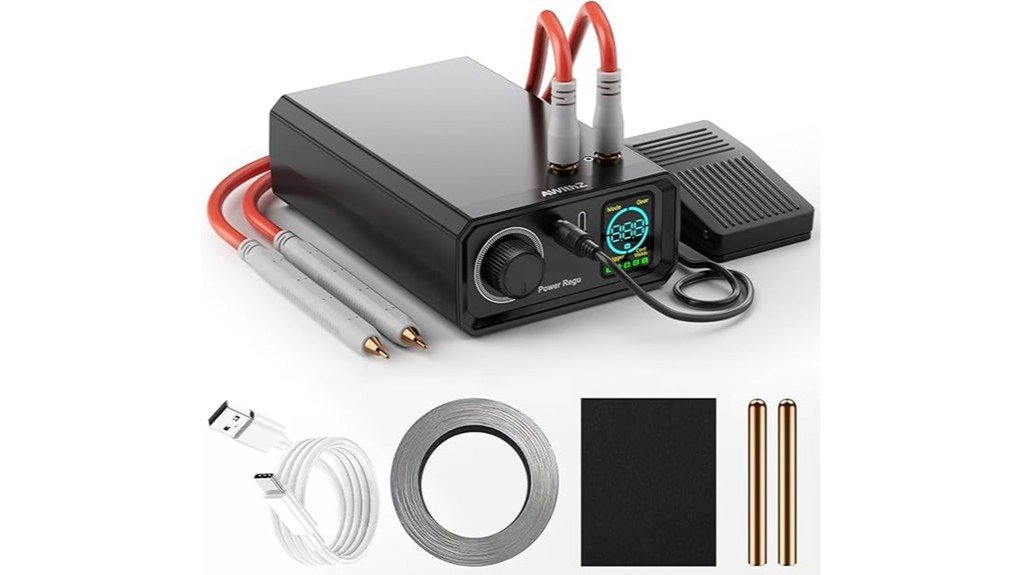
- The package includes the welder, welding pens, foot switch, charging cable, and nickel-plated sheet metal.
- The listing does not publish output-current measurements, duty cycle, safety certifications, or a defined manufacturer warranty term.
At a Glance
| Specification | Detail |
|---|---|
| Brand | AWithZ |
| Model | UK1 |
| Product type | Portable battery spot welder |
| Power claim | 9000W in the product title; measurement method is not published |
| Power source | Battery powered |
| Internal battery listing | Two lithium-polymer batteries, included |
| Output adjustment | 100 levels through a rotary knob |
| Pulse description | Dual-pulse output, according to the product title |
| Trigger options | Hand trigger and foot switch |
| Listing-stated thickness range | 0.1mm to 0.3mm |
| Package dimensions | 7.32 x 5.04 x 4.61 inches |
| Listed item weight | 1.61 pounds |
| Included components | UK1 welder, welding pens, foot switch, charging cable, and nickel-plated sheet metal |
| Available listing variants | UK1 and UK3; this review covers UK1 |
| Automatic shutoff | After eight minutes without operation, according to the listing |
| Warranty | Specific manufacturer warranty period not stated on the accessible listing |
| Best use | Occasional DIY battery-pack assembly and repair with thin strip material |
Before You Buy: Treat “9000W” as a product-title claim, not a verified continuous-output rating. The listing does not provide pulse current, pulse duration, duty cycle, independent certification details, or a defined manufacturer warranty term. Confirm the current manual and seller documentation before using the UK1 for expensive cells, thicker strip, or repeated production work.
What Is the AWithZ UK1 Battery Spot Welder?
The AWithZ UK1 is a rechargeable tool that joins thin strip to battery terminals with short electrical pulses. The listing positions it for cylindrical cells, mobile-phone batteries, and button-style batteries. Its included lithium-polymer batteries let you weld without keeping the unit connected to wall power.
The rotary knob covers 100 output levels and controls gear, trigger time, operating mode, and continuous weld count. That offers more tuning range than a basic unit with only a few presets.
The title also describes dual-pulse output, but AWithZ does not publish pulse timing or current values on the accessible page. Judge settings through controlled scrap tests and the supplied instructions, not the “9000W” label alone.
Who Should Buy It?
Best For
- DIY builders making or repairing small packs with thin nickel-plated strip.
- Hobbyists who want 100 adjustment levels rather than a few fixed power steps.
- Users who value a foot switch for two-handed probe control and repeatable placement.
Skip If
- You need published pulse-current data, duty-cycle ratings, or third-party certifications.
- You expect verified performance on pure copper, aluminum, or strip thicker than the stated 0.3mm limit.
- You run daily commercial production and need a serviceable bench machine with documented support.
Key Features of the AWithZ UK1
100-Level Power Control
The large rotary knob lets you move through 100 levels instead of jumping between a small number of presets. This matters because a setting that holds 0.1mm strip may overheat a thinner tab or fail on a different material. More steps make it easier to increase output gradually until you reach a sound weld.
Testing still matters because probe pressure, strip composition, charge level, and contact cleanliness affect the result. Start low and record settings that work.
Hand and Foot Triggering
You can activate the UK1 with its hand control or the included foot switch. Hand triggering is convenient for simple bench tests. The foot switch is more useful when alignment matters because you can hold both welding pens, keep the strip flat, and trigger the pulse without shifting either hand.
The probes still need even pressure and stable spacing. Keep the leads clear so they do not pull the workpiece out of position.
Dual-Pulse Output and Operating Modes
The title identifies dual-pulse output, while the panel adjusts mode, trigger time, and continuous weld count. These controls support repeatable work after you find a reliable setup.
AWithZ does not provide full pulse charts, which limits comparison with models that publish peak current and recommended settings. Practical testing remains essential.
Portable, Battery-Powered Kit
The listed weight is 1.61 pounds, and the package measures 7.32 x 5.04 x 4.61 inches. Those figures make the UK1 easier to store than a transformer-style bench welder. The package includes the welding pens, foot switch, charging cable, and nickel-plated sheet metal, so you can perform initial setup tests without ordering every accessory separately.
The lithium-polymer power system requires careful charging and storage. Keep the welder away from high heat and follow the manual’s charging limits.
Pro Tip: Make a small setting card for each strip type you use. Record the material, thickness, output level, probe spacing, and whether the weld passed a scrap peel test. This is more reliable than choosing a setting by thickness alone.
Performance and Weld Quality
The UK1 is designed for thin battery strip, not general metal fabrication. Its listing-stated 0.1mm to 0.3mm range covers common light-duty battery work, but that range should not be treated as a promise for every metal. Nickel-plated steel, pure nickel, copper, and aluminum conduct heat and electricity differently, so equal thickness does not mean equal welding difficulty.
Clean tips, flat strip, firm pressure, a stable cell holder, and a charged welder support consistent results. A weak weld lifts easily, while excessive output can burn through strip or heat the cell. Aim for a joint that holds during a controlled test without visible cell damage.
The listing says overheating disables the trigger and produces an alert. It also claims an eight-minute automatic shutoff. These features help, but they do not replace monitoring cell temperature.
How It Performs in Real Use
For Cylindrical Cell Packs
The foot switch is the most useful feature when you are placing strip across cylindrical cells. You can keep both probes vertical and apply even pressure before firing the pulse. The 100-level control also helps when you change between thin test strip and the final pack material.
For Small Repair Jobs
For a tab replacement or small repair, the UK1 is easier to position than a large bench welder. Identify cell chemistry, polarity, and the correct repair method before opening a pack.
For Phone and Button-Battery Tabs
The listing includes mobile-phone and button-style battery modes. Use conservative settings, avoid repeated pulses in one location, and never weld a damaged cell.
For Repeated Batch Work
The continuous-weld control may help with repeatable placement, but the listing does not publish a duty cycle or number of welds per charge. That makes the UK1 hard to evaluate for production volume. For long batches, pause as directed by the manual and monitor the tool, leads, probes, strip, and cells for heat buildup.
Setup Tips Before First Use
- Charge and inspect the unit: Follow the supplied charging instructions, then check the cable, welding pens, foot switch, and casing for damage.
- Confirm the strip material: Thickness alone is not enough. Identify whether the strip is nickel-plated steel, pure nickel, or another material before selecting a setting.
- Practice away from live cells: Use the included strip and suitable scrap to learn the controls before working on a battery.
- Keep probe tips clean: Dirty or oxidized tips increase resistance and make results less consistent. Clean or dress them only as the manual directs.
- Use stable cell holders: Prevent cells from rolling and keep loose metal away from exposed terminals.
- Increase output gradually: Move up in small steps until a test weld holds. Avoid starting at the highest setting.
- Let heat dissipate: Do not stack repeated pulses on the same spot. Stop if the cell, strip, probes, or welder becomes unusually hot.
Battery Safety and Workshop Practices
Battery spot welding uses high current around cells that can fail if shorted or overheated. Wear eye protection, remove jewelry, work on a nonconductive surface, and keep loose metal away from exposed terminals.
Reject dented, swollen, leaking, corroded, or poorly insulated cells. Use the correct terminal insulators and verify polarity before connecting a group.
Treat temperature monitoring and automatic shutoff as backups. Stop if you see smoke, misplaced sparks, damaged insulation, melting plastic, or a rapid temperature rise, then follow the cell maker’s safety guidance.
Pros and Cons
Pros
- 100 adjustment levels support gradual tuning for different strip setups.
- Hand and foot-pedal triggering give you flexible control.
- Dual-pulse output and adjustable trigger settings support repeatable testing.
- Battery-powered design is compact and easy to store between projects.
- Package includes welding pens, foot switch, charging cable, and test strip.
Cons
- The “9000W” claim lacks published current, pulse-duration, and test-method details.
- No verified duty-cycle or welds-per-charge figure is provided.
- Warranty length and independent safety certifications are not clearly stated.
Is It Worth the Price?
The UK1 is worth considering as a budget-oriented portable welder when you value fine control and an included foot switch. Its accessories and 100-level range support controlled learning and testing.
It is less convincing for professional use. Buyers who need documented current, material charts, duty cycle, service parts, or a defined warranty should choose a better-documented welder.
For occasional DIY packs, the UK1 offers useful portability and control. Limited documentation matters more when you are working with expensive cells.
How It Compares to Alternatives
The SEESII 3360W portable spot welder is worth comparing if you prefer a visual display and 1-to-99 gear control in another compact format. The AWithZ UKF10 is a more relevant step-up within the same brand if you want a supercapacitor design and published material limits for heavier strip. A full bench-top welder remains the better category choice for frequent production, replaceable electrodes, and documented duty-cycle needs.
The UK1 makes sense when you want a foot switch, welding pens, portable power, and 100-step control in one kit. Choose another model when published electrical data and service support matter more.
Frequently Asked Questions
What is the exact brand and model?
The verified Amazon product is the AWithZ 9000W Battery Spot Welder, model UK1. The same listing also shows a UK3 option, so confirm that UK1 is selected before ordering.
What thickness can the AWithZ UK1 weld?
The product title states a 0.1mm to 0.3mm range. Actual capability depends on the metal type, strip width, probe condition, pressure, and battery charge, so test your exact material before building a pack.
Can it weld pure nickel, copper, or aluminum?
The package includes nickel-plated sheet metal, but the accessible listing does not give a complete verified chart for pure nickel, copper, or aluminum. Do not assume equal performance across those materials, even at the same thickness.
What comes with the UK1?
The listing identifies the UK1 welder, a pair of welding pens, a foot switch, a charging cable, and nickel-plated sheet metal. Check the current package list when ordering because seller bundles can change.
How do you know when a test weld is strong enough?
Practice on suitable scrap and use a controlled peel test away from a live pack. A sound weld should resist lifting and leave clear attachment points without burning through the strip or deforming the cell surface.
Is the foot switch necessary?
No, the UK1 also supports hand triggering. The foot switch is useful when you want both hands on the welding pens, especially when strip alignment and even pressure are difficult to maintain.
Does it have overheat protection?
The listing says the welder monitors temperature, disables triggering, and alerts you when overheating is detected. It also states that the unit shuts down after eight minutes without operation, but you should still stop whenever the tool or cells become unusually hot.
Who should skip the AWithZ UK1?
Skip it if you need verified industrial throughput, published pulse-current data, a stated duty cycle, or confirmed performance on demanding metals. It is better suited to controlled, occasional DIY battery work with thin strip.
The Bottom Line
The AWithZ UK1 is a practical portable spot welder for careful DIY builders who want 100-level adjustment, dual-pulse operation, and a foot switch in a compact kit. Its main weakness is incomplete technical documentation, so buyers who need verified current, duty-cycle, certification, or warranty data should choose a more fully specified professional model. For occasional thin-strip battery work, it earns a 7/10 recommendation with caveats.
Ready to Buy?
Check the latest price, selected model, package contents, and warranty details before you decide.