Choosing the wrong angle-grinder abrasive can remove too much metal, leave deep scratches, overheat the workpiece, or add an extra finishing step. A flap disc is usually the better choice for controlled weld blending and a cleaner finish. A bonded grinding wheel is usually better for prolonged, heavy stock removal and rough shaping.
Quick Answer
Choose a flap disc for blending welds, smoothing edges, deburring, and preparing metal for paint or coating. Choose a bonded grinding wheel for heavy weld removal, deep beveling, and rough shaping. A flap disc offers more finish control, while a grinding wheel is generally better for sustained, aggressive grinding.
Key Takeaways
- Use a flap disc when surface finish and control matter as much as material removal.
- Use a bonded grinding wheel for prolonged heavy grinding, gouging, and rough shaping.
- Type 27 flap discs suit shallow angles, while Type 29 discs suit steeper, more aggressive work.
- The disc’s maximum RPM must equal or exceed the grinder’s no-load RPM.
- Never use a thin cut-off wheel for side grinding, and never operate an angle grinder without the correct guard.
At a Glance
| Choose a Flap Disc | Weld blending, deburring, edge smoothing, contour work, and surface preparation |
| Choose a Grinding Wheel | Heavy weld removal, rough shaping, deep beveling, and long grinding passes |
| Best Two-Step Method | Remove large weld buildup with a grinding wheel, then blend the surface with a flap disc |
| Do Not Substitute | A thin cut-off wheel is for cutting only unless its manufacturer specifically labels it for combined cutting and grinding |
What Is the Main Difference Between a Flap Disc and a Grinding Wheel?
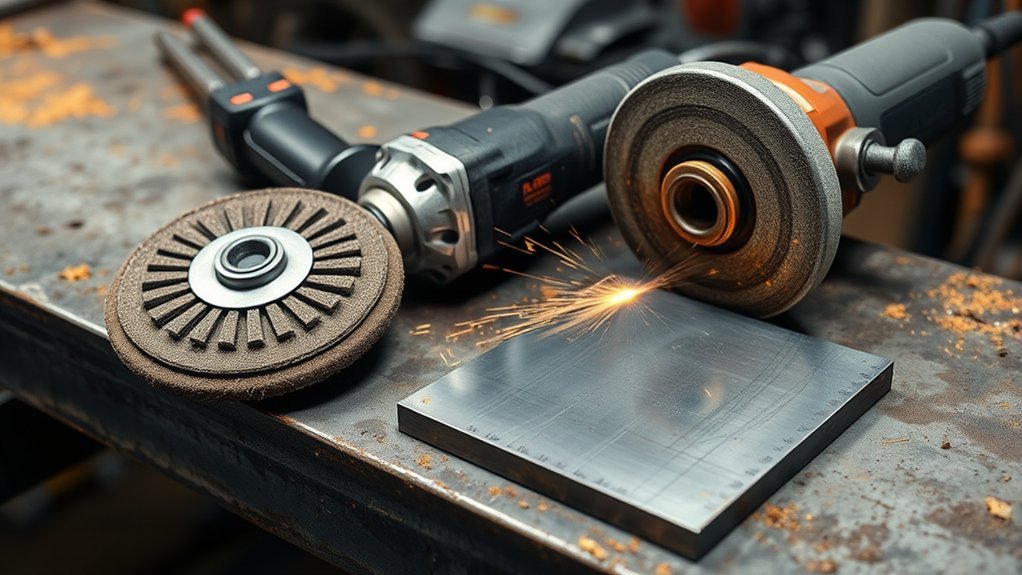
A flap disc is a coated abrasive made from overlapping pieces of abrasive cloth attached to a backing plate. As the outer abrasive wears, more abrasive grain becomes exposed. This construction lets many flap discs remove metal and leave a blended finish in the same operation.
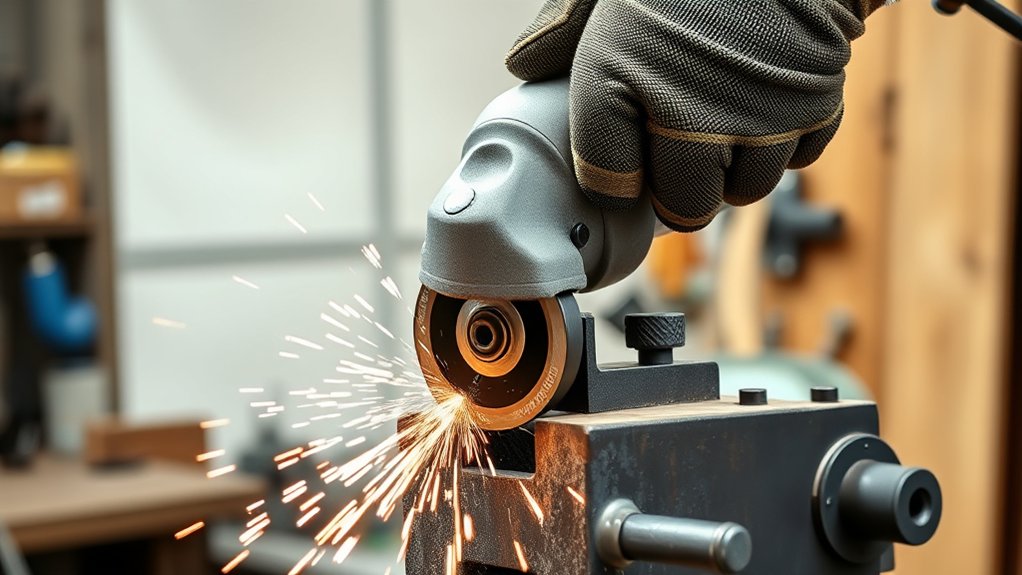
A grinding wheel in this comparison means a thick, bonded, depressed-center wheel made for side grinding on an angle grinder. Its abrasive grains are held in a rigid bond. This gives the wheel a firm grinding face suited to heavy pressure, rough shaping, and long stock-removal jobs.
The difference is not simply “slow versus fast.” Disc quality, abrasive grain, grit, grinder power, pressure, workpiece material, and operator technique all affect cutting speed. A modern coarse ceramic flap disc can remove metal quickly, but a bonded grinding wheel is generally the more durable choice when heavy removal is the only goal.
Note: A grinding wheel and a cut-off wheel are not the same. A grinding wheel is thick enough for approved side-grinding loads. A thin cut-off wheel is designed to cut with its edge and can break if you grind on its side.
What Is a Flap Disc?
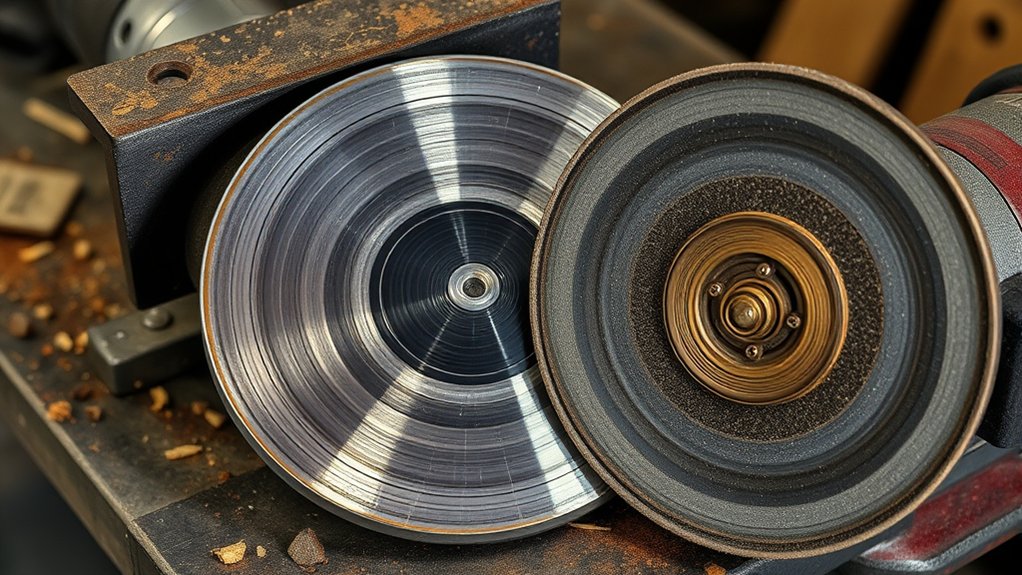
Flap discs are versatile abrasive tools used for grinding, blending, deburring, and finishing metal. Their overlapping flaps gradually wear away and expose fresh abrasive. This helps maintain a useful cut while spreading contact across a broader area than the narrow edge of a rigid wheel.
Many flap discs can handle weld removal, edge deburring, beveling, blending, scale removal, and surface preparation. For example, 3M’s flap-disc guidance lists applications ranging from weld grinding and beveling to finishing and surface preparation.
The layered face is more forgiving than a bonded wheel when you are trying to keep the surrounding base metal flat. It can follow slight curves and contours while lowering the risk of a sharp gouge. Poor technique can still remove too much metal, especially with a coarse disc or excessive pressure.
Main Benefits of Flap Discs
- Controlled removal: The disc is easier to feather across a weld or edge.
- Cleaner finish: It usually leaves a more uniform scratch pattern than a bonded grinding wheel.
- Fewer accessory changes: Many jobs can be ground and blended with one disc.
- Contour capability: The abrasive face can follow slight curves and uneven surfaces.
- Wide grit range: Coarse discs remove material, while finer discs refine the finish.
Limitations of Flap Discs
A flap disc is not automatically the best tool for every finish job. Paint, soft coatings, adhesive, and aluminum can load the abrasive and reduce its cut. A dedicated stripping disc or an aluminum-specific abrasive may work better in those situations.
Flap discs can also wear quickly when they are held at the wrong angle, pushed into a sharp corner, or used on their outer edge. Missing or lifting flaps are a reason to stop and replace the disc.
What Is a Bonded Grinding Wheel?
A bonded grinding wheel is a rigid abrasive accessory in which abrasive grains are held together by a bonding material. Angle grinders commonly use depressed-center wheels for heavy stock removal, weld grinding, bevel preparation, gouging, and rough shaping.
The rigid face tolerates sustained grinding and can offer long service life during large jobs. It also concentrates force more aggressively than a flap disc, so it can leave deeper scratches or gouges when the operator uses too much pressure or holds the wheel incorrectly.
Grinding wheels are available for different metals and applications. Always read the wheel label. A wheel intended for carbon steel may not be the right choice for aluminum, stainless steel, masonry, or another material.
Warning: Never mount a cracked, chipped, dropped, water-damaged, badly worn, or incorrectly sized wheel. Do not use a wheel that is past a manufacturer-marked use-by date or has an unreadable speed rating.
Choosing Between Grinding Wheels and Flap Discs
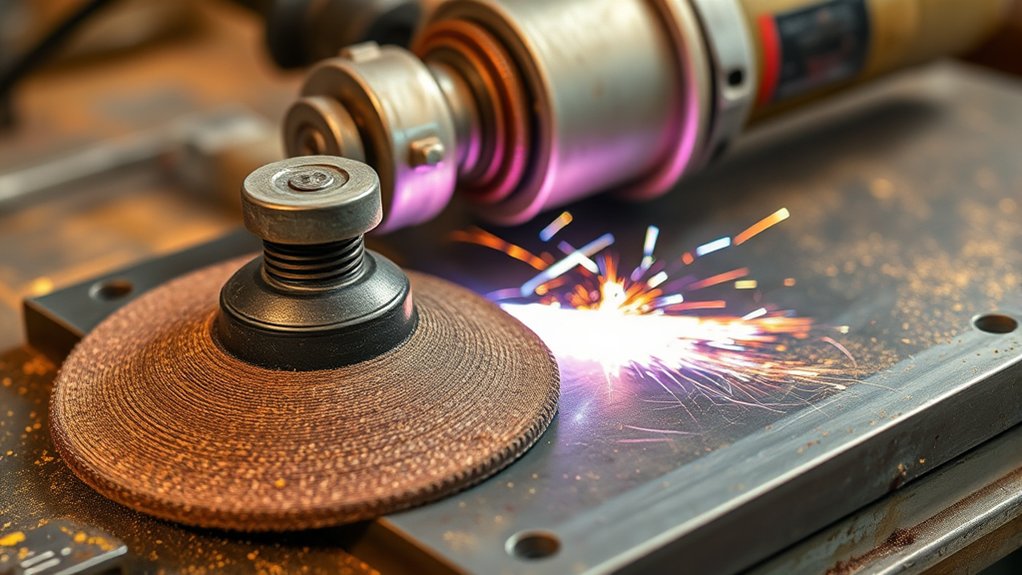
Match the abrasive to the result you need instead of choosing by habit. Consider the amount of metal to remove, the required finish, the workpiece shape, the metal type, and whether another operation will follow.
| Task or Factor | Flap Disc | Bonded Grinding Wheel |
|---|---|---|
| Heavy, prolonged stock removal | Capable with a coarse, high-performance disc, but may wear faster | Usually the better first choice |
| Weld blending | Excellent control and finish | Useful for removing large buildup before blending |
| Deep beveling or rough shaping | Suitable when the disc is rated for the task | Strong choice for aggressive work |
| Curves and contours | More conformable and easier to feather | Rigid and less forgiving |
| Finish quality | Usually smoother, depending on grit and technique | Usually rougher and may require a second finishing step |
| Risk of gouging | Lower with proper pressure and angle | Higher if held too steeply or left in one spot |
| Typical workflow | One-step removal and blending on light or moderate jobs | First pass before a flap disc or finishing abrasive |
Products Worth Considering
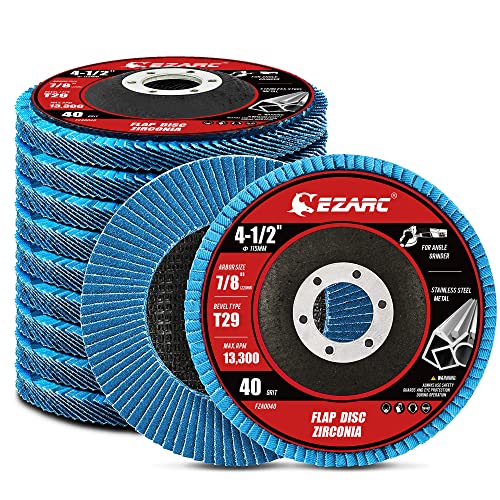
【Great Performance】EZARC flap sanding discs are made of hard zirconia material which lasts longer than standard aluminum oxide abrasive material, built for a more robust and economical grinding wheel

High performance aluminum oxide grain for long life and high material removal of the grinding wheel

Material Removal Rate
A bonded grinding wheel is usually preferred when you need to remove a large amount of metal for an extended period. Its rigid construction holds up well during heavy grinding and rough shaping.
However, do not assume that every grinding wheel is faster than every flap disc. Norton reports a controlled comparison in which a ceramic grinding wheel and a 36-grit ceramic flap disc removed the same test weld in the same amount of time. Product design and application can matter as much as accessory category.
Surface Finish Quality
Flap discs usually leave a smoother, more blended finish because many abrasive flaps share contact with the workpiece. A bonded wheel can leave deeper marks that require a flap disc, fiber disc, or surface-conditioning abrasive afterward.
The final scratch pattern also depends on grit. A 40-grit flap disc is still aggressive and will not leave the same finish as an 80- or 120-grit disc.
Control, Vibration, and Comfort
A flap disc often feels easier to feather across welds, corners, and curved surfaces. A grinding wheel feels firmer and more aggressive. Actual vibration depends on disc balance, grinder condition, mounting, pressure, and workpiece shape.
Stop immediately if a newly mounted accessory produces strong or unusual vibration. Disconnect the tool and check the disc, flange, arbor fit, guard, and grinder spindle before continuing.
Disc Life and Total Cost
Grinding wheels can provide long life during heavy, continuous grinding. Flap discs may cost more per disc than basic wheels, but they can reduce labor and accessory changes by combining grinding and blending.
The lowest purchase price is not always the lowest job cost. Consider removal speed, finish quality, disc changes, rework, and the risk of removing too much base metal.
Choose the abrasive that reaches the required finish with the fewest safe steps—not simply the disc that feels most aggressive.
Best Situations for Using Flap Discs
Use a flap disc when the finish matters as much as the cut. Common applications include:
- Blending weld beads into the surrounding base metal
- Smoothing sharp edges and burrs
- Removing moderate weld spatter
- Refining a bevel before welding
- Working across slight curves and contours
- Preparing clean metal for paint or coating
- Removing light oxidation or small surface defects
A flap disc is also useful when a grinding wheel would be too easy to dig into thin sheet metal. Work carefully because even a flap disc can thin or warp sheet when heat builds up.
Best Situations for Using Grinding Wheels
Use a bonded grinding wheel when the main goal is aggressive metal removal rather than a finished appearance. Good applications include:
- Removing thick or uneven weld buildup
- Rough shaping a heavy steel component
- Grinding a large bevel on thick plate
- Cleaning heavy flame-cut edges
- Removing casting gates or large surface projections with an approved wheel
- Long grinding passes where disc durability matters
After heavy grinding, switch to a flap disc when the surface must be blended, painted, coated, or left with a more uniform appearance.
Pro Tip: Mark the desired finished surface with a paint marker before grinding. Stop the bonded wheel just above that line, then use a flap disc to blend the last small amount without cutting deeply into the base metal.
Type 27 vs. Type 29 Flap Discs
Flap-disc shape affects how the abrasive contacts the metal. Follow the angle printed on the disc and the manufacturer’s instructions. Current Norton flap-disc guidance gives these common ranges:
- Type 27 flat flap disc: Commonly used from 0 to 15 degrees for flat surfaces, finishing, and controlled blending.
- Type 29 conical flap disc: Commonly used from 15 to 25 degrees for more aggressive stock removal, beveling, and edge work.
Do not run a flap disc completely flat unless the manufacturer specifically permits it, and do not grind with the disc’s outer edge. The wrong angle can damage the backing, overheat the adhesive, snag the flaps, or cause premature failure.
Products Worth Considering

✨【Meets All Your Needs】Our 4-1/2-inch flap disc set comes with 40/60/80/120 grits, totaling 12 packs. This comprehensive set includes 4 pieces each of 40 grit and 60 grit, along with 2 pieces each of 80 grit and 120 grit, providing a versatile selection for grinding various metals. It perfectly caters to all your grinding needs.

HIGH-DENSITY JUMBO DESIGN: Type 27 flap discs with a high-density jumbo layout support surface blending, beveling, grinding, deburring, and edge chamfering. Flat profile seats flush on workpieces for controlled material removal, ideal for professionals and DIY use

HIGH-DENSITY JUMBO DESIGN: Type 27 flap discs with a high-density jumbo layout support surface blending, beveling, grinding, deburring, and edge chamfering. Flat profile seats flush on workpieces for controlled material removal, ideal for professionals and DIY use
How to Choose the Right Grit
Grit controls both cut rate and scratch depth. Lower grit numbers have larger abrasive particles that cut more aggressively. Higher grit numbers remove less material per pass and leave a finer finish.
| Grit | Good Starting Uses | What to Expect |
|---|---|---|
| 36 or 40 | Fast weld removal, beveling, heavy edge cleanup | Fast cut with a coarse scratch pattern |
| 60 | General weld blending, deburring, moderate cleanup | Balanced removal and finish |
| 80 | Final blending, surface preparation, lighter edge work | Slower cut and finer scratches |
| 120 | Fine surface refinement before another finishing step | Light removal and a smoother finish |
These ranges are starting points, not universal rules. Abrasive type, workpiece hardness, grinder speed, pressure, and the required coating or finish can change the best choice.
Choosing an Abrasive for the Metal
Carbon and Mild Steel
General-purpose aluminum-oxide discs can work for light steel fabrication. Zirconia or ceramic abrasives often provide a stronger cut and longer useful life during weld grinding and repeated stock removal.
Stainless Steel
Use a disc specifically approved for stainless steel. Avoid using an abrasive that has already ground carbon steel because embedded carbon-steel particles can contaminate the stainless surface and contribute to later rust staining.
For appearance-critical or corrosion-sensitive work, keep dedicated grinders, discs, wire brushes, and work areas for stainless steel. Look for manufacturer markings such as stainless, INOX, or contaminant-free, and confirm the product specifications.
Aluminum and Other Soft Metals
Aluminum can clog or “load” a general-purpose abrasive. The loaded disc may stop cutting, generate more heat, and smear the surface. Use an aluminum-specific, non-loading abrasive and follow its label.
Note: A standard flap disc is not always the best accessory for paint, adhesive, undercoating, or thick scale. A dedicated stripping or surface-conditioning disc can remove coatings with less risk of changing the metal’s shape.
A Practical Weld-Cleanup Workflow
- Inspect the weld first. Decide whether the goal is removing excess reinforcement, smoothing spatter, blending the bead, or preparing for coating.
- Secure the workpiece. Clamp it so it cannot move, spin, or drop while the grinder is running.
- Remove only the high spots. Use a bonded grinding wheel when the weld has heavy buildup. Keep the wheel moving and stop before reaching the finished surface.
- Switch to a flap disc. Use a suitable coarse or medium grit to blend the remaining weld into the surrounding metal.
- Refine the scratch pattern. Move to a finer flap disc or surface-conditioning abrasive if the coating or appearance requires it.
- Inspect between passes. Check flatness, thickness, heat, discoloration, and remaining defects instead of grinding continuously.
- Clean the surface. Remove dust with a suitable vacuum or cleaning method before welding, painting, or coating.
This sequence is especially useful for weld cleanup where removing too much base metal could weaken the part or leave a visible low spot.
Safety Checks Before Using Either Disc
Angle grinders operate at high speed and can eject fragments, sparks, metal particles, and dust. Follow the grinder manual, the accessory label, workplace rules, and applicable safety standards.
Before Mounting the Disc
- Unplug the grinder or remove its battery before changing an accessory.
- Confirm that the disc type is approved for the grinder and the planned operation.
- Match the disc diameter, arbor or thread, thickness, flange arrangement, and guard type to the grinder.
- Check that the disc’s marked maximum RPM is equal to or higher than the grinder’s no-load RPM.
- Inspect for cracks, chips, bent backing, missing flaps, moisture damage, contamination, or an unreadable label.
- Do not use a disc that has been dropped or stored improperly.
- Install the correct guard and position its closed side between your body and the accessory.
- Install the side handle and use it.
OSHA’s portable-tool standard requires inspection and speed compatibility for abrasive wheels and requires the guard to be positioned to deflect fragments away from the operator.
Prepare the Work Area
- Clamp or otherwise secure the workpiece.
- Remove combustible materials from the spark path.
- Do not grind near flammable vapors, combustible dust, fuel, gas cylinders, or unprotected people.
- Use suitable ventilation or dust extraction for the metal, coating, and abrasive being ground.
- Route cords and hoses away from the disc and spark stream.
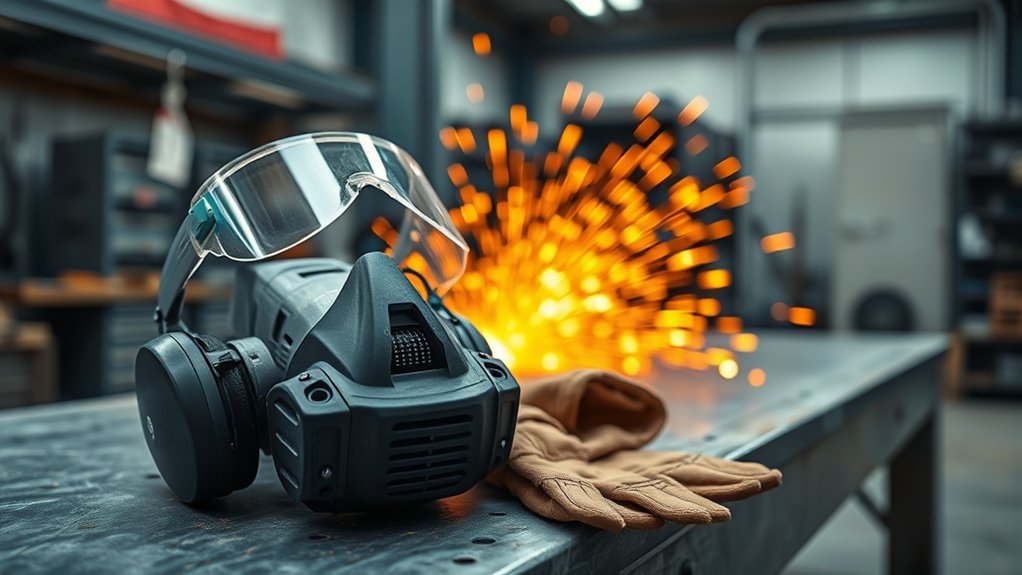
Wear the Right PPE
- Impact-rated eye protection or goggles with side protection
- A face shield worn over the primary eye protection
- Hearing protection
- Close-fitting work clothing made for the spark and heat exposure
- Suitable gloves that do not interfere with tool control
- Safety footwear
- Respiratory protection when required by the hazard assessment and applicable rules
OSHA requires appropriate eye or face protection where workers are exposed to flying particles and requires side protection where flying objects are a hazard. See OSHA 29 CFR 1910.133.
Safe Startup and Operation
- Hold the grinder with both hands and keep a balanced stance.
- Keep your body out of the accessory’s plane while it accelerates.
- Run a newly mounted disc at no load in a protected direction before touching the workpiece.
- Let the grinder reach full speed before beginning the cut or grind.
- Use the angle stated by the accessory manufacturer.
- Keep the disc moving rather than dwelling in one spot.
- Do not force, twist, jam, or sharply impact the accessory.
- Never grind with the side of a cut-off wheel.
- Wait for the disc to stop completely before setting the grinder down.
Warning: Do not remove the guard to fit a larger disc. A larger accessory may exceed the grinder’s designed capacity, guard coverage, and safe operating speed even when its arbor appears to fit.
Common Problems and Fixes
The Disc Cuts Too Slowly
Check that the disc is intended for the metal and task. A worn, loaded, glazed, or overly fine disc may stop cutting effectively. Also check grinder speed, extension-cord size, battery charge, and whether you are applying the pressure recommended by the manufacturer.
The Disc Leaves Deep Gouges
Reduce pressure, flatten the working angle within the approved range, keep the grinder moving, and avoid letting the disc’s edge dig into the metal. Switch to a finer grit once the heavy removal is complete.
The Metal Turns Blue or Distorts
Heat is building faster than the workpiece can absorb or release it. Use lighter passes, keep the disc moving, allow cooling time, and use a sharper or more suitable abrasive. Take extra care with stainless steel and thin sheet.
The Flap Disc Loads or Smears
The disc may be wrong for aluminum, paint, adhesive, or another soft material. Stop using it and choose an abrasive designed to resist loading. Do not try to restore a damaged disc by scraping it with another object.
The Grinder Vibrates More Than Normal
Stop immediately. Disconnect the power and inspect the disc for damage, poor seating, missing flaps, incorrect flanges, or an arbor mismatch. Check the grinder spindle and bearings if vibration continues with a correctly installed new accessory.
Frequently Asked Questions
When should you use a flap disc instead of a grinding disc?
Use a flap disc when you need to blend welds, smooth edges, deburr metal, follow slight contours, or prepare a surface for finishing. It gives you more control and usually leaves a more uniform finish than a bonded grinding wheel.
When should you use a grinding wheel?
Use a bonded grinding wheel for prolonged heavy stock removal, rough shaping, deep beveling, or removing thick weld buildup. Follow with a flap disc when the surface needs blending or a cleaner final finish.
Can a flap disc replace a grinding wheel?
A coarse, high-performance flap disc can replace a grinding wheel on many light and medium weld-removal jobs. A bonded grinding wheel may still be more durable and economical for long periods of heavy grinding or rough shaping.
What are three signs that a disc should not be used?
Do not use a disc with cracks, missing pieces or flaps, or heavy uneven wear. Also reject a disc that has been dropped, soaked, bent, badly contaminated, or marked with a maximum RPM below the grinder’s no-load speed.
What is the main reason for using a flap disc?
The main reason is to combine controlled material removal with blending. A flap disc can smooth welds and reduce visible grinding marks without requiring an immediate change to a separate finishing abrasive.
Can you cut metal with a flap disc?
No. A standard flap disc is designed for grinding and finishing, not cutting through metal. Use a properly rated cut-off wheel with the correct cut-off-wheel guard, and never side-grind with that thin wheel.
Can you use the edge of a flap disc?
Do not grind on the thin outer edge unless the manufacturer specifically designs and approves the disc for that use. Edge loading can damage the flaps or backing plate and may cause the disc to fail.
Which flap disc should you use on stainless steel?
Use a flap disc specifically approved for stainless steel, often marked stainless, INOX, or contaminant-free. Keep it separate from abrasives used on carbon steel to reduce the risk of surface contamination and later rust staining.
Sources
- OSHA 29 CFR 1910.243: Guarding of Portable Powered Tools — grinder guarding, wheel inspection, mounting, and maximum-speed requirements
- OSHA 29 CFR 1910.133: Eye and Face Protection — protection from flying particles and side-impact hazards
- OSHA: Safe Use of Portable and Hand-Held Power Tools — inspection, guards, startup position, PPE, and operating practices
- 3M Winning Abrasive Combinations Guide — flap-disc profiles, operating angles, applications, and material guidance
- Norton Abrasives: Do’s and Don’ts of Flap Discs — operating angles, guard use, inspection, storage, and speed matching
Conclusion
The right abrasive depends on both the amount of metal you need to remove and the finish you need afterward. Choose a bonded grinding wheel for sustained heavy removal, deep beveling, and rough shaping. Choose a flap disc for controlled weld blending, edge smoothing, contour work, and cleaner surface preparation.
Many weld-cleanup jobs use both: a grinding wheel for the high spots and a flap disc for the final blend. Whichever accessory you choose, match its size, arbor, guard, material rating, and maximum RPM to the grinder. Inspect it before every use, secure the workpiece, wear proper eye and face protection, and never use a cut-off wheel for side grinding.