You’ll see robotic welding throughout modern car manufacturing, especially in body-in-white lines where stamped panels, frames, brackets, and reinforcements must be joined the same way thousands of times. The most common high-volume method is resistance spot welding, while robotic MIG/MAG, laser welding, laser brazing, and some TIG welding handle seams, subassemblies, prototypes, and specialty parts. Robots bring speed and repeatability, but trained people still set up, inspect, maintain, and troubleshoot the work.
Quick Answer
Robotic welding in car manufacturing uses programmed robot arms, weld guns, torches, fixtures, sensors, and safety systems to join vehicle parts with repeatable speed and accuracy. Robots handle spot welds, arc welds, and some laser joining, while people manage programming, maintenance, inspection, repairs, and final quality decisions.
Key Takeaways
- Resistance spot welding is the main robotic welding method for many sheet-metal car body structures.
- Robotic MIG/MAG, laser welding, laser brazing, and TIG welding are used where the part design, material, or seam type calls for them.
- A weld robot is only one part of the cell; fixtures, controls, sensors, shielding, fume extraction, and guarding matter just as much.
- Automation improves repeatability and throughput, but it does not guarantee perfect welds without good setup, inspection, and maintenance.
- Human welders and technicians still handle complex repairs, programming, quality checks, calibration, and production problem solving.
What Is Robotic Welding in Car Manufacturing?
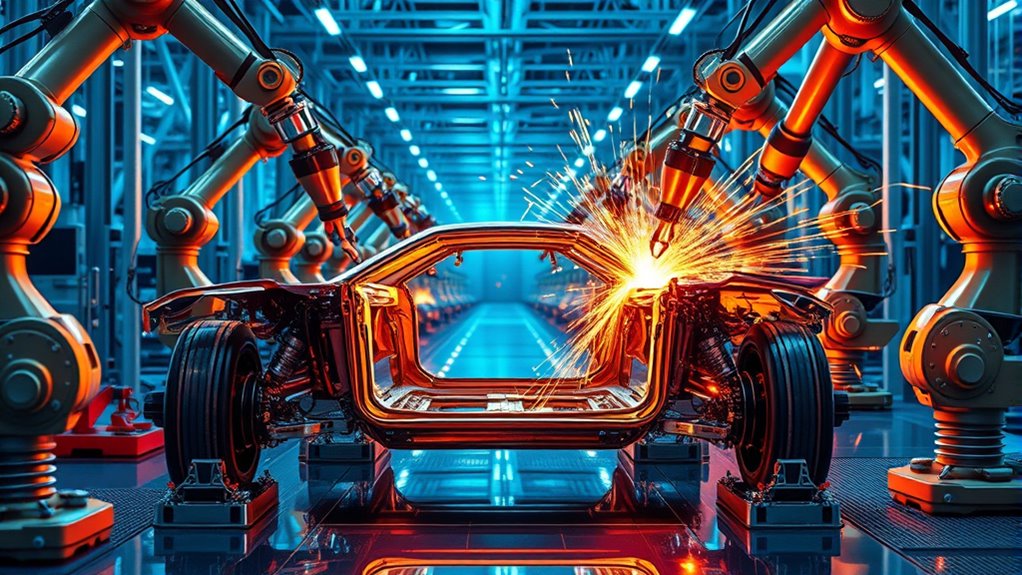
Robotic welding in car manufacturing is the use of automated robot systems to join vehicle parts by heat, pressure, filler metal, or a mix of these methods. The robot follows a programmed path or weld schedule, while tooling holds each part in a fixed position.
In a car plant, the robot may carry a resistance spot-weld gun, a MIG/MAG torch, a laser head, a brazing head, or a specialized end effector. OSHA describes industrial robot systems as more than the robot arm alone; they can include the end effector, controls, power sources, sensors, and communication interfaces that let the full cell work together.
The goal is not just speed. You use robotic welding to control variables that are hard to keep identical by hand, such as position, squeeze force, current, voltage, travel speed, torch angle, arc length, wire feed, and timing.
That control matters in high-volume production. The International Federation of Robotics reported 542,076 industrial robot installations worldwide in 2024, with automotive remaining the second-largest customer industry at 126,088 installations. That does not mean every automotive robot welds, but it shows how central automation is to vehicle production.
Robotic welding also supports lighter vehicle designs because repeatable joints help engineers control strength, distortion, and dimensional accuracy. Still, the robot only performs well when the joint design, fixture, weld schedule, and maintenance plan are right.
Note: In automotive plants, “robotic welding” often includes resistance spot welding, not only arc welding. That is why a body shop full of welding robots may look different from a fabrication shop full of MIG torches.
Main Types of Robotic Welding Used on Cars
Different parts of a vehicle need different joining methods. A door opening, rocker panel, floor pan, battery tray, exhaust bracket, and aluminum casting do not all need the same weld.
Products Worth Considering
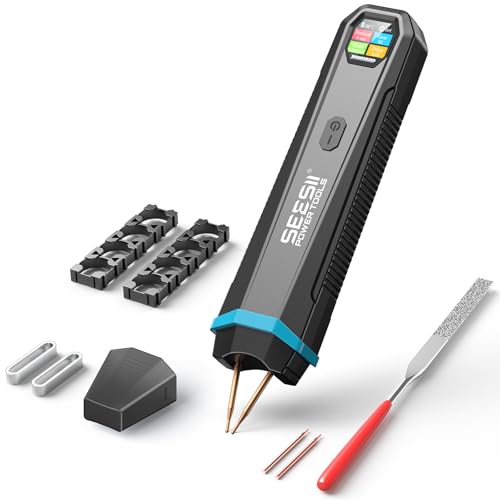
Fully Cordless: Say goodbye to tangled power cords—grab this spot welder and work anytime, anywhere; Note: For optimal performance, fully charge it to 100% before first use; If the product is left unused, please charge it monthly to preserve battery health
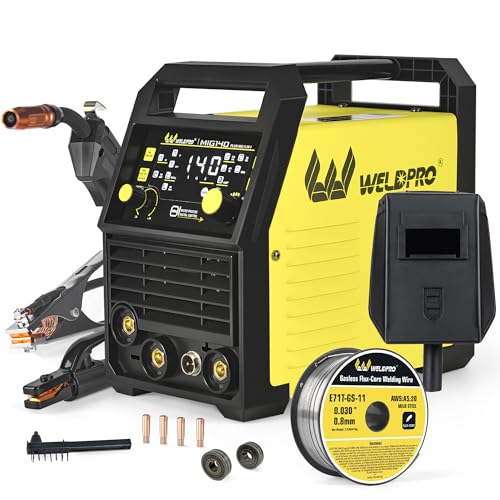
VERSATILE 5-IN-1 WELDING SOLUTIONS & INTELLIGENT CONTROL: This multifunctional welder combines SYN MIG, THI MIG, MMA (Stick), Lift TIG, and Spot Welding capabilities, making it compatible with a variety of materials including steel, stainless steel, cast iron, and mild steel. The advanced MCU intelligent control automatically adjusts voltage and wire feed speed based on material and thickness, perfect for newcomers and allowing experienced welders to fine-tune voltage with precision (±3V) for all types of DIY projects, home repairs, and workshop tasks

🚀【8000W Battery Spot Welder】:The upgraded spot welder with Dual Pulse Output, foot pedal welding mode which can easily weld 0.1-0.3mm thick nickel sheets, you can finish the welding work easily and efficiently, the welding spot is nice and elegant. Can be used for spot welding of batteries, hardware, and electronic components. Screen size is 2.5 X1 CM, Soldering pen Length is 350mm. Sot welder LXWXH 15X9.5X6 CM
Resistance Spot Welding
Resistance spot welding is the workhorse for many steel body-in-white assemblies. A robot presses copper electrodes against overlapping sheets, passes current through the joint, and forms a small weld nugget between the panels.
This method is fast, easy to automate, and well suited to repeated welds on stamped sheet metal. Research on automotive body-in-white joining describes resistance spot welding as a dominant process because it supports large-scale production and repeatable quality checks.
Robotic MIG and MAG Welding
Robotic MIG/MAG welding uses a wire-fed arc to join seams, brackets, frames, suspension parts, exhaust parts, and other subassemblies. In automotive work, MAG welding with active shielding gas is common for steel, while MIG is often used as the broader shop term.
Wire feed, voltage, travel speed, contact-tip condition, and torch angle all affect weld quality. If you also do manual work, a reliable understanding of MIG welding settings helps you see why robot programs are built around stable wire speed, voltage, stickout, and travel speed.
Laser Welding and Laser Brazing
Laser welding and laser brazing are used where speed, low heat input, small seams, or clean visible joints are important. These methods can reduce distortion, but they require precise fit-up, clean parts, and careful safety controls.
Robotic TIG Welding
Robotic TIG welding is less common for high-volume body-panel work because it is slower than spot welding or MIG/MAG welding. It may still appear in prototypes, specialty parts, thin materials, stainless components, or applications that need a very clean weld. When TIG is used, selecting the correct TIG filler rod still matters for weld integrity.
How Robotic Welding Builds Car Bodies
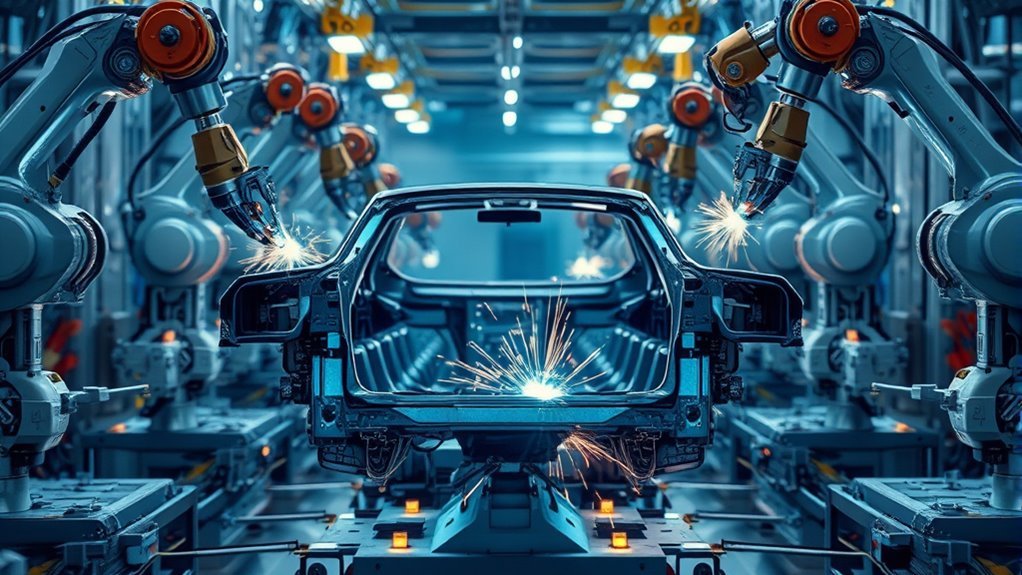
Car body assembly depends on repeatable joining. In the body shop, stamped panels move through fixtures that locate the parts before welding. Robots then join floor sections, side frames, pillars, roof rails, wheel housings, doors, liftgates, and reinforcements.
This stage is often called body-in-white production, meaning the main body shell is joined before paint, trim, glass, interior parts, and powertrain components are installed. Spot welding robots usually make many of these joints. Arc welding or laser joining may be used where a continuous seam or special joint design is needed.
The robot does not decide quality by itself. It follows a weld schedule or path set by engineers and technicians. The fixture must clamp parts correctly, the robot must reach the joint at the right angle, and the weld equipment must deliver the right current, pressure, gas flow, wire feed, or laser output.
Robots improve weld consistency because they repeat the same motion and schedule, but weld quality still depends on clean parts, correct fixturing, maintained tooling, and verified parameters.
When everything is set up well, robotic welding gives you higher throughput, tighter dimensional control, and less rework. When the setup is wrong, the same mistake can repeat quickly across many bodies. That is why modern plants combine robotics with sensors, monitoring, inspection, and human oversight.
In some lines, wire-fed welding equipment, positioners, and integrated power sources help the cell move from part to part with fewer manual steps. A compact wire feed welding setup is not the same as an automotive robot cell, but the basic need for stable wire delivery and correct power settings is shared.
What a Robotic Welding Cell Includes
A robotic weld cell is a complete system. The robot arm gets attention, but the surrounding equipment often decides whether the cell succeeds.
- Robot arm: Moves the weld gun, torch, laser head, or gripper through programmed positions.
- Controller: Stores programs, coordinates motion, and communicates with other equipment.
- End effector: The tool on the robot, such as a spot gun, MIG torch, laser head, gripper, or inspection camera.
- Fixture or jig: Holds parts in the correct position so the robot welds the same joint every cycle.
- Welding power source: Supplies current, voltage, or laser energy for the joining process.
- Wire feeder and gas system: Used for robotic MIG/MAG welding to feed filler wire and shielding gas.
- Sensors and vision: Help verify part presence, position, seam location, robot position, and sometimes weld quality.
- Fume extraction: Captures fumes and gases created during welding, cutting, or brazing.
- Safety guarding: Includes fencing, interlocks, emergency stops, light curtains, scanners, and lockout points.
- Data logging: Records weld schedules, faults, current, voltage, cycle time, and quality data for traceability.
Pro Tip: A robot cannot compensate for a bad fixture forever. If panels shift, clamps wear, or locating pins loosen, the robot may keep repeating the path while the weld quality quietly drops.
How Robots Weld Precision Car Parts
When precision car parts need dependable welds, robotic cells help control heat, position, timing, and repeatability. This is useful for brackets, subassemblies, reinforcements, frames, battery-related structures, and parts that must fit into a tight downstream assembly.
A robot can place each weld in the same location with little variation, as long as the part is loaded correctly and the tooling is maintained. Sensors may confirm that a part is present, check clamp status, identify a seam, or flag a mismatch before the weld is made.
For arc welding, the robot can maintain travel speed, work angle, push or drag angle, stickout, and weave pattern more consistently than a tired human operator. For spot welding, the system can control electrode force, weld current, weld time, and cooling time.
That consistency helps limit distortion and protects dimensional tolerances. It also makes inspection data easier to compare from one vehicle to the next.
However, precision is not automatic. Dirty surfaces, wrong gas flow, worn electrodes, poor grounding, bad fit-up, damaged tips, spatter buildup, or drifted calibration can still cause defects. Effective ventilation and PPE planning also remains important because automated welding can still produce fumes, heat, sparks, and arc hazards.
How Robots Control Weld Quality
Robotic weld quality comes from controlling the process before, during, and after the weld. The robot repeats the motion, but the full cell controls the weld.
Before the Weld
Before welding starts, the system checks part presence, clamp status, fixture position, program selection, and sometimes material or model variant. If the wrong part enters the cell, the robot may stop instead of welding the wrong location.
During the Weld
During welding, the cell may monitor values such as current, voltage, wire feed speed, electrode force, travel speed, gas flow, arc stability, or cycle time. Some systems use cameras, laser seam tracking, through-arc sensing, or distance sensors to adapt to small part variations.
After the Weld
After welding, quality checks can include visual inspection, destructive testing, ultrasonic inspection, peel tests, nugget checks, dimensional checks, and review of weld data logs. In high-volume plants, data matters because it helps find patterns before defects spread across a large batch.
Note: Sensors help, but they do not replace a weld-quality program. Automotive plants still need trained inspectors, scheduled testing, preventive maintenance, and clear rules for stopping production when weld data moves out of range.
Common Robotic Welding Defects and Troubleshooting
Robots reduce human variation, but they can repeat a problem very quickly. Troubleshooting starts with the joint, the fixture, the consumables, and the program.
- Porosity: Check shielding gas flow, leaks, drafts, contaminated material, and dirty wire or base metal.
- Lack of fusion: Review heat input, travel speed, torch angle, joint fit-up, and program path.
- Excess spatter: Check voltage, wire feed speed, contact tip condition, gas mix, stickout, and surface cleanliness.
- Missed weld location: Inspect fixture wear, part loading, calibration, robot mastering, and seam tracking.
- Weak spot welds: Check electrode force, current, weld time, electrode wear, sheet stack-up, and coating condition.
- Burn-through: Review material thickness, heat input, gap size, dwell time, and weld schedule.
- Distortion: Check weld sequence, heat input, clamping, cooling time, and part design.
The best fix is usually not one setting change. You need a repeatable process: clean parts, stable fit-up, maintained consumables, verified programs, and inspection data that shows whether the change worked.
Why Robotic Welding Improves Safety and Cost
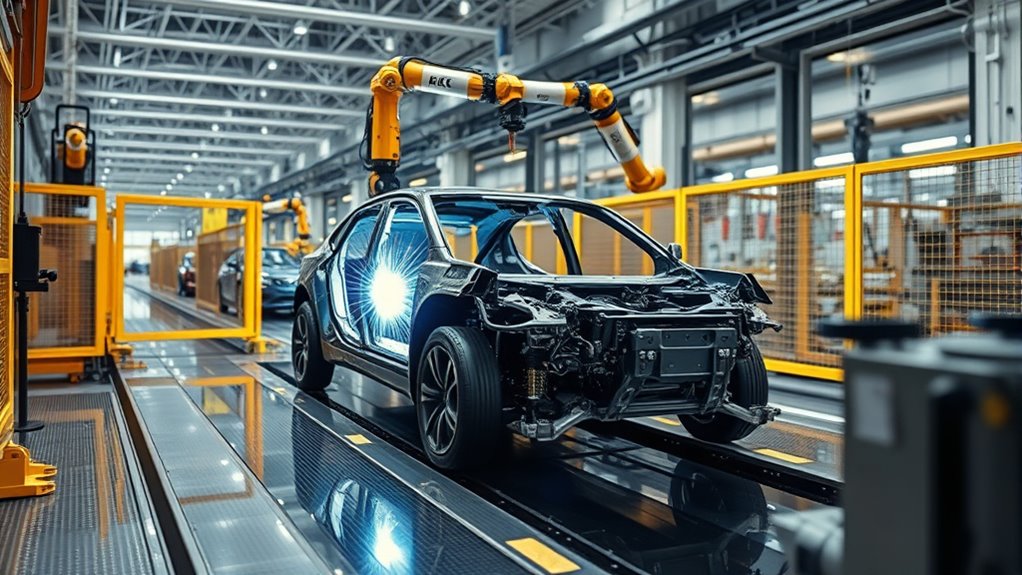
By moving workers away from the weld point, automation can reduce direct exposure to heat, sparks, repetitive motion, awkward posture, and welding fumes. OSHA covers welding, cutting, and brazing hazards, and NIOSH notes that robots can improve safety by taking on high-risk work while also creating new robot-related hazards.
You gain a safer welding environment only when the cell is designed correctly. The robot may remove a person from the arc, but it adds risks such as unexpected motion, struck-by hazards, caught-between hazards, electrical hazards, stored energy, and maintenance exposure.
Warning: Never treat a robotic weld cell as safe just because it is automated. Guarding, interlocks, lockout/tagout, fume extraction, PPE, emergency stops, and trained maintenance procedures are still required.
Cost savings can be strong when a robot cell runs enough parts to justify the investment. Savings may come from faster cycle times, fewer repeat defects, lower rework, better material use, and fewer ergonomic injuries. The best returns usually appear on high-volume parts with stable designs and repeatable fit-up.
Automation does not always pay off quickly. Low-volume custom work, frequent design changes, poor part consistency, limited floor space, or weak maintenance support can make a robotic system hard to justify. You also need to budget for fixtures, guarding, extraction, programming, operator training, spare parts, and downtime.
Fire and spark control also matters around any welding operation. A shop that already follows strong spark and fire prevention practices is in a better position to manage the added hazards of automated welding.
Robotic Welding for EVs, Aluminum, and Mixed Materials
Electric vehicles and lightweight vehicle designs are changing how automakers join parts. Steel is still important, but many vehicles now include aluminum, ultra-high-strength steel, castings, battery enclosures, structural adhesives, self-piercing rivets, flow-drill screws, laser joining, and other mixed-material methods.
Robotic welding remains important, but it is no longer the only joining answer. Some materials do not respond well to traditional spot welding. Others need special electrodes, pulse schedules, lower heat input, or a different joining method entirely.
For aluminum, heat control and surface condition are critical. Aluminum conducts heat quickly and forms oxide on the surface, so welding schedules and cleaning methods must be planned carefully. For EV battery structures, weld quality can affect sealing, crash performance, corrosion resistance, and thermal management.
This is one reason robots are valuable. They can repeat difficult heat-control and positioning tasks. But engineers still need to choose the right joining process for each material stack, not force every joint into the same welding method.
Where Automotive Welders Still Need People
Even in highly automated automotive plants, you still need people for welding tasks that require judgment, adaptability, and direct oversight. Robots are excellent at repeating a known task. People are better when the work changes, the part is unusual, or the defect needs interpretation.
Human welders, technicians, and engineers still matter in these areas:
- Manual welding on irregular components, prototypes, fixtures, and low-volume parts
- Robot setup, calibration, mastering, program touch-ups, and code changes
- Weld-quality inspection after body assembly, paint, finishing, and repair
- Electrode dressing, torch cleaning, tip changes, wire troubleshooting, and gas checks
- Root-cause analysis when a weld defect appears across multiple vehicles
- Surge-response work when a robot cell goes down or a production bottleneck appears
You’ll also rely on human inspection to catch defects that automated systems may miss, especially where paint, sealer, adhesive, scratches, or tight access makes a flaw hard to read.
In practice, automation expands your capacity, but people still direct the process, correct errors, and protect final quality.
Frequently Asked Questions
What welding robots are used in the automotive industry?
Automotive plants use articulated robots most often because their multi-axis arms can reach around body structures and fixtures. Plants may also use gantry systems, pedestal-mounted robots, robot transfer units, collaborative robots for limited tasks, spot-welding robots, arc-welding robots, laser-welding robots, and inspection robots.
How is robotics used in car manufacturing?
Robotics is used for welding, sealing, adhesive application, painting, material handling, machine tending, part transfer, inspection, fastening, and logistics. In welding areas, robots join body panels, reinforcements, brackets, frames, and subassemblies while sensors and fixtures help keep the process repeatable.
What type of welding is commonly used in vehicle manufacturing?
Resistance spot welding is one of the most common methods for sheet-metal body structures. Robotic MIG/MAG welding is used for seams and subassemblies. Automakers may also use laser welding, laser brazing, projection welding, TIG welding, adhesive bonding, riveting, and mechanical fasteners depending on the material and joint design.
Are robots replacing automotive welders?
Robots replace many repetitive weld passes in high-volume plants, but they do not remove the need for skilled people. Welders and technicians still program robots, maintain equipment, inspect welds, perform repairs, solve fit-up problems, and handle work that changes too often for a fixed automation cell.
Can robotic welding handle aluminum and EV parts?
Yes, but the process must match the material. Aluminum may need different weld schedules, surface preparation, electrodes, filler, or laser settings. EV battery trays and mixed-material structures may also use adhesives, rivets, screws, sealants, and laser joining in addition to welding.
Which newer American auto plants use a lot of robots?
A recent example is Hyundai Motor Group Metaplant America in Georgia. Hyundai describes the plant as a highly connected, automated, flexible manufacturing system that uses AI, data, robotics, vision systems, automated guided vehicles, and inspection robots. Other modern plants also use extensive robotics, but automation levels vary by line, model, and process.
Conclusion
Robotic welding is one of the main reasons modern car plants can build bodies and subassemblies with repeatable speed. Spot welding robots handle much of the sheet-metal body structure, while robotic arc, laser, and specialty welding support seams, brackets, frames, EV parts, and precision assemblies. The best results come from a balanced system: robots provide repeatability, fixtures hold accuracy, sensors and data catch problems, and skilled people keep the process safe, calibrated, and accountable.
Sources
- International Federation of Robotics, World Robotics 2025 Executive Summary — current industrial robot installation data and automotive robot adoption context.
- OSHA Technical Manual: Industrial Robot Systems and Industrial Robot System Safety — robot system components, applications, sensors, and hazards.
- OSHA Welding, Cutting, and Brazing — welding hazards, standards, and safety resources.
- CDC/NIOSH Robotics in the Workplace — benefits and risks of workplace robotics, including safety concerns around robot systems.
- Hyundai Motor Group Metaplant America Grand Opening — current example of a highly automated U.S. automotive plant using AI, robotics, vision systems, AGVs, and inspection robots.
- Improved Training Strategies for Physics-Informed Neural Networks using Real Experimental Data in Aluminum Spot Welding — research context for resistance spot welding in automotive body-in-white quality control.