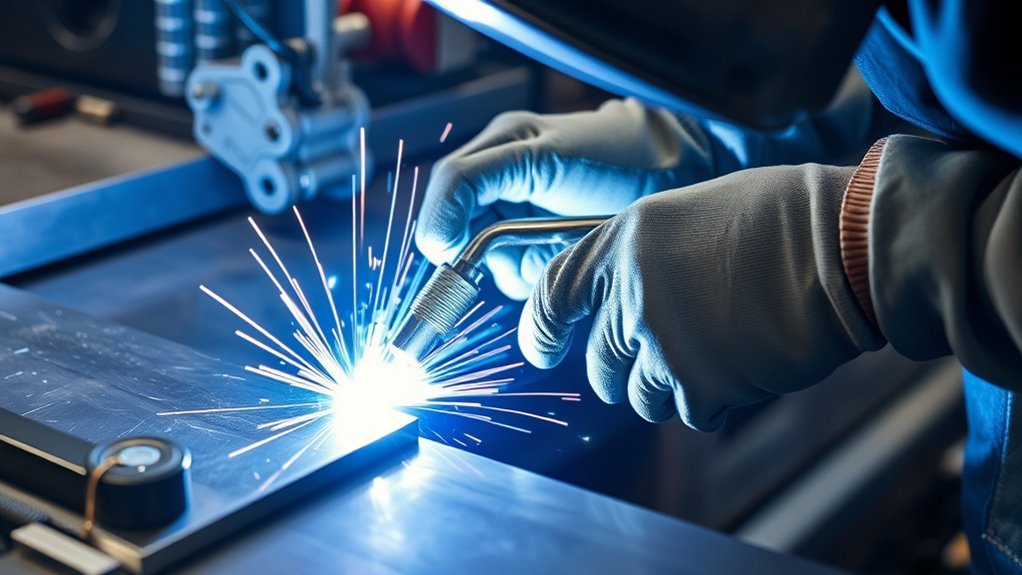
Undercoating a welded floor pan is not merely a cosmetic finishing step. It restores corrosion and abrasion protection that grinding and welding removed from the original steel. The repair must be structurally sound first, then cleaned, protected with one compatible coating system, seam-sealed, undercoated, and treated inside hidden flanges before the interior is reassembled.
Quick Answer
To undercoat a welded floor pan, verify the welds, remove rust and spatter, clean and dry both sides, then choose one compatible system. An OEM-style repair normally uses 2K epoxy primer, automotive seam sealer, underbody coating, and cavity wax. Keep drains, mounts, wiring, brakes, fuel parts, and exhaust components clear.
Key Takeaways
- Do not coat the floor pan until the welds are complete, cool, structurally sound, and free of pinholes or burn-through.
- Choose either an epoxy-primer system or a dedicated rust-encapsulator system; do not stack unrelated products in an improvised order.
- In an OEM-style repair, 2K epoxy primer normally goes on before compatible automotive seam sealer and underbody coating.
- Restore protection inside inaccessible lap joints, crossmembers, and flanges with cavity wax after the exterior coatings are complete.
- Keep factory drains, threaded mounts, wiring, brake and fuel fittings, exhaust parts, labels, and inspection points uncoated.
- Do not spray an isocyanate-based two-component bed liner without the professional ventilation, enclosure, supplied-air protection, and training required for that system.
At a Glance
| Time Required | About 6–10 hours for inspection, preparation, masking, and coating, plus the full primer, sealer, undercoating, and cavity-wax cure times stated by each manufacturer |
| Difficulty | Moderate for a nonstructural finished weld; professional repair is appropriate around seat-belt anchors, seat mounts, rockers, crossmembers, unibody rails, and other load-bearing areas |
| Tools Needed | Rated ramps or jack stands, wheel chocks, scraper, wire wheel or abrasive tool, vacuum, sanding supplies, cleaner, masking materials, seam-sealer gun, brush or approved applicator, lighting, gloves, eye and face protection, and product-specific respiratory protection |
| Cost | Roughly $75–$250 for a small brush or aerosol repair using materials already compatible with one another; tools, professional spray equipment, supplied-air PPE, and labor can increase the total substantially |
Confirm the Floor Pan Repair Is Ready for Coating
Undercoating must protect a finished repair, not conceal a weak one. Inspect the floor pan from both sides under bright light. Look for pinholes, missed welds, burn-through, cracked beads, loose plug welds, deep pitting, thin metal, sharp edges, and gaps at lap joints. Shine a strong work light from the opposite side to help reveal small holes.
Do not grind a weld completely flat merely for appearance. Remove sharp projections and spatter while preserving enough weld and base-metal thickness to maintain the repair. If rust continues into a flange, reinforcement, crossmember, rocker, or other closed structure, expose and repair that damage before applying any coating.
A patch involving a seat mount, seat-belt anchor, suspension attachment, rocker, crossmember, or unibody rail is not a generic cosmetic floor repair. Follow the vehicle manufacturer’s repair procedure for sectioning locations, weld type, adhesives, reinforcements, corrosion restoration, and dimensional checks. Have uncertain structural work inspected before hiding it beneath seam sealer or undercoating.
Warning: Support the vehicle on a level, solid surface using rated ramps or safety stands at the manufacturer-approved support points. Chock the wheels and set the parking brake when appropriate. Never work underneath a vehicle supported only by a hydraulic or scissor jack.
All welding, cutting, and grinding must be finished before flammable primer, seam sealer, rust coating, cavity wax, or undercoating is applied. Remove carpet, padding, insulation, loose sound deadener, wiring clips, and other heat-sensitive materials from both sides of the repair. Check behind panels and inside nearby cavities for glowing debris, melted insulation, or smoldering material before beginning chemical preparation.
Tools, Materials, and Safety Gear
Gather the complete coating system before starting. Primer, seam sealer, rust encapsulator, topcoat, and undercoating are not automatically compatible merely because each product can be used on automotive steel.
- Rated ramps or jack stands, wheel chocks, and a suitable floor jack if the vehicle must be raised
- Work lights for inspecting both sides of welds and finding pinholes
- Scraper, wire wheel, file belt, grinder, and abrasives rated for the tool’s maximum speed
- 60–80 grit abrasive for initial cleanup, plus any additional grit required by the selected coating system
- Vacuum, lint-free rags, and the cleaner specified by the primer or rust-coating manufacturer
- 2K epoxy primer for a conventional OEM-style repair, or a complete rust-encapsulator system where appropriate
- Weld-through coating only for mating surfaces that still need to be welded
- Automotive seam sealer approved for floor pans and compatible with the selected primer
- Paintable rubberized or water-based undercoating, hard-curing underbody coating, or interior floor coating
- Automotive cavity wax and an applicator wand for hidden flanges or boxed areas
- Masking tape, masking paper, plastic sheeting, plugs, and temporary bolts for protecting threaded holes
- Chemical-resistant gloves, protective clothing, safety glasses, a face shield for wire-wheel or grinding work, and respiratory protection required by each product’s SDS
Note: Use one documented coating system. Confirm each product’s approved substrate, required primer, sanding range, flash time, recoat window, maximum film thickness, temperature range, and topcoat compatibility before opening the containers. When combining brands, test the complete layer stack on scrap metal or a small noncritical area first.
Products Worth Considering
![[2-Pack] Berkland Polyurethane Seam Sealer, Black - Paintable Auto Body](https://m.media-amazon.com/images/I/4184QW8Um7L._SL500_.jpg)
PROFESSIONAL AUTOMOTIVE SEAM SEALER — BLACK — WON'T SHRINK OR CRACK — Polyurethane formula in black seals body panel seams, weld joints, and gaps with a durable, flexible compound. Black color blends with dark undercarriage surfaces, rocker panels, and wheel wells where visible sealant lines need to disappear.

PROFESSIONAL AUTOMOTIVE SEAM SEALER — BLACK — WON'T SHRINK OR CRACK — Polyurethane formula in black seals body panel seams, weld joints, and gaps with a durable, flexible compound. Black color blends with dark undercarriage surfaces, rocker panels, and wheel wells where visible sealant lines need to disappear.
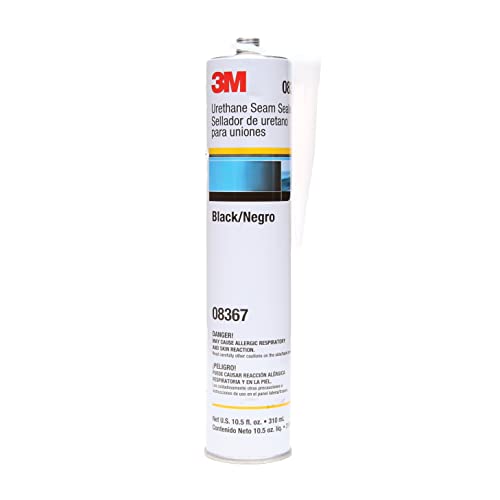
SINGLE COMPONENT FORMULA: Adheres well to bare metal, primed metal and painted surfaces
How to Undercoat a Welded Floor Pan in the Right Order
For a typical finished repair, the safest working order is:
- Support the vehicle safely and remove nearby trim, insulation, wiring, and flammable material.
- Inspect the welds and repair every hole, weak edge, and rusted section.
- Remove spatter, scale, loose coating, grease, and dust from both sides.
- Choose either an epoxy-primer system or a dedicated rust-encapsulator system.
- Prime or rust-seal the steel according to that system.
- Apply compatible automotive seam sealer to welded joints and lap seams.
- Mask service parts, drains, mounts, labels, and hot components.
- Apply the approved underbody or interior coating in the specified coats.
- Apply cavity wax inside hidden flanges and closed sections after exterior coatings are complete.
- Allow full curing, inspect the repair, and test-fit all hardware before final reassembly.
Step 1: Prepare the Welded Floor Pan
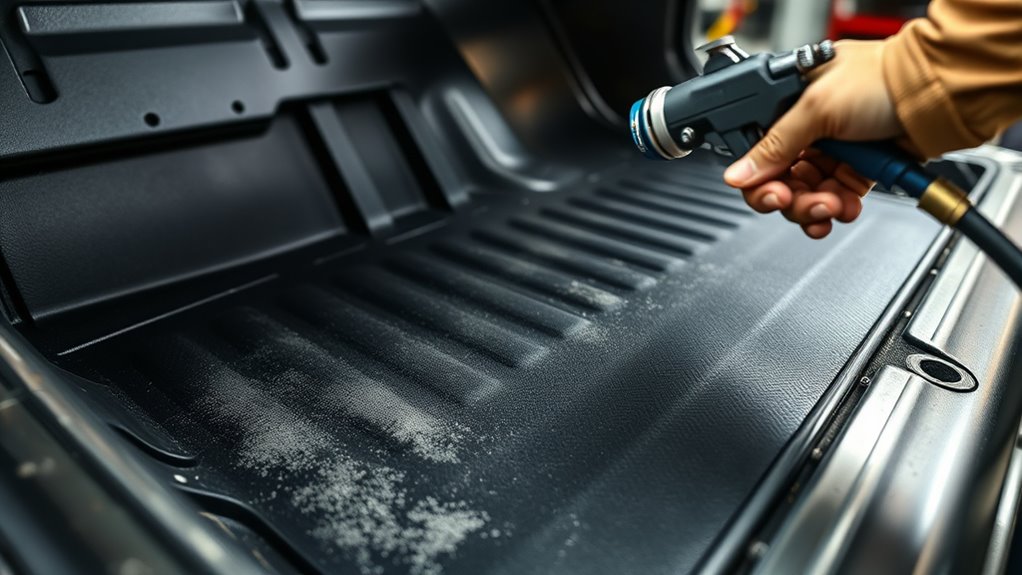
Begin with mechanical cleanup. Scrape away loose seam sealer, damaged undercoating, slag, and weak paint around the repair. Use a wire wheel, file belt, or suitable abrasive to remove surface rust and spatter from patch edges, plug welds, corners, and lap joints.
Use only wheels and brushes rated for the tool speed, and wear eye and face protection. Wire strands can break free at high speed. Work carefully around thin sheet metal, brake and fuel lines, wiring, and factory reinforcements.
Sand the prepared area enough to provide the surface profile required by the selected primer or rust coating. Sixty- to 80-grit abrasive is useful for initial cleanup, but the product instructions control the final grit. Feather sound surrounding paint rather than leaving a sharp coating edge.
Vacuum the area instead of blowing contaminated dust through the cabin. Wipe the metal with the cleaner approved for the selected coating system. Do not substitute a solvent cleaner when a water-based rust-treatment system specifically prohibits it.
Dry the panel and every lap seam completely. Use time, moving air, or clean oil-free compressed air where appropriate. Do not apply extra heat until flammable cleaner vapors have been fully removed, and do not direct uncontrolled heat toward fuel-system parts, wiring, insulation, or seam cavities.
Pro Tip: Wipe the prepared floor pan with a clean white rag. Black grinding dust, brown residue, oil, or loose particles on the rag mean the surface needs more cleaning before it is ready for primer or seam sealer.
Step 2: Choose the Correct Primer or Rust-Coating System
The primer or rust coating is the foundation of the repair. Do not apply epoxy primer and then add a rust encapsulator as an extra layer unless both manufacturers expressly approve that sequence.
Products Worth Considering
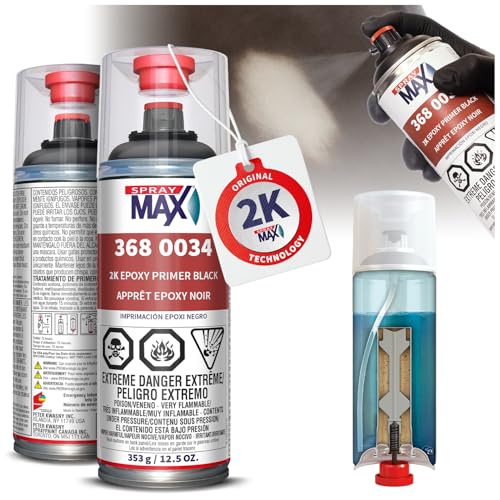
SUPERIOR CORROSION PROTECTION: This epoxy primer automotive coating provides excellent adhesion and rust protection on steel, aluminum, and galvanized metal surfaces – ideal for cars, motorcycles, and restorations.


SUPERIOR CORROSION PROTECTION: This epoxy primer automotive coating provides excellent adhesion and rust protection on steel, aluminum, and galvanized metal surfaces – ideal for cars, motorcycles, and restorations.
Use an Epoxy-Primer System for a Normal Finished Repair
When welding is complete and the steel can be cleaned to a sound surface, a conventional OEM-style system normally uses a compatible 2K epoxy primer before seam sealer and underbody coating. Current 3M collision-repair guidance recommends applying its seam sealers over 2K primer or e-coat for added corrosion protection.
Mix and apply the epoxy primer at the ratio, film thickness, temperature, and flash time specified in its technical data. Prime the repair far enough past the weld to cover all exposed steel and feathered coating edges. Do not flood lap joints with a heavy coat that cannot cure or vent properly.
Check the seam-sealer technical data before choosing an etching primer. For example, the current 3M OEM Match Epoxy Seam Sealer data sheet recommends 2K epoxy or 2K urethane primer and states that acid-etch primer should not be in direct contact with that sealer.
Use Weld-Through Coating Only Before Welding
Weld-through coating protects mating surfaces that will become inaccessible after panels are joined. Apply it before welding only where the chosen welding procedure requires it. The 3M Weld-Thru II product information identifies it as a zinc-based coating for metal surfaces that will be spot- or MIG-welded.
Follow the welding-product directions at plug-weld locations. Some weld-through coatings must be removed from the exact weld site to obtain reliable penetration and conductivity while remaining on the surrounding hidden flange. After welding, remove loose, scorched, or contaminated residue from accessible surfaces and restore the finished coating system.
Use POR-15 or Another Rust Encapsulator as Its Own System
A rust encapsulator can be useful on sound but pitted or seasoned metal that cannot be returned completely to clean bright steel. It is not a replacement for cutting out perforated, weak, or structurally compromised metal.
For POR-15 specifically, follow the manufacturer’s complete Rust Preventive Coating system. Remove loose scale and weak paint, degrease with the specified water-based cleaner, use the required metal preparation, rinse as directed, and allow the metal and all seams to dry completely.
POR-15 currently recommends roughening smooth or new metal with approximately 100–180 grit abrasive and applying two thin covering coats. Apply the second coat while the first is dry but still slightly tacky. If the first layer has fully cured, wait at least 24 hours and scuff it with a maroon pad or approximately 280–320 grit abrasive before adding another coat or topcoat.
Do not coat ordinary primer with POR-15 merely to add another barrier. The manufacturer states that the coating loses its direct-metal benefit when placed over other paint. Before adding seam sealer, primer, undercoating, or bed liner over any rust encapsulator, obtain written compatibility and recoat instructions for the complete layer stack.
Step 3: Seal the Floor-Pan Welds and Seams
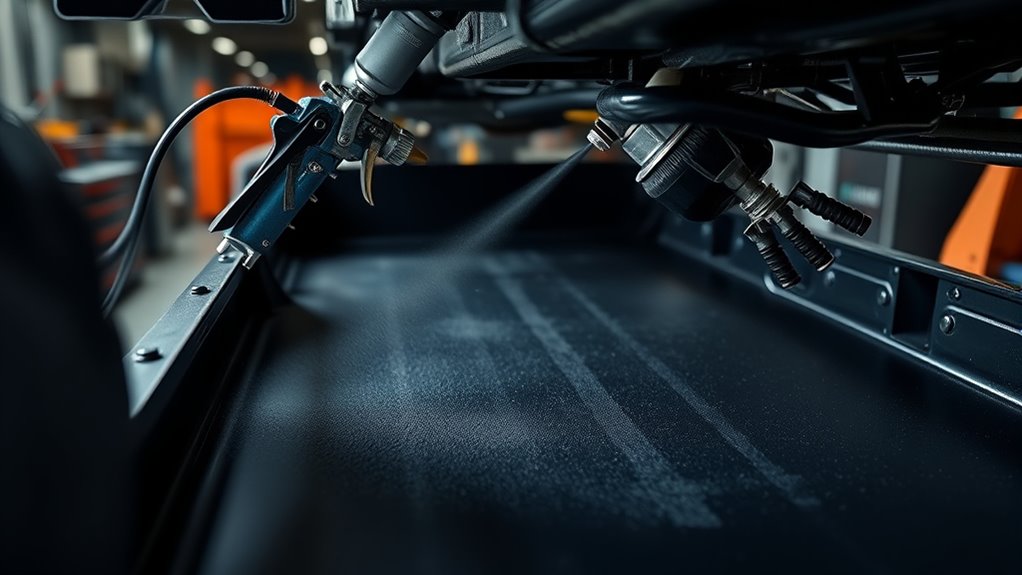
Apply automotive body seam sealer to every repaired lap joint, patch edge, plug-weld row, and factory-style seam that originally required sealing. Use a product approved for interior and exterior automotive body seams rather than household caulk.
Many seam sealers can adhere to properly prepared bare or primed steel, but the preferred substrate is product-specific. For an OEM-style epoxy system, allow the primer to reach its stated seam-sealer window, then apply the compatible sealer over the primed joint.
Lay a steady bead and tool it into the joint so it bridges the patch edge and closes water paths without leaving air pockets. Cover the seam continuously, but do not bury an unrepaired pinhole under a thick bead. Seam sealer is a moisture barrier, not a structural filler.
Seal both sides where the original construction and access permit it. Keep factory drain openings, threaded holes, body plugs, seat mounts, seat-belt anchors, and inspection points clear. Do not create new drainage holes unless the vehicle maker’s repair information permits them.
Observe the working time, skin time, paint time, and full cure time. A surface may feel dry while uncured material remains underneath. Applying a heavy coating too soon can trap solvent, soften the seam, or cause lifting.
Step 4: Protect Hidden Flanges With Cavity Wax
Grinding and welding can burn away corrosion protection from the inaccessible side of a flange even when the visible surface is fully primed. Floor pans, spare-tire wells, crossmembers, extensions, rockers, and reinforcement pockets may therefore need cavity wax after the visible coatings are complete.
The current 3M floor-repair quality-control guide lists cavity wax as part of floor-pan and crossmember corrosion restoration alongside weld-through coating, seam sealing, and undercoating.
- Finish all welding, priming, seam sealing, painting, and undercoating first.
- Use existing body plugs or approved access openings whenever possible.
- Insert the cavity-wax wand far enough to reach the back of welded flanges and boxed sections.
- Withdraw the wand slowly while spraying to leave an even film.
- Keep factory drains, electronics, connectors, hot exhaust areas, brake parts, and trim attachment points clear.
- Replace all access plugs after the wax has settled as directed.
Do not drill an access hole unless the vehicle repair procedure allows it and provides a safe location. A poorly placed hole can weaken the panel, enter a wiring path, expose the cabin, or create another corrosion point.
Step 5: Mask Areas You Should Not Undercoat
Masking protects safety-critical, heat-sensitive, and serviceable parts from overspray or heavy coating buildup.
- Exhaust pipes, catalytic converters, mufflers, oxygen sensors, and heat shields
- Brake rotors, drums, pads, shoes, calipers, parking-brake mechanisms, hoses, and line fittings
- Fuel hoses, fittings, vents, connectors, tank service points, and identification labels
- Wiring, ground points, battery cables, connectors, sensors, harness clips, and grommets
- Factory drains, body plugs, threaded holes, studs, seat mounts, and seat-belt anchor threads
- Rubber bushings, moving suspension or steering joints, driveshaft parts, and grease fittings
- VIN stampings, service labels, inspection marks, and areas needed for future structural inspection
Temporary bolts or sacrificial plugs can protect threaded holes, but remove them before the coating hardens around the fastener. Test-fit seat hardware, body plugs, and trim clips before final curing if heavy interior coating will be used.
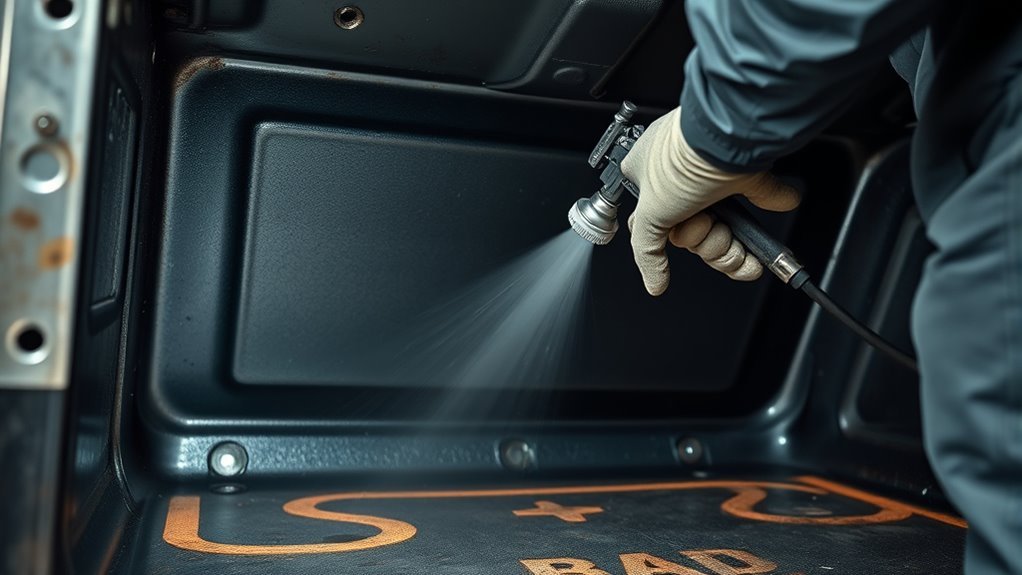
Step 6: Apply the Undercoating or Floor Coating
Choose the finish according to location, abrasion exposure, future service needs, and the original vehicle construction.
- Paintable water-based or rubberized undercoating: Useful for restoring a flexible, textured finish on floor pans, wheel housings, and underbody sections.
- Hard-curing underbody coating: Provides a firmer abrasion layer but may chip if applied too thickly or over a flexible, poorly cured base.
- Roll-on interior coating or bed liner: Creates a durable, washable interior surface but adds thickness and can make later inspection or removal difficult.
- Cavity wax: Protects hidden panel backs and flanges; it is not an exposed abrasion coating.
Some undercoatings are approved for direct application to prepared bare metal, while others require primer or existing paint. For example, 3M No Cleanup Waterbased Undercoating is listed for direct-to-metal use and floor-pan applications. The technical data for the exact product always controls.
Apply several controlled coats rather than one heavy layer. Maintain the specified nozzle distance, overlap, film thickness, and flash time. Excessive buildup can sag, trap solvent, remain soft, hide drain openings, and interfere with reassembly.
Protect the Underside From Water, Salt, and Gravel
The underside receives direct water spray, road salt, grit, and stone impact. Extend the coating slightly beyond the prepared repair onto sound, properly abraded surrounding material so there is no exposed edge where moisture can enter.
Build an even finish over patch edges and sealed welds without coating components that move, heat up, drain water, or require inspection. Check overhead corners, brackets, lap edges, and the back of flanges for dry spray or missed spots.
A thick bed-liner shell is not automatically better than an OEM-style underbody coating. Use it only when the product is compatible with the complete repair system and the added thickness will not hide required inspection areas or interfere with service.
Coat the Floor-Pan Interior for Easy Cleaning
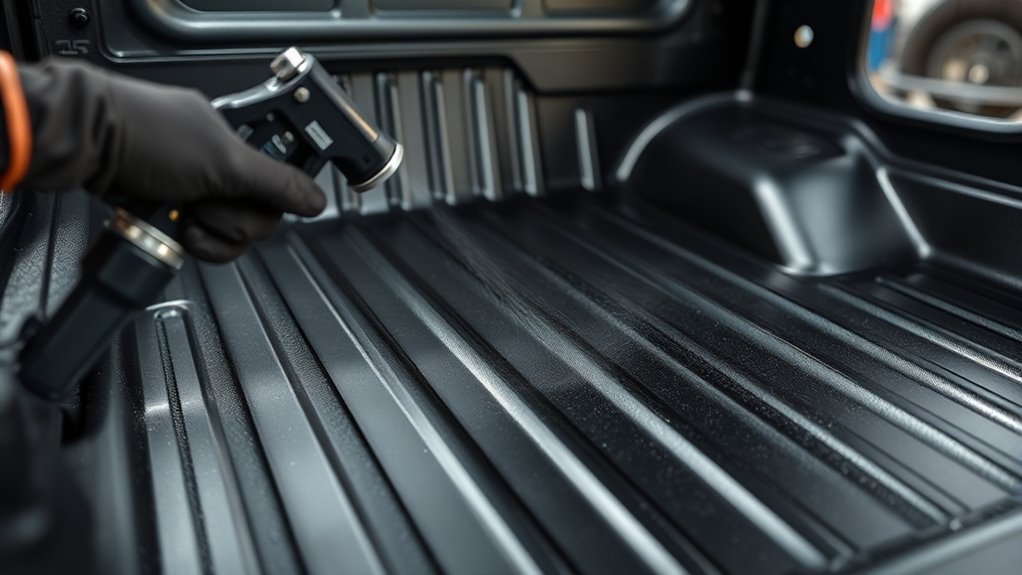
An interior floor coating can provide a washable surface and additional protection beneath removable carpet or in a utility interior. The metal must still be structurally sound, primed or rust-treated as required, and fully seam-sealed first.
- Mask seat, seat-belt, console, trim, wiring, and body-plug mounting points.
- Apply the approved interior coating in thin, uniform coats.
- Keep factory drains and ventilation paths open.
- Avoid heavy buildup where carpet, padding, seats, trim, and wiring channels must fit.
- Allow the full chemical cure and odor-off-gassing period before installing absorbent padding or carpet.
Test-fit hardware before final assembly. Seat and seat-belt fasteners must sit against their intended mounting surfaces and receive the vehicle manufacturer’s specified fasteners and torque.
Brush or Roll the Coating
A brush or small roller provides good control around patch edges, brackets, corners, and seams. Confirm that the primer, rust coating, and seam sealer have reached the required recoat stage before beginning.
- Load the brush or roller lightly.
- Cover corners, weld edges, and seams first.
- Spread a thin, continuous coat over the flat sections.
- Inspect from several angles for pinholes and missed edges.
- Allow the required flash or cure period before the next coat.
Do not continue brushing after the material begins to tack. Reworking a partially cured film can pull it away from the surface and create thin areas.
Spray Application Safety
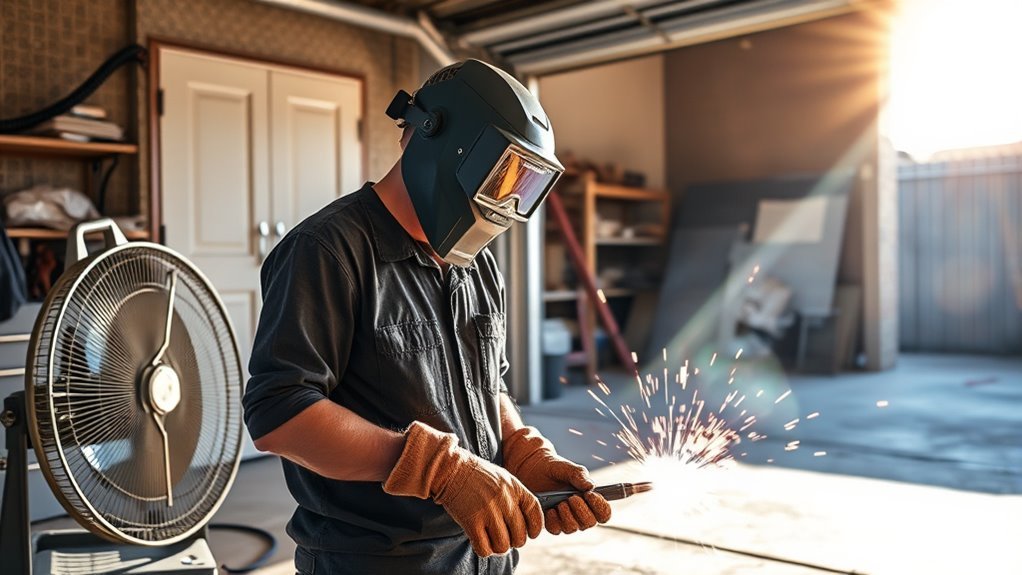
Warning: Spray only with the ventilation, enclosure, ignition control, PPE, and respiratory protection required by the product. Do not assume an open garage door or a cartridge respirator makes every coating safe to spray.
OSHA spray-finishing rules require mechanical ventilation capable of removing flammable vapor, mist, and residue to a safe location during spraying and for sufficient time afterward. Keep smoking materials, pilot lights, heaters, sparks, and open flames away from the spray area.
Two-component polyurethane or polyurea bed liners may contain MDI isocyanates. NIOSH guidance for MDI-based spray-on liners calls for an exhausted enclosure, protective clothing, trained workers, and a full-face supplied-air respirator during spray application. Have this type of coating professionally applied when those controls are unavailable.
For a product that is suitable for DIY aerosol spraying, hold the nozzle at the stated distance, overlap each pass evenly, and avoid heavy wet coats. Direct exhaust away from people, doors, windows, HVAC intakes, ignition sources, and any compressor supplying breathing air.
Store and dispose of coating waste, used filters, contaminated masking, and solvent-soaked rags according to the product label and local hazardous-waste requirements.
Step 7: Let the Coating Cure Before Reassembly
Dry-to-touch time is not the same as full cure. Seats, carpet, insulation, body plugs, and wiring can press into a film that feels dry but has not developed full strength.
- Keep the repair dry and within the product’s specified temperature and humidity range.
- Maintain safe ventilation while solvents or reaction products leave the coating.
- Do not place padding, carpet, or trim against the surface until full cure is reached.
- Inspect the interior and underside under bright light after curing.
- Touch up thin spots, exposed edges, and coating damage using the approved repair method.
- Verify that drains, plugs, wiring paths, grounds, labels, seat mounts, and seat-belt anchors remain clear.
- Test-fit and reinstall hardware using the correct fasteners and vehicle-specific torque specifications.
If cavity wax is part of the repair, apply it at the stage specified by its manufacturer, normally after the exterior paint, seam sealer, and underbody coatings are complete and no further welding or heating will occur.
A durable floor-pan repair is a complete corrosion-protection system: sound metal, protected welds, sealed seams, an abrasion-resistant outer coating, and cavity wax on hidden surfaces.
Final Inspection and Maintenance
Inspect the repair again after the first drive once the coating has fully cured. Look for contact with exhaust parts, rubbing wiring, blocked drainage, loose plugs, or coating that has softened near a heat source.
Check the underside at least once a year and after a winter of salted-road use, deep mud, gravel driving, off-road impacts, or underbody repair. Clean damaged areas, remove loose coating, prepare the exposed edge, and restore the same compatible coating system before corrosion spreads underneath it.
Troubleshooting Common Undercoating Problems
Stop adding material when the finish develops a defect. More coating usually hides the cause instead of correcting it.
- Fish-eyes or craters: Oil, silicone, wax, moisture, or incompatible cleaner remains on the surface. Remove the affected coating to a sound edge, clean with the approved product, and reapply.
- Peeling or lifting: The substrate may be glossy, contaminated, under-cured, or incompatible. Remove loose material, feather the edge, abrade, clean, and rebuild the approved layer system.
- Soft or tacky coating: The film may be too thick, too cold, poorly mixed, or outside its recoat window. Allow the manufacturer’s maximum recovery time or remove and replace the soft material.
- Rust bleeding through: Moisture, scale, weak metal, or rust remained beneath the coating. Strip the affected section, repair the steel, dry the seams, and restore the system.
- Cracked seam sealer: The seam may still be moving, the substrate may be poor, or the wrong sealer may have been used. Remove loose material and inspect the weld before resealing.
- Bubbles in a rust coating: The coating may be too heavy, the substrate may still be wet, or humidity may be outside the product limit.
- Clogged drain holes: Reopen only the original factory drains without enlarging or creating new structural holes.
- Coating near an exhaust part softens or smells: Remove it from the hot zone and restore any required heat shield or clearance.
- Corrosion returns inside a lap joint: The hidden flange may not have been protected. Open the repair if necessary, correct the rust, and apply approved cavity protection.
Frequently Asked Questions
Where should you not spray undercoating?
Do not spray undercoating on exhaust parts, brakes, fuel fittings, wiring, connectors, ground points, moving joints, rubber bushings, factory drains, threaded mounts, seat-belt anchors, VIN stampings, service labels, sensors, or areas needed for future inspection. Mask these locations before coating.
What is the best seam sealer for floor pans?
Use an automotive body seam sealer approved for floor pans and for the substrate beneath it. Two-part epoxy, polyurethane, and MS polymer products are common, but their primer requirements, working times, flexibility, and paint windows differ. Match the sealer to the primer and topcoat technical data rather than choosing by chemistry alone.
Can you spray undercoating on bare metal?
Only when the exact undercoating is approved for direct-to-metal use. Some automotive undercoatings are designed for clean, prepared bare steel, while others require epoxy primer or painted metal. Follow the product technical data instead of applying a universal rule.
Should I use epoxy primer or POR-15 on a welded floor pan?
Use an epoxy-primer system when the finished repair can be cleaned to sound steel and you are restoring an OEM-style paint, seam-sealer, and underbody stack. POR-15 or another encapsulator may suit prepared, sound but pitted metal. Treat it as a separate manufacturer-defined system rather than applying it over ordinary primer.
Should seam sealer go before or after primer?
Follow the seam sealer’s technical data. For a typical OEM-style repair, a compatible 2K epoxy primer is applied first and the seam sealer goes over the prepared primer. Some sealers also permit bare metal, but that does not override the manufacturer’s preferred corrosion-protection procedure.
Should seam sealer go before or after undercoating?
Seam sealer normally goes before undercoating. It closes welded joints and lap seams, while the undercoating protects the larger exposed surface from water, salt, and abrasion. Allow the sealer to reach its specified overcoat stage before covering it.
Do welded floor-pan seams need cavity wax?
Cavity wax is recommended when welding or grinding disturbed coating inside an inaccessible flange, reinforcement, rocker, crossmember, or other closed section. Apply it after the visible primer, seam sealer, paint, and undercoating are complete, using approved existing access points.
How long does floor-pan undercoating last?
Service life depends on surface preparation, coating type, film thickness, road salt, moisture, gravel impact, heat, and vehicle use. Inspect the repair at least annually and after harsh winter or off-road use. Repair chips, cracks, or lifted edges before moisture can travel beneath the coating.
Can you undercoat the inside of a floor pan?
Yes. The interior may receive a compatible floor coating or roll-on liner after the metal is repaired, cleaned, primed or rust-treated, and seam-sealed. Keep the film thin around seats, seat belts, carpet, trim, plugs, wiring, and drains, and allow it to cure fully before covering it.
Conclusion
A welded floor pan lasts when every layer performs a specific job. Confirm the repair is structurally sound, clean and dry both sides, choose one compatible primer or rust-treatment system, seal the joints, apply the correct exposed coating, and protect inaccessible flanges with cavity wax. Safe vehicle support, proper spray controls, full cure time, and regular inspection are just as important as the final finish.
Sources
- 3M RepairStack Quality Control Guide — Floor Repair, 2026 — supports floor-pan use of weld-through coating, seam sealer, undercoating, and cavity wax.
- 3M OEM Match Epoxy Seam Sealer Technical Data — supports floor-pan application, substrate preparation, 2K-primer preference, and primer-compatibility guidance.
- 3M No Cleanup Waterbased Undercoating — supports floor-pan use and the fact that some undercoatings are approved for direct-to-metal application.
- POR-15 Rust Preventive Coating Instructions — supports preparation, two thin coats, tacky recoating, cured-film scuffing, and topcoat guidance.
- OSHA 29 CFR 1910.107 — Spray Finishing — supports mechanical ventilation, ignition control, and combustible-residue precautions.
- NIOSH — Preventing MDI Exposure During Spray-On Truck Bed Liner Applications — supports enclosure, exhaust, protective clothing, training, and supplied-air respiratory protection for MDI-based spray liners.