An undersized extension cord can make an angle grinder slow down, run hot, or lose torque under load. Choosing the right cord is not as simple as picking 12 gauge for every grinder. You must match the cord to the tool’s nameplate amperage, total cord length, grounding design, and work environment. The grinder’s manual always takes priority over a general chart.
Quick Answer
Check the grinder’s manual first. For a 120-volt grinder rated 12–16 amps, common manufacturer tables call for 14 AWG at 25 feet and 12 AWG at 50 feet; 100-foot runs may be listed as not recommended. Lower-amp grinders may use 16 or 14 AWG. Use the shortest approved cord.
Key Takeaways
- Use the grinder’s nameplate amps and manual—not wheel size or advertised horsepower—to select a cord.
- Cord gauge depends on both amperage and total length; lower AWG numbers mean thicker conductors.
- A thicker 10 AWG cord does not override a manufacturer warning that a long run is not recommended.
- Use outdoor-rated cord sets and GFCI protection outside or where moisture may be present, but keep plugs and connectors dry.
- Inspect the entire cord before use, fully extend reels as directed, and remove hot, damaged, or modified cords from service.
At a Glance
| Time Required | About 5 minutes to check the tool, measure the run, and read the cord label |
| Difficulty | Easy |
| Tools Needed | Grinder nameplate or manual, tape measure, and the extension cord’s jacket label |
| Cost | No cost to check; replacement cord cost varies by gauge, length, jacket, and connector type |
What’s in This Article
- How Extension Cord Gauge Affects an Angle Grinder
- Check the Angle Grinder’s Power Rating
- Extension Cord Gauge Chart for Angle Grinders
- How to Choose the Right Extension Cord
- Choosing the Right Extension Cord Length
- Indoor, Outdoor, and Damp-Location Use
- Grounded vs. Double-Insulated Angle Grinders
- How to Read Extension Cord Markings
- How to Identify a Quality Extension Cord
- Essential Extension Cord Safety Tips
- Common Extension Cord Mistakes
- Recommended Extension Cord Setups
- Troubleshooting Power and Heat Problems
- Frequently Asked Questions
How Extension Cord Gauge Affects an Angle Grinder
Extension cord gauge is measured in American Wire Gauge, or AWG. A lower AWG number means a thicker conductor. Thicker conductors have less electrical resistance, so they generally reduce voltage drop and heat over the same distance.
An angle grinder is a motor load. When the cord is too small or too long, the voltage at the tool can fall while the grinder is working. You may notice slower speed, weak cutting performance, extra heat, or nuisance breaker trips. Continued use can stress the cord, plug, connections, and tool motor.
Gauge and length must be selected together. A cord that is adequate at 25 feet may be too small—or not recommended—at 100 feet.
Do not assume every high-amp grinder should use 10 AWG. A heavier cord can reduce voltage drop, but the grinder manufacturer may still prohibit a long extension because of starting current, connector limits, or expected voltage loss.
Check the Angle Grinder’s Power Rating
Start with the tool’s nameplate or instruction manual. Look for the amperage rating, usually shown as “A” or “amps.” Corded angle grinders commonly span a wide range, from compact models below 10 amps to heavy-duty models rated near 15 amps. The exact number on your tool controls the decision.
If the label shows input watts but not amps, dividing input watts by volts gives only a rough current estimate. For example, 1,200 input watts divided by 120 volts equals about 10 amps. Motor efficiency, power factor, and startup current make this less reliable than the nameplate amp rating, so use the manual whenever possible.
Note: Do not calculate cord size from wheel diameter, advertised output watts, or horsepower. Two 4-1/2-inch grinders can have very different amp ratings.
Also confirm the supply voltage. The chart below is for typical 120-volt corded tools in the United States. A 240-volt grinder or a tool used outside the U.S. may require a different cord, plug, and sizing table.
Extension Cord Gauge Chart for Angle Grinders
The following matrix reflects a common minimum-gauge table published in corded power-tool manuals, including the DEWALT DWE402 angle grinder manual. Bosch grinder manuals publish a similar amp-by-length approach. Treat this as a starting point only; your grinder’s own manual and the cord’s label take priority.
| Tool Amp Rating | 25 ft | 50 ft | 100 ft | 150 ft |
|---|---|---|---|---|
| More than 0 to 6 A | 18 AWG | 16 AWG | 16 AWG | 14 AWG |
| More than 6 to 10 A | 18 AWG | 16 AWG | 14 AWG | 12 AWG |
| More than 10 to 12 A | 16 AWG | 16 AWG | 14 AWG | 12 AWG |
| More than 12 to 16 A | 14 AWG | 12 AWG | Not recommended | Not recommended |
“Minimum” means you may use a thicker conductor with a lower AWG number when the tool and connector are compatible. For example, 12 AWG is thicker than 14 AWG. However, do not replace “not recommended” with 10 AWG unless the grinder manufacturer specifically approves that length and setup.
Warning: A 12–16 amp grinder on a 100-foot cord may fall outside the manufacturer’s recommended setup. Move closer to a suitable outlet or use a manufacturer-approved power arrangement instead of guessing at a heavier cord.
Products Worth Considering

Product Highlights: Made with 12AWG/3C thickened pure copper conductors, designed for high-power large household appliances. Thicker and more durable than common 14 AWG, it handles heavy loads without overheating or leakage during long-term use. Blue molded plug with a unique color for quick identification, ideal for low-light environments. Available in lengths from 6–125 ft to meet various scenarios, covering different household appliances and applications. Comes with a roll of “Caution” warning tape to mark the extension cord location, helping prevent tripping or accidental contact with high-power lines. Especially suitable for kitchens, garages, workshops, and high-traffic areas
Product Highlights: Made with 12AWG/3C thickened pure copper conductors, designed for high-power large household appliances. Thicker and more durable than common 14 AWG, it handles heavy loads without overheating or leakage during long-term use. Blue molded plug with a unique color for quick identification, ideal for low-light environments. Available in lengths from 6–125 ft to meet various scenarios, covering different household appliances and applications. Comes with a roll of “Caution” warning tape to mark the extension cord location, helping prevent tripping or accidental contact with high-power lines. Especially suitable for kitchens, garages, workshops, and high-traffic areas

12 Gauge Heavy Duty Right angle 15 amp to 20 amp extension cable 6feet, Angled Nema 5-15P 90 degree plug to T-blade adapter cord build with 12AWG SJTW AC 20amp power cord yellow, Max Rated:1875W @15A 125V,connect with a 20 amp plug to 20amp T blade Female receptacle (Comb 15/20A), need you devices support a wide voltage range 110V to 220V to connect with nema 6-15P or nema 6-20P 15A/20A 250V ac power devices
How to Choose the Right Extension Cord
Use this five-step process before grinding, cutting, sanding, wire brushing, or polishing.
Products Worth Considering
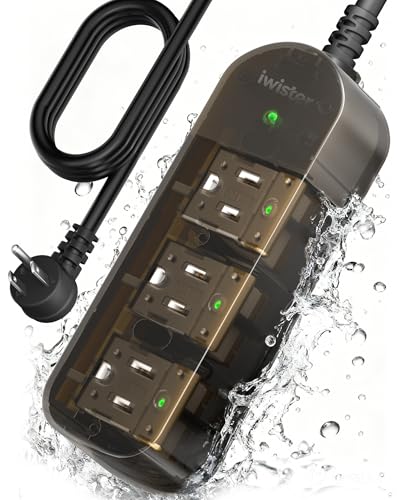
1625W High-Power: Iwister outdoor power strip weatherproof includes 3 outlets, ideal for powering high-power devices. Designed for a wide range of outdoor power needs, including electric lawn mowers, pressure washers, pool pumps, outdoor string lights, BBQ grills, and more. Helpful Tip: MEASURE BEFORE PURCHASE to choose the right cord length and AVOID CHOOSING THE WRONG SIZE.

Outdoor Extension Cord: ISLEWIRE 50-foot black extension cord with 3-prong connectors is ideal for extending the reach of power tools, gardening appliances, and other power-hungry equipment (such as Halloween and Christmas string lights, block heaters, lawn mowers, and snow removal equipment). This 3-outlet extension cord can handle 13 amps, 125 volts, and 1625 watts, making it suitable for garages, homes, offices, and various indoor and outdoor environments.

Up to 1875W Applications: Outdoor extension cord waterproof 12 gauge, 15 amp, 125 volts, 1875 watts, NEMA 5-15P to NEMA 5-15R, SJTW power cord, ETL/cETL listed, heavy duty extension cord 50 ft is perfect for heavy duty use or powering major appliances
1. Read the Nameplate
Find the grinder’s voltage and amp rating. If the nameplate is damaged or unreadable, locate the manual by model number before choosing a cord.
2. Measure the Total Run
Measure from the receptacle to the work area, including slack needed to route the cord safely behind you. Choose the shortest cord that reaches without stretching, crossing traffic paths, or placing the connector near sparks or water.
3. Check the Manufacturer’s Table
Use the row for the grinder’s amp rating and the column for the total cord length. If your exact value falls between rows or lengths, use the more demanding category or contact the manufacturer.
4. Match the Plug, Jacket, and Environment
Use a grounded three-wire cord for a grinder with a three-prong plug. For outdoor work, use a cord marked for outdoor use. On construction sites, cord sets may also need hard- or extra-hard-service markings and other jobsite protections.
5. Inspect and Test Under No Load
Inspect the plug, receptacle end, strain relief, and full jacket. Connect the grinder with the switch off, then run it briefly without touching the workpiece. Stop if the plug connection sparks, feels loose, or develops unusual heat.
Choosing the Right Extension Cord Length
Longer cords have more resistance. That resistance increases voltage drop and can reduce the voltage that reaches the grinder. Use the shortest practical cord instead of buying extra length “just in case.”
- Keep the cord run under 50 feet when practical for high-amp grinders.
- Do not stretch a cord tight across a walkway or around a sharp edge.
- Avoid connecting several cords end to end.
- If a manufacturer permits multiple cords, calculate the total combined length and ensure every cord meets the minimum gauge for that total run.
- Fully extend a cord reel or spool when required by its label; coiled cable can retain heat and may have a lower coiled-load rating.
Pro Tip: Place the power source closer to the work when a high-amp grinder would otherwise require a very long cord. Reducing distance is usually more reliable than trying to solve every voltage-drop problem with a heavier cable.
Indoor, Outdoor, and Damp-Location Use
An outdoor-rated extension cord has a jacket designed for outdoor conditions, but it is not permission to use an angle grinder in rain, standing water, or any location prohibited by the tool manual. Look for a cord marking that includes “W,” such as SJTW, when the cord is sold for outdoor use.
Use GFCI protection outdoors and anywhere moisture may contact electrical equipment. Keep plug-and-receptacle connections elevated, dry, and away from puddles. The OSHA flexible-cord guidance warns that wet connectors can allow leakage current and recommends limiting moisture exposure with suitable connectors.
- Do not handle energized plugs with wet hands.
- Do not lay a connection point on wet soil or concrete.
- Do not assume an outdoor cord is waterproof or submersible.
- Use a cord and connector approved for the actual location.
- Stop work if rain, coolant, or another liquid can reach the grinder or connection.
Grounded vs. Double-Insulated Angle Grinders
A grinder with a three-prong plug is grounding-type equipment. Use a three-wire extension cord with an intact grounding conductor, three-prong plug, and matching grounded connector. Never remove the grounding pin or use an adapter that defeats it.
Some angle grinders are double insulated and use a two-prong plug. These tools do not rely on an equipment-grounding conductor, but the cord must still have the correct amp capacity, length, listing, jacket, and condition. Look for the double-insulation symbol—one square inside another—or wording in the manual.
OSHA’s portable-equipment rules require grounding continuity for grounding-type equipment and prohibit adapters that interrupt the grounding connection.
How to Read Extension Cord Markings
The cord jacket should show information such as conductor size, conductor count, voltage rating, service type, and outdoor suitability. A marking such as “12/3 SJTW” generally identifies 12 AWG conductors, three conductors, junior hard-service construction, thermoplastic insulation, and outdoor suitability.
- 12/3: 12 AWG with three conductors.
- S or SJ: hard service or junior hard service.
- T: thermoplastic insulation or jacket construction.
- O: oil-resistant jacket; additional “O” markings can indicate broader oil resistance.
- W: suitable for outdoor use under the cord’s listing and instructions.
Marking systems vary, so read the product label and listing information rather than relying on color. A yellow cord is not automatically 12 gauge, outdoor-rated, or jobsite-approved.
How to Identify a Quality Extension Cord
Choose a factory-assembled cord set with a readable label and a certification mark from a recognized testing laboratory, such as UL or ETL/Intertek. OSHA maintains a current list of nationally recognized testing laboratories.
Check that the plug blades are straight, the grounding pin is present when required, and the connector grips the grinder plug firmly. The strain relief at both ends should be intact, and the jacket should have no cuts, crushed areas, tape repairs, melted spots, or exposed conductors.
The U.S. Consumer Product Safety Commission’s extension-cord guidance identifies minimum wire size, strain relief, polarity, continuity, and an appropriate outdoor jacket as important safety characteristics.
Essential Extension Cord Safety Tips
Safe cord use protects the operator, the grinder, and the work area. Follow these checks before and during every job.
- Inspect the full cord, plug, grounding pin, connector, and strain relief before use.
- Remove damaged equipment from service instead of covering damage with tape.
- Use the cord only within its marked voltage, amp, watt, environment, and temperature ratings.
- Route the cord behind you and away from the wheel, sparks, hot metal, sharp edges, doors, and vehicle traffic.
- Do not carry or pull the grinder by its cord.
- Disconnect by gripping the plug, not the cable.
- Use GFCI protection outdoors or where water may be present.
- Keep flammable liquids, vapors, dust, and combustibles away from grinding sparks and electrical connections.
OSHA requires portable cords and cord-connected equipment to be visually inspected before use on a work shift and removed from service when damage could expose a worker to injury.
Warning: Stop immediately if a cord, plug, or connector becomes hot, smells burnt, crackles, sparks, discolors, or shows exposed wire. Unplug the setup only when you can do so safely, then replace or professionally repair the damaged equipment as permitted by its listing and workplace rules.
Common Extension Cord Mistakes
- Using one rule for every grinder: “Always use 12 gauge” ignores the tool’s amp rating and cord length.
- Assuming 10 AWG solves any distance: A manual may still list a long run as not recommended.
- Reading advertised watts instead of nameplate amps: Output claims do not provide a dependable cord-sizing value.
- Using an indoor cord outside: Indoor jackets may not withstand the environment.
- Treating outdoor-rated as waterproof: Connectors and tools must still stay dry unless specifically approved for wet use.
- Removing the ground pin: This defeats a key shock-protection path on grounding-type tools.
- Daisy-chaining cords: Extra connections can loosen, heat up, collect moisture, and increase total voltage drop.
- Leaving a reel tightly coiled: A reel may have a much lower load rating while coiled.
- Resetting a tripped breaker repeatedly: A trip can signal an overload, fault, damaged cord, or failing tool that needs investigation.
Recommended Extension Cord Setups
You do not need a special brand-specific cord. You need a listed cord set that meets the grinder manual, total length, plug configuration, and location requirements.
- Compact grinder below 10 amps: A 16 or 14 AWG cord may be permitted depending on length; check the manual.
- Grinder rated more than 10 to 12 amps: Common tables allow 16 AWG at 25–50 feet, 14 AWG at 100 feet, and 12 AWG at 150 feet, but the specific tool manual controls.
- Grinder rated more than 12 to 16 amps: Common tables call for 14 AWG at 25 feet and 12 AWG at 50 feet; longer runs may be not recommended.
- Outdoor or garage work near moisture: Use an outdoor-rated cord, GFCI protection, and a dry, protected connection.
- Grounded grinder: Use a three-wire cord with an intact grounding path.
- Rough jobsite use: Use a cord marked and listed for the required hard-service environment and follow site rules.
When two compliant options are available, the shorter and thicker cord generally provides more voltage margin. It may also be heavier and less flexible, so route it carefully to avoid creating a trip or snag hazard.
Troubleshooting Power and Heat Problems
If the grinder feels weak or the cord gets warm, stop and check the entire power path before continuing.
| Symptom | Likely Checks | Safe Response |
|---|---|---|
| Grinder slows under light load | Cord too long or small, loose receptacle, overloaded circuit, worn brushes, or tool fault | Stop, verify gauge and length, try a suitable closer outlet, and service the tool if the problem remains |
| Plug or connector is hot | Loose contact, corrosion, damaged blades, undersized cord, or overload | Unplug safely and remove the cord, receptacle, or tool from service until inspected |
| Breaker or GFCI trips | Circuit overload, ground fault, damaged insulation, wet connection, or tool defect | Do not bypass protection or install a larger breaker; find and correct the cause |
| Sparking at the connection | Loose, worn, or mismatched plug and receptacle | Stop using the connection immediately and replace or repair the defective component |
Frequently Asked Questions
How do you determine what gauge extension cord an angle grinder needs?
Read the grinder’s nameplate amp rating, measure the total cord length, and use the manufacturer’s amp-by-length table. Then confirm that the cord’s plug, conductor count, jacket, listing, and environment rating match the tool and work area.
Which is better for an angle grinder, 12 gauge or 16 gauge?
A 12 AWG cord is thicker and has less resistance, but 16 AWG may meet a manufacturer’s minimum for some lower-amp tools or shorter runs. “Better” means compliant with the manual and no longer or heavier than necessary for safe use.
Do you need a 12-gauge or 14-gauge extension cord?
It depends on amps and distance. A common manufacturer table calls for 14 AWG at 25 feet and 12 AWG at 50 feet for tools rated more than 12 to 16 amps. Lower-amp tools may permit 14 AWG at longer distances.
Which is better, a 10-gauge or 12-gauge extension cord?
A 10 AWG cord is thicker and usually has less voltage drop, but it is also heavier and does not automatically make an otherwise prohibited long run acceptable. Use 10 AWG only when the cord and tool manufacturer allow the setup.
Can you use two extension cords with an angle grinder?
One correctly sized cord is safer and more reliable. If the grinder manufacturer allows multiple cords, use the total combined length for sizing, ensure every cord meets the required minimum gauge, and keep the connection secure, dry, and away from the work path.
Can you use a 100-foot cord with a 15-amp angle grinder?
Do not assume so. Common power-tool tables mark 100-foot runs as not recommended for tools rated more than 12 to 16 amps. Follow the grinder’s manual and move closer to an approved outlet rather than relying on a generic 10- or 12-gauge recommendation.
Can an outdoor extension cord be used indoors?
Usually yes when its voltage, amp, plug, and listing match the tool, but it may be bulkier and less flexible. Keep it fully accessible, do not run it under rugs or through doors, and follow the cord manufacturer’s instructions.
Why does an angle grinder lose power on an extension cord?
Common causes include excessive cord length, undersized conductors, loose connections, a shared or overloaded circuit, low supply voltage, or a tool problem. Stop using the setup if the cord or plug becomes hot and correct the cause before continuing.
Conclusion
The right extension cord gauge for an angle grinder comes from three facts: the grinder’s nameplate amps, the total cord length, and the manufacturer’s instructions. A common chart may allow 14 or 16 AWG for some tools and distances, while a 12–16 amp grinder may need 12 AWG at 50 feet and no extension at 100 feet. Use a listed cord with the correct grounding and outdoor rating, protect damp-area work with a GFCI, inspect every connection, and stop at the first sign of heat, damage, or unstable power.
Sources
- DEWALT DWE402 Small Angle Grinder Instruction Manual — minimum AWG table by amp rating and cord length
- Bosch GWS11-450P Angle Grinder Operating/Safety Instructions — extension-cord capacity, grounding, and outdoor-use guidance
- OSHA 29 CFR 1910.334: Use of Equipment — inspection, removal of damaged cords, grounding continuity, and wet-hand precautions
- OSHA: Flexible Cords — cord damage, service markings, grounding, and wet-connector hazards
- U.S. Consumer Product Safety Commission: Extension Cords Business Guidance — minimum wire size, strain relief, continuity, polarity, and outdoor-jacket safety characteristics
- OSHA: Current List of Nationally Recognized Testing Laboratories — recognized product-safety testing organizations