Making an automotive patch panel takes more than cutting a piece of steel that covers a rust hole. You need to confirm that the damaged area is suitable for a local repair, cut back to sound metal, match the original panel material, restore the body contour, control welding heat, and protect both sides of the finished seam from moisture.
Quick Answer
To make an automotive patch panel, confirm the damage is limited to a repairable nonstructural steel panel. Cut back to sound metal, copy the opening with tape or cardboard, shape matching sheet metal, test-fit it flush, weld with spaced overlapping tacks, then grind lightly and restore primer, seam sealer, paint, and backside corrosion protection.
Key Takeaways
- Use this method only on a repairable nonstructural panel and follow the vehicle maker’s body repair procedure before cutting or welding.
- Match the original panel’s material and thickness instead of assuming that one sheet-metal gauge fits every vehicle.
- Remove all weak metal and clean paint, rust, oil, sealer, undercoating, and solvent residue from the weld zone.
- Shape and test-fit the patch until it sits flush without being forced into the opening.
- Use small, widely spaced tack welds and allow natural cooling to limit distortion.
- Restore corrosion protection, factory seams, drain paths, coatings, and hidden-cavity protection after welding.
At a Glance
| Time Required | Several hours for a small, simple patch. Shaping, cooling, corrosion treatment, filler, primer, and paint may extend the work across one or more days. |
| Difficulty | Intermediate for a simple nonstructural mild-steel panel. Structural, aluminum, high-strength-steel, bonded, hybrid, and EV repairs require vehicle-specific training and procedures. |
| Tools Needed | MIG welder suitable for the panel material, welding PPE, cutoff wheel or body saw, grinder, drill or spot-weld cutter, clamps, marker, template material, measuring tools, hammer, dolly, vise or brake, and sanding tools |
| Cost | Varies with panel size, metal type, abrasives, paint system, corrosion products, and the tools you already own. The coating system may cost more than the small piece of sheet metal. |
Warning: Cutting, grinding, and welding can ignite hidden trim, seam sealer, insulation, fuel vapor, undercoating, or debris. Check both sides of the panel for fuel and brake lines, wiring, batteries, restraint components, glass, foam, and combustible material. Keep a suitable fire extinguisher nearby, ventilate the work area, and inspect the repair for at least 30 minutes after the final spark.
Decide Whether to Patch or Replace the Panel
A local patch is best for a limited rust area in a confirmed repairable outer panel. The surrounding metal must be solid enough to weld, and the repair must not alter a structural load path, restraint mounting point, suspension mounting point, hinge reinforcement, roof rail, pillar, rocker reinforcement, frame rail, or crash-management component.
Before cutting a modern vehicle, check the vehicle-specific body repair information. The I-CAR OEM Technical Information Matrix shows why this matters: vehicle makers may specify the panel material, permitted sectioning locations, factory seams, attachment method, weld type, adhesive, weld-through-primer requirement, foam, sealer, and corrosion-protection process.
Replace the complete panel or use a qualified collision repair shop when:
- The rust reaches a structural or restraint-related part.
- The panel contains high-strength steel, ultra-high-strength steel, aluminum, magnesium, or mixed materials that you cannot positively identify.
- The maker does not permit a partial repair in that location.
- Corrosion continues through an inner reinforcement or several overlapping layers.
- A bolt-on replacement fender, door, hood, or other service panel offers a safer and more durable repair.
- The vehicle is a hybrid or EV and the work is near high-voltage wiring, the traction battery, charging components, or a high-voltage enclosure.
Note: This guide covers a small nonstructural steel patch. Do not copy the same welding method onto aluminum, bonded panels, advanced high-strength steel, or a structural component unless the vehicle maker specifically approves the repair and attachment process.
Plan the Repair and Check Safety First
Study the repair before removing paint or making a cut. Photograph nearby body lines, factory seams, plug-weld locations, drain holes, brackets, and coating patterns. These references help you reproduce the original shape and keep water-management features working after the repair.
Remove nearby trim, carpet, weatherstripping, sound deadener, insulation, plastic clips, glass, and any part that heat or sparks could damage. Use a mirror, inspection camera, or bright light to inspect the rear of the panel. Do not assume an empty-looking cavity is free of wiring, foam, vapor lines, or reinforcement.
Protect the Vehicle’s Electrical and Restraint Systems
Follow the vehicle maker’s welding and battery-disconnection procedure. Modern vehicles may require a pre-repair scan, saved settings, a specific shutdown sequence, an SRS discharge wait time, disconnection of more than one low-voltage battery, or special steps after reconnection. The I-CAR battery-disconnect guidance explains why a simple one-step battery instruction is not enough for every vehicle.
Do not open or disable a hybrid or EV high-voltage system unless you are trained, equipped, and authorized to follow the model-specific procedure. High-voltage components can remain dangerous even after the ignition is off.
Place the welder work clamp on clean, bare metal as close to the weld as practical. Do not route welding current through bearings, hinges, control modules, wiring, or other sensitive parts.
Wear the Right PPE and Control Fumes
Wear safety glasses under a welding helmet with the correct filter shade. Use cut-resistant gloves while handling sharp sheet metal, leather welding gloves while welding, hearing protection, flame-resistant clothing, and sturdy closed boots.
The CCOHS welding PPE guidance covers eye, face, hand, skin, hearing, foot, and respiratory protection. A respirator must be selected for the actual hazard and used under the applicable instructions. A dust mask is not an automatic substitute for fume control.
Keep your head out of the fume plume and use local exhaust or strong mechanical ventilation. According to CCOHS guidance on welding fumes and gases, the base metal, filler, coatings, oils, rust inhibitors, zinc, paint, solvents, and plastic coatings can all affect the fumes produced.
Remove coatings from the weld area using a method suitable for the material. Do not weld over wet solvent, chlorinated cleaner residue, paint, undercoating, seam sealer, oil, grease, or loose rust. Check the product label and safety data sheet before stripping or spraying any coating.
Choose Your Tools, Metal, and Joint Type
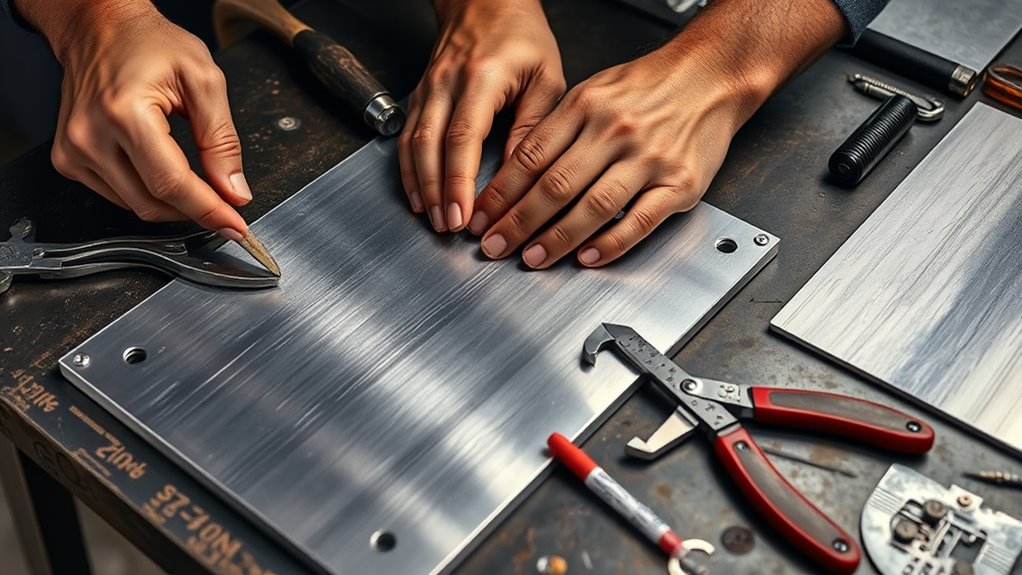
Choose replacement metal that matches the original undamaged panel in material and thickness. Strip a small reference area before measuring so paint, filler, and corrosion do not affect the reading. Use calipers or a micrometer when possible, or compare the panel with an equivalent service part.
Do not assume that 18-gauge steel is correct. Some older restoration panels may be close to that thickness, while other body panels are thinner, thicker, galvanized, or made from another alloy. A poor material match changes how the patch forms, welds, and reacts to heat.
Useful fabrication tools include a brake for straight bends, a vise or hand seamer for short flanges, a hammer and dolly for local shaping, and a shrinker or stretcher for curved edges. An English wheel can smooth a broad crown, but many small patches can be made with careful hand forming.
For cutting, use aviation snips, a shear, body saw, nibbler, or thin cutoff wheel. Use a spot-weld cutter when separating a factory flange so you preserve the support panel beneath it. Deburr every cut edge before fitting.
Products Worth Considering

PRECISION LAYOUT UP TO 42": Effortlessly scribe accurate circles and arcs up to 42 inches (107 cm) in diameter. Perfect for large-scale sheet metal fabrication, HVAC ducting, and roofing templates.

High-Quality Construction: This 12-inch metal folding tool is constructed from cold-rolled carbon steel, ensuring high strength and durability for long-lasting use. The folding seams are formed by two 1.5mm cold-rolled steel plates that are stamped and welded together, providing excellent structural integrity and precision

【Bevel Bending Design】: This dobladoras de metal manuales,featuring a beveled bearing and beveled roller design, this machine supports a bending range of 0–100°. it does not scratch the material surface during 90° bends, perfect for suitable for metal sheet profiling, eave forming, or snap-fit panel fabrication.
Choose the Correct Joint
| Joint | Best Use | Main Consideration |
| Butt joint | Visible outer-skin repair where both edges can be fitted accurately | Produces a clean, flush repair but requires careful gap control and heat management |
| Lap or flanged joint | A location where the OEM procedure permits an overlap or a hidden nonstructural repair | The overlap can trap moisture unless both mating surfaces and the finished seam are protected correctly |
| Plug weld | Reproducing approved factory spot-welded flanges | Hole size, spacing, clamp pressure, coating, and attachment method should follow the OEM procedure |
Do not change a factory weld to adhesive, rivets, brazing, a lap seam, or another attachment method unless the vehicle maker permits that substitution.
Select the Welder, Wire, and Gas
Use a welder that can be adjusted low enough for the panel thickness. Choose the wire diameter, polarity, shielding gas, contact tip, drive roll, and settings recommended by the welder manufacturer and the vehicle repair procedure. Small-diameter solid wire with shielding gas is commonly used for thin mild-steel bodywork, but the correct setup depends on the machine and material.
Practice on two scraps that match the patch and original panel thickness. Reproduce the same joint, surface preparation, position, and gap you will use on the vehicle. Tune the welder until each tack fuses both edges without a tall cold lump or a blown hole.
Note: Weld-through primer is not a universal coating for every seam. Follow the vehicle maker and coating manufacturer. Apply an approved product only where required on mating surfaces, and keep the direct GMA weld point clean and bare when the procedure calls for coating removal there.
Mark the Rusted Area
Remove enough paint, filler, scale, and loose coating to see the true damage. Rust often spreads beyond the first bubble or pinhole, especially around lower seams, wheel openings, rocker panels, doors, and overlapping flanges.
Probe suspicious areas gently. Solid metal should not crumble, flex excessively, or break away under light pressure. Inspect the rear face whenever it is accessible. Dirt, wet insulation, blocked drains, and failed seam sealer can cause the same rust to return after a cosmetic repair.
Identify Rust Boundaries
- Mark a boundary in solid metal outside every hole, crack, deeply pitted area, and thin edge.
- Check nearby seams, braces, flanges, wheel housings, cowl areas, rockers, and lower door sections.
- Look for swelling between overlapping panels, which can indicate hidden corrosion between layers.
- Confirm that the remaining edge is thick and clean enough to weld.
- Identify factory drain holes and keep them outside the cut whenever possible.
Do not bridge a perforated area with body filler, fiberglass filler, seam sealer, or a surface patch. These products do not restore missing metal or stop corrosion trapped behind the panel.
Trace the Cut Lines
Apply masking tape around the repair and draw a simple cut line. Smooth curves and gently rounded corners are usually easier to shape and weld than jagged edges or sharp internal corners.
Mark body lines, flange starts, overlap locations, factory spot welds, braces, and plug-weld positions before cutting. Add orientation marks such as front, rear, top, and outside so the template cannot be flipped accidentally.
Cut conservatively at first. You can enlarge the opening after the weak metal is exposed, but you cannot restore original sheet metal once it has been removed.
Make a Template Before Cutting the Patch
Use masking tape, poster board, thin cardboard, or a file folder to copy the opening and the surrounding contour. For a simple flat patch, trace the opening directly. For a curved panel, press the template against the surface and add small relief cuts to the template so it can lie flat without buckling.
Mark every bend, flange, crown direction, body line, plug-weld position, and reference edge. When the removed original piece is still complete enough to show the shape, use it as an additional reference, but do not copy a rust-thinned edge as the final patch size.
Transfer the template to the new metal with a fine marker. Leave the blank slightly oversized so you can trim it during repeated test-fitting.
Cut and Shape the Patch Panel
Cut the patch blank with a controlled tool that does not twist the sheet. Avoid overheating the edge with a grinder. After cutting, remove burrs and sharp corners so the patch sits flat and can be handled safely.
- Mark the bend lines and reference points clearly.
- Form straight flanges with a brake, vise, or hand seamer.
- Create shallow curves gradually with a hammer and dolly or gentle hand pressure.
- Use a shrinker or stretcher only when the edge shape requires it.
- Compare the patch with the vehicle after every few adjustments.
- Trim the edge in small amounts until the contour and opening match.
Work across a broad area instead of striking one small spot repeatedly. Concentrated hammering can stretch the metal and create a high crown or an unstable oil-can area.
Pro Tip: Shape the patch before trimming it to final size. Bending and stretching can change the edge dimensions, so a patch cut perfectly to size while flat may become too small after forming.
A durable patch begins at the fit-up stage. Welding should hold the correct shape in place, not force a poorly shaped panel to become flat.
Products Worth Considering

【2-in-1 Dual Jaw Design】This metal shrinker stretcher features independent shrinking and stretching jaws that work simultaneously without jaw changes, making it a versatile 2-in-1 sheet metal shrinker stretcher for efficient work.

[Two-in-One Shrinker & Stretcher]: Switch between shrinking and stretching instantly without swapping jaws. This metal shrinker stretcher for auto body repair features two independently mounted jaws—one for shrinking and one for stretching—that work simultaneously. Simply step on the left pedal to shrink metal for curved panels, or press the right pedal to stretch metal for flanges and edges
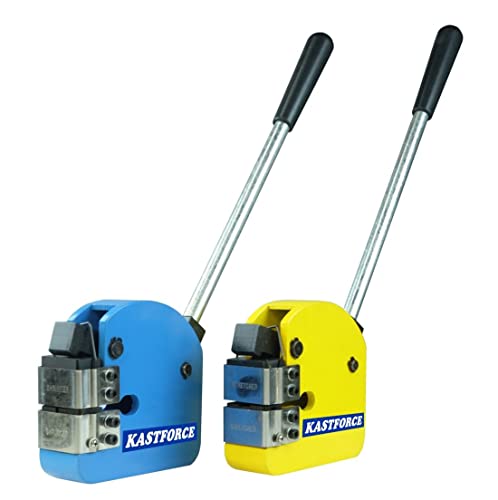
Complete Combo Pack: Includes two body and two jaws for comprehensive metal forming capabilities
Test-Fit the Patch Panel
Place the patch in the opening and hold it with panel clamps, magnets, Cleco pins, or temporary screws where their holes can be closed safely. Check the fit from the front, rear, side, and along nearby body lines.
Look for:
- An even edge around the full patch
- A contour that follows the original panel without clamp pressure
- No twist, rocking, or spring tension
- No contact with a brace, wire, hose, foam, or inner panel
- Correct alignment at body lines and adjacent panel gaps
- Enough rear access for inspection and corrosion protection
For a butt joint, aim for a consistent fit that suits your proven practice setup. Do not force one universal gap measurement onto every wire size and welding technique. The gap must be narrow enough to avoid repeated burn-through while still allowing the tack to fuse both edges.
For plug welds, prepare the approved holes in the top layer and clamp both panels tightly together. A gap between the layers can prevent proper fusion into the lower panel.
Prepare the Weld Zone and Set Up the Welder
Remove paint, primer, corrosion, adhesive, seam sealer, undercoating, and contamination from the direct weld area. Clean both the patch edge and the original panel edge to bright metal. Allow all cleaners to evaporate fully before welding.
Check the shielding gas, polarity, wire feed, contact tip, ground connection, and machine settings. Protect the work from wind that can disturb the gas shield. Repeat your practice tacks if the joint position or fit differs from the first test coupon.
Keep the work clamp close to the repair and attached to clean metal. Confirm that the welding-current path does not pass through a hinge, bearing, module, or sensitive electrical connection.
Thin body panels need very little arc time. Use quick tacks, move to a distant part of the seam, and let the panel cool naturally. Do not run a continuous bead, and do not use compressed air to scatter heat, dust, vapors, or sparks around the vehicle.
Tack the Patch Panel in Place
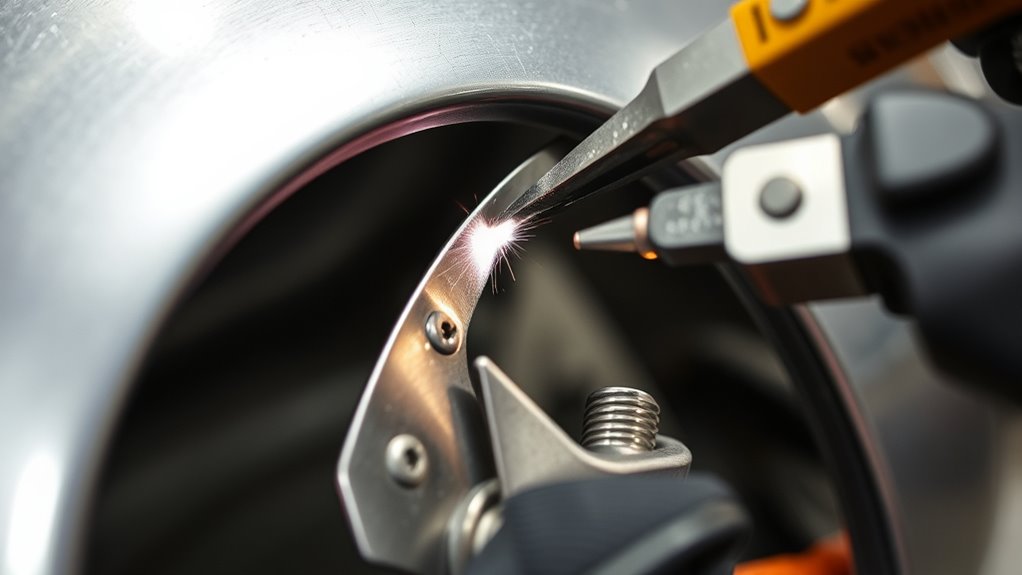
Once the patch sits flush without force, secure it and place a few small tacks at widely separated points. Begin near reference areas that control the contour or body line.
- Confirm the full perimeter is aligned before the first tack.
- Place three or four quick tacks at distant points around the patch.
- Remove or relax the clamps and confirm that the patch stays flush.
- Correct any pull, high spot, or low spot before adding more weld.
- Add new tacks midway between the existing ones.
- Continue dividing the open spaces until the patch is held evenly.
Heat can pull the seam even when the original fit was correct. Stop as soon as the panel starts to move. Grinding off one early tack and correcting the fit is easier than repairing a warped panel after the seam is closed.
Close the Seam With Overlapping Tacks
After the patch is locked in place, close a butt seam with a series of short overlapping tacks rather than one continuous bead. Move around the panel in a skip pattern so consecutive welds are not placed next to each other while the metal is still hot.
Allow the weld area to cool naturally between passes. Use your bare hand only after removing the welding glove and only when there is no burn risk; otherwise, judge cooling time conservatively. The goal is to prevent heat from building in one section.
Inspect the rear face where possible. The weld should join both edges rather than sit as a cold lump on the surface. Clean any contamination before closing a pinhole. If the original edge keeps disappearing, stop and cut back to stronger metal instead of repeatedly filling a failing edge.
For a factory-style plug weld, follow the OEM hole size, spacing, attachment method, and coating procedure. Confirm that each weld fused into the lower panel before moving on.
Grind and Inspect the Weld
Let the panel cool fully before grinding. Begin by leveling only the high weld metal. Keep the tool moving, use light pressure, and avoid grinding into the surrounding sheet.
- Dress the highest weld areas with a suitable grinding or cutoff disc used carefully.
- Switch to a finer abrasive before the weld is completely level.
- Use a straightedge, flexible sanding block, or reflected light to find high and low areas.
- Inspect both sides for missed welds, cracks, weak fusion, and pinholes.
- Close isolated pinholes with clean, quick tacks and allow the panel to cool again.
Do not grind the seam until it becomes paper-thin. A perfectly invisible bare-metal seam is not useful if the surrounding panel has been weakened.
If a light skim of body filler is needed, follow the filler and primer manufacturer’s approved substrate sequence. Some systems permit filler over properly prepared epoxy primer, while others specify direct-to-metal application. Keep filler thin and use it for final leveling, not to hide a badly shaped patch.
Restore Corrosion Protection and Paint
Grinding and welding remove factory corrosion protection. A lasting repair must restore protection on the visible face, between approved overlapping surfaces, along moisture paths, and on the rear of the patch.
The exact product order depends on the vehicle maker and coating system. A typical compatible system may include:
| Step | Purpose |
| Epoxy or approved corrosion-resistant primer | Seals prepared metal and forms the base of the compatible refinishing system |
| Seam sealer | Restores approved factory seams and blocks water entry at joints and overlaps |
| Primer-surfacer | Levels fine sanding marks and prepares the repair for the color system |
| Basecoat and clear coat or approved single-stage paint | Restores color, gloss, ultraviolet resistance, and weather protection |
| Undercoating or anti-chip coating where specified | Restores impact and moisture protection in wheel housings, lower panels, and underbody areas |
| Cavity wax or approved internal coating | Protects the rear face, weld heat-affected area, flanges, and closed cavities after refinishing |
The 3M collision-repair corrosion-protection guidance describes cavity wax as an important treatment for internal body areas such as rocker panels, pillars, and closed cavities. Apply it only after the coating system has reached the stage specified by the product and OEM instructions.
Keep factory drains open. Do not fill a rocker, door, quarter panel, or wheel housing drain path with seam sealer, undercoating, foam, or cavity wax. Replace removed plugs and access covers after treatment.
Spray primer, paint, sealer, and cavity products only in a suitable ventilated area. Follow the product label and safety data sheet, and keep all coatings and vapors away from sparks, flames, heaters, and hot metal.
Complete the Final Inspection
Do not treat painting as the final step. Inspect the repair, the vehicle systems, and the work area before returning the vehicle to service.
- Check the visible contour, body line, panel gap, and finish under several lighting angles.
- Inspect the rear of the patch for exposed metal, pinholes, missed coating, and trapped debris.
- Confirm that drain holes, weather paths, factory seams, plugs, and ventilation openings remain functional.
- Reinstall insulation, trim, wiring retainers, glass, and other parts only after the coatings have cured as required.
- Reconnect batteries and restore vehicle functions according to the OEM procedure.
- Complete any required post-repair scan, relearn, initialization, or calibration.
- Check both sides of the panel and nearby cavities repeatedly for smoke, heat, odor, or smoldering material for at least 30 minutes after the final welding or grinding spark.
OSHA’s welding and cutting requirements address removal or guarding of fire hazards and call for a fire watch for at least half an hour where one is required. Hidden automotive cavities deserve the same cautious approach.
Troubleshooting Common Patch Panel Problems
| Problem | Likely Cause | Fix |
| Burn-through | Too much heat, long trigger time, wide gap, rust-thinned edge, or unsuitable machine setup | Stop, cut back to sound metal if needed, improve the fit, shorten the tack, and retest the settings on matching scrap |
| Warping or a sunken seam | Heat concentrated in one area, a continuous bead, or a patch installed under tension | Stop welding, allow natural cooling, correct the fit, and resume with smaller welds placed farther apart |
| Patch sits high | Oversized edge, excessive crown, burrs, or interference behind the panel | Remove the patch, mark the contact point, trim or reshape it gradually, and test-fit again |
| Patch sits low | Insufficient crown, stretched center, or an edge pulled inward by welding | Correct the shape before continuing. Do not rely on thick filler to restore the contour |
| Tall weld with weak fusion | Cold setting, dirty metal, poor work-clamp contact, or incorrect wire and gas setup | Clean the metal and clamp point, verify polarity and gas, then retest the machine on scrap |
| Pinholes after grinding | Missed spaces, contamination, weak fusion, or excessive grinding | Clean to bright metal and close isolated holes with quick tacks. Replace an edge that has become too thin |
| Rust returns | Rust remained between layers, a drain stayed blocked, or the rear face and seam were not protected | Remove all affected material, restore the moisture path, and protect every accessible face with the approved coating system |
Frequently Asked Questions
What gauge sheet metal should I use for a patch panel?
Use metal that matches the original undamaged panel in material and thickness. Measure a coating-free area with calipers or a micrometer, or compare it with an equivalent service panel. Do not assume that 18-gauge steel is correct for every vehicle.
How do I choose the right welding machine for this repair?
Choose a machine that can be adjusted for the panel thickness and that supports the wire, gas, polarity, and material required by the repair procedure. Practice the same joint on matching scrap before welding the vehicle.
Can I make a patch panel without removing the surrounding panel?
Yes, when the rust is limited to a repairable nonstructural outer panel and the surrounding metal is sound. You must still inspect the rear, remove all weak metal, protect nearby parts from heat, and restore corrosion protection after welding.
Can I patch rust in a rocker panel, pillar, rail, or seat-belt mounting area?
Do not use a generic patch method in a structural or restraint-related area. Obtain the vehicle-specific repair procedure and use a qualified collision technician when the repair affects a rocker reinforcement, pillar, rail, suspension mount, hinge reinforcement, seat-belt mount, or crash structure.
What safety gear is essential when cutting and welding sheet metal?
Wear safety glasses, the correct welding helmet, cut-resistant gloves for handling metal, leather welding gloves, hearing protection, flame-resistant clothing, and sturdy boots. Use effective ventilation and respiratory protection selected for the actual exposure.
How do I prevent the patch panel from warping?
Shape the patch so it fits without tension, use tiny spaced tack welds, move around the seam, and allow natural cooling between welds. Do not run a continuous bead on a thin outer panel.
How large should the gap be around a butt-welded patch?
There is no single gap that suits every wire size, machine, thickness, and technique. Keep the fit narrow and consistent, then prove the joint on matching scrap. A wide or uneven gap makes burn-through and distortion more likely.
Should I butt weld, lap weld, or plug weld a rust repair patch?
Use the joint allowed by the vehicle maker. A butt joint can give a flush visible repair, an approved lap joint may suit some hidden areas, and plug welds can reproduce certain factory spot-welded flanges. Protect every overlap from trapped moisture.
How do I stop rust from returning after the patch is welded?
Remove all weak and contaminated metal, restore the approved primer and paint system, reseal factory seams, keep drain paths open, and protect the rear face and closed cavities with the specified internal coating or cavity wax.
Conclusion
A durable automotive patch panel starts with the decision to repair the right area in the right way. Confirm that the panel is nonstructural and repairable, identify its material, follow the vehicle maker’s procedure, and remove every weak edge before making the patch.
Shape and test-fit the replacement until it follows the original contour without force. Use small, spaced welds to control heat, grind only enough to level the seam, and restore every coating, seam, drain path, and hidden corrosion barrier that the repair disturbed. Careful preparation and backside protection are what separate a lasting metal repair from a rust hole that returns under fresh paint.
Sources
- OSHA 29 CFR 1910.252: Welding, Cutting, and Brazing — supports fire prevention, guarding, ventilation, and post-welding fire-watch guidance.
- CCOHS: Welding Fumes and Gases — supports coating removal, contaminant hazards, fume factors, and ventilation guidance.
- CCOHS: Welding Personal Protective Equipment and Clothing — supports eye, face, hand, skin, respiratory, hearing, and foot protection.
- I-CAR OEM Technical Information Matrix — supports vehicle-specific material, sectioning, attachment, welding, sealer, and corrosion-protection requirements.
- I-CAR: Battery Disconnect Considerations — supports model-specific battery, SRS, scan, initialization, and reconnection precautions.
- 3M Collision Repair Corrosion Protection Resources — supports cavity wax, internal-panel protection, undercoating, and corrosion-restoration practices.