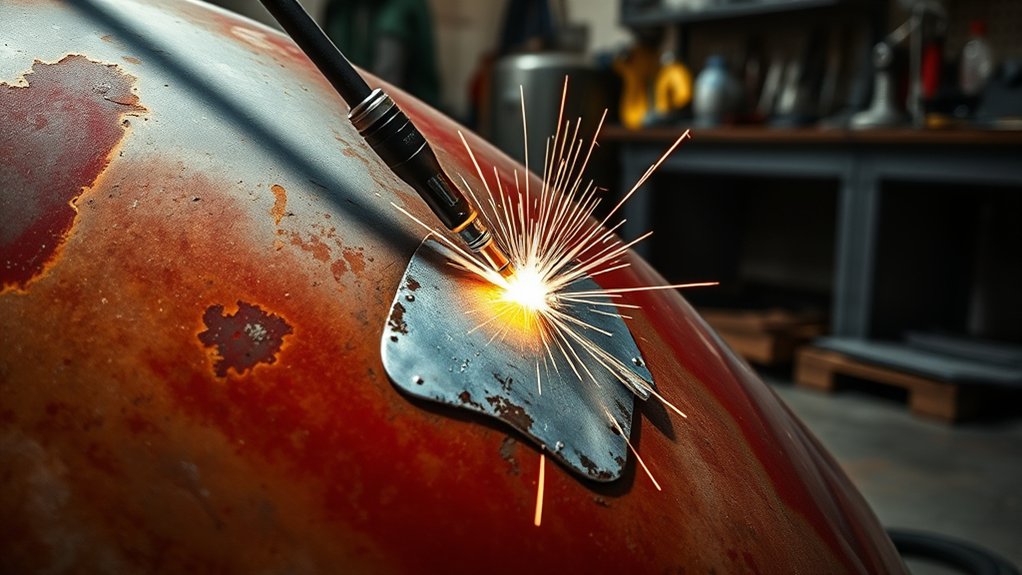
Quarter-panel rust often extends farther behind the paint than you can see, especially around wheel-opening lips, seams, lower edges, and the fuel-filler area. A lasting repair means opening the area, removing every section of weak steel, repairing any rusted inner metal, fitting a close-matching patch, and welding it with controlled heat. You also need to restore the coatings on both sides of the panel so corrosion does not begin again behind the finished repair.
Quick Answer
To patch-weld rust on a quarter panel, inspect both sides, cut back to solid metal, form a matching steel patch, and weld it with widely spaced MIG tacks. Follow the vehicle’s repair procedures, control hidden fire risks, then protect the weld with the correct primer, seam sealer, refinishing system, and cavity wax.
Key Takeaways
- Visible paint bubbles may hide corrosion in the inner wheelhouse, seams, or reinforcement behind the quarter panel.
- Confirm the panel material and follow the vehicle manufacturer’s sectioning, welding, battery, SRS, and high-voltage procedures.
- Fit the patch closely and use short, separated tack welds instead of a continuous bead on thin outer sheet metal.
- Test the welder on matching scrap before touching the vehicle and keep the work clamp close to the weld area.
- Protect the front, seams, overlaps, and back side of the repair with compatible corrosion-protection materials.
- Watch the repair area for at least 30 minutes after welding or grinding because hidden materials can smolder.
At a Glance
| Time Required | Several hours to a full day for a small outer-skin patch; longer when the inner wheelhouse, seams, filler work, or paint blending also need repair |
| Difficulty | Advanced DIY; not a suitable first welding project on a valuable or road-critical vehicle |
| Tools Needed | MIG welder, cutoff tool, grinder, body hammer and dolly, clamps, sheet-metal tools, welding PPE, local fume extraction, fire extinguisher, and inspection light |
| Cost | Mostly sheet metal, wire, gas, abrasives, primer, sealer, and coatings if you already own the tools; substantially more if you need welding or refinishing equipment |
Decide Whether the Quarter Panel Can Be Patched
A small outer-skin patch may work when the damage is localized and the surrounding steel, inner wheelhouse, pinch welds, reinforcements, and mounting points remain solid. A larger repair section or complete quarter-panel replacement may be safer when corrosion follows a long wheel-opening seam, reaches multiple layers, or has weakened metal near a suspension, seat-belt, body-mounting, or crash-management area.
Do not choose a repair method from appearance alone. Remove enough trim and coating to inspect the back side and nearby layers. Rust commonly begins between the outer quarter panel and inner wheelhouse, so a clean-looking outer edge does not prove that the hidden flange is sound.
Note: Quarter panels are not made from the same material on every vehicle. Confirm whether the repair area is mild steel, high-strength steel, or aluminum, and obtain the vehicle manufacturer’s body-repair procedure before cutting or welding.
Stop and arrange a professional inspection when:
- The rust reaches a reinforcement, pillar, rocker, frame rail, suspension attachment, seat-belt anchorage, or other structural area.
- The inner wheelhouse or trunk-side structure has lost a large amount of metal.
- The vehicle manufacturer does not permit sectioning in the proposed location.
- The panel is aluminum or an unfamiliar advanced steel and you do not have the correct equipment or procedure.
- The repair is close to a high-voltage battery, fuel tank, filler neck, vapor line, airbag component, or sensitive electronic module.
Identifying Rust Damage on Your Quarter Panel
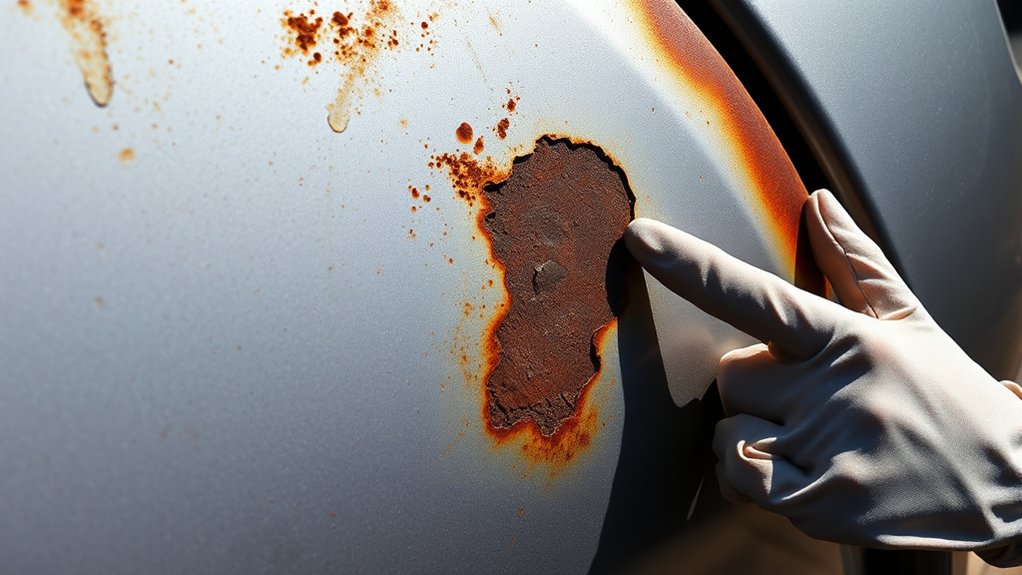
Inspect the full quarter panel, not only the visible hole. Concentrate on the wheel-opening lip, lower rear edge, trunk drop-off, fuel-filler pocket, pinch welds, body seams, trim holes, and any place where mud, road salt, or moisture can remain trapped.
Look for bubbling paint, staining at seams, cracked filler, pinholes, flaking scale, distorted metal, and previous patch edges. Press gently with a pick or screwdriver after removing loose coating. Solid steel should resist pressure. Metal that flexes, cracks, flakes, or crumbles cannot support a durable weld.
Inspect the back side with a bright light, mirror, or inspection camera when access is limited. Remove the wheelhouse liner, trunk trim, insulation, sound-deadening material, and nearby interior panels as needed. Check the inner wheelhouse and the flange where it joins the outer quarter panel.
Use repair photos and forum discussions only to understand typical corrosion patterns. Your vehicle’s material, construction, prior repairs, climate exposure, and factory repair restrictions control the actual plan. If welding involves zinc-coated steel, remove coating only from the required weld zone and review safe methods for removing zinc coating. Restore corrosion protection after welding.
Essential Tools and Materials for Rust Repair
For a typical mild-steel outer-panel patch, a short-circuit MIG welder with solid wire and shielding gas gives you useful heat control. Light-gauge work commonly uses .023- or .024-inch wire, but you must match the wire, polarity, gas, voltage, and wire speed to your machine, base metal, and joint.
Gather the following tools and supplies before opening the panel:
- MIG welder, correct contact tip, solid wire, shielding gas, and a sound work clamp.
- Matching scrap metal for setup and practice welds.
- Cutoff wheel, air saw, nibbler, or other controlled sheet-metal cutting tool.
- Angle grinder, compact sander, wire brush, and suitable abrasives.
- Sheet metal close to the original panel thickness.
- Cardboard or poster board for making a patch template.
- Body hammer, dolly, hand seamer, shrinker-stretcher, or forming tools needed for the panel curve.
- Butt-weld clamps, locking pliers, panel clamps, magnets, and alignment tools.
- Inspection light, mirror, marker, ruler, straightedge, and contour gauge.
- Wax and grease remover approved by the refinishing system.
- Compatible epoxy or urethane primer, body filler or finishing glaze, seam sealer, paint materials, underbody coating, and cavity wax.
- Fire-resistant blankets or spark-deflection material and a suitable fire extinguisher.
Wear safety glasses under your welding helmet, welding gloves, nonflammable long sleeves, hearing protection, and suitable footwear. A well-fitting helmet and heat-resistant gloves help protect you from sparks and hot sheet metal.
Warning: Paint, galvanized coating, undercoating, adhesives, rust treatments, seam sealer, and sound-deadening products can release hazardous fumes when heated. Strip coatings from the weld zone, use effective local exhaust, keep your head outside the fume plume, and select respiratory protection through a proper hazard assessment. Do not rely on an ordinary dust mask for welding fumes.
Products Worth Considering

Automotive Bodywork and Rust Repair
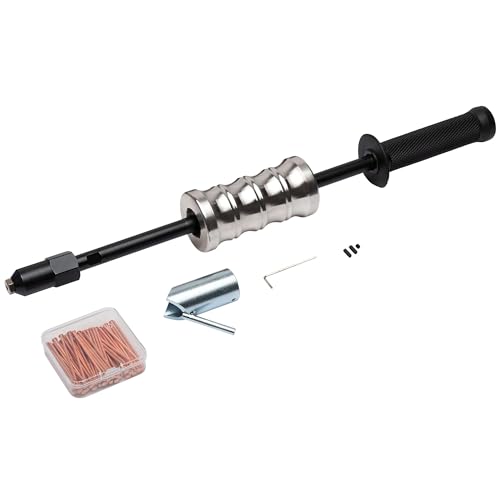
Converts MIG Welder to Stud Welder: Allows your existing MIG welder to perform stud welding for dent repair.
Before You Begin
Plan the complete repair before making the first cut. A small visible bubble can become a much larger opening after you expose the back side and remove thin metal. Make sure you have enough patch material, access, time, coating products, and weather protection to finish the exposed steel without leaving it bare.
Follow the Vehicle Repair Procedure
Check the vehicle manufacturer’s body-repair information for the approved sectioning location, joint design, weld type, corrosion-protection process, battery procedure, restraint-system precautions, and any required measurements. Do not assume that a method used on an older mild-steel vehicle is acceptable on a newer model.
For a conventional vehicle, follow the manufacturer’s battery-disconnection and reconnection sequence. Welding guidance may require both battery cables to be disconnected and isolated. Remove the negative cable first when the procedure specifies that order, and observe the required waiting period before working near airbags or pretensioners.
Hybrid, plug-in hybrid, and electric vehicles need vehicle-specific high-voltage disabling procedures. Do not handle an orange high-voltage cable, service disconnect, traction battery, or nearby welded structure unless you are trained and equipped for that system.
Place the welder’s work clamp on clean metal close to the repair and, when possible, on the same panel. Keep the welding current path short. Route welding cables away from wiring, sensors, electronic modules, and restraint components.
Remove Hidden Fire and Damage Risks
Remove or protect nearby carpet, trim, upholstery, wiring, modules, glass, painted surfaces, fuel-vapor components, insulation, foam, undercoating, and seam sealer. Pay special attention to a quarter panel near the fuel door, filler neck, vapor hoses, tank, and trunk trim.
Do not weld where fuel, fuel vapor, flammable cleaner, or an explosive atmosphere may be present. Complete cleaning and degreasing before welding, and keep chlorinated cleaning vapors away from the welding area.
Warning: Welding and grinding sparks can enter a seam or land behind the panel. Have another person watch the back side when practical. Keep fire-extinguishing equipment ready and continue checking the vehicle for smoke, odor, heat, and smoldering material for at least 30 minutes after hot work ends.
Clean and Expose the Repair Area
Wash away mud and road residue before grinding. Strip paint, filler, rust, seam sealer, and undercoating far enough from the proposed cut to expose the true condition of the steel. Keep flammable solvents closed and away from sparks once cleaning is complete.
Clean both sides of every surface that will be welded. The article on keeping sheet metal clean before welding provides additional preparation guidance. Contamination can create unstable arcs, porosity, weak fusion, and excessive spatter.
Cutting and Patching Rust: Step-by-Step
The goal is to join sound metal to sound metal while disturbing as little of the surrounding panel as possible. Work in small stages so you can inspect hidden layers before enlarging the opening.
Products Worth Considering

Reinforced mesh provides supportive backing to fill holes

Maximized Adhesion & Strength: Evercoat Body Shop Metal Reinforced Filler delivers superior adhesion to aluminum, galvanized steel, and steel, ensuring lasting repairs that won’t weaken over time, even under tough conditions.

Strength and Duability: Forge your projects with a foundation that lasts. Our 12" x 6" metal sheets are crafted from high-grade carbon steel with a solid 0.04" (approx. 20 Gauge) thickness. These aren't flimsy scraps; they are structural-grade plates designed to handle heavy stress, high-heat welding, and complex metalwork without warping.
1. Assess and Mark the Full Rust Area
Mark the visible damage, then expand the inspection beyond the bubbles and pinholes. Probe the metal and compare the front with the back side. Draw the final cut line only after you find a continuous border of firm, clean steel.
Avoid cutting across a body line, tight corner, reinforcement, or inaccessible seam when a nearby flatter area gives you a safer joint. Keep the opening as simple as the panel shape allows, but never leave weak metal merely to create an easier shape.
2. Make a Template and Cut the Opening
Create a cardboard template before removing the final piece when the panel has a curve, character line, or wheel-opening return. You can also save a sound portion of the removed metal as a shape reference.
Make a conservative first cut inside the marked line. Inspect the newly exposed edge and inner structure, then trim outward until every edge is solid. Deburr the opening and remove sharp corners that could concentrate heat or make the patch difficult to fit.
If the opening exposes rusted inner-wheelhouse metal, repair that layer before closing the outer panel. Do not hide untreated inner damage behind a new outer patch.
3. Form and Fit the Patch
Transfer the opening to sheet metal that closely matches the original thickness. Cut the patch slightly oversize, then trim it gradually. Shape the crown, wheel-opening lip, flange, and body line before trying to weld it in place.
- Compare the patch with the surrounding panel from several angles.
- Use a straightedge or flexible contour guide to check the crown.
- Keep the patch flush rather than recessed or standing proud.
- Use a close, consistent joint that your chosen welding method can bridge without excessive filler metal.
- Confirm access for clamps, the welding gun, grinding tools, primer, seam sealer, and cavity wax.
A large or uneven gap demands more weld metal and heat, increasing the chance of burn-through and distortion. Continue trimming and forming until the patch sits naturally without being forced into position.
Pro Tip: Spend more time fitting than welding. A close-fitting patch needs less heat, creates fewer pinholes, and is easier to finish without a thick layer of body filler.
4. Prepare the Metal and Welder
Clean the patch and original panel to bright, sound metal at the weld joint. Remove coating far enough from the arc to prevent contamination and smoke, but avoid stripping a much larger area than the repair requires.
Protect mating surfaces that will become inaccessible with the coating or weld-through product specified by the vehicle manufacturer and product supplier. Do not coat the direct fusion area with an ordinary primer, rust converter, paint, or encapsulator unless the product is specifically approved for that welding process.
Set up the welder on scrap from the removed panel or metal of the same type and thickness. Follow the machine’s settings chart, then adjust voltage and wire speed until the arc is stable and the weld fuses both edges without burning a large hole.
For typical light-gauge mild-steel body panels, .023- or .024-inch solid wire and an argon-rich shielding-gas mixture are common starting choices. Confirm polarity and gas flow in the welder manual. Self-shielded flux-core wire generally produces more heat and spatter than desired for a cosmetic outer-skin patch.
Make several practice butt joints and plug welds that match the actual repair. Inspect both sides and bend or break a sample to confirm fusion. General advice about avoiding porosity from dirty metal also applies here, but your final setup must match the MIG process and wire you are using.
Note: Heavy preheating and procedures intended to prevent quench cracks in cast iron do not apply to a thin steel quarter-panel skin. Control heat with fit-up, machine settings, tack size, spacing, and cooling time.
5. Tack-Weld the Patch in Place
Clamp the patch flush and recheck the contour. Place the first small tacks at widely separated points, such as opposite sides or corners. Confirm that the panel remains aligned before adding more.
Continue adding short tacks in a staggered pattern. Move to a distant, cool area after each tack. Do not chase the seam in one direction or run a continuous bead around the patch. Let the panel cool naturally between rounds until you can place a bare hand near, but not on, the weld area without feeling strong radiant heat.
As the tacks fill the seam, watch for edge movement, shrinking, and changes in the panel crown. Correct a small alignment problem early rather than welding the entire seam and trying to force the panel back afterward.
6. Close the Seam and Check the Weld
Build the seam by placing additional tacks between the cooled welds. Each new tack should fuse both panel edges and connect cleanly without leaving a pinhole. Continue moving around the patch until the seam is closed.
Inspect the front and back where accessible. Look for:
- Pinholes or narrow gaps along the seam.
- Weld metal sitting on top without fusion into both edges.
- Burn-through or enlarged gaps.
- Black contamination, heavy soot, or visible porosity.
- Cracks at the edge of a tack.
- A panel crown that has flattened, risen, or begun to oil-can.
Use a bright light behind the seam to reveal pinholes when the back side is accessible and free of combustible material. Repair one defect at a time with a small tack rather than reheating a long section.
7. Grind and Metal-Finish the Repair
Allow the panel to cool before grinding. Reduce the highest parts of the weld gradually, keeping the abrasive on the weld rather than thinning the surrounding original metal. Switch to a finer abrasive as the weld approaches the panel surface.
Stop grinding when the seam is level enough for metal finishing. Do not grind until the joint becomes paper-thin. Use a body hammer and dolly carefully where you have access, checking the contour often with your hand and a straightedge.
Clean the repair and inspect it again for pinholes, cracks, or areas that move independently. Complete any necessary welding before applying filler, primer, or sealer.
Welding Techniques for a Stronger Repair
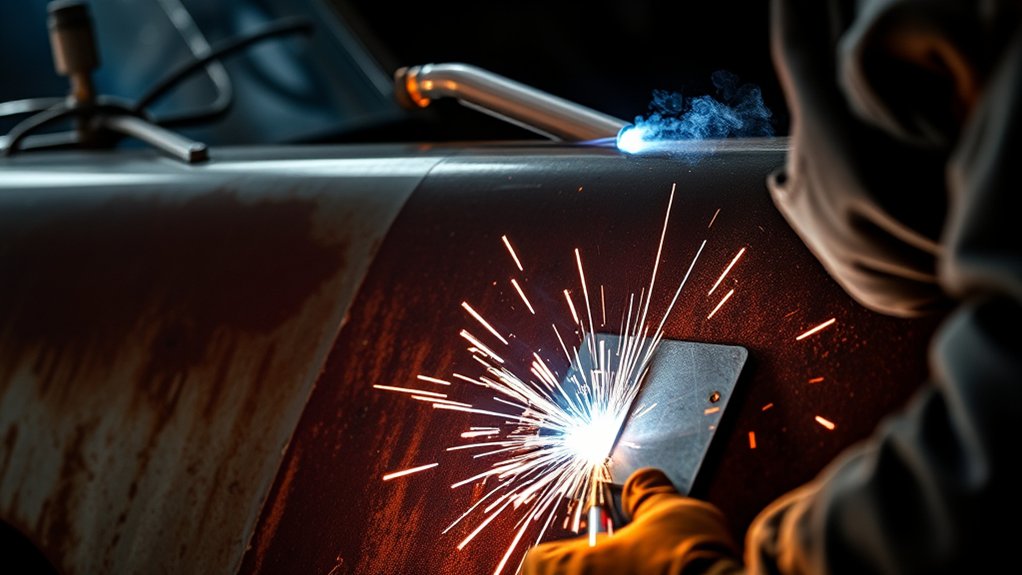
Fit-up and heat distribution affect the finished panel as much as the welder setting. Thin sheet metal expands as you heat it and contracts as the weld cools. Too much concentrated heat can pull the panel out of shape even when the weld itself looks sound.
Butt Welds, Overlaps, and Factory Joints
A carefully fitted butt joint can produce a smooth repair on the visible outer skin and limits the amount of doubled metal behind the seam. It also demands accurate fit-up and disciplined heat control.
An overlap or flanged joint may be easier to hold in some hidden locations, but the extra seam can trap moisture if it is not protected correctly. Do not create an overlap solely because it is easier to weld when the manufacturer specifies another sectioning joint.
Reproduce factory seams, flanges, adhesives, and weld locations when the repair reaches an original joint. The vehicle manufacturer may specify resistance spot welding, MIG plug welds, seam welds, adhesives, or a combination.
Spot Welds, Plug Welds, and Tack Welds
These terms describe different operations:
- Resistance spot weld: A dedicated spot welder clamps overlapping sheets and creates a weld through electrical resistance.
- MIG plug weld: The arc is directed through a prepared hole in the top sheet to fuse it to the sheet below. This is often used at flanges when the OEM procedure permits it.
- Tack weld: A small MIG weld that holds alignment or gradually closes a butt seam.
- Stitch or skip sequence: Short welds or tacks placed in separated areas to limit concentrated heat.
Do not substitute one weld type for another without checking the repair procedure. A plug weld must fuse the lower sheet, not merely fill the hole in the upper sheet.
Heat Management Techniques
- Start with close fit-up so you do not have to bridge large gaps.
- Use the smallest suitable wire and the correct short-circuit settings for the metal.
- Keep each tack small and move to a distant section after every weld.
- Pause between rounds instead of trying to finish the seam quickly.
- Keep the work clamp close to the repair on clean metal.
- Limit grinding pressure and duration because grinding also adds heat.
- Stop and correct distortion before adding more welds.
Do not spray water onto the weld or energized equipment. For routine outer-panel work, reduce heat at the source and allow controlled cooling between tacks instead of repeatedly overheating and force-cooling the panel.
A durable patch depends less on making a long weld quickly and more on fitting the steel accurately, placing small welds patiently, and protecting every hidden edge afterward.
Troubleshooting Common Quarter-Panel Welding Problems
| Problem | Likely Cause | Correction |
|---|---|---|
| Burn-through | Gap too large, metal too thin, tack too long, or setting too hot | Stop, let the panel cool, improve support and fit, and retest the settings on scrap |
| Weld sits on top | Insufficient fusion, poor work-clamp contact, contamination, or unsuitable setting | Clean the joint and clamp point, verify gas and polarity, and adjust on a test coupon |
| Porosity or soot | Paint, rust, coating, oil, moisture, wind, or shielding-gas problem | Remove the defective weld, clean both sides, shield the work from drafts, and verify gas delivery |
| Repeated pinholes | Incomplete tack overlap, contamination, or excessive grinding | Clean and close each hole with one controlled tack after the area cools |
| Panel warping or oil-canning | Too much concentrated welding or grinding heat, or poor initial contour | Stop adding heat, reassess the contour, and use controlled metal-finishing methods before continuing |
| Patch moves while welding | Too few initial tacks or inadequate clamping | Re-align the patch and add small, opposing locator tacks before closing the seam |
Treat Surrounding Areas for Long-Term Protection
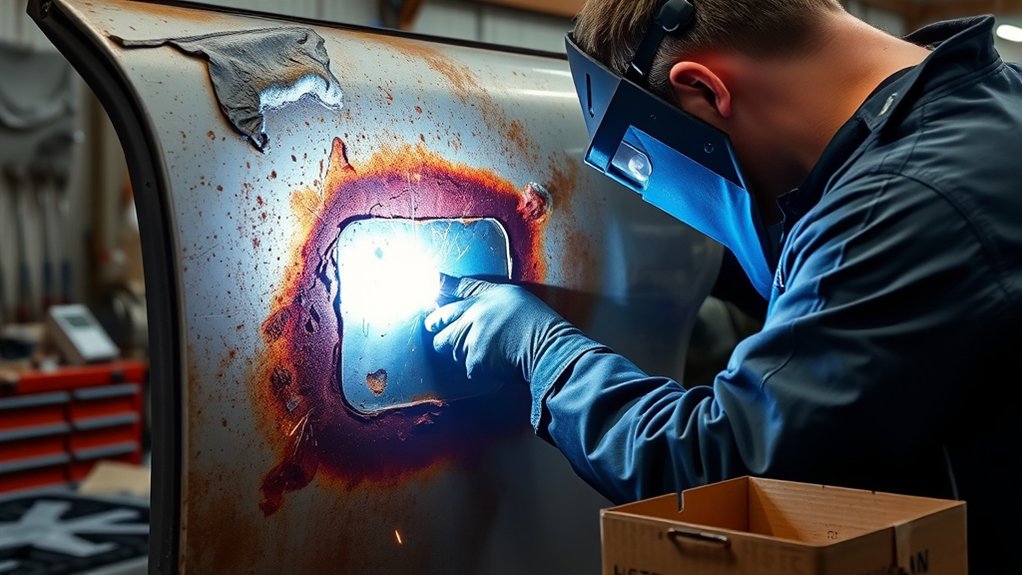
Welding removes or damages factory corrosion protection around the repair. Replacing that protection is part of the repair, not an optional cosmetic step. Moisture can return through a pinhole, overlap, wheel-opening seam, uncoated weld backside, or damaged flange.
Protect the Front Side and Seams
- Remove welding residue and finish the metal without thinning the panel.
- Clean the surface with products approved by the paint system.
- Apply epoxy or urethane primer where the product and refinishing procedure require it.
- Apply only the amount of body filler or finishing glaze needed to restore the contour. Follow the filler manufacturer’s instructions on whether it goes over bare metal or cured primer.
- Re-prime and block-sand as required by the refinishing system.
- Apply seam sealer to factory seams, overlaps, wheel-opening lips, and repaired joints where specified.
- Restore the base coat, clear coat, stone protection, or underbody coating used in that area.
Many seam sealers perform best over a suitable two-component primer or intact OEM E-coat, but some products are designed for direct-to-metal use. Follow the technical data sheet instead of assuming that every sealer uses the same order.
Protect the Back Side and Hidden Cavities
Prime and coat accessible backside metal after the welding and grinding are complete. Restore seam sealer around wheel-opening and pinch-weld joints. Apply cavity wax through factory access holes or a suitable wand so it reaches the weld backside, overlap, hem, and enclosed cavity.
A general coating such as Rust-Oleum on rusted metal may suit some non-cosmetic surfaces, but it should not be mixed into an automotive refinishing system unless the products are compatible and approved for the location. Do not cover active rust, moisture, or uncured material.
Pro Tip: Photograph the repaired inner metal and corrosion protection before reinstalling liners or trim. The photos provide a useful record and help you confirm that no flange or cavity was missed.
Common Mistakes to Avoid
- Covering rust instead of removing it: Filler, resin, epoxy, seam sealer, or paint cannot restore steel that has perforated or lost strength.
- Cutting before inspecting the back side: You may damage wiring, a fuel component, an inner wheelhouse, or a reinforcement.
- Ignoring OEM repair information: An attractive patch can still be wrong for the vehicle material or sectioning location.
- Welding over coatings: Paint, zinc, rust converter, seam sealer, and undercoating contaminate the weld and may produce hazardous fumes.
- Using a long continuous bead: Concentrated heat can distort a large area of the quarter panel.
- Bridging a large gap with weld: This adds excessive heat and increases burn-through and shrinkage.
- Grinding the surrounding panel thin: A flat-looking seam is not useful if the steel beside it has lost strength.
- Calling every weld a spot weld: Tack welds, MIG plug welds, and resistance spot welds serve different purposes.
- Leaving the back side bare: Rust can restart behind a repair that looks perfect from the outside.
- Skipping the post-weld fire watch: Seam sealer, foam, trim, or insulation may smolder out of sight.
How to Wrap Up Your Rust Repair Like a Pro
Complete a final inspection before applying the last coatings and reinstalling trim. Correcting a pinhole or missed seam now is easier than reopening a painted panel later.
| Step | Action | Pass Condition |
|---|---|---|
| 1. Inspect the weld | Check the full seam from both sides where accessible | No cracks, unfused edges, open gaps, or visible pinholes |
| 2. Check the panel shape | Use your hand, a straightedge, and reflections across the panel | The patch follows the original crown without severe highs, lows, or oil-canning |
| 3. Confirm rust removal | Inspect the opening edges, inner wheelhouse, flanges, and seams | No loose scale, perforated metal, or untreated active corrosion remains |
| 4. Verify coating coverage | Inspect primer, seam sealer, paint, underbody coating, and cavity wax | Edges, seams, overlaps, and the weld backside are protected |
| 5. Complete the fire watch | Monitor the panel, interior, wheelhouse, floor, and nearby cavities | No smoke, unusual odor, rising temperature, or smoldering material for at least 30 minutes |
| 6. Reassemble and initialize | Reconnect systems and reinstall trim according to the OEM procedure | No warning lights, damaged wiring, loose trim, trapped moisture, or required initialization left incomplete |
Frequently Asked Questions
What is the best filler for rust holes?
No body filler is a permanent substitute for perforated or weakened steel. Cut out the rust and install sound metal first. After the weld is finished and protected according to the refinishing system, use a thin layer of compatible body filler or finishing glaze only to correct minor surface contours.
What is the cheapest way to fix rusted rocker panels?
A DIY welded patch may reduce labor cost when the damage is small and you already own the correct tools. However, rocker panels often contain multiple layers and can contribute to vehicle strength. Inspect the inner structure and follow the OEM repair procedure before choosing a low-cost patch.
How much does it cost to fix quarter-panel rust?
Cost depends on how far the rust extends, whether the inner wheelhouse or reinforcements need work, the panel material, paint blending, local labor rates, and whether a patch or complete panel is required. A body shop must inspect the vehicle before it can provide a reliable estimate.
Can you use JB Weld to fill rust holes?
JB Weld may bond a small non-structural item, but it does not restore the strength or corrosion protection of missing quarter-panel steel. It should not replace a welded metal repair, cover active rust, or be used where the panel is part of a structural joint.
Should you butt-weld or overlap a quarter-panel patch?
A close-fitting butt joint often gives a smoother result on a visible outer skin. An overlap may be appropriate at a hidden flange or manufacturer-specified sectioning joint, but it creates another moisture path that must be sealed and protected. Follow the vehicle’s repair procedure whenever it specifies the joint.
Can you weld over rust converter or ordinary primer?
Do not weld through an ordinary rust converter, primer, paint, encapsulator, or seam sealer. Remove it from the fusion area unless its technical data sheet and the OEM procedure specifically approve it for that welding process. Coatings can contaminate the weld and release hazardous fumes.
When is quarter-panel rust too extensive for a small patch?
A small patch is usually inappropriate when corrosion follows a long seam, affects the inner wheelhouse or several layers, reaches a reinforcement or structural attachment, or leaves too little solid metal for an approved joint. A larger repair section or professional panel replacement may be necessary.
Safety Disclaimer: This guide is for general information and does not replace hands-on welding training, vehicle-specific body-repair information, workplace safety requirements, or professional collision-repair advice. Welding and grinding can create fire, electrical, fume, burn, fuel-vapor, restraint-system, and high-voltage hazards. Stop and consult a qualified repair professional when the material, structure, electronics, fuel system, or approved repair method is uncertain.
Conclusion
A quarter-panel patch lasts only when you remove all weak metal, repair hidden layers, fit the replacement steel closely, and control heat throughout the weld. The work does not end when the seam looks smooth. OEM procedures, electrical isolation, fire monitoring, primer, seam sealer, refinishing materials, and cavity protection are all part of the repair.
Practice the complete joint on matching scrap before welding the vehicle. If the rust reaches structural metal, the inner wheelhouse is badly damaged, or the approved repair method is unclear, professional panel repair is safer than hiding the problem behind filler or an undersized patch.
Sources
- OSHA 29 CFR 1910.252: Welding, Cutting, and Brazing — fire prevention, fire-watch duration, PPE, ventilation, zinc-coated metal, and cleaning-compound precautions
- I-CAR: Protecting Restraint Systems During Welded Quarter-Panel Replacement — battery isolation, high-voltage precautions, work-clamp placement, cable routing, and electronics protection
- Miller: Successfully Welding Sheet Metal With MIG and TIG — thin-sheet heat control, small-diameter wire, shielding gas, fit-up, and process selection
- Miller: MIG Basics for Automotive Welding Repair — practice welds, work-clamp contact, wire selection, plug welds, and staggered tack welding
- 3M Collision Repair Corrosion Protection Resources — weld sealing, seam protection, coatings, and cavity-wax application
- CDC/NIOSH Archive: Metal Fume Fever — zinc oxide fume exposure associated with heating galvanized steel