Like dialing in a certified weld, you’ll size your cuts by amperage, air, and duty cycle. With a 200 A plasma cutter, expect peak results on 3/8–1 in steel, a max near 1-1/2 in, and slower travel with more bevel and dross as thickness climbs. You’ll need clean, dry air at spec CFM/PSI, adequate input power, and proper consumables. Compare models by rated severance vs. production cut—then decide when oxy-fuel is smarter.
Practical Cutting Limits for 200 Amp Plasma Cutters
For most 200 A plasma systems, practical cutting limits center on 3/8–1.0 in steel for efficient, clean results, with 1.0 in near the top of ideal performance and 1.5 in considered marginal. You should plan around this window, validating with test cuts and manufacturer charts.
At 3/8–1/2 in, you’ll achieve high travel speeds and square kerfs; by 1.0 in, expect slower speeds and tighter process control. Beyond 1.0 in, especially at 1.5 in, anticipate dross, bevel, and frequent restarts.
Match cutting techniques to material types and thickness: use appropriate consumables, correct standoff, dry air, and amperage aligned to nozzle rating.
Monitor duty cycle—long continuous cuts near 1.0 in can trigger cool-downs, reducing throughput. Material properties matter: higher-strength steels and poor surface conditions reduce cut quality at the same thickness.
Maintain ideal arc voltage and gas flow, and keep torch lead lengths minimal to limit voltage drop. Validate cut edges against tolerance and kerf spec.
Recommended Thickness by Application and Material
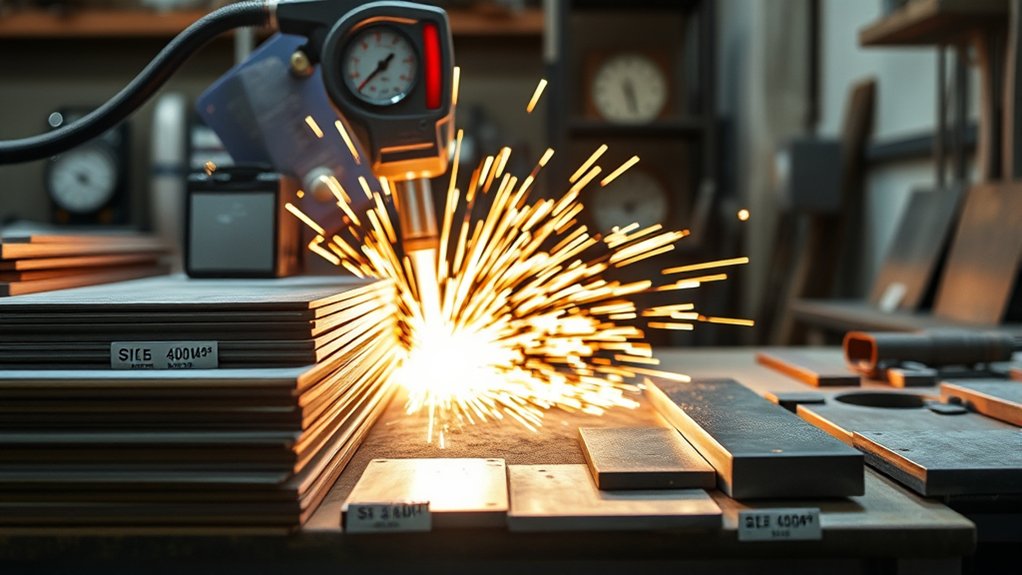
One clear rule anchors application planning: target 1/2–3/4 in as the primary production range, reserve 1 in as the recommended maximum, and treat 1-1/2 in as a capability with degraded quality.
For carbon steel, specify 1/2–3/4 in for repeatable, low-slag edges using drag or standoff cutting techniques; use 1 in for occasional structural components where post-cut finishing is acceptable.
For stainless steel, keep primary work at 1/2–5/8 in to minimize heat tint and taper; 3/4–1 in is viable with slower travel.
For aluminum, prioritize 3/8–5/8 in due to higher thermal conductivity; 3/4–1 in works with optimized pierce timing.
Duty Cycle, Air Supply, and Power Requirements
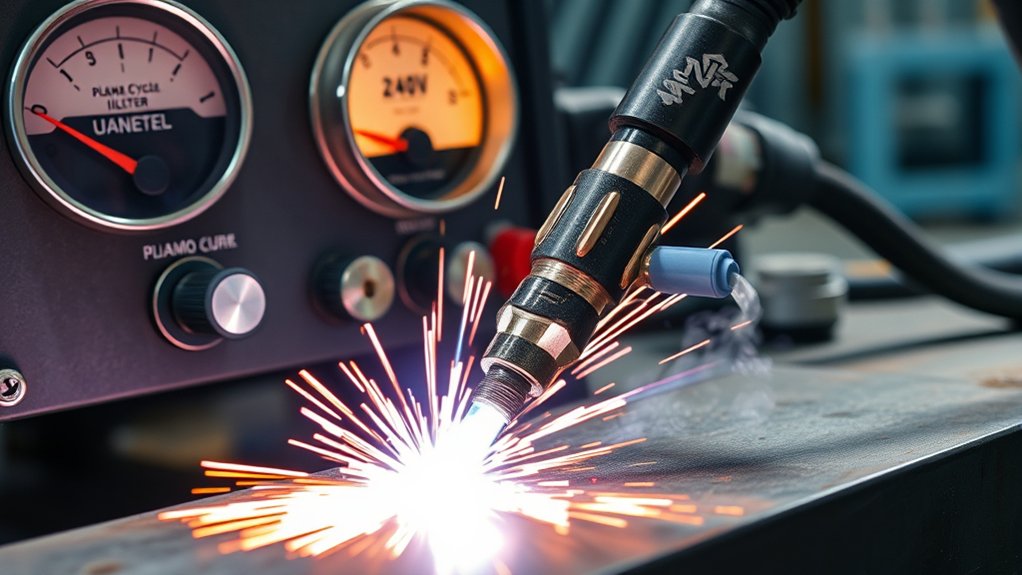
Although cutting capacity gets the headlines, a 200‑amp plasma system’s uptime and cut quality hinge on its duty cycle, air supply, and power infrastructure. You should verify duty cycle importance first: many units rate 60–100% at specified ambient temperatures, so plan arc-on time and cooling intervals to avoid thermal shutdowns. For air, hold 60–70 psi at the torch under flow, not static, and dry it—air quality impact is real. Moisture and oil cause double arcs, dross, and consumable erosion. Use a dryer, filters, and an adequately sized compressor.
Match power to the nameplate: most systems need 230–400 V. Size feeders, breakers, and cords for continuous load; poor connections cause voltage sag, weak arcs, and nuisance trips. Confirm phase, wire gauge, and grounding per code.
| Parameter | Target/Action |
|---|---|
| Duty cycle | 60–100%; manage heat |
| Air pressure | 60–70 psi flowing |
| Air quality | Dry/clean; use dryer/filters |
| Power | 230–400 V; correct breaker/gauge |
Model Comparisons and Recommended Cuts
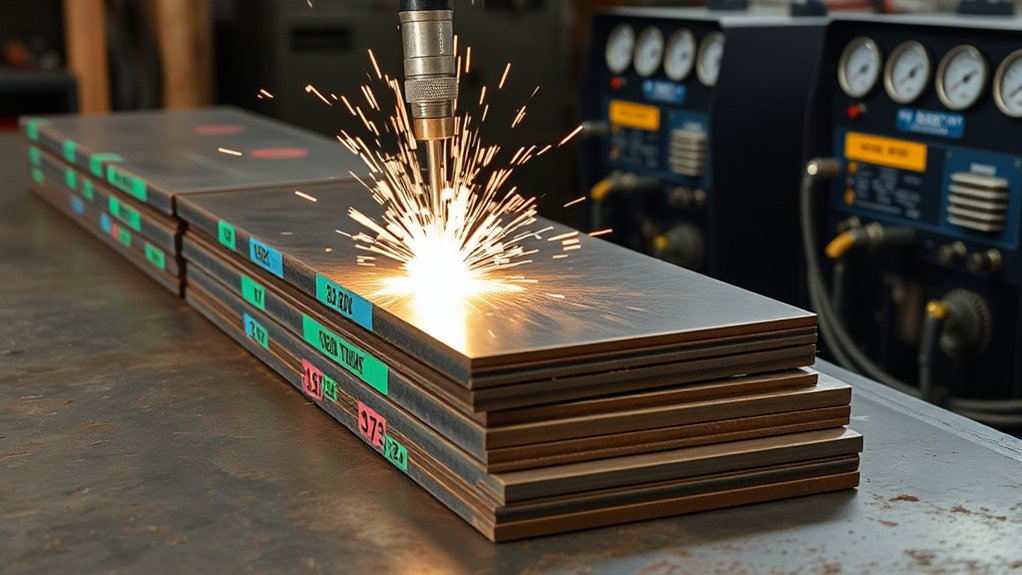
When you match plasma models to target thickness, use manufacturer-rated recommended cuts, not just sever ratings.
In a Hypertherm comparison, the Powermax125 is your heavy-duty benchmark with a recommended 1-1/2 in capacity; it maintains cut speed, squareness, and kerf quality on plate where smaller units stall.
For mid-heavy work, the Miller Spectrum 875 posts a 7/8 in recommended cut, bridging fab shops and light industrial.
Lincoln features on the Tomahawk 1000 deliver reliable performance at 3/4 in recommended cuts.
For 1/2–5/8 in plate, the Hypertherm Powermax45 XP offers upgraded consumables and arc density.
Lightweight jobs suit the Miller Spectrum 375 X-Treme at 5/16–3/8 in, noting no built-in compressor.
1) Match amperage to thickness: ~60–90 A for 1/2–5/8 in; 90–120 A for 3/4–7/8 in; 125–200 A for 1–1/2 in.
2) Prioritize duty cycle at target thickness to sustain continuous cuts without thermal trips.
3) Verify air quality and flow to maintain cut speed, dross control, and edge angularity.
When to Choose Oxy-Fuel or Higher-Capacity Machines
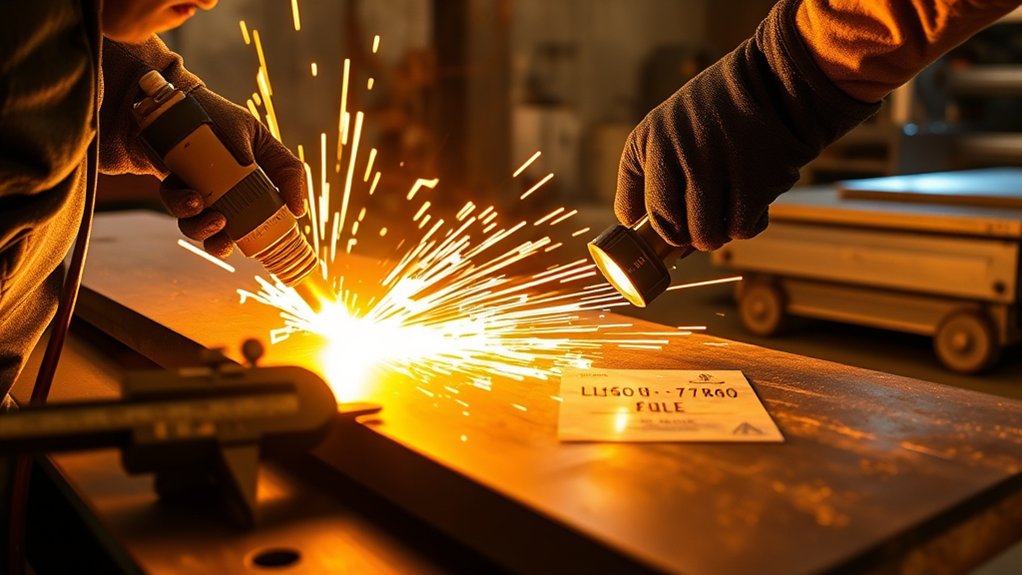
For plate beyond 1 in, shift from standard shop plasma to oxy-fuel or a higher-capacity plasma source to maintain speed, edge quality, and duty cycle.
At 3/4–1-1/2 in, step up to ≥200 A systems; they hold cut speed and kerf consistency where 100–150 A units stall.
Recognize plasma cutter limitations: even a Powermax125-class unit can sever 1-1/2 in, but expect slower travel, more dross, and reduced consumable life at the top end.
Choose oxy-fuel for >2 in carbon steel, where preheat, exothermic reaction, and straight-cut bevels deliver repeatable results.
Oxy fuel advantages include robust pierce capability, thick-section productivity, and simpler torch maintenance for heavy plate.
Use plasma when you need tighter tolerances and cleaner edges on thinner stock; use oxy-fuel when section modulus and heat input are acceptable.
Match amperage, gas selection, and torch height to the thickness to meet production-rate, edge-squareness, and duty-cycle targets.
Frequently Asked Questions
How Does Pierce Capacity Differ From Edge-Start Cutting Capacity?
Pierce capacity is lower than edge-start cutting capacity because you must penetrate material, reducing pierce efficiency. With an edge start technique, you avoid full penetration, enabling thicker cuts. You’ll reference manufacturer charts, duty cycle, standoff, and gas flow.
What Consumable Lifespan Should I Expect at 200 Amps?
Expect 25–120 minutes arc-on per set at 200 amps, depending on consumable types and lifespan factors. You’ll maximize life with correct gas, dry air (<10 ppm moisture), 0.060–0.080" standoff, 250–320 ipm, 140–160 V, and clean starts.
How Does Torch Lead Length Affect Cut Quality and Voltage Drop?
You’ll see longer leads increase voltage drop, degrading torch performance and cut quality. Even 1% drop per 10 ft can widen kerf and dross. Use larger-gauge cables, tight connections, high-quality lead insulation, and adhere to manufacturer maximum lead lengths.
Are CNC Automation Settings Different for 1/2-Inch Versus 1-Inch Cuts?
Yes. You’ll adjust feed rate, amperage, gas flow, pierce delay, and height control differently. For 1-inch, slow more, increase current and gas, extend delays. These changes stabilize arc, improve cut quality, and maximize automation efficiency reliably.
What Safety PPE Is Essential for High-Amperage Plasma Cutting?
You need welding gloves and face shields—sparks erupt, vision stays protected. Add ANSI Z87.1 goggles, FR jacket, leather boots, Class D fire extinguisher nearby, hearing protection (NRR 25+), respirator meeting P100 with fume extraction, and insulated, dry work surface compliance.
Conclusion
You now know what a 200-amp plasma cutter can truly deliver. Plan for clean, fast cuts from 3/8–1 inch, with a hard ceiling near 1-1/2 inches. Match duty cycle, air quality (dry, 90–120 psi, adequate CFM), and power to spec; otherwise, you’ll pay in bevel, dross, and speed. Compare models by rated vs. severance thickness. When parts get thick, call a spade a spade—choose oxy-fuel or higher-capacity plasma to stay within tolerance.