A 30 amp plasma cutter hits a sweet spot between portability and precise cuts, but your output and setup make all the difference. You can expect clean severance on mild steel from 20 ga (0.032 in) up to 1/4 in, with the best quality around 3/16 in. Keep your air at 55–60 psi, and match tip size, amperage, and travel speed to the material thickness. Aluminum usually needs about double the amperage. If you start seeing kerf issues, edge dross, or warping, the adjustments below will get you back on track.
Quick Answer
- A 30 amp plasma cutter handles mild steel from 20 gauge up to 1/4 in, with the cleanest edges at 3/16 in or thinner.
- Set air pressure to 55–60 psi (measured while flowing), use a 0.8 mm (.030) tip, and run 21–30 amps depending on thickness.
- Target travel speeds of 24–38 ipm for mild steel. Stainless cuts slower (6–8 ipm at 1/4 in), and aluminum cuts faster (15+ ipm).
- For thin sheet metal, clamp the work firmly, run high travel speeds, and use FineCut consumables to reduce warping.
- Most 30 amp units have a 35% duty cycle: about 3.5 minutes of cutting followed by 6.5 minutes of cooling.
Power and Voltage Basics for 30 Amp Plasma Cutting
While amperage determines your cutting capacity, getting good results from a 30 A plasma cutter means matching current, air pressure, and tip size to the material. For stable arc energy at this rating, aim for 55–60 psi at the torch with a 0.8 mm (.030) tip. This range keeps a high-velocity jet, preserves arc constriction, and supports roughly 10 inches per minute on rated mild steel cuts.
Always verify your line pressure under flow. Static readings can be misleading.
Set pressure while air is flowing; idle, static readings can mislead and undercut true torch pressure.
Check the manufacturer’s chart to confirm current, tip, and standoff settings. Then validate cut quality by looking at kerf width, dross class, and heat tint. As part of plasma cutter maintenance, inspect the regulator, filter, and consumables regularly. Leaks or saturated filters will drop dynamic pressure and destabilize the arc.
Keep your air clean and dry per ISO 8573 recommendations. Write down your settings and results so you can repeat them consistently across materials and operators.
Recommended Material Thickness Range for 30 Amp Tips
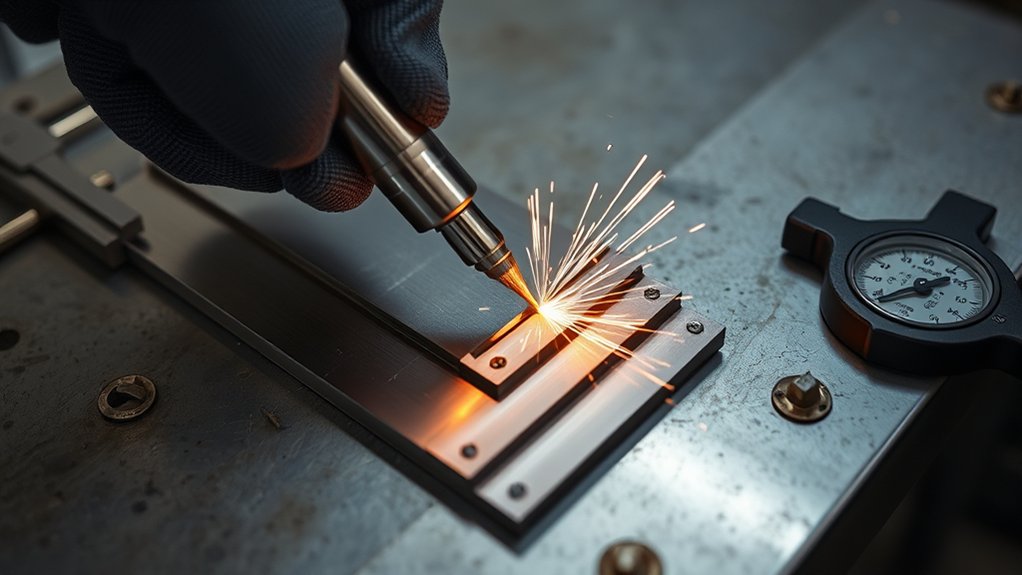
With a 30 amp tip (0.8 mm orifice), you’ll be working on thin-gauge stock up to about 1/4 in mild steel. Stainless is typically capped near 1/8 in for efficient performance.
Set air at 55–60 psi and expect travel speeds around 20–25 ipm to hold consistent kerf with minimal dross.
You should get clean, square edges within this range. Thicker sections will force slower speeds, more bevel, and extra post-cut cleanup.
Typical Thickness Range
For a 30 amp plasma tip, the recommended material thickness runs from 20 gauge (0.032 in / 0.81 mm) up to 1/4 in (6.35 mm) mild steel.
Within this range, you’ll get the best cut efficiency when your plasma settings match the thickness and speed. Staying inside these limits keeps kerf narrow, edges square, and dross low.
1) 20–12 ga: Use higher travel speeds. Maintain 55–60 psi air pressure for a stable arc and clean edges.
2) 1/8–3/16 in: Moderate speeds work best. Hold torch height precisely to preserve arc focus and contour fidelity.
3) 1/4 in: Expect about 21–30 IPM. Verify airflow at 55–60 psi and keep a steady pace to minimize top bevel.
Avoid going thicker. Exceeding 1/4 in usually degrades quality and means more post-cut cleanup.
Material Compatibility Notes
Even within a 30 amp class, your material choice and thickness control cut quality and speed. A 30 amp tip works well on materials up to 1/4 in (6.4 mm) and is ideal for sheet metal and thin steel.
Operate within 21–30 A and 55–60 psi air to maintain stable arc characteristics. Keep material properties in mind: aluminum conducts heat fast and typically needs roughly double the amperage compared to steel to maintain an efficient plasma column.
Plan your cutting techniques around kerf. Expect around 0.8 mm (0.030 in) kerf width for precise layout and fit-up on thin sections.
Adjust travel speed for the thickness and alloy. For mild steel, target about 24–38 ipm for quality cuts at 1/4 in or thinner. Bump speed up slightly on thinner stock. Slow down a bit as thickness approaches the 1/4 in limit.
Cut Quality Expectations
A 30 amp tip can sever up to about 1/2 in (12.7 mm), but you should set your quality expectations around thinner stock. For the best edge fidelity, treat 3/16 in (4.76 mm) as the quality limit. 1/4 in (6.35 mm) is still acceptable for rated cuts with moderate cleanup.
Beyond that, kerf widens, bevel increases, and dross gets worse. You’ll need tighter dross management and slower travel.
- Set parameters: run 21–30 A on mild steel with dry air at 55–60 psi. Verify flow under load.
- Apply cutting techniques: maintain standoff, keep the torch angle square, and hold constant speed. Pierce off-part and lead in.
- Inspect results: look for a bright, continuous arc, minimal top spatter, and light bottom dross. If dross is heavy, reduce speed slightly or increase air.
Amperage, Nozzle Size, and Air Pressure Settings
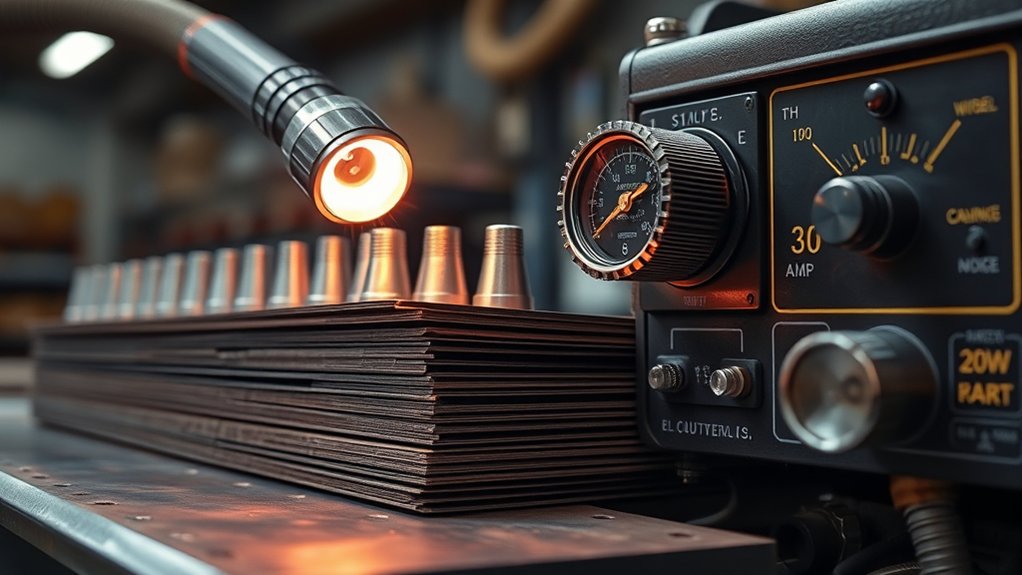
When setting up a plasma cutter, match amperage, nozzle orifice, and air pressure to the material and your cut quality goals. With a 30 A machine, use a 30 A tip with a 0.8 mm (0.030 in) orifice for work in the 21–30 A range. Set clean, dry air to 55–60 psi at the torch while flowing. This combination stabilizes the arc, limits amperage effects like excessive kerf width or undercut, and supports consistent edge squareness.
For mild steel up to 1/4 in, start at the charted amperage and pressure from your manufacturer. Low pressure risks arc blowout and incomplete penetration. Excessive pressure increases dross and can slow the process. Verify dynamic pressure with the trigger depressed.
Stay on top of nozzle maintenance: check orifice roundness, replace worn tips, and keep electrodes within spec to prevent double-arcing and erratic kerf.
Validate settings on scrap first. Then adjust in small increments to correct angularity, dross, or arc lag before making production cuts.
Cutting Speed Expectations by Metal Type and Thickness
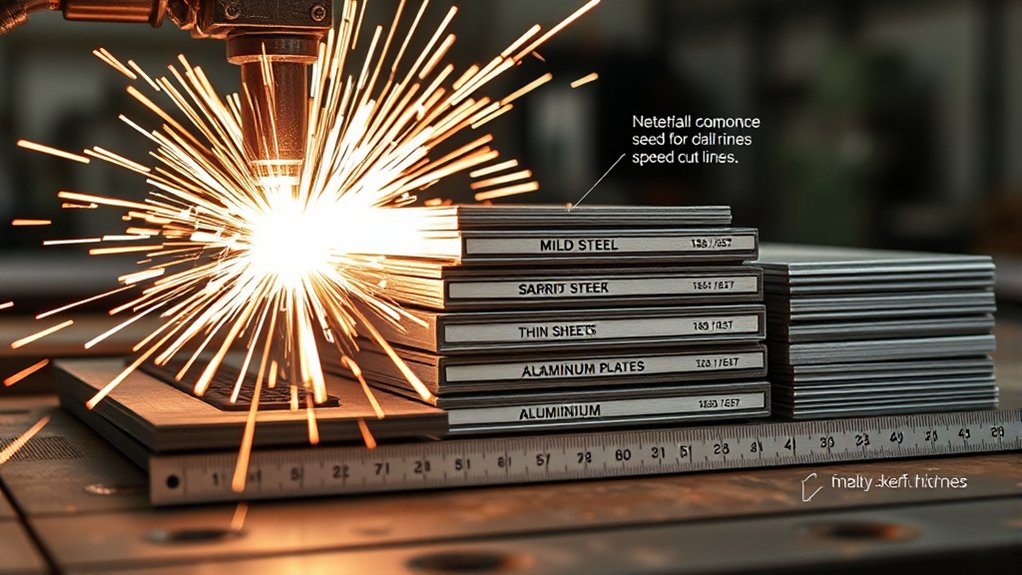
Set realistic cut speeds by matching metal type and thickness to your 30 A system’s capability. Always verify with test cuts.
Cutting speed depends on material type, thickness, and proper air delivery. At 55–60 psi with a 30 A tip, expect consistent arc focus and predictable feed rates.
1) Mild steel: Target a rated cut of 3/8 inch at roughly 10 IPM. Thinner gauges scale faster. For 1/4 inch, increase travel speed proportionally while maintaining full penetration. If you see trailing sparks or dross, raise speed slightly or confirm pressure.
2) Stainless steel: Plan for 1/4 inch at about 6–8 IPM. Stainless conducts heat poorly, so avoid excessive dwell. Keep torch angle square and maintain steady motion to control heat input and prevent slow, dross-prone passes.
3) Aluminum: Cut up to 3/8 inch at over 15 IPM thanks to its lower melting point. Use brisk starts and maintain higher travel speed to minimize heat soak. Verify edge continuity and adjust speed before production.
Kerf Width and Edge Quality With 30 Amp Consumables
With a 30 A tip using a 0.8 mm (0.030 in) orifice at 55–60 psi, expect a narrow, consistent kerf that works well for precision jobs on thin to moderate gauges, especially around 1/4 in mild steel. You’ll hold kerf integrity by pairing amperage with proper pressure and maintaining steady travel speed.
Too slow, and heat input widens the kerf and raises dross. Too fast, and you’ll undercut edges. On mild steel and aluminum, you’ll typically see clean, square edges with minimal secondary processing. 1/4 in mild steel offers the best balance of speed and edge refinement.
| Parameter | Guidance |
|---|---|
| Amperage | 21–30 A (tip rated) |
| Air pressure | 55–60 psi (stable, dry) |
| Kerf width | Narrow; material-dependent |
| Travel speed | Moderate; avoid lingering |
| Best thickness | 1/4 in mild steel |
Check consumable condition, maintain torch-to-work distance, and keep motion uniform to preserve kerf integrity and minimize dross while maximizing edge refinement.
Setup for Thin Sheet Metal to Minimize Warping
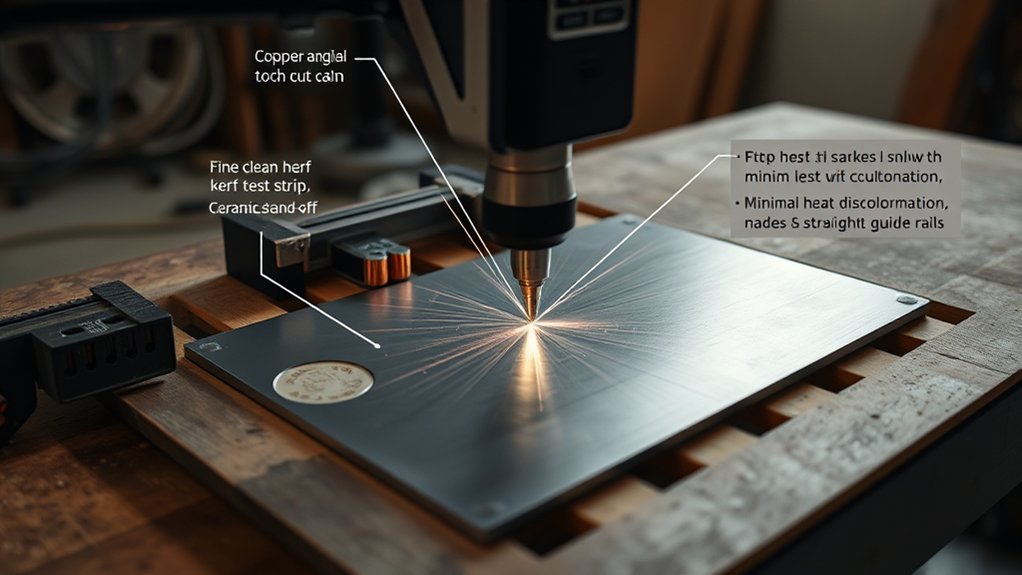
For thin sheet, secure the work with rigid fixturing and edge clamps to eliminate flex and slip that cause distortion.
Set high travel speeds (38 IPM or faster) and pair a 30 A tip with FineCut consumables to maintain a narrow kerf and a stiffer arc.
Control heat input by matching amperage to thickness per manufacturer specs and minimizing dwell. This ensures consistent, low-distortion cuts.
Secure Fixturing Methods
Thin sheet metal cuts fast, but you’ll only hold tolerance if the sheet is rigidly constrained to limit heat-induced distortion.
Use fixturing techniques and stability methods that keep the work flat, immobile, and evenly supported. Clamps or modular fixtures prevent sliding and flexing, especially on polished stainless and aluminum where rigidity preserves edge quality and dimensional accuracy. Distribute restraint evenly to avoid localized bow.
1) Use low-profile edge clamps at 150–300 mm spacing. Add crossbars or vacuum pods to hold interior zones flat without obstructing the torch path.
2) Place copper or aluminum backing bars beneath kerf lines to absorb heat and support the cut. Maintain continuous contact to reduce dross.
3) Use weighted plates or magnetic hold-downs to balance load across the panel. Verify squareness and flatness with feeler gauges before piercing.
High Travel Speeds
Even on thin sheet, you control distortion by running the torch fast enough to outrun heat spread. For 30 A class machines, target at least 10 inches per minute (IPM) as a baseline for clean edges without deformation.
Validate with a straight-line test: look for a narrow, vertical kerf and minimal dross. Increase speed until arc lag appears, then back off 5–10%.
Use FineCut consumables to tighten kerf width and focus the arc, improving edge fidelity at higher speeds.
Secure the sheet to prevent flex and sliding. Movement forces you to slow down, which increases heat propagation.
Reduce pierce time by edge-starting rather than stacking layers. This preserves cut quality while maintaining commanded travel speed.
Heat Input Control
High travel speed limits heat spread, but you still need to set the machine to control total heat input on thin sheet. Prioritize heat management: keep traverse above 10 IPM to minimize propagation, match amperage to thickness, and stabilize the work. For roughly 1/8 in material, a 30 amp tip provides adequate energy density without overdriving the kerf.
1) Set parameters: adjust current to the thinnest section, verify gas flow, and select FineCut consumables to yield a narrow kerf and stiff arc that lowers distortion risk.
2) Control starts: program pierce delay just long enough for full penetration. Avoid over-piercing when starting off-edge.
3) Fixturing: clamp sheets at multiple points to suppress flex, maintain standoff, and guarantee consistent arc energy distribution.
Techniques for Clean Cuts on 1/8 to 1/4 Inch Materials
When cutting 1/8 to 1/4 inch stock with a 30-amp plasma system, lock in foundational settings first: set amperage to 21–30 A for 1/8 inch, hold air pressure at 55–60 psi, and use FineCut consumables to tighten kerf and stiffen the arc on thin material.
Apply disciplined cutting techniques: square the torch, set standoff at 1/16–1/8 inch, and verify plasma settings with scrap test passes before production. Track speed by edge lag. For 1/4 inch, target 24–30 IPM to minimize dross and bevel.
| Visual cue | Action standard |
|---|---|
| — | — |
| Bright, narrow arc column | Maintain standoff; don’t outrun the arc |
| 5–10° trailing sparks | Travel 24–30 IPM on 1/4 inch |
| Minimal top spatter | Air 55–60 psi, clean dry supply |
Start your lead-in off-part to avoid divot marks, then pierce perpendicular and shift to a 10–15° drag angle.
Keep the kerf centered. Adjust speed if slag tails forward (too slow) or sparks exit upward (too fast). Finish with a brief, straight lead-out to prevent crater formation.
Safety and Duty Cycle Considerations at 30 Amps
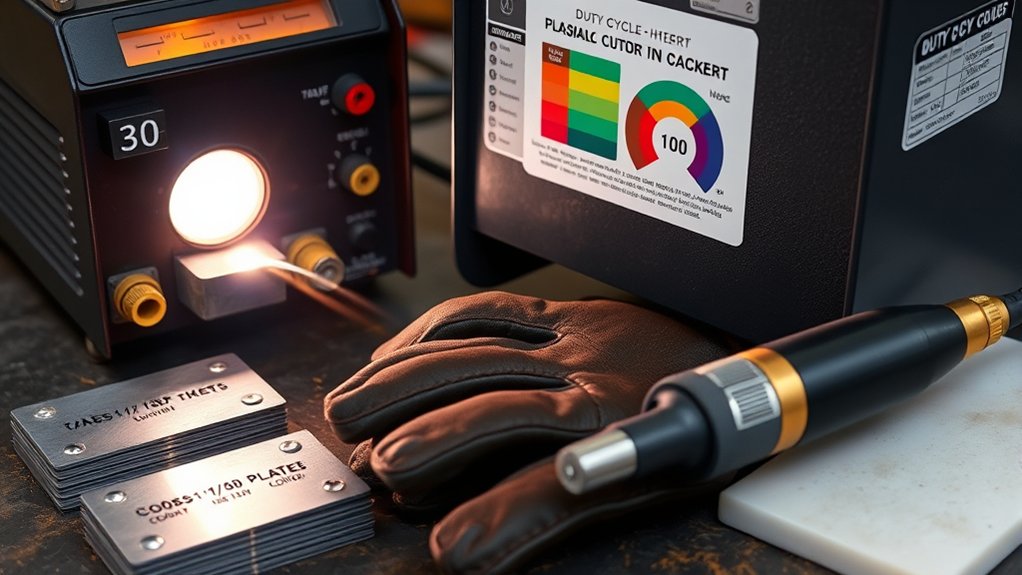
Once your settings are dialed for clean cuts on 1/8–1/4 inch stock, you also need to manage operator safety and the machine’s 30 A duty cycle. At 30 amps, most units rate a 35% duty cycle. That means you can run for 3.5 minutes, then cool for 6.5 to prevent thermal shutdown and component stress.
Keep air at 55–60 psi to stabilize arc quality and minimize dross while avoiding excessive backpressure.
Maintain 55–60 psi air to stabilize the arc, reduce dross, and avoid harmful backpressure.
1) Safety gear and environment: Wear an ANSI Z87.1 face shield with the shade specified by your manufacturer, fire-resistant gloves and clothing, and hearing protection. Confirm grounded work clamps, a dry work area, and local exhaust or outdoor ventilation to control fumes and particulates.
2) Duty cycle control: Log arc-on time, stick to the 10-minute duty window, and allow full cooldown if the thermal light trips. Avoid coiling leads on hot metal.
3) Consumables and air quality: Inspect tips and electrodes each session. Replace them when the orifice is out-of-round. Use dry, oil-free air via a filter/dryer to protect the torch and maintain consistent cut performance.
Troubleshooting Cut Quality at 21–30 Amp Operation
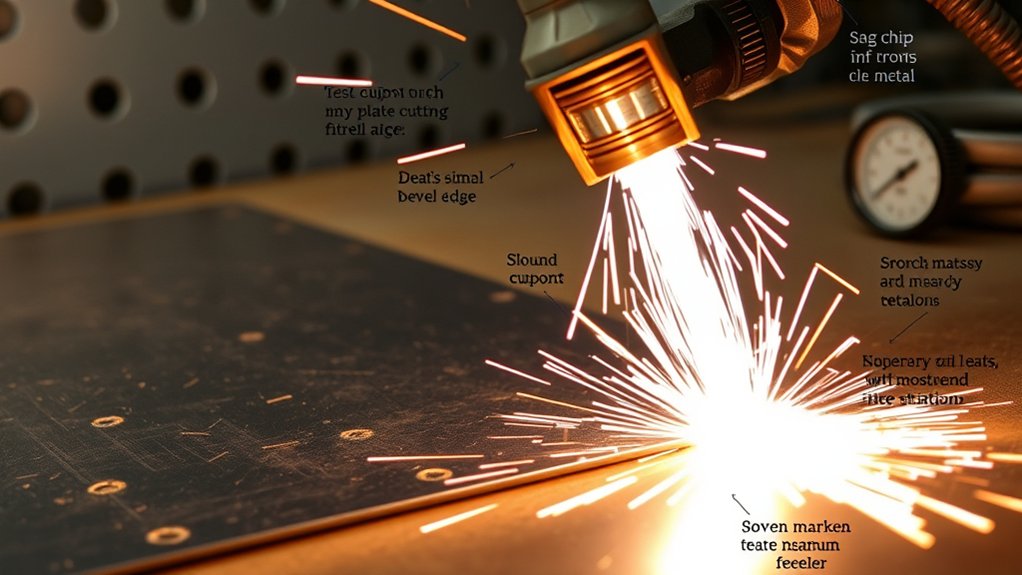
While 21–30 amp settings can sever up to 1/4 inch mild steel, stick with thinner stock for best edge quality. Use a 30 A tip (about 0.8 mm/.030) to tighten kerf.
For quality control, verify supply air at 55–60 psi under flow. Pressure below spec causes dross, uncut webs, and arc instability. Inspect the nozzle and electrode for pitting, ovality, and discoloration. Replace as needed, since consumable maintenance directly affects kerf width and angularity.
Apply consistent standoff (about 1.5–2.0 mm) and maintain a square torch to minimize bevel. Adjust cutting techniques by matching speed to thickness: slow slightly on thicker work within this range to avoid lag lines while preventing overheating and warping.
If slag accumulates on the top edge, increase speed. If it hangs on the bottom, reduce speed or raise pressure into spec.
Clean the torch body, shield, and swirl ring routinely, and make sure you have low-resistance grounding. Stable work return lowers arc blow and improves repeatability.
Frequently Asked Questions
Can a 30 Amp Plasma Cutter Run on a Small Portable Generator?
Yes, as long as the generator capacity matches the plasma cutter requirements. Check that the generator provides continuous wattage (about 4–6 kW), 120/240 V compatibility, stable frequency (60 Hz), low THD (under 5%), and enough surge headroom. Use heavy-gauge cords and observe duty-cycle limits.
Which Air Compressor CFM Is Ideal for Consistent 55–60 Psi Delivery?
Choose a compressor delivering 4–5 CFM at 90 psi to maintain consistent 55–60 psi. This meets CFM requirements with reserve, guarantees pressure stability under duty cycles, and aligns with common pneumatic specifications and regulator/receiver best practices.
How Do Altitude and Humidity Affect Cut Performance and Air Drying?
Altitude reduces available oxygen and compressor output, which degrades arc stability and cut quality. You’ll compensate with higher flow. Humidity increases water load and worsens performance. You’ll need efficient drying (refrigerated or desiccant type), drains, and dew-point monitoring to keep cuts consistent.
What Extension Cord Gauge Is Safe for 30 Amp Plasma Cutters?
Use 10 AWG copper for 30 A plasma cutters. Choose heavy-duty extension cord types (SJTW or SOOW), rated for 125/250 V, with oil and abrasion-resistant wire insulation. Keep runs under 50 ft to limit voltage drop.
Are CNC Tables Compatible With 30 Amp Torches and Arc-Start Types?
Yes. You can run most CNC tables with 30-amp torches if the controller supports on/off and arc-OK signals. Verify CNC compatibility by matching torch types: blowback (pilot arc) vs. HF start. Make sure you have proper EMI mitigation and grounding.
Conclusion
You now have the data to dial in your 30A plasma cutter. Stay within 20 ga to 1/4 in steel (best results up to 3/16), hold 55–60 psi, and match travel speeds (24–38 ipm) to thickness. For aluminum, plan on roughly double the amperage. Verify kerf and edge quality, adjust nozzle size, and control heat to prevent warping. Monitor duty cycle, PPE, and grounding. When in doubt, measure first, because that saves consumables and time.