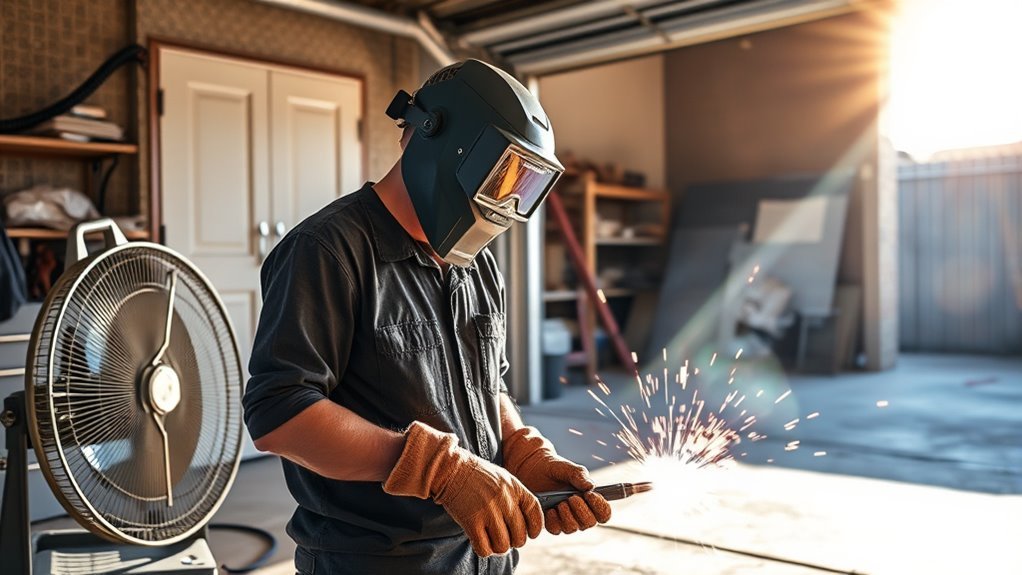
Pulse MIG welding can help you control heat when thin auto body panels leave little room for error. Standard MIG can work well, but too much heat can warp panels, burn edges, and add cleanup time. In this guide, you’ll learn how pulse MIG works, when it helps most, and how to set it up for cleaner repair welds.
Quick Answer
Pulse MIG welding uses high peak current and low background current to control heat and transfer filler metal in steady droplets. You can use it on auto body panels to reduce warping, lower spatter, and improve bead control on thin steel, stainless steel, and aluminum.
Key Takeaways
- Pulse MIG helps you control heat on thin auto body panels.
- The process can reduce burn-through, spatter, and panel distortion.
- Aluminum, stainless steel, mild steel, and some high-strength steels can work well with proper settings.
- Clean grounding, steady wire feed, and correct machine settings affect weld quality.
- You still need proper joint prep, safety gear, and practice before welding visible panels.
What Is Pulse MIG Welding?
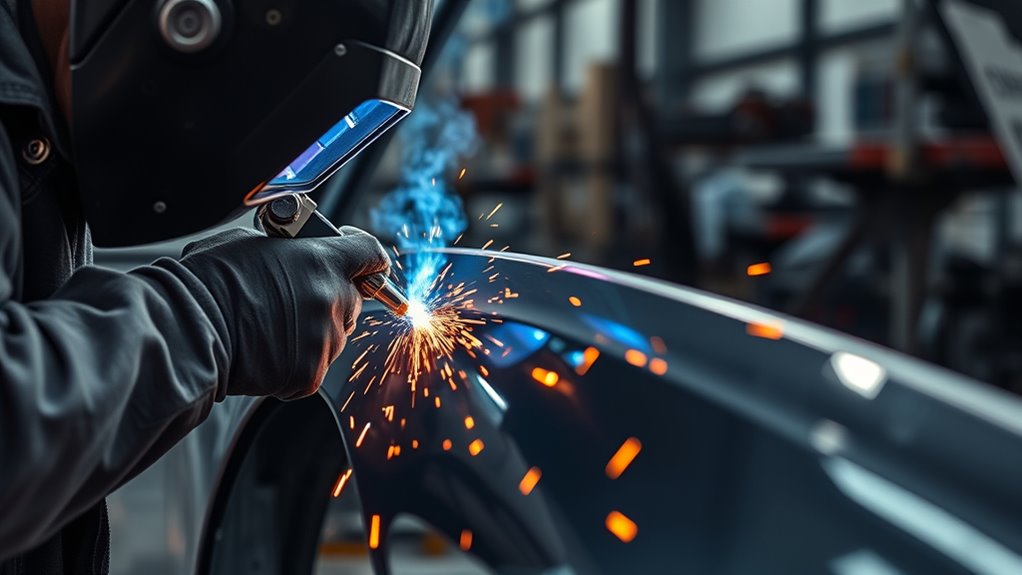
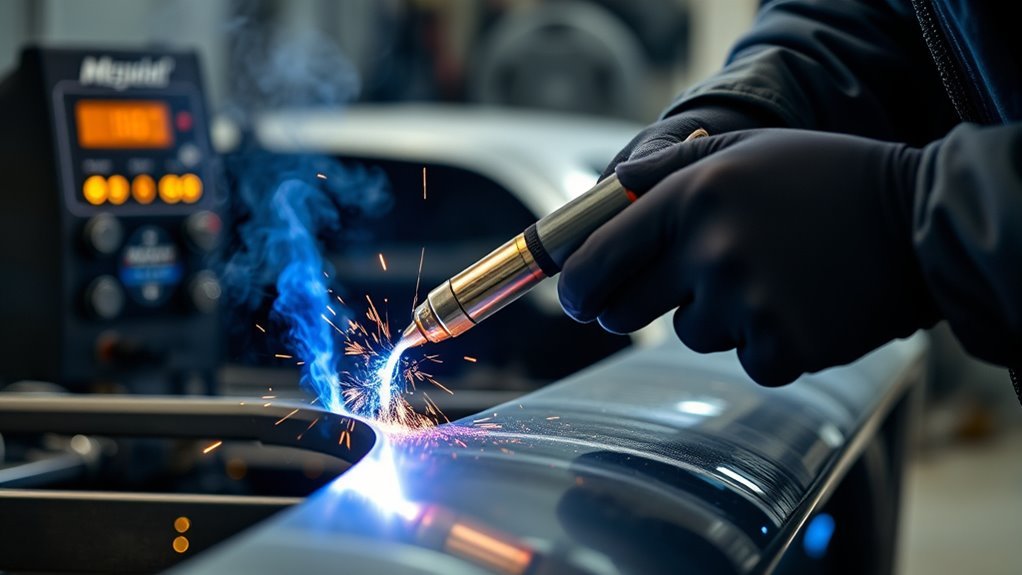
Pulse MIG welding is a controlled arc process that switches between high and low current. This pulsing action helps you regulate heat input and reduce burn-through on thin auto body metal.
Pulse MIG welding alternates current levels to control heat, reduce burn-through, and limit distortion in auto body repair.
You use Pulse MIG to shape the arc with more control. The welding cycle transfers metal in measured droplets instead of an unstable stream.
That control cuts spatter and keeps the bead cleaner. Cleaner beads matter when you need high-quality finishes on visible panels.
In automotive applications, the process works well on thin metals, including aluminum and stainless steel. It helps you balance penetration and filler deposit without flooding the joint with excess heat.
TIG welding offers precise control over arc and heat input, which can help you maintain quality results on stainless steel.
Synergic controls can also simplify setup. They let you adjust key parameters faster and keep the process more consistent.
For you, Pulse MIG means better command over the weld pool, cleaner results, and more control during repair work.
Why Use Pulse MIG on Auto Body Panels?
That level of arc control explains why you may choose Pulse MIG for auto body panels. With Pulse MIG welding, you get heat input control that supports welding thin materials without slowing repair work too much.
The process delivers reduced spatter and cleaner-looking welds. That can help you finish panels with less grinding and better visual consistency.
- Controlled heat input: You manage energy transfer more precisely on thin auto body panels.
- Strong deposition control: You place filler metal more steadily during repair work.
- Improved weld pool stability: You keep better control during vertical seams, edges, and awkward positions.
You also gain flexibility on aluminum and high-strength steels. That gives you more repair options without relying on one material strategy.
Understanding gauge thickness can also help you choose better settings for different materials and panel thicknesses.
When you need precision and speed together, Pulse MIG welding gives you a practical path to stronger, cleaner auto body work.
How Pulse MIG Prevents Warping on Thin Metal
When you weld thin auto body metal, Pulse MIG helps limit warping by switching between high peak and low background currents. This cycle keeps total heat input under tighter control.
Lower heat input reduces thermal expansion in thin metal. That helps your automotive body panels stay flatter and more accurate.
Controlled droplet transfer stabilizes the arc and improves weld pool control. You can place metal more precisely without overheating the joint.
That stability also cuts burn-through risk on delicate edges and seams. Excess heat can quickly damage fitment in those areas.
Because the process reduces spatter, you can get cleaner beads and less post-weld cleanup. You can work with more confidence because the process supports fusion while helping you protect panel shape.
For auto body repair, that means you control the panel instead of letting heat control the repair. Maintaining controlled droplet transfer also supports more consistent weld quality.
Which Metals Work Best With Pulse MIG?
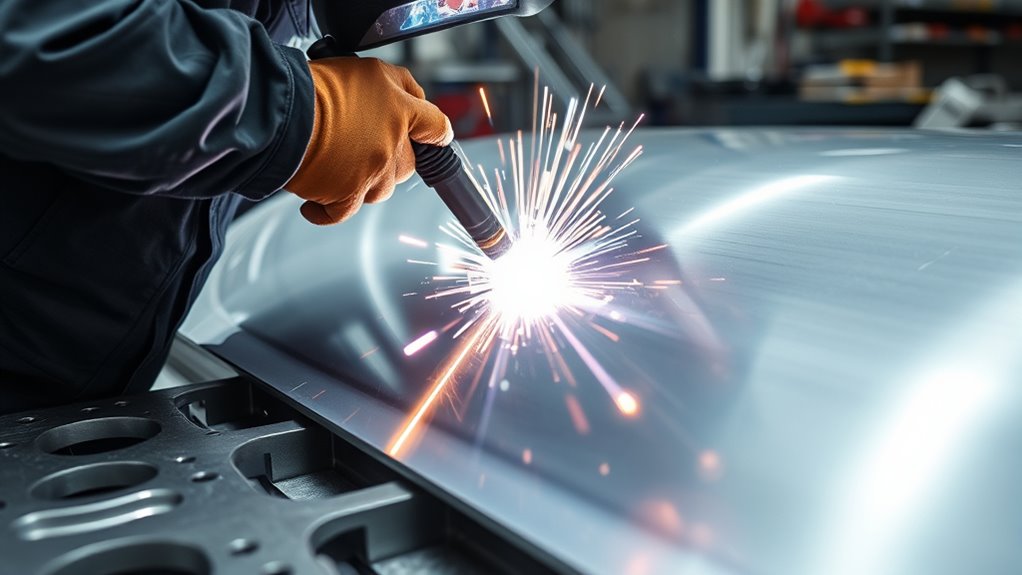
Which metals respond best to Pulse MIG in auto body work? You’ll get stronger results when you match the welding process to the metal’s heat behavior and penetration needs.
Pulse MIG gives you tight control over heat input, so you can work with these common auto body metals:
- Aluminum, where lower heat input helps limit distortion and protect thin sheets.
- Stainless steel, where stable arc control can reduce defects and distortion.
- Mild steel, where you want clean bead appearance and low spatter.
- High-strength steel, where controlled heat helps protect the joint from excess heat damage.
For aluminum, pulse MIG helps you preserve panel shape while still making a clean weld. On stainless steel, it stabilizes the arc and improves consistency.
On mild steel, you’ll often see less spatter and a smoother finish. On high-strength steels, controlled transfer can support strength without overheating the joint.
Understanding maximum fillet weld size can also help you plan stronger repair welds. If you want more control in auto body repair, this process gives you disciplined settings and repeatable results.
Products Worth Considering

5-in-1 MIG Welder: This 250A 5-in-1 pro mig welder supports various functions - MIG Pluse, gasless MIG, gas MIG, MMA, and Lift TIG. The innovative pulse welding function provides fast, high-quality, low-spatter welds and better thermal control than traditional MIG welders, allowing perfect welds at lower temperatures.

7 in 1 Welding Machine: The multi-function welding machine included Gas/Solid Wire MIG,Pulse MIG, Gasless Flux Core MIG, Stick/MMA, Spot welding, Lift TIG, spool gun compatible (tig gun and spool gun not included,WP-17V-35,LBT150).

【6-IN-1 MULTIPROCESS MIG WELDER】: The AZZUNO MIG Welder offers versatile welding capabilities with modes Flux Core MIG, Gas MIG, PULSE Aluminum MIG, Spool Gun, Stick, and Lift TIG. With just 2 buttons and 2 knobs, all welding operations can be easily performed. (TIG gun not included, WP-17V-35-50).
How to Set Up Pulse MIG for Repairs
Once you match pulse MIG to the right metal, set up the machine so the process stays stable and predictable. Good setup can make the difference between a clean repair and a warped panel.
Start with a pulse MIG welder that lets you tune machine parameters for thickness and alloy. Set peak current and low background current to balance penetration with heat control.
Dial in wire feed speed to match the arc response. Then confirm that the wire feeder moves wire smoothly and consistently.
Secure electrical grounding directly to clean, bare metal. Poor ground adds resistance and can destabilize the pulse.
Keep cable management tight, under 50 feet when possible. Avoid coiling excess lead because coil shape can affect welding performance.
With these settings, you get stronger weld pool control in positions that challenge conventional MIG. That includes vertical seams, edges, and small gaps.
Warning: Always follow the vehicle maker’s repair procedures before welding structural or high-strength steel panels.
This setup gives you the precision to repair efficiently without losing control of the panel.
Products Worth Considering

FIVE PROCESSES, ONE MACHINE FOR EVERY JOB - Pulse MIG, SPOT, Flux Core, Lift TIG and Stick in a single 140A welder. Pulse mode smooths the arc for less spatter, and SPOT mode pulses on a timer so thin auto body panels weld without burn-through or warping. Synergic control matches current to wire speed automatically, with no guesswork. The clear digital display shows your settings while you work. One machine replaces three

Tired of juggling multiple machines? This 140A 5-in-1 combines Gas MIG, Gasless Flux Core, Lift TIG, Stick, and Pulse in one IGBT-powered unit. Gas MIG for clean auto body welds. Flux Core for outdoor fence repairs without a gas cylinder. Lift TIG for stainless precision. Stick for structural steel up to 3/16 inch. Pulse for thin metal control — rare at this price point. One machine, five processes, zero compromise

Dyna-Pulse MIG Welding: Now with Dyna-Pulse MIG, this welder supports mild steel, stainless steel, aluminum (with spool gun), and flux-cored wire; powered by continually upgradable USB-enabled software
Common Mistakes to Avoid With Pulse MIG
Pulse MIG gives you more control, but it does not fix poor preparation. Clean the joint, remove coatings from the weld area, and confirm your ground before you start.
Avoid using too much heat to chase penetration on thin panels. Increase control first through travel speed, wire feed, and pulse settings before you push the panel too hard.
Don’t skip test welds on scrap metal with the same thickness. A short test helps you check bead shape, penetration, and distortion before you touch the actual panel.
Frequently Asked Questions
When Should You Use Pulse MIG Welding?
You should use pulse MIG when your project needs precise heat control on thin metal. It also helps when you weld aluminum, stainless steel, edges, seams, or panels that can distort easily.
What Are the Disadvantages of Pulse MIG Welding?
Pulse MIG usually costs more than basic MIG because it needs a more advanced welder. You also need more setup knowledge, better filler control, and practice to tune the arc correctly.
Do You Need Pulsed MIG for Auto Body Repair?
You may need pulsed MIG if you often weld thin panels, aluminum, stainless steel, or heat-sensitive joints. Standard MIG can still work for many repairs, but pulse MIG gives you more heat control when panel distortion matters.
What Is the Main Advantage of Pulse MIG Welding?
The main advantage is heat control. You can reduce distortion and burn-through while keeping a steady arc and clean bead shape.
Can Beginners Use Pulse MIG on Auto Body Panels?
Beginners can use pulse MIG, but they should practice on scrap metal first. Learn how wire feed, travel speed, shielding gas, and pulse settings change the bead before welding a real panel.
Safety Disclaimer: This article is for informational purposes only and does not replace professional welding training or vehicle repair guidance. Use proper protective gear, follow equipment instructions, and consult a qualified repair professional before welding structural parts.
Conclusion
You can use pulse MIG welding when you need controlled heat and clean fusion on thin auto body panels. It helps you reduce warping, limit burn-through, and keep repair work more consistent.
Before welding a real panel, match the wire, shielding gas, and pulse settings to the metal. Then make a test weld on scrap material with the same thickness.
With careful setup and steady technique, pulse MIG can help you produce cleaner repairs with less panel distortion. That control makes it a strong choice for delicate bodywork.