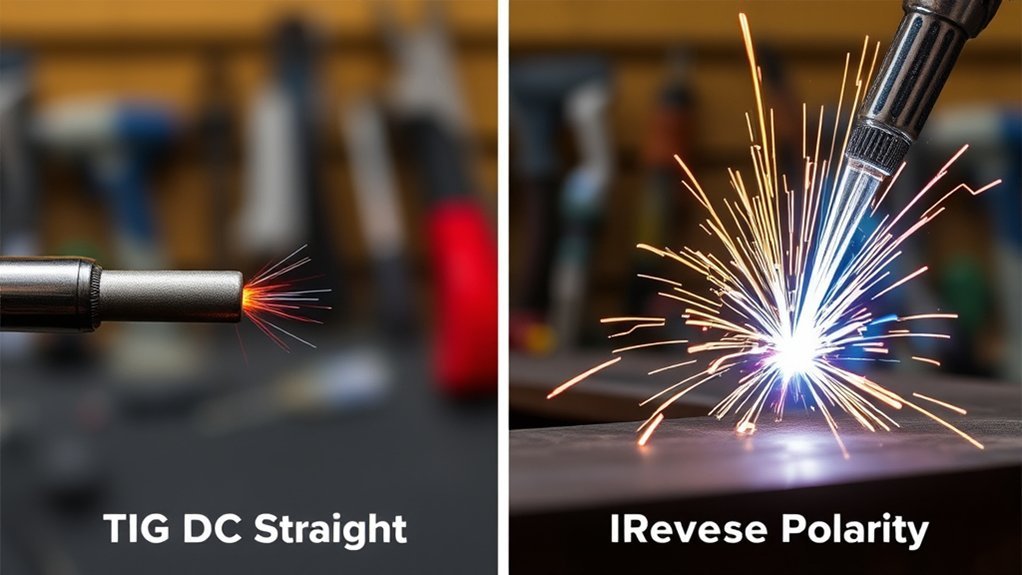
In TIG welding, polarity changes how the arc heats the workpiece and tungsten. It affects penetration, oxide cleaning, electrode life, and puddle behavior. For most TIG welding on steel, stainless steel, chromoly, nickel, titanium, and many copper alloys, use DCEN, also called DC straight polarity. DCEP, or DC reverse polarity, is rarely used for normal TIG welding because it puts excessive heat into the tungsten.
Quick Answer
Use DCEN for most TIG welding on steel, stainless steel, nickel, titanium, and similar metals. It directs most arc heat into the workpiece and keeps the tungsten cooler. Use AC for most manual aluminum and magnesium TIG. Reserve DCEP for rare, procedure-specific applications.
Key Takeaways
- DCEN means electrode negative. The TIG torch is negative, the work is positive, and most GTAW heat is directed into the workpiece.
- DCEP means electrode positive. It provides oxide-cleaning action at the work surface but places heavy heat on the tungsten and sharply limits usable amperage.
- AC is the standard manual choice for aluminum and magnesium. It alternates between electrode-negative penetration and electrode-positive cleaning.
- Polarity is only one setting. Amperage, AC balance, tungsten size, gas coverage, joint fit-up, cleanliness, and travel speed still control the final weld.
At a Glance
| Time Required | About 5 to 10 minutes to identify the metal, confirm the machine mode, inspect the connections, prepare the tungsten, and run a test bead |
| Difficulty | Beginner to intermediate |
| Tools Needed | TIG welder with the required DC or AC mode, TIG torch, work lead, clean tungsten, shielding gas, filler rod if needed, and approved metal-cleaning tools |
| Cost | No added setup cost if your machine supports the required mode; shielding gas, tungsten, filler, and other consumables are separate |
TIG Welding Polarities: DC Straight vs. DC Reverse
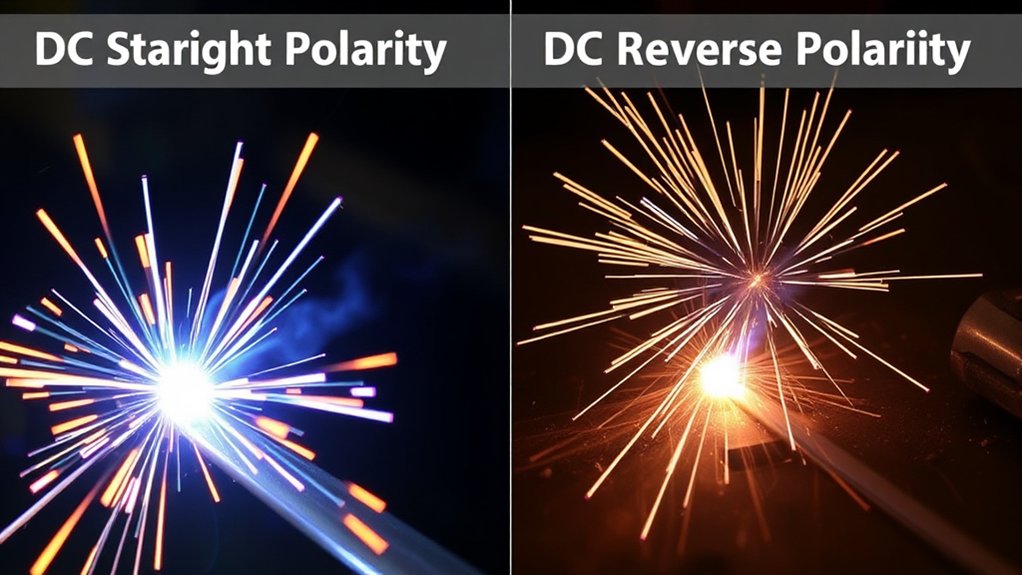
TIG welding is also called gas tungsten arc welding, or GTAW. It uses a non-consumable tungsten electrode, an inert shielding gas such as argon or helium, and a constant-current power source. In DC TIG, the two polarity choices are DCEN and DCEP. AC alternates between them many times per second.
- DCEN means direct current electrode negative. The TIG torch is connected to the negative output, and the work lead is connected to the positive output. It is also called straight polarity.
- DCEP means direct current electrode positive. The TIG torch is connected to the positive output, and the work lead is connected to the negative output. It is also called reverse polarity.
- AC means alternating current. The machine switches between electrode negative and electrode positive during each cycle.
Polarity should be discussed by welding process rather than as one universal rule. In GTAW, DCEN normally directs most arc heat into the workpiece, which supports penetration and fusion while keeping the tungsten cooler. ESAB describes DCEN as the main GTAW polarity and DCEP as rarely used because of the heat it places on the non-consumable electrode. See ESAB’s current introduction to GTAW polarity.
| Polarity | Torch Connection | Main Effect | Tungsten Load | Typical TIG Use |
|---|---|---|---|---|
| DCEN | Negative | Strong workpiece heating and penetration | Relatively low | Most steel, stainless, nickel, titanium, chromoly, and copper-alloy work |
| DCEP | Positive | Oxide-cleaning action with shallow workpiece heating | Very high | Rare, qualified specialty procedures or specific legacy-machine preparation steps |
| AC | Alternates positive and negative | Combines penetration and oxide cleaning | Depends on AC balance and amperage | Most manual aluminum and magnesium TIG welding |
In GTAW, DCEN typically directs about 70% of the arc heat into the workpiece, helping produce useful penetration while reducing the heat carried by the tungsten.
Why DCEN Is the Default for Most TIG Welding
DCEN is the normal choice for most TIG welding because it provides a stable, focused arc and directs most of the useful heat into the base metal. The tungsten can carry substantially more current on DCEN than it can on DCEP because it is not receiving the same level of electrode heating.
Use DCEN for most TIG work on:
- Mild steel and carbon steel
- Stainless steel
- Chromoly
- Nickel alloys
- Titanium, with complete shielding and backside protection where required
- Many copper, bronze, and copper-nickel alloys when the procedure supports it
On thin stainless steel, DCEN provides a focused and controllable arc, but polarity alone does not prevent burn-through. Use the correct amperage, a tight joint fit, short arc length, steady travel, and pedal or pulse control where available. Copper chill bars or other approved heat sinks can also help on suitable parts. If you are dialing in stainless settings, your DCEN for stainless steel setup should still begin with clean metal, the correct tungsten size, and reliable gas coverage.
Titanium also normally uses DCEN, but polarity is only the start. The hot weld, heat-affected zone, and backside must remain protected from air until they cool enough to resist contamination. Miller’s titanium tube and pipe guidance recommends DCEN and explains the need for primary, trailing, and backside shielding.
Pro Tip: On DCEN, a properly prepared tungsten should hold a sharp or slightly truncated point and produce a focused arc. If it balls, melts, splits, or sheds particles, stop and check polarity, amperage, tungsten size, gas coverage, and contamination before continuing.
What DCEP Does in TIG Welding
DCEP places the tungsten on the positive side of the welding circuit. In GTAW, this directs heavy heat into the non-consumable electrode. The tungsten’s usable current capacity falls sharply, while penetration into the workpiece becomes broad and shallow.
The electrode-positive part of an arc can provide oxide-cleaning action at the work surface. This is valuable when welding metals such as aluminum and magnesium, which form stubborn surface oxides. However, running continuously on DCEP overheats the tungsten so quickly that it is rarely practical as the main manual TIG setting.
Warning: Do not switch a normal DCEN TIG setup to DCEP and keep the same amperage. The tungsten can overheat, ball excessively, split, or fall into the weld as an inclusion. Use DCEP only when the equipment manual or a qualified welding procedure specifically requires it.
Some older transformer-machine procedures used a brief DCEP arc to form a ball on certain tungsten electrodes before AC welding. Many modern inverter TIG machines instead use ceriated or lanthanated tungsten with a pointed or truncated preparation. Follow the recommendations for your exact machine and electrode rather than using an old balling method automatically.
AC vs. DC for Aluminum and Magnesium
Aluminum and magnesium form tough oxide films. Aluminum oxide melts at a far higher temperature than the aluminum beneath it, so the surface must be mechanically cleaned and the arc must provide suitable cleaning action. Otherwise, oxide can remain in the puddle and cause a dirty, sluggish, or poorly fused weld.
Most manual aluminum and magnesium TIG welding therefore uses AC. During the electrode-negative portion, more heat is directed into the base metal for melting and penetration. During the electrode-positive portion, the arc provides oxide-cleaning action.
Modern AC/DC TIG welders often include AC balance control:
- More EN time generally gives greater workpiece heating, stronger tungsten current capacity, and less visible etching.
- More EP time increases oxide cleaning but also heats and rounds the tungsten more aggressively.
- Too little cleaning can leave oxide flakes, contamination, or a puddle that will not wet in correctly.
- Too much cleaning can create an overly wide etched zone, reduce penetration, and overheat the tungsten.
Note: AC-balance controls are not labeled the same way on every machine. One welder may display EN percentage, another may display EP percentage, and another may use a cleaning scale. Read the manual before changing the setting so you know which direction adds cleaning.
AC frequency is a different control. Frequency changes how wide or concentrated the AC arc feels. Balance changes the share of EN and EP time. Miller explains that AC frequency mainly affects arc width and penetration profile, while balance affects cleaning and tungsten life in its AC tungsten and waveform guidance.
DCEN aluminum TIG is possible under specialized procedures, often on thicker, extremely clean material with helium or a helium-rich shielding setup. It does not provide the normal AC oxide-cleaning action, so it is not the best starting point for general repairs or beginners.
A DC-only scratch-start or lift-TIG machine cannot provide ordinary AC aluminum TIG. It may weld aluminum only through a specialized DCEN procedure with suitable gas, preparation, equipment capacity, and operator skill. For routine aluminum work, use an AC-capable TIG welder or another approved process.
How Polarity Affects Penetration, Tungsten, and Weld Quality
Polarity changes the arc’s basic heat balance, but it does not replace correct welding technique. A sound weld still depends on amperage, arc length, travel speed, joint shape, filler selection, shielding, and cleanliness.
| Weld Characteristic | DCEN | DCEP | AC |
|---|---|---|---|
| Penetration | Generally deeper and more focused | Generally shallow | Controlled by amperage, balance, frequency, and waveform |
| Tungsten heating | Lower | Very high | Increases as EP time increases |
| Oxide cleaning | Little to none | Strong | Adjustable through AC balance on equipped machines |
| Tungsten shape | Usually pointed or slightly truncated | Balls or overheats quickly | Often pointed or truncated on modern inverter machines, then rounds slightly in use |
| Typical result | Stable arc and controlled fusion | Low current capacity and shallow fusion | Balanced aluminum or magnesium welding when correctly adjusted |
DCEN does not make dirty metal weldable. Remove oil, paint, rust, mill scale, oxide, moisture, and unsafe coating residue before striking an arc. Keep the filler clean, maintain a short arc, and protect the weld with steady shielding gas. Miller’s current TIG troubleshooting guide identifies incorrect polarity, poor gas coverage, contaminated tungsten, and dirty material as common causes of weld problems.
How to Choose the Right Polarity for Your TIG Welding Project
Use the base metal as your first guide. Then check the thickness, joint design, tungsten size, shielding gas, equipment limits, and welding procedure. For structural, pressure, aerospace, vehicle-safety, or code-regulated work, follow the approved welding procedure specification rather than relying on a general settings chart.
| Material | Typical TIG Polarity | Why |
|---|---|---|
| Mild steel and carbon steel | DCEN | Stable arc, useful penetration, and good tungsten life |
| Stainless steel | DCEN | Focused heat and controlled puddle behavior |
| Chromoly | DCEN | Controlled fusion when paired with the specified filler and heat input |
| Nickel alloys | DCEN | Stable arc and controlled penetration |
| Titanium | DCEN | Focused heat; requires complete torch, trailing, and backside shielding where applicable |
| Copper and copper alloys | Usually DCEN | Provides workpiece heating, though high-conductivity material may need preheat or helium under an approved procedure |
| Aluminum | AC for most manual TIG | Combines base-metal melting with adjustable oxide cleaning |
| Magnesium | AC for most manual TIG | Provides oxide cleaning while limiting continuous DCEP heating of the tungsten |
Shielding gas also matters. Pure argon is common for many TIG jobs because it starts easily and provides a stable arc. Helium or argon-helium mixes can increase heat input on thicker or highly conductive material, but they may require different flow and starting settings. If you are deciding whether 100% argon fits your job, match the gas to the metal, thickness, torch, and machine capability.
Products Worth Considering

Compatible with CGA-580 tanks: Easily attach this Gas Pressure Regulator/Flowmeter to your Argon, Helium, and CO2 tanks with its CGA-580 inlet connector

APPLICATION: The ARCCAPTAIN gas pressure regulator can be used with argon, helium, and carbon dioxide gas tanks.

WIDE APPLICATION: It easily connects to Argon, Helium, and Argon/CO₂ mixed gas tanks via the CGA-580 inlet nut. No additional adapters are required. Featuring superior airtight and leak-proof performance, it achieves stable and sealed gas supply with minimal gas loss. This regulator is ideal for MIG/TIG welding, chemical processing, general industrial use, and electronics industry applications.
Setup Checklist Before You Strike an Arc
- Identify the base metal. Steel, stainless, nickel, chromoly, and titanium usually mean DCEN. Aluminum and magnesium usually mean AC.
- Read the machine panel and manual. Some welders assign polarity internally when you select TIG mode. Others require physical cable connections. Do not swap cables unless the manual tells you to do so.
- Shut the machine down before changing physical leads. Isolate power as directed by the manufacturer and never move welding cables while the output is energized.
- Connect the torch correctly. For a conventional DCEN setup, connect the torch to negative and the work lead to positive.
- Inspect the circuit. Attach the work clamp to clean bare metal. Check cables, terminals, gas hoses, and torch parts for damage, looseness, leaks, or overheating.
- Choose the right tungsten. Match the tungsten type and diameter to the amperage, polarity, waveform, and equipment manual.
- Prepare the tungsten tip. For DCEN, use a lengthwise-ground point with a small flat where recommended. For AC, follow the instructions for your inverter or transformer machine.
- Clean the joint and filler. Remove oil, paint, rust, scale, oxide, moisture, and coating residue. Use tools dedicated to the metal when cross-contamination is a concern.
- Set shielding gas flow. Use enough flow to shield the puddle without causing turbulence. Check for drafts, leaks, an oversized arc length, or a damaged cup before simply increasing flow.
- Choose the filler. Match filler composition to the base metal and service conditions. A filler rod selection chart can help with common combinations, but code work must follow the approved procedure.
- Run a test bead. Use scrap from the same alloy and thickness. Check arc focus, puddle shape, tungsten condition, penetration, bead color, and gas coverage before welding the part.
Polarity cannot correct poor fit-up or an undersized weld. Use the joint design and weld size required for the load and material. For fillet welds, proper fillet weld sizing remains essential.
Products Worth Considering

TOP QUALITY: This 10-pack of red tig tungsten electrodes 1/16"x7"(Red, WL20/EWLa-2) adhere to Standard AWS A5.12M/A5.12:2009 and DIN EN 26848 GB/T 31908-201. All our tungsten has 100% traceability.

TOP QUALITY: This 10-pack of red tig tungsten electrodes 3/32"x7"(Red, WL20/EWLa-2) adhere to Standard AWS A5.12M/A5.12:2009 and DIN EN 26848 GB/T 31908-201. All our tungsten has 100% traceability.

BLUE-2% LANTHANATED: Lanthanated electrodes are popular due to the relative ease of striking an arc and lower amperage required. They perform exceptionally well in both AC and DC applications.
How to Confirm TIG Polarity on an Unfamiliar Machine
Do not rely only on cable color or the location of a connector. Different welders use different layouts, and some multi-process machines change polarity internally when you select a process.
- Check the selected process. Confirm that the display or selector shows TIG or GTAW rather than stick, MIG, or another mode.
- Check the polarity display. Look for DCEN, electrode negative, EN, a minus sign at the torch terminal, or the connection diagram in the manual.
- Trace the physical leads. Where the machine requires external connections, verify that the TIG torch is in the negative output for DCEN.
- Clamp to clean metal. A weak or dirty work connection can imitate some polarity problems.
- Test at moderate current on scrap. The arc should be focused, and a correctly sized tungsten should hold its prepared shape on DCEN.
- Stop if the tungsten overheats rapidly. Fast balling, splitting, or melting can indicate DCEP, excessive amperage, poor gas coverage, or an undersized electrode.
Note: Tungsten behavior is a troubleshooting clue, not a substitute for the wiring diagram. Always confirm the process and connections from the equipment manual before changing leads.
Troubleshooting Common TIG Polarity Problems
If a TIG weld suddenly looks wrong, check polarity and process mode early. A reversed setup can overheat the tungsten, delay puddle formation, or reduce fusion even when the amperage display appears normal.
| Symptom | Likely Cause | Corrective Action |
|---|---|---|
| Tungsten balls or melts quickly on steel | Torch connected positive, wrong process mode, excess amperage, small tungsten, or poor shielding | Confirm TIG DCEN, inspect gas coverage, reduce current, or install the correct tungsten size |
| Shallow weld with poor fusion | DCEP selected, amperage too low, fast travel, long arc, or poor joint access | Confirm DCEN, shorten the arc, adjust current and travel, and retest on scrap |
| Dirty aluminum puddle on DCEN with argon | No normal AC cleaning action, oxide contamination, or wrong machine mode | Clean the material and select AC for ordinary manual aluminum TIG |
| Black flakes or pepper-like contamination in aluminum | Insufficient cleaning, dirty material, or filler added before the oxide clears | Clean again, verify AC mode, add appropriate EP cleaning, and wait for a bright puddle before adding filler |
| Excessively wide etched zone on aluminum | Too much EP time or unnecessary cleaning action | Increase EN time according to the machine’s balance-control labeling |
| Arc wanders or starts poorly | Contaminated tungsten, long arc, weak work connection, wrong tip shape, or poor shielding | Regrind or replace the tungsten, shorten the arc, clean the clamp area, and inspect gas flow |
| Black soot, porosity, or poor color | Dirty metal, gas leak, drafts, moisture, contaminated filler, or inadequate post-flow | Clean the joint and filler, repair leaks, block drafts, and verify pre-flow and post-flow |
| Tungsten turns dark after stopping | Post-flow too short, gas interrupted, or torch pulled away too soon | Increase post-flow as directed by the manual and hold the torch over the cooling weld and tungsten |
Safety Notes Before Changing Polarity
TIG welding exposes you to ultraviolet and infrared radiation, hot metal, electrical hazards, compressed gas, fire risk, fumes, and oxygen displacement. Wear a welding helmet with an appropriate lens shade, flame-resistant clothing, dry welding gloves, and safety glasses with side protection.
Turn off and isolate the machine as directed before changing physical cable connections. Inspect the welding leads, torch, work clamp, gas hose, cooling system, and connectors before use. OSHA requires welding connections to be properly made, the work lead to be firmly attached, gas and cooling systems to be free of leaks, and manufacturer instructions to be followed. See OSHA 29 CFR 1910.254.
Grinding tungsten produces fine dust and flying particles. Use eye protection, local exhaust where needed, and a dedicated grinding wheel so other metals do not contaminate the electrode. Follow the tungsten manufacturer’s safety data and take added care when handling or grinding thoriated electrodes.
Remove coatings, grease, solvent residue, paint, and unknown contamination before welding. Do not weld on closed containers, tanks, drums, or parts that held flammable or toxic material unless they have been prepared, tested, vented, and approved for hot work by qualified personnel.
Shielding gases are not breathable air. OSHA warns that argon and helium can displace oxygen and cause suffocation, especially in tanks, vessels, pits, and other enclosed spaces. Use suitable ventilation, keep your head out of the plume, and never enter a confined space for welding or purging without the required atmospheric testing, controls, and rescue plan. OSHA’s welding fume and gas guidance also notes that stainless steel welding can create hazardous hexavalent chromium exposure.
Warning: Never use oxygen for ventilation or to blow dust from clothing. Keep cylinders upright and secured, protect them from heat and electrical contact, remove combustibles from the hot-work area, and keep suitable fire protection ready.
Frequently Asked Questions
What happens when you TIG weld in reverse polarity?
Reverse polarity in TIG means DCEP, or electrode positive. Heavy heat is directed into the tungsten, so its usable current capacity falls and it can ball, split, melt, or contaminate the weld. Workpiece penetration is normally shallow, although the electrode-positive action provides oxide cleaning.
What is DC straight polarity used for?
DC straight polarity, or DCEN, is used for most TIG welding on steel, stainless steel, chromoly, nickel, titanium, and many copper alloys. It directs most GTAW heat into the workpiece, supports penetration, and keeps the tungsten cooler than DCEP.
What is the difference between reverse polarity and straight polarity?
Straight polarity in TIG normally means DCEN, with the electrode negative and the workpiece positive. Reverse polarity means DCEP, with the electrode positive and the workpiece negative. DCEN gives useful workpiece heating and penetration. DCEP gives oxide-cleaning action but overheats the tungsten and produces shallow penetration.
What does DC reverse polarity mean in TIG welding?
DC reverse polarity means direct current electrode positive, or DCEP. The TIG torch is connected to positive, and the work lead is connected to negative. It is rarely used as the main GTAW setting because it places excessive heat on the non-consumable tungsten.
Should you TIG weld aluminum with DCEN or AC?
Use AC for most manual aluminum TIG welding. AC combines electrode-negative workpiece heating with electrode-positive oxide cleaning. DCEN aluminum TIG is possible under specialized procedures, often with helium-based shielding and extremely clean material, but it is not the normal starting point.
Why does my tungsten melt so fast when TIG welding?
Rapid tungsten melting can mean the torch is positive by mistake, the amperage is too high for the tungsten diameter, the AC balance has too much EP time, the gas coverage is poor, or the electrode is contaminated. For steel TIG, confirm DCEN first, then inspect current, tungsten size, connections, and shielding.
Does the TIG torch connect to positive or negative?
For conventional DCEN TIG welding, the torch connects to the negative output and the work lead connects to positive. Some multi-process welders switch polarity internally, so always follow the connection diagram for the exact machine instead of relying only on terminal position or cable color.
Can a DC-only TIG welder weld aluminum?
A DC-only TIG welder cannot perform ordinary AC aluminum TIG. Specialized DCEN aluminum procedures are possible with suitable helium shielding, very clean material, enough machine capacity, and experienced technique. For routine aluminum fabrication or repair, an AC-capable TIG welder is the more practical choice.
Does more electrode positive always make an aluminum weld better?
No. More EP time increases oxide cleaning, but it also heats the tungsten, widens the etched zone, and can reduce penetration. Use only enough cleaning to produce a bright, stable puddle on properly prepared aluminum, and interpret the balance control according to your machine manual.
Conclusion
For most TIG welding, use DCEN unless the base metal, equipment manual, or qualified procedure calls for something else. DCEN directs most GTAW heat into the workpiece, protects the tungsten from excessive electrode heating, and provides useful penetration on steel, stainless steel, nickel, titanium, chromoly, and many copper alloys.
Use DCEP only for rare, procedure-specific work because it places heavy heat on the tungsten and normally gives shallow penetration. For most manual aluminum and magnesium TIG, choose AC and set only enough electrode-positive time to clean the oxide while preserving penetration and tungsten life.
Sources
- ESAB: Intro to Polarity in TIG Welding — supports DCEN use, DCEP limitations, workpiece heating, and oxide-cleaning guidance.
- Miller Electric: Guide to TIG Welding Basics — supports DCEN setup, tungsten behavior, gas coverage, arc length, and troubleshooting.
- Miller Electric: Common TIG Welding Problems — supports aluminum AC polarity, EN/EP action, AC-balance troubleshooting, and contamination checks.
- Miller Electric: AC Balance Control for Aluminum TIG — supports the relationship between AC balance, cleaning, penetration, and tungsten heating.
- Miller Electric: Best Practices for Welding Titanium Tube and Pipe — supports DCEN polarity and primary, trailing, and backside shielding requirements.
- OSHA: Controlling Hazardous Fume and Gases During Welding — supports ventilation, coating removal, stainless fume, oxygen-displacement, and confined-space cautions.