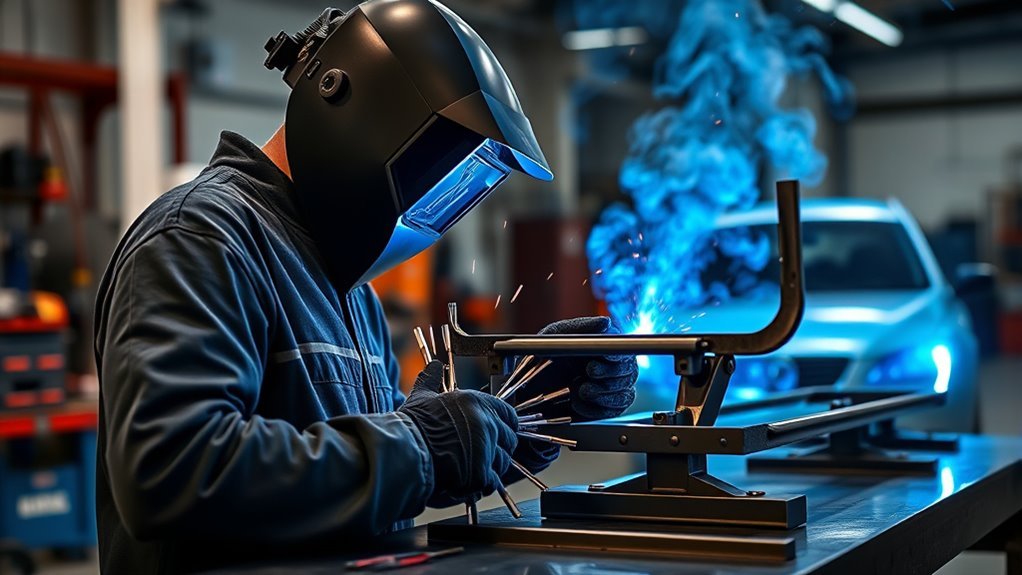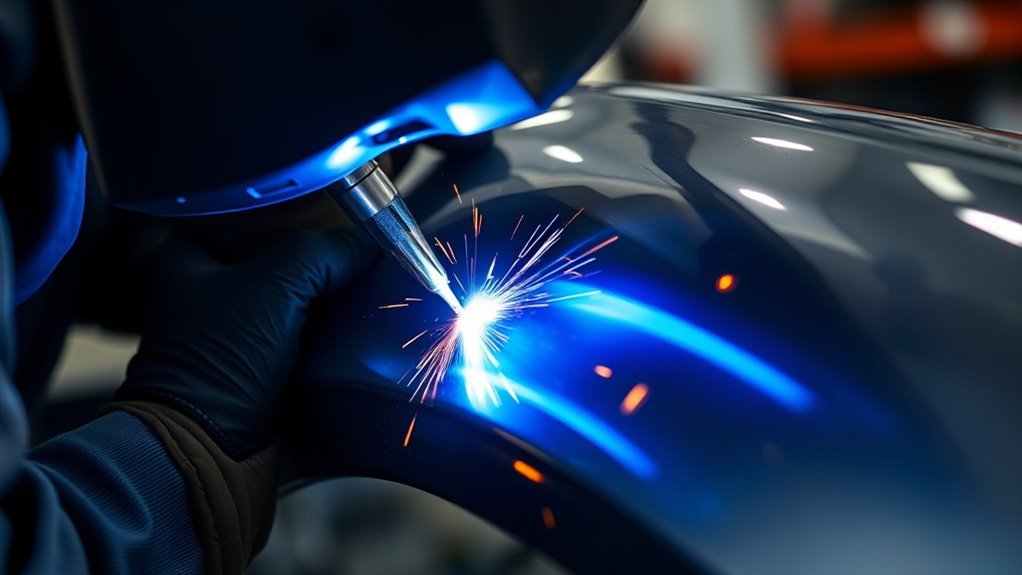
Use two-pass welding on auto body panels only when the repair joint, material, and OEM procedure call for more penetration than one light pass can provide. The basic idea is simple: make a controlled root pass first, clean it, let the panel cool, then add a lighter cap or fill pass. The method can help on selected repair sections, reinforcement panels, and thicker patch joints, but it is not the right choice for every thin outer skin.
Quick Answer
Two-pass welding uses a root pass for penetration and a cap pass for added strength and profile control. On auto body work, use it only on suitable material and joint designs, after checking OEM repair procedures. Avoid it on thin cosmetic panels where extra heat can cause warping, burn-through, or weakened steel.
Key Takeaways
- Two-pass welding is a controlled method, not a shortcut. The first pass establishes fusion, and the second pass fills and smooths the seam.
- For normal thin outer body panels, stitch welding, plug welding, spot weld replacement, MIG brazing, or panel bonding may be the OEM-specified method instead.
- Heat control matters more than bead size. Keep passes short, let the panel cool, and test settings on matching scrap before welding the vehicle.
- Clean metal, tight fit-up, proper shielding, and corrosion protection after grinding are just as important as the weld bead itself.
At a Glance
| Time Required | About 45 minutes to 2 hours for a small repair area, including prep, test welds, cooling time, grinding, and inspection. |
| Difficulty | Intermediate to advanced. Not ideal for a first auto body welding project. |
| Tools Needed | MIG or TIG welder, correct filler, PPE, clamps, copper backing, grinder or flap disc, wire brush, degreaser, test coupons, fire extinguisher, and good ventilation. |
| Cost | Usually low if you already own welding equipment. Expect consumable costs for wire, gas, discs, cleaner, primer, and corrosion protection. |
What Is Two-Pass Welding on Auto Body Panels?
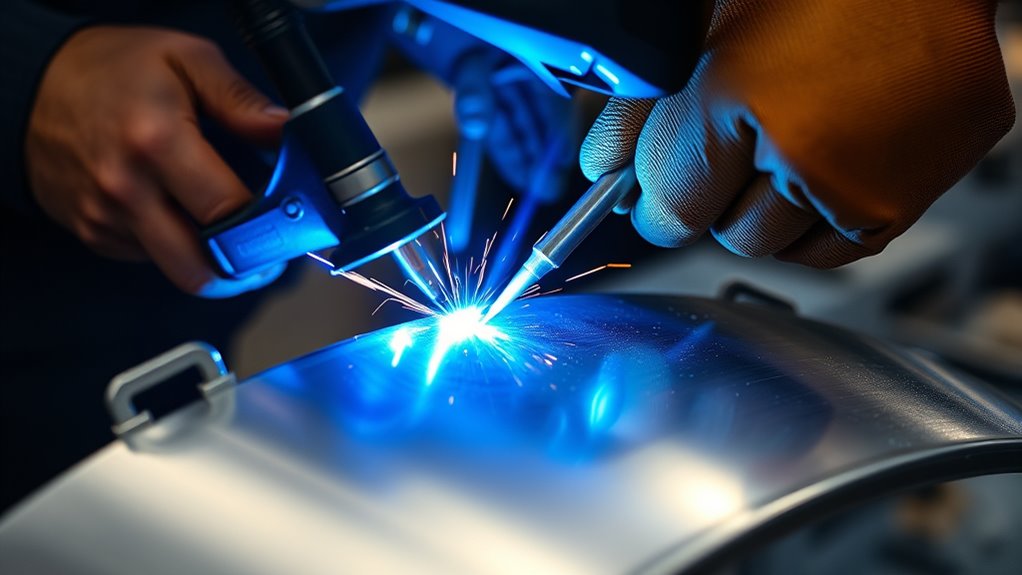
Two-pass welding means you weld the same joint in two controlled stages. The root pass goes in first and ties the base metal together at the root of the joint. The cap pass, also called the fill pass, goes over the root to add metal, smooth the profile, and complete the seam.
In auto body repair, this method can help when the joint is too demanding for one light bead but too heat-sensitive for one heavy bead. Instead of trying to force full penetration with one hot pass, you split the work into two smaller passes. That gives you more control over fusion, bead shape, and grinding later.
Note: Two-pass welding does not replace the vehicle maker’s repair procedure. If the OEM procedure calls for squeeze-type resistance spot welding, MIG brazing, rivet bonding, adhesive bonding, or panel replacement, follow that procedure instead of adding weld passes.
You use this method when a joint needs a stronger root and a cleaner finished profile. You avoid it when extra heat would do more harm than good. That balance matters because welding changes the heat-affected zone, and the heat-affected zone can be critical on modern high-strength steel and aluminum panels.
When Two-Pass Welding Makes Sense
Two-pass welding makes the most sense on selected auto body repair joints where one pass may not give enough penetration, but a single oversized pass would overheat the panel. Think of rocker repairs, reinforcement patches, thicker flanges, structural brackets, and controlled butt joints on material that can safely be fusion welded.
Best Use Cases
- Thicker patch sections: Use two passes when the panel or repair section has enough thickness to handle controlled heat without burning away.
- Butt joints with a prepared edge: A small bevel can help the root pass reach the joint without forcing too much heat into the surface.
- Repair areas that need grinding: A controlled cap pass gives you enough weld metal to dress the seam without thinning the root.
- Practice coupons that prove the setup: If matching scrap shows good root fusion and low distortion, the process is more likely to work on the vehicle.
When Not to Use Two-Pass Welding
Do not use two-pass welding just because you want the repair to feel stronger. On thin cosmetic skins, the second pass can add too much heat and pull the panel out of shape. On some modern steels, extra heat can also reduce the strength the steel was designed to have.
| Avoid two-pass welding when… | Use this instead… |
| The panel is a thin outer skin that warps easily. | Short tack or stitch welds with long cooling pauses, if welding is allowed. |
| The OEM procedure calls for spot weld replacement, MIG brazing, rivets, or adhesive. | Follow the OEM joining method exactly. |
| The steel is UHSS, boron steel, or an unknown high-strength grade. | Identify the material and follow the service manual before applying heat. |
| The joint still has paint, seam sealer, zinc coating, adhesive, undercoat, or oil inside it. | Strip, clean, ventilate, and re-check the joint before welding. |
Panel Thickness and Material Limits
Do not rely on one universal thickness number. Auto body panels vary by location, vehicle model, material grade, and repair method. A door skin is not the same as a rocker reinforcement, and mild steel is not the same as boron steel or aluminum.
As a practical rule, two-pass welding becomes more reasonable as the repair section gets thicker and more structural. It becomes less reasonable as the panel gets thinner, flatter, more visible, or more heat-sensitive. If the panel oil-cans by hand, expect it to warp easily under a second pass.
For aluminum, cleanliness and oxide removal are critical because aluminum forms oxide quickly and conducts heat fast. For high-strength steel, heat input must be limited because excess heat can change the properties around the weld. When in doubt, stop and verify the material before you weld.
Heat Control Benefits
The benefit of a two-pass weld is not “more heat.” The benefit is controlled heat. A narrow root pass can focus on fusion, while a lighter cap pass can improve shape after the joint has cooled. This is safer than one large, overheated bead that blows through the edge or leaves a tall lump you have to grind away.
Still, two passes can create more total heat if you rush them. Keep the passes short, cool the panel between passes, and do not chase a perfect-looking bead at the cost of panel shape.
Pro Tip: Make a test weld on scrap cut from the same repair panel or the same gauge of metal. Break, bend, grind, or section the coupon before welding the car. A test coupon tells you more than a machine chart.
Safety and OEM Checks Before You Weld
Before you prep the seam, confirm that welding is allowed in that exact location. Check the OEM repair procedure, material map, and joining method. Modern vehicles may combine mild steel, high-strength steel, ultra-high-strength steel, aluminum, adhesives, foam, seam sealer, and coatings in one repair area.
Warning: Welding on a vehicle can ignite seam sealer, undercoating, carpet, insulation, fuel vapor, wiring, and hidden debris. Keep a fire extinguisher nearby, clear combustibles, protect glass and interiors, ventilate the area, and inspect the backside of the panel during and after welding. OSHA’s welding guidance also warns that welding can produce hazardous fumes and gases, so avoid breathing fumes and use adequate ventilation.
Use proper PPE every time: welding helmet, safety glasses, gloves, flame-resistant clothing, hearing protection for grinding, and respiratory protection when ventilation or coatings require it. If you are welding zinc-coated or galvanized steel, review ventilation needs carefully because zinc-bearing coatings can create hazardous fumes. OSHA’s welding and cutting rules include specific ventilation language for zinc-coated materials and general welding ventilation.
Also disconnect or protect sensitive electronics as recommended by the vehicle maker, keep welding current paths short, and place the work clamp on clean metal near the repair. A poor ground can cause arc instability, excess heat, and damage in places you did not intend to heat.
How to Prep Auto Body Panels for Two-Pass Welding
Good prep decides whether the weld works. Start by cleaning both panels until they are free of rust, paint, oil, undercoating, seam sealer, adhesive, and other contaminants. Clean metal gives the root pass a better chance to fuse instead of boiling contamination into the weld. Proper surface prep also supports later paint adhesion and corrosion protection.
Products Worth Considering

Powerful Cleaning: Water-based formula contains solvents and detergents designed to cut through surface oils and grime. Use this cleaner prior to sanding or applying automotive paint and primer to ensure a clean surface.
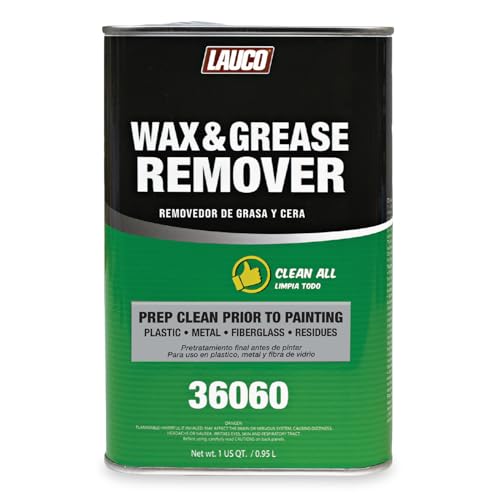
PROFESSIONAL PAINT PREP CLEANER: Industrial-strength solvent degreaser that instantly removes wax, grease, oil, silicone, and contaminants from plastic, metal, fiberglass, and aluminum surfaces before painting.

Superior Formula: Custom Coat professional-grade wax and grease remover for auto body; Removes adhesive residue, oil, silicone, paint overspray, and road tar; Exceptional grease-cutting power in a waterborne formula; Leaves zero residue
Panel Cleaning Basics
Degrease before grinding so you do not smear oil into the metal. Then strip coatings from both sides of the weld area where possible. Use a grinder, sanding disc, or flap disc only as aggressively as needed. Finish with a wire brush or clean abrasive pad so the weld zone is bare, dry, and bright.
- Degrease the panel before abrasive work.
- Remove paint, primer, rust, seam sealer, undercoat, and zinc coating from the weld zone as required.
- Clean the backside when you can reach it.
- Dry the joint completely before welding.
- Use clean gloves so you do not re-contaminate the edge.
If the panel is galvanized or zinc coated, do not treat the coating like ordinary paint dust. Remove the coating from the weld zone, use ventilation, and avoid breathing fumes.
Beveling and Fit-Up
Once the panel is clean, shape the joint for the weld itself. For thicker repair sections, a small bevel can help the root pass reach the base of the joint. For thin sheet, skip an aggressive bevel because it can leave the edge too weak and increase burn-through risk.
Fit-up should be tight and consistent. Gaps make the arc unstable and force you to add more filler and heat. Use clamps, magnets, panel holders, or temporary screws where appropriate, then tack the joint so it cannot move.
- Keep the joint edges even and burr-free.
- Use the smallest practical gap for the process and material.
- Add tack welds to hold alignment before the root pass.
- Use copper backing behind thin steel when access allows.
- Check the panel shape before welding, not after it has moved.
For joint design basics, review how a butt joint works and why edge prep affects penetration.
Welder Setup and Test Coupons
Set the welder on test coupons before welding the vehicle. Use the same material thickness, joint style, cleaning method, and position. If your test joint burns through, stacks a cold bead on top, or shows porosity after grinding, fix the setup before moving to the car.
For MIG welding steel, use the correct wire diameter, shielding gas, voltage, and wire-feed speed for the panel. For TIG welding, use the right tungsten, filler, polarity, and shielding gas. For aluminum, remove oxide, keep filler clean, and practice heat control because the panel can go from cold to overheated quickly.
Note: Weld-through primer is not a substitute for clean bare metal in the fusion zone. Use it only where the product instructions and repair procedure allow it, usually between overlapping flanges rather than inside a butt-weld seam.
How to Make the Root and Cap Passes
In two-pass welding, you build the joint from strength first and appearance second. The root pass should be narrow, controlled, and hot enough to tie both edges together. The cap pass should be lighter and wider, with just enough filler to cover the root and leave a smooth surface.
- Tack the joint first. Place tacks in a balanced pattern so the panel stays aligned.
- Run the root pass in short sections. Use steady travel speed and avoid lingering in one spot.
- Let the metal cool. Do not add the second pass while the panel is still heat-soaked.
- Clean the root pass. Remove slag, oxide, soot, spatter, and high spots. For flux-core work, follow proper metal preparation and slag removal steps.
- Inspect the root. Look for cracks, pinholes, undercut, missed edges, or cold-lap before covering it.
- Add the cap pass. Use lower heat or faster travel as needed so the cap blends without overheating the panel.
- Cool naturally. Avoid quenching hot welds with water unless a specific procedure tells you to do so.
Keep the bead small. A tall cap may look strong, but it creates more grinding work and more heat. The goal is a fused seam that needs only light dressing, not a ridge that has to be carved flat.
A good two-pass weld is controlled, clean, and boring. If the panel turns blue far from the seam, the heat is spreading too much.
Products Worth Considering

E71T-GS FLUX CORE WIRE: This self-shielding, AWS E71T-GS flux-cored wire excels due to its advanced core design, delivering exceptional arc stabilization and high feedability for effortless welding. The core also incorporates powerful deoxidizing agents, ensuring clean, reliable welds even when welding through light rust or mill scale.

E71T-GS GASLESS FLUX CORE WIRE: This AWS E71T-GS self-shielded flux-cored wire delivers smooth, stable welding without external shielding gas. It offers excellent arc stability, consistent feedability and reliable performance, allowing users to produce clean welds with minimal setup work. Its advanced flux formulation enables welding over light rust and mill scale for improved everyday practicality.

E71T-GS FLUX CORE WIRE: This self-shielding, AWS E71T-GS flux-cored wire excels due to its advanced core design, delivering exceptional arc stabilization and high feedability for effortless welding. The core also incorporates powerful deoxidizing agents, ensuring clean, reliable welds even when welding through light rust or mill scale.
Common Two-Pass Welding Mistakes to Avoid
A few common mistakes can ruin a two-pass weld quickly. Most come from poor prep, too much heat, or covering a bad root pass with a cap that only looks better on the surface.
- Skipping OEM checks: Do not weld high-strength or structural areas until you know the approved joining method.
- Welding over contamination: Paint, oil, rust, seam sealer, adhesive, and zinc coating can cause porosity and weak fusion.
- Using one hot bead as the root: A root pass should penetrate without melting the edge away.
- Adding the cap too soon: If the panel is still hot, the second pass can create warping and shrink stress.
- Grinding too aggressively: Over-grinding can thin the panel or remove too much weld metal.
- Ignoring the backside: Hidden burn marks, pinholes, or fire damage behind the seam can turn a neat-looking repair into a failure.
- Using body filler to hide a bad seam: Filler can smooth a surface, but it cannot fix poor fusion.
Machine settings matter too. If amperage, wire speed, or shielding gas are wrong, the weld may look rough, spatter heavily, or fail to fuse. A basic amperage reference can help with process understanding, but always tune the setup on scrap before welding the panel.
Troubleshooting Two-Pass Weld Defects
| Problem | Likely Cause | Fix |
| Burn-through | Too much heat, wide gap, slow travel, or thin edge. | Reduce heat, shorten welds, tighten fit-up, use copper backing, and practice on scrap. |
| Porosity | Contamination, poor shielding gas, drafts, moisture, or coating fumes. | Clean deeper, check gas flow, block drafts, dry the panel, and remove coatings. |
| Lack of fusion | Travel too fast, heat too low, poor bevel, or bead sitting on top. | Adjust settings, improve joint prep, and inspect the root before capping. |
| Warping | Too much weld length, too little cooling time, or poor tack sequence. | Use shorter sections, skip around, let the panel cool, and keep tacks balanced. |
| Cracking | Wrong filler, hard material, trapped stress, contamination, or poor cooling control. | Stop welding, identify the material, check the repair procedure, and remake the joint if needed. |
Finish and Inspect the Weld Seam
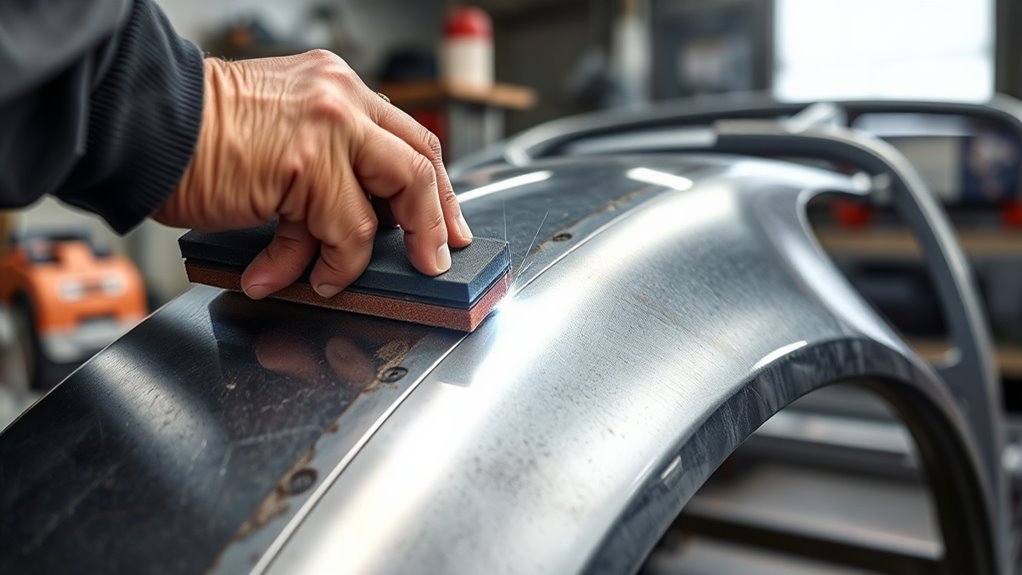
Inspect the weld seam before you grind it smooth. Look for a uniform bead, full tie-in at both edges, and no visible cracks, pinholes, undercut, or missed spots. Use strong light and check from more than one angle. If you can see the backside of the repair, inspect that too.
- Check the root and cap for continuity.
- Look for undercut, porosity, cracking, cold-lap, or burn-through.
- Grind only enough to level the seam.
- Avoid thinning the surrounding panel.
- Clean the repair area after grinding.
- Apply epoxy primer or the OEM-approved corrosion protection system.
- Seal the backside, cavity, or flange area where required.
Do not grind the weld flat just to make it disappear. If you remove too much metal, you can weaken the joint you just built. Use a flap disc or fine grinding wheel with light pressure, then finish with corrosion protection before filler, primer, or paint.
Wire type also matters. If the bead is erratic or the weld will not clean up, confirm that the wire and shielding setup match the material. A wrong or feeding-related wire issue can affect weld quality, so review basic wire and welder troubleshooting before blaming the panel.
Frequently Asked Questions
What is the best welding process for body panels?
MIG welding is common for steel body panel repair because it is fast and practical, while TIG works well when you need more precision and have the skill to control heat. Resistance spot welding, plug welding, MIG brazing, rivet bonding, and adhesives may be required by the OEM procedure. The best process is the one approved for that vehicle, material, and joint location.
Can I use 7018 for a root pass on auto body panels?
Usually, no. A 7018 stick electrode is meant for structural steel work, not thin cosmetic auto body panels. It can add too much heat and is hard to control on sheet metal. For body panels, MIG, TIG, spot welding, or OEM-specified joining methods are normally more appropriate. Use 7018 only where the material, thickness, and procedure clearly support stick welding.
What is the difference between single-pass and multipass welding?
Single-pass welding completes the joint with one bead. Multipass welding uses two or more beads, with cleaning and cooling between passes. On auto body work, multipass welding should be used carefully because every extra pass adds heat. It is useful only when the joint needs it and the material can tolerate it.
Does two-pass welding make the panel stronger?
It can make the joint stronger if the root pass fuses correctly, the cap pass bonds to sound metal, and heat stays under control. It can also make the repair worse if it overheats thin sheet, changes high-strength steel properties, or hides a bad root pass. Strength comes from the right procedure, not from adding more bead.
Should I cool the panel with water between passes?
Do not quench a hot weld with water unless the repair procedure specifically allows it. Rapid cooling can add stress and may affect some steels. Let the panel cool naturally, skip to another area, or use air movement around the work area without blasting contamination into the weld zone.
What is the golden rule in welding body panels?
The golden rule is to control heat while following the correct repair procedure. Clean the joint, identify the material, use the right process and filler, test your settings, weld in short controlled sections, inspect before grinding, and protect the repair from corrosion afterward.
Conclusion
Two-pass welding gives you a controlled way to build penetration first and finish the seam second, but it is not a default fix for every auto body panel. Use it only when the material, joint, and OEM procedure support it. Keep the root pass clean, cool the panel before the cap pass, inspect the weld before grinding, and restore corrosion protection after finishing. When the joint is thin, heat-sensitive, or OEM-restricted, choose the approved lower-heat joining method instead.
Sources
- OSHA 1910.252 General Requirements — fire prevention, eye protection, fume warnings, and welding ventilation requirements.
- OSHA Welding, Cutting, and Brazing — official overview of welding safety hazards and regulatory topics.
- AWS ANSI Z49.1 Safety in Welding, Cutting, and Allied Processes — welding safety standard referenced for safe welding practices.
- TWI: Heat-Affected Zone — background on how welding heat can alter base metal near the weld.