Disclosure: As an Amazon Associate, we earn from qualifying purchases. If you click a link on this page and make a purchase, we may receive a small commission at no extra cost to you.
Building small battery packs can get frustrating when soldering adds too much heat or bulky equipment takes over your bench. The AGOAL 5000W Mini Battery Spot Welder gives you a compact way to attach thin nickel strips to 18650 lithium battery cells with more control than direct soldering. It focuses on adjustable output, foot-switch activation, and portable storage for light battery-pack work. This review helps you decide if its thin-material limits, recharge needs, and compact ABS build match your DIY battery projects.
Quick Verdict
Rating: 7/10, Recommended with caveats
Best For: DIY users building or repairing small 18650 battery packs with thin nickel strips
Bottom Line: This mini spot welder is useful when you need a compact, adjustable tool for light battery welding. Its main tradeoff is limited material thickness, so it is not the right choice for heavy tabs, thick pure nickel, or industrial welding.
| Specification | Detail |
|---|---|
| Brand | AGOAL |
| Model | AGOAL20230601 |
| Product Type | Portable mini battery spot welder |
| Power Claim | 5000W listed output class |
| Housing Material | ABS housing |
| Dimensions | 6.5 × 3.86 × 2.36 inches |
| Listed Weight | 871 g |
| Display | LCD voltage and battery-level display |
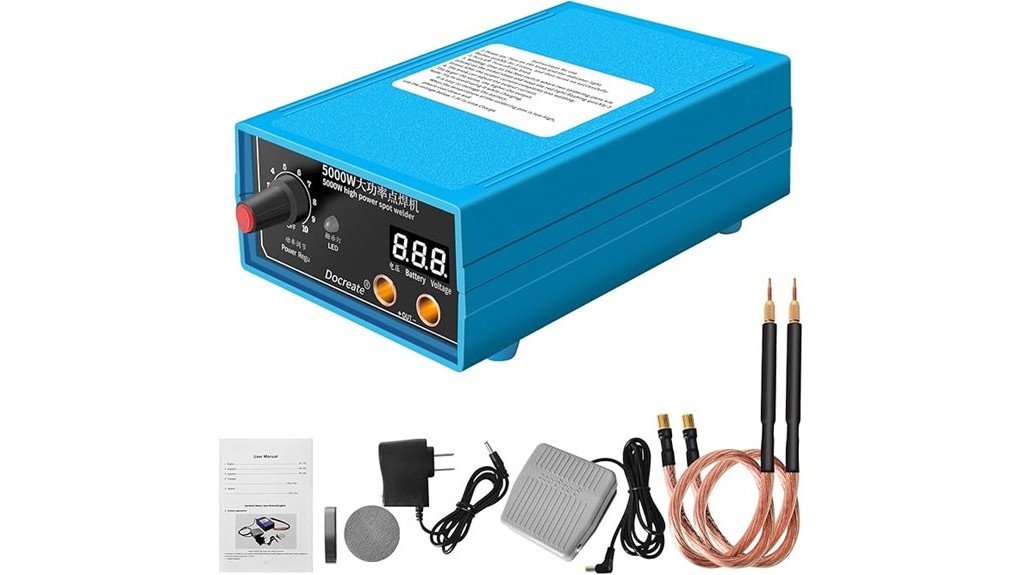
| Operation | Foot switch with two welding pens |
| Output Control | Adjustable output current |
| Supported Materials | 0.1–0.15mm nickel-plated steel sheet and about 0.1mm pure nickel sheet |
| Primary Battery Use | 18650 lithium battery pack assembly and repair |
| Included Tool Notes | Spot welder, welding pens, nickel strip, and foot switch are listing-supported items |
| Charging Note | Fully charge before first use and recharge when the display falls below 7.3V |
| Best Use | Light-duty battery tab welding, small repairs, and hobby battery-pack work |
What Is the AGOAL 5000W Mini Battery Spot Welder?
The AGOAL 5000W Mini Battery Spot Welder is a compact tool for attaching thin nickel strips to battery cells. It is aimed at 18650 lithium battery pack assembly, small battery repairs, and hobby projects where a full-size transformer spot welder would be too large.
Instead of heating a battery tab with a soldering iron, this tool creates small resistance welds through two welding pens. That helps you work faster and reduces direct heat exposure on the battery cell when you use the tool correctly.
The main appeal is control. You get adjustable output current, a foot switch, and a small 6.5 × 3.86 × 2.36 inch body that fits better in a home workshop than a large bench-mounted machine.
Who Should Buy It?
Best For
- DIY users assembling small 18650 battery packs with thin nickel strips
- Hobbyists who need a portable spot welder for light battery tab repairs
- Home workshop users who want foot-switch control without a large bench unit
Skip If
- You need to weld thick pure nickel, heavy battery bus bars, or structural metal
- You want continuous production welding without recharge breaks
- You need verified industrial duty-cycle specs or professional shop performance
Design and Build Quality
The compact ABS housing keeps the unit light enough to move between work areas. Its listed 871 g weight and small body make it easier to store than a larger bench spot welder.
ABS is practical for a portable tool housing, but it is not the same as a metal industrial enclosure. You should treat this as a light-duty electronics and battery-pack tool, not a rugged shop machine for constant daily abuse.
The welding pens are useful because they let you place the weld points exactly where the nickel strip touches the battery terminal. Replaceable tip support also matters because worn or dirty tips can reduce weld quality over time.
Controls and Ease of Use
The foot switch is one of the strongest usability features. You can hold both welding pens in position, press the nickel strip firmly, and trigger the weld without shifting your hands.
The LCD display helps you watch battery voltage while you work. The listing-supported guidance says to fully charge the unit before first use and recharge it when the display drops below 7.3V.
Adjustable output current gives you more room for trial and error. Thin nickel-plated steel may need less output than a slightly tougher strip, but you should always test on scrap material before working on a real battery pack.
Welding Performance and Material Limits
This welder is best matched with 0.1–0.15mm nickel-plated steel sheet and about 0.1mm pure nickel sheet. Those limits are important because many poor results come from expecting a mini welder to handle material that is too thick.
For 18650 battery packs, it can make clean tab welds when the strip is thin, the tips are clean, and the output setting is matched to the material. If the weld pulls off too easily, you may need a higher setting, cleaner contact points, more pressure, or slower pacing between welds.
Do not judge this tool by the 5000W claim alone. Portable battery spot welders often work best in a narrow use range, so material thickness and technique matter more than the headline wattage number.
Battery Pack Compatibility
The main use case is 18650 lithium battery pack work. That includes replacing battery tabs, rebuilding small packs, or connecting nickel strips across cells in a custom layout.
You may be able to use it with similar cylindrical cells when the tab size, strip thickness, and contact area are suitable. Still, you should check your battery type, strip material, and pack design before you start welding.
Before You Buy: This welder is designed for thin battery-strip work. Do not buy it for thick pure nickel, heavy tabs, stainless fabrication, or structural welding.
Setup Tips Before First Use
Charge the unit fully before your first welding session. Watch the LCD voltage display during use, and pause for charging if the voltage drops below the listed 7.3V guidance.
Clean the battery terminal and nickel strip before welding. Dirt, oxidation, and oil from your hands can weaken the contact point and make the weld less consistent.
Start with a scrap strip, then test the weld strength before you move to real cells. A good test weld should hold firmly without tearing loose from light handling, but you should avoid overheating the cell or repeatedly welding in the same spot.
Pro Tip: Keep both welding pen tips flat, firm, and evenly spaced on the nickel strip before pressing the foot switch. Let the tool rest briefly between welds if strength starts to drop.
Safety Notes for Battery Welding
Battery welding needs care because lithium cells can be damaged by heat, shorts, punctures, or incorrect pack design. Work in a clean area, keep metal tools away from exposed terminals, and avoid loose nickel strips that can bridge positive and negative contacts.
Wear eye protection and keep flammable materials away from the work surface. If a cell gets hot, smells unusual, swells, leaks, or shows damaged wrapping, stop and handle it according to safe battery-disposal guidance.
This tool does not replace battery-pack knowledge. If you are building packs for e-bikes, power tools, scooters, or other high-current devices, make sure your cell choice, nickel strip, BMS, insulation, and fuse strategy match the load.
How It Performs in Real Use
For 18650 Battery Pack Builds
The AGOAL mini spot welder makes the most sense for small 18650 packs using thin nickel strips. The foot switch helps you place each weld with both hands steady, which can improve consistency across a pack.
For Battery Tab Repairs
It can help when you need to reconnect a loose tab or replace a damaged thin nickel strip. You still need clean surfaces and correct output settings because weak welds can create resistance and reliability problems.
For Home Workshop Projects
The small body works well when you only build packs occasionally and do not want a large machine on your bench. It is easier to store, but you give up the power reserve and duty cycle of a larger welder.
For Longer Sessions
Longer sessions may require recharge breaks and slower pacing. If you plan to build many packs at once, a higher-capacity spot welder or capacitor-style unit may save time.
Common Mistakes to Avoid
Do not start on a live battery pack without testing the settings first. A scrap nickel strip gives you a safer way to learn how the tool responds at each output level.
Avoid pressing the pen tips at an angle. Uneven contact can cause weak welds, arcing, or marks that look stronger than they are.
Do not assume every strip sold as “nickel” behaves the same way. Nickel-plated steel and pure nickel weld differently, and thicker material can exceed what this mini welder handles well.
Pros and Cons
Pros
- Adjustable output current helps match weld strength to thin strip material
- Foot switch lets you keep both hands on the welding pens for better placement
- Compact 6.5 × 3.86 × 2.36 inch body is easy to store in a small workshop
- LCD display helps you monitor voltage and know when to recharge
- Works well for light 18650 battery-pack assembly when used within material limits
Cons
- Limited to thin nickel-plated steel and about 0.1mm pure nickel sheet
- Long sessions may need recharge breaks and slower pacing
- Not suitable for heavy-duty shop welding, thick tabs, or structural metal work
Is It Worth the Price?
This spot welder fits the budget-to-mid-range category for hobby battery-pack tools. It is worth considering if you need a compact welder for occasional 18650 projects and do not want a large bench unit.
The best value comes from its portability, foot-switch control, LCD display, and adjustable output. You get less value if you expect production-level duty cycle, heavy tab welding, or reliable performance on thicker nickel.
For light DIY battery work, it can be a smart buy. For high-current pack building or frequent shop use, you should compare stronger capacitor-based or transformer-based spot welders before deciding.
How It Compares to Alternatives
Compared with larger transformer-based spot welders, the AGOAL mini unit is easier to store and move. Larger machines usually offer stronger output and better consistency on thicker material, but they cost more and need more bench space.
Compared with handheld portable spot welders that have built-in tips, this model’s separate welding pens and foot switch give you more control over placement. Capacitor-style battery spot welders may be better if you want stronger pulses, higher capacity, or more repeatable results across bigger battery projects.
Frequently Asked Questions
What batteries can the AGOAL 5000W Mini Battery Spot Welder be used with?
It is mainly designed for 18650 lithium battery pack assembly and repair. You may use it with similar cylindrical cells when the strip thickness and contact layout are suitable.
What nickel strip thickness does it support?
The supported range is 0.1–0.15mm nickel-plated steel sheet and about 0.1mm pure nickel sheet. Thicker strips may produce weak welds or inconsistent results.
Is this spot welder safe for lithium battery work?
It can be used for lithium battery tab welding when you follow safe battery-handling practices. Avoid shorts, damaged cells, repeated welds in one spot, and any pack design you do not understand.
Does it work on pure nickel?
It is listed for about 0.1mm pure nickel sheet. If you need to weld thicker pure nickel, this mini unit may not provide enough consistent strength.
How do you know when to recharge it?
Use the LCD display to watch the voltage level. The listing-supported guidance says to recharge the unit when the display falls below 7.3V.
Why does foot-switch control matter?
The foot switch lets you hold both welding pens steady before triggering the weld. That helps reduce movement and makes placement easier on small battery terminals.
Can it replace a professional battery spot welder?
No. This is a compact light-duty unit for small battery-pack projects, not a professional production welder with a verified industrial duty cycle.
Who should skip this mini spot welder?
Skip it if you need to weld thick tabs, heavy bus bars, structural metal, or many battery packs in one session. A stronger capacitor-based or bench-style welder will likely fit those jobs better.
The Bottom Line
The AGOAL 5000W Mini Battery Spot Welder is a practical pick if you build or repair small 18650 battery packs with thin nickel strips. Its best strengths are portability, adjustable output, LCD voltage monitoring, and foot-switch control.
You should skip it if you need heavy-duty weld strength, thick pure nickel compatibility, or nonstop production use. For light DIY battery welding, it earns a cautious recommendation as long as you stay within its material limits.