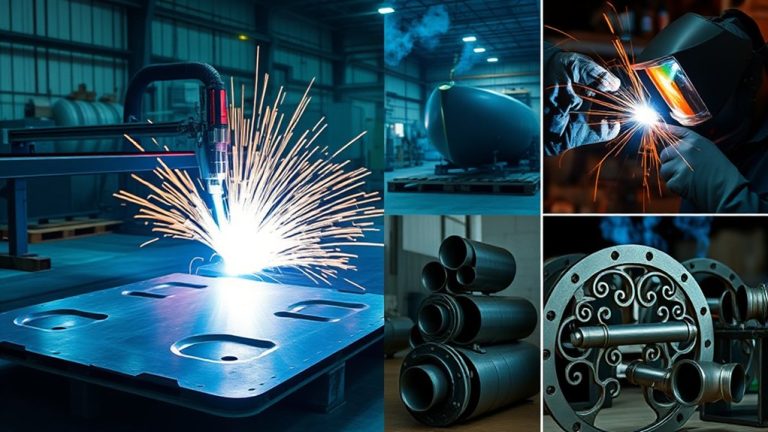
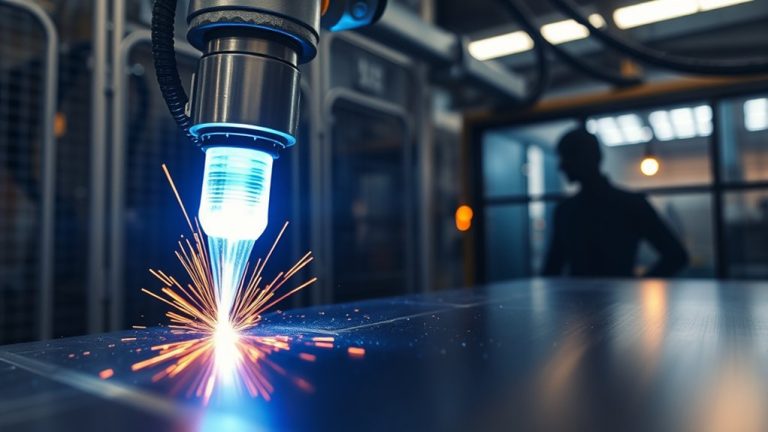
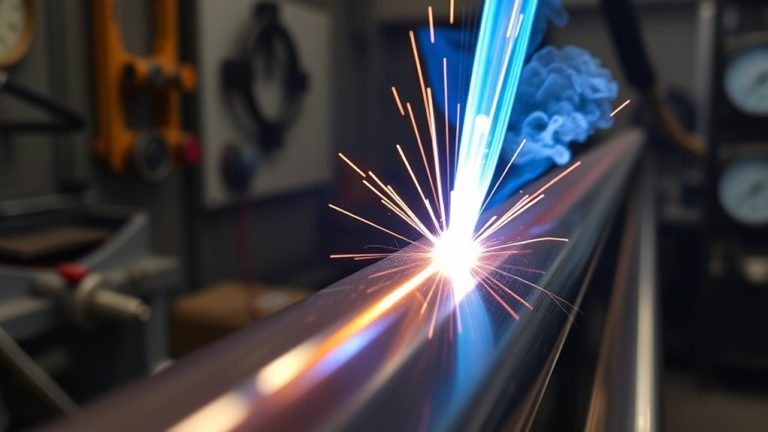
By coincidence, you’re likely already near a shop where plasma cutters shape metal every day. You use them to make precise, repeatable cuts in steel, aluminum, and alloys with tight tolerances, while managing heat-affected zones and arc stability. You’ll choose duty cycle, amperage, and gas type for the job, and follow lockout/tagout and PPE protocols to mitigate arc flash and fumes. The surprising part is where these cuts actually happen—and what materials push the limits.
Automotive Manufacturing
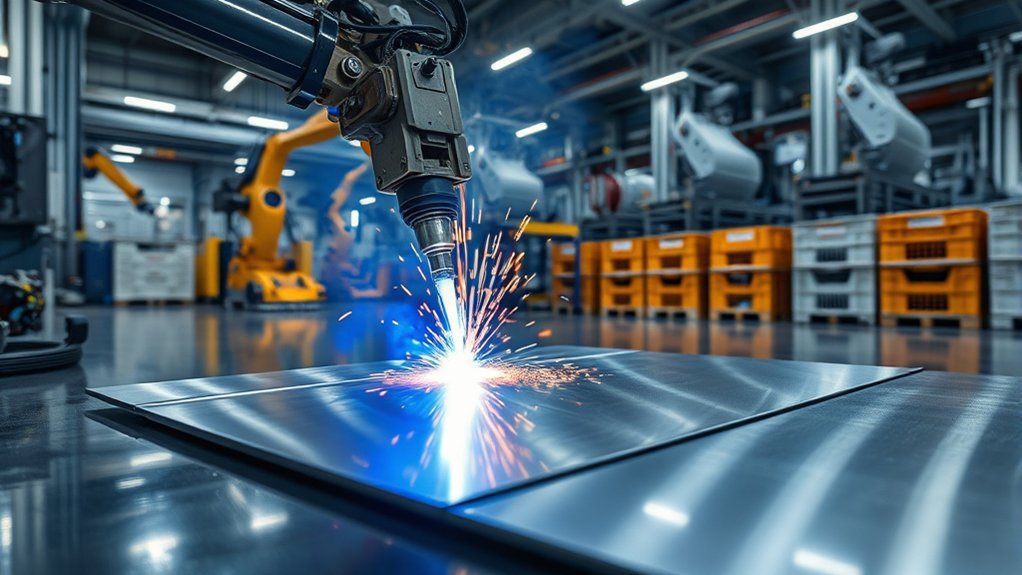
Although automotive lines vary by platform, plasma cutters consistently execute precise cuts on chassis members, exhaust tubing, and body panels across steel, stainless, and aluminum alloys.
You program toolpaths from CAD/CAM, validate kerf compensation, and lock in amperage, gas flow, and standoff to meet tolerance bands for chassis components and exhaust systems. Use interlocks, fume extraction, and PPE; verify ground integrity before arc initiation.
On automated cells, you deploy CNC gantries and robotic torch manipulators to maximize throughput while maintaining repeatability (CPk targets).
On automated cells, deploy CNC gantries and robotic torch manipulators to maximize throughput while hitting CPk repeatability targets.
Nest parts to reduce scrap, apply lead-ins/outs to prevent heat-affected distortion, and monitor consumable wear with scheduled checks. For EV frames, you sequence cuts to protect battery enclosure interfaces and specify low-heat input settings to preserve high-strength lightweight alloys.
Track outcome metrics: cycle time, first-pass yield, edge angularity, and surface roughness.
Calibrate regularly, document parameters, and implement lockout/tagout during maintenance to sustain quality, cost control, and safe operations.
Construction and Heavy Equipment Fabrication
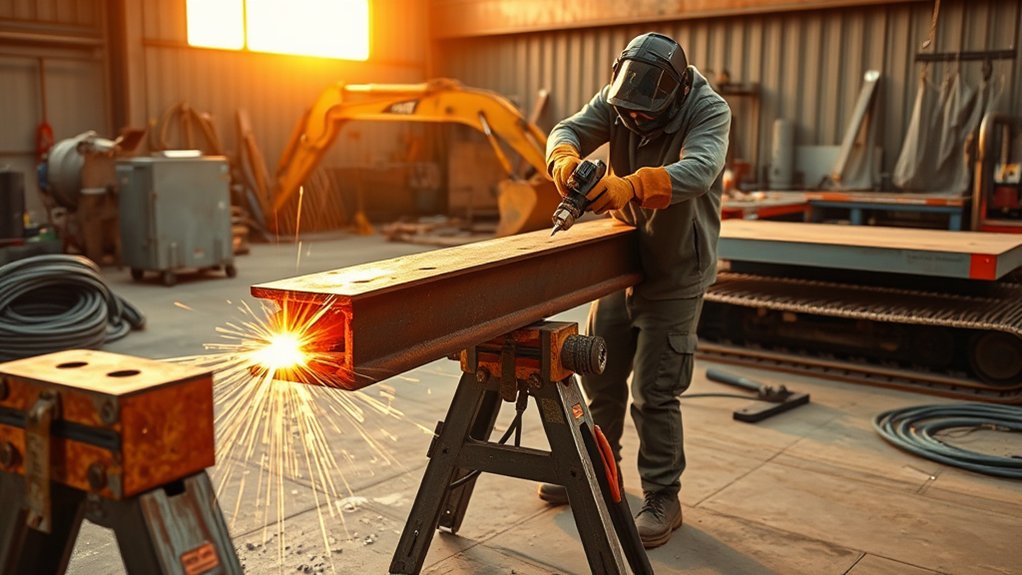
When schedules compress and tolerances tighten, plasma cutters let you profile structural steel, wear plate, and custom brackets with speed and repeatable accuracy on site or in the shop.
You’ll handle steel beam shaping, gusset plates, stiffeners, and pin bosses with CAD/CAM paths, tight kerf control, and verified cut parameters. Specify amperage, gas mix, standoff, and travel speed to hold dimension, minimize HAZ, and preserve structural integrity.
Use portable units for field rework—trim flanges, slot connection plates, and cope beams without hauling stock offsite, cutting logistics and boosting project efficiency.
Program bevel cuts for weld prep (V, K, X) and maintain root face per WPS. Confirm material ID, thickness, and grounding; clamp workpieces, shield combustibles, and control fumes per OSHA/ NFPA guidance.
Inspect edges, remove dross, and measure with calibrated gauges before fit-up. With correct consumables and duty cycle management, you’ll process mixed thicknesses while minimizing waste and rework.
Aerospace and Defense
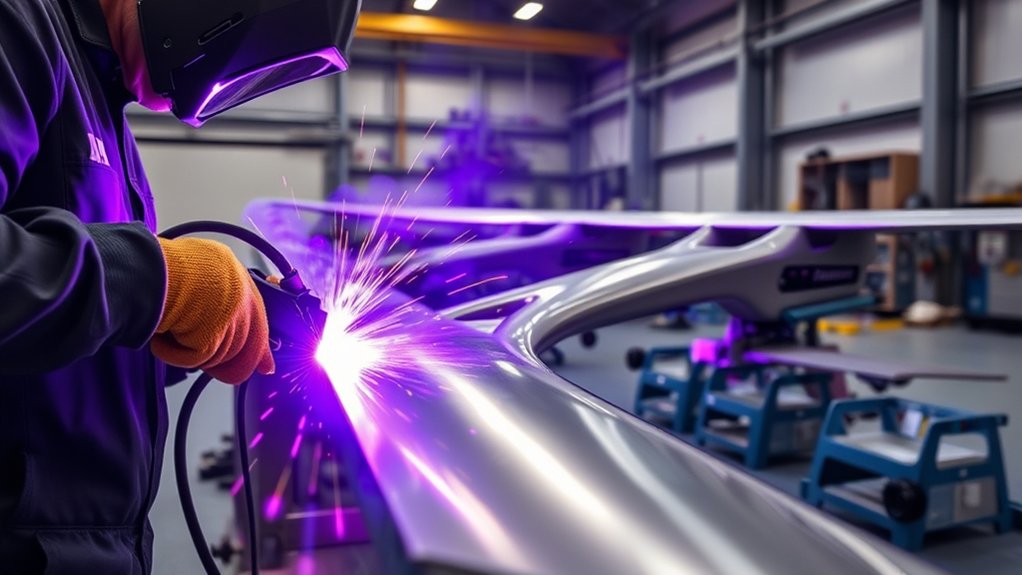
Beyond jobsite steel and weld-prep, you’ll use plasma cutters in aerospace and defense to profile high-grade alloys (Ti, Inconel, Maraging, 17-4 PH) into lightweight, load-bearing geometries under strict tolerances.
Profile high-grade aerospace alloys into lightweight, load-bearing geometries with strict tolerances.
You’ll program CNC tables with verified toolpaths, then validate kerf, taper, and HAZ against spec to keep aero-structures within form-and-fit. For aerospace components, you’ll cut ribs, brackets, and bulkhead details while logging consumable life, gas mix, and current to maintain repeatability.
In defense applications, automated cells nest armor plates and weapon system interfaces, using closed-loop height control for consistent cut quality across varying coatings.
You’ll gate every lot with PPAP/FAI, serialize parts, and attach digital travelers for full traceability. Rapid prototyping benefits from quick iteration: import CAD, post, cut, inspect, correct.
You’ll enforce NADCAP/AS9100 processes, verify edge integrity with NDT where required, and document corrective actions. The outcome: precise, low-defect parts that meet weight targets and compliance.
Artistic and Custom Fabrication
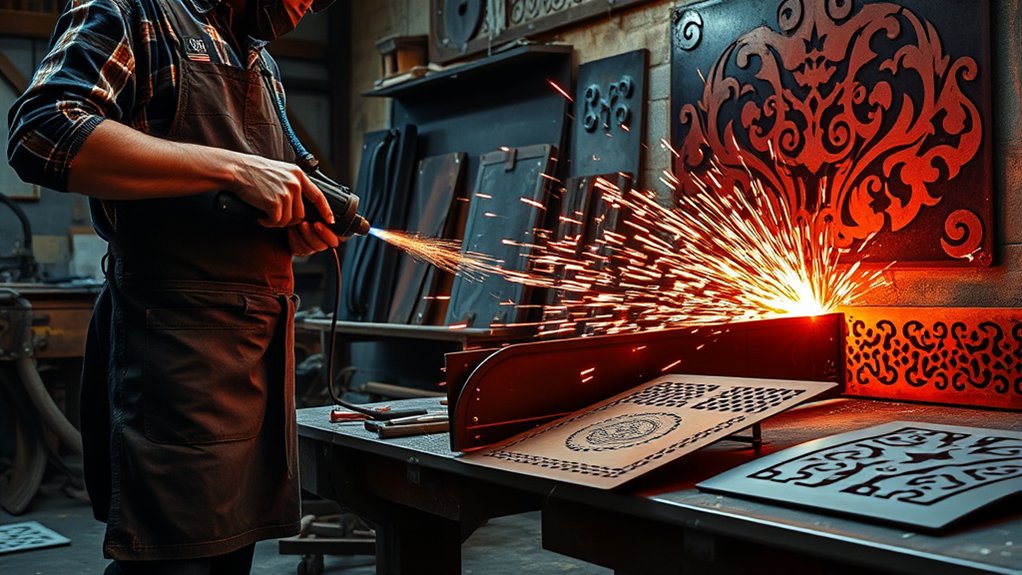
In artistic and custom fabrication, you use plasma cutters to execute intricate metal artistry—tight radii, filigree, and clean bevels—in steel, aluminum, and stainless.
You integrate CAD/CAM files with CNC controls to achieve high-precision paths, repeatability, and minimal kerf variance while reducing waste and setup time.
Maintain safety by specifying proper consumables, controlling arc current and travel speed, securing workpieces, and enforcing PPE and fume extraction.
Intricate Metal Artistry
Two core capabilities make plasma cutters a staple for intricate metal artistry: precision and versatility. You execute tight radii, filigree, and pierces on steel or aluminum, turning sheet into modern sculptures that channel creative expression.
With a fine-cut nozzle, you trace detailed patterns, then switch consumables to bevel edges or drill clean holes. Handheld units keep costs low while delivering consistent kerf widths on medium thickness stock.
Operate like code: plan, set, verify, cut. Define amperage, gas flow, and standoff; confirm ground integrity; mask paths with layout dye; test on scrap.
Maintain eye, hand, and respiratory protection; manage sparks and dross with fire-safe clearance. By leveraging multi-metal compatibility and disciplined parameters, you produce durable decorative or functional pieces with crisp geometry and reliable repeatability.
CNC Design Integration
Although you’re still cutting metal, CNC design integration turns the workflow into code: sketch vector geometry, set kerf compensation, assign lead-ins/outs, define pierce order, and post G-code with verified amperage, gas, height, and feed.
You’ll use CNC software to automate paths, enforce torch safety interlocks, and lock consistent quality across runs. For artistic and custom fabrication, complex contours, bevels, and tight radii become repeatable, enabling sculptures, architectural panels, and signage with clean edges.
Digital modification lets you iterate fast—tweak nodes, scale features, or swap fonts—then regenerate toolpaths for rapid prototyping or one-off commissions.
Apply nesting to minimize scrap and maximize yield. Validate cut charts, pierce delays, and ramping to avoid dross and warping. Dry-run motion, verify clearances, and maintain consumables to prevent misfires and scrap.
Maintenance and Repair Operations
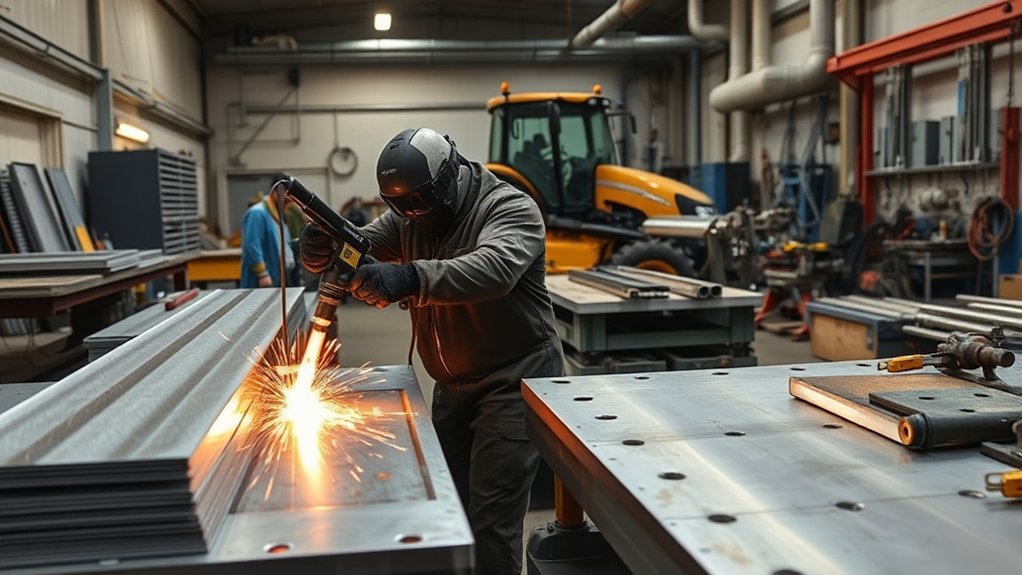
Because downtime costs compound fast, maintenance and repair operations rely on portable plasma cutters to execute on‑site cuts, trims, and removals with minimal setup and high safety margins.
Portable plasma cutters enable fast, safe on-site cuts, trims, and removals to reduce costly downtime.
You deploy them to restore field efficiency, isolate damaged sections, and complete urgent repairs without waiting on shop resources. Their arcs pierce rusted, coated, or thick members with little surface prep, so you can cut, bevel, or slot quickly and proceed to fit-up or replacement.
Specify a unit with stable duty cycle, reliable arc start, and compliant grounding. Use lockout/tagout, dry PPE, and correct consumables; verify clean air supply and intact leads.
For corroded structures, score access, then make controlled passes to avoid heat‑affected distortion.
Smart, IoT‑enabled cutters stream runtime and consumable life, drive predictive maintenance, and trigger alerts for tip wear, filter saturation, or overheat conditions.
That telemetry helps you schedule parts, minimize truck rolls, and maintain consistent, safe productivity in the field.
Common Metals and Thickness Ranges for Plasma Cutting
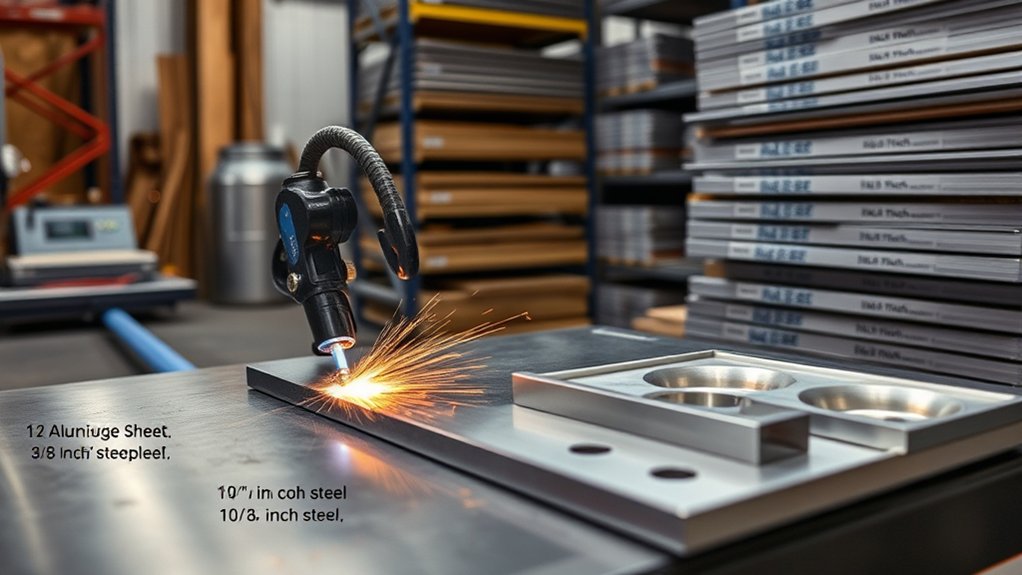
Versatility defines plasma cutting: you can cleanly process conductive metals like mild steel, stainless steel, aluminum, copper, and brass by matching amperage, gas, and speed to the job.
You’ll choose parameters based on metal types and thickness limits, then verify arc stability, kerf width, and edge quality. Light-duty 30–40A units deliver clean cuts to ~10 mm; heavy-duty 80–200A machines reach 25–50 mm, with CNC systems at ≥200A exceeding 50 mm cleanly.
Severance extends further: ~16 mm on light machines, ~75 mm on heavy, and specialized rigs exceeding 160 mm.
- Select amperage to thickness: 1 A per 0.001 in (approx) as a quick sanity check.
- Match gas: air for mild steel; nitrogen or argon-hydrogen for stainless/aluminum; keep dry, oil-free.
- Increase travel speed on thin sheet for smoother edges and minimal dross.
- Use standoff/torch height control to maintain consistent kerf.
- Enforce PPE, ventilation, and dry work leads to prevent arc blow and hazards.
Frequently Asked Questions
What Safety Gear Is Essential When Operating a Plasma Cutter?
Right off the bat, don’t play with fire: you need protective eyewear, safety gloves, flame-resistant clothing, welding helmet or shield, hearing protection, respirator, steel-toe boots, and grounded, dry workspace. Verify PPE ratings; inspect gear; follow lockout-tagout.
How Does Plasma Cutting Compare to Laser and Oxy-Fuel Cutting?
You compare plasma to laser and oxy-fuel by speed, thickness, and cost. Plasma advantages: fast on conductive metals, lower cost, moderate cutting precision. Laser wins thin, intricate cuts. Oxy-fuel excels thick steel. You prioritize ventilation, PPE, grounding, interlocks.
Can Plasma Cutters Be Used Outdoors in Windy Conditions?
Yes, but you must mitigate wind impact. Use wind shields, higher gas flow, and standoff guides. Expect outdoor limitations: arc blowout, dross, unstable kerf. Ground securely, dry the power source, wear PPE, and pause if gusts exceed specs.
What Air Quality and Compressor Requirements Do Plasma Cutters Need?
Like a watchdog guarding code, you need dry, oil-free air with robust air filtration, 0.1–0.3 micron. Match compressor size to duty: 4–7 CFM @ 90–120 PSI, continuous-rated, with dryer, regulator, drains, and safety interlocks.
How Do Consumable Parts Affect Cut Quality and Operating Costs?
Consumable wear directly degrades cut quality and increases operating costs. You monitor nozzle orifice, electrode pit depth, and shield alignment; replace per hours/arcing limits. Use OEM parts, correct amperage, clean dry air, proper pierce height, and maintain coolant, ensuring consistent, safe cuts.
Conclusion
You now see how plasma cutters fit your workflow: fast, precise, and adaptable across automotive, construction, aerospace, art, and MRO. For example, you might retrofit a fleet of snowplows by nesting A36 3/8″ brackets in CAD/CAM, exporting NC code, then cutting on a 65 A air plasma at 120 IPM with 0.06″ kerf. You’d verify torch height (0.06″), maintain dry air, clamp returns, and follow LOTO and PPE protocols, ensuring repeatable cuts, minimal dross, and safe operation.