Interpass temperature is one of the main heat controls in multi-pass welding. Measuring it before each new pass helps the welder follow the qualified procedure, manage cooling rate, and avoid heat-related changes that can affect cracking resistance, toughness, strength, corrosion performance, or distortion.
Quick Answer
Interpass temperature is the temperature of the weld metal or nearby base metal immediately before the next weld pass. Measure it at the location and with the method required by the welding procedure specification, then continue only when the reading is within the specified minimum and maximum limits.
Key Takeaways
- Measure interpass temperature immediately before each new weld pass.
- Use the minimum and maximum limits in the approved WPS, code, procedure qualification, or material supplier instructions.
- Do not rely on a universal temperature chart for carbon steel, stainless steel, nickel alloys, or aluminum.
- Contact tools are often more dependable than infrared tools on shiny, reflective, smoky, or uneven metal surfaces.
- Stop welding when the joint is outside the allowed range, correct the temperature with an approved method, and measure again.
At a Glance
| Time Required | A few seconds per reading, plus any required heating or cooling time |
| Difficulty | Moderate; procedure-controlled work requires trained personnel and verified instruments |
| Tools Needed | Approved WPS, temperature crayon, contact thermometer, thermocouple, or suitable infrared thermometer |
| Cost | Low for temperature-indicating crayons; higher for calibrated contact, thermocouple, or infrared systems |
What Is Interpass Temperature in Welding?
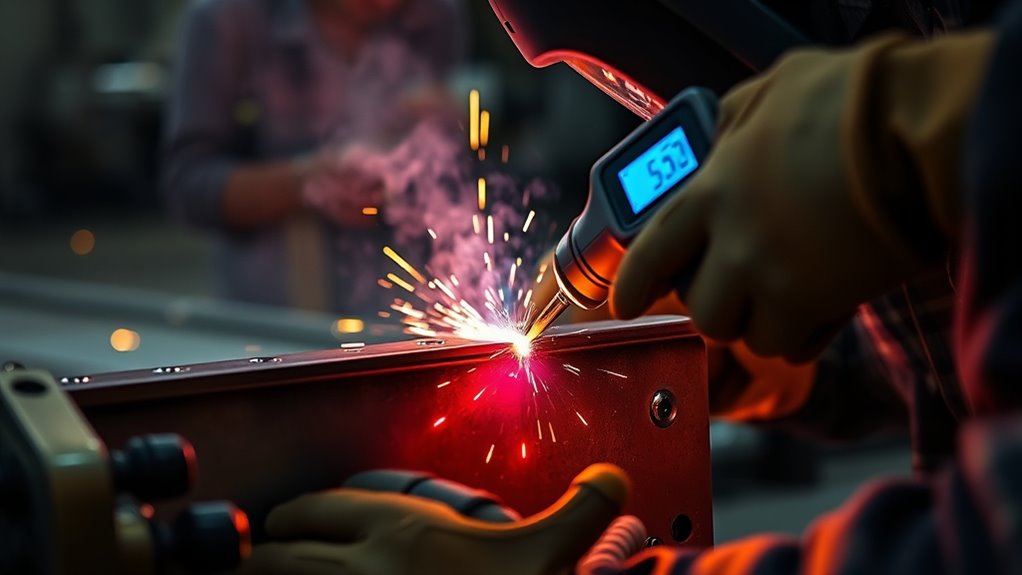
Interpass temperature is the temperature in a multi-run weld and the immediately surrounding material just before the next weld run is deposited. The current ISO 13916:2025 welding-temperature measurement standard covers the measurement of preheating, interpass, and preheat-maintenance temperatures.
The acceptable temperature is not a general shop preference. It is a procedure variable affected by the base-metal grade, thickness, filler metal, joint design, restraint, welding process, heat input, mechanical-property requirements, and governing code.
Minimum and Maximum Interpass Temperature
A WPS may specify a minimum, a maximum, or both:
- Minimum interpass temperature: Prevents the joint from cooling below the level needed to control cooling rate or hydrogen-cracking risk. It is often the same as, or close to, the specified minimum preheat temperature.
- Maximum interpass temperature: Limits accumulated heat that could change weld-metal or heat-affected-zone properties, increase distortion, alter corrosion performance, or move the production weld outside the conditions represented by procedure qualification.
TWI’s guidance on preheat and interpass temperature explains that minimum limits commonly control hydrogen cracking, while maximum limits control microstructural development and consistency with the qualified procedure.
The WPS—not a generic internet chart—sets the acceptable interpass-temperature window for a procedure-controlled weld.
Preheat vs. Interpass Temperature
Preheat and interpass temperature are related but are not identical:
- Preheat temperature is established before welding begins.
- Interpass temperature is checked immediately before the second and later passes.
- Preheat-maintenance temperature is the minimum temperature that must be maintained during an interruption when the procedure requires it.
Note: A weld can satisfy its initial preheat requirement and still move outside the interpass range later. Check the temperature throughout the weld sequence, not only before the root pass.
Why Interpass Temperature Affects Weld Quality
Every weld pass adds heat to the joint. The temperature before the next pass affects the next heating and cooling cycle, which can influence weld-metal and heat-affected-zone microstructure.
| Condition | Possible Concern | Required Response |
|---|---|---|
| Below the specified minimum | Faster cooling, higher hardness, or increased hydrogen-cracking risk in susceptible steels | Apply approved, uniform heat and remeasure |
| Within the specified range | Thermal conditions remain within the qualified procedure | Deposit the next pass using the WPS parameters |
| Above the specified maximum | Excessive heat accumulation, distortion, grain growth, softening, precipitation, or loss of required properties | Stop and allow approved cooling before remeasuring |
In hydrogen-sensitive steels, maintaining the required minimum temperature slows cooling and can give diffusible hydrogen more time to escape. That does not mean hotter is always better. Excessive interpass heat can reduce weld-metal strength or alter the heat-affected zone in some high-strength steels.
Stainless steel requires different controls. Austenitic grades generally benefit from low heat input and restrained interpass temperature to reduce distortion and time at temperatures that may promote precipitation. Sensitization risk also depends on carbon content, grade, stabilization, and total time at temperature.
Preparation remains part of the control system. Remove slag, moisture, oil, paint, scale, and other contaminants before the next pass. Good clean metal preparation supports sound fusion and reduces hydrogen and porosity risks.
Warning: Never substitute a generic material chart for the approved WPS on structural, pressure, pipeline, high-strength, corrosion-resistant, or code-regulated work. An incorrect limit can invalidate the procedure or damage the required material properties.
Where and When to Measure Interpass Temperature
Measure interpass temperature in the weld zone immediately before the next pass. Under ISO-style practice, the reading is taken on the weld metal or immediately adjacent base metal. The project code, WPS, inspection plan, or customer specification may require a more exact point, distance, or number of readings.
Do not measure only where the previous pass ended if the next pass will begin somewhere else. Check close enough to the next welding location to represent the temperature the new pass will encounter, while following the required measurement method.
Long joints, thick sections, unequal thicknesses, large attachments, and joints heated from one side can have uneven temperatures. Check more than one location when a single reading would not represent the full weld zone.
Products Worth Considering
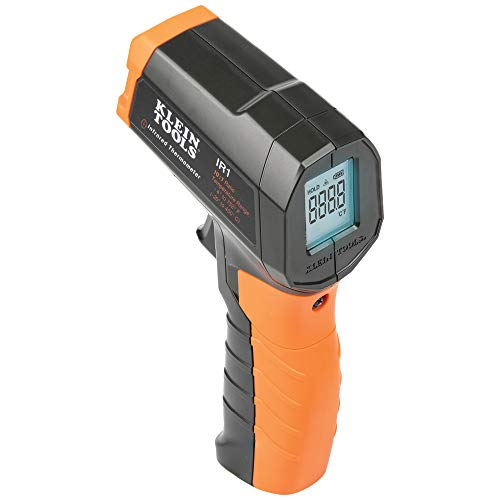
PRECISE TEMPERATURE MEASUREMENT: Optical resolution (distance-to-spot) of 10:1 ensures accurate temperature readings from a distance

TEMPERATURE SELECTION: User selectable Fahrenheit and Celsius measurements for convenience and versatility

DIFFERENTIAL TEMPERATURE: PDT655 can store temperature readings and measure differential temperature by Measuring (T1 - T2)
Temperature Measurement Tools
| Tool | Best Use | Main Limitation |
|---|---|---|
| Temperature-indicating crayon or paint | Fast threshold or go/no-go checks in a known temperature range | Shows whether a threshold was reached rather than a precise continuous reading; some materials can contaminate sensitive alloys |
| Contact thermometer | Direct surface checks on accessible metal | Needs good contact and enough response time |
| Thermocouple | Continuous monitoring, thick sections, heating systems, and recorded work | Placement, attachment, lead condition, and instrument setup affect accuracy |
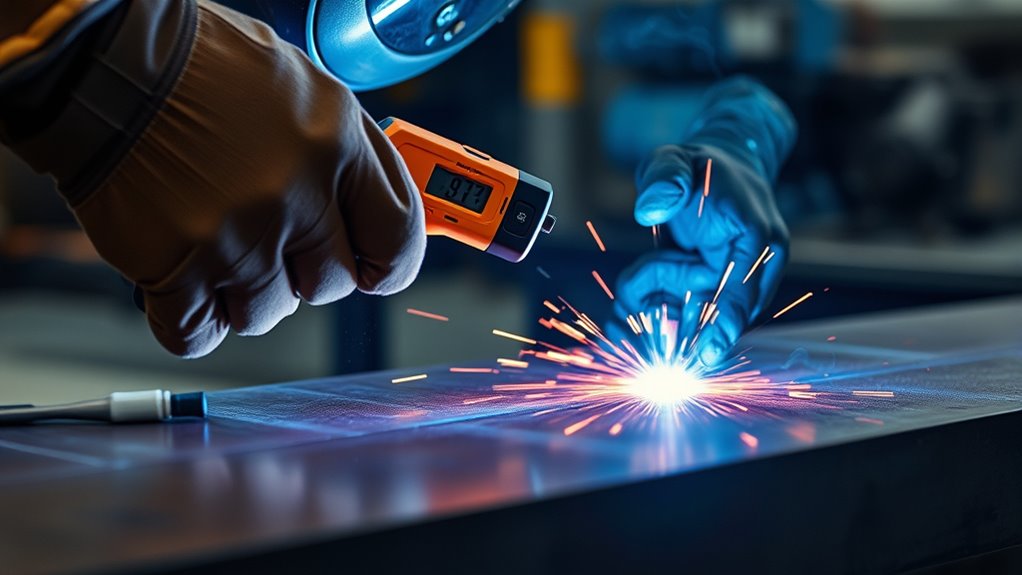
| Infrared thermometer | Fast, non-contact checks when the surface and instrument are suitable | Shiny metal, low emissivity, reflections, smoke, steam, angle, and distance-to-spot ratio can distort the result |
Fluke’s infrared-measurement guidance warns that polished metal has low emissivity and may cause an infrared thermometer to under-report the actual temperature. The laser shows the approximate center of the target, not the full measurement area.
Pro Tip: On procedure-controlled work, confirm questionable infrared readings with an approved contact method. Mark the planned measurement locations on the traveler or inspection sketch so each shift checks the same areas.
How to Measure Interpass Temperature Correctly
- Read the WPS. Identify the minimum temperature, maximum temperature, required tool, measurement location, and recording requirements.
- Prepare the weld area. Remove slag and loose contamination without placing temperature-indicating material where it could enter a sensitive weld.
- Check the instrument. Use an approved instrument within its operating range and current verification or calibration status.
- Measure immediately before welding. Check the weld metal or immediately adjacent base metal at the location representative of the next pass.
- Check multiple points when needed. Long seams, thick sections, unequal joint members, and local heaters may produce an uneven temperature field.
- Compare the reading with both limits. Do not begin the next pass if the temperature is below the minimum or above the maximum.
- Correct, remeasure, and record. Use only an approved heating or cooling method, verify the new temperature, and document the result when traceability is required.
Recordkeeping may include the joint or weld number, pass number, time, measurement location, measured value, instrument identification, operator or inspector initials, and any corrective action. Follow the project inspection and test plan when it requires additional information.
Temperature control works alongside process control. Correct shielding gas flow, travel speed, amperage, voltage, bead placement, and cleaning between passes remain necessary for weld quality.
Products Worth Considering

[Quality Material] Our water temp gauge is made of high-quality ABS material, which is light weight, fast fading, high temperature resistance, wear resistance, corrosion resistance, and can be used for a long time.

【HIGH ACCURACY】: Measurement range is 100-300F(38-150C),Sensor mounting thread: NPT 1/ 8 ",Power: 12V,24V DC, Max. 0.3A.

Protects engine - this must-have engine coolant temperature gauge is designed to provide accurate at-a-glance measurement and monitoring of coolant temperature to help prevent engine overheating
Interpass Temperature Limits for Common Materials
There is no single safe temperature range for an entire material category. The table below provides context for reading a WPS; it does not replace one.
| Material Family | Interpass Consideration |
|---|---|
| Carbon and low-alloy steel | The minimum may be tied to preheat and hydrogen-cracking control. A maximum may be imposed to protect weld-metal or HAZ properties. Grade, thickness, restraint, hydrogen level, heat input, and code all matter. |
| High-strength, quenched-and-tempered, or TMCP steel | Heat-input and maximum-interpass limits can be especially strict because excessive heat may soften or alter the engineered microstructure. Follow the steel manufacturer and qualified WPS. |
| Austenitic stainless steel | Low heat input and an interpass temperature around 150°C (302°F) maximum are common guidance for many applications, but the exact value depends on grade, thickness, filler, corrosion requirements, and procedure. |
| Ferritic, martensitic, duplex, or super-duplex stainless steel | These families have different transformation, toughness, hydrogen-cracking, grain-growth, and phase-balance concerns. Do not apply an austenitic stainless limit to them. |
| Nickel alloys | TWI gives broad guidance not to exceed 250°C (482°F) for many alloys, while some suppliers specify limits near 100°C (212°F) for particular alloys such as C276. Use the alloy-supplier and WPS limit. |
| Aluminum alloys | Heat-treatable alloys are sensitive to peak temperature and time at temperature. For one 6061-T6 structural procedure context, ESAB cites a 250°F (121°C) maximum and a 15-minute time limit; this is an example, not a universal aluminum setting. |
TWI’s stainless-steel welding guidance recommends low heat input and approximately 150°C maximum interpass temperature for common austenitic stainless practice. Different stainless families require different controls.
For nickel alloys, TWI’s nickel-alloy welding guidance notes that many alloys should remain below 250°C, while some alloy suppliers specify much lower values.
For aluminum, ESAB’s 6061-T6 procedure-test guidance shows why alloy, temper, holding time, and code context must accompany any numeric limit. Excessive heat can reduce strength in the heat-affected zone of heat-treatable aluminum.
When welding stainless steel, use the specified filler and process controls together with disciplined heat input management.
Note: A temperature listed in a supplier guide or code example may apply only to a named alloy, temper, thickness, filler, process, or qualification test. Confirm the complete context before using it.
How to Control Interpass Temperature in Multi-Pass Welds
Temperature control begins before the arc starts. Plan the bead sequence, heating method, measurement points, expected pause time, and documentation requirements from the WPS and fabrication plan.
- Confirm the required minimum and maximum temperatures.
- Bring the complete specified area to the required preheat temperature using uniform, approved heating.
- Deposit the pass within the WPS amperage, voltage, travel-speed, bead-size, and heat-input limits.
- Clean and visually check the pass.
- Measure the interpass temperature at the required location immediately before the next pass.
- Heat or cool only by an approved method if the reading is outside the range.
- Remeasure before restarting and record the result when required.
If the Joint Is Too Hot
- Stop welding and allow the joint to cool naturally unless the WPS authorizes another method.
- Stagger weld locations or alternate sides when the approved sequence permits it.
- Use approved stringer beads rather than wide weaves when the procedure allows.
- Review travel speed, current, voltage, bead size, and deposition sequence for excessive heat input.
- Do not use water, wet rags, ice, or unapproved compressed air on a procedure-controlled weld.
- Measure again before restarting.
If the Joint Is Too Cold
- Stop before striking the next arc.
- Use the approved gas, resistance, induction, radiant, or electric-blanket heating method.
- Heat the required area evenly and through the specified thickness.
- Avoid concentrated flames or local hot spots.
- Allow temperature equalization when heating and measurement occur on the same surface.
- Measure again and continue only after the joint reaches the required range.
Outdoor work may lose heat quickly in cold air or wind. Wind screens, insulation, controlled heating, and more frequent checks can help when the WPS and site rules permit them.
Hot-work preparation remains essential. Inspect leads, grounds, torches, hoses, regulators, heating equipment, fire protection, and nearby combustible materials. Related equipment inspections and hot-work precautions also apply when welding or using auxiliary heat.
Interpass Temperature Troubleshooting
| Problem | Likely Cause | Corrective Action |
|---|---|---|
| Temperature rises with every pass | High deposition rate, slow travel, wide weave, small heat sink, or insufficient pause time | Pause, review heat input and sequence, use approved cooling time, and remeasure |
| One end is much hotter | Uneven heating, different section thickness, joint geometry, or repeated starts in one area | Use multiple measurement points and revise the approved sequence or heating arrangement |
| Infrared reading is unexpectedly low | Low emissivity, reflected surroundings, oversized measurement spot, smoke, or poor angle | Move to the correct distance, clear the sight path, set emissivity correctly, or verify with a contact tool |
| Joint falls below minimum during breaks | Long interruption, wind, cold ambient conditions, or inadequate insulation | Restore temperature with approved uniform heating and monitor during the interruption if required |
| Different tools disagree | Calibration status, emissivity, contact quality, response time, location, or instrument range | Stop, verify the tools and method, then use the approved reference instrument |
Common Mistakes to Avoid
- Using a general online range instead of the approved WPS.
- Checking only the initial preheat and skipping later passes.
- Measuring far from the area where the next pass will begin.
- Taking one reading on a long or unevenly heated joint.
- Using an infrared thermometer without accounting for emissivity and spot size.
- Applying temperature crayons where residue could contaminate a sensitive alloy.
- Continuing to weld while the joint is above the maximum or below the minimum.
- Using concentrated heating that warms only the surface or creates hot spots.
- Using water, wet cloths, or another unapproved forced-cooling method.
- Failing to record readings when the inspection plan requires traceability.
Coated material creates additional concerns. Galvanized steel must be handled with appropriate coating-removal, ventilation, and fume-control procedures. Review the specific welding challenges associated with galvanized steel before applying heat.
Frequently Asked Questions
Can interpass temperature affect welding speed?
Yes. The welder may need to pause, change the approved bead sequence, alternate weld locations, or adjust production planning so the joint stays within the WPS range. The correct waiting period is based on a temperature reading, not a fixed number of minutes.
Does interpass temperature vary by welding process?
The rate of heat accumulation can vary among SMAW, GMAW, GTAW, FCAW, and SAW because their current, voltage, travel speed, deposition rate, and arc efficiency differ. The acceptable limit still comes from the WPS for the process, material, filler, and joint.
How long should you wait between weld passes?
Wait until an approved measurement shows that the weld zone is within the required interpass range. A fixed waiting time is unreliable because thickness, joint size, ambient conditions, heat input, and weld sequence change the cooling rate.
Can weather conditions change interpass temperature?
Yes. Wind and cold air can increase heat loss, while hot weather, direct sun, or an enclosed work area can increase heat accumulation. Check more often when environmental conditions change and use only the wind protection, insulation, heating, or cooling methods permitted by the procedure.
Is preheat temperature the same as interpass temperature?
No. Preheat is established before welding begins. Interpass temperature is checked immediately before the second and later passes. The minimum values may be identical in some procedures, but the WPS should list each applicable requirement.
What happens if interpass temperature gets too high?
The result depends on the material. Possible effects include distortion, grain growth, lower weld-metal strength, HAZ softening, precipitation, altered stainless-steel phase balance, reduced corrosion performance, or failure to match the qualified procedure. Stop and cool by an approved method before continuing.
What happens if interpass temperature is below the minimum?
In susceptible steels, the weld may cool too quickly and face a higher risk of hard microstructures or hydrogen cracking. Apply the approved heating method, restore the specified temperature throughout the required area, and measure again before welding.
Where should interpass temperature be measured?
Measure on the weld metal or immediately adjacent base metal at a point representative of where the next pass will be deposited. Follow any more specific distance, side, or location stated in the WPS, code, or inspection plan.
What tool works best for checking interpass temperature?
The best tool is the approved, verified instrument that suits the temperature range, surface, material, access, and accuracy requirement. Thermocouples and contact thermometers are strong choices for repeatable readings. Temperature crayons are useful for threshold checks, while infrared tools need careful emissivity and spot-size control.
Can an infrared thermometer be trusted on a weld?
It can be useful when the instrument, emissivity setting, surface condition, target size, distance, viewing angle, and line of sight are suitable. Bare shiny metal can produce a falsely low reading, so verify doubtful or critical results with an approved contact method.
Safety Disclaimer: This article provides general welding information only. Follow the approved WPS, governing code, material and consumable instructions, hot-work permit, ventilation requirements, PPE rules, fire-prevention plan, and site procedures. Treat recently welded and heated metal as a burn hazard even when it no longer glows.
Conclusion
Interpass temperature is a measured procedure variable, not a number to estimate by color, touch, elapsed time, or a generic material chart. Check it immediately before every required pass and compare the result with both the minimum and maximum limits in the WPS.
If the joint is outside the range, stop. Apply only the approved heating or cooling method, let the temperature equalize when required, and measure again. Consistent measurement, heat-input control, cleaning, and records make multi-pass welding more repeatable and help protect the required mechanical and corrosion properties.
Sources
- ISO 13916:2025 — Welding temperature measurement — scope and current standard for preheat, interpass, and preheat-maintenance measurement.
- TWI — Which Is Important: Preheat or Interpass? — minimum and maximum interpass purposes and hydrogen control.
- TWI — Good Welding Practices for Stainless Steel — stainless heat-input and interpass guidance.
- TWI — Welding of Nickel Alloys, Part 2 — nickel-alloy interpass and heat-input guidance.
- ESAB — 6061-T6 Welding Procedure Test Guide — alloy-specific aluminum heat and interpass example.
- Fluke — Infrared Thermometer Measurement Guidance — emissivity, reflective surfaces, field of view, and environmental errors.