Automotive metal fabrication is the process of turning sheet, tube, plate, and bar stock into vehicle parts that fit, hold up under stress, and support safe vehicle performance. You cut, bend, stamp, machine, weld, bond, and finish metal so it can become body panels, brackets, frames, exhaust parts, suspension mounts, battery trays, and crash-critical structures.
Quick Answer
Automotive metal fabrication shapes raw metal into vehicle components through cutting, forming, welding, machining, and finishing. The right process depends on the part’s load, material, thickness, corrosion exposure, and tolerance needs. Steel, advanced high-strength steel, aluminum, magnesium, and stainless steel are common choices.
Key Takeaways
- Automotive fabrication includes cutting, bending, stamping, deep drawing, hydroforming, welding, fastening, bonding, and surface finishing.
- Material choice controls strength, weight, corrosion resistance, cost, formability, and repair difficulty.
- High-strength steel and aluminum help reduce weight, but each material needs the right joining and heat-control strategy.
- Safety-critical parts require proper drawings, fixtures, weld inspection, corrosion protection, and compliance with OEM or engineering requirements.
- Good fabrication is not just about shaping metal; it is about repeatable fit, controlled heat, verified dimensions, and long-term durability.
What Is Automotive Metal Fabrication?
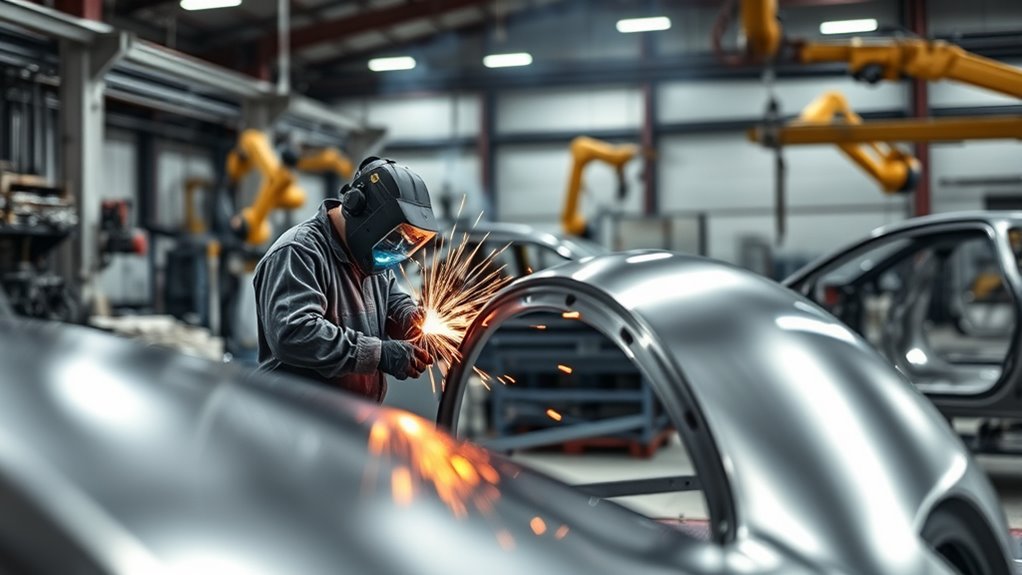
Automotive metal fabrication is the controlled process of cutting, bending, forming, joining, and finishing metal parts for vehicles. The goal is simple: make a part that matches the drawing, fits the vehicle, resists the expected loads, and survives heat, vibration, moisture, road debris, and corrosion.
You use metal fabrication to convert flat sheet, tube, plate, castings, or machined blanks into precise automotive metal fabrication outputs. A hood panel, exhaust bracket, rocker reinforcement, seat mount, battery tray, or roll cage tube may all need different fabrication steps, but each depends on the same core idea: controlled shape plus controlled strength.
In production vehicles, fabricated parts must also support crashworthiness, durability, and occupant protection. The National Highway Traffic Safety Administration describes crashworthiness as vehicle design and safety countermeasures that help reduce fatal and serious injuries. That is why structural fabrication needs more than a clean-looking weld or a smooth bend.
In a repair, restoration, racing, or custom shop, the same principles apply on a smaller scale. You still need the right material, bend radius, weld process, fixture control, coating, and inspection method. Additionally, incorporating plasma cutting technology can improve speed and flexibility when the part does not require the edge precision of laser or waterjet cutting.
Common Materials in Automotive Metal Fabrication
Material selection drives the entire fabrication plan because each alloy changes formability, strength, weight, corrosion behavior, heat sensitivity, and joining method. A part that works well in mild steel may crack, distort, or lose strength if you copy the same design in aluminum or advanced high-strength steel.
| Material | Common Automotive Uses | Main Fabrication Notes |
| Mild steel | Patch panels, brackets, floors, mounts, older body panels | Easy to cut, bend, weld, and repair; needs coating to prevent rust. |
| HSLA and AHSS | Reinforcements, pillars, rockers, crash structures, safety cages | High strength at lower weight, but heat input, repair methods, and forming limits must be controlled. |
| Aluminum alloys | Hoods, doors, fenders, battery trays, brackets, subframes, heat shields | Lightweight and corrosion resistant, but needs clean prep, correct filler, and distortion control. |
| Stainless steel | Exhaust tubing, trim, heat shields, corrosion-exposed hardware | Strong corrosion resistance, but heat tint, warping, and weld contamination must be managed. |
| Magnesium alloys | Select lightweight housings, brackets, interior structures, specialty parts | Very light, but cost, corrosion control, forming limits, and fire risk during machining need strict controls. |
Mild steel gives you excellent formability and weldability, so it remains useful for economical panels, brackets, and repair work. High-strength steel and advanced high-strength steel help engineers improve strength-to-weight balance for safety structures. The latest WorldAutoSteel AHSS guidance notes that the commercial AHSS grade portfolio has expanded significantly, giving engineers more options for lighter and stronger vehicle structures.
AHSS grade names can also point to tensile strength levels. For example, the AHSS Guidelines explain that DP590 refers to a steel with a minimum tensile strength of 590 MPa, while PHS1500 is commonly tied to press-hardened steel strength levels around 1,500 MPa. You should not treat these materials like ordinary mild steel because heat, bend radius, and repair procedure matter much more.
A lighter part is only an upgrade when it still meets the strength, fatigue, crash, heat, and corrosion requirements of the vehicle system.
Aluminum alloys are common where lower weight and corrosion resistance matter. The U.S. Department of Energy notes that replacing heavy steel components with high-strength steel, aluminum, or glass-fiber-reinforced polymer composites can reduce component weight by 10% to 60%, depending on the part and design. Magnesium and carbon-fiber-reinforced composites can reduce weight even further in some applications, but they bring higher cost, processing limits, and joining challenges.
Note: Do not choose metal by strength alone. Match the alloy to the part’s load path, thickness, bend radius, corrosion exposure, joining method, and inspection plan.
Material thickness also matters. Thin exterior panels may need careful forming to prevent oil-canning, waviness, and distortion. Thicker brackets, mounts, and chassis pieces may need stronger tooling, more weld heat control, or a different joint design. You must match fabrication techniques to the alloy, thickness, and job of the part. Additionally, understanding thermal properties helps you reduce distortion and avoid weak or brittle joints.
How Metal Fabrication Forms Vehicle Parts
Metal fabrication turns flat sheet, tube, plate, and formed stock into vehicle parts through a series of controlled steps. In a production setting, that work often starts with CAD data, tooling design, finite element analysis, prototype samples, and test parts. In a repair or custom shop, it may start with measurements, templates, cardboard patterns, tube notching, and trial fit-up.
- Define the part: Confirm the part’s dimensions, load, mounting points, material, and finish requirements.
- Select the metal: Choose steel, AHSS, aluminum, stainless, magnesium, or another alloy based on strength, weight, corrosion exposure, and joining method.
- Cut the blank: Use laser, plasma, waterjet, saw, shear, CNC punching, or machining to create the starting shape.
- Form the shape: Bend, stamp, roll, deep draw, hydroform, or press the material into the required geometry.
- Fit and fixture: Hold the part in position so dimensions stay repeatable during welding, bonding, riveting, or bolting.
- Join the part: Use MIG, TIG, resistance spot welding, laser welding, brazing, mechanical fasteners, structural adhesive, or a mixed joining method.
- Finish and protect: Deburr, grind, coat, galvanize, powder coat, e-coat, paint, anodize, or apply seam sealer where needed.
- Inspect the result: Check dimensions, hole locations, weld quality, coating coverage, and fit before the part goes into service.
You shape automotive components to exact dimensions so panels, brackets, and chassis components fit with minimal rework. Cutting and bending establish clean edges and target angles, while stamping reproduces repeatable forms and complex contours for body shells and reinforcements.
When you work with high-strength steel, you preserve load paths and safety margins without adding unnecessary mass. Hydroforming helps you form intricate tube or sheet shapes with less waste and fewer separate pieces. Proper cutting methods reduce distortion, improve fit-up, and make the welding or fastening step more predictable.
The best results come from controlling the whole chain. A perfect weld cannot fix a poorly located hole, a wrong bend radius, or a material choice that cannot handle vibration. The finished part needs to fit the vehicle, handle its load, and keep its corrosion protection after cutting and welding are complete.
Core Automotive Metal Fabrication Processes
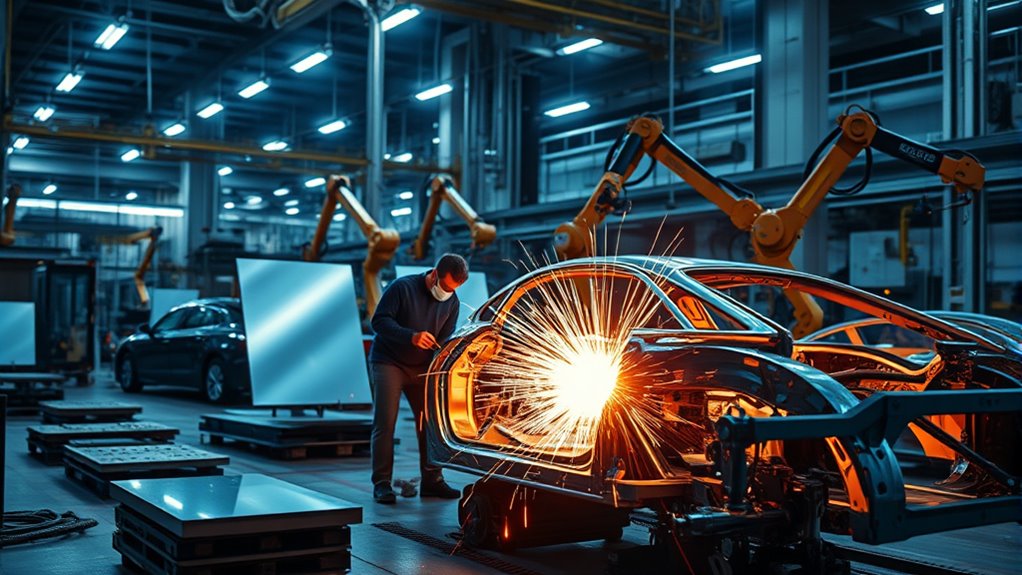
Once you have accurate part geometry, the next step is choosing the core fabrication process. The best choice depends on volume, tolerance, edge quality, heat sensitivity, material thickness, cost, and whether the part is cosmetic or structural.
| Process | Best Use | Key Control Point |
| Laser cutting | Precise sheet blanks, brackets, tabs, gussets, production parts | Heat-affected edge, kerf width, burr control, nesting efficiency |
| Plasma cutting | Fast cutting for steel plate, brackets, repair sections, shop work | Dross, edge angle, heat input, cleanup before welding |
| Waterjet cutting | Heat-sensitive materials, thick plate, accurate custom shapes | Cut taper, abrasive cost, speed, edge finish |
| Press brake bending | Brackets, channels, trays, flanges, low-to-medium volume parts | Bend radius, springback, grain direction, tooling marks |
| Stamping and deep drawing | High-volume panels, reinforcements, shells, complex formed parts | Tooling cost, thinning, wrinkles, splits, dimensional repeatability |
| MIG, TIG, spot, and laser welding | Frames, exhausts, brackets, panels, reinforcements, assemblies | Joint prep, penetration, heat input, distortion, inspection |
| Powder coating, galvanizing, e-coat, paint, and sealers | Corrosion protection, appearance, chip resistance, sealing seams | Surface prep, coating thickness, adhesion, coverage inside seams |
In metal fabrication, you use laser cutting and CNC machining to produce clean edges, tight tolerances, and less waste. These processes are useful when hole location, tab fit, or part repeatability matters.
Next, you move into forming, where V-bends and U-bends shape sheet metal into shells, brackets, and body panels without losing dimensional control. Stamping is better for high-volume parts, while press brake bending is often better for custom or lower-volume fabrication.
You then join metal components with welding, mechanical fasteners, brazing, or structural adhesive. MIG welding works well for many steel brackets and chassis parts. TIG welding gives cleaner control on thin material, stainless steel, and aluminum. Resistance spot welding is common in body structures because it is fast and repeatable. Proper welding preparation is essential for strong, defect-free joints.
After joining, surface finishing protects the part. Powder coating, galvanizing, paint, e-coat, anodizing, seam sealer, and cavity wax all serve different jobs. Bare metal inside a seam or around a weld can fail early even when the fabricated shape is correct.
Pro Tip: Plan the finish before you weld the part. Closed seams, boxed sections, and overlapping joints can trap moisture if you cannot coat or seal the inside after assembly.
Products Worth Considering

Machine provides outstanding performance on small jobs like motorcycle tanks, tank covers, seat cowls and aircraft fillets. Engineered for easy operation with a quick-release lower anvil for efficient wheel changes. The upper wheel features rounded edges to prevent marring, delivering scratch-free, professional results on your metalwork.

Used Book in Good Condition

MIG Welding Backer - Create a Precise Spot weld Without Cutting Scrap Metal Plugs Ideal For MIG Welding
Automotive Fabrication Safety and Compliance
Automotive fabrication can expose you to heat, sparks, fumes, ultraviolet radiation, sharp edges, grinding dust, compressed gases, and fire risks. OSHA lists welding, cutting, and brazing under specific standards for general industry, maritime, and construction, so safety planning should be part of the job, not an afterthought.
Warning: Do not weld or cut near fuel tanks, fuel lines, battery packs, airbags, interior trim, undercoating, or unknown coatings unless the hazard has been isolated and the work area is prepared. Coated and galvanized metals can release hazardous fumes when heated.
At a minimum, you need the right eye protection, gloves, clothing, ventilation, respiratory protection when required, fire control, and a clean work area. Remove paint, oil, seam sealer, zinc coating, and contamination from the weld zone when the procedure allows. Keep a fire extinguisher nearby and check the opposite side of panels, floors, and boxed sections because heat can ignite material you cannot see.
Structural road-use parts deserve extra caution. A cosmetic bracket and a suspension mount do not carry the same risk. When you fabricate or repair crash structures, seat mounts, steering mounts, suspension brackets, roll cages, or frame sections, use the correct material, engineering drawings, OEM repair information, or motorsport rulebook. For production vehicles, federal safety standards such as FMVSS No. 208 exist to reduce occupant deaths and injury severity through crashworthiness requirements.
Quality Control and Inspection in Automotive Fabrication
A fabricated automotive part should be checked before it is installed. Quality control protects fit, function, and safety. It also prevents small errors from becoming expensive rework after welding, coating, or final assembly.
- Check dimensions: Confirm length, width, angle, hole spacing, flange height, and mounting position against the drawing or template.
- Control fit-up: Use fixtures, clamps, tack welds, and reference points so heat does not pull the part out of shape.
- Inspect welds: Look for undercut, porosity, lack of fusion, poor penetration, cracks, and excessive grinding.
- Verify material: Do not mix mild steel, AHSS, aluminum, and stainless steel without confirming the joining method and corrosion plan.
- Measure critical features: Use calipers, angle gauges, templates, go/no-go gauges, CMM checks, or laser scanning when tolerance matters.
- Protect bare metal: Recoat cut edges, weld zones, drilled holes, seams, and hidden cavities after fabrication.
Good inspection is especially important when you fabricate suspension components, frame repairs, body reinforcements, roll cages, or towing-related brackets. These parts see vibration, road shock, fatigue cycles, and sometimes crash loads. A part can look clean and still be weak if the weld lacks fusion, the material was overheated, or the design creates a stress riser.
Common Automotive Metal Fabrication Applications
In automotive fabrication, you see metalworking across several high-impact systems. Each system has different structural and functional demands.
Body panels and exterior parts include fenders, doors, hoods, floor pans, quarter panels, rocker skins, and repair patches. These parts need clean shape, smooth surface finish, corrosion protection, and controlled distortion.
Frames and structural reinforcements include crossmembers, rocker reinforcements, pillars, brackets, gussets, crash boxes, and subframe mounts. These parts need stronger material control, better fixtures, and more careful inspection because they help carry loads through the vehicle.
Exhaust systems use tubing, flanges, hangers, resonators, mufflers, flex sections, and heat shields. Stainless steel is common because exhaust parts face moisture, heat, road salt, and vibration.
Suspension and steering mounts include control arm tabs, sway bar mounts, strut tower reinforcements, shock brackets, and steering rack supports. These parts need accurate geometry because small location errors can affect alignment, tire wear, and handling.
Motorsport and off-road fabrication often includes roll cages, skid plates, bumpers, chassis reinforcement, seat mounts, harness bars, and tube structures. When you need occupant protection in competition or trail use, a roll cage demands precise tube fit-up, correct material, approved geometry, and high-quality welding.
EV and hybrid vehicle parts add battery trays, battery enclosure brackets, cooling plates, inverter mounts, and protective shields. These parts may combine aluminum, steel, fasteners, adhesives, and sealants to manage strength, weight, corrosion, and water intrusion.
In every case, metal fabrication for automotive converts raw stock into vehicle components that must perform under stress. Proper fillet weld sizing is crucial for maintaining the strength of structural joints without adding unnecessary heat or distortion.
Products Worth Considering

【DIY Exhaust Tubing】 Comes with 1 X 45 Degree Bend Pipe, Natural Finish; Universal Fitment for Vehicle

[304 STAINLESS STEEL] Manufactured from high-grade 304 stainless steel, this round tubing offers exceptional structural strength, rigidity, and superior resistance to rust and corrosion. Perfect for long-term durability in demanding indoor and outdoor environments.
[304 STAINLESS STEEL] Manufactured from high-grade 304 stainless steel, this round tubing offers exceptional structural strength, rigidity, and superior resistance to rust and corrosion. Perfect for long-term durability in demanding indoor and outdoor environments.
Modern Trends in Automotive Metal Fabrication
Automotive fabrication keeps changing because vehicles must carry more technology while improving safety, efficiency, and range. The U.S. Department of Energy notes that a 10% reduction in vehicle weight can improve fuel economy by 6% to 8%, which explains why lightweight materials remain important in both gas-powered and electrified vehicles.
Advanced high-strength steels let engineers reduce thickness in some areas while maintaining strength. Aluminum helps reduce mass in closures, brackets, trays, and some structures. Mixed-material bodies use steel, aluminum, adhesives, rivets, welds, and coatings together, but they also make fabrication more complex because heat, corrosion, and galvanic reactions must be controlled.
Automation is another major trend. Robotic welding, laser cutting, CNC bending, automated inspection, digital fixtures, and simulation tools help manufacturers hold repeatable tolerances at high volume. In custom shops, smaller CNC plasma tables, laser cutters, tube notchers, and 3D scanners make accurate fabrication more accessible than it used to be.
Frequently Asked Questions
Do fabricators make a lot of money?
Fabricators can make solid pay, especially with welding skill, blueprint reading, CNC experience, inspection knowledge, and overtime. For structural metal fabricators and fitters, O*NET’s 2025 BLS-sourced wage data lists a U.S. median of $51,330, with the 10th to 90th percentile range from $37,960 to $72,280. Pay varies by region, industry, certification, and specialization.
Who are the Big Three in automotive?
The Big Three usually refers to the historic Detroit automakers: General Motors, Ford Motor Company, and Stellantis, which includes Chrysler, Dodge, Jeep, and Ram brands. The term is historical as much as current because U.S. sales rankings change over time and global automakers such as Toyota, Honda, Hyundai-Kia, and others also hold major market share.
What do automotive fabricators do?
Automotive fabricators measure, cut, form, weld, machine, fit, and finish metal parts for vehicles. They may build brackets, exhaust systems, body panels, mounts, frames, roll cages, suspension tabs, or prototype parts. Good fabricators also read drawings, choose materials, set up fixtures, inspect welds, and protect finished parts from corrosion.
What is the salary of a metal fabricator?
For structural metal fabricators and fitters in the United States, 2025 O*NET/BLS wage data lists a median of $51,330 per year. Welders, cutters, solderers, and brazers are a related occupation, and O*NET describes them as workers who use hand-welding, flame-cutting, soldering, or brazing equipment to join or repair metal parts.
Can you fabricate structural car parts at home?
You can fabricate some brackets, panels, and non-critical parts at home if you have the right tools and skill. Structural parts are different. Frames, suspension mounts, seat mounts, steering supports, roll cages, and crash structures should follow engineering drawings, OEM repair information, or motorsport rules because material choice, weld quality, and geometry affect safety.
What is the best metal for automotive fabrication?
There is no single best metal. Mild steel is easy to form and weld, AHSS is strong for safety structures, aluminum reduces weight, stainless steel resists corrosion and heat, and magnesium is very light but harder to process. The best choice depends on load, weight target, corrosion exposure, cost, repairability, and joining method.
Conclusion
In automotive metal fabrication, you turn raw sheet, tube, plate, and bar into parts that fit the vehicle and perform under real loads. Cutting, forming, welding, fastening, and finishing all matter, but none of them works alone. The final part depends on correct material selection, controlled heat, accurate fixtures, sound joints, corrosion protection, and inspection.
Whether you are making a bracket, patch panel, exhaust section, battery tray, suspension mount, or safety structure, the goal is the same: build a part that is strong enough, light enough, accurate enough, and protected enough for its job. You do not just shape metal. You shape durability, fit, safety, and vehicle performance.
Sources
- U.S. Department of Energy: Lightweight Materials for Cars and Trucks — supports lightweight material and component weight-reduction claims.
- U.S. Department of Energy: Lightweight and Propulsion Materials — supports the fuel-economy benefit of vehicle weight reduction.
- WorldAutoSteel: Updated AHSS Application Guidelines — supports current AHSS guidance and automotive steel context.
- AHSS Guidelines: Press Hardening Steel Grades — supports AHSS grade naming and tensile-strength context.
- OSHA: Welding, Cutting, and Brazing Standards — supports welding and cutting safety requirements.
- O*NET: Structural Metal Fabricators and Fitters Wage Data — supports U.S. wage ranges for metal fabricators.